187 résultats
1894LFA00d24Un ouvrage de 343 pages, format 230 x 280 mm, broché, publié en 1894, Librairie Ancienne de Louis Brun (Lyon), bon état
1891276956O.R. Reisland Leipzig 1891. Hardcover mit Leinenrücken und -ecken 1891-1931. Jahrgänge 1112132526272829303132333839404142464748495051. Der 39. Jahrgang ist nicht gebunden. Zustand: Keine Beschädigungen ehem. Exemplare einer Klosterbibliothek mit Kennungen. Rücken Ecken Kanten sehr gut. O.R. Reisland, Leipzig, hardcover
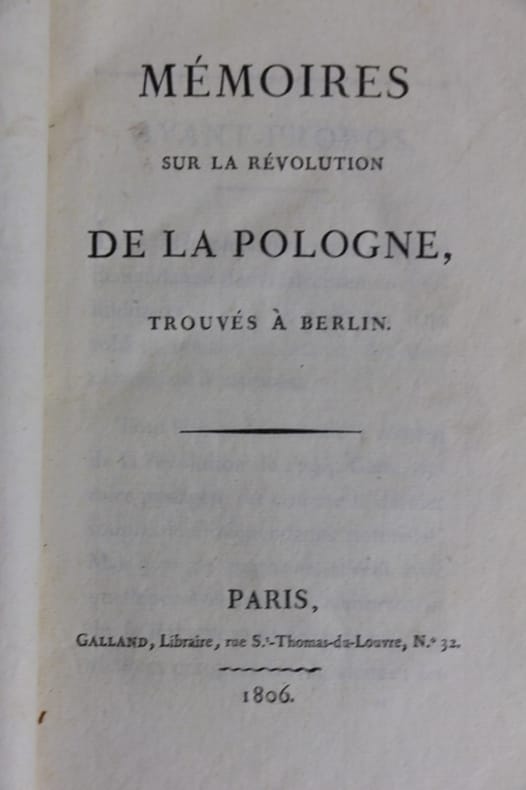
180694403Paris, Galland 1806 In-8 demi-veau époque à petits coins de vélin, dos lisse fileté, p. de titre en bas. verte, CIV- 215 pp. Très bon exemplaire bien complet des 2 grandes cartes dépliantes in fine Plan de la ville de Varsovie et Partie du Théâtre de la Guerre en Pologne de l'année 1794.
1814393561814 2 volumes in-8 (200 x 125 mm), demi-veau havane de lépoque, dos lisses ornés de doubles filets gras au noir en place des nerfs, auteur, titre et tomaison dorés, (4), iv, 303 pages et (4), 352 pages. Paris, Treuttel et Wurtz, Renouard, Le Normand, Delaunay, 1815.
183964468Avec une préface par M. Saint-Marc Girardin, Troisième édition revue et augmentée, 1 vol. in-8 reliure de l'époque demi cuir de russie, dos estampé à froid, Chez Brockhaus et Avenarius, Paris, Leipzig, 1839, portrait de Jean Sobieski, en frontispice, 460 pp. avec une gravure hors texte (portrait de Kosciuszko)
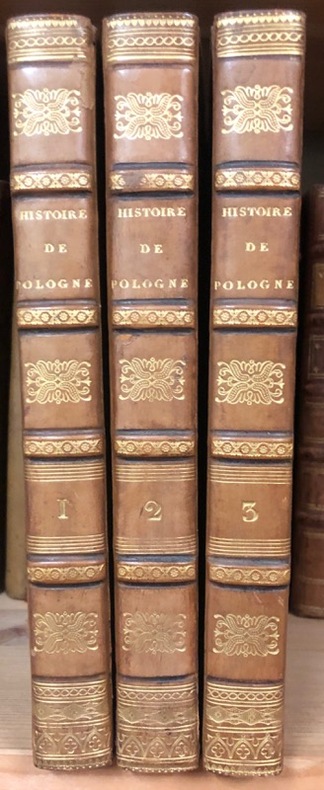
181913828Paris, Chez H. Nicolle et Chez Desenne, 1819. 4 vol. in-8 de (4)-CLXVI-342 pp. ; (4)-500 pp. ; (4)-464 pp. et (4)-397-(2) pp., veau blond glacé, dos ornés à nerfs, large plaque romantique poussée à froid sur les plats, guillochis dorés sur les coupes, dentelles dorées sur les chasses tranches marbrées (reliure de l'époque).
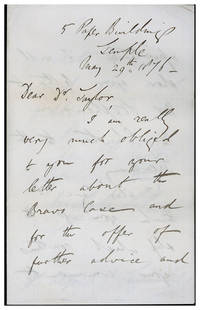
1876484621876. <p>Taylor Alfred Swaine 1806-80. Archive of material relating to the famous Charles Bravo poisoning case consisting of 1 Autograph letter signed to Taylor from Harry Bodkin Poland 1829-1928. Bifolium. 3pp. Temple London 29 May 1876. 205 x 127 mm. 2 3 autograph letters signed to Taylor from Augustus K. Stephenson 1827-1904. 15pp. total. London 3 June 1876 2 bifolia 8pp.; 5 June 1876 bifolium 4pp.; and 22 July 1876 bifolium 3pp. 184 x 114 mm. 3 Taylor. The Balham mystery. Galley proof corrected in Taylor's hand of the first portion of an unsigned article in The British Medical Journal 20 May 1876: 631-633. 578 x 148 mm. Together 4 letters and one printed proof. Some rodent damage to Stephenson's letters affecting several words mended in several places with clear tape. Small lacuna along one fold in the galley proof affecting a few words. Minor dampstaining but good to very good.</p> <p> From the library of Alfred Swaine Taylor founder of forensic toxicology an archive relating to the notorious and sensational Charles Bravo poisoning a case that is still unsolved. The Bravo mystery has inspired several works of fiction including Shirley Jackson's We Have Always Lived in the Castle 1962 and a three-part BBC serial titled The Poisoning of Charles Bravo 1975.</p> <p> Bravo 1845-76 a 33-year-old barrister died of tartar emetic antimony poisoning on 21 April 1876 less than five months after his marriage to a wealthy widow; the marriage was reportedly an unhappy one. The inquest on Bravo's death held on 25 and 28 April returned an open verdict but the circumstances of the case were so suspicious that Taylor offered his expert advice to Harry Bodkin Poland one of the attorneys for the Crown. Our archive includes the letter Poland sent thanking Taylor for "your letter about the Bravo Case and for the offer of further advice and assistance" and informing Taylor that he "will show your letter to Mr. Augustus K. Stephenson the Solicitor to the Treasury." Stephenson is represented in the archive by three letters asking for Taylor's expert opinion on the case: "You have read the account of the Post-mortem encl. by Dr. Payne . . . That being so does it enable you to form an opinion as to whether the antimony was taken in solid food . . . letter of 3 June. "Assuming small traces of antimony to have been found in the liver of a deceased person-Can you form any opinion as to length of time before death that the antimony was taken" letter of 5 June. "Can you tell me whether antimony in the form of tartar emetic wd. if taken in small doses at intervals during pregnancy induce a miscarriage letter of 22 July.</p> <p> The last item in our archive is a galley proof corrected in Taylor's hand of the first two-thirds of an article on the Bravo case published on 20 May in the British Medical Journal; although the article is unsigned it was most likely written by Taylor. Based on the medical evidence Taylor concluded that Bravo had ingested the fatal dose of antimony during his last meal. He severely criticized the investigators in the case for not testing the remains of the bottle of wine he had drunk with the meal-"the only article of food not shared in common with the three who sat at the dinner-table . . . If tartar emetic had been found in this wine much of the present mystery hanging about the case would be removed . . . In tracing the further history of this bottle we learn that no one now knows what became of it or its contents." </p> . unknown
183130282large folio broadsheet circular printed on both sides "Supplement." At upper left corner but no other imprint information. Folded in quarters some minor spotting else a very good copy. <br /><br /><p>The Marquis de Lafayette the president of the committee once again leads a fight for freedom although this time only diplomatically. Lafayette subscribed 2000 francs – the largest subscriber. </p> <p> The presumed first printing of this broadsheet very likely an extra or supplement to the Journal des Debats a Parisian weekly with regular contributions by Victor Hugo one of the committee members and with what would have been a sympathetic political stance. The broadsheet prints the resolutions in favor of the committee in four columns dated in type at end February 12 1831. The committee members are also listed as well as subscribers throughout France and their donations. Victor Hugo and Lafayette's son George were both among the committee members. </p> <p> The November Uprising 1830-1831 Polish-Russian War also known as the Cadet Revolution was an armed rebellion in the heartland of partitioned Poland against the Russian Empire. The uprising began on 29 November 1830 in Warsaw when the young Polish officers from the local Army of the Congress Poland's military academy revolted led by lieutenant Piotr Wysocki. They were soon joined by large segments of Polish Society and the insurrection spread to the territories of Lithuania western Belarus and the right bank of Ukraine. Despite some local successes the uprising was eventually crushed by a numerically superior Imperial Russian Army under Ivan Paskevich. Czar Nicholas I decreed that henceforth Poland was an integral part of Russia with Warsaw little more than a military garrison and its university closed. </p> <p>Sympathetic echoes of Polish aspirations were reverberating throughout Europe. Under Lafayette's chairmanship enthusiastic meetings were held in Paris. James Fenimore Cooper the American author who was in France at that time was also involved in attempts to help the Poles. Money for the Polish cause was also raised and collected in the United States. </p><p>Although early reprints are available we have been unable to locate a copy of this undoubted first printing. A complete reprint appears beginning on page 19 in La Pologne et la France en 1830-1831 volume 9 Paris: Typ de Pinard 1831. </p> books
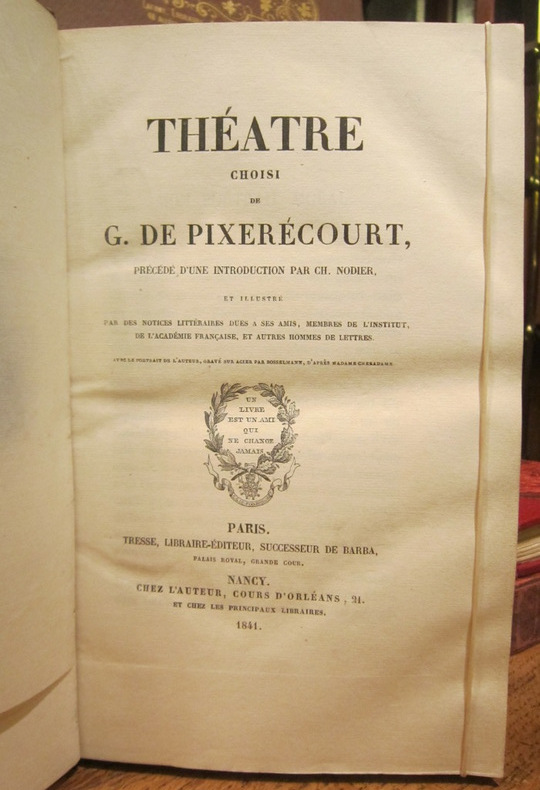
1841002830Paris et Nancy, Tresse, et Chez Lauteur, 1841
18640001111MELROSE MASSACHUSETTS MASS MA. Good. 1864. Manuscript. On offer are two original manuscript diaries dated 1864 and 1865 by 'Doctor' James W. Poland of Melrose Massachusetts. James W. Poland was a long time Baptist minister in Goffstown New Hampshire when in an attempt to treat himself for some ailment he came up with the formula for a medicine he called Dr. Poland's White Pine Compound. The medicine was a huge success and Dr. Poland found himself in a new career as a proprietary medicine maker. Eventually he also produced Dr. Poland's Cedar Plaster White Mountain Bitters Diarrhea Elixer Hair Preserver Poland's Magic Powders etc. At the time these diaries were written Dr. Poland had moved to Melrose Mass. and was active making some of these medicines especially the Magic Powders. He was selling on his own and also working for Dr. George W. Swett of the New England Botanic Depot in Boston. In 1864 he transferred the rights to some of his medicines to Swett. Dr. Poland's diary entries are short with a note of the weather his or his family's health problems travel mainly to Boston gardening activities purchases sales of the medicines and church activities once in a while he preached in Melrose at the Baptist church. Usually there were no notes of outside events with the notable exceptions of Lincoln's election in 1864 Lincoln's inauguration on March 4 1865 Lee's surrender on April 10th and Lincoln's assassination on April 14th. Dr. Poland writes: "Pres. Lincoln shot by Booth an assassin - Lord Save Us!" He notes his own birthday 57 years old in 1865 and the death of his mother on Nov. 5th of the same year. Included are a number of ephemera items related to Dr. Poland's profession as a maker and seller of proprietary patent or "quack" medicines including: two receipts for pew rental at the First Baptist Society of Melrose; two newspaper clippings of testimonials for the use of Dr. Poland's White Pine Compound; a business license from the U.S. Internal Revenue dated June 1 1863 a tax to help pay for the war; and a page of handwritten advertising copy for Dr. Poland's Specific; a cure for costiveness constipation. Both diaries have written entries in pencil for every day of the year and are overall in G condition.; 16mo - over 5¾" - 6¾" tall; QUACK MEDICINE PHYSICIAN QUACKERY PATENT MEDICINE SNAKE OIL BAPTISTS MASSACHUSETTS MASS MA CIVIL WAR 19TH REGIMENT FORT COLUMBUS YORK HARBOR ANTIETAM FORT SENECA SOCIAL STUDIES GENDER STUDIES HANDWRITTEN MANUSCRIPT DOCUMENT LETTER AUTOGRAPH DIARY JOURNAL LOG KEEPSAKE WRITER HAND WRITTEN DOCUMENTS SIGNED LETTERS MANUSCRIPTS HISTORICAL HOLOGRAPH WRITERS DIARIES JOURNALS LOGS AUTOGRAPHS PERSONAL MEMOIR MEMORIAL PERSONAL HISTORY AMERICANA Als antiquité contrat vélin document manuscrit papier Antike Brief Pergament Dokument Manuskript Papier oggetto d'antiquariato atto velina documento manoscritto carta antigüedad hecho vitela documento manuscrito papel. . unknown
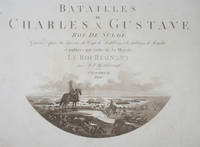
180645461Stockholm 1806. Large folio oblong. 44 x 61 cm. Contemp. hcalf covers with marbled paper. Titlelabel in red and gilt pasted on frontcover. Wear to foot of spine otherwise fine. Engraved titlepage battle view engraved plate depicting the Carl Gustav on horseback in front of a battle scene and 11 engraved plates showing battlescenes after Dahlberg's drawings. All engravings in beautiful toned sepia aquatint. A few marginal brownspots. A very fine copy. <br/><br/><em>Very scarce first printing of this series of plates aiming at glorifying the Swedish victories showing battlescenes - Warsaw Carnova Columbi Guesne and the crossing of the Belt in Denmark - from the wars against Poland and Denmark 1655-58 in fine engravings by Skjöldebrand. </em> unknown
180645461Stockholm, 1806. Large folio oblong. (44 x 61 cm.). Contemp. hcalf, covers with marbled paper. Titlelabel in red and gilt pasted on frontcover. Wear to foot of spine, otherwise fine. Engraved titlepage (battle view), engraved plate depicting the Carl Gustav on horseback in front of a battle scene and 11 engraved plates showing battlescenes after Dahlberg's drawings. All engravings in beautiful toned sepia aquatint. A few marginal brownspots. A very fine copy.