116 résultats
194547189Krakow: Spóldzielnia Wydawnicza "Czytelnik" Czytelnik Publishing Cooperative 1945. First edition. Softcover. g to von-. Octavo 8 1/4 x 6". 93pp. 13 leaves of double sided photographic plates interleaved and unpaginated. Illustrated tan red and black wrappers with black lettering on the front cover. Photographic b/w frontispiece. Spóldzielnia Wydawnicza "Czytelnik."<br /> <br /> Possibly an earlier publication on lower quality paper compare to a slightly smaller publication by the "Library of the Union of Polish Patriots in the USSR" Biblioteczka Zwiazku Patriotów Polskich w ZSRR with the same text in different layout. That publication issued on higher quality paper and with twenty-eight photogravures three more than in this publication with twelve photographs appearing in both publications though in lesser quality here.<br /> <br /> Court Proceedings of the Polish-Soviet Special Criminal Court established in Lublin in August 1944 in order to investigate the crimes committed by the Germans in the Majdanek extermination camp. Despite the importance of this document it must be mentioned that the Commission made erroneous assumptions regarding the duration of the camp and the number of people killed at Majdanek. The Publishing cooperative "Czytelnik" was established behind Soviet front lines in 1944. It became the first post-World War II. publisher in Poland.<br /> <br /> The total numbers of the victims is still controversial: In this report 1.5 million victims of different nationalities were counted however according to the latest researches there were 79000 victims 59000 of whom were Jews See: Kranz T.: "Bookkeeping of Death and Prisoner Mortality at Majdanek." pp. 81-110. In: Silberklang D. Ed.: Yad Vashem Studies. Vol. 35:1. Jerusalem 2007.<br /> <br /> Illustrated with 25 pages of b/w photographic reproductions including a frontispiece on 13 double-sided interleaved plates altogether thirty-two photographs depicting members of the Commission Nazi guards now prisoners who used to run the camp and survivors alike testifying before the Commission. Also includes views of the actual concentration camp piles of suitcases Zyklon B poison gas pellets gas chambers ovens and survivors amid corpses.<br /> <br /> Wrappers with some chipping rubbing creasing and/or closed tears to extremities. Small stain on the back cover and side edge of book block. Verso of frontispiece with a vertical crease. Some pages throughout with some light age toning or small water spots. Overall text and images clear and vibrant. Wrappers in good interior in very good- condition overall. One of two editions of this work published in Moscow and Krakow in 1945. It is not certain which was released first. Each has different wrappers size pagination and publishers. Spóldzielnia Wydawnicza "Czytelnik" (Czytelnik Publishing Cooperative) unknown
1925H8653Rzym / Rome: Szkola Typograficczna Piusa X. 1925. Very Good. Oblong 8vo 9 inches wide textured wraps with photo onlay tied with twined cord approximately 75 pp many photos and plates in b&w light wear small stain to cover. Very RARE no copies on OCLC text in Polish. Szkola Typograficczna Piusa X. unknown
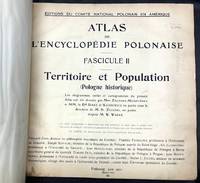
1920H39461Fribourg Switzerland: Comité national polonais en Amérique 1920. First Printing. Wraps. Fair. Quarto 13.5 x 13.5 inches in modern gray paper covers with cloth spine ex-library with perforated stamp on title page light marks bookplate with proper withdrawn stamp loosely laid in. With 33 maps mainly folding some with overlays and some in color followed by 27 sheets of tables. Fair condition with soil and light wear to outermost pages some of the wax or glassine overlays splitting and worn most of the maps are in good to very good condition condition but some have some splitting along folds light edgewear and loss surface soil and small stains at lower inner corners. The second of two volumes of maps to accompany the encyclopedia the first volume concentrating on the economics of Poland and its inhabitants. Uncommon in the trade and relatively few in institutions. Includes map on "Repartition des Juifs" in Poland. Comité national polonais en Amérique unknown
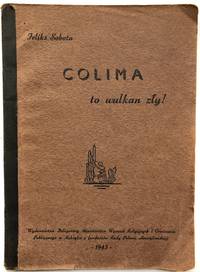
1945H5886Leon Mexico: Wydawnictwo Delegatury Ministerstwa Wyznan Religijnych i Oswiecenia Publicznego w Meksyku z Funduszow Rady Polonii Amerykanskiej 1945. Paperback. Very Good. First printing. Quarto cloth backed wraps 93 pp illustrated including photoplates. Very good. Worldcat locates 9 copies in institutions. In Polish: a geological and archaeological study of Colima Mexico including studies of its terrain and volcanic possibilities. Extremely uncommon publication from the Polish refugee colony at Santa Rosa near Leon in Guanajuato Mexico. Thousands of Polish refugees were first sent off to Soviet gulags and from there were placed in mainly British commonwealth countries including Iran and India although some ended up in Israel. The United States in trying to forge an alliance with Stalin declined to make room for Polish refugees although some indeed did end up on the west coast where they were put into Japanese internment camps. But the Mexican ambassador to Britain Alfonso Rozenzweig Diaz an admirer of the Polish General Sikorski who had pleaded with Roosevelt for assistance offered to put up a community of Poles in Santa Rosa Guanajuato where he made a "hacienda" available schools and school supplies which were supplemented by Polish-American organizations in the States. When the war ended in 1945 the President of Mexico made the Poles remaining at Santa Rosa welcome to either apply for permanent residency or to leave to Poland which was then under Soviet control and therefore almost as unwelcoming as it was under the Germans. Only a handful who had family back in Poland chose to return. Most others ended up in the United States but some who had married or established businesses stayed on in Guanajuato. Most of the Poles who ended up in Santa Rosa were at the end of a 2-year 20000km journey filled with much hardship. Wydawnictwo Delegatury Ministerstwa Wyznan Religijnych i Oswiecenia Publicznego w Meksyku z Funduszow Rady Polonii Amerykanskiej paperback
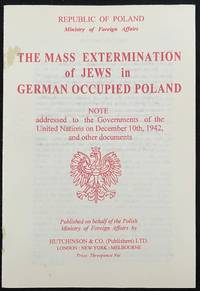
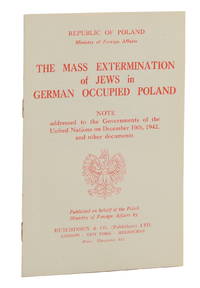
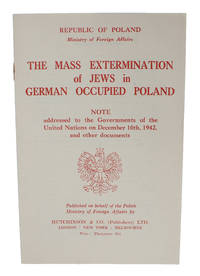
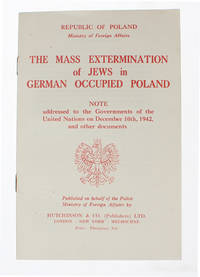
194343453London New York; Published on Behalf of the Polish Ministry of Foreign Affairs by Hutchinson & Co 1943. 1st edition. Original illustrated red and white paper wrappers. 8vo. 16 pages. 22 cm. National Government Publication. Printed in red and black ink. Includes a note by Polish Foreign Minister Edward Raczynski and speeches by Deputy Prime Minister Stanislaw Mikolajczyk.<br> The official 16-page diplomatic publication from December 1942 by the Polish Government-in-Exile in London marking a turning point in international understanding of the Nazi destruction of the Jews of Europe. <br> Jan Karski a courier for the Polish Underground had smuggled microfilmed evidence and intelligence out of occupied Poland to London. This raw intelligence gathered from his time secretly inside the Warsaw Ghetto and the Izbica transit camp formed the core of the facts published in the booklet.<br> <br> "In October 1942 at the height of the destruction of Polish Jewry Jan Karski born Jan Kozielewski was ordered to clandestinely go to the West and deliver a report on the situation of occupied Poland to the Polish government-in-exile in London. The situation of the Jews in Poland was to be one section of that report. Since the government in exile was concerned with the internal politics of Poland's underground parties Karski held meetings with the different factions including the Jewish Zionist and the Jewish Socialist Bund movements. <br> Thus shortly before his departure Karski met with two Jewish leaders who asked him to inform the world's statesmen of the desperate plight of Polish Jewry and of the hopelessness of their situation. Their message was: 'Our entire people will be destroyed.'<br> The Jewish leaders' appeals touched Karski and he decided to see things with his own eyes in order to make his report. With great risk to his life he was smuggled into the Warsaw ghetto and into a camp in the Lublin area. The horrors he witnessed marked him deeply and propelled him to become not only the messenger of the Polish underground but to concentrate on giving voice to the suffering of the dying Jews.<br> In November 1942 Karski reached London delivered the report to the Polish government-in-exile and set out to meet Winston Churchill other politicians journalists and public figures. Upon completing his mission Karski went on to the United States where he met with President Roosevelt and other dignitaries and tried in vain to stir up public opinion against the massacre of the Jews. In 1944 while in the United States Karski wrote a book on the Polish Underground Story of a Secret State with a long chapter on the Jewish Holocaust in Poland.<br> After the war Karski stayed in the United States where he was later appointed Professor at Georgetown University Washington DC.<br> On 2 June 1982 Yad Vashem recognized Jan Karski as Righteous Among the Nations" Yad Vashem. <br> <br> Leading Holocaust scholar Lucy Dawidowicz cites the booklet in her now classic work "The Holocaust and the Historians" Harvard 1983 p. 167; the report could not be more explicit in its description of the horrors nor in its plea for help: <br> "The new methods of mass slaughter applied during the last few months confirm the fact that the German authorities aim with systematic deliberation at the total extermination of the Jewish population of Poland and of the many thousands of Jews whom the German authorities have departed to Poland from Western and Central European countries and from the German Reich itself. The Polish Government considers it their duty to bring to the knowledge of the Governments of all civilised countries the following fully authenticated information received from Poland during recent weeks which indicates all too plainly the new methods of extermination adopted by the German authorities." <br> The report elaborates: "The actual process of deportation was carried out with appalling brutality. At the appointed hour on each day the German police cordoned off a block of houses selected for clearance entered the back yard and fired their guns at random as a signal for all to leave their homes and assemble in the yard. Anyone attempting to escape or to hide was killed on the spot. No attempt was made by the Germans to keep families together. Wives were torn from their husbands and children from their parents. Those who appeared frail or infirm were carried straight to the Jewish cemetery to be killed and buried there. <br> On the average 50-100 people were disposed of in this way daily. After the contingent was assembled the people were packed forcibly into cattle trucks to the number of 120 in each truck which had room for forty. The trucks were then locked and sealed. The Jews were suffocating for lack of air. The floors of the trucks were covered with quicklime and chlorine. As far as is known the trains were dispatched to three localities - Treblinka Belzec and Sobibor to what the reports describe as 'Extermination camps.' <br> The very method of transport was deliberately calculated to cause the largest possible number of casualties among the condemned Jews. It is reported that on arrival in camp the survivors were stripped naked and killed by various means including poison gas and electrocution. The dead were interred in mass graves dug by machinery." <br> <br> Read more about the singular importance of this publication at <br> en.wikipedia.org/wiki/The_Mass_Extermination_of_Jews_in_German_Occupied_Poland# . <br> In 2020 Polish Postal authorities chose this very publication to illustrate their official first day cover honoring righteous Poles who had saved Jews during the Holocaust see illustration. <br> <br> Subjects: World War 1939-1945 - Jews - Poland. World War 1939-1945 - Poland - Atrocities. Holocaust Jewish 1939-1945 - Poland. Jews - Poland. OCLC: 234118765. <br> Touch of staining at staples without the rust almost always seen in other surviving copies. Very Good condition. A copy with rust stains sold in 2018 at auction for over £6000. Rare and very important. BHOLO2-97-48-MMXRLADFACC. London, New York; Published on Behalf of the Polish Ministry of Foreign Affairs by Hutchinson & Co unknown
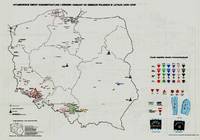
197941929Warszawa Warsaw: Pan´stw. Wydawn. Naukowe 1979. 1st Edition. Original black printed portfolio 8vo. Portfolio of seven large folding maps on on 4 sheets of heavy paper 3 are double sided 1 is singled sided. Primarily black and white with some color. Text in Polish. <br> Title translates to “Nazi camps in Poland 1939 - 1945. An Encyclopaedic Reference Book: Maps." Collection of 7 maps each 84 cm x 60 cm 33 x 24 inches produced by Jan Laskowski at the Main Commission for the Investigation of Nazi Crimes in Poland. The maps comprise Volume II of the work; Volume I is a heavily illustrated 676-page book of the same title which we offer separately. <br> The Seven maps all present are: <br> - Map 1 Single Sided: Hitlerowskie obozy na ziemiach polskich w latach 1939 - 1945. “Nazi camps in Poland in the years 1939 - 1945â€. Showing: concentration and extermination camps sub-camps of concentration camps extermination centers POW camps more important sub-camps working divisions commandos and temporary POW camps penal labor camps major labor camps prisons transit camps & ghettos. <br> - Map 2A: Getta na ziemiach polskich w okresie okupacji hitlerowskiej w latach 1939 - 1945 “Ghettos in Poland during the Nazi occupation in 1939 - 1945â€. <br> - Map 2B: Hitlerowskie obozy przejsciowe na ziemiach polskich w latach 1939 - 1945 “Nazi transit camps in Poland in 1939-1945â€. <br> - Map 3A: Hitlerowskie wiezienia i areszty na ziemiach polskich w latach 1939 - 1945 “Nazi prisons and arrests in Poland in 1939 - 1945â€. <br> - Map 3B: Hitlerowskie obozy pracy na ziemiach polskich w latach 1939 - 1945 “Nazi labor camps in Poland in the years 1939 - 1945â€. <br> - Map 4A: Hitlerowskie obozy jenieckie na ziemiach polskich w latach 1939 - 1945 “Nazi POW camps in Poland in 1939 - 1945â€. <br> - Map 4B: Hitlerowskie obozy koncentracyjne i osrodki zaglady na ziemiach polskich w latach 1939 - 1945 “Nazi concentration camps and extermination centers in Poland in 1939 - 1945â€. <br> Maps 2A & 2B have been described as a “Terrifying pair of maps showing the locations of German POW and internment camps in Poland during World War II highlighting the widespread locations of these establishments. In some parts of the map the information becomes so dense that three inset maps are shown. This map was designed by Jan Laskowski and printed in 1979 as part of a work on the Nazi extermination machine produced by PWN Warsaw a state-owned research-focused publishing house in Poland.<br> The map on the front is particularly interesting for its depiction of symbols used to classify internees in German camps. The uppermost of these depictions shows the combinations that can be made for different types of prisoners of different levels of importance. The armbands that would have been worn by these prisoners is shown as well as the prison uniforms. Other details are also shown. <br> The map lists hundreds of sites run by Nazi operators throughout the country. These include concentration camps death camps transitional camps and ghettos. The map is divided according to Poland's voivodeships with a key in the lower left. Names of cities too long to spell are also provided in the lower left. <br> This map was produced during a point in Poland's history during which it was actively revisiting the period during the Second World War. Leading social scientists devoted their time to trying to gather all the living as well as the recorded history of the events of the Holocaust and related atrocities before this information vanished. Leading these efforts particularly during the 1960s and 1970s was the Glówna Komisja Scigania Zbrodni przeciwko Narodowi Polskiemu known as the Chief Commission for the Prosecution of Crimes against the Polish Nation. They were active in publishing maps both for domestic educational purposes and for international remembrance and diplomatic efforts regarding the Holocaust. Jan Laskowski was a leading cartographer who produced a number of maps in this field. <br> These maps were produced as part of a series of maps that purported to combine to form an atlas of all of Hitler's crimes in Poland. Many of the large wall maps produced during this period could only show a fraction of the crimes or only the atrocities committed in one region. Thus a series of maps was needed to show all the points necessary which this present work contributes to. <br> Polish Reinterpretations of the Holocaust: Studying the effects of German occupation in Poland is a delicate subject. While it is certain that Poland suffered at least as badly as any other European nation during the Second World War reinterpretations of the Holocaust in the country have also been used to satisfy nationalistic tendencies. It has become evident to Western observers in the last several years that there is a strong nationalist movement in Poland that seeks to place blame for the Holocaust solely on the shoulders of non-Polish actors a movement originally fostered under Soviet rule. This movement has gone so far as to limit freedom of speech criminalizing with a three-year sentence the suggestion that Poland or its citizens in any form participated in the murders committed by Nazis. As such the term ‘Polish concentration camps’ has been deemed unacceptable with the government-approved term being ‘concentration camps on Polish territory.’ <br> All lines of evidence show that this map 2A & 2B was produced using the most accurate and impartial historical sources. The language on the map is simple naming only ‘Hitler's Atrocities’ and there is no evidence of a clear anti-German bias. However it is impossible to separate this map one of the most important productions of the remembrance movement during this period from the social situation in which it was produced. Maps like these can easily be converted into propaganda instruments and today's Polish leaders most of whom grew up during Soviet occupation will have formed their understanding of the Holocaust through maps like these. <br> Soviet Censorship: While the content of the map appears to have been produced free from bias the map still had to go through Soviet censorship. Mentioning prisoner of war camps in which primarily Soviet troops were interned would have been a prerequisite condition upon which the publication of the map rested. Further the lack of mention of any Soviet killings or camps requires no explanation….The map unlike many later maps makes no differentiation between the populations who suffered at the various camps. This represents the Soviet agenda that all nations suffered fought and won equally which sought to limit divisions in this post-identity state†Ruderman 2022. <br> SUBJECTS: World War 1939-1945 -- Prisoners and prisons German. -- Concentration camps -- Poland. Guerre mondiale 1939-1945 -- Prisonniers et prisons des Allemands. -- Camps d'internement -- Pologne. Obozy koncentracyjne -- Polska -- 1900-1945. OCLC: 830885973. <br> Light shelf wear to portfolio as expected. All maps in pristine condition with normal folds as issued. Very Good Condition. Complete and dramatic BR5 holo2-147-19-'cc. Warszawa (Warsaw): Pan´stw. Wydawn. Naukowe unknown
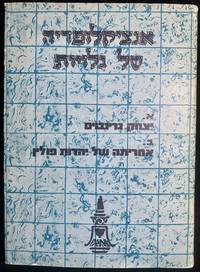
197343067Yerushalayim: Hevrat Entsiklopedyah shel galuyot 1973. First edition Original boards with illustrated dust jacket 4to XIII 726 columns 363 pages includes illustrations and maps. 31 cm. In Hebrew. Title translates as “Encyclopedia of the Diaspora: A. Yitzhak Gruenbaum B. The Legacy of Polish Jewry.â€<br> Encyclopedia on Jewish life in Poland and Yitzhak Gruenbaumi published as part 12 of the Encyclopedia of the Diaspora series published in Jerusalem from the 1950s-1970s. <br> “Yitzhak Gruenbaum was a noted leader of the Zionist movement among Polish Jewry in the interwar period and of the Yishuv in Mandatory Palestine. Gruenbaum was the first Interior Minister of the State of Israel…<br> …In Poland Gruenbaum headed the Radical Zionist faction initially known in Poland as Al Hamishmar. In 1919 he was elected to the Sejm Polish parliament where together with Apolinary Hartglas he organized a "Jewish bloc" that united most of the Jewish parties. He was the moving force in forming a collaboration with other minority parties represented in the Sejm including Germans Ukrainians and others to form a Bloc of National Minorities alliance in 1922 that acted to represent the rights of minority populations in Poland. His efforts brought about an increase of Jewish representation in the Sejm which was accompanied by a rise of the political Zionism.†Wikipedia<br> SUBJECTS: Holocaust Jewish 1939-1945 -- Europe. Memorial books Holocaust Jews -- Europe -- History. Holocaust Jewish 1939-1945 -- Encyclopedias. OCLC: 9351058.<br> Very Good Condition in Very Good Dust Jacket. YIZ-23-88-CCLEX. Yerushalayim: Hevrat Entsiklopedyah shel galuyot unknown
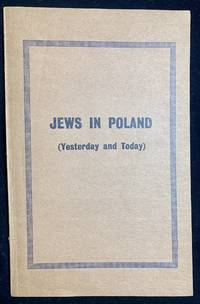
196843041London: The White Eagle Press Limited 1968. First edition. Original paper wrappers Small 8vo 88 pages. 21 cm. In English.<br> On the condition of Jews in Poland both historical and contemporary. Includes discussion of the Holocaust defense of Poland from charges of anti-Semitism and resistance organizations.<br> “On the eve of the Second World War Poland was home to over three million Jews making it the second-largest community in the world. Warsaw the capital had a population of over 300000 Jews more than 30% of the population of the city—and a larger Jewish community than in most European countries. Around 85% of Polish Jewry was annihilated during the Holocaust. After the war many survivors refused to return to or remain in Poland which was marked by civil war and anti-Semitic violence. Since the end of Communism the small Jewish community in Poland has been able to reassert its identity and begin the process of rebuilding. Most of the country's Jews live in Warsaw but smaller communities also exist in Kraków Wroclaw Lodz Katowice Szczecin Gdansk and several other cities.†World Jewish Congress<br> SUBJECTS: Jews -- Poland. OCLC: 10213086<br> Ex-library with usual markings but otherwise excellent. Very Good Condition. YIZ-23-77-CCX-’el. London: The White Eagle Press Limited unknown
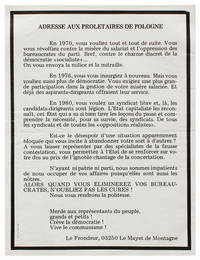
198117271Le Mayet De Montagne: Le Frondeur N.d. ca 1981. Printed broadside 56cm x 43cm. Printed in black on thin uncoated stock. Faint fold-lines else Fine. Issued by the French anarchist collective "Le Frondeur" as both an encouragement and a critique of the Polish Solidarity movement. Accusing the striking workers of ".allowing the state to consolidate itself on your backs at the price of an ignoble blackmail of collaboration" the broadside concludes: "Fuck the representatives of the people large and small! Off Democracy! Long live communism! translation courtesy of Left Bank Books Seattle. Rare; no examples located via WorldCat; an on-line search discovers one copy in the collection of CIRA Centre International de Recherches sur l'Anarchisme Paris. Le Frondeur unknown
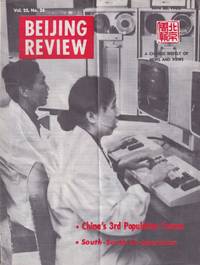
1982216936Beijing.: Beijing Review. June 281982. Black and white photographic illustrations 15pp. Light vertical crease throughout extremities little shelf worn overall a good copy. Article headlines include: China Offers PLO One Million US Dollars; Three Kampuchean Resistance Leaders Form Coalition Government; Ceasefire Agreement Reached Over Malvinas; Six Months of State of Siege in Poland. . Beijing Review. unknown
1942SZEPEBKS007359IRussia - S.S.S.R. : Poloni in Russia S.S.S.R. 1942. Hardcover. Near Fine/No Jacket. POLISH CATHOLIC IMPRINT IN THE SOVIET UNION - MISSAL FOR POLISH SOLDIERS IN RUSSIA DURING WORLD WAR II Typographia Exercitus Poloni in Russia S.S.S.R. - No date1942. - Small 8vo 20x13.5 cm. - 64 pp. - Royal blue hardback fine. - A Roman Catholic missal for chaplains of the Polish Army in Russia during World War II. - On the title- page a tipped-in printed slip with the text: "Ad usum Capellanorum Militum in Russia" On verso of front free endpaper: "Concordat cum originali / Jangi-July3 Maii 1942 / Vlodimirus Cienski / Decanus Militaris Polonorum in Russia. / Imprimatur Joseph Gawlina Episcopus / 11.VII 1942 g.". - In Latin and Polish. - WorldCat locates 2 copies only Buffalo History Museum and NUVAT Union Catalog of Polish Research Libraries. - No other book listed in WorldCat by this publisher. <br/> <br/> Poloni in Russia (S.S.S.R.) hardcover
194595822Lodz: Centralna Zydowska Komisja Historyvzna w Polsce 1945. 1st edition. Good. oblong quarto. original chipped boards 38 104 32pp. b/w plates An amazing document drawn largely from "souvenir" photos taken by German soldiers and published immediately after the end of the war. Dual text POLISH RUSSIAN ENGLISH FRENCH & HEBREW. Heavy use inc. loose pages o/w a complete copy of a very scarce not to say rare volume suitable for restoration & rebinding Centralna Zydowska Komisja Historyvzna w Polsce hardcover
194816623Paris: L'Union Populaire Juive en France 1948. First Edition. Octavo. Printed paper wrappers; 515pp; illus some folding; facs. Includes bibliography. Text entirely in Yiddish. Text slightly tanned but a tight clean copy overall VG or better in the original wrappers. First-hand account of atrocities in the Vilnius ghetto by a survivor; extensively documented including facsimiles of original documents and photographic evidence of Nazi atrocities. Uncommon especially in this state of preservation. L'Union Populaire Juive en France unknown
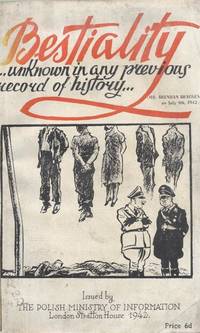
194239727London: Stratton House 1942. First edition. Original illustrated wraps. 12mo. 56 pages. 19 cm. ‘A Record of the German Barbarities in Poland in the First Six Months of 1942.’ <br> With two page map of concentration camps in Germany. <br> Extremely detailed early report concerning Nazi atrocities executions concentration camps the extermination of the Lublin ghetto etc. Contents include: Introduction; Documents from Poland; General Sikorski's protest speech; Resolution of the Polish National Council; Press conference at the Ministry of Information; and Justice will be done: official statements and declarations. <br> Included in in the “<br> Documents from Poland†section is a piece on the “Destruction of the Jewish Population.†<br> “As early as 1940 the Government Delegate alerted London about the persecution of Jews in Poland. Thereupon the Polish government-in-exile sent a note on this subject to allied governments May 3 1941. Also in 1941 the Polish Ministry of Information in London published a booklet on the persecution of Jews in Poland entitled ‘Bestiality Unknown in Any Previous Record of History’ and based on information received from occupied Poland. In January 1942 the Ministry issued another publication ‘The New German Order in Poland. ’ Both publications created a stir throughout the allied world which after 1941 could no longer plead ignorance of the persecution of Jews in Poland. †"The Polish Underground State: A Guide to the Underground 1939-1945" Stefan Korbonski. <br> The US Holocaust Museum keeps their copy in their Rare Book Room. Subjects: World War 1939-1945 - Poland. World War 1939-1945 - Atrocities. <br> OCLC: 8022841. <br> Staples show rust as generally found light rubbing to covers attractive and dramatic about Very Good Condition.B HOLO2-104-27C-MMACCBBE-I-'. London: Stratton House unknown
1943140946511London New York & Melbourne: Hutchinson & Co. Publishers Co 1943. First edition. First edition. 16 pp. Staple bound in publisher's self wraps. Near Fine with a little rusting to staples and staining along spine. A bright attractive copy of a momentous historical document. <p>For the first time this pamphlet publicly disclosed the ongoing Holocaust for an Allied audience in the midst of World War II with information provided by Polish diplomat-tuned-secret-agent Jan Karski. It focused on events in Poland including the Warsaw Ghetto rebellion and mentioned various concentration camps in Eastern Europe. It also contained the text of the Joint Declaration by Members of the United Nations of 17 December 1942 and an excerpt of a statement by Deputy Prime Minister Stanisław Mikołajczyk of 27 November 1942. Rare in commerce. Hutchinson & Co. (Publishers) Co unknown
197252067Warsaw: Miejskie Zaklady Komunikacyjne ca. 1972. Oblong 8vo. 10 x 7 in. 4; 2 38 pp. on thick gray paper stock. With 37 tipped-in black & white photographs each w/ clear mylar sheet tissue guard. Red cloth gilt lettering & decoration on front cover rounded corners yapp edges NF copy hand numbered in white ink w/ printed explanatory sheet of all the photographs. First edition of this exceedingly scarce Communist-era photo album detailing Poland’s mass transit system including their electric streetcars buses and the great advances made after World War II. The Municipal Offices Transport was a Communist government public transit agency which was in charge of electric light rail lines tracks bus lines along with the MZK resorts and operated from 1964 to 1994. These photos show the City offices the tremendous damage in Warsaw after liberation rebuilding track in 1945 piles of rubble & debris in 1945 the rebuilt bus & transit systems in 1972 the modern light rail systems and tram stops and the dispatching of buses. In addition the album includes a birds-eye view of the Repair Department facilities and warehouses the bus depot the cavernous repair garages and the technicians repairing and mounting tires washing the buses as well as the machine shops for repairing the light rail cars. In addition there are photos of road construction electric line repair for the trolleys offices medical clinic and the staff holiday resort on the Vistula. No copies located in Worldcat. Miejskie Zaklady Komunikacyjne, hardcover
195840767Rome: Sacrum Polniae Millenium 1958. Sml. folio. 444 pp. Printed wrappers blk lettrng on frnt cvr & spine vry mnr darkng to cvrs shlfwr slghtly shakn occasional pencil notes & a couple leaves w/ vry minimal underlining still a VG- copy. First edition of this scarce and informative monograph on the efforts to unite parts of the Eastern Orthodox Church in Poland Lithuania and Western Russia with the Catholic Church and the impact of the Synod of Brest in 1596 which brought the Ruthenian churches and monasteries back into the Catholic sphere. Sacrum Polniae Millenium, unknown
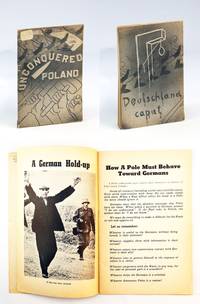
1943442j1479New York: Poland Fights - Polish Labor Group. Fair with no dust jacket. 1943. First Edition. Paperback. "As German boots marched and German tanks rumbled through the mined streets of Warsaw the workers buried their remaining arms drew closer to one another and silently disappeared to continue the fight with means other than rifles and bullets. Underground Poland was born! And this is its story." - page 2. Topics include: How a Pole Must Behave Toward Germans; List of 15 Strictly Forbidden Activities; Underground Poetry; Invisible Sabotage; Roads To Death; 1.5 Million Slave Laborers; Boycott; Recalcitrant Peasants; Avengers and Guerrillas; The Ghetto Strikes Back; Collective Responsibility of Monuments; Wawer Massacre; Hide It From The Germans!; Our Future. Stapled booklet with 44 glossy unnumbered pages in illustrated covers. Text in English. Profusely illustrated with black and white reproductions of photos document facsimiles illustrations and a map. No indication of any prior printings. Former library copy with related markings to front and back of front cover. Bound by a single staple which is pulling from the tender illustrated covers. One-inch opening at bottom of coverfold. A worthy example of this highly informative WWII-era artifact. Wiener Library Catalogue Series 7 1004. 8.5" x 5.5"; Front Cover; 8vo . Poland Fights - Polish Labor Group paperback
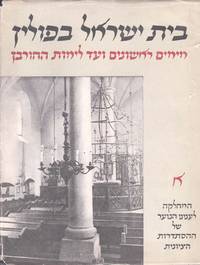
195342814Jerusalem; Youth Dept. Of The Zionist Organisation 1953. 1st edition. Clothbound with dust jackets. 4to. 215 10 288 pages. 28 cm. In Hebrew. With 14 black and white illustrations. Title translates as: "House of Israel in Poland; from the earliest days to the Holocaust. " A two volume Yizkor for Polish Jewish community history. Bound in red cloth. Subjects: Jews - Poland - History. Light shelf wear to cloth jacks show wear very good condition in good jackets. YIZ-15-20A-E. Jerusalem; Youth Dept. Of The Zionist Organisation unknown
195331692Nyu-York; Farlag “unzer Tsayt†1953. 1st edition. Publishers cloth. 8vo. 252; 318; 288; 304; 308; 244; 275 pages. 23 cm. First edition. In Yiddish. “Poland; Memoirs and Picturesâ€. The grand epic memoir of Yekhiel Yeshaye Trunk 1887–1961 ; which he began as soon as arriving in New York in 1941 it took a decade to complete. “Trunk’s broad political social and cultural experiences informed his autobiographical epic Poyln a study of the decline of the upper strata of Polish Jewish society and the rise of a new secular Jewishness embodied in folklore Yiddish literature and the Bund. This work his crowning achievement focused almost entirely on the multifaceted collectivity of Polish Jewry while relegating his personal story and inner struggle to the sideline. †YIVO Encyclopedia . Trunk was the chief archivist of YIVO at the time of his death and was considered in an obituary published in the New York Times “one of the leading historians in the United States on the destruction of European Jewry during the Nazi era. †Seven volume set bound in green cloth with gilt title. Subjects: Authors Yiddish - Poland - Biography. Jews - Poland - History. First volume cloth heavily worn with previous owners bookstamp otherwise very clean. All other volumes have minor shelf wear to cloth otherwise clean and fresh. Very good condition. YIZ-15-9. Nyu-York; Farlag “unzer Tsayt†unknown
194360436London New York Melbourne printed in Great Britain Published on behalf of the Polish Ministry of Foreign Affairs 1943. 8vo. Stapled as issued. Title-page printed in red. Stapels with rust slightly affecting surrounding paper. A very fine near mint copy. 16 pp. <br/><br/><em>The scarce first printing of this hugely important publication which constitutes one of the very first official reports on Holocaust and one of the most accurate accounts that had been presented to the West changing their knowledge of what was actually going on. This seminal pamphlet consists of 1 Raczynski's account of the ongoing Holocaust based among other reports on the eye-witness-report by Jan Karski a Polish Government emissary in occupied Poland who bribed his way into a German concentration camp and witnessed the mass extermination of Jews 2 the seminal "Joint Declaration" by members of the United Nations in which "The above-mentioned Govenments and the French National Committee condemn in the strongest possible terms this bestial policy of cold-blooded extermination. They declare that such events can only strengthen the resolve of all free-loving peoples to overthrow the barbarous Hitlerite tyranny. They reaffirm their solems resolution to ensure that those responsible for these crimes shall not escape retribution and to press on with the necessary practical measures to this end." p. 12 3 an extract of Deputy Prime Minister Mikolajczy's statement on behalf of the Polish Government and 4 the text of Raczynski's broadcast of December 1942 in which pleaded for action wishing to make the public and the Allied nations "understand how real is the tragedy which is taking place not so very far from the shores of this island on the continet of Europe - on the soil of Poland. For more than three years the Germans have consistently done everything they could to hide from the eyes of the world the martyrdom of the Polish nation the like of which has never been known in the history of humanity. But "when we would keep silence the very stones will cry out"." p. 15.While the details were neither complete nor wholly accurate the Allies were aware of most of what the Germans had done to the Jews at a relatively early date. The mass murder of the Jews was of such dimensions however that at first they could not believe the reports that reached them. This quickly changed though.In February of 1942 Jacob Grojanowski an escaped prisoner of the Chelmno extermination camp provided the Oneg Shabbat group with detailed information about what went on at the Chelmno camp. His report became known as the Grojanowski Report. It was smuggled out of the Warsaw Ghetto via the Polish underground and reached London in June of 1942. It is not known exactly what happened to the report at that point but by February of 1942 the United States Office of War Information had decided not to release information about the extermination of Jews thinking that there was a risk of the public viewing the war as only being a Jewish problem. Thus the Grojanowski Report was not released. By at least October of 1942 British radio had broadcast news of the gassing of Jews to the Netherlands and in December 1942 the Western Allies released their Joint Declaration which is printed in the present publication describing and condemning in the strongest manner Hitler's violent attempts at exterminating the Jews of Europe. In 1942 Jan Karski 1914-2000 a Polish World War II resistance movement fighter and later professor at Georgetown University gave his first report to the Polish British and U.S. governments on what was going on in the German extermination camps in Poland.Karski reported to the Polish government in exile i.e. Raczynski who was the Ambassador and one of its most prominent leaders and the Western Allies on the situation in German-occupied Poland. Karski personally met with Franklin Roosevelt and British Foreign Secretary Anthony Eden to explain what went on in Poland and Raczynski wrote up the report. Eventually the American Government confirmed the reports to Jewish leaders in late November 1942 and shortly thereafter they were publicized i.e. in the present publication. Karski's report through Raczynski became one of the most important reports in the history of the Holocaust being a major factor in informing the West. It sparked one of the first official publications from the Allies on the mass extermination of Jews in Poland and resulted in the official reports and condemnations from the Allied countries i.e. the "Joint Declaration" also published here."The purpose of this publication is to make public the contents of the Note of December 10th 1942 addresses by the Polish Government to the Governments of the United Nations concerning the mass extermination of Jews in the Polish territories occupied by Germany and also other documents treating on the same subject. . In the hope that the civilized worlds will draw the appropriate conclusions the Polish Government desire to bring to the notice of the public by means of the present White Paper these renewed German efforts at mass extermination with the employment of fresh horrifying methods." From the Introductory Note p. 3."Most recent reports present a horrifying picture of the position to which the Jews in Poland have been reduced. The new methods of mass slaughter applied during the last few months confirm the fact that the German autorities aim with systematic deliberation at the total extermination of the Jewsih population of Poland and of the many thousands of Jews whom the German authorities have deported to Poland from Western and Central European countries and from the German Reich itself.The Polish Government consider it their duty to bring to the knowledge of the governments of all civilized countries the following fully authentical information received from Poland during recent weeks which indicates all too plainly the new methods of extermination adopted by the German authorities." p. 4. </em> unknown
194360182London New York Melbourne printed in Great Britain Published on behalf of the Polish Ministry of Foreign Affairs 1943. 8vo. Stapled as issued. Title-page printed in red. Stapels with rust slightly affecting surrounding paper. A very fine near mint copy. 16 pp. <br/><br/><em>The scarce first printing of this hugely important publication which constitutes one of the very first official reports on Holocaust and one of the most accurate accounts that had been presented to the West changing their knowledge of what was actually going on. This seminal pamphlet consists of 1 Raczynski's account of the ongoing Holocaust based among other reports on the eye-witness-report by Jan Karski a Polish Government emissary in occupied Poland who bribed his way into a German concentration camp and witnessed the mass extermination of Jews 2 the seminal "Joint Declaration" by members of the United Nations in which "The above-mentioned Govenments and the French National Committee condemn in the strongest possible terms this bestial policy of cold-blooded extermination. They declare that such events can only strengthen the resolve of all free-loving peoples to overthrow the barbarous Hitlerite tyranny. They reaffirm their solems resolution to ensure that those responsible for these crimes shall not escape retribution and to press on with the necessary practical measures to this end." p. 12 3 an extract of Deputy Prime Minister Mikolajczy's statement on behalf of the Polish Government and 4 the text of Raczynski's broadcast of December 1942 in which pleaded for action wishing to make the public and the Allied nations "understand how real is the tragedy which is taking place not so very far from the shores of this island on the continet of Europe - on the soil of Poland. For more than three years the Germans have consistently done everything they could to hide from the eyes of the world the martyrdom of the Polish nation the like of which has never been known in the history of humanity. But "when we would keep silence the very stones will cry out"." p. 15. While the details were neither complete nor wholly accurate the Allies were aware of most of what the Germans had done to the Jews at a relatively early date. The mass murder of the Jews was of such dimensions however that at first they could not believe the reports that reached them. This quickly changed though. In February of 1942 Jacob Grojanowski an escaped prisoner of the Chelmno extermination camp provided the Oneg Shabbat group with detailed information about what went on at the Chelmno camp. His report became known as the Grojanowski Report. It was smuggled out of the Warsaw Ghetto via the Polish underground and reached London in June of 1942. It is not known exactly what happened to the report at that point but by February of 1942 the United States Office of War Information had decided not to release information about the extermination of Jews thinking that there was a risk of the public viewing the war as only being a Jewish problem. Thus the Grojanowski Report was not released. By at least October of 1942 British radio had broadcast news of the gassing of Jews to the Netherlands and in December 1942 the Western Allies released their Joint Declaration which is printed in the present publication describing and condemning in the strongest manner Hitler's violent attempts at exterminating the Jews of Europe. In 1942 Jan Karski 1914-2000 a Polish World War II resistance movement fighter and later professor at Georgetown University gave his first report to the Polish British and U.S. governments on what was going on in the German extermination camps in Poland.Karski reported to the Polish government in exile i.e. Raczynski who was the Ambassador and one of its most prominent leaders and the Western Allies on the situation in German-occupied Poland. Karski personally met with Franklin Roosevelt and British Foreign Secretary Anthony Eden to explain what went on in Poland and Raczynski wrote up the report. Eventually the American Government confirmed the reports to Jewish leaders in late November 1942 and shortly thereafter they were publicized i.e. in the present publication. Karski's report through Raczynski became one of the most important reports in the history of the Holocaust being a major factor in informing the West. It sparked one of the first official publications from the Allies on the mass extermination of Jews in Poland and resulted in the official reports and condemnations from the Allied countries i.e. the "Joint Declaration" also published here. "The purpose of this publication is to make public the contents of the Note of December 10th 1942 addresses by the Polish Government to the Governments of the United Nations concerning the mass extermination of Jews in the Polish territories occupied by Germany and also other documents treating on the same subject. . In the hope that the civilized worlds will draw the appropriate conclusions the Polish Government desire to bring to the notice of the public by means of the present White Paper these renewed German efforts at mass extermination with the employment of fresh horrifying methods." From the Introductory Note p. 3. "Most recent reports present a horrifying picture of the position to which the Jews in Poland have been reduced. The new methods of mass slaughter applied during the last few months confirm the fact that the German autorities aim with systematic deliberation at the total extermination of the Jewsih population of Poland and of the many thousands of Jews whom the German authorities have deported to Poland from Western and Central European countries and from the German Reich itself.The Polish Government consider it their duty to bring to the knowledge of the governments of all civilized countries the following fully authentical information received from Poland during recent weeks which indicates all too plainly the new methods of extermination adopted by the German authorities." p. 4. </em> unknown
194446237London: MaxLove Publishing Co. Ltd. 1944. 8vo. 91 1 pp. Numerous photo illusts. Beige cloth red lettering w/ d.j. cover art photo of crying woman minor dustsoiling scuffing shelfwear NF/VG copy. First edition of this scarce and harrowing account of the brutal treatment of Poles by the Nazi occupiers during World War II. The author details her experiences in Polish homes how Polish women are being plucked off the street never to return the constant hangings women fighting in the Polish Underground and more. MaxLove Publishing Co., Ltd., hardcover
1962014050New York: Amerpol Pub. Corp. 1962. This is a very good hardcover set of three volumes with only light wear. Consecutive issues from 1962 through 1968. Not a complete run but a substantial group. 29 issues: Vol. VII No. 1 1962; No. 2 1962; No. 3 1962; No. 4-5 1962; No. 6 1962; Vol.VIII No. 1 1963; No. 2-3 1963; No. 4 1963; No. 5 1963; No. 6 1963; Spring 1964 No. 1; Summer 1964 No. 2; Autumn 1964 No. 3; Winter 1964/65 No. 4; Vol. X Spring 1965 No. 1; Summer-Autumn 1965 No. 2-3; Winter 1965/66 No.4; Vol. XI Spring 1966 No. 1; Summer 1966 No. 2; Autumn 1966 No. 3; Winter 1966/67 No. 4; Spring 1967 No. 1; Summer 1967 No. 2; Autumn-Winter 1967 No. 3-4; Vol. XIII Spring 1968 No. 1; Summer 1968 No. 2; Autumn 1968 No. 3; and Winter 1968/69 No. 4. Text in English with some articles in Polish. Illustrated throughout in black & white. The red cloth bindings have titles in gilt on the spines. Maybe the publisher's bindings maybe private no other marks to the bindings not ex-library. Some issue covers appear trimmed. A very nice long run of this journal. 11" high X 7" wide. Heavy 3 volume set foreign shipping will be extra. These books will be securely wrapped and packed in a sturdy box and shipped with tracking. . Hard Cover. Very Good. Amerpol Pub. Corp. Hardcover
1997__1858984823Edward Elgar Pub 1997. Hardcover. New. 327 pages. 9.75x6.75x1.00 inches. Edward Elgar Pub hardcover