WWII; PolandBiblio.com
1 006 résultats
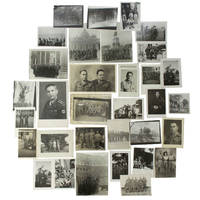
1944187231944. Polish Armed Forces soldiers serving with Allied forces during World War II documented in a group of photographs dating from 1945 to 1946 preserving visual evidence of the Polish II Corps and its role in the Italian Campaign. The Polish II Corps formed from Polish soldiers who had been released from Soviet imprisonment after the German invasion of the Soviet Union and were reorganized under Allied command receiving training in the Middle East before deployment to the Mediterranean theater. These troops participated in some of the most difficult operations of the Italian Campaign including the assault on German defensive positions at Monte Cassino in 1944 one of the decisive engagements that opened the road to Rome for Allied forces. The photographs record the presence of Polish soldiers in Italy during the final stages of the war and in the immediate aftermath of Allied victory.<br /> <br /> Photo archive consisting of 34 black and white silver gelatin photographs depicting members of the Polish Armed Forces serving with Allied units in Italy and surrounding regions during and immediately after the war. The photographs include individual portraits and group images of soldiers in uniform along with scenes of soldiers posed in front of prominent Roman landmarks such as St. Peter's Basilica the Colosseum and the Giuseppe Garibaldi monument. Several photographs show large groups of soldiers assembled near military vehicles and supply trucks while others depict soldiers aboard ships likely involved in transport within the Mediterranean theater. Many photographs carry inscriptions on the verso written in Polish including references to "Włochy" the Polish word for Italy confirming the location of the photographs. Some images show soldiers standing among palm trees suggesting photographs taken during the earlier phase of the corps' movement through the Middle East before deployment to Italy.<br /> <br /> By the end of the war the Polish forces serving alongside Allied armies had expanded significantly and the soldiers photographed here belonged to a formation that grew to more than 100000 personnel. After the war many Polish soldiers faced uncertain futures as their homeland fell within the Soviet sphere of influence following the war's conclusion. Photographs documenting Polish soldiers in the Italian theater therefore preserve visual records of a military force composed largely of displaced individuals who continued fighting under Allied command despite the political upheaval affecting their country. Thirty four silver gelatin photographs measuring approximately 2.5 x 3.5 inches to 5.5 x 3.5 inches. Minor edge wear present; overall condition very good. unknown
19563041725Würzburg, Holzner, 1956. 254 S. Lwd.
1974G76748Wroclaw, Zaklad Narodowy Imienia Ossolinskich Wydawnictwo 1974 361pp.with ills., 25cm., cloth, few stamps, good condition, [text in Polish, with English summary on pp.326-329], G76748
19903491438Wroclaw, Zaklad Narodowy im. Ossolinskich, 1990. 359 S. Mit Abbildungen auf Tafeln. OKart.
1908F116316Münster i.W., Aschendorff 1908 xxii + 686pp., 25cm., published in the series "Beiträge zur Geschichte der Philosophie des Mittelalters. Texte und Untersuchungen" Band III Heft 2, bound in a nice and solid hardcover (marbled boards, spine in black cloth), small stamp on title page, text is clean and bright, good condition, weight: 1.3kg., F116316
1985BA6124,5 cm X 30,5 cm, 207 pp, Reliure cartonnée rouge - orangée + jaquette illustrée. Le livre est partagé en deux parties : 88 pp de textes sur la vie de Witkacy, avec quelques photographies N&B dans l texte. Puis la deuxième partie du livre est consacrée à des reproductions couleurs hors texte de peintures de Witkiewicz. (206 reproductions). Il est très rare de trouver en France des reproductions de peintures de cet artiste baroque et surréaliste.
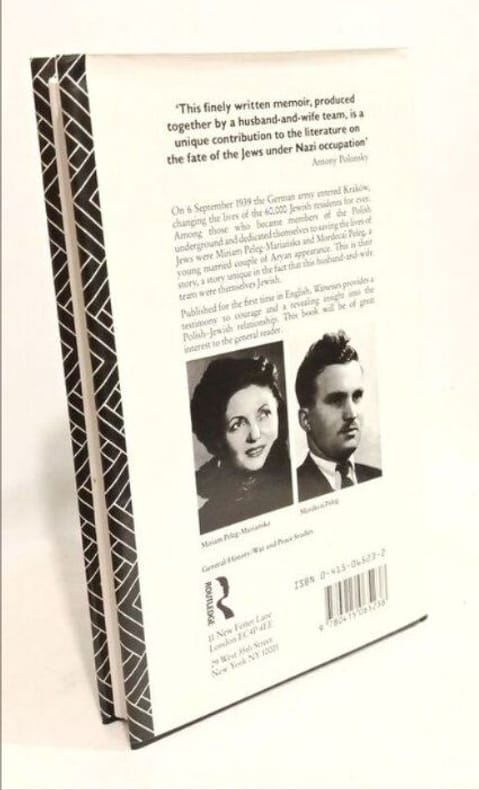
1992100137512Routledge 1992 256 pages 14x2x22cm. 1992. Cartonné jaquette. 256 pages.
19363433141Wilno, 1936. 36 S. Po tekscie liczne ilustracje. OBroschur.
1998132055Sport i Turystyka MUZA SA, Warsaw, 1998. 316 S. ; 32 x 24 cm ; Pp. ;
198112349AB(Krakau, 1981). 30 x 23,5 cm. 8 Tafeln mit farbigen Abbildungen lose in Orig.-Kartonmappe Mappe minimal angestaubt, sonst schönes Exemplar. >Theater CRICOT 2<
19944879Koscian : Medyk, 1994. [134] pp. Predom. ill. Gr. 4°. Orig. cloth with blind stamping and DJ.
19733257144Düsseldorf, Droste, 1973. 363 S. OLwd (mit OUmschlag).
1989184000Editions Interpress Varsovie, Editions Interpress, 1989. In-4 relié toile noire de l'éditeur sous jaquette illustrée de 75 pages de texte avec nombreuses photos noir et blanc et couleur par Stanislaw KLIMOWSKI. Bon état.
198952AyVarsovie Interpress 1989 In4 75 pages + phoyographies - cartonnage éditeur avec jaquette - bon etat général
198952AyVarsovie Interpress 1989 In4 75 pages + phoyographies - cartonnage éditeur avec jaquette - bon etat général
19705712Flammarion, 1970, fort in-8°, 503 pp, 44 photos et 4 illustrations sur 24 pl. hors texte, 8 pl. de documents en fac-similé hors texte, pièces annexes, broché, couv. illustrée, bon état
199538301ABOhne Ort., Kerber Verlag / edition pro., 1995. 4°. 239 S. OLeinen mit OUmschlag., 38301AB 1. Auflage. KLeiner, sauber hinterlegter Einriss am Umschlagrand, sonst sehr gutes Exemplar.
1965rx1143Instytut Wydawniczy Nasza Ksiegarnia Warszawa Cartonné 1965 In-4 (24,3 x 23 cm), cartonné toilé, non paginé, texte en polonais, photographies en noir et blanc ; mouillures et quelques taches sur les plats, deux pages déchirées vers la fin de l'ouvrage, plusieurs ex-libris tamponnés à l'intérieur, en l'état. Livraison a domicile (La Poste) ou en Mondial Relay sur simple demande.
1914A111-111Wien, Kaiserlich-K?nigliches Milit?r-Geographisches Institut, 1914. Hochformat, ca. 34 x 55 cm, Ausgabe: mehrf?rbig; Zustand: gut +
199225342Warszawa : Festina, 1992. [76] pp. : predom. ill. 4°. Orig. cardboard covers (cloth structure) with DJ.
1970869Warszawa, Sport i turystyka, 1970 in-8, 22 pp., 45 double photographies, table des illustrations dépliantes, cartonnage éditeur
1943597161 vol. in-12 reliure de l'époque demi-basane verte, dos à 5 nerfs, couv. conservée, Editions Balzac, Paris, 1943, 334 pp.
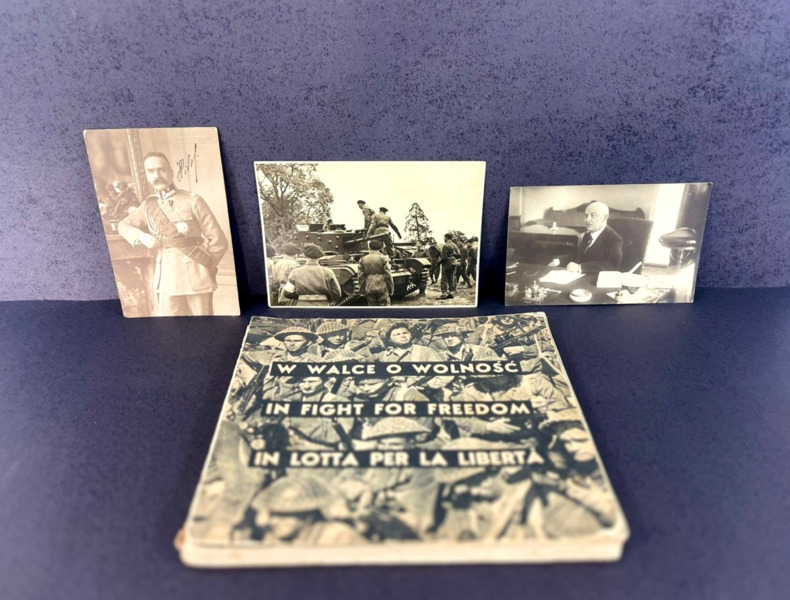
1945517This is a set which belonged to Janusz Gluchowski, a high-ranking Polish military officer at the time of the WW2. The set contains three original B&W pictures. First one: undated postcard showing Marshal Jozef Pilsudski, signed by himself in black ink, 8.5 x 13.5 cm, with two embossed mentions above and below. Second picture: undated postcard showing Poland President Gabriel Narutowicz, with a written mention on the back. Third picture: 11 x 15.5 cm photograph. General Tadeusz Bór-Komorowski inspecting a British Cromwell tank, accompanied by Polish officers of the 3rd Armored Regiment (3 puk pancerny). The image was captured during an official ceremony in the city of Kelso, Scotland, in the immediate post-war period, on June 15, 1945. The scene shows the General in an observation position, climbing onto the tank while surrounded by Polish soldiers. The tank corresponds to a British model widely used by Polish forces in exile during the Western European campaign. On the reverse, the following handwritten inscriptions appear: VI 1945, Kelso. N. Wódz gen. Bór-Komorowski dokonuje inspekcji 3 p. panc. N. Wódz w towarzystwie bryg. puku na czogu." / June 15, 1945, Kelso The book is an illustrated three-languages (Polish, English and Italian) set commemorating the struggles of the Polish II Corps. Edited by Wyda Rererat [Referat] Kultury i Prasy Kresowej Dywizji Piechoty in Rome, 1945. Oblong book of 21 x 19 cm, unpaginated (144 pp.). Cover detached. Endpapers and first page show Janusz Gluchowski's stamp. In publisher's photographically illustrated wrappers. Each page contains a photographic image or a photomontage accompanied with a short text in three languages. Front cover shows some wear and tear, the binding is a bit loose - we would advise having this book bound. The Polish II Corps was a major tactical and operational unit recruited from Polish deportees in the Soviet Gulags in 1943. First they fought in the Middle East, and in 1944 February they were transferred to Italy and as independent part of the British Army to fight in the Italian campaign, in the battles of Monte Cassino and Ancona and also the Battle of Bologna during the final offensive in Italy in 1945. The book goes through the story of Poland and the later established Polish II Corps, starting with the German and Soviet occupation in 1939. It shows the deportation of Poles to forced labour to the Gulag and, after the Polish-Russian Military Agreement in 1941, the establishment of the Polish Army on Soviet soil, also their military training and their fights in various battles. Janusz Julian Gluchowski was a Major General in the Polish Army during the Second Polish Republic. He was born on August 6, 1888, in Bukowa. He fought in the Polish Legions in World War I, the Polish-Ukrainian War, the Polish-Soviet War, and the invasion of Poland by Nazi Germany, Slovakia, and the Soviet Union in 1939, which culminated in the start of World War II. In his adolescence, he attended high school in Czstochowa. In 1905, he became a member of the Combat Organization of the Polish Socialist Party and was wounded in the hand during an attack near Czstochowa. To avoid arrest by the Russian authorities, he left for Belgium, where he studied at the University of Liège. He returned to divided Poland around 1910 and settled in Austrian Galicia. In 1912 he graduated from the Officers' School of the Riflemen's Association in Stroza, near Krakow. In the early hours of August 1914, he commanded a platoon in Oleandria and was Wadysaw Belina-Pramowski's representative during the legendary attack of the so-called Seven Lancers of Belina (Uaska siódemka). On August 6th, together with the First Cadre Company, he left Krakow and marched to Miechów. In October 1914 he was promoted to Lieutenant (Poruchik) and, in November 1916, to Rittmeister (Cavalry Master). Until 1917 he served in the First Uhlan Regiment of the Polish Legions. After the Oath Crisis (Kryzys przysigowy) he was interned first in Fort Beniaminów and later in Werl. Released in October 1918, he went to Lublin, where, in early November, he formed the Third Ulan Regiment (later renamed the Seventh Ulan Regiment of Lublin). Along with his unit, he fought in the Polish-Soviet War. On May 29, 1920, he was promoted to Polkovnik. He was transferred in July 1920 to Eastern Galicia, taking command of the First Cavalry Brigade, fighting against the Soviets in Galicia and Volhynia. After the war, he remained in this position until 1925, when he was transferred to the Fourth Cavalry Brigade. Promoted to Brigadier General on March 16, 1927. Appointed commander of the Center for Higher Military Studies on June 4, 1930, and three years later, after the death of General Stanislaw Tessaro, he was appointed commander of Military District X in Przemyl. In October 1935, he became Deputy Minister of Military Affairs. In the early days of the 1939 invasion of Poland, Gluchowski ordered General Walerian Czuma to prepare the defense of Warsaw. In mid-September 1939, he fled to Romania. After his escape, he managed to travel to the Middle East and, in January 1941, received orders to go to London. In October 1941, he was appointed Commander of the Training Brigade stationed in Scotland. On September 23, 1943, he was appointed commander of all Polish Army units stationed in Great Britain, except the First Independent Parachute Brigade, which remained under the authority of the Commander-in-Chief. He was promoted to Major General on June 1, 1945. He decided not to return to Soviet-occupied Poland and remained in Great Britain. He frequently criticized the Soviet regime and the Soviet occupation authorities in postwar Poland. Furthermore, he was one of the founders and president of the Jozef Pilsudski Institute in London. He was, therefore, an active member of the Polish community in Great Britain. He was president and honorary member of several Polish veterans' organizations. He died on June 11, 1964, in London, England.
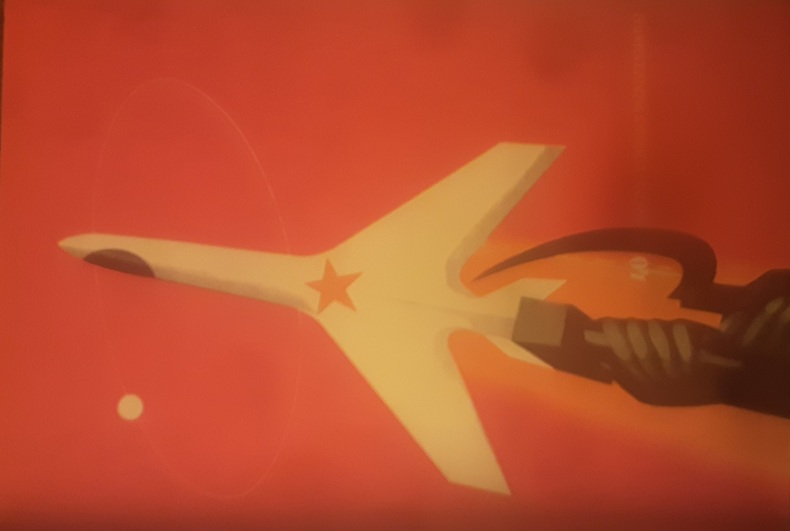
1962CCC-44033. éditeur, 1962 - Cartonné, 21 cm x 30 cm, 244 pages - Bien complet de la jaquette en état tres moyen -livre en tres bon etat. Texte en tchèque de Pavol Michalides - Nombreuses reproduction noir & blanc et couleurs in et hors-texte d'affiches politiques . photos possible
199055032ABBerlin, Brandenburgisches Verlagshaus, 1990. 4° (25x23), 133 S., mit zahlr. dokumentarischen Aufnahmen, graph. Darst., KartenSkizzen, fotoill OPbd, 3., korrigierte Aufl. nahezu ungelesen, schönes gepflegtes Exemplar,