Beuter, AntonAntiquariat.de

33 résultats
155624953ABVinegia (Venedig), Ferrari, 1556. Kl. 8° (16,5 x 11 cm). 36 (statt 38) Bl., mit einer doppelblattgroßen Karte von Spanien, 533 S., 1 Bl., mit Druckermarke, sowie hübschen Initialen und Vignetten im Text. Lederband der Zeit auf 3 Bünden, geprägter Titel auf Vorderdeckel, Rollen- und Plattenstempel, Messingschließen. [4 Warenabbildungen]
1600WRCAM34111Madrid 1600. 4pp. Folio. Later plain wrappers. Minute dust soiling. Very good. In a half morocco and cloth box. Four contracts between the sundry kings of Spain and certain conquistadors. "The agreements are with Rodrigo de Bastidas of Santo Domingo for the colonization of the Province and Port of Santa Marta in 1524 with Don Gonzalo Ximinez de Quesada in 1569 for the discovery of the New Kingdom of Granada with Captain Don Diego Fernandez de Cerpa in 1568 for the discovery and colonisation of the province of La Guayana Caura and New Andaluzia and with Panfilo de Narvaez in 1526 for the discovery of Florida" - BIBLIOTHECA AMERICANA. The terms of the agreements generally discuss rights granted by the Crown to the relevant explorer and stipulate what the explorer is required to provide the Crown in return. Gold and other precious metals top the lists. When originally catalogued by Maggs the official signature at the end of the last agreement was attributed to Baltasar Lopez de Castro; but on the original cataloguing present with the text a later hand has suggested Antonio Fernandez de Castro. <br> <br> Good evidence of the terms under which the conquistadors operated in the New World including Florida. Extremely rare. Not on OCLC nor in Palau or Servies. MAGGS BIBLIOTHECA AMERICANA I:109 this copy. MAGGS BIBLIOTHECA AMERICANA VI:177 this copy. hardcover books
1520WRCAM17720Augsburg 1520. 4pp. Small quarto. Later plain paper boards. Marginal tears and old fold marks with slight discoloration else very good. "After the death of Ferdinand II Charles V succeeded to the Kingdom of Spain. In 1517 he proceeded to Spain which he left in 1520. At his departure he was very unpopular; he made this speech when he left and said 'That he did not see the happy faces with which he had been received.' He also mentions America in the following words: 'He might have been satisfied with the Spanish Empire the Balearic Islands and Sardinia the Kingdom of Sicily Italy and a large part of Germany and Gaul AND THAT OTHER GOLD-BEARING WORLD'" - Maggs. <br> <br> EUROPEAN AMERICANA locates only two copies at The New York Public Library and the Bibliothèque Nationale. There is also a Rome edition of which a copy is located at Harvard. The present copy appears to be the only one offered for sale in this century. EUROPEAN AMERICANA 520/17. MAGGS BIBLIOTHECA AMERICANA I:33 this copy. PALAU 44419. ROTHSCHILD 3137. hardcover books
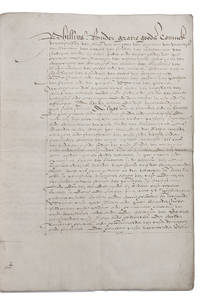
1557649ED93VJP3OThe Hague and Brussels 1557. Folio 36 x 25.5 cm. Manuscript mortgage agreement signed by King Philips representatives written in brown ink on parchment in a nearly upright cursive gothic hand with about 36 lines per page in a text block measuring about 25.5 x 18 cm. With a typescript transcription of the main text in red and an interlinear translation in Spanish in black by Prof. Dr. Edgard Verheyden. 2 blank 9 1 blank pp. Original mortgage agreement in Dutch in which King Philip II of Spain who had sovereignty over the Low Countries and held the title Count of Holland grants Jan Hanneman the rights to the tithes from his lands of Voorburg and Voorschoten. Philip had succeeded to the Spanish crown the year before on the abdication of the Holy Roman Emperor Charles V and the present elegantly written text explains that he and the Spanish Government wish to ameliorate their "very large and excessive debts" it later speaks of 300000 guilders which would be 50000 Flemish pounds resulting from years of war the building and maintenance of many fortifications and the salaries of the troops so the King wishes to mortgage or sell some of his royal domains and the rights to tithes that go with them. Efforts in 1556 had not yielded enough. Spain was later able to finance the wars with treasures from the colonies most famously transported in the annual silver fleet beginning in 1566 but here a decade earlier the King was desperate for funds.Formerly folded. In very good condition but with the sewing recent and rather loose. A primary source for Spain's financial state in 1557 and for the history of Voorburg and Voorschoten. unknown
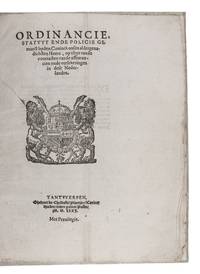
1571HCLAD73TWO2SAntwerp: Christophe Plantin 1571. Modern vellum. 4to. With armorial woodcut on the title page. Rare royal decree on marine insurance addressed to the Council of Brabant replacing the decree of 27 October 1570. In 1569 the Duke of Alfa took a radical measure by banning all marine insurance. "This "provisional" decree of 31 March 1569 was abolished by an ordinance of 27 October 1570 of Philips II. Marine insurances were again allowed. Ships could only leave the port with the permission of an officer after an inspection of their armament. This decree also charged that all policies should contain a detailed report of the goods on board. Diego Gonzalez Gante was appointed to inspect these contracts. He also had to prepare an new instruction. This decree contained as well a formulary of an marine insurance. After a petition of the merchants and Nations of Antwerp a new ordinance was promulgated three months later on 20 January 1571. This decree provided that only ten percent remained to the own risk of the insurance taker. The goods the name of the vessel and the captain had to be mentioned in the insurance policy. To prevent fraud Diego Gonzalez Gante was also appointed to control everything. An insurance policy which was not recorded by him was to be declared null and void. Not only in Antwerp but also in Bruges Amsterdam and Middelburg people under his authority had full powers to verify this" Huybrechts. This decree also prohibited life assurance.With three lines underscored otherwise a very good copy and wholly untrimmed.l USTC 401508 6 copies; Voet 1981 4 copies incl. 3 the same; WorldCat 3 the same copies; cf. M. Huybrechts ed. Marine insurance at the turn of the millennium II 2000 p. 18; V.d. Wulp 213 1570 ordinance. Christophe Plantin, hardcover
1573B556<p>Mexico City 9th day of March1573 size 450 x 320mm</p><p>SIR FRANCIS DRAKE'S ENGLISH PIRATES</p><p>Arrest Warrant For English Pirates Signed By The First Inquisitor of New Spain in 1573</p><p>Remarkable arrest warrant signed by the Inquisitor of New Spain directing the arrest and capture of 5 accused heretics including two English Pirates who had recently completed a daring jail break from prison in Mexico City.</p><p>This is an official arrest warrant dated March 9 1573 ordered by Pedro Moya de Contreras c. 1528-1591 first inquisitor of the newly founded Mexican Inquisition addressed to Don Alonso Sánchez de Miranda Dean of Guadalajara.</p><p>Moya de Contreras arrived in New Spain in 1571 as the newly appointed inquisitor thereafter rising to the office of Archbishop of Mexico City and finally Viceroy of New Spain 1584-1585. This two-fold letter is part of the legacy of the Inquisition in the New World aimed at ecclesiastical authorities and their flock to raise awareness of the rampant menace of Lutheran individuals in Mexico.</p><p>Following the failed attempt by the fabled pirates Francis Drake and John Hawkins to seize San Juan de Ulúa in 1568 about 500 mostly English pirates remained stranded in New Spain. Over the course of the next several years these 500 scattered throughout Mexico where they intermingled with the locals. Some 77 of these fell into the hands of Luis Carvajal the elder alcalde mayor of Tampico. Carvajal a converso was the patriarch of the Carvajal family which was later tragically tortured and murdered by the Inquisition as crypto-Jews. They were delivered to Mexico City as prisoners of war and were given relatively minor sentences of forced labor in various places throughout Mexico.</p><p>With the arrival of Moya de Contreras in 1571 the remaining pirates were no longer considered as mere prisoners of war but as heretics - "Luteranos" - and as such subject to the Inquisition's regulations. In 1572 Pedro Moya de Contreras issued a general order for all remnants of the Hawkins expedition to be apprehended and put to trial in New Spain. As a result about 36 were again rounded up captured and condemned for heresy. This group was processed through the Inquisition's court where they were subjected to a grand auto-da-fe in 1574 the largest ever held.</p><p>Three of these pirates are mentioned in Moya's letter to Don Alonso Sánchez de Miranda:</p><p>"Guillermo de Siles a Frenchman of 24 years of age small in height with pale features with little growth of hair on his face small blue eyes ."</p><p>"Pablo Haquines de la Cruz Paul Hawkins an Englishman who came with the armada of John Hawkins with sturdy shoulders and pale features with little growth of hair on his face of about 20 years of age ."</p><p>"Andres Martin Andrew Martin an Englishman with those from the said armada young man without growth of hair tall and slim with pale features of about 18 years of age."</p><p>The three had escaped from the Jail of the Inquisitor by burrowing under the walls of the cell in the middle of the night an escape which was apparently previously unrecorded. The arrest warrant provides that should anyone contravene the order or give aid to these heretics they will face the prospect of "latae sentenciae excommunication" including the sequestration of their possessions.</p><p>The actions of Pedro Moya de Contreras at that time under the supervision of Pedro de los Ríos chief inquisitor in Mexico clearly reflect all new precepts and creeds from the Tridentine Council 1545-1563 brought along to the New World to reform the Catholic faith.</p><p>The following is an English Translation of the arrest warrant provided by Boris Bruton:</p><p>We doctor don Pedro Moya de Contreras apostolic inquisitor against vile heresy and apostasy for the city of Mexico and Provinces of New Spain by our authority apostolic etc. order you Reverend don Alonso Sanchez de Miranda dean of Guadalajara commissary of this Holy Office to arrest the persons of Gomes de Leon his Majesty's servant or His Majesty's scribe resident of Puebla de Los Angeles a man of about 30 years old very fair of complexion of a good height wearing breeches with a short green cape; and Francisco Gonzales captain resident of Toluca elderly man of about 50 years grey-haired short in size scant beard hooked nose and tanned as though coming from the mountains dressed all in black. And William de Siles Frenchman about 24 years old short fair complected scant blond beard small blue eyes dressed in doublet and pants of coarse cloth; And Pablo Hawkins de la Cruz Englishman one of those who came on the fleet of John Hawkins young man somewhat stooped heavy-set fair beardless about 20 years old. And Andrew Martin Englishman member of the same fleet young man beardless lanky fair about 18 years old. Both of these are fluent in Spanish.</p><p>Last Sunday. All these men last Sunday night the eighth of this month about midnight burrowed through one of the cells of this Holy Office and escaped. These men you may seize and remove from any church or any other sacred exempted place whether in your district or outside of it in your own person or others whom you shall choose by authority of this letter or in prosecution of this our order as authorized on your own authority relaying my own warning and order with respect to all the other towns and cities of your bishopric. You are to order announce and publish this order so that no person whether he be Spanish or indian of whatever class or distinction shall receive hide shelter help on their way give any benefit or supplies or mounts horses to them;</p><p>and anyone who shall have information concerning these felons shall it to you or whomever you will have designated for this. Those who act contrary to this will be liable for prosecution for having received and sheltered heretics and in addition they shall incur the penalty of automatic excommunion excommunion latae sentenciae and forfeiture of all their property. To accomplish all the foresaid we give the power and authority for any person Spanish mestizo indian negro or mulato even if he has not been appointed officially by you to arrest these men as noted so that if anyone has given shelter or concealed them let a report be made of it and send it to us without delay.</p><p>Written in Mexico City the 9th day of March 1573.</p><p>Signed Doctor Moya de Contreras / by order of the Señor Inquisitor / Pedro de los Rios</p><p>Condition Description: ALS 2 ff. both folios tide marked on both left and right margins extending into written area both folios with loss to fore margins but written area unaffected.</p><p>Please go to www.marshallrarebooks.com for many more books on this subject.</p>
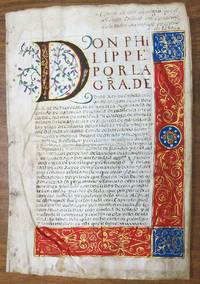
1572RF 1076<p><strong>Royal Provision of Phillip II Confirming and Ratifying the Privileges Granted by the Masters of the Order of Santiago to the Village of Corral de Almaguer Toledo 1572</strong></p><p>Manuscript. Small folio. 12 1/4 x 8 1/4". 8 double-sided vellum manuscript leaves originally bound together now unbound hand painted and decorated in blue red and gilt at various points throughout the text. The first page is hand-painted and decorated along the edge and includes a large decorative initial in multiple colors. Manuscript text in gothic style. Signed "Yo el Rey" on the back of the final leaf by King Phillip II of Spain in 1572.</p><p>ATTRACTIVELY ILLUMINATED EARLY MANUSCRIPT. JUDAICA INTEREST. Our manuscript contains the 4 confirmed provisions originally drafted by Infante Henry Duke of Aragon 1421 and 1440 Alonso de Cárdenas here listed as "Alfoso" sic in 1480 and then "The Catholic Kings" in 1494 all of whom at various times served as "Grand Masters of the Order of Santiago". The provisions were instigated against the Jewish communities of the villages of Corral de Almaguer and Ocana in Toledo province. Residents of the towns affiliated with the Order of Santiago repeately complained throughout the 15th and 16th centuries to the the authorities of that order of that the Jews and later conversos had bought land from Christians and had not paid any taxes on their purchases. Ultimately the Jews of Corral de Almaguer were ordered to pay comparable taxes to the Christians for said property but the Jews of Ocana were excepted because of their previous payments of other taxes. Given the fact that this manuscript copy dates from 1572 and was signed and reconfirmed by King Phillip II so long after the expulsion of 1492 shows there were still clearly tensions and persecution of local conversos even long after the communities had converted to Catholicism.</p><p>The top left margin on the front of the first leaf contains a handwritten note in ink stating in Spanish "It consists of this-privilege that Juan Collado was a secretary of the Order of Santiago in the year 1480". There are a few additional scant marginal notes in ink throughout and additional handwritten notes and signatures some indecipherable on the verso of the final leaf under the King's signature.</p><p>This document provide a fascinating and invaluable resource to those studying the history of Jews in Spain during the 15th and 16th centuries.</p><p>Text in Spanish.</p> hardcover
15695032541569. Book. A lengthy series of royal edicts / decrees / writs produced by the court under Philippe's close scrutiny in 1569 regarding financial and other obligations on the part of the persons in the area of Castro del Rio and elsewhere. 49 vellum leaves 98pp of manuscript 4 blank pages. The last page of which bears the date 18 November 1569 and the elaborate signatures and marks of the King and a number of his courtiers. Each page of the text bears 2 flourishes ie initials likely by the King and by the person responsible for the production of the document. In the original leather covers much rubbing and wear with remnants of the binding ribbons but the document still well-bound and with we think the original tri-coloured spine-cord binding the text to the cover. The first page with ornate decoration and illustrations in ink embellished with gold detailing and flourishes. Exquisite calligraphy throughout on well-preserved vellum. No seals present. 14" x 10". hardcover