2 759 résultats
03009040 items 47 pages various sizes ranging from small sheets to folio in Dutch both High and Low Swedish and English the documents have various condition issues damp-stains old tape stains soiling tears and loss associated with over three hundred years of neglect but they are generally legible. <br /><p>The collection of documents and papers offered here pertain to the earliest European settlers on the Delaware River – the colony of New Sweden and one family of settlers in particular the Nilsson family- Jonas Nilsson and his children. These settlers Swedes Finns and Dutch constituted the majority of the population on the South River as they called the Delaware before the Quaker "invasion" that began with John Fenwick's group in 1675 and culminated with William Penn's 23 ships in 1681-1682. The bulk of the papers in this collection date from two periods when the colony was in transition: first from Swedish to Dutch control and then from Dutch to English control. Paper and documents from New Sweden are exceedingly rare many of the records generated by the colony simply did not survive. Most of the materials which did survive have been housed in institutions for generations if not centuries. Collections such as this one essentially the three hundred plus year old Nilsson family papers simply do not appear in the market. </p><p> The collection contains the signatures and marks of many "ancient Swedes." The collection contains a document bearing what is only the second known signature of one of them: "Laurentius Caroli Lutheran minister" Pastor Lars Carlsson Lock. The collection also includes documents signed by Hendrick Coleman one of the leaders of the "Long Finn Rebellion" the first armed insurrection against the English in America. </p><p> For many historians the colony of New Sweden 1638-1655 is perceived as an insignificant blip in American colonial history. One of the reasons is that few records have survived in America for the Swedes Finns and Dutch who were the first permanent European settlers in the region. Between 1637 and 1656 Sweden equipped thirteen passenger voyages for the South Delaware River which departed with about 800 prospective settlers. Eleven vessels and some 600 passengers reached their intended destination. </p><p> The present collection of documents relates to one of those settlers Joen Jonas Nilsson and his family. Nilsson arrived in the New World on the fourth ship in 1643. Nilsson like many of his fellow settlers was illiterate so while there is no correspondence the collection contains the sort of documents and papers that deal with aspects of everyday life legal matters land disputes and other matters mainly involving his neighbors in Kingsessing in what is now present day Philadelphia. The collection documents what daily life was like over 300 years ago in the lost colony of New Sweden and gives a picture of conditions and domestic life facing the first settlers in the mid-Atlantic over 300 years ago. </p><p> <b>Biographical Sketch of Joen Jonas Nilsson 1620-1693 </b> </p><p>"Jonas Nilsson from Skaraborg County Sweden came to New Sweden as a soldier in 1643 and married Gertrude daughter of Sven Gunnarsson. His seven sons used the patronymic Jonasson which evolved into Jones. Their family in 1671 included Nils b. 1655 Judith b. 1658 Gunilla b. 1661 Måns b. 1663 Anders b.c. 1666 Christina b. 1668 and John b.1670. Subsequent children were Peter Jonas Brigitta and Jonathan. Jonas Nilsson died in October 1693 at the age of 73. Lovelace's patent to Jonas Nilsson dated 18 May 1672 named Hans Månsson Peter Andersson widow Dalbo Anders Boon and Mr. Otto Ernest Cock as owners of land adjoining his several parcels." </p><p>Craig Peter Stebbins "<i>1671 Census of the Delaware</i>" page 21 Philadelphia: Genealogical Society of Pennsylvania 1999 </p><p>Joen Nilsson was one of the many soldiers accompanying Governor Printz on the Fourth Expedition to New Sweden. Nilsson of Skåning hundred Skaraborg län would later become better known under the name of Jonas Nilsson. Born in 1621 Jonas was a tailor by trade. He was an imposing character reported to be six and a half feet tall. He began his voyage to New Sweden from Stockholm in September 1642. After arriving at Fort Christina 15 February 1643 he was one of many men assigned to help build Fort Elsborg where he was subsequently stationed. Nilsson served governor Printz faithfully as a soldier and also served the colony as a tailor for eleven years until 1653. But when Printz returned to Sweden in 1653 Nilsson did not go with him. He obtained his discharge and became a Freeman. After Governor Rising arrived in 1654 Nilsson was able to secure passage to Sweden to collect the moneys due him. New Sweden was essentially a barter economy where the currency consisted of beaver skins half-beaver skins and sewant. To collect real money for one's services it was necessary to go to Sweden. Most of the settlers in New Sweden owed money to the New Sweden Company and had no incentive to return. Before he left Nilsson signed the Freemen's Loyalty Oath on June 9 1654 and married Gertrude Svensdotter in 1654. She was the daughter of Sven Gunnarson and was born in 1636 in Sweden she immigrated to New Sweden in 1639 on the ship <i>Kalmar Nyckel</i>. Jonas left his young bride in mid-July 1654 to return to Sweden on the ship <i>Eagle</i>. He collected the back wages due him and returned to New Sweden on the <i>Mercurius </i>which arrived in March 1656.Meeting the ship were his wife Gertrude and his eldest son Nils who was born during his absence. Nilsson then became one of the first settlers in Kingsessing where he established an Indian trading post on Kingsessing Creek southwest of the Schuylkill River in present day West Philadelphia. Kingsessing was a Swedish village on the north bank of a creek known as Minqua Kill or Kingsessing there were four households in this village when the 1671 census was taken- one was Nilsson's. </p><p> Nilsson was a friend protector and business advisor of Armegot Printz daughter of the former governor Johan Printz Jonas was a witness to her sale of a church bell to the Swedish church on 24 May 1673. </p><p> In Philadelphia near the present day 77th and Laycock streets stood a house built by Jonas Nilsson c. 1650s. Nilsson for some years before building this house had dwelt in a cave the site of which is still preserved in the side of the hill which slopes from the front door of the cottage to what was originally the bank of a navigable creek. Ships from the Delaware brought up merchandise to the front door of the cottage and the cave the first home of Jonas Nilsson where he reared his eleven children became a storehouse for the goods brought up for his trade with the Indians. The old house with its two rooms and garret was hardly larger than a packing box. The ground floor room had an immense fireplace walled up which extended almost the entire width of the room and nearly to the ceiling which was scarcely more than seven feet high. George Washington later sat in front of that fireplace. Sessions of court were held wherever a building was available and the old Jonas Nilsson cottage was one of the earliest places in America where trial by jury was held. A trail that led to the house from the direction of Tinicum Island has appeared on maps of the city from the very beginning as Jones's Lane. Nilsson's home and trading post was the center of trade with the Minquas Indians arriving from the west via the Great Minquas trail. Nilsson made his fortune by bartering and trading goods for furs with the Minquas. </p><p> Jonas Nilsson lived for his entire married life in Kingsessing West Philadelphia where he raised his family of eleven children. Besides his trade with the Indians he was a successful farmer on his tract of 200 acres. He also acquired an additional 270 acres of land at nearby Aronameck from Peter Yocum land which he divided among his three eldest sons. Each of Nilsson's sons took the patronymic Jonasson which evolved into Jones. </p><p> Jonas's wife Gertrude was a formidable woman. Her outspoken criticism of defamatory remarks by the English against the Swedes was at least once the subject of court notice. Her father Sven Gunnarson and her brothers – the Svenson's which later evolved into Swanson- were later to play a unique role in the early history of both Philadelphia and Pennsylvania. </p><p> In August 1639 the Swedish government needing settlers for its New Sweden colony sent word to the governors of Elfsborg Dalsland and Varmland to capture deserted soldiers and others who had committed some slight misdemeanor and to send them to America. Among the "convicts" rounded up in this effort was Sven Gunnarsson. When the Swedish War Ship the <i>Kalmar Nyckel</i> left Goteborg in September 1639 he was aboard with his pregnant wife and two small children. Initially in New Sweden Sven was stationed at the Fort Christina plantation where he was found in 1644 working on the New Sweden tobacco farm and his son Sven still a boy was herding cattle at the same location. By 1654 Sven Gunnarsson and his family had moved to Kingsessing. In October 1654 he was finally granted freedom from his servitude and joined other freemen residing at Kingsessing now West Philadelphia Here he was known as Sven the Miller as he operated the first gristmill built in New Sweden on the present Cobbs Creek. </p><p> Being a freeman in New Sweden was like being a peasant under the tyrannical rule of Governor Johan Printz. Like other freemen Sven was required to work without pay at Printz's Printzhof plantation whenever the Governor demanded was prohibited from trading with the Indians and forced to buy all necessities at the company store. Like other freemen he fell heavily into debt. Another such freeman Lasse Svensson the Finn and his wife Carin had their plantation seized by Printz who renamed it Printztorp Both Lasse the Finn and his wife were forced to live without shelter in the woods. Both perished leaving several impoverished children. </p><p> It was not surprising; therefore that Sven Gunnarsson was one of the 22 freemen who signed a petition of grievances that they submitted to Governor Printz in the summer of 1653. Printz called it a "mutiny" and returned to Sweden. </p><p> Sven the Miller fared better under Governor Rising 1654-1655. He even volunteered to help defend Fort Christina against the Dutch invasion on August 31 1655. A pitched battle was averted when Rising decided to surrender the colony. Conditions proved to be even better under Dutch rule. Stuyvesant allowed the Swedes living north of the Christina River to organize their own government. That government known as the Upland Court treated Sven Gunnarsson well. </p><p> After the Dutch takeover of New Sweden Sven Gunnarsson moved with his family across the Schuylkill to Wicaco a former Indian settlement where Sven's 1125-acre plantation embraced what would become the future City of Philadelphia. On May 5 1664 the Dutch Governor Alexander D'Hinoyossa granted him and his three sons' acres at Wicaco which was confirmed 31 May 1671 by a grant from Governor Francis Lovelace after the territory came under English rule. Here on his land the first log church at Wicaco now Gloria Dei Church was built by 1677. The last known reference to Sven occurs in the Upland Court minutes of 13 November 1677 where he withdrew a lawsuit after the defendant settled out of court. And he appeared on the list of tydables in the court's jurisdiction as living with his son Anders. Sven Gunnarsson died about 1678 and probably was one of the first to be buried at the Wicaco church. </p><p>In the spring of 1683 Sven's three sons agreed to provide the northern part of Wicaco for William Penn's planned new city to be called Philadelphia. The sons who had adopted the patronymic Svensson which evolved into the anglicized Swanson were left with 230 acres apiece. Sven Svensson Swanson was the eldest son of Sven Gunnarsson he was born in Sweden. He was a Wicaco Church warden and a justice on the Upland court in 1681-82 and was elected to the Pennsylvania Assembly in 1683. They sold William Penn the land upon which the city of Philadelphia was laid out. </p><p>"Having promised in July 1681 to lay out a "large town or city in Pennsylvania" William Penn drew up his specifications for his town. He named his cousin William Crispin 1627-1681 and Nathaniel Allen d. 1692 and John Bezar d. 1684 two Quakers from the western part of England as his commissioners and instructed them to set aside 10000 acres on the best site for a port along the Delaware… William Penn's commissioners however were not able to acquire enough land to carry out many of Penn's plans because the Swedish Dutch and English inhabitant's had already taken up most of the river frontage along the west bank of the Delaware from New Castle to the Falls opposite present day Trenton New Jersey. The commissioners concluded that the best site for William Penn's town was a few miles north of the mouth of the Schuylkill River on land patented by the Swanson family and in the spring of 1682 they obtained 300 acres of river frontage from the Swansons … in which to lay out his capital city."1 </p><p>"One of William Penn's most important and most difficult tasks was to lay out his capital city. Originally he wanted to set aside 10000 acres for Philadelphia but since all of the choicest riverfront property along the western bank of the Delaware was already patented William Penn's commissioner's had to settle for a much smaller site. In early 1682 they bought a tract extending a mile along the Delaware River from three Swedes the Swanson brothers of Wicaco. Dissatisfied with this cramped area William Penn acquired a mile of river frontage on the Schuylkill from two other Swedes Peter Cock and Peter Rambo parallel to his frontage on the Delaware. This gave him a rectangle of 1200 acres stretching two miles in length from east to west between the two rivers and one mile in width from north to south. Within this rectangle Surveyor-General Thomas Holme plotted his famous grid plan of the city."2 </p><p>Records prove that Sven also had two daughters including Gertrude Svensdottar who was born in Sweden in 1638 and who married Jonas Nilsson in 1654 she died in Kingsessing in 1695 survived by eleven children. </p><p>Jonas Nilsson died October 23 1693 and is buried at Gloria Dei Old Swedes Church Burial Ground in Philadelphia. </p><p><b> Brief History of New Sweden</b> </p><p> In March 1638 two ships <i>Kalmar Nyckel</i> and <i>Fogel Grip</i> brought to the Delaware River twenty-three Swedish soldiers and two officers to establish the first and only Swedish colony in the New World. They built a fort on the shore of a small river emptying into the Delaware which stream they named Christina Kill after their queen. The site was the first permanent settlement in the entire Delaware River Valley including Delaware New Jersey and Pennsylvania and is now within the boundaries of the present city of Wilmington Delaware. Having bought from the Indians a tract of land on the western side of the Delaware extending from Sanikan Trenton New Jersey to Cape Henlopen at the mouth of Delaware Bay they claimed this territory for their country calling it New Sweden. </p><p> In 1640 a second expedition arrived with supplies and new colonists their first governor Peter Hollandaer and the first clergyman Rev. Reorus Torkillus. Another expedition arrived in 1641 and a fourth in 1643 bringing a new governor Johan Printz. </p><p> Printz started at once to extend his domain building small forts on the eastern or New Jersey side of the Delaware at Tinicum near the present site of Philadelphia at Upland Chester Pennsylvania and at the mouth of the Schuylkill River. More ships came and more colonists the forests were cleared farms cultivated a village Christinahamn was laid out behind Fort Christina their first establishment. </p><p> Johan Printz ruled New Sweden with despotic power. Military leader as well as civil governor lawgiver chief judge and head of all the colony's activities he was supreme over the whole Delaware Valley south of Sanikan. He was "a man of brave size weighing over 400 pounds" headstrong tyrannical rough violent overbearing arrogant and arbitrary but an intelligent man a brave soldier a strict disciplinarian an able administrator. In all he was a colonial governor whose achievements have been overshadowed by aspects of his character and conduct. He monopolized the fur trade driving out English who came from New Haven and Dutch who came from New Amsterdam seeking to establish trading posts and settlements. By successive expeditions the colony increased to nearly 400 people. </p><p> Pieter Stuyvesant Dutch governor of New Amsterdam built a fort at Sandhook New Castle Delaware called Casimir. Printz's successor Johan Rising in 1653 captured it and again gave Sweden the control of the whole valley. This so angered the Dutch in Holland that in 1655 they sent a warship to New Amsterdam where it was joined by six others. With 300 fighting men Stuyvesant came down from Manhattan took his fort back again and after a ten days' bloodless siege captured Fort Christina as well. Thus New Sweden disappeared from the map and a Dutch province took its place. </p><p> The collection consists of documents bills receipts legal documents pertaining to Joen Jonas Nilsson. </p><p> The earliest dated documents in the collection date from 1656 when Nilsson returned to New Sweden aboard the <i>Mercurius</i>. Traveling aboard along with the 130 colonists was Hendrick Huygen the Dutch supercargo of the Swedish expedition. Huygen was the nephew of Peter Minuit the legendary early director of New Netherland and purchaser of Manhattan who had also offered his services to the Swedish government and had guided the first Swedish expedition in 1637 and had decided where to plant the Swedish flag. Huygen had served as commissary to the colony of New Sweden and had earlier left the colony briefly his return on the <i>Mercurius</i> resulted in one of the first rifts between the Dutch and the Swedes after the Dutch takeover of the colony. The collection includes a document pertaining to Nilsson dated May 17 1656 signed by Huygen while aboard the <i>Mercurius.</i> </p><p>The rift began in March 1656: "…A shipload of 130 Swedes and Finns arrived on the South River expecting to join the Swedish colony. Dutch authorities decided that the settlers "for grave reasons" were an unwelcome addition and ordered the ship the <i>Mercurius</i> to return to Sweden. Meanwhile the commander of the river reported that some of the remnant Swedes had proved "troublesome or very dangerous" namely by holding "secret intelligence with the savages." To prevent more unrest the council ordered the troublemakers to New Amsterdam twelve soldiers on the Delaware and any Swedes who had not taken the oath to do so or face deportation. Hendrick Huygen … had helped the Swedes many times before. Although he tried to resolve the dispute in "a friendly conference" the Dutch commander detained him as "a traitor and enemy of his state." Huygen appealed to the council for permission to settle the colonists temporarily at an uninhabited place until a resolution could be obtained from the home governments. He did not wish them to be dispersed through the Dutch colony for fear that families would be separated and that "they must altogether be deprived of their worship of God and live under a foreign nation whose language and manners are not known to them." </p><p> While Huygen negotiated at Manhattan and Stuyvesant's council continued to insist that the Swedes leave after a stop at New Amsterdam for supplies some Swedes Finns and Indians boarded the <i>Mercurius</i> and sailed it past Fort Casimir contrary to orders and landed up river. Whether it was an effort by the Swedes to liberate their country people or just some of the goods on board the Dutch reacted quickly to restore order. They suspected that "some of the principal men of the Swedes were at the bottom of it and that also most of the other Swedes who had taken the oath of loyalty had in their opinion been stirred up or misled." With the additional soldiers and the warship <i>de Waagh</i> the Dutch eventually drove off the Swedish ship and concentrated on resolving the "differences jealousies and dissensions" that flourished along the Delaware between Indians Swedes and Dutch. </p><p> The <i>Mercurius</i> affair heightened Dutch suspicions that the Swedes were not to be trusted. When the council appointed a vice-director to oversee the Delaware region of New Netherland it instructed him to keep the Swedes and Indians out of Fort Casimir as much as possible and to prohibit "the free people especially the Swedes" from spending the night inside without his knowledge and consent. In general "he must look well after the Swedes who still are there" weed out any "who are not well affected towards the Honble Company and our native country" and "with all possible politeness make them leave … to prevent any more dissatisfaction." From the Swedes perspective they were the conquered living among the conquerors. They remained hopeful that the States General would return the colony to Sweden. In the meantime they asserted their rights and remained a close-knit community."3 </p><p>The Dutch were persuaded to grant the Swedes and Finns a measure of self-government north of the Christina River. And in August 1656 the Swedes own law courts were approved. This first court consisted of Olof Stille Mats Hansson Peter Cock and Peter Rambo. The collection includes some very early legal documents before these and other early court members pertaining to legal cases involving Jonas Nilsson when the court was in session at Kingsessing in September 1665 and at Upland. </p><p>The collection includes a document dated 5 September 1665 signed by Laurentius Carels 1624-1688. Carels was one of the first settlers of Delaware County Pennsylvania and one of the first Swedish Lutheran clergymen in New Sweden. As was typical among Swedish ministers he generally used a Latinized version of his name Laurentius Caroli Lockenius. He is listed in historical records under several different names most commonly Lars Carlsson Lock. This document bears only the second known signature of Lock. The only other signature of Lock's appears on a 1662 letter to Peter Stuyvesant. </p><p> Lars Carlsson was born in Sweden in 1624. In September 1647 at the age of 23 Lars Carlsson sailed from Göteborg to New Sweden arriving in early 1648. He subsequently adopted the surname Lock from his place of origin Lockerud near Mariestad in Skaraborg County Sweden. In the colony he replaced the veteran minister John Campanius. He was based at a church on Tinicum Island built by Johan Printz the governor of New Sweden. At the start of his ministry he served about 200 members. Pastor Lock is believed to have been the author of the July 27 1653 Settlers' Petition to Governor Printz This is because Lock was one of the few settlers who was literate and served as the scrivener he is also believed to have composed the July 7 1654 Settlers' Supplemental Complaint against Printz. These complaints lead to the return of Printz to Sweden. The Swedish colony of New Sweden ended during the summer of 1655. The Swedish settlement was incorporated into Dutch New Netherland on September 15 1655. The Swedish settlers were allowed to retain a pastor of their confession. Reverend Lars Lock remained but the other pastors returned to Sweden. His congregation was widely scattered extending from the Schuylkill River on the north to the Christina River on the south. </p><p>His role as the only minister on the Delaware River did not end until 1677 when the Swedish settlers living northeast of Darby Creek built a new log church at Wicaco present day Philadelphia now Gloria Dei Old Swedes' Church and invited Jacob Fabritius to be their pastor. Jacob Fabritius a native of Grosglogau in Silesia had arrived in New York in 1669 to serve the Dutch Lutheran churches along the Hudson River. Lars Carlsson Lock continued to serve in the pulpits of both the Tinicum church and the Crane Hook church until his death at Upland Creek in September 1688. </p><p>There are a series of documents from 1673 which seem to involve legal questions involving land. Various Swedes are mentioned in these documents including Peter Jegoe Jan Claasen and Anders Svensson Bonde Bonde was one of Nilsson's Kingsessing neighbors he lived on Boon's Island. Anders Svensson born in 1620 in Sweden came to New Sweden in 1639-40 on the <i>Kalmar Nyckel</i> having been hired in Gothenburg as laborer at a wage of five guilders per month. Later adopting the surname of Bonde "farmer" in Swedish he was promoted on 1 May 1643 to the position of gunner. He would have served alongside Jonas Nilsson who was also a soldier. In 1653 he returned to Sweden with Governor Printz only to return to America again on the <i>Mercurius</i> in 1656. Nilsson sailed along with him on the return voyage. By 1660 he had married a woman named Anna parents not identified who had been born in Nya Kopparberget Ljusnarsberg parish Örebro län. Under English rule the second syllable of his surname was dropped so that the surname became "Boon" in most civil records. </p><p>The collection also includes a document dated 1677 which comprise accounts for Jonas Nilsson's services assisting William Tom the High Sheriff for the Delaware in making peace with the Indians: </p><p>"Mr. William Tom Debt </p><p>To Jonas Nielson </p><p>For expenses of wyne & beare by yr order att ye time when the Indians had killed 2 Christians and you made peace wth them att Kingsess…" </p><p>The document lists the various amounts and the costs of brandy and other spirits as well as gun powder and one canoe Nilsson seeks payment of the amount from the estate of William Tom deceased. </p><p>Dated 9 13th 1677. </p><p> William Tom came to New Castle in 1664 with John Carr's company. In 1671 he was the High Sheriff for the Delaware and owned considerable property. While under house arrest for debt he wrote his will 3 January 1677/8 and died that month leaving his entire estate after payment of debts to his godson Richard Cantwell. When the estate was finally settled 22 February 1682/3 nothing was left for Richard. </p><p>There is a document in the collection dated Wikako May 7 1680 concerning Jonas Nilsson and the church at Wicaco now Gloria Dei Old Swedes Church in present day Philadelphia. The document is signed by Jacob Fabritius the minister of the Wicaco Church and also by Sven Gunnarsson and his son Sven Svensson with their "marks". Gunnarsson and Svensson were respectively Nilsson's father and brother in law. These two men owned the land upon which present day center city Philadelphia is located. Their last name was anglicized to Swanson with the arrival of the English. Sven Svensson Swanson sold 300 acres of land to William Penn. </p><p>Sven Gunnarsson who was sent to America for punishment arrived in New Sweden with his wife and several small children on the Kalmar Nyckel in 1640. After becoming a freeman he settled in Kingsessing and was one of the freemen signing the 1653 complaint against Governor Printz. Before 1664 he moved with his three sons to Wicaco where according to Peter Stebbins Craig he died "circa 1678." But Gunnarsson was still alive in May of 1680 as evidenced by this document. He had two known daughters Gertrude who married Jonas Nilsson and a daughter who married Peter Månsson son of Måns Svensson Lom and moved to Cecil County Maryland. His three sons were Sven Svensson born in Sweden Olle Svensson born on the Kalmar Nyckel in 1640 and Anders Svensson born in New Sweden in 1644. </p>Sven Svensson Swanson was a Wicaco church warden Sven Svensson was the eldest and sole surviving son of Sven Gunnarsson in 1693 when the Census of Swedes on the Delaware was taken. He was born in Sweden and his wife Catherine parents not identified was born near Stockholm. Svensson was a justice on the Upland court in 1681-82 and was elected to the Pennsylvania Assembly in 1683. His will of 21 July 1696 proved 8 October 1696 named four daughters: Birgitta who in 1693 was married to Sven Bonde; Margaret born 1671; Barbara 1674; and Catharine 1682. His only known son Lars Svensson died unmarried by 1693. Sven's widow Catharine was allegedly 92 years old when she was buried 19 August 1720. <p>The collection also includes a copy of a portion of Jonas Nilsson's will the sheet has been trimmed along the left edge. Peter Stebbins Craig states in his 1693 Census of the Swedes on the Delaware that: "Jonas Nilsson being "very sick of body" signed his will on 14 Jan. 1691 and died in October 1693." In it Nilsson notes how his lands in Kingsessing and in Aronameck were to be divided amongst his wife and children. The text is in English and likely dates from January 1691 Nilsson indicates in the first sentence that he was "verie sick and weak of bodie" the document was signed and sealed in the presence of Robert Longshore. </p><p>Robert Longshore who was one of Nilsson's Kingsessing neighbors was an Englishman and deputy surveyor for William Penn. Robert Longshore became part of the Swedish community when he married Margaret Cock born 1667 the daughter of Peter Larsson Cock. In 1693 their household of four included two children: Euclid and Alice Elsa. Longshore died intestate and letters of administration were issued to his widow Margaret on 12 March 1694/5. </p><p>There are two copies of an undated document circa 1670-1671 concerning Jonas Nilsson signed by Hendrick Coleman with his mark Jan Gustafsson and one other individual. Hendrick Andersson Coleman was a Finn of Swedish ancestry. He gained considerable notoriety as one of the principal figures accused in the Long Finn Rebellion. Coleman was the principal accomplice of Marcus Jacobson the "Long Finn" who urged the Swedes and Finns to take up arms against the English. The Long Finn rebellion was the first insurrection against the English in America. On August 2 1669 the governor issued an order for his arrest noting that Henry Coleman well versed in the Indian language had abandoned his plantation including cattle and corn and was hiding in the woods with the Indians. He was arrested and fined 930 guilders. Coleman is reputed to have married the daughter of an Indian chief. In 1671 he resided at Carkoen's Hook Kingsessinga but moved in 1675 with Peter Larsson alias Putcan to a 100 acre tract on the northwest side of Mill Darby Creek opposite Carkoen's Hook. After the death of his brother Lars Hendrick moved to Gloucester County to live on the farm he inherited. He died about 1697 survived by his wife Anna and one daughter also named Anna. </p><p>a. Coleman is found in Kingsessing on: "A 1671 List of the Inhabitants from Matiniconk Island to New Castle. New York Historical Manuscripts Dutch Volumes XX-XXI Delaware Papers English Period p. 306 </p><p>Johan Gustafsson was from the Kinnekulle area Skaraborg lan came to New Sweden in 1643 as a soldier under Governor Printz. on the same ship as Jonas Nilsson. Printz' successor Governor Rising promoted him to the position of a gunner and as such he was stationed at Fort Trinity New Castle in 1655 when Captain Sven Skute surrendered the fort to the Dutch. </p><p>Another undated document is signed by Anders Homman the trumpeter of New Sweden and Carl Anderson for whom no information can be found. </p><p>Anders Andersson Hommann was born December 1620 in Sollentuna parish Stockholm lan Anders Hommann came to New Sweden on the <i>Swan</i> in 1643 as a soldier. Effective march 1 1648 he was promoted to the position of trumpeter. After the surrender of New Sweden he chose to remain in America and married Catharine parents unknown who was born in Finland. He was one of the original patentees of Carkoens Hook in Kingsessing and served as constable of the Upland court 1678-80. On 26 March 1684 Anders Anderson of "Carkas Hook" was granted 150 acres on Repaupo Creek in Gloucester County New Jersey. Frequently thereafter this creek was called Trumpeter's Creek or Hoeman's Creek after its first resident. He had eight known children: Matthias Lars Rebecca Olof Peter Anders Michael and Birgitta most of whom were living at home in 1693 when the census was taken. Anders was buried in the old Glebe burial ground at Upland Chester on 9 September 1700. His will left his entire estate to his son Matthias who was charged with the duty of maintaining his mother Catharine during the remainder of her life. Carl Anderson may have been a son of Anders. </p><p>There is an undated document circa 1656-1679 concerning Jonas Nilsson Kingsessing and one of his neighbor's there Peter Andersson. Peter Andersson came to New Sweden as a farm hand in 1640. In 1671 his family included his wife Gunilla a son Anders Petersson b. 1657 and probably daughters not yet identified. Peter died circa 1679 after which his son adopted the surname Longacre Långåker in Swedish meaning long field. Peter Andersson's patent issued by Governor Nicolls on 1 Jan. 1667/8 mentioned that Peter Andersson's land obtained from Peter Rambo adjoined lands owned by Sven Gunarsson Anders Dalbo and Jonas "Sweer" which must be an alias for Jonas Nilsson. The document is signed by Nilsson and Andersson with their marks. The document may also bear the signature of Andersson's wife Gunilla. </p><p>There is an undated document in the collection signed by Olle Svensson and mentioning two individuals for whom I can find no information Hakan Jenk and Hendrick Andris Dalbo. John Olleson Svensson Swanson was one of the sons of Sven Gunarsson. Although Olle Svensson "Wolla Swanson" was still carried on the 1693 tax list he had died in the summer of 1692. Born on the <i>Kalmar Nyckel</i> in 1640 Olle had married Lydia Ashman daughter of Robert Ashman and sister of Lasse Cock's wife. Olle served as justice on the Upland court 1673-1680. In 1693 all of his children still lived at home with their mother Lydia: John 1668; Swan; Maria; Birgitta; Lydia 1680; Catharine; and Judith 1688. </p><p>The collection contains an undated document concerning Jonas Nilsson and two of the most venerable of the "ancient Swedes": Peter Rambo and Peter Cock. It is signed at the end by Jonas Nilsson with his mark. </p><p>Peter Gunnarsson Rambo heads the list of the 1693 Census of the Swedes on the Delaware. Peter Rambo a revered citizen of New Sweden was from Hisingen near Gothenburg and had arrived in New Sweden on the second voyage of the <i>Kalmar Nyckel</i> in 1639-40. Employed initially as a farm hand at ten guilders a month Peter sent part of his wages home to his father Gunnar Petrsson. On 1 November 1644 Peter Rambo became a freeman and settled in Kingsessing. In 1653 he joined other freemen in signing the complaint against Governor Printz. Under Governor Rising's rule he served on the Council of New Sweden. He also served on the court under Swedish Dutch and English rule for 29 years. On April 7 1647 Peter Rambo married Brita Mattsdotter from Vasa. By 1669 they had moved to a 300 acre plantation at Passyunk. They had four sons and four daughters one of whom died at the age of eight. Two other daughters married Anders Bengtsson and Peter Mattson. The third married daughter has not been identified; she died by August 1694. Peter Rambo's wife died 12 October 1693 and Peter himself was buried on 29 January 1698 at the age of 85. </p><p>Peter Larsson Cock was born at Bångsta Turinge parish Stockholm län in 1610 and adopted the surname of Kock meaning "cook" in Swedish in 1641 when having been sent as an imprisoned soldier to New Sweden he became the cook on the ship. On the same voyage was Måns Svensson Lom with his wife two "almost grown up daughters" and a small son. Peter's wife Margaret whom he married in 1643 was likely one of these daughters. They had thirteen children one of whom died young. There were six sons. Three daughters married sons of Peter Rambo three others married Anders Petersson Longacre Robert Longshore and Bengt Bengtsson. After becoming a freeman Peter Cock settled on an island at the mouth of the Schuylkill River. In July 1651 he witnessed two Indian affidavits confirming that the Swedes were owners of the land on which Stuyvesant had built Fort Casimir his name being erroneously copied as Peter Bock instead of Kock. Governor Printz accused him of illegally trading guns with the Indians and after Cock had been exonerated by the jury sentenced him to three months of hard labor anyway. This incident was one of the grievances in the freeman's 1653 complaint against Printz which Peter Cock signed. Under Governor Rising Cock served as a judge on the court a position that he retained under Dutch and English rule until succeeded by his eldest son Lars in 1680. Frequently called upon to handle negotiations with the Indians Peter Cock also won favor with the English by capturing Marcus Jacobsson the instigator of the "Long Finn Rebellion" of 1669. Peter Cock died at his island which he called "Kipha" 10 November 1687. His widow Margaret who had been born in Roslagen Sweden was buried 13 February 1703 at the age of 77. During the 18th century the family surname evolved into Cox. </p><p>The collection has an undated document likely circa 1690-93 in English headed: <i>"An accompt of what goods and moneys that Jonas Nielsons children have taken from him at severall times as followeth</i>:" The document lists silver and pieces of Spanish Gold various textiles a silver spoon livestock and two guns as well as their respective values which Nilsson's children Gunilla Andrew Jones and John Jones had "taken" at "severall times." </p><p>And lastly there is a small manuscript note dating from circa 1693 headed: <i>A List of papers belonging to ye Executors of Jonus Nelson</i> </p><p>It is an inventory likely including many of the papers in the present collection of Jonas Nilsson's papers at the time of his decease. </p><p>"15 – papers in duch or sweads & some English out of use </p><p> One deed of peeter yocom for land 130 acres </p><p> On pattin from York </p><p> On will of Jonus Nelson & administration </p><p> One deed of 270 acres of Land sind & delivered to Neils Jones </p><p> 2 inventory paper </p><p> On ragod note of som goods took </p><p> One noat in ye custody of Margrot Longshor ordered to deposit by Jonas Nelson of som goods took from Kingsesing now dd to Justa Gustison </p><p>A noat of part of ye occupants mony dd to gustevso </p><p>A petition to ye …ward one </p><p>A paper of survey of Lands </p><p>On pass in sweads suposod </p><p>Two tax receipts </p><p>Two quitrent receipts </p><p>Two papers in dutz or swead </p><p>On atzon in demand one paper" </p> <p>1. Soderland Jean R. ed. William Penn and the Founding of Pennsylvania: A Documentary History </p><p>Philadelphia: University of Pennsylvania 1983 p. 82 </p><p>2. Soderland Jean R. ed. William Penn and the Founding of Pennsylvania: A Documentary History </p><p>Philadelphia: University of Pennsylvania 1983 p. 204 </p><p>3. Williams James H. The Fall of New Sweden: Political Takeovers Cultural Makeovers 2004 http://www.mceas.org/Williams.pdf </p> <p>References: </p><p>Craig Peter Stebbins 1671 Census of the Delaware </p><p>Philadelphia: Genealogical Society of Pennsylvania 1999 </p><p>Craig Peter Stebbins The 1693 Census of the Swedes on the Delaware Family Histories of the Swedish Lutheran Church Members Residing in Pennsylvania Delaware West New Jersey & Cecil County Md. 1638-1693 </p><p>Winter Park Florida: SAG Publications Studies in Swedish American Genealogy 3 1993 </p><p>Craig Peter Stebbins and Williams Kim-Eric eds. Colonial Records of the Swedish Churches in Pennsylvania Volume 1 The Log Churches at Tinicum Island and Wicaco 1646-1696 </p><p>Philadelphia: Swedish Colonial Society 2006 </p><p>Gehring Cahrles T. trans. And ed. New York Historical Manuscripts Dutch Columes XVIII-XIX Delaware Papers Dutch Period A Collection of Documents Pertaining to the Regulation of Affairs on the South River of New Netherland 1648-1664 </p><p>Baltimore: Clearfield Company 2000 </p> <p>Gehring Charles T. ed. New York Historical Manuscripts Dutch Volumes XX-XXI Delaware Papers English Period A Collection of Documents Pertaining to the Regulation of Affairs on the Delaware 1664-1682 </p><p>Baltimore: Genealogical Publishing Co. Inc. 1977 </p> books
223-Do.J. Feder in Grau, grau und braun laviert, mit schwarzer Tuschlinie umrandet, auf Bütten mit Wasserzeichen: C & I Honig, links unten signiert und datiert ?J:P: Hackert. f. 1764.?, alte Bezeichnung im Unterrand getilgt. 33,3:51,4 cm. - Einriss im unteren Drittel des rechten Randes nahezu unsichtbar restauriert. Provenienz: Auktion Hotel Drouot, Paris, 4.03.1994; Berliner Privatsammlung; Galerie von Negelein, Kiel, 1995; Carola van Ham, Köln, Auktion 270, 21.11.2008, Nr. 374; Dorotheum, Wien, Auktion 18.04.2012, Nr. 811. Gutachten: Dr. Claudia Nordhoff, Rom, vom 15.12.2012.
188129268Paris, G. Masson, 1881. Un vol. au format in-folio (473 x 338 mm) de 1 f. bl., 2 ff. n. fol., [34] photographies et 1 f. bl. Reliure moderne de demi-cartonnage gris-perle à l'imitation de chagrin, dos lisse orné de triples filets dorés et en noir, pièce de titre de maroquin marine, titre doré.
46401165, in-4, MANUSCRIT DU XVII e siècle sur papier vergé, cuir de Russie fauve, dos à nerfs orné de caissons et de fleurons dorés, double encadrement de roulettes dorées sur les plats, fleuron au centre, coupes ciselées, tranches dorées. (Reliure du XVIII e siècle). - 215 pp.- (1) f. blanc- 125 pp- (11 )ff. PRECIEUX MANUSCRIT SOIGNEUSEMENT CALLIGRAPHIE par André Galdenblad qui fut le secrétaire de Christine de Suède ( 1626-1689). Il renferme deux textes de la reine complétés par des notes sur un ensemble de médailles lui ayant appartenu. En 1692, André Galdenblad fit plusieurs copies des Pensées de la reine Christine. Arckenholtz, le premier éditeur de ses œuvres cite notamment la copie qui appartint au comte de Bielke, celle conservée dans la "" superbe bibliothèque de Sir Hans Sloane à Chelsea "". La Bibliothèque royale de Stockholm en possède également une. Arckenhotz précisait: "" J'ai d'autant moins balancé à l'adopter [L'ouvrage de loisir] que cette Princesse a été reconnue pour l'Auteur, aussi bien que d'une brochure portant le titre de Réflexions diverses sur la vie & les actions du Grand Alexandre. L'une et l'autre pièce sera jugée digne d'elle, comme renfermant plusieurs Maximes et Pensées sublimes, qui approchent assez de celles des meilleurs Auteurs de ce genre."" L'ouvrage de loisir est une suite de réflexions morales, politiques et religieuses ordonnées en différents thèmes. Les plus nombreuses exposent les principes de vie et d'action que Christine propose à l'usage des princes et dont beaucoup relèvent d'une éthique héroïque: devoirs du prince envers lui-même et envers les autres, châtiment, pardon, conduite avec l'entourage, etc. Dans de nombreuses sentences à portée spirituelle la reine livre l'intimité de son âme, de même que s'explique un certain nombre de ses actions, par exemple dans les sentences où elle exprime son aversion irréversible pour le mariage. "" Elles offrent l'histoire d'une personne en son siècle ( et) apportent la clé pour approcher l'esprit et le cœur de cette princesse étonnante"". ( Raymond, préf. aux Apologies de la reine Christine). L'édition donnée par Arckenhotz ( tome II, 1751) comporte 1166 sentences; la première édition critique publiée par Raymond en 1993 sur la copie faite par le comte Jean Oxsentiern conservée à la Bibliothèque de Montpellier en comprend 1139. Notre manuscrit est composé de 1189 sentences. Plusieurs d'entre elles présentent de notables différences avec les versions imprimées dont elles précisent et renforcent le sens. Il comporte de plus 34 sentences qui ne figurent dans aucune des deux éditions que nous avons collationnées. Dans son essai sur Alexandre Le Grand - dont la seule édition est celle d'Arckenholtz - qu'elle veut donner en exemple aux princes, Christine applique à son héros quelques sentences développées dans l'Ouvrage de loisir ( c'est moins à la personne des princes qu'à leur fortune que la plupart des hommes font la cour, etc). Sa critique des rigueurs d'Alexandre trouve également un écho dans les sentences, et montre la constance de la reine dans sa conception de l'exercice du pouvoir. Les médailles décrites dans la troisième partie du manuscrit sont reproduites dans l'édition d'Arckenholtz. TRÈS BEAU MANUSCRIT AYANT APPARTENU À JEAN-GABRIEL SPARWENFELT ( 1655-1727) qui noté en tête du premier feuillet:"" Communiqué à Rome par le secrétaire de la Feu reine Christine le S. Gallemblad à moÿ I.G.S. au moi de juin 1692 e donné à Frascatti"". Cet érudit suédois qui fit ses études à Upsal, composa un dictionnaire de slavon à la suite d'un long séjour à Moscou; Il fut envoyé ensuite à la recherche de monuments gothiques par le roi de Suède et voyagea, tant en Europe qu'en Afrique et au Moyen-Orient d'où il rapporta une importante collection de manuscrits précieux qu'il légua à la bibliothèque d'Upsal. Il correspondit avec la plupart des célébrités de son temps. Au cours de ses voyages, il s'arrêta à Rome à trois ou quatre reprises et y fut toujours très bien reçu par Christine pour laquelle il avait des lettres de recommandation du roi Charles IX ( Arckenhotz I, 337). Il rentra définitivement en Suède en 1694 où il occuppa la charge de Grand-Maître des Cérémonies."
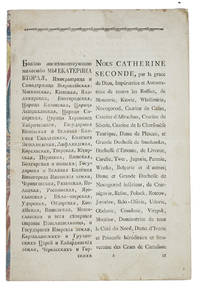
1790K1VF2DNXCCLTSt. Petersburg 1790. Folio. 30 x 20 and 29.5 x 20.5 cm. Imperial Printing Office Unsewn marbled paper spine ad 1; side stitched blue paper spine ad 2. With the text in Russian and French in parallel columns and with ornamental rules at the head of each page. 10; 20 pp. First and only editions of two peace treaties between Catherine the Great of Russia and Gustav III of Sweden which concluded the Russo-Swedish war of 1788-1790 each page with the Russian text in the left column and the French text in the right column. The Treaty of Värälä signed on 14 August 1790 though here dated 6 August by Catherine's representative Otto Heinrich Igelström and Gustav II's proxy Gustaf Mauritz Armfelt effectively restored the pre-war status quo and barred Russia from interferring in Swedish internal affairs which had been one of the reasons Gustav III a cousin of Catherine the Great declared war on Russia in 1788. After initial defeats Sweden was able to destroy nearly a third of the Russian fleet at sea. The second treaty signed on 19 October 1791 at Drottningholm outside of Stockholm established a close military alliance between Sweden and the Russian Empire with each power pledging active support and Catherine agreeing to pay Sweden annual subsidies. Since it was signed with a keen eye on the French Revolution the treaty can been seen as a predecessor to the war of the first coalition of 1792-1797 though neither Russia nor Sweden participated in the latter. Both are printed on Russian paper with cyrillic names and initials in the watermarks. Very good copies old horizontal crease first and last leaves lightly soiled.l KVK & WorldCat ads 1 & 2 SUB Göttingen ad 1 Ohio State ad 2 Strassbourg; not in Bitovt. unknown
1626elala1915Stockholm: Ignatius Meurer 1626. 1626. small 4to. ff. 8. woodcut arms on title. modern bds. lower & inner margin of title repaired. "Charter of the Swedish Söder Compagniet or South Company drafted by Willem Usselinx granting it commercial and navigational rights in 'Africa America and Magellanica'. Alden Desirous of securing for his country a share in the spoils of the New World King Gustavus of Sweden invited Usselinx chief organizer of the Dutch West India Company to establish a general trading company in Sweden in October of 1624. Shortly thereafter Usselinx's draft of the charter was prepared a prospectus for the company originally known as the 'Australian Company' was issued and royal assent was given. The Company played a fundamental role in the establishment of the colony of New Sweden in Delaware. Alden 626/130. Bell S823. Jameson 17. Sabin 98202. Winsor IV pp. 443-502. Hardcover. Very Good. Stockholm: Ignatius Meurer, 1626. Hardcover
1930252511930-1935 29 Aquarelles, gouaches collages et maquettes originales, 9 études à l'encre et à la mine de plomb et 48 éditions diverses, (1929-1935), in 8 et in 4.
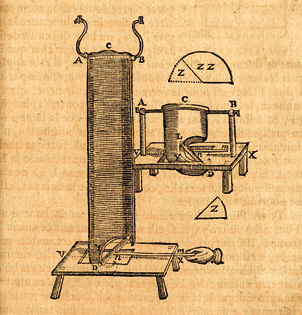
16676759Paris, Charles Angot, 1667, 3 tomes in-4 veau brun dos-à-nerfs très décoré et doré titre doré roulette sur les coupes tranche rouge (reliure de l'époque) ; (24) pp. y compris le titre, 540 pp., 47 figures. Lettres de Mr Descartes, où sont expliquées plusieurs belles difficultez touchant ses autres ouvrages. Nouvelle édition reveue et corrigée. Tome second. Paris, Charles Angot, 1666 ; (16), 564, (4) pp. et près d'une centaine de figures ou croquis. Lettres de Mr Descartes. Où il répond à plusieurs difficultez que luy ont esté proposées sur la Dioptrique, la Géométrie, et sur plusieurs autres sujets. Tome Troisième et dernier. Paris, Charles Angot, 1667 ; (24), 646 pp. et près de 180 figures ou croquis.
15582271Basieae, Ex officina Isingriniana, 1558. 1 vol. in-8 de [18]-907-[100] pages, plein vélin ancien, dos lisse. Etiquette de titre manquante.
17448781Paris, Piget; Durand, 1744. In-4 de [8]-238-[2] pages, plein veau marbré brun, dos à nerfs orné de filets et fleurons dorés, pièce de titre brune, tranches rouges.
1776008154London: Printed for J. Bew / Printed for the Author and Sold by B. Crosby 1776. "Memoirs of an Unfortunate Queen" published 1776 "Authentic Memoirs.Catherine II" published 1797. Each book RARE in its own right "Unfortunate Queen"last seen in Maggs Catalogue 1955 "Catherine II" last seen at auction in 1920 Rare Book Hub. 3 260 pp. vi 6 291 7 pp. Frontispiece engraved portrait of Caroline Matilda. Catherine II with half-title and title page. Very Good in early 19th c. quarter calf over marbled boards the back gilt with two stag decorations edges mottled boards rubbed interiors of both books exceptionally clean and bright. A unique and quite attractive book. . First Edition. Quarter Calf. Very Good/No Jacket As Issued. 12mo - over 6¾" - 7¾" tall. Printed for J. Bew / Printed for the Author and Sold by B. Crosby Hardcover books
90228aaf1799, in-8vo, cahier non relié de 20 ff. manuscrites, entre 20 et 22 lignes p.p., avec plusieurs ratures et corrections dans le texte, sur la première page, sous le titre est noté: „Ce projet de compte rendu et annoté de la main du Min. de la guerre Bernadotte en destin à ma soeur Mme Braeterhaffer(?)“. A l’intérieur on a collé une petite gravure montrant: le portrait de l’auteur (Gerard pinx -Fr. Bolt sc.).
In -4°, pp. 15, 1 tav.; legatura in carta decorata. L’autore era Membro dell’Accademia fisicomatematica di Giusto Ciampini, piccola accademia che rientrava nella protezione di Cristina di Svezia, della quale fu anche segretario. L’opera si presenta in forma di lettera indirizzata a Francesco Redi: nel trattato si discute dell’origine di una grave deformità alla nascita, in una dimensione ricollegabile più al campo, fortemente dibattuto all’epoca, della teoria della generazione. Nota di possesso manoscritta: “Francisci Mariae Campioni”, ecclesiastico ed erudito dell’epoca. Edizione originale. The author was a member of Accademia fisicomatematica di Giusto Ciampini, a small roman academy put under the protection of Christina Queen of Sweden, academy that he was also secretary of. This work is posed as a letter to Francesco Redi: the heavy anatomical aberration of a newborn is discussed, in a optic strictly linked to the field, widely discussed at time, of the generation theory. An ownership inscription under the title page: “Francisci Mariae Campioni”, who was a contemporary ecclesiastic and scholar. Original edition.
180117080Brunswick P. F. Fauche et Cie 1801 -in-8 demi-veau 4 tomes reliés en 2 volumes, reliure demi-veau havane in-octavo à coins (binding half calfskin in-octavo) (13 x 20,2 cm), reliure d'époque, dos long (spine without raised band), décoration or (gilt decoration) à double filets or (gilt lines) , pièce de titre sur fond bordeaux avec double filets or (label of title with double gilt line) et pièce de tomaison sur fond vert foncé avec double filets or (label of volume numbering with double gilt line), papier fantaisie jaune d'époque aux plats (cover with imagination paper), toutes tranches lisses (all smooth edges), EX-LIBRIS aquarellé en couleurs en 2ème de couverture du tome 2 : aux armes des Bougrenet de La Tocnaye portant :"d'or au lion de gueule chargé de mâcles d'or ", orné de 5 gravures hors-texte en noir (dont trois dépliante ) pour "PROMENADE D'UN FRANCAIS DANS L'IRLANDE", les autres récits ne sont pas illustrés, 273 pages pour "PROMENADE D'UN FRANCAIS DANS LA GRANDE-BRETAGNE" , IV-357 pages pour "PROMENADE D'UN FRANCAIS DANS L'IRLANDE", (XIV + 280) + ( II + 310 ) Pages, 1801 Brunswick P. F. Fauche et Cie Editeurs,
10040S.l., s.n., s.d. [vers 1700]. Recueil in-folio de 8 planches gravées en taille douce, non chiffrées sous couverture d'attente muette. Très pâle mouillure en fond atteignant les 4 dernières planches. 1 pli renforcé au verso de la planche du Cortège.
17853860Aus dem Schwedischen übersetzt von Johann Gottlieb Georgi. 2 Bände. Mit 2 gest. Tafeln. Berlin, Haude & Spener, 1785. 8vo. (20,2 x 11,2 cm). 1: XVI, 512 S. 2: 4 Bll., 456 S., 19 Bll. Register. Gesprenkelte Kalblederbände d. Zt. mit etwas Rückenvergoldung u. grünem Lederrückenschild.
1776008154London: Printed for J. Bew / Printed for the Author and Sold by B. Crosby 1776. Book. Very Good. Hardcover. First Edition. 12mo - over 6¾" - 7¾" tall. "Memoirs of an Unfortunate Queen" published 1776 "Authentic Memoirs.Catherine II" published 1797. Each book RARE in its own right "Unfortunate Queen"last seen in Maggs Catalogue 1955 "Catherine II" last seen at auction in 1920 Rare Book Hub. 3 260 pp. vi 6 291 7 pp. Frontispiece engraved portrait of Caroline Matilda. Catherine II with half-title and title page. Very Good in early 19th c. quarter calf over marbled boards the back gilt with two stag decorations edges mottled boards rubbed interiors of both books exceptionally clean and bright. A unique and quite attractive book. Printed for J. Bew / Printed for the Author and Sold by B. Crosby Hardcover
197464046Moderna museet. As New. 1974. Paperback. 9171000496 . FREE UPGRADE to Courier/Priority Shipping Upon Request IN STOCK AND IMMEDIATELY AVAILABLE FOR SHIPMENT - AS NEW THE TEXT BLOCK IS PRISTINE CLEAN UNMARKED AND IN EXCELLENT CONDITION - - Text in Swedish. 64 pp. With 57 text ills. 12 col. tipped in. 23 x 19 cm. -- with a bonus offer-- . [Moderna museet] paperback
197059584Stockholm Sweden: Aartsbisschoppelijk Museum. As New. 1970. Paperback. FREE UPGRADE to Courier/Priority Shipping Upon Request IN STOCK AND IMMEDIATELY AVAILABLE FOR SHIPMENT - AS NEW THE TEXT BLOCK IS PRISTINE CLEAN UNMARKED AND IN EXCELLENT CONDITION - - Text in Swedish with portions in English as well. 96 pp. With 32 ills. 21 x 12 cm. -- with a bonus offer-- . Aartsbisschoppelijk Museum paperback
200650947Stockholm Sweden: Bukowskis. New. 2006. Paperback. FREE UPGRADE to Courier/Priority Shipping Upon Request IN STOCK AND IMMEDIATELY AVAILABLE FOR SHIPMENT - Flawless copy brand new pristine never opened - More than 1700 lots many illustrated in color. Sale includes paintings including Swedish and Russian paintings furniture carpets glass European and Oriental ceramics and more. Among the artists represented: Burliuk Jongkind Millet P. M. Mönstad Anders Zorn and others. -- with a bonus offer-- . Bukowskis paperback
200650679Sweden: Bukowskis. New. 2006. Paperback. FREE UPGRADE to Courier/Priority Shipping Upon Request IN STOCK AND IMMEDIATELY AVAILABLE FOR SHIPMENT - Brand new copy text unmarked and tight to binding - Text in Swedish. 1363 lots many color illustrations. Includes paintings prints contemporary art silver jewelry design carpets glass ceramics Svenskt Tenn furniture and more. -- with a bonus offer-- . Bukowskis paperback
201297752Rizzoli. New. 2012. Paperback. 0847837599 . FREE UPGRADE to Courier/Priority Shipping Upon Request - IN STOCK AND IMMEDIATELY AVAILABLE FOR SHIPMENT - Flawless copy brand new pristine never opened -- 320 pp. ; 738 color illustrations. -- with a bonus offer-- . Rizzoli paperback
196993405Stockholm Sweden: Moderna Museet. As New. 1969. Paperback. FREE UPGRADE to Courier/Priority Shipping Upon Request - IN STOCK AND IMMEDIATELY AVAILABLE FOR SHIPMENT - AS NEW THE TEXT BLOCK IS PRISTINE CLEAN UNMARKED AND IN EXCELLENT CONDITION - - Text in Swedish and English. 150 pp. With 126 ills. 26 x 20 cm. -- with a bonus offer-- . Moderna Museet paperback
196959109Stockholm Sweden: Moderna Museet. As New. 1969. Paperback. FREE UPGRADE to Courier/Priority Shipping Upon Request IN STOCK AND IMMEDIATELY AVAILABLE FOR SHIPMENT - AS NEW THE TEXT BLOCK IS PRISTINE CLEAN UNMARKED AND IN EXCELLENT CONDITION - - Text in French and Swedish. 80 pp. With 98 ills. 26 x 20 cm. -- with a bonus offer-- . Moderna Museet paperback
196558822Stockholm Sweden: Moderna Museet. As New. 1965. Paperback. FREE UPGRADE to Courier/Priority Shipping Upon Request IN STOCK AND IMMEDIATELY AVAILABLE FOR SHIPMENT - AS NEW THE TEXT BLOCK IS PRISTINE CLEAN UNMARKED AND IN EXCELLENT CONDITION - - Text in Swedish. 96 pp. With 62 ills. 26 col. . 26 x 19 cm. -- with a bonus offer-- . Moderna Museet paperback