174 résultats
1958BOOKS210176Moscow-Leningrad USSR. G/NO DUSTJACKET. 1958. Cloth Hardcover. In Russian. . 8vo. 244 Corners slightly rubbed pages slightly yellowed. . hardcover
1958000227Moscow: Gosfinizdat 1958. Hardcover. Very Good. Oblong 8vo; original paper-covered boards; cloth spine; pp. 2 90 2; one of 5000 copies. The data is in the form of statistical tables. Foredge of covers and corners rubbed; slight darkening to outer margin of boards; pages clean. During Communism the governments in the Eastern Bloc often printed similar materials in order to justify their spending as well as to keep up the moral of the masses. OCLC lists only one copy at the National Library of Israel. Moscow: Gosfinizdat hardcover
194262487Moscow: Foreign Languages Publishing House 1942. 1st edition. Nice Copy. small octavo. wrappers 51pp. Included are speeches by 10 Deputies to the Soviet inc. those from Latvia Lithuania Estonia Ukraine & Belorussia. Some light spotting o/w a nice copy. Scarce Foreign Languages Publishing House unknown
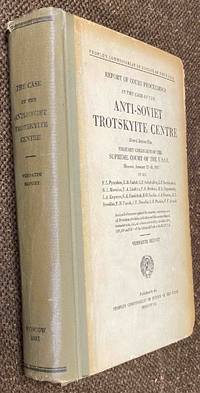
1937R68519Moscow: People's Commissariat of Justice of the U.S.S.R. 1937. 1st edition. Very Good. octavo. orig. boards vi 580pp. Heard before the Military Collegium of the Supreme Court of the U.S.S.R.Moscow January 23-30 1937. Verbatim Report People's Commissariat of Justice of the U.S.S.R. hardcover
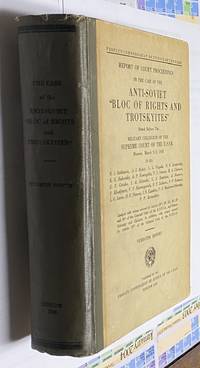
1938R68520Moscow: People's Commissariat of Justice of the U.S.S.R. 1938. 1st edition. Very Good. octavo. orig. boards 799pp. Heard before the Military Collegium of the Supreme Court of the U.S.S.R.Moscow March 2-13 1938. Verbatim Report People's Commissariat of Justice of the U.S.S.R. hardcover
1938986G50Moscow: People's Commissariat of Justice of the U.S.S.R 1938. Cloth. Very Good. 9" by 6". Not Stated. A smart copy of the verbatim report of the Trial of the Twenty-One with a Russian title page. A smart copy of a verbatim report of what is known as the Trial of the Twenty-One.A trial which was the last of the three public Moscow trials charging prominent Bolsheviks with espionage and treason taking places towards the end of the Soviet Great Purge. The accused were tortured to extract confessions and publicly admitted their guilt during show trial.Most of the accused were convicted and sentenced to death with all charges considered fabricated except against the NKVD chief Genrikh Yagoda of poisoning Valerian Kuybyshev Vyacheslav Menzhinsky and Maxim Gorky despite these orders being given from Stalin himself. In quarter green cloth with a Russian title page. In quarter cloth. Externally very smart. Shelf wear to extremities. Odd mark to boards with fading to front board. Small stamp to rear paste down. Internally firmly bound. Pages are bright and clean. Very Good People's Commissariat of Justice of the U.S.S.R hardcover
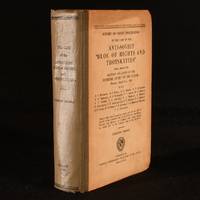
193780372Moscow: The People's Commissariat of Justice of the U.S.S.R. 1937. Presumed First Edition First printing thus. Hardcover. Fair. 22 cm. 8 580 pages. Cover very worn and soiled. Hindges weak. Edges rubbed and corners bumped. Some moisture staining at bottom all pages separate and text complete. This second purge trial involved 17 lesser figures including Karl Radek Yuri Pyatakov and Grigory Sokolnikov. Alexander Beloborodov was also arrested and intended to be tried along with Radek but did not make the confession required of him and so he was not produced in court. Thirteen of the defendants were eventually executed by shooting. The rest received sentences in labor camps. Radek was spared as he implicated others including Nikolai Bukharin Alexei Rykov and Marshal Mikhail Tukhachevsky setting the stage for the Trial of Military and Trial of the Twenty One. Radek provided the pretext for the purge on a massive scale with his testimony that there was a "third organization separate from the cadres which had passed through Trotsky's school" as well as "semi-Trotskyites quarter-Trotskyites one-eighth-Trotskyites people who helped us not knowing of the terrorist organization but sympathizing with us people who from liberalism from a Fronde against the Party gave us this help." By the third organization he meant the last remaining former opposition group called Rightists led by Bukharin. At the time many Western observers who attended the trials said that they were fair and that the guilt of the accused had been established. They based this assessment on the confessions of the accused which were given in open court without any apparent evidence that they had been tortured or drugged. The Moscow Trials were a series of show trials held in the Soviet Union at the instigation of Joseph Stalin between 1936 and 1938 against Trotskyists and members of Right Opposition of the Communist Party of the Soviet Union. There were three Moscow Trials: the Case of the Trotskyite-Zinovievite Terrorist Center Zinoviev-Kamenev Trial aka "Trial of the Sixteen" 1936 the Case of the Anti-Soviet Trotskyist Center Pyatakov-Radek Trial 1937 and the Case of the Anti-Soviet "Bloc of Rights and Trotskyites" Bukharin-Rykov Trial aka "Trial of the Twenty-One" 1938. The defendants of these were Old Bolshevik party leaders and top officials of the Soviet secret police. Most defendants were charged under Article 58 of the RSFSR Penal Code with conspiring with the Western powers to assassinate Stalin and other Soviet leaders dismember the Soviet Union and restore capitalism. The Moscow Trials led to the execution of many of the defendants. They are generally seen as part of Stalin's Great Purge an attempt to rid the party of current or prior oppositionists especially but not exclusively Trotskyists and any leading Bolshevik cadre from the time of the Russian Revolution or earlier who might even potentially become a figurehead for the growing discontent in the Soviet populace resulting from Stalin's mismanagement of the economy. Stalin's hasty industrialization during the period of the First Five Year Plan and the brutality of the forced agricultural collectivization had led to an acute economic and political crisis in 1928-33 a part of the global problem known as the Great Depression and to enormous suffering on the part of the Soviet workers and peasants. Stalin was acutely conscious of this fact and took steps to prevent it taking the form of an opposition inside the Communist Party of the Soviet Union to his increasingly totalitarian rule. The People's Commissariat of Justice of the U.S.S.R. hardcover
193721133Hardcover in cream white boards with black lettering and grey spine with black lettering Tight binding Unmarked text. Edge wear corners bumped This second purge trial involved 17 lesser figures including Karl Radek Yuri Pyatakov and Grigory Sokolnikov. Alexander Beloborodov was also arrested and intended to be tried along with Radek but did not make the confession required of him and so he was not produced in court. Thirteen of the defendants were eventually executed by shooting. The rest received sentences in labor camps. Radek was spared as he implicated others including Nikolai Bukharin Alexei Rykov and Marshal Mikhail Tukhachevsky setting the stage for the Trial of Military and Trial of the Twenty One. History USSR law Court Trail Execution 031423 The People's Commissariat of Justice of the U.S.S. R hardcover
1938040123Hardcover in cream white boards with black lettering and grey spine with black lettering. Tight binding Unmarked text. Edge wear corners bumped. People's Commissariat of Justice of the U.S.S. R hardcover
193858833Moscow: The People's Commissariat of Justice of the U.S.S.R. 1938. Presumed First Edition First printing thus. Hardcover. Fair. 22 cm. 7 799 1 pages. Errata slip at last page. Cover shows wear and soiling. Edges rubbed and corners bumped. The third show trial in March 1938 known as The Trial of the Twenty-One tied together all the loose threads from earlier trials. It included 21 defendants alleged to belong to the so-called "Bloc of Rightists and Trotskyites" It was now alleged that Bukharin and others had conspired to assassinate Lenin and Stalin numerous times after 1918 and had murdered Soviet writer Maxim Gorky by poison in 1936. The group also stood accused of espionage. Bukharin and others were claimed to have plotted the overthrow and territorial partition of the Soviet Union in collusion with agents of the German and Japanese governments among other preposterous charges. Even sympathetic observers who had stomached the earlier trials found it hard to swallow the new charges as they became ever more absurd and the purge had now expanded to include virtually every living Old Bolshevik leader except Stalin. Stalin also observed some of the trial in person from a hidden chamber in the courtroom. On the first day of the trial Krestinsky caused a sensation when he repudiated his written confession and pleaded not guilty to all the charges. However he changed his plea the next day after "special measures" which dislocated his left shoulder among other things. The Moscow Trials were a series of show trials held in the Soviet Union at the instigation of Joseph Stalin between 1936 and 1938 against Trotskyists and members of Right Opposition of the Communist Party of the Soviet Union. There were three Moscow Trials: the Case of the Trotskyite-Zinovievite Terrorist Center Zinoviev-Kamenev Trial aka "Trial of the Sixteen" 1936 the Case of the Anti-Soviet Trotskyist Center Pyatakov-Radek Trial 1937 and the Case of the Anti-Soviet "Bloc of Rights and Trotskyites" Bukharin-Rykov Trial aka "Trial of the Twenty-One" 1938. The defendants of these were Old Bolshevik party leaders and top officials of the Soviet secret police. Most defendants were charged under Article 58 of the RSFSR Penal Code with conspiring with the Western powers to assassinate Stalin and other Soviet leaders dismember the Soviet Union and restore capitalism. The Moscow Trials led to the execution of many of the defendants. They are generally seen as part of Stalin's Great Purge an attempt to rid the party of current or prior oppositionists especially but not exclusively Trotskyists and any leading Bolshevik cadre from the time of the Russian Revolution or earlier who might even potentially become a figurehead for the growing discontent in the Soviet populace resulting from Stalin's mismanagement of the economy. Stalin's hasty industrialization during the period of the First Five Year Plan and the brutality of the forced agricultural collectivization had led to an acute economic and political crisis in 1928-33 a part of the global problem known as the Great Depression and to enormous suffering on the part of the Soviet workers and peasants. Stalin was acutely conscious of this fact and took steps to prevent it taking the form of an opposition inside the Communist Party of the Soviet Union to his increasingly totalitarian rule. The People's Commissariat of Justice of the U.S.S.R. hardcover
1938004807Moscow Russia: Peoples Commissariat of Justice of the U.S.S.R. 1938. 800pp with errata sheet. Original verbatim english language transcript of the purge trial of Bukharin and several others. Board covers have some wear. First Edition. Hard Cover. Very Good/No Jacket Issued. 8vo - over 7¾" - 9¾" tall. Peoples Commissariat of Justice of the U.S.S.R. hardcover
55626Paris o. Vlg. 1935. 2° 15 S. zahlr. s/w Abb. Geh. Etw. gebrauchsspurig u. Umschlag min. randrissig sonst gutes Exemplar. = Russie d’aujourd’hui 3e année. Organ der “Amis de l’ U.R.S.S.» Mit einem Text v. J.-R. Bloch «L’armée rouge» u.a. Text frz. 010 Paris, o. Vlg., 1935 unknown
55628Paris o. Vlg. 1938. 2° 15 S. zahlr. s/w Abb. Geh. Titelbl. leicht fleckig sonst gutes Exemplar. Organ der “Amis de l’ U.R.S.S.» Mit einem Beitrag v. Jean Lurçat. Text frz. «Lénine à Paris». 010 Paris, o. Vlg., 1938 unknown
55629Paris o. Vlg. 1937. 2° 15 S. zahlr. s/w Abb. Geh. Min. gebrauchsspurig m. kl. Randrissen sonst gutes Exemplar. Organ der “Amis de l’ U.R.S.S.» Text frz. 010 Paris, o. Vlg., 1937 unknown
55623Paris o. Vlg. 1934. 2° 15 S. zahlr. s/w Abb. Geh. Rücken an Fuss u. Kapitale durchgerieben min. randrissig sonst gutes Exemplar. = Russie d’aujourd’hui 2e année. Organ der “Amis de l’ U.R.S.S.» Aus dem Inhalt: La merveilleuse transformation de l’Asie etc. Text frz. 010 Paris, o. Vlg., 1934 unknown
55624Paris o. Vlg. 1935. 2° 15 S. zahlr. s/w Abb. Geh. An Rücken min. gebräunt sonst tadell. = Russie d’aujourd’hui 3e année. Organ der “Amis de l’ U.R.S.S.» Text frz. 010 Paris, o. Vlg., 1935 unknown
55627Paris o. Vlg. 1938. 2° 15 S. zahlr. s/w Abb. Geh. Min. gebrauchsspurig sonst gutes Exemplar. Organ der “Amis de l’ U.R.S.S.» Aus dem Inhalt: Les vingt ans de l’armée rouge. Text frz. 010 Paris, o. Vlg., 1938 unknown
1972R62395Moscow: Progress Publishers 1972 . 1st edition. Fine. tall octavo. dust jacket 364pp. b/w pls. This collection of papers trace the striking progress achived by science in the USSR as a whole and in the individual Union republics. Progress Publishers unknown
1332930581.Gpaperback. Good. Access codes and supplements are not guaranteed with used items. May be an ex-library book. paperback
1938HALL094931Hardback. 1938. Verbatim Report. 685pp Moscow 1938. VG . hardcover
19352091502135500567Army Accounting College Research Department 1935. Soft Cover. Fine. Number of pages: 350 pages 93 pages Size: 16 x 22 cm Army Accounting College Research Department paperback
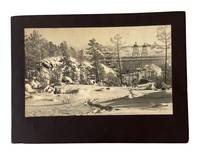
1955234761955. Bratskgesstroy photo album depicting construction of the Bratsk Hydroelectric Power Plant on the Angara River between 1955 and 1964 documenting one of the Soviet Union's largest postwar industrial projects during Nikita Khrushchev's campaign to industrialize Siberia. Construction began in 1955 at the Padun narrows north of Irkutsk where the Angara's rapids and elevation drop made the river suitable for massive hydroelectric generation. The first turbine entered service in November 1961 as the Bratsk reservoir began flooding thousands of square kilometers of forest and river settlements to create what Soviet publications called the "Bratsk Sea." By the mid-1960s the station had become the largest hydroelectric plant in the world supplying electricity to aluminum smelters timber combines rail electrification and new industrial cities across eastern Siberia.<br /> <br /> Photo album of approximately 17 large format professional silver gelatin photographs Bratsk and the Angara River region 1955-1964. large format photographs with Russian printed captions identify stages of construction including "Padun narrows" "Blocking the right bank of the Angara March 1957" "Installation of wires on the Irkutsk-Bratsk 220 kV transmission line" "Completion of the main concrete trestle" "Winter 1960-61" and "June 1963." Winter construction scenes show cranes rising above frozen riverbanks trucks dumping fill into rushing water during diversion work and workers fastening electrical insulators high above snow-covered terrain. Later images depict the completed spillway releasing torrents of water beneath rows of gantry cranes along with an interior control room lined with gauges switches meters and telephone communications equipment. Several leaves contain handwritten French tourism slips describing the visitor's experience moving through the region and observing ice electrical infrastructure and the completed dam landscape.<br /> <br /> The Bratsk project formed part of the Soviet Union's postwar eastward industrial expansion which sought to shift energy production and heavy industry deep into Siberia during the Cold War. The first turbine entered service in November 1961 as the Bratsk reservoir began flooding thousands of square kilometers of forest and river settlements to create what Soviet publications called the "Bratsk Sea." By the mid-1960s the station had become the largest hydroelectric plant in the world supplying electricity to aluminum smelters timber combines rail electrification and new industrial cities across eastern Siberia. Soviet newsreels propaganda posters and foreign delegations treated Bratsk as proof that the USSR could transform remote Siberian territory into a modern industrial frontier through centralized planning hydroelectric engineering and mass labor mobilization. Light wear occasional silvering and minor surface abrasions to several photographs; album binding intact. Overall in very good condition. unknown
1966217767Moskva: Izdatel'stvo ""Nauka"" 1966. First Edition. Hardback. Very good copy in the original title-blocked cloth. Spine bands and panel edges slightly dulled and dust-toned as with age. Remains particularly well-preserved overall; tight bright clean and strong.; 8vo 8"" - 9"" tall; 231 pages; Physical desc.: 231 p. 21 cm. Subject: Dictionaries -- USSR. Moskva: Izdatel'stvo ""Nauka"" hardcover
1966216995Moskva : Izdatel'stvo ""Nauka"" 1966. First Edition. Hardback. Very good copy in the original title-blocked cloth. Spine bands and panel edges slightly dulled and dust-toned as with age. Remains particularly well-preserved overall; tight bright clean and strong.; 8vo 8"" - 9"" tall; 231 pages; Physical desc.: 231 p. 27 cm. Subject: Dictionaries -- USSR -- 1918 - 1962. Moskva : Izdatel'stvo ""Nauka"" hardcover
1936187710Moscow : Soyuzorgouchet 1936. First Edition. Hardback. Very good copy in the original gilt-blocked cloth. Slight suggestion only of dust-dulling to the spine bands and panel edges. Remains particularly well-preserved overall; tight bright clean and strong.; 8vo 8"" - 9"" tall; 538 pages; Description: xvi 538 p. tables ; 26 cm. Subjects: Russia -- Soviet Union -- Statistics. Moscow : Soyuzorgouchet hardcover