143 résultats
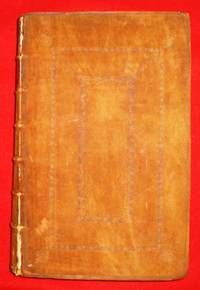
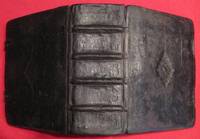
1615611London: Printed by Robert Barker 1615. Leather Bound. Very Good . 7 x 8 1/2 inches. 4to. B 10 leaves C-E in 8s. Lacks preliminaries. Begins with Communion. Griffiths 1615/4. Bound with: The Bible that is the Holy Scriptures conteined in the Old and New Testament translated according to the Ebrew and Greeke and conferred with the best translations in diuers languages; with most profitable annotations vpon all hard places and other things of great importance Geneva/Breeches version. London: Robert Barker 1615. Collates as 4 leaves of NT Preliminaries before BCP A-Hhh in 8s Iii 2 leaves Kkk-Yyy in 8s Zzz 10 leaves. General title lacking. Bible text complete with light dampstain throughout. A few pages with old ink marks or stains tears or repairs without loss of text. Top margin closely cropped on some pages. NT title page and preliminaries bound before BCP. Herbert 340/341. Bound with: Robert Herrey Two Right Profitable and Fruitfull Concordances or Large and Ample Tables Alphabeticall. London: Printed by Robert Barker 1615. 158 of 164 pages. Collates as A - I in 8s K 7 of 8 leaves. ESTCS122242. Bound with: Sternhold Thomas and John Hopkins The Whole Book of Psalms. Cambridge: John Field 1666. 34 pages with final blank. Lacks title page. Printed in unusual four column Roman type. Printing information from ESTCR17943. Prior owner's name John Adcock 1683 on endpapers in fancy script. Bound in full period brown leather with remnants of clasps and deep blindstamped central lozenges to covers. Professionally rebacked with original spine relaid new sewn headbands and new endpapers. The last Black Letter Geneva Bible in Quarto bound with a version of the 1552 English BCP. Printed by Robert Barker unknown
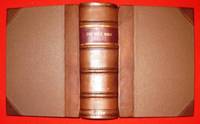
1633457London: Robert Barker and Assignes of John Bill 1633. Leather Bound. Very Good. 9 1/2 x 13 3/4 inches. Folio. 2 ffep A - b 4 leaf quires B - H 6 leaf quires I 4 leaf quire. Title page cropped and relaid with loss to imprint. Marginal loss to A3 not affecting text. Griffiths 1633/2. Bound with: The Holy Bible Containing the Old Testament and the New Authorised/KJV version. London: Robert Barker and Assignes of John Bill 1633. 10 327 numbered leaves OT 328-403 of 404 Apocrypha 406-507 NT. Engraved title to Bible closely cropped at fore-edge. Lower half of last leaf of preface A8 lacking. Folio 1 of OT with lower marginal loss affecting text. 163 with loss of lower quarter. Old repairs to marginal tears on a few pages. Occasional closed tear or marginal loss with no loss of text and minor soiling and old marking. Folio 108 misnumbered 118 117 as 61 148 as 184 152 as 154 216 as 215 224 as 223 225 as 226 232 as 231 233 as 237 234 as 238 235 as 246 then resuming at 236 as 240 due to the misfoliation noted in Herbert 249 as 242 302 as 281 379 as 378 392 as 372 452 as 470. The general title reflects the alteration of "1632" to "1633" noted in Herbert. NT colophon dated 1632. Herbert 466. Bound with: Sternhold Thomas and John Hopkins. The Whole Booke of Psalmes Collected into English Meeter. London: Printed by R. Badger for the Company of Stationers 1632. Title page 1 - 114 numbered pages 2 rfep. 35 and 36 misnumbered. ESTCS122383. All edges rouged. Marbled endpapers. Front pastedown with armorial bookplate of Thomas Whitmore and 1 ffep with 18th Century Whitmore family records. Bound in later Georgian full paneled reverse calf. Spine with six raised bands and red morocco spine label with gilt "Holy Bible" and border. Chipping to head and tail of spine and hinges starting. Rounding to corners with minimal loss. An excellent copy of the 1552 English BCP and KJV Bible. Normally found in quarto this much scarcer folio edition in a Georgian binding. Robert Barker and Assignes of John Bill unknown
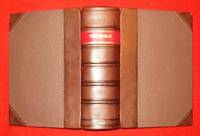
1629481London: Printed by Bonham Norton and John Bill 1629. 3/4 leather. Very Good. 7 x 8 3/4 inches. 4to. A2 - A6 B - H 8 leaf quires. Title page lacking. Printed in two column Roman type. Margins of first two signatures a little grubby with closed tears and a few pages with marginal losses affecting a few letters of text. Otherwise pages lightly soiled. G8 with closed tear and old repair with no loss of text. Griffiths 1629/4. ESTCS93878. Bound with: The Holy Bible contayning the Old Testament and the New: newly translated out of the original tongues: and with the former translations diligently compared and reuised by his Maiesties speciall commandement Authorised KJV version. London: Bonham Norton and John Bill 1629. 6 introductory material 32 numbered pages genealogies lacking 1 2 5-8 15-16 21-22. Printed in two column Roman type. Loss to lower quarter of pages 31 and 32. A - Ffff 8 leaf quires. Light soiling and close cropped but otherwise nice. P2 bound after P3. Lacks Cc2 Cc3 Bbb4 Bbb5 Ppp1 NT title Gggg1 and Gggg2. Marginal losses to Qq1 Qq8 Vu1 Ggg4 and Ppp9 affecting notes and minimally text. Loss to lower corner of Ii4 Ii5 Dddd7 and Dddd8 affecting small amount of text. Loss of lower 1/4 to Mm8. Herbert 425. ESTCS124382. Bound with: Sternhold Thomas and John Hopkins. The booke of Psalmes collected into English meeter. London: Imprinted for the Company of Stationers 1628: A - H 8 leaf quires. Lacks A1 and H8. Printed in two column Roman type. ESTCS4530. All page edges rouged. Bound in modern 3/4 brown calf with brown cloth. Five raised bands to spine with red morocco spine label with title and date to lower spine. A very good copy of the original 1552 English BCP bound with a Geneva/Breeches Bible and Psalms. A staple of many American colonists. Printed by B[onham] Norton and J[ohn] Bill unknown
1630482London: Printed by Robert Barker and the Assignes of John Bill 1630. 3/4 leather. Very Good. 7 x 9 inches. 4to. 84 of 92 pages. A 8 leaves B 10 leaves C - E 8 leaves. Printed in two column black letter. Lacks title page title page for The Whole Booke of Psalmes Collected into English meetre by Thomas Sternhold John Hopkins and others. . . dated 1600 bound before BCP and preliminaries. Griffiths 1630/7. ESTCS123192. Bound with: The Bible: translated according to the Ebrew and Greeke and conferred with the best translations in diuers languages. Geneva/Breeches version. London: Robert Barker 1602. 2 434 4 441 - 554 leaves. Printed in two column black letter. Title page with old tissue repairs to margin and lower portion of text. Closed tears to 335 and 462 loss to top corner of 9-11 32 324 and 392. Loss to bottom of 131 145 198 210 235 248 454 458 459 486 and 546 and to top half of 165. Lacks 50 G2 220 252 253 and 289. Several pages misnumbered. Herbert 269. ESTCS116971. Bound with: Herrey Robert. Two right profitable and fruitfull concordances or large and ample tables alphabeticall. London: Robert Barker 1602. 162 of 164 pages. Collates as A - K 8 leaf quires L2. Lacks K8. ESTCS102034. Compare ESTCS5161 signature of B4 under "it" of "habitation". An occasional light stain smudge or mark but generally clean. Bound in modern 3/4 dark brown calf with red spine label and five raised bands to spine. A very good copy of the original 1552 English BCP bound with a Geneva/Breeches Bible and Psalms. A staple of many American colonists. Printed by Robert Barker and the Assignes of John Bill unknown
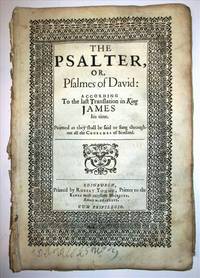
16362103Edinburgh: Printed by Robert Young 1636. First edition. Loose_leaf. Very Good. 7 1/2 x 10 3/4 inches. Small folio. Signatures: aa - kk in 8s. Edges ragged. Disbound. With the third state of 2H3 "he" at the end of the first line of the verso. 2K6 has the catchword "Certaine" and 2K7 and 2K8 are canceled as normal. See ESTCS113851 ESTCS101893. A very good reading copy of this first edition of Psalter accompanying the Scottish Book of Common Prayer printed the same year. Printed by Robert Young unknown
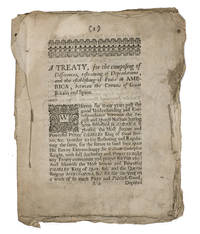
1670ABC_45696London 1670. Small 4to. in the Savoy printed by the assigns of John Bill and Christopher Barker = Thomas Newcombe printers to the Kings most excellent Majesty Sewn. With a woodcut factotum and decorative bands built up from typographic ornaments the crowned rose harp leak - depicted by a fleur-de-lis - and thistle representing England Ireland Wales and Scotland. 1 1 blank 11 1 pp. English translation of the Treaty of Madrid dated 1670 also called the Godolphin Treaty between England and Spain. Adopted in July 1670 and ratified on 28 September it officially ended the so-called Anglo-Spanish War 1654-1660 in the Caribbean. The open warfare between England and Spain caused by commercial rivalry had already ended in 1660 after six years of attacking each others commercial and colonial interests but the tension in the Caribbean caused conflict for ten more years. The war officially ended with two peace treaties signed at Madrid: the first dated 1667 and the present second dated 1670. The name Godolphin Treaty derives from William Godolphin 1635-1696 an English diplomat for Charles II and a member of Parliament. The negociations for this treaty between him and the Spanish representative Gaspar de Bracamonte Guzmán ca. 1595 - 1676 a Spanish statesman and count of Peñaranda who also played an important role in the famous Peace of Münster 1648 between France and the Holy Roman Empire started in the autumn of 1669. We can find those names at the end of the treaty.The present treaty was reprinted alone in 1698 printed by Charles Bill and the executrix of Thomas Newcomb deceasd printers to the Kings most Excellent Majesty ESTC R223888.Lacking A1 the title-page verso blank and the final blank leaf but otherwise complete so with no loss in the text of the treaty. Paper a little frayed around the edges first and last page a little dust-soiled but otherwise in good condition. The rare first edition of an important treaty for American history.l Chalmers A collection of treaties between Great Britain and other powers II 1790 pp. 34-40 naming an 1686 imprint; ESTC R35944; Sabin 96528 cf. 96527 for a Spanish edition; Wing C3616A; for Newcombe and the Kings printing office: C. William Miller In the Savoy: a study in post-Reformation imprints in: Papers of the Bibliogr. Soc. 1 1948/49 pp. 39-46 at pp. 42-43. unknown
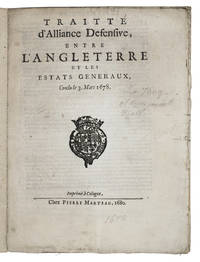
1680ABC_46098Cologne recté: Amsterdam 1680. 4to. Pierre Marteau" 19th-century brown paper wrappers. With the woodcut English royal arms on the title-page. 8 pp. Extremely rare pamphlet with the text - in French - of the Anglo-Dutch defensive alliance of 3 March 1678. In May 1672 French forces had invaded the Dutch Republic and initially seemed to have achieved an overwhelming victory the so-called Rampjaar 1672. England supported France in what became the Second Anglo-Dutch maritime war 1672-1674. By late July 1672 however the Dutch position had stabilized thanks to the new Stadholder Willem III. Concern about French gains led to the August 1673 Treaty of the Hague between the Republic Brandenburg-Prussia the Emperor Leopold and King Charles II of Spain; in early 1674 England and the Dutch made peace in the Treaty of Westminster. In November 1677 Willem III married his cousin Mary niece of King Charles II of England. In the meantime peace talks had begun in 1676 in Nijmegen resulting in an Anglo-Dutch defensive alliance concluded on the 3rd of March 1678 almost a half year before the treaty was signed in August. But English troops arrived in significant numbers only in late May allowing King Louis XIV to improve his negotiating position by capturing Ghent on the same day the alliance was concluded on 3 March.Untrimmed and with bolts unopened. In good condition.l Muller 7609; STCN 160843154 2 copies; not in Knuttel; VD17. unknown
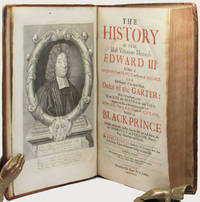
168834660Cambridge: Printed by John Hayes for the Author 1688. First Edition. Complete and illustrated with all five finely engraved folio portrait plates called for of Edward armoured and in various other poses the Prince of Wales-the Black Prince and the Author Joshua Barnes finely decorated six seven and ten-line initial letters and engraved devices title-page printed in red and black. Large Folio 14" x 9" bound in contemporary paneled calf the spine with raised bands over the cords tan morocco lettering label gilt ruled and lettered. xvi 911 pp. A handsome copy the text-block and engraved plates all very clean crisp and unpressed the binding very strong and solid some expected evidence of age the corners in good order the spine panel original the hinges sometime strengthened and sophisticated. FIRST EDITION OF THIS IMPORTANT BIOGRAPHY OF EDWARD III WITH FINELY ENGRAVED PLATES. Edward III 1312–1377 was King of England from January 1327 until his death in 1377. He is noted for his military success and for restoring royal authority after the disastrous and unorthodox reign of his father Edward II. Edward III transformed the Kingdom of England into one of the most formidable military powers in Europe. His fifty-year reign is one of the longest in English history and saw vital developments in legislation and government in particular the evolution of the English Parliament as well as the ravages of the Black Death. He outlived his eldest son Edward the Black Prince and was succeeded by his grandson Richard II.<br> Edward was crowned at age fourteen after his father was deposed. After a successful campaign in Scotland he declared himself rightful heir to the French throne starting the Hundred Years' War 1337–1453. Following some initial setbacks this first phase of the war went exceptionally well for England and would become known as the Edwardian War. Victories at Crécy and Poitiers led to the highly favourable Treaty of Brétigny 1360 in which England made territorial gains and Edward renounced his claim to the French throne. <br> Edward was temperamental and thought himself capable of feats such as healing by the royal touch as some prior English kings did. He was also capable of unusual clemency. He was in many ways a conventional medieval king whose main interest was warfare but he also had a broad range of non-military interests. Admired in his own time and for centuries after. modern historians credit him with significant achievements. <br> Complete copies of this great work on Edward are rare. Most lack all or some of the engraved plates or are rebound. Printed by John Hayes for the Author hardcover
1695565London: Printed for J. Wickins; and to be sold by the Booksellers of London and Westminster 1695. FIRST EDITION. Hardcover. Very good. Octavo. COLLATION: A-B4 C-F8 G-Q4 COMPLETE. 2 19-176 pp. Attractive half calf antique marbled boards red morocco label gilt compartments gilt with small tools. ¶ FIRST EDITION of this important collection of Parliamentary debates providing original and valuable documentation of the constitutional crisis that ensued during the Glorious Revolution of 1688. James II of England a.k.a. James VII of Scotland while fleeing to France dropped the Great Seal of the Realm into the Thames. In Parliament the question was discussed whether he had forfeited the throne or had abdicated. The present volume offers detailed arguments for the both but ultimately the latter designation was agreed upon and in a full assembly of the Lords and Commons it was resolved in spite of James's protest "that King James II having endeavored to subvert the constitution of the kingdom by breaking the original contract between king and people and by the advice of Jesuits and other wicked persons having violated the fundamental laws and having withdrawn himself out of this kingdom has abdicated the government and that the throne is thereby vacant." The Scottish parliament pronounced a decree of forfeiture and deposition. ¶ In our copy the imprint reads "and to be sold" in another issue the imprint reads "and sold". ¶ References: Wing 2nd ed. E1288A. ESTC R14958. Provenance: the Sunderland copy sale of the Bibliotheca Sunderlandiana Puttick & Simpson 1882 Fourth Portion lot 9338 -- subsequently in the Theological Institute of Connecticut now known as the Hartford Seminary with blindstamps. NB: in 1976 a collection of more than 200000 books from the Hartford Seminary Library were sold to Emory University including this one --> deaccessioned from Pitts Theology Library. Printed for J. Wickins; and to be sold by the Booksellers of London and Westminster hardcover
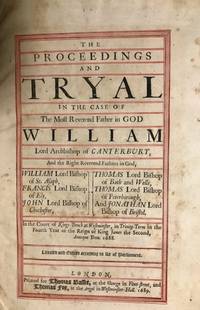
168935228London: Printed for Thomas Basset at the George in Fleet-Street and Thomas Fox at the Angel in Westminster-Hall 1689. First Edition. Full calf. Fair. Folio. 3 140 pages. MISSING THE ENGRAVED FRONTISPIECE Marbled calf leather binding with leather title label on the spine. Outer joints for both boards are cracked and the boards are loose but still attached. Text is outlined in red horizontal and vertical printed lines. Armorial bookplate of "Hans Sloane Stanley" located on the front paste down. Sir Jonathan Trelawny Bishop of Bristol William Lloyd Bishop of St. Asaph William Sancroft Bishop of Canterbury was three of the Bishops on trial for seditious libel under King James II. From wikipedia: <br /> <br /> Sir Jonathan Trelawny 3rd Baronet 24 March 1650 – 19 July 1721 was a British Bishop of Bristol Bishop of Exeter and Bishop of Winchester. Trelawny is best known for his role in the events leading up to the Glorious Revolution which are sometimes believed to be referenced in the Cornish anthem The Song of the Western Men. He was born at Trelawne in the parish of Pelynt Cornwall the eldest surviving son of Sir Jonathan Trelawny 2nd Baronet. He was educated at Westminster School and then went to Christ Church Oxford at the start of the Michaelmas term of 1668 where he distinguished himself as a scholar.<br /> A staunch royalist he was ordained in 1673 and became a beneficed clergyman. He was appointed rector of South Hill on 4 October and of St. Ives on 12 December 1677 becoming Bishop of Bristol in 1685. He was one of the Seven Bishops tried for seditious libel under James II. Trelawny and the other bishops petitioned against James II's Declaration of Indulgence in 1687 and 1688 granting religious tolerance to Catholics and as a result he was arrested and imprisoned in the Tower of London on charges of seditious libel. The bishops said that whilst they were loyal to King James II their consciences would not agree to allowing freedom of worship to Catholics even if it were to be within the privacy of their own homes as the Declaration proposed; thus they could not sign. Trelawny was held for three weeks before trial then tried and acquitted; this led to great celebrations with bells being rung in his home parish of Pelynt.1<br /> <br /> William Lloyd was born at Tilehurst in Berkshire in 1627 the son of Richard Lloyd then vicar1 who was the son of David Lloyd of Henblas Anglesey. By the age of eleven he had understanding in Greek and Latin and somewhat of Hebrew before attending Oriel and Jesus Colleges Oxford later becoming a Fellow of Jesus College.2 He graduated M.A. in 1646. In 1663 he was prebendary of Ripon in 1667 prebendary of Salisbury in 1668 archdeacon of Merioneth in 1672 dean of Bangor and prebendary of St Paul's London in 1680 bishop of St Asaph in 1689 lord-almoner in 1692 bishop of Lichfield and Coventry and in 1699 bishop of Worcester.3 As Bishop of Lichfield he rebuilt the diocesan residence at Eccleshall Castle which had been destroyed in the Civil War.4<br /> Lloyd was an indefatigable opponent of the Roman Catholic tendencies of James II of England and was one of the seven bishops who for refusing to have the Declaration of Indulgence read in his diocese was charged with publishing a seditious libel against the king.3 However he was acquitted in 1688 which was one of the events that lead to the fall of James II.citation needed<br /> He engaged Gilbert Burnet to write The History of the Reformation of the Church of England and provided him with much material. He was a good scholar and a keen student of biblical apocalyptic literature and himself "prophesied" to Anne Queen of Great Britain Robert Harley 1st Earl of Oxford and Mortimer William Whiston and John Evelyn the diarist. Lloyd was a staunch supporter of the Glorious Revolution.3<br /> He lived to the age of ninety-one and died at Hartlebury Castle on 30 August 1717. He was buried in the church of Fladbury near Evesham in Worcestershire of which his son was rector and where a monument is erected to his memory with a long inscription.5<br /> <br /> William Sancroft 30 January 1617 – 24 November 1693 was the 79th Archbishop of Canterbury2 and was one of the Seven Bishops imprisoned in 1688 for seditious libel against King James II over his opposition to the king's Declaration of Indulgence. Deprived of his office in 1690 for refusing to swear allegiance to William and Mary he later enabled and supported the consecration of new nonjuring bishops leading to the nonjuring schism. Printed for Thomas Basset, at the George in Fleet-Street, and Thomas Fox, at the Angel in Westminster-Hall unknown
165024224Ohne Ort, ohne Drucker, 1650. Kl.-8°. Mit gest. Frontispiz u. illustr. Kupfertitel. 1 Bl., 931 S., 1 weißes Bl., Pgmt. d. Zt. m. durchzogenen Bünden, handschriftl. Rückentitel u. dreiseitigem Rotschnitt.
168940603Hamburg, Zu bekommen im gülden A,B,C. bey der Börse, (1689). 4°. 8 nn. Bll., Geheftet.
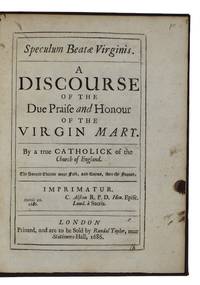
1686AQ29729London: Printed and are to be Sold by Randal Taylor 1686. 6 42pp. ESTC R18597 Wing H1870. Bound with: ON OF THE ROMAN COMMUNION i.e. WIDENFELDT Adam. Wholsome advices from the Blessed Virgin to her Indiscreet Worshippers. London. Printed for Randal Tayler 1687. First edition. 20 20pp. With an initial imprimatur leaf. ESTC R18760 Wing W2090A. Quarto. Modern brown cloth. Bookplate of Eric Gerald Stanley to FEP very occasional ink-spotting. Two devotional works dedicated to the sanctity of the Virgin Mary; the first a revised edition of a pamphlet by Bishop of the nonjuring Church of England and antiquary George Hickes 1642-1715; the second the sole edition of an English translation of Adam Widenfeldt's 1617/18-1678 controversial Jansenist monograph Monita salutaria B. V. Mariae ad cultores suos indiscretos. From the recently dispersed library of Eric Gerald Stanley 1923-2018 scholar of Old English literature Rawlinson and Bosworth Professor of Anglo-Saxon at the University of Oxford. . Second edition. Printed, and are to be Sold by Randal Taylor hardcover
168112602London, William Crooke, um 1681. Kupferstich. Blattgröße = Druckspiegel: 11,4 x 6,8 cm.
169511229Amsterdam, Heinrich Wetstein, 1695. 16° (10-15 cm). 302 S., 3 Bll. Ganzleder der Zeit über vier Bünden mit goldgeprägter Rückenverzierung und montiertem Rückenschild
1700115587ca. 1700. Plattengröße: 315 x 182 mm (und kleiner Rand).
1689703549Genf, Duiller, 1689. 5 Bl., 194 S., 4 Bl., 272(recte 172) S., 2 Bl.,3 Bl., 276, 240S. Folio. Blindgeprägter Pergamentband der Zeit auf 6 Bünden. Papier teils gebräunt. Im unteren Rand schwach wasserrandig. Die Seitennummerierung fehlerhaft aber in sich stimmig. Gute Gesamterhaltung.
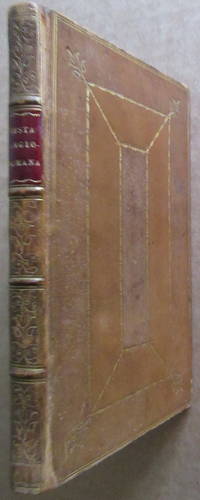
1678082226United Kingdom: Willam Jacob . 136 pages. Full leather - wear around edge of spine leather etc. Name on title page small old and in ink. Light browning to title page very minor. Small size 15cm x 9 cm slim book in decorative leather. See image from Winghale Books. Festa Anglo-Romana Or the Feasts of the English and Roman Church with Their Fasts and Vigils Being an Exact and Concise Accompt of Their Various Etymologies and Appellations with the Reasons and Grounds of Their Celebration - this is the William Jacob 1678 edition. . Good. Hardcover. 1678. Willam Jacob hardcover
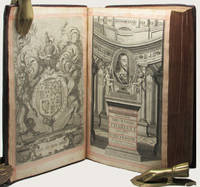
166234668<p>London: Printed by James Flesher for R. Royston Book-seller to His most Sacred Majesty. 1662; 1662. 2 volumes bound in one. First Edition. Illustrated with superb folio plates engraved on copper a frontispiece "Dieu et Mon Droit" depicting the Royal Coat of Arms and engraved illustrated title-page a double-page illustration showing Charles and the ship of state another double-plate showing the 'Bramble speaking to the Trees' and another double-page plate of the Cedar showing the apostolic delineations a final plate showing the Earl of Clarendon the engravings and title-pages throughout bordered with double and triple-ruling in red collated complete. Large Thick Folio 14" x 9.25" handsomely bound in the original contempoaray polished speckled calf the spine with raised bands over cords double ruled in gilt red morocco lettering label bgilt central gilt ornamental devices in the compartments. 2 frontispiece and engraved title xii 120 2 458 2; viii 733 4 Table plates pp. An unusually fine survival still retaining its original binding. The text-block and illustrations all crisp and clean and unpressed the binding still strong and in a a very pleasing state of preservation. An especially pleasing copy. FIRST EDITION OF THE MOST COMPLETE OF ALL WORKS ON KING CHARLES I OF ENGLAND AND THE KINGDOM. Charles I 1600 – 1649 was King of England Scotland and Ireland from 27 March 1625 until his execution in 1649.<br />Charles was born into the House of Stuart as the second son of King James VI of Scotland. After his father inherited the English throne in 1603 he moved to England where he spent much of the rest of his life. He became heir apparent to the kingdoms of England Scotland and Ireland in 1612 upon the death of his elder brother Henry Frederick Prince of Wales.<br />After his accession in 1625 Charles quarreled with the English Parliament which sought to curb his royal prerogative. He believed in the divine right of kings and was determined to govern according to his own conscience. Many of his subjects opposed his policies in particular the levying of taxes without Parliamentary consent and perceived his actions as those of a tyrannical absolute monarch. His religious policies coupled with his marriage to a Catholic generated antipathy and mistrust from Reformed religious groups such as the English Puritans and Scottish Covenanters who thought his views too Catholic. He supported high church Anglican ecclesiastics and failed to aid continental Protestant forces successfully during the Thirty Years' War. His attempts to force the Church of Scotland to adopt high Anglican practices led to the Bishops' Wars strengthened the position of the English and Scottish parliaments and helped precipitate his own downfall.<br />From 1642 Charles fought the armies of the English and Scottish parliaments in the English Civil War. After his defeat in 1645 at the hands of the Parliamentarian New Model Army he fled north from his base at Oxford. Charles surrendered to a Scottish force and after lengthy negotiations between the English and Scottish parliaments was handed over to the Long Parliament in London. Charles refused to accept his captors' demands for a constitutional monarchy and temporarily escaped captivity in November 1647. Re-imprisoned on the Isle of Wight he forged an alliance with Scotland but by the end of 1648 the New Model Army had consolidated its control over England. Charles was tried convicted and executed for high treason in January 1649. The monarchy was abolished and the Commonwealth of England was established as a republic. The monarchy was restored in 1660 with Charles's son Charles II as king.<br />Archbishop William Laud whom Parliament beheaded during the war called Charles a "mild and gracious prince who knew not how to be or how to be made great." Charles was more sober and refined than his father but he was intransigent. He deliberately pursued unpopular policies that brought ruin on himself. Both Charles and James were advocates of the divine right of kings but while James's ambitions concerning absolute prerogative were tempered by compromise and consensus with his subjects Charles believed he had no need to compromise or even to explain his actions. He thought he was answerable only to God. "Princes are not bound to give account of their actions" he wrote "but to God alone". wiki</p> Printed by James Flesher for R. Royston, Book-seller to His most Sacred Majesty. hardcover
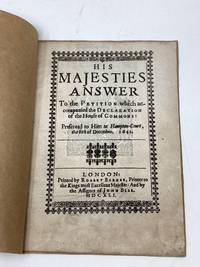
164180748London England: Robert Barker Printer to the KIng's Most Excellent Majestie and by the Assigns of John Bill 1641. Pamphlet. Very Good. Small 4to. pp ii12. Title within ornamental border Title vignette; head-piece; initially bound in mock-marbled paper wrapper. Royal arms on verso of title. Smal piece torn from upper margin of A4. Some stains. New marbled paper wrappers. His majesty was to put it mildly not pleased with the petition. Robert Barker (Printer to the KIng's Most Excellent Majestie) and by the Assigns of John Bill unknown