164 résultats
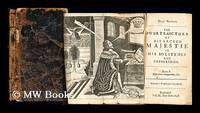
1695148477London.: W. Roberts 1695. 1st Edition . Hardcover. Very Good/No Jacket. 8vo - over 7¾" - 9¾" tall. 1695 & 1732 later full leather hardcover first work: xiv 1-104pp plus advertisment leaf. Second Work: viii 1-224pp plus advertisment leaf covers rubbed and a little chipped small tear with small loss to marginn of first title page without loss some internal browning otherwise very good. We are a real bookshop with real books situated in and shipping from the United Kingdom. Shelf B67. <br/> <br/> W. Roberts hardcover
1660MAIN024447ICambridge and Charlestown: Mitchell and Shepard. Good see notes. 1660. hardcover. hardcover. 8vo . 240 203pp . PLUS--> The Second Part of the Parable which begins with Chap. I: Of Carnal Security in Virgin Churches Scans available. Leather over thick boards. Significant 2" gouge to leather bottom rear foreedge corner corners through. Edgewear as you would expect. Hubbed spine with title label. Title page notes posthumously produced by Shepard's son and Jonathan Mitchell pastor at Cambridge with no date listed. In a box below it reports a printing in London 1660. Binding is holding together reasonably well but would benefit by some restorative measures. Paper is in quite nice condition but has rippling throughout as is common with books of this era. Have not had any luck to speak researching this though it does appear tp predate other copies by several decades. Calling this very scarce is more than fair. You know that wall at the Bodleian where all the books are chained up This could be on it. . Mitchell and Shepard hardcover
1648276357In R.M. 1648. First Edition Reprint. Softcover. Poor copy in the original stiff-card wrappers; wear and tear as with age. Missing back cover. Text remains in fine condition and without blemish. Physical description; 187 pages. Subjects; Charles I King of England 1600-1649. In R.M. paperback
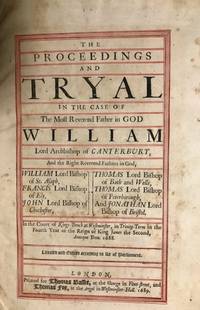
168935228London: Printed for Thomas Basset at the George in Fleet-Street and Thomas Fox at the Angel in Westminster-Hall 1689. First Edition. Full calf. Fair. Folio. 3 140 pages. MISSING THE ENGRAVED FRONTISPIECE Marbled calf leather binding with leather title label on the spine. Outer joints for both boards are cracked and the boards are loose but still attached. Text is outlined in red horizontal and vertical printed lines. Armorial bookplate of "Hans Sloane Stanley" located on the front paste down. Sir Jonathan Trelawny Bishop of Bristol William Lloyd Bishop of St. Asaph William Sancroft Bishop of Canterbury was three of the Bishops on trial for seditious libel under King James II. From wikipedia: <br /> <br /> Sir Jonathan Trelawny 3rd Baronet 24 March 1650 – 19 July 1721 was a British Bishop of Bristol Bishop of Exeter and Bishop of Winchester. Trelawny is best known for his role in the events leading up to the Glorious Revolution which are sometimes believed to be referenced in the Cornish anthem The Song of the Western Men. He was born at Trelawne in the parish of Pelynt Cornwall the eldest surviving son of Sir Jonathan Trelawny 2nd Baronet. He was educated at Westminster School and then went to Christ Church Oxford at the start of the Michaelmas term of 1668 where he distinguished himself as a scholar.<br /> A staunch royalist he was ordained in 1673 and became a beneficed clergyman. He was appointed rector of South Hill on 4 October and of St. Ives on 12 December 1677 becoming Bishop of Bristol in 1685. He was one of the Seven Bishops tried for seditious libel under James II. Trelawny and the other bishops petitioned against James II's Declaration of Indulgence in 1687 and 1688 granting religious tolerance to Catholics and as a result he was arrested and imprisoned in the Tower of London on charges of seditious libel. The bishops said that whilst they were loyal to King James II their consciences would not agree to allowing freedom of worship to Catholics even if it were to be within the privacy of their own homes as the Declaration proposed; thus they could not sign. Trelawny was held for three weeks before trial then tried and acquitted; this led to great celebrations with bells being rung in his home parish of Pelynt.1<br /> <br /> William Lloyd was born at Tilehurst in Berkshire in 1627 the son of Richard Lloyd then vicar1 who was the son of David Lloyd of Henblas Anglesey. By the age of eleven he had understanding in Greek and Latin and somewhat of Hebrew before attending Oriel and Jesus Colleges Oxford later becoming a Fellow of Jesus College.2 He graduated M.A. in 1646. In 1663 he was prebendary of Ripon in 1667 prebendary of Salisbury in 1668 archdeacon of Merioneth in 1672 dean of Bangor and prebendary of St Paul's London in 1680 bishop of St Asaph in 1689 lord-almoner in 1692 bishop of Lichfield and Coventry and in 1699 bishop of Worcester.3 As Bishop of Lichfield he rebuilt the diocesan residence at Eccleshall Castle which had been destroyed in the Civil War.4<br /> Lloyd was an indefatigable opponent of the Roman Catholic tendencies of James II of England and was one of the seven bishops who for refusing to have the Declaration of Indulgence read in his diocese was charged with publishing a seditious libel against the king.3 However he was acquitted in 1688 which was one of the events that lead to the fall of James II.citation needed<br /> He engaged Gilbert Burnet to write The History of the Reformation of the Church of England and provided him with much material. He was a good scholar and a keen student of biblical apocalyptic literature and himself "prophesied" to Anne Queen of Great Britain Robert Harley 1st Earl of Oxford and Mortimer William Whiston and John Evelyn the diarist. Lloyd was a staunch supporter of the Glorious Revolution.3<br /> He lived to the age of ninety-one and died at Hartlebury Castle on 30 August 1717. He was buried in the church of Fladbury near Evesham in Worcestershire of which his son was rector and where a monument is erected to his memory with a long inscription.5<br /> <br /> William Sancroft 30 January 1617 – 24 November 1693 was the 79th Archbishop of Canterbury2 and was one of the Seven Bishops imprisoned in 1688 for seditious libel against King James II over his opposition to the king's Declaration of Indulgence. Deprived of his office in 1690 for refusing to swear allegiance to William and Mary he later enabled and supported the consecration of new nonjuring bishops leading to the nonjuring schism. Printed for Thomas Basset, at the George in Fleet-Street, and Thomas Fox, at the Angel in Westminster-Hall unknown
16432402130023London :: Printed for Edward Husbands and are to be sold at his shop in the Middle Temple 1643. Paperback. Very Good. Rare English Civil War Pamphlet : includes letters from King Charles and Queen Henrietta and other Royalist figures concerning attempts to defeat Parliamentary forces and suppress the will of the English Parliament Rebound in modern cloth. 2 90 101-104 p. Wing R2446. London :: Printed for Edward Husbands, and are to be sold at his shop in the Middle Temple paperback
16531912300005London : Roger Daniel M. DC. LIII; E.C. Printed in the Year M. DC. LVIII 1653. Hardcover. Good. Bound in worn contemporary calf. Front hinge splitting. Rear board nearly detached. Collated: 2 93 2 375 pages. Toning to pages. Ruled in red. Wing B2469. Herbert 641 this copy bound without plates. General title dated 1658. The New Testament has separate title page dated 1653; register is continuous. Provenance: Wentworth Huyshe armorial bookplate. Huyshe 1847-1934 was a noted author historian journalist and actor. He converted to Roman Catholicism and settled in Chipping Campden. Signed by Huyshe in 1874. London : Roger Daniel, M. DC. LIII; E.C., Printed in the Year M. DC. LVIII hardcover
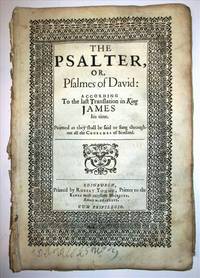
16362103Edinburgh: Printed by Robert Young 1636. First edition. Loose_leaf. Very Good. 7 1/2 x 10 3/4 inches. Small folio. Signatures: aa - kk in 8s. Edges ragged. Disbound. With the third state of 2H3 "he" at the end of the first line of the verso. 2K6 has the catchword "Certaine" and 2K7 and 2K8 are canceled as normal. See ESTCS113851 ESTCS101893. A very good reading copy of this first edition of Psalter accompanying the Scottish Book of Common Prayer printed the same year. Printed by Robert Young unknown
1682104802London, Printed for S. Mearne, 1682. Folio. (2), 11 pp. New marbled boards.
168112602London, William Crooke, um 1681. Kupferstich. Blattgröße = Druckspiegel: 11,4 x 6,8 cm.
166540968Cambridge: James Field 1665. 12mo 14.5 cm 5.75". 18 ff. 126 pp. 1 blank f. <br><br>also bound in Bible. Psalms. Greek. 1664. title-page in Greek romanized asPsalterion tou David. Kata tous Hevdomekonta. Cambridge: James Field 1664. 12mo. 1 f 171 1 blank pp. lacks blank leaf k6.<br>Â Â Â Â The mid-17th century was a low point in the history of English typography but in this pair of Anglican religious texts James Field printer to the University of Cambridge produced => a very good example of the printer's art of Greek printing especially in the use of a small point size. The guiding force behind their production was James Duport 160679 dean of Peterborough and master of Magdelene College Cambridge a noted scholar of Latin and Greek and supporter of the university press. The preface to the Book of Common Prayer is signed with his initials and it is established that he was the editor of the Psalms; the texts were almost certainly issued together but are also at times found individually in contemporary binding.<br>Â Â Â Â Field's minute typography here is dense and presented chiefly in double-column format in both works; and instead of woodcut head- or tailpieces and xylographic initials he deploys printer's ornaments to enliven the text at the top of some sections and occasionally elsewhere. => The layout is overall lovely and thoughtful and the printing is extremely clear and precise.<br>Â Â Â Â Binding: Contemporary morocco with covers framed in a single blind fillet; spine with gilt-stamped leather title-label and gilt-stamped compartment decorations. Marbled endpapers all edges gilt. => All pages ruled in red in the best style of the era.<br>Â Â Â Â Provenance: Isaac Watts 16741748 the godfather of English hymnody is also fondly remembered for his Psalms of David: Imitated in the Language of the New Testament a work that was reprinted over a thousand times. His ownership signature is on the blank leaf opposite the BCP title-page here. Later the volume was owned by Charles Mayo 17671858 a scholar of Old English who dated his ownership as "St. John's College Oxford 1787." Most recently in the library of American collector of Greek printing Albert A. Howard small booklabel "AHA" at rear. <br>Â Â Â Â <br>Â Â Â Â BCP: Benton Book of Common Prayer 2nd ed. p. 25 no. 122; ESTC R24205; Wing 2nd ed. B3632; Griffiths Bibliography of the Book of Common Prayer 453. Psalms: STC R204252; Wing 2nd ed. 1994 B2720A. Bound as above extremities a little rubbed with small chip at head of spine and edges of label chipped; joints strengthened some time ago and volume varnished. Inscriptions and small booklabel as above; pages gently age-toned otherwise clean. => A solid and attractive copy of an attractive production with wonderful provenance. James Field hardcover books
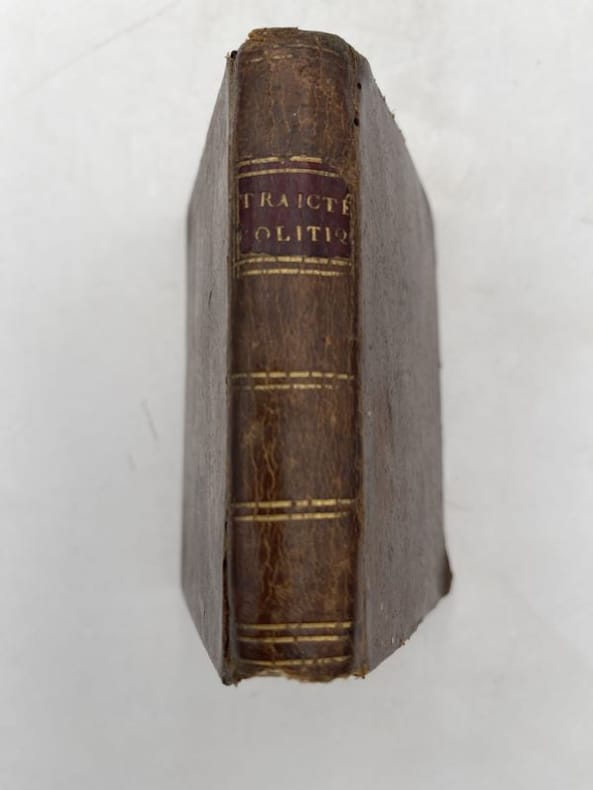
1658177113Lugduni Lugduni, 1658, en réalité Paris 1793. In-18 relié pleine basane brune, dos lisse à filets dorés, pièce de titre bordeaux. 172 pages, avec signet de tissu. Petits frottements à la reliure, coiffe présentant un petit manque de cuir, coiffe inférieure arasée, coins émoussés, petite galerie de vers en partie inférieure du mors du deuxième plat sur 2 cm. Tache brune en page de titre allant en s'estompant sur les suivantes jusqu'à ne plus être à partir de la page 30, texte à bonnes marges. Bibliographie : Brunet I/189-190. Ouvrage rare, portant une mention fausse d'édition, édité à Paris en 1793 pour ce pamphlet anglais contre Cromwell. William Allen ne serait qu'un pseudonyme.
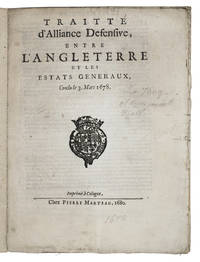
1680ABC_46098Cologne recté: Amsterdam 1680. 4to. Pierre Marteau" 19th-century brown paper wrappers. With the woodcut English royal arms on the title-page. 8 pp. Extremely rare pamphlet with the text - in French - of the Anglo-Dutch defensive alliance of 3 March 1678. In May 1672 French forces had invaded the Dutch Republic and initially seemed to have achieved an overwhelming victory the so-called Rampjaar 1672. England supported France in what became the Second Anglo-Dutch maritime war 1672-1674. By late July 1672 however the Dutch position had stabilized thanks to the new Stadholder Willem III. Concern about French gains led to the August 1673 Treaty of the Hague between the Republic Brandenburg-Prussia the Emperor Leopold and King Charles II of Spain; in early 1674 England and the Dutch made peace in the Treaty of Westminster. In November 1677 Willem III married his cousin Mary niece of King Charles II of England. In the meantime peace talks had begun in 1676 in Nijmegen resulting in an Anglo-Dutch defensive alliance concluded on the 3rd of March 1678 almost a half year before the treaty was signed in August. But English troops arrived in significant numbers only in late May allowing King Louis XIV to improve his negotiating position by capturing Ghent on the same day the alliance was concluded on 3 March.Untrimmed and with bolts unopened. In good condition.l Muller 7609; STCN 160843154 2 copies; not in Knuttel; VD17. unknown
16955822London c. 1695. Copper engraving 12.2 x 15 cms black and white blank verso. Map unknown
165043534Ohne Ort, um 1650. Oval ca. 12 x 9 cm, Blatt ca. 18 x 14 cm. 1 Blatt, verso Text. Aus "Theatrum Europaeum".