Germany Reichsministerium des InnernBiblio.com

14 résultats
1419ZB59123Berlin 1914-1937. 47 volumes lacking 1928 pt. 1 1931 pt. 2 1932 pt. 2 1933 pt. 2 1934 pt. 2 1st half if published minor ownership markings else good-very good. - If you are reading this this item is actually physically in our stock and ready for shipment once ordered. We are not bookjackers. Buyer is responsible for any additional duties taxes or fees required by recipient's country. Photos available upon request. Berlin unknown
1493591DGNürnberg, Anton Koberger, 1493. Kol. Holzschnitt. Blattgrösse: 45 x 62 cm. + Wichtig: Für unsere Kunden in der EU erfolgt der Versand alle 14 Tage verzollt ab Deutschland / Postbank-Konto in Deutschland vorhanden +
1493591DGNürnberg, Anton Koberger, 1493. Kol. Holzschnitt. Blattgrösse: 45 x 62 cm.
1496910392CGAugsburg:, J. Schönsperger, 1496. Holzschnitt 8,5 x 19 cm auf der vollen Blattseite.
14930005337Nuremberg Germany: Anton Koberger 1493. First edition. Very Good. Woodcuts by the Workshop of Michael Woldgemut & Wilhelm Pleydenwurff. Folio conjoined leaves measuring approximately 455mm by 320mm very minor breaks at fold minor soiling matted but not glazed or framed. <br/><br/>LIBER CHRONICARUM is the most famous travel book of the 15th century and the most exhaustively illustrated book of the incunable era. The complete work contains 1809 woodcuts of which only 29 are double-page town views:: these conjoined leaves is one of those 29 town views specifically "Colonia" i.e. Cologne Germany. The verso of leaf XCI is a half-page view of "Augusta" i.e. Augsburg Germany with descriptive text. Also smaller portraits of historical personages including Cleopatra Alexander the Great Herodias L. Pomponius Leoneus and M. Agrippa. et alios Notes: this is from the Latin edition. The German-language edition DAS BUCH DER CHRONIKEN has different woodblock portraits for Pomponius Leoneus and Agrippa. Also the view of Augsburg is only the left half of the scene which is one of the double-page views. Goff S-307; Hain - Cop 14508x; Klebs 889.1; Oates 1026; Procter 2084; BMC II 437 . Woodcuts by the Workshop of Michael Woldgemut & Wilhelm Pleydenwurff. Anton Koberger unknown
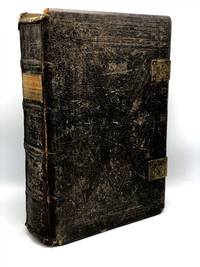
1474403583Strassburg: Johann Mentelin 1474. Folio 410 x 292 mm. Gothic types 3 columns 66 lines. Collation: the following gatherings all have stamped signatures a: a-i10 k l8 m10; stamped signatures b: 2a-d10 e81 f10 g-l10; stamped signatures c: 3a-h10 i12; stamped signatures d: 4a-h10 i8 k12. 415 leaves of 417 lacking preliminary and terminal blanks. 9-line initial "Q" in red and yellow on first page of text 7- to 8-line initials in red for each letter of the alphabet column headings in red in upper margin rubricated throughout. Approximately 50 leaves with mostly marginal tiny worm holes occasionally touching letters the last leaf with lower half renewed not affecting text a few leaves at end with skillful marginal repairs occasionally affecting signature. A LARGE COPY SCARCE IN A CONTEMPORARY BINDING <br/><br/>FIRST EDITION. Binding: Contemporary German dark brown calf over bevelled wooden boards sides with two broad double-fillet outer panels bounding a floral roll the central panels with intersecting double-filets forming diamonds and triangles each decorated within with roseate leaf quatrefoil stag and star tools the spine in five compartments with four double-corded raised bands 18th-century tan lettering-piece on spine in the second compartment brass clasps and catches printer's waste endpapers. Straps and hardware renewed probably when the label was added some overall wear old repairs to joints preserving original spine.<br/><br/>"The origins of the Latin biblical concordance must be sought in the thirteenth century at the Dominican convent of St. Jacques in Paris during a period when theologians felt urgent need for a compilation of all the uses of a particular scriptural word or phrase. Richard and Mary Rouse in their fundamental article 'The Verbal Concordance to the Scriptures' Archivum Fratrum Praedicatorum 44 1974 5-30 have shown that three attempts were then made to produce such a concordance all seemingly at St. Jacques. It was the third of these to which the name of Conrad of Halberstadt was later erroneously attached by Trithemius that won the day and obtained the largest diffusion. Over eighty manuscripts of this version survive the majority written in Paris between 1280 and 1330" Paul Meyvaert and Serge Lusignan review of Novae concordantiae Bibliorum Sacrorum iuxta vulgatam versionem by Bonifatius Fischer in: Speculum Vol. 56 No. 3 July 1981 pp. 611-613. <br/><br/>Johannes Mentelin had published the first printed Bible in German in 1466 and Nicolaus de Lyra's Postilla super totam Bibliam a commentary on the Bible in 1472. Of the approximately 40 works ascribed to his press the Concordantiae bibliorum is notable as "very peculiar in its method of signature and shows in an interesting manner the transitional period between the manuscript and printed methods of signing" William Blades "The Use & Development of Signatures in Books" in: Books in Chains and Other Bibliographical Papers 1892 pp. 110-112. The signatures mostly preserved in this copy are printed in the lower right corner. The text is divided in quarters and designated with stamped signatures "a" through "d". The copy in Leipzig UB has a rubricator's date of 1474 establishing the latest possible year of publication. <br/><br/>Scarce: Only two other copies have been offered at auction in the last 40 years: The Blades-St. Bride Foundation-Rattey copy sold Swann 15 April 2004 lot 45 now in the Scheide Library Princeton and the copy sold Christie's London 17 November 1976 lot 143. These were both rebound and we trace no copies in contemporary bindings on the market. ISTC lists only seven copies in North America: Brown; LoC; La Casa del Libro; Mrs. Alexander P. Rosenberg New York; The Morgan Library; Scheide Library Princeton; the Huntington Library; and Bridwell Library SMU. <br/><br/>References: Goff C849; BMC I 58; BSB-Ink C-497; GW 7418; H 5629. See VL V 189-91 at 189-90 and R. H. and M. A. Rouse "The Verbal Concordance to the Scriptures" Archivum Fratrum Praedicatorum 44 1974 5-30 at 19-20 and 25; also Kaeppeli I 276-83 no. 755 where it is ascribed to Conradus. <br/><br/> Johann Mentelin hardcover books
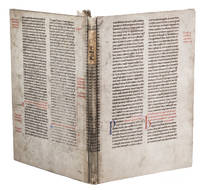
14869BDEHOBV62VDWürzburg: Georg Reyser 1486. Later bound in two leaves from a 13th-century vellum theological manuscript rubricated and decorated with alternating red and blue initials with penwork. Folio. Printed in red and black in rotunda type 32 lines; printed area: 18 x 12 cm; type: 112a. With illustrations cut from 19th- or 20th-century reproductions of early woodcuts ca. 21 x 14 cm pasted on the front Annunciation and back pastedown Christophorus with the year "cccc xx tercio". Interesting example of the study of early printing in 19th-century England. The 12 leaves come from the library of the 19th-century collector Dr C. Inglis whose father boasted an impressive collection of early printed books. Inglis believed that the leaves came from an unknown work titled De vita et honestate clericorum ex consilio Moguntinum printed in 1453 by Gerhardus Episcopus. Tipped in is a letter to Inglis by the well-known bibliographer William Blades discussing this matter. Although the text opens with "De Vita et honestate clericorum ex consilio Maguntinensis Gerhardi Archiepiscipi" it was in fact part of Statuta synodalia herbipolensia printed at Würzburg by Georg Reyser in ca. 1486. The first 6 leaves are 2-d7 and the final 6 leaves are quire g.With owner's inscription of Sir Edward Coates bookplate with initials "CC" Clifford Coates the bookplate of Dr. C. Inglis and some annotations on front pastedown; an autograph letter signed by Wiliam Blades to C. Inglis tipped to flyleaf. 12 well-preserved leaves.l Cf. BMC II 572; Goff S-741; Hain 15036; Hubay Inc. Universitätsbibl. Würzburg 1953; ISTC is00741000. Georg Reyser, hardcover
149614689Augsburg, Schönsperger, 1496. Ca. 8,5 cm x 19,5 cm (Bildfläche); ca. 39,5 cm x 27 cm (doppelte Buchseite).
149615115Augsburg, Schönsperger, 1496. Ca. 8,5 cm x 14 cm (Bildfläche); ca. 19 cm x 27 cm (ganze Buchseite).
149615323Augsburg, Schönsperger, 1496. Ca. 8,5 cm x 14 cm (Bildfläche); ca. 27 cm x 19 cm (ganze Buchseite).
149614429Augsburg, Schönsperger, 1496. Ca. 8,5 cm x 19 cm (Bildfläche); ca. 19 cm x 27 cm (Buchseite).
149615293Augsburg, Schönsperger, 1496. Ca. 8,5 cm x 19 cm (Bildfläche); ca. 27 cm x 19,5 cm (ganze Buchseite).
149615321Augsburg, Schönsperger, 1496. Ca. 10 cm x 19,5 cm (Bildfläche); ca. 27 cm x 20 cm (ganze Buchseite).
149614615Augsburg, Schönsperger, 1496. Ca. 8,5 cm x 19,5 cm (Bildfläche); ca. 19,5 cm x 27 cm(Buchseite).