MENDELSSOHNABAA

51 résultats
187034559Leipzig: Hermann Mendelssohn 1870. MENDELSSOHN BARTHOLDY Carl and Paul eds. Octavo. Dark tan leather-backed marbled boards raised bands on spine in decorative compartments gilt titling gilt. 1f. recto title verso blank 1f. part-title verso blank 3-597 i blank pp. With index. <br/><br/>Binding slightly worn rubbed and bumped; hinges split; free front endpaper detached. Foxed; edges browned; occcasional pencilling. Hermann Mendelssohn unknown books
1863000101Leipzig: Hermann Mendelssohn 1863. First Edition. Cloth. Very Good. 8vo - over 7¾. Book. 2 vols. vi 366 pp. vi 520 pp. both VG condition. Gilding on blindstamped cloth bindings bright. Some light and occasional foxing. Minor fraying by gutters. Both have neat cut out areas on yellow FFP like cut out of price tag. Mendelssohn was assiduous and literate letter writer during his brief not meaning a pun here life. Includes travel writing in Switzerland Italy etc. <br/><br/> Hermann Mendelssohn hardcover books
1899551Leipzig 1899. Hardcover. Very Good. 7th ed. In 2 parts one vol. Index. Marbled foredge. Cover slightly rubbed. Illus. with gilt cover & spine. Original binding. <br/><br/> hardcover books
186521430No Place Listed: No Publisher 1865. CDV photograph of a portrait of Jakob Ludwig Felix Mendelssohn Bartholdy 1809-1847 German composer pianist organist and conductor of the early Romantic period; no photographer or studio noted; no date circa 1865 albumen; approx. 4" x 2 1/2" overall size; light wear; old discoloration at top edge; dried paste-glue residue on back; old penciled identifier on front; good condition. Good. No Publisher unknown books
18623978London: Longman Green Longman and Roberts 1862. viii358pp. Nicely bound circa 1920 in polished red calf spine faded to brown over cloth. T.e.g. Inked ownership signature at top of title. Bookplate on front pastedown. Longman, Green, Longman, and Roberts hardcover books
1867124196London England: Longmans Green and Co 1867. Hardcover. Good Boards have pulled away from page; Binding intact; Some light foxing. Dark brown cloth; 437 pp.; BW frontispiece. Includes a catalogue of Mendelssohn's musical compilations compiled by Dr. Julius Rietz. Longmans, Green, and Co hardcover books
186534812Philadelphia: Frederick Leypoldt F.W. Christern 1865. Hardcover. Very Good. MENDELSSOHN BARTHOLDY Carl and Paul eds. 12mo. Full black cloth titling gilt to spine. vi 421 pp. With musical examples. Binding slightly worn; binder's handstamp to rear pastedown. Frederick Leypoldt, F.W. Christern hardcover books
186523714Philadelphia: Frederick Leypoldt 1865. 12mo. vi 421 1 pp. <br><br>Second American edition of this collection edited by Paul Mendelssohn Bartholdy and Dr. Carl Mendelssohn Bartholdy and translated by Lady Wallace. A catalogue of Mendelssohn's musical compositions compiled by Dr. Julius Rietz has been added. Publisher's olive textured cloth covers blind-stamped spine with gilt-stamped title; corners rubbed cloth torn at spine extremities. Front fly-leaf with inked inscription; half-title with bookseller's pressure-stamp. Frederick Leypoldt hardcover books
1867005891New York: S.T. Gordon 1867. First Edition. Cloth. Near Fine /No Dustjacket. volume one of 8 books a beautiful collection of some of the Lieder in a very sturdy brown cloth volume advertisments in the rear for numerous other classical titles clean throughout. S.T. Gordon unknown books
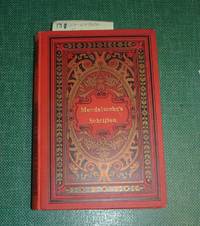
18921149626Breslau: Wilh. Jacobsohn & Co 1892. Neue Titelauflage. VG/no DJ Octavo in red cloth over boards with Victorian filigree and borders gilt lettering on spine. Ex libris name stamp on verso of portrait page. Minor shelf wear and bumping; text clean; 602 pp. Small florette wallpaper endpapers. Spider marbling on edges of text block. In exceptional condition. ---TEXT IN GERMAN. <p>Shelved upstairs in shelves near copier. 1149626. Rockville Non-Retail Listings. Wilh. Jacobsohn & Co unknown books
183018718Leipzig Paris: Frédéric Hofmeister Simon Richault PN 1515 1830. Folio. Unbound as issued. 9; 9; 9; 7 pp. Engraved. Title to viola part. <br/><br/>Some very light wear and soiling; two small binder's holes to inner blank margins. In very good condition overall. First Edition. Not in Krause. Mendelssohn Papers III 604. Hoboken 10 130. <br/><br/>"One of the most gifted and versatile prodigies Mendelssohn stood at the forefront of German music during the 1830s and 40s as conductor pianist organist and above all composer. His musical style fully developed before he was 20 drew upon a variety of influences including the complex chromatic counterpoint of Bach the formal clarity and gracefulness of Mozart and the dramatic power of Beethoven and Weber ." <br/><br/>" . Between 1827 and 1847 he composed six string quartets and had begun work on a seventh at the end of his life . The first two op. 13 in A minor 1827 and op. 12 in Eb 1829 show a rapprochement with the late quartets of Beethoven. To the Swedish musician Adolf Lindblad Mendelssohn explained his concern for the organic relationship of the various movements to the whole. In op. 12 the opening of the first movement is brought back to conclude the finale . " R. Larry Todd in Grove Music Online. Frédéric Hofmeister, Simon Richault [PN] 1515 unknown books
185036199Leipzig: Breitkopf & Härtel PN 4980 1850. Folio. Unbound as issued. 1 title 2 blank 3-13 i publisher's catalogue; 9 i blank; 10; 8 pp. Engraved.<br/><br/>The first page of the first violin part page 3 contains the song "Ist es Wahr" for voice and piano; the violin part begins on page 4.<br/><br/>Wrappers slightly worn. Minor stain to title. Re-issue of the first edition of 1830. MWV R22. Wehner p. 276. Not in Hoboken. Krause 177.<br/><br/>"One of the most gifted and versatile prodigies Mendelssohn stood at the forefront of German music during the 1830s and 40s as conductor pianist organist and above all composer. His musical style fully developed before he was 20 drew upon a variety of influences including the complex chromatic counterpoint of Bach the formal clarity and gracefulness of Mozart and the dramatic power of Beethoven and Weber . <br/><br/>. Between 1827 and 1847 he composed six string quartets and had begun work on a seventh at the end of his life. The first two op. 13 in A minor 1827 and op. 12 in Eb 1829 show a rapprochement with the late quartets of Beethoven. To the Swedish musician Adolf Lindblad Mendelssohn explained his concern for the organic relationship of the various movements to the whole . In op. 13 the quintessential thematic material is drawn from the lied Frage op. 9 no. 1 with explicit quotations from the song in the outer and more hidden references in the inner movements of the quartet." R. Larry Todd in Grove Music Online. Breitkopf & Härtel [PN 4980] unknown books
183028108Leipsic: Breitkopf & Härtel PN 4980 1830. Folio. Disbound. Violino 1: 1f. title 3 "Thema": song op. 9 no. 1 for voice and piano 4-13 i blank pp.; Violino 2: 9 i blank pp.; Viola: 10 pp.; Violoncello: 8 pp. Title lithographed; music engraved. <br/><br/>Somewhat soiled and foxed; dampstained and with binder's holes to inner margin; contemporary signature "Lemke" in ink trimmed and "2" in manuscript at upper right corner of title; "F. Mendelssohn" in ink in another hand to upper right corner of first page of each part. First Edition. MWV R22 p. 276. Hoboken 10 132 spelled "Quator" and with publisher's handstamp to title. <br/><br/>"One of the most gifted and versatile prodigies Mendelssohn stood at the forefront of German music during the 1830s and 40s as conductor pianist organist and above all composer. His musical style fully developed before he was 20 drew upon a variety of influences including the complex chromatic counterpoint of Bach the formal clarity and gracefulness of Mozart and the dramatic power of Beethoven and Weber." <br/><br/>". Between 1827 and 1847 he composed six string quartets and had begun work on a seventh at the end of his life. The first two op. 13 in A minor 1827 and op. 12 in Eb 1829 show a rapprochement with the late quartets of Beethoven. To the Swedish musician Adolf Lindblad Mendelssohn explained his concern for the organic relationship of the various movements to the whole. In op. 13 the quintessential thematic material is drawn from the lied Frage op. 9 no. 1 with explicit quotations from the song in the outer and more hidden references in the inner movements of the quartet." R. Larry Todd in Grove Music Online. Breitkopf & Härtel [PN 4980] unknown books
186036191Copenhague: Horneman & Erslev 1860. Folio. Disbound. 1 collective title listing within decorative lithographic border by Ch. M. Tegners 2-9 pp. Engraved. <br/><br/>Collective title lists 19 numbers by various composers.<br/><br/>Slightly browned and soiled. MWV U67.<br/><br/>"One of the most gifted and versatile prodigies Mendelssohn stood at the forefront of German music during the 1830s and 40s as conductor pianist organist and above all composer. His musical style fully developed before he was 20 drew upon a variety of influences including the complex chromatic counterpoint of Bach the formal clarity and gracefulness of Mozart and the dramatic power of Beethoven and Weber.<br/><br/>Mendelssohn's emergence into the first rank of 19th-century German composers coincided with efforts by music historiographers to develop the concept of a Classic-Romantic dialectic in 18th and 19th-century music. To a large degree his music reflects a fundamental tension between Classicism and Romanticism in the generation of German composers after Beethoven." R. Larry Todd in Grove Music Online. Horneman & Erslev unknown books
184035290Vienne: Pietro Mechetti qm Carlo PN P.M. No. 2133 1840. Small folio. Disbound. 1f. recto title verso blank 3-11 pp. Engraved.<br/><br/>Disbound. Slightly worn and soiled; browning to edges; light scattered foxing. Second German edition. MWV U 67 p. 312. Published before the "Neue rechtmässige Original-Ausgabe" published in 1854 Krause 212. Ward Jones III 381. <br/><br/>One of the most gifted and versatile prodigies Mendelssohn stood at the forefront of German music during the 1830s and 40s as conductor pianist organist and above all composer. His musical style fully developed before he was 20 drew upon a variety of influences including the complex chromatic counterpoint of Bach the formal clarity and gracefulness of Mozart and the dramatic power of Beethoven and Weber.<br/><br/>Mendelssohn's emergence into the first rank of 19th-century German composers coincided with efforts by music historiographers to develop the concept of a Classic-Romantic dialectic in 18th and 19th-century music. To a large degree his music reflects a fundamental tension between Classicism and Romanticism in the generation of German composers after Beethoven." R. Larry Todd in Grove Music Online. Pietro Mechetti qm Carlo [PN P.M. No. 2133] unknown books
183329636Bonn: N. Simrock PN 3045 1833. Folio. Unbound. <br/><br/>Violino 1mo: 1 title 2-13 i blank<br/>Violino 2do: 11 i blank<br/>Viola 1ma: 11 i blank<br/>Viola 2da: 11 i blank<br/>Violoncello: 11 i blank pp. <br/><br/>Engraved throughout. <br/><br/>Slightly worn and browned; binder's hole to upper inner margin; early manuscript initial "A" and the number "5" to first page of music of each part. First Edition. Scarce. Wehner p. 275. Catalogue of the Mendelssohn papers III 634. Hoboken 10 144. <br/><br/>"One of the most gifted and versatile prodigies Mendelssohn stood at the forefront of German music during the 1830s and 40s as conductor pianist organist and above all composer. His musical style fully developed before he was 20 drew upon a variety of influences including the complex chromatic counterpoint of Bach the formal clarity and gracefulness of Mozart and the dramatic power of Beethoven and Weber." <br/><br/>"Of the two string quintets the first op. 18 in A begins with a graceful Mozartian theme somewhat reminiscent of the Clarinet Quintet K581. The use of fugal writing and in the original minuet intricate double canons imbued the first version of this work with a severely academic quality; in 1832 Mendelssohn replaced the minuet with the emotionally charged Intermezzo in memory of Eduard Ritez." R. Larry Todd in Grove Music Online. N. Simrock [PN 3045] unknown books
183326802Bonn: N. Simrock PN 3041 1833. Folio. Disbound. 1 title 2-17 i blank pp. Engraved. <br/><br/>With overpaste of Magazyn van Muziek en Instrumenten von L. Plattner Rotterdam.<br/><br/>Signature "B. P. Manus" to upper right corner of title. Occasional fingering in pencil.<br/><br/>Slightly soiled and browned; minimally foxed; spine frayed; small stains to title; stain to lower margin of final blank page; signature very slightly trimmed. First German edition first issue. Rare. Wehner Sammeldruck 5 individual pieces listed as U86 U80 U89 U73 U90 U78. Not in the Catalogue of the Mendelssohn Papers in the Bodleian Library Vol. III. The first edition was published by Novello in London in 1832.<br/><br/>Two collections of works by Felix Mendelssohn-Bartholdy were published with this opus number by different publishers: the present Lieder ohne Worte and six songs published in Leipzig by Breitkopf & Härtel in 1833. Beginning with the complete edition by Rietz 1874-1877 scholarship has assigned "op. 19a" to the songs and "op. 19b" to the Lieder ohne Worte contradicting chronology. N. Simrock [PN 3041] unknown books
185035152Leipzig: Breitkopf & Härtel PN 5543 1850. Octavo. Dark ivory cloth-backed marbled boards with titling gilt to spine. 1f. recto title verso blank 52 pp. Engraved.<br/><br/>With small publisher's and Theune Amsterdam to foot of title. <br/><br/>Binding slightly worn. Minor internal wear browning soiling and foxing; contemporary signature illegible to blank upper margin of title. First Edition later issue. Wehner MWV P 7 p. 244; SD 10 pp. 472-3. Krause 141. Ward Jones III 401. Hoboken 10 167 first issue. <br/><br/>Mendelssohn began work on the Hebrides overture in August 1829 while on the west coast of Scotland. There he visited the famous Fingal's Cave in the Inner Hebrides named after the mythological Gaelic hero Fingal largely a creation of Scottish poet James Macpherson. Mendelssohn revised portions of the overture numerous times including the title. It was first performed as The Isles of Fingal by the Philharmonic Society in London 14 May 1832. Although Mendelssohn finally settled on Die Hebriden as the title the first editions were published as Fingals-Höhle.<br/><br/>One of the most gifted and versatile prodigies Mendelssohn stood at the forefront of German music during the 1830s and 40s as conductor pianist organist and above all composer. His musical style fully developed before he was 20 drew upon a variety of influences including the complex chromatic counterpoint of Bach the formal clarity and gracefulness of Mozart and the dramatic power of Beethoven and Weber.<br/><br/>Mendelssohn's emergence into the first rank of 19th-century German composers coincided with efforts by music historiographers to develop the concept of a Classic-Romantic dialectic in 18th and 19th-century music. To a large degree his music reflects a fundamental tension between Classicism and Romanticism in the generation of German composers after Beethoven." R. Larry Todd in Grove Music Online. Breitkopf & Härtel [PN 5543] unknown books
185536211Leipzig: Breitkopf & Härtel PNs 5668 5668a 1855. Folio. 1 title 2-31 i publisher's catalogue pp. Music engraved. <br/><br/>Disbound. Slightly worn soiled creased and stained; outer leaves detached. MWV SD11.<br/><br/>"One of the most gifted and versatile prodigies Mendelssohn stood at the forefront of German music during the 1830s and 40s as conductor pianist organist and above all composer. His musical style fully developed before he was 20 drew upon a variety of influences including the complex chromatic counterpoint of Bach the formal clarity and gracefulness of Mozart and the dramatic power of Beethoven and Weber.<br/><br/>Mendelssohn's emergence into the first rank of 19th-century German composers coincided with efforts by music historiographers to develop the concept of a Classic-Romantic dialectic in 18th and 19th-century music. To a large degree his music reflects a fundamental tension between Classicism and Romanticism in the generation of German composers after Beethoven." R. Larry Todd in Grove Music Online. Breitkopf & Härtel [PNs 5668, 5668a] unknown books
187835280Leipzig: Breitkopf & Härtel PN M.B. 85 1878. RIETZ Julius 1812-1877 ed. Folio. Original publisher's gray wrappers with titling within decorative border. 1f. recto title verso blank 1f. contents 328 pp. Engraved. Text in German.<br/><br/>In the series: "Felix Mendelssohn Bartholdy's Werke. Kritisch durchgesehene Ausgabe von Julius Reitz. Mit Genehmigung der Originalverleger. Serie 13. Oratorien. Partitur." From the Breitkopf edition of Mendelssohn's Complete Works No. 85. <br/><br/>From the library of composer Horace Middleton 1879-1961 with his small handstamp to upper wrapper and title. Small oval handstamp of Novello to upper wrapper and blank foot of title.<br/><br/>Wrappers rather worn; corner of upper lacking; lower detached. Occasional light foxing heavier to some leaves; edges somewhat soiled; some signatures split. Wehner MWV A 14 p. 19. <br/><br/>Paulus an oratorio to a libretto by Julius Schubring after Acts was first performed as part of the Niederrheinische Musikfest in Düsseldorf on 22 May 1836. Simrock printed the first edition of the piano-vocal score in December 1836 and the full score the following spring. <br/><br/>Mendelssohn distinguished himself in many fields and his contributions to sacred choral music are no exception. He was the most prominent advocate for the music of J.S. Bach reviving the St. Matthew Passion in 1829 and helped to reestablish the oratorio by providing two superb examples: St. Paul 1836 and Elijah 1846.<br/><br/>"From Bach's Passions and Handel's oratorios Mendelssohn borrowed the use of the traditional narrator to relate in recitatives the dramatic action of the work. Conspicuously Bachian are the chorales interspersed throughout the oratorio to demarcate the principal structural divisions diffusing according to Carl Klingemann 'a calmness through the whole'. On the other hand a debt to Handel is revealed in the rich variety of the choruses which include several that directly engage in the dramatic action and several cast in a variety of fugal styles. Prefacing the oratorio is an overture that evokes Paul's struggle for spiritual awakening by means of the chorale Wachet auf and a dissonant fugue with its subject derived from the first strain of the chorale." R. Larry Todd in Grove Music Online.<br/><br/>Horace Middleton was a British-born musician who served on the faculty of Bennett College from 1919 to the mid-1930s. He was best known for the music he composed for the Greek plays performed at the college. See obituary Millbrook Round Table November 23 1961. Breitkopf & Härtel [PN M.B. 85] unknown books
184433410Roma: Litografia Martelli 1844. CAPRANICA Domenico 1792-1870 translator. Folio. Original publisher's boards with title within decorative border. 1f. title within decorative border 1 blank 2-116 96 pp. Text in Italian. Lithographed.<br/><br/>With price printed to upper board "Prezzo Sc. 6 50." and with "A. Gualtieri inc." and "so trovano presso A. Tosi al Corso 139 e 140" to foot of title.<br/><br/>Binding worn and soiled with significant defects to upper; endpapers somewhat soiled and foxed. Interior clean and crisp with only minor soiling to some edges and blank margins. Printed on quality paper resulting in a strong and clear impression. First Italian edition. MWV A14. Ward Jones III 149. Gaspari III p. 14. Rare 1 copy located outside of Italy at Oxford. <br/><br/>Paulus an oratorio to a libretto by Julius Schubring after Acts was premiered as part of the Niederrheinische Musikfest in Düsseldorf 22 May 1836.<br/><br/>Mendelssohn distinguished himself in many fields and his contributions to sacred choral music are no exception. He was the most prominent advocate for the music of J.S. Bach reviving the St. Matthew Passion in 1829 and helped to reestablish the oratorio by providing two superb examples: St. Paul 1836 and Elijah 1846.<br/><br/>"From Bach's Passions and Handel's oratorios Mendelssohn borrowed the use of the traditional narrator to relate in recitatives the dramatic action of the work. Conspicuously Bachian are the chorales interspersed throughout the oratorio to demarcate the principal structural divisions diffusing according to Carl Klingemann 'a calmness through the whole'. On the other hand a debt to Handel is revealed in the rich variety of the choruses which include several that directly engage in the dramatic action and several cast in a variety of fugal styles. Prefacing the oratorio is an overture that evokes Paul's struggle for spiritual awakening by means of the chorale Wachet auf and a dissonant fugue with its subject derived from the first strain of the chorale." R. Larry Todd in Grove Music Online.<br/><br/>An interesting example of Italian music lithography of the time. Litografia Martelli unknown books
183835281Bonn: N. Simrock PN 3441 1838. Folio. 21 pp. 4 parts of 4 pp. each title and price to Soprano I part. Engraved. Text in Latin and German. <br/><br/>SSAA with organ.<br/><br/>From the library of composer E.J. Biedermann 1849-1933 with his signature in pencil to head of score and each part; small oval handstamp of G. Schirmer to foot of title and each part.<br/><br/>Split at spine; minor creasing; edges slightly worn and cockled. First Edition later issue. Wehner MWV B 23 p. 51. Not in Krause. Ward Jones III 488 490. Hoboken 10 193.<br/><br/>One of the most gifted and versatile prodigies Mendelssohn stood at the forefront of German music during the 1830s and 40s as conductor pianist organist and above all composer. His musical style fully developed before he was 20 drew upon a variety of influences including the complex chromatic counterpoint of Bach the formal clarity and gracefulness of Mozart and the dramatic power of Beethoven and Weber.<br/><br/>Mendelssohn's emergence into the first rank of 19th-century German composers coincided with efforts by music historiographers to develop the concept of a Classic-Romantic dialectic in 18th and 19th-century music. To a large degree his music reflects a fundamental tension between Classicism and Romanticism in the generation of German composers after Beethoven." R. Larry Todd in Grove Music Online. N. Simrock [PN 3441] unknown books
184936217London: J. Alfred Novello . 69 Dean Strt. Soho & 24 Poultry PN 550 1849. Folio. Unbound. 1f. recto title verso blank 41 i publisher's catalogue pp. Engraved throughout. With "Novello's Edition of the Works of Felix Mendelssohn Bartholdy Op. 42" printed to head of title.<br/><br/>Publisher's blindstamp to title dated "20 9 49" 20 September 1849.<br/><br/>Slightly worn; small edge tears; minor soiling to outer leaves; abrasion to final leaf with small hole; significant tear to pp. 5/6 with no loss. Scarce early edition. MWV A15.<br/><br/>"One of the most gifted and versatile prodigies Mendelssohn stood at the forefront of German music during the 1830s and 40s as conductor pianist organist and above all composer. His musical style fully developed before he was 20 drew upon a variety of influences including the complex chromatic counterpoint of Bach the formal clarity and gracefulness of Mozart and the dramatic power of Beethoven and Weber.<br/><br/>Mendelssohn's emergence into the first rank of 19th-century German composers coincided with efforts by music historiographers to develop the concept of a Classic-Romantic dialectic in 18th and 19th-century music. To a large degree his music reflects a fundamental tension between Classicism and Romanticism in the generation of German composers after Beethoven." R. Larry Todd in Grove Music Online. J. Alfred Novello ... 69, Dean Strt. Soho, & 24, Poultry [PN 550] unknown books
183918717Leipsic: Breitkopf & Härtel PNs 6022 6023 6024 1839. Folio. Unbound as issued. Engraved.<br/>I: 13 11 11 9 pp.<br/>II: 13 11 11 11 pp. <br/>III: 15 13 13 13 pp. <br/><br/>With fine decorative titles printed in sepia to each quartet. <br/><br/>Staining mostly marginal to first few leaves of first quartet including title and outer edges of third quartet otherwise very good copies. First Editions. Very scarce. Not in Krause. Müller-Reuter I pp. 131-133. Hoboken 10: 201 202 203. <br/><br/>"One of the most gifted and versatile prodigies Mendelssohn stood at the forefront of German music during the 1830s and 40s as conductor pianist organist and above all composer. His musical style fully developed before he was 20 drew upon a variety of influences including the complex chromatic counterpoint of Bach the formal clarity and gracefulness of Mozart and the dramatic power of Beethoven and Weber." <br/><br/>"The three quartets op.44 written during the idyllic period of Mendelssohn's honeymoon and first year of marriage show signs of a Classical tendency." R. Larry Todd in Grove Music Online. Breitkopf & Härtel [PNs 6022, 6023, 6024] unknown books
186635286Vienne: C.A. Spina PN P.M. No. 3604 1866. Small folio. 1f. recto title verso blank 3-15 i blank pp. Engraved.<br/><br/>Small oval handstamp of Beer & Schirmer New York to blank foot of title; small circular embossed stamp of Essex Institute to upper outer corner of first several leaves.<br/><br/>Disbound. Somewhat worn browned and foxed; plates quite worn resulting in poor impression; upper inner corners dampstained; first leaf detached; tears to title repaired with old tape. Spina re-issue from first edition plates. MWV U 156 p. 343. Krause 230. Not in Ward Jones. Hoboken 10 223 first edition.<br/><br/>One of the most gifted and versatile prodigies Mendelssohn stood at the forefront of German music during the 1830s and 40s as conductor pianist organist and above all composer. His musical style fully developed before he was 20 drew upon a variety of influences including the complex chromatic counterpoint of Bach the formal clarity and gracefulness of Mozart and the dramatic power of Beethoven and Weber.<br/><br/>Mendelssohn's emergence into the first rank of 19th-century German composers coincided with efforts by music historiographers to develop the concept of a Classic-Romantic dialectic in 18th and 19th-century music. To a large degree his music reflects a fundamental tension between Classicism and Romanticism in the generation of German composers after Beethoven." R. Larry Todd in Grove Music Online. C.A. Spina [PN P.M. No. 3604] unknown books