86 résultats
1863Alibris.0034587Vienna Austria: M. Löwy's Sohn. 1863. 1/4 leather. Fair. No dust jacket. ex-library no dust jacket cover is well-worn stamp on outside edge label inside front cover front hinge is completely separated with tape holding book block to front cover back hinge is partly separated label & stamps. 360 p. M. Löwy's Sohn hardcover
1861Alibris.0034586Vienna Austria: M. Löwy's Sohn. 1861. 1/4 leather. Fair. No dust jacket. 611 p. ex-library cover is well-worn stamp on outside edge binding is completely split along hinges book block is taped to cover label inside front cover foxing age spots on pages label & stamp inside back cover M. Löwy's Sohn hardcover
1900108c8606London: B. Williams 1900. Sheet music. Fair. Paoerback. St. Paul's Edition. Folio - over 12" - 15" tall. 10 pages. Undated. Appears to be circa 1900. Above-average external wear and soiling. Binding intact. Assorted minor chips and tears. A worthy copy of this memorable work. B. Williams Paperback
18848971Dorpat: Schnakenburg's Buchdrukerei 1884. 1st ed. 1884. 8vo. 89 pp. Tables. Original printed self-wrappers. Some soil very good. 1st Edition. Soft cover. Very Good. Dorpat: Schnakenburg's Buchdrukerei, 1884. 1st ed. paperback
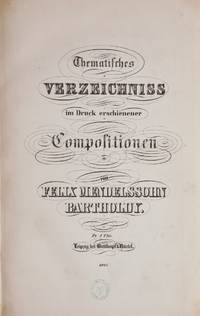
184340969Leipzig: Breitkopf & Härtel PN 6925 1843. Octavo. Full 19th century dark green textured cloth with ruled border gilt "C.C.P" gilt to upper decorative device blindstamped to lower. 1f. recto title verso blank 63 "Compositionen ohne Ausgabe einer Opuszahl" i blank 65-83 i "Dedicationen der Werke Felix Mendelssohn-Bartholdy's" pp. Title lithographed catalogue engraved. Small publisher's oval handstamp to foot of title. Occasional annotations in pencil. Scattered staining mostly minor; small tear to upper blank margin of p. 63 repaired with archival tape to verso. OCLC 1477534799. <br /> <br /> Together with:<br /> Zweite Abtheilung. Unbound. 1f recto title verso "Bemerkung." pp. 39 i blank. 41-44. Title worn and slightly foxed and stained with tear repaired with archival tape to verso; small tears to edges. Not in OCLC.<br /> <br /> First Edition.<br /> <br /> Bound with: <br /> CHOPIN<br /> Thematisches Verzeichnis der im Druck erschienen Compositionen von Friedrich Chopin. Leipzig . Paris . London: Breitkopf & Härtel . Brandus & Co. . Wessel & Co. PN 8497 ca. 1853. 1f. recto title verso blank i-iii "Inhalt. I. Werke mit Opuszahl. II. Werke ohne Opuszhal. III. Portraits. IV. Über Chopin" iv "Dedicationen" 31 i blank 33-35 i blank pp. A few "x" marks in contemporary manuscript. Occasional minor staining and foxing. <br /> <br /> First Edition. OCLC 29298462.<br /> <br /> Binding slightly worn rubbed and bumped; spine lacking with inner edges of boards reinforced with black tape. Breitkopf & Härtel [PN 6925] unknown
183920885London: G. Berger 1839. First Edition. . Hardcover. Good. Folio. 416pp. Mus.exs. Spine and covers rubbed and bumped covers staind spine cocked title page creased sonme page edges frayed and corners bent. Consisting f Songs Duets and Glees with Accompaniments for the Pianoforte and Arrangements for the Pianoforte Harp Guitar Etc. by Bishop Barnet Bochsa Grantham Kalkbrenner Lee Lanza Loder Neukomm Phillips and Sola with Adaptations and~Arrangements from Bartholdy BNeethoven Haydn Hummel T. Kuhlan Lindpainter H. Marschner Mendelssohn Spohr Weber and All the old Masters. Embracing: Original Tales and Esays. - Posthumous Papers of Celebrated Authors. - Original Poetry. - Translations from the Spanish German Italian and French. - Sketches of Scenery. - Manners and Customs. - Biography of Celebrated Characters. - Choice Brief and Pointed Passages fromthe Best New Works. - Comments on Passing Events. - Original Correspondence. - The Fine Arts Poetry Paintng Music and Sculpture. - Criticisms on Meritorious Productions. - Reminiscences of Olden Times. - Strictures on the Drama and Other Amusements and a Variety of Miscellaneous Matter Pathetic Moral Humorous etc. <br/> <br/> G. Berger hardcover
1847012322NY: Mason Brothers 1847. 1st Edition. Hardcover. Near Fine. Oblong 8v0. green pebbled cloth blind stamp rule and garland surround to titles in gilt 128 pp. Uncommon 19thC American song book in uncommonly un- or little-used condiution. No ownership markings. Musical scores set by A. P. Kendrick music typographer 20 Devonshire St Boston. Mason Brothers hardcover
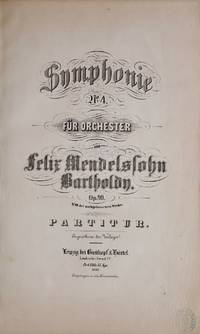
185140958Leipzig . London: Breitkopf & Härtel . Ewer & Co. PN 8347 1851. Octavo. Contemporary dark green morocco-backed dark green cloth boards with monogrammatic device gilt to upper incorporating musical instruments. 1f. recto title verso blank 193 i blank pp. Engraved throughout. <br /> <br /> Small publisher's oval handstamp and Ewer & Co.'s blindstamp to lower outer corner of title; decorative handstamp of "The Wandering Minstrels" to blank verso of title; "Presented by" handstamp followed by signature "Hon: S. Egerton" to upper margin of first page of music. <br /> <br /> With performance markings mostly dynamics with occasional articulations in lead and blue pencil.<br /> <br /> Binding slightly worn and bumped; upper hinge partially split; endpapers browned. Occasional minor browning and staining.<br /> <br /> A very good copy overall. First Edition. MWV pp. 225-226 no. 16. Hoboken 10 no. 284. Catalog of the Mendelssohn Papers in the Bodleian Library III 734. Felix Mendelssohn Bartholdy Leipzig catalog 152. Müller-Reuter I p. 73. Fuld p. 556.<br /> <br /> Mendelssohn finished his "Italian" Symphony in Berlin on 13 March 1833 conducting its first performance in London on 13 May 1833 at a London Philharmonic Society concert. The first edition of the full score was not published until after the composer's death. <br /> <br /> "The Italian sojourn of 1830 provided the raw musical material for the Italian Symphony finished and performed in London in 1833 revised the following year but published only posthumously as Symphony no.4 in 1851. For Julius Benedict the brightly scored opening was 'warmed with the balmy air of a southern clime'. The slow movement profitably compared to the 'Marche des pèlerins' from Berlioz's nearly contemporaneous Harold en Italie begins with a haunting modal melody evidently meant to depict a religious ceremony or procession. The third movement was probably inspired by Goethe's humorous poem Lilis Park. The finale labelled 'Saltarello' begins with a characteristic hopping figure reminiscent of the saltarellos Mendelssohn heard in Rome and Naples but then introduces in its development a new conjunct figure intended according to William Rockstro as a tarantella; the two are juxtaposed in the closing bars of the score." R. Larry Todd in Grove Music Online<br /> <br /> "The Wandering Minstrels were an amateur orchestra of forty or so players drawn from the ranks of the aristocracy and military. The Earl of Wilton and his sons were leading lights in the orchestra and for many years the Earl's younger son the Honourable Seymour Egerton was conductor and president.<br /> <br /> The Wandering Minstrels conscientiously documented their activities. Their albums of posters photographs and concert programmes shine a light on a little-studied aspect of musical life in the 19th century: concerts given by noble amateurs. The albums provide information on the music performed the structure of the concerts and Victorian programming habits and show which composers - and which musical works - were popular. Mendelssohn and Gounod were the most popular composers by a long way." British Library website music blog 17 August 2012. Breitkopf & Härtel ... Ewer & Co. [PN 8347] unknown
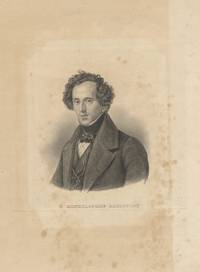
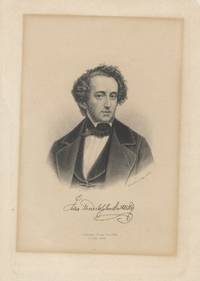
185041200Germany 1850. Image size 146 x 124 mm; sheet size 261 x 214 mm.<br /> <br /> The composer is depicted half-length facing quarter-right. No engraver publisher or place of publication. <br /> <br /> Unevenly browned; foxed; remnants of former mount to verso. unknown
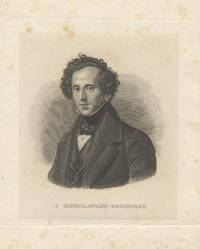
185041205Germany 1850. Image size 146 x 124 mm; sheet size 251 x 166 mm.<br /> <br /> The composer is depicted half-length facing quarter-right. No engraver publisher or place of publication. <br /> <br /> Slightly worn and foxed; horizontal crease to lower portion not affecting image. unknown
187541198Berlin: J. Guttentags Verlags Buchhdlg. D. Collin 1875. image size 216 x 144; sheet size 238 x 170. <br /> <br /> The composer is depicted half-length facing quarter-right his head turned left with his signature printed in facsimile below image.<br /> <br /> Browned. J. Guttentags Verlags Buchhdlg. D. Collin unknown
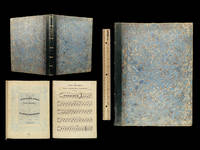
187024169<p><strong>1870 Felix Mendelssohn Songs Without Words Romantic Piano MUSIC German Lieder</strong></p><p>Felix Mendelssohn was a 19th-century Romantic composer known for his symphonies famed oratorios chamber music and incidental music. One of his most recognized works perhaps his most iconic is '<em>Songs Without Words'</em>. In 1829 Mendelssohn began working a series of piano solo works which were similar in style to the German 'lieder' or song; however Mendelssohn instead of including a vocal line had the melody played by the piano itself thus making these songs 'songs without words'. </p><p>This edition of Mendelssohn's famed '<em>Songs'</em> includes the 5 of the books each with six songs along with a number of separate piano works that were not organized with an opus number. Works found in this edition include:</p><p><!-- if !supportLists-->· <!--endif-->Book 2 Op. 30</p><p><!-- if !supportLists-->· <!--endif-->Book 4 Op. 53</p><p><!-- if !supportLists-->· <!--endif-->Book 5 Op. 62</p><p><!-- if !supportLists-->· <!--endif-->Book 6 Op. 67</p><p><!-- if !supportLists-->· <!--endif-->Book 7 Op. 85</p><p><!-- if !supportLists-->· <!--endif-->Likely not by Mendelssohn – these 3 do not appear in complete lists of Mendelssohn works</p><p><!-- if !supportLists-->o <!--endif-->Andante in F-sharp minor Fr. 1.50</p><p><!-- if !supportLists-->o <!--endif-->Allegro Vivace in E major</p><p><!-- if !supportLists-->o <!--endif-->"Barcarola" Allegro non troppo A major</p><p><!-- if !supportLists-->· <!--endif-->Scherzo in B minor WoO 2</p><p>Item number: #24169</p><p>Price: $499</p><p>MENDELSSOHN Felix</p><p><strong><em>Songs Without Words</em></strong></p><p>London: Chez J.A. Novello Bonn bei N. Simrock ca. 1870.</p><p><u>Details</u>: </p><p><!-- if !supportLists-->· <!--endif-->Collation: complete with all pages</p><p><!-- if !supportLists-->o <!--endif-->Each musical piece with separate pagination </p><p><!-- if !supportLists-->· <!--endif-->Language: German </p><p><!-- if !supportLists-->· <!--endif-->Binding: Leather; tight and secure</p><p><!-- if !supportLists-->· <!--endif-->Size: ~13in X 10in 33cm x 25cm</p><p>Our Guarantee:</p><p>Very Fast. Very Safe. Free Shipping Worldwide.</p><p>Customer satisfaction is our priority! Notify us with 7 days of receiving and we will offer a full refund without reservation!</p><p>24169</p><p>Photos available upon request. </p> J.A. Novello Bonn bei N. Simrock hardcover
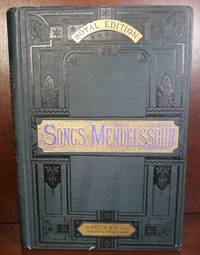
19005778London: Boosey & Co 1900. Measuring approximately 10" x 7" with 237 numbered pages. <br /> <br /> This book is in good minus condition. Moderate bumping to both ends of spine. Gilt lettering and design on spine and front board still full and vivid. All edges gilt. Front hinge is cracked causing book to be cocked and having slight overbite to textblock. Old music store stamp on title page. Interior pages are clean. <br /> <br /> Jakob Ludwig Felix Mendelssohn Bartholdy 3 February 1809 – 4 November 1847 widely known as Felix Mendelssohn was a German composer pianist organist and conductor of the early Romantic period. <br /> <br /> Please view the many other rare titles available for purchase at our store. We are always interested in purchasing individual or collections of fine books.<br /> <br /> Inventory # O2-109. Boosey & Co unknown
1879126381Leipzig & Berlin: C.F. Peters 1879. Hardcover. Very Good. Sheet music. Four volumes bound together each volume with its own front cover and pagination. Quarto. 54; 50; 60; 62pp. Half black calf black cloth boards with gilt trim along the calf gilt bands along the spine creating six compartments with "piano" stamped in gilt in the second compartment from the top. Boards and spine worn the front cover of the first volume is detached and laid in each volume with a music shop stamp on the front cover very good with the music clean. Instrumental pieces for piano.<br /> <br /> 1 Liszt: Chapelle Sixtine; Bülow: Op. 19 – Tarantella; Tausig: Transcription von Rich. Wagner’s Kaisermarsch; Rubinstein: Op. 23 No. 2 Concert-Etude<br /> <br /> 2 Raff Op. 93 – Dans la nacelle; Raff Op. 105 No. 3 – Troisieme Eglogue; Raff Op. 105 No. 4. - Quatrieme Eglogue; Raff Op. 105 No. 5 – Cinquieme Eglogue; Raff Op. 92 – Capriccio; Raff Op. 79 – Cachoucha Caprice<br /> <br /> 3 Transcriptionen von Alfred Jaell: No. 1: Nicolai – Lustigen Weiber von Windsor; No. 2: Mendelssohn – Hochzeitsmarsch; No. 3: Wagner – Lohengrin und Tannhäuser; No. 4: Bellini - Norma<br /> <br /> 4 Transcriptionen von Alfred Jaell: No. 1: Gounod – Faust-Walzer; No. 2: Meyerbeer – Afrikanerin Romance der Ines; No. 3: Meyerbeer – Afrikanerin Chor der Bischöfe; No. 4: Meyerbeer – Afrikanerin Arie des Nelusko; No. 5 Gounod – Romeo und Julie. C.F. Peters hardcover
184140964Bonn . Paris . London: bei N. Simrock . Chez Lemoine . Chez Ewer & Co. PN 3935 1841. Folio. Disbound. Contemporary dark blue paper wrappers with decorative cut paper label titled in manuscript to upper. 1f. recto title verso blank 3-21 i blank pp. Lithographed.<br /> <br /> Wrappers worn and detached. Moderate foxing to first and last leaves. Early German edition. MWV SD23 p. 478. Krause 227. Hoboken 10 222.<br /> <br /> "One of the most gifted and versatile prodigies Mendelssohn stood at the forefront of German music during the 1830s and 40s as conductor pianist organist and above all composer. His musical style fully developed before he was 20 drew upon a variety of influences including the complex chromatic counterpoint of Bach the formal clarity and gracefulness of Mozart and the dramatic power of Beethoven and Weber.<br /> Mendelssohn's emergence into the first rank of 19th-century German composers coincided with efforts by music historiographers to develop the concept of a Classic-Romantic dialectic in 18th and 19th-century music. To a large degree his music reflects a fundamental tension between Classicism and Romanticism in the generation of German composers after Beethoven . <br /> <br /> . The origins of the Lieder ohne Worte of which Mendelssohn published 36 pieces in six volumes between 1832 and 1845 two more volumes followed posthumously remain couched in mystery. Among his earliest piano lieder was one in E♭ written for Fanny's birthday in 1828 Fanny herself composed numerous examples of the genre; the idea of creating songlike piano pieces may have originated in a game Fanny and Felix played in which they apparently added texts to piano pieces. Then too the critical thought of A.B. Marx who explored in his writings of the 1820s the expressive potential and 'definiteness' of instrumental music was not without impact. Most of the lieder fall into three groups pianistic parallels to the vocal categories of solo songs duets and partsongs. The meaning of the new genre perplexed Mendelssohn's contemporaries. Schumann suggested that the composer had produced texted lieder but then suppressed the texts; when the composer's cousin Marc-André Souchay offered to give some of the lieder fanciful titles Mendelssohn replied that he had intended each lied 'just as it stands'. Only a small number of the lieder bear titles from Mendelssohn e.g. the three called Venetianisches Gondellied or his circle e.g. the 'Frühlingslied'; nevertheless later in the 19th century a host of insipid titles accrued to the lieder contributing to the view of Mendelssohn as a composer of overtly sentimental piano music for the parlour." R. Larry Todd in Grove Music Online. bei N. Simrock ... Chez Lemoine ... Chez Ewer & Co. [PN 3935] unknown
185140963Bonn . London: bei N. Simrock . bei J. A. Novello PN 3383 1851. Folio. Disbound. Contemporary dark blue paper wrappers with manuscript title label to upper. 1f. recto title verso blank 3-19 i blank pp.<br /> <br /> Wrappers worn and detached. Moderate foxing throughout heavier to margins. First German edition later issue. MWV SD 23 p. 478. Krause 227. Hoboken 10 222.<br /> <br /> "One of the most gifted and versatile prodigies Mendelssohn stood at the forefront of German music during the 1830s and 40s as conductor pianist organist and above all composer. His musical style fully developed before he was 20 drew upon a variety of influences including the complex chromatic counterpoint of Bach the formal clarity and gracefulness of Mozart and the dramatic power of Beethoven and Weber.<br /> Mendelssohn's emergence into the first rank of 19th-century German composers coincided with efforts by music historiographers to develop the concept of a Classic-Romantic dialectic in 18th and 19th-century music. To a large degree his music reflects a fundamental tension between Classicism and Romanticism in the generation of German composers after Beethoven . <br /> <br /> . The origins of the Lieder ohne Worte of which Mendelssohn published 36 pieces in six volumes between 1832 and 1845 two more volumes followed posthumously remain couched in mystery. Among his earliest piano lieder was one in E♭ written for Fanny's birthday in 1828 Fanny herself composed numerous examples of the genre; the idea of creating songlike piano pieces may have originated in a game Fanny and Felix played in which they apparently added texts to piano pieces. Then too the critical thought of A.B. Marx who explored in his writings of the 1820s the expressive potential and 'definiteness' of instrumental music was not without impact. Most of the lieder fall into three groups pianistic parallels to the vocal categories of solo songs duets and partsongs. The meaning of the new genre perplexed Mendelssohn's contemporaries. Schumann suggested that the composer had produced texted lieder but then suppressed the texts; when the composer's cousin Marc-André Souchay offered to give some of the lieder fanciful titles Mendelssohn replied that he had intended each lied 'just as it stands'. Only a small number of the lieder bear titles from Mendelssohn e.g. the three called Venetianisches Gondellied or his circle e.g. the 'Frühlingslied'; nevertheless later in the 19th century a host of insipid titles accrued to the lieder contributing to the view of Mendelssohn as a composer of overtly sentimental piano music for the parlour." R. Larry Todd in Grove Music Online. bei N. Simrock ... bei J. A. Novello [PN 3383] unknown
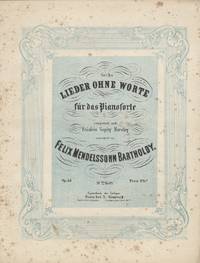
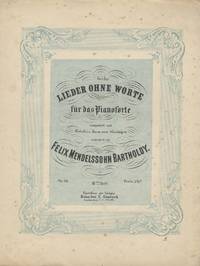
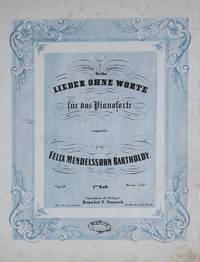
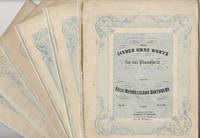
185140954Bonn . Paris . London: bei N. Simrock . bei M. Schlesinger . chez J. A. Novello PN 3041 1851. 1f. recto title verso blank 3-17 i blank pp. First German edition later issue "chez" rather than "bei" J. A. Novello. MWV SD5 p. 470. Krause 216. Hoboken 10 150.<br /> <br /> Bound with:<br /> Sechs Lieder Ohne Worte Componirt und Fräulein Elise von Woringen zugeeignet . Op. 30. IItes. Heft . Eigenthum der Verleger . Pr. 3 Frs. Bonn . London . Paris: bei N. Simrock . chez N. Mori . chez Schönenberger PN 3204 ca. 1851. 1f. recto title verso blank 3-19 i blank pp. First German edition later issue. MWV SD9 p. 472. Krause 220. Hoboken 10 177.<br /> <br /> Bound with:<br /> Sechs Lieder Ohne Worte für das Pianoforte . componirt und Fräulein Rosa von Woringen zugeeignet . Op. 38. IIItes. Heft . Preis 3 Frs. Bonn . London: bei N. Simrock . bei J. A. Novello PN 3383 ca. 1851. 1f. recto title verso blank 3-19 i blank pp. First German edition later issue. MWV SD9 p. 472. Krause 220. Hoboken 10 177.<br /> <br /> Bound with:<br /> Sechs Lieder Ohne Worte für das Pianoforte . componirt und Fräulein Sophÿ Horsleÿ zugeeignet . Op. 53 . IVtes. Heft . Preis 4 Frs. Bonn . London . Paris: bei N. Simrock . Chez Ewer & Co. . Chez Lemoine PN 3935 1841. 1f. recto title verso blank 3-25 i blank pp. First German edition later issue. MWV SD23 p. 478. Krause 227. Hoboken 10 222.<br /> <br /> Bound with:<br /> Sechs Lieder Ohne Worte für das Pianoforte . componirt und Frau Dr. Clara Schumann geb. Wieck zugeeignet . Op. 62. . Vtes. Heft . Preis 3 Frs 50c. Bonn . Lyon . Mailand . London: bei N. Simrock . bei Benacci & Peschier . bei J. Lucca . bei Ewer & Co. PN 4343 ca. 1860. 1f. recto title verso blank i blank 4-19 i blank pp. First Edition early issue. MWV SD29 p. 481. Krause 231. Hoboken 10 237.<br /> <br /> Bound with:<br /> Sechs Lieder Ohne Worte für das Pianoforte . componirt und Fräulein Sophie Rosen zugeeignet . Op. 67. . VItes. Heft . Preis 3 Frs 50c. Bonn . Mailand . Paris . London: bei N. Simrock . bei J. Ricordi . bei M. Schlesinger . bei Ewer & Co. PN 4478 1845. 1f. recto title verso blank i blank 4-21 i blank pp. First Edition early issue. MWV SD32 p. 482. Krause 236. Hoboken 10 245. <br /> <br /> 6 volumes. Folio. Contemporary black cloth-backed dark blue boards with titling in manuscript to upper. Titles lithographed on blue ground within decorative blue border music engraved. <br /> <br /> Provenance<br /> Heinrich Dorn 1800-1892 noted conductor composer music critic and teacher of the Schumanns with "H. Dorn" in manuscript to upper outer corner of upper board with his small oval handstamp "H. Dorn Coeln" and handstamp "M. Schloss in Coeln" to foot of titles. <br /> <br /> Binding slightly worn and soiled with small stains to upper. Some minor foxing soiling small stains and showthrough heavier to some leaves; small dampstain to blank lower margin of final half of volume; inner margins occasionally reinforced; some minor paper repairs. "One of the most gifted and versatile prodigies Mendelssohn stood at the forefront of German music during the 1830s and 40s as conductor pianist organist and above all composer. His musical style fully developed before he was 20 drew upon a variety of influences including the complex chromatic counterpoint of Bach the formal clarity and gracefulness of Mozart and the dramatic power of Beethoven and Weber.<br /> <br /> Mendelssohn's emergence into the first rank of 19th-century German composers coincided with efforts by music historiographers to develop the concept of a Classic-Romantic dialectic in 18th and 19th-century music. To a large degree his music reflects a fundamental tension between Classicism and Romanticism in the generation of German composers after Beethoven. .<br /> <br /> The origins of the Lieder ohne Worte of which Mendelssohn published 36 pieces in six volumes between 1832 and 1845 two more volumes followed posthumously remain couched in mystery. Among his earliest piano lieder was one in E♭ written for Fanny's birthday in 1828 Fanny herself composed numerous examples of the genre; the idea of creating songlike piano pieces may have originated in a game Fanny and Felix played in which they apparently added texts to piano pieces. Then too the critical thought of A.B. Marx who explored in his writings of the 1820s the expressive potential and 'definiteness' of instrumental music was not without impact. Most of the lieder fall into three groups pianistic parallels to the vocal categories of solo songs duets and partsongs. The meaning of the new genre perplexed Mendelssohn's contemporaries. Schumann suggested that the composer had produced texted lieder but then suppressed the texts; when the composer's cousin Marc-André Souchay offered to give some of the lieder fanciful titles Mendelssohn replied that he had intended each lied 'just as it stands'. Only a small number of the lieder bear titles from Mendelssohn e.g. the three called Venetianisches Gondellied or his circle e.g. the 'Frühlingslied'; nevertheless later in the 19th century a host of insipid titles accrued to the lieder contributing to the view of Mendelssohn as a composer of overtly sentimental piano music for the parlour." R. Larry Todd in Grove Music Online<br /> <br /> Dorn "studied the piano singing and composition in Königsberg made several long journeys throughout Germany during which he met Weber in Dresden and completed his studies with Ludwig Berger Bernhard Klein and Zelter in Berlin where his first opera Rolands Knappen was produced successfully in 1826. At the same time he became a co-editor of the Berliner allgemeine Muzikzeitung for which he wrote a spirited defence of the beleaguered Gaspare Spontini. Over the next two decades he built a solid reputation as a conductor of opera holding theatre posts at Königsberg 1828 Leipzig 1829-32 where he taught counterpoint to the young Schumann Hamburg 1832 Riga 1834-43 and Cologne 1844-8. He organized the first music festival of the Russian Baltic provinces in Riga 1836 and directed the Lower Rhine music festivals 1844-7. His most prestigious appointment in 1849 after Nicolai's death was as co-conductor with Wilhelm Taubert of the Berlin Hofoper. After his retirement from that post in 1869 he remained active in Berlin for many years as a teacher and writer." Adelyn Peck Leverett revised by Christopher Fifield in Grove Music Online. bei N. Simrock ... bei M. Schlesinger ... chez J. A. Novello [PN 3041] unknown
185036216Bonn . Londres . Paris: N. Simrock . J.J Novello . M. Schlesinger PN 3041 1850. 1 title 2 blank 3-17 i blank pp. Lithographed. First German edition later variant issue.<br /> <br /> With:<br /> - Op. 30. Sechs Lieder . componirt und Fräulein Elise von Woringen zugeeignet . Op. 30. IItes. Heft Pr. 3 Frs - 24 Sgr. Bonn . London . Paris: N. Simrock . N. Mori . M. Schlesinger PN 3205 ca. 1845. 1 title 2-3 blank 4-17 i blank pp. Engraved. First Edition later issue. Hoboken 10 177. <br /> <br /> - Op 38. Sechs Lieder . componirt Fräulein Rosa von Woringen zugeeignet . Op. 38. IIItes. Heft Preis 3 Frs. - 24 Sgr. Bonn: N. Simrock PN 3383 ca. 1850-60. 1 title 2 blank 3-19 i blank pp. Later edition. <br /> <br /> - Op. 53. Sechs Lieder . componirt und Fräulein Sophÿ Horsleÿ zugeeignet . Op. 53. IVtes. Heft Preis 4 Frs. Bonn: N. Simrock PN 3935 ca. 1860. 1 title 2 blank 3-21 i blank pp. <br /> <br /> - Op. 62. Sechs Lieder . componirt und Frau Dr. Clara Schumann geb. Wieck zugeeignet . Op. 62. Vtes. Heft Preis 3 Frs 50c. Bonn: N. Simrock PN 4343 ca. 1850. 1 title 2-3 blank 4-19 i blank pp. Engraved. <br /> <br /> - Op. 67. Sechs Lieder . componirt und Fräulein Sophie Rosen zugeeignet . Op. 67. VItes. Heft Preis 3 Frs 50c. Bonn: N. Simrock PN 4478 ca. 1860. <br /> <br /> 6 volumes. Folio. Titles printed on blue ground within decorative blue border. <br /> <br /> Handstamp of 19th century New York musicseller Scharfenberg to foot of titles of all but one volume. <br /> <br /> Disbound; spines reinforced with tape. Slightly worn; moderate browning and foxing throughout. "One of the most gifted and versatile prodigies Mendelssohn stood at the forefront of German music during the 1830s and 40s as conductor pianist organist and above all composer. His musical style fully developed before he was 20 drew upon a variety of influences including the complex chromatic counterpoint of Bach the formal clarity and gracefulness of Mozart and the dramatic power of Beethoven and Weber.<br /> <br /> Mendelssohn's emergence into the first rank of 19th-century German composers coincided with efforts by music historiographers to develop the concept of a Classic-Romantic dialectic in 18th and 19th-century music. To a large degree his music reflects a fundamental tension between Classicism and Romanticism in the generation of German composers after Beethoven." R. Larry Todd in Grove Music Online. N. Simrock ... J.J Novello ... M. Schlesinger [PN 3041] unknown
184418508Bonn: N. Simrock PN 4343 1844. Folio. Disbound. 19 pp. Engraved. Lithographic title with decorative blue background and border. <br /> <br /> Moderate foxing and browning. First Edition later issue. Fuld p. 525. Krause 231. Hoboken 10 237. Catalogue of the Mendelssohn Papers in the Bodleian Library III 444. <br /> <br /> This volume of the Songs Without Words contains Mendelssohn's "Spring Song. N. Simrock [PN 4343] unknown
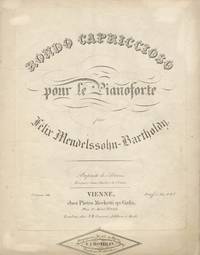
183140960Vienne: Pietro Mechetti qm Carlo PN 2133 1831. Folio. Disbound. 1f. recto title verso blank 3-11 i blank pp. Engraved. With London agents "J.B. Cramer Addison & Beale" to foot of title.<br /> <br /> Contemporary diamond-shaped label of Swiss bookseller F. I. Rothlin to foot of title. <br /> <br /> Slightly worn browned and soiled; first and last leaves partially detached; Rothlin label very slightly trimmed at foot. First Viennese edition without Berlin agent "Ad. Mt. Schlesinger" to title. Scarce. Weinmann Mechetti p. 52. Hoboken 10 135 a later issue. Not in Krause. Pietro Mechetti qm Carlo [PN 2133] unknown
183140966Vienne: Pietro Mechetti qm Carlo PN 2133 1831. Folio. Stiff marbled wrappers with manuscript title label to upper. 1f. recto title verso blank 3-11 i blank pp. Engraved. <br /> <br /> Title and final leaf moderately foxed; occasional minor foxing throughout. First Viennese edition later issue. Scarce. With London agents "J.B. Cramer Addison & Beale" and Berlin agent "Ad. Mt. Schlesinger" to foot of title. Weinmann Mechetti p. 52. Not in Krause. Hoboken 10 135 first issue. <br /> <br /> "One of the most gifted and versatile prodigies Mendelssohn stood at the forefront of German music during the 1830s and 40s as conductor pianist organist and above all composer. His musical style fully developed before he was 20 drew upon a variety of influences including the complex chromatic counterpoint of Bach the formal clarity and gracefulness of Mozart and the dramatic power of Beethoven and Weber.<br /> <br /> Mendelssohn's emergence into the first rank of 19th-century German composers coincided with efforts by music historiographers to develop the concept of a Classic-Romantic dialectic in 18th and 19th-century music. To a large degree his music reflects a fundamental tension between Classicism and Romanticism in the generation of German composers after Beethoven." R. Larry Todd in Grove Music Online. Pietro Mechetti qm Carlo [PN 2133] unknown
184035290Vienne: Pietro Mechetti qm Carlo PN P.M. No. 2133 1840. Small folio. Disbound. 1f. recto title verso blank 3-11 pp. Engraved.<br /> <br /> Disbound. Slightly worn and soiled; browning to edges; light scattered foxing. Second German edition. MWV U 67 p. 312. Published before the "Neue rechtmässige Original-Ausgabe" published in 1854 Krause 212. Ward Jones III 381. <br /> <br /> One of the most gifted and versatile prodigies Mendelssohn stood at the forefront of German music during the 1830s and 40s as conductor pianist organist and above all composer. His musical style fully developed before he was 20 drew upon a variety of influences including the complex chromatic counterpoint of Bach the formal clarity and gracefulness of Mozart and the dramatic power of Beethoven and Weber.<br /> <br /> Mendelssohn's emergence into the first rank of 19th-century German composers coincided with efforts by music historiographers to develop the concept of a Classic-Romantic dialectic in 18th and 19th-century music. To a large degree his music reflects a fundamental tension between Classicism and Romanticism in the generation of German composers after Beethoven." R. Larry Todd in Grove Music Online. Pietro Mechetti qm Carlo [PN P.M. No. 2133] unknown
186273741Leipzig: Mendelssohn 1862. Gebunden. Mendelssohn unknown
186113109Leipzig: Mendelssohn 1861. Gebunden. Mendelssohn unknown
183329636Bonn: N. Simrock PN 3045 1833. Folio. Unbound. <br /> <br /> Violino 1mo: 1 title 2-13 i blank<br /> Violino 2do: 11 i blank<br /> Viola 1ma: 11 i blank<br /> Viola 2da: 11 i blank<br /> Violoncello: 11 i blank pp. <br /> <br /> Engraved throughout. <br /> <br /> Slightly worn and browned; binder's hole to upper inner margin; early manuscript initial "A" and the number "5" to first page of music of each part. First Edition. Scarce. Wehner p. 275. Catalogue of the Mendelssohn papers III 634. Hoboken 10 144. <br /> <br /> "One of the most gifted and versatile prodigies Mendelssohn stood at the forefront of German music during the 1830s and 40s as conductor pianist organist and above all composer. His musical style fully developed before he was 20 drew upon a variety of influences including the complex chromatic counterpoint of Bach the formal clarity and gracefulness of Mozart and the dramatic power of Beethoven and Weber." <br /> <br /> "Of the two string quintets the first op. 18 in A begins with a graceful Mozartian theme somewhat reminiscent of the Clarinet Quintet K581. The use of fugal writing and in the original minuet intricate double canons imbued the first version of this work with a severely academic quality; in 1832 Mendelssohn replaced the minuet with the emotionally charged Intermezzo in memory of Eduard Ritez." R. Larry Todd in Grove Music Online. N. Simrock [PN 3045] unknown