86 résultats
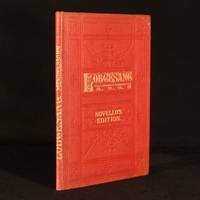
1885995H8London: Novello and Company Limited c1885. Cloth. Very Good. 10.5" by 7". None. The scarce Novello octavo edition score of Mendelssohn"s expansive choral-symphonic masterpiece "Hymn of Praise Lobgesang". In the publisher's original red cloth binding. Novello's original octavo edition. This copy is undated. Dated here using Jisc from copies held at the University of Edinburgh Libraries University of Leeds Library and University of Nottingham Library. A vocal score of Felix Mendelssohn"s Lobgesang "Hymn of Praise" a hybrid symphony cantata combining orchestral and sacred choral movements chorus soloists and piano. It sets biblical texts and includes the chorale "Nun danket alle Gott" in a richly lyrical Romantic idiom. In the publisher's original cloth binding. Externally smart. Slight fading and discolouration to extremities and spine. Slight shelf wear to extremities. Minor loss to cloth at top corner of front board. One or two very slight handling marks to boards. Internally firmly bound. Hinge slightly cracked at the title page but firm. Pages bright and clean. Previous owner's contemporary ink inscription to title page. The odd spot heavier to first and last few leaves. Very Good Novello and Company, Limited hardcover
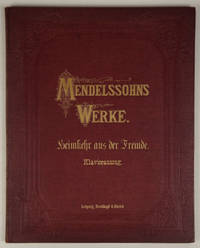
187735155Leipzig: Breitkopf & Härtel PN M.B.122 Kl.A 1877. Folio. Original publisher's full dark red cloth with titling gilt to upper within decorative blindstamped border titling gilt to spine; dark ivory endpapers. 1 title 2-83. i blank pp. Engraved. Text in German. With "Breitkopf & Härtels Musikbücher Nr. 181" to head of upper wrapper. <br /> <br /> With Hungarian translation in ink along with marked cuts to No. 6. Terzett "O wie verschweig' ich."<br /> <br /> In the series "Felix Mendelssohn Bartholdy's Werke. Kritisch durchgesehene Ausgabe von Julius Reitz. Mit Genehmigung der Originalverleger Serie 15. Grössere weltiche Gesangwerke. Klavier-Auszug." From the Breitkopf edition of Mendelssohn's Complete Works No. 122. <br /> <br /> Together with: <br /> Heimkehr aus dem Fremde. Libretto. Leipzig: Breitkopf & Härtel 1885. 16mo. Original publisher's light gray printed wrappers. 1f. recto title verso blank 12 2 pp. publisher's catalogue of piano-vocal scores and libretti with additional publisher's catalogue to verso of upper and recto and verso of lower wrapper.<br /> <br /> Together with:<br /> An invitation to the 1931 production of the opera from the Budapest Choral and Orchestra Association Ének- és Zenekaregyesűlet partially laid down to front free endpaper signed by István Eisler for the commissioning group and with his name in ink along with a date of December 1930 to upper outer corner and handstamp of Hungarian publisher/musicseller Rózsavölgyi és társa dated December 12 1930 to lower outer corner of endpaper. Later printing. MWV L6 p. 196.<br /> <br /> Heimkehr aus der Fremde a Liederspiel in 1 act to a libretto by Karl Klingemann was given a private premiere in Berlin on 26 December 1829. The first public performance took place in Leipzig on 10 April 1851. <br /> <br /> "Mendelssohn's deft command of orchestral colour is evident throughout the work and his ability to create charming effects with the simplest of means is impressive." Clive Brown in Grove Dictionary of Opera<br /> <br /> "One of the most gifted and versatile prodigies Mendelssohn stood at the forefront of German music during the 1830s and 40s as conductor pianist organist and above all composer. His musical style fully developed before he was 20 drew upon a variety of influences including the complex chromatic counterpoint of Bach the formal clarity and gracefulness of Mozart and the dramatic power of Beethoven and Weber.<br /> <br /> Mendelssohn's emergence into the first rank of 19th-century German composers coincided with efforts by music historiographers to develop the concept of a Classic-Romantic dialectic in 18th and 19th-century music. To a large degree his music reflects a fundamental tension between Classicism and Romanticism in the generation of German composers after Beethoven." R. Larry Todd in Grove Music Online. Breitkopf & Härtel [PN M.B.122 Kl.A] unknown
187736206Leipzig: Breitkopf & Härtel PN 8335 1877. Folio. Original publisher's dark brown wrappers with titling within decorative border. 1 recto title verso blank 3-57 i blank pp. Engraved.<br /> <br /> Wrappers slightly worn and soiled. Occasional light foxing; some leaves detached and frayed at edges. First Edition of this arrangement. MWV L6 p. 196. Rare no copies located outside of Germany. Not in Krause the Catalogue of the Mendelssohn Papers in the Bodleian Library or Hoboken.<br /> <br /> Heimkehr aus der Fremde to a libretto by Karl Klingemann was first performed privately in Berlin on 26 December 1829; its first public performance took place in Leipzig on 10 April 1851. <br /> <br /> "Mendelssohn's deft command of orchestral colour is evident throughout the work and his ability to create charming effects with the simplest of means is impressive." Clive Brown in Grove Dictionary of Opera<br /> <br /> "One of the most gifted and versatile prodigies Mendelssohn stood at the forefront of German music during the 1830s and 40s as conductor pianist organist and above all composer. His musical style fully developed before he was 20 drew upon a variety of influences including the complex chromatic counterpoint of Bach the formal clarity and gracefulness of Mozart and the dramatic power of Beethoven and Weber.<br /> <br /> Mendelssohn's emergence into the first rank of 19th-century German composers coincided with efforts by music historiographers to develop the concept of a Classic-Romantic dialectic in 18th and 19th-century music. To a large degree his music reflects a fundamental tension between Classicism and Romanticism in the generation of German composers after Beethoven." R. Larry Todd in Grove Music Online. Breitkopf & Härtel [PN 8335] unknown
183018718Leipzig Paris: Frédéric Hofmeister Simon Richault PN 1515 1830. Folio. Unbound as issued. 9; 9; 9; 7 pp. Engraved. Title to viola part. <br /> <br /> Some very light wear and soiling; two small binder's holes to inner blank margins. In very good condition overall. First Edition. Catalogue of the Mendelssohn Papers in the Bodleian Library III 604. Hoboken 10 130. Not in Krause. <br /> <br /> "One of the most gifted and versatile prodigies Mendelssohn stood at the forefront of German music during the 1830s and 40s as conductor pianist organist and above all composer. His musical style fully developed before he was 20 drew upon a variety of influences including the complex chromatic counterpoint of Bach the formal clarity and gracefulness of Mozart and the dramatic power of Beethoven and Weber .<br /> <br /> Between 1827 and 1847 he composed six string quartets and had begun work on a seventh at the end of his life. . The first two op. 13 in A minor 1827 and op. 12 in Eb 1829 show a rapprochement with the late quartets of Beethoven. To the Swedish musician Adolf Lindblad Mendelssohn explained his concern for the organic relationship of the various movements to the whole. In op. 12 the opening of the first movement is brought back to conclude the finale." R. Larry Todd in Grove Music Online. Frédéric Hofmeister, Simon Richault [PN] 1515 unknown
184537452Leipzig: F. A. Brockhaus 1845. First edition. Hardcover. g. Small Octavo ca. 4200pp. Original half leather over dark green pebbled cloth. Marbled endpapers and edges. Portrait lithograph of Mendelssohn by Frisch with tissue guard. Edited by Prof. Dr. G. B. Mendelssohn based on original prints and handwritings in seven volumes. Vol. 1: Biography and philosophical writings Vol. 2: Metaphysical writings Vol. 3: Correspondence and smaller writings Vol. 4.1: Smaller writings and correspondence Vol. 4.2: Correspondence. Vol. 5: Correspondence. Vol. 6: Ritual Laws of the Jews and various translations. Vol. 7: Mendelssohn's translation of the Five Books of Moses. Moses Mendelssohn was a German Jewish philosopher and practicing orthodox Jew. His ideas are credited with contributing significantly to the 'Jewish enlightenment' of the 18th and 19th centuries the Haskalah. Text in German fracture. Binding rubbed. Some volumes with professional repair at gutters starting a back gutter of volume 2 and 3. Volumes dusty and marbled edges faded. Moderate sporadic foxing of book blocks. Bindings and interior in overall good condition. F. A. Brockhaus hardcover
188035282Berlin: N. Simrock PN 4717 1880. Folio. 35 pp. score 18 parts with imprint Bonn: N. Simrock PN 4710 8 Frs. 2 Thlr 4 Sgr. Engraved. Text in German.<br /> <br /> Provenance<br /> <br /> Composer E.J. Biedermann 1849-1933 with his signature in pencil to head of violin I part; small oval handstamp of G. Schirmer to all parts.<br /> <br /> With performance letters in blue pencil to parts.<br /> <br /> Score slightly worn; Violin I part quite worn; split and frayed at spine; other parts slightly worn. First Edition of this arrangement. MWV D6. Score is a re-issue following Simrock's move to Berlin; parts are an earlier issue.<br /> <br /> One of the most gifted and versatile prodigies Mendelssohn stood at the forefront of German music during the 1830s and 40s as conductor pianist organist and above all composer. His musical style fully developed before he was 20 drew upon a variety of influences including the complex chromatic counterpoint of Bach the formal clarity and gracefulness of Mozart and the dramatic power of Beethoven and Weber.<br /> <br /> Mendelssohn's emergence into the first rank of 19th-century German composers coincided with efforts by music historiographers to develop the concept of a Classic-Romantic dialectic in 18th and 19th-century music. To a large degree his music reflects a fundamental tension between Classicism and Romanticism in the generation of German composers after Beethoven." R. Larry Todd in Grove Music Online<br /> <br /> Maximilian Carl Eberwein son of composer Franz Carl Eberwein was a noted pianist and pedagogue. His arrangement of the present work for full orchestra was first published in 1848. N. Simrock [PN 4717] unknown
186075521-A-67691Bonn: N. Simrock ca 1860. Op. 19 30 38 53 62 67 . -Ends of spine damaged boards worn pages foxed. Everything legible though. N. Simrock hardcover
190020209Leipzig: C. F. Peters 1900. Hardcover. vg. 4to. 169pp. Red cloth with embossed gilt lettering and Art-Nouveau-style "Jugenstil" decoration. Decorated endpapers. Delightfully decorated title page. Musical scores and lyrics of 79 songs composed by the renowned composer and pianist of the Romantic period Jakob Ludwig Felix Mendelssohn Bartholdy a.k.a. Felix Mendelssohn 1809 – 1847 Born to a notable German- Jewish family Mendelssohn was the grandson of the acclaimed Jewish-German philosopher Moses Mendelssohn. His work includes concerts oratorios symphonies piano and chamber music. Source: Public Domain. Minor age wear to binding with browning throughout. Owner's stamp to free front endpaper and title page not affecting text. Minor pencil marks to few pages. Otherwise clean and tight. Lyrics in German musical notations in Italian. Very good condition. C. F. Peters hardcover
185045970London: Hart & Co Circa 1850s. Hardcover. Fair. 164p quarto Wear to the corners rear inner hinge cracked front inner hinge starting. Neat perod engraved bookplate A fair copy in blue cloth <br/><br/> Hart & Co hardcover
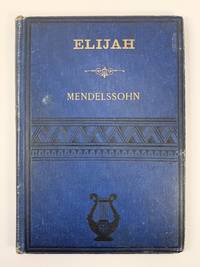
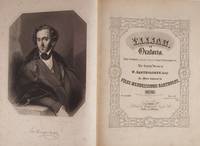
184740967London . Bonn: Ewer & Co. Newgate Strt. . N. Simrock 1847. Large folio. Full maroon cloth with dark red leather title label gilt to spine. 1f. recto blank verso frontispiece 1f. recto engraved title within decorative border verso blank 1f. recto index verso blank iv typeset libretto 279 i blank pp. Text in English. Music engraved. Small format single-page list of errata bound in following title.<br /> <br /> The fine frontispiece portrait engraving of the composer is by A.H. Payne and W.C. Wrankmore after Hildebrand.<br /> <br /> Occasional annotations in pencil including instrument names and tempo indications. <br /> <br /> Binding slightly worn rubbed and bumped. Light uniform browning; frontispiece slightly foxed and creased at lower outer corner; foxing mainly to margins; minor soiling to blank margins of title; occasional minor soiling to lower outer corners. First English edition first issue with "Newgate Strt." address published in the same year as the first German edition published by Simrock in Bonn. MWV A25. Catalogue of the Mendelssohn Papers in the Bodleian Library III 362. Hoboken 10 253. <br /> <br /> Elijah to a libretto by J. Schubring was first performed in Birmingham England on 26 August 1846; Schubring also collaborated with Mendelssohn on his earlier oratorio St. Paul.<br /> <br /> "Mendelssohn was not the only 19th-century composer to revive the oratorio but his two completed works St Paul 1836 and Elijah 1846 were the only representatives of his time to achieve lasting popularity. . With few exceptions Mendelssohn's other sacred works lie largely in the shadow of St Paul and Elijah. .<br /> <br /> One of the most gifted and versatile prodigies Mendelssohn stood at the forefront of German music during the 1830s and 40s as conductor pianist organist and above all composer. His musical style fully developed before he was 20 drew upon a variety of influences including the complex chromatic counterpoint of Bach the formal clarity and gracefulness of Mozart and the dramatic power of Beethoven and Weber.<br /> <br /> Mendelssohn's emergence into the first rank of 19th-century German composers coincided with efforts by music historiographers to develop the concept of a Classic-Romantic dialectic in 18th and 19th-century music. To a large degree his music reflects a fundamental tension between Classicism and Romanticism in the generation of German composers after Beethoven." R. Larry Todd in Grove Music Online. Ewer & Co. Newgate Strt. ... N. Simrock unknown
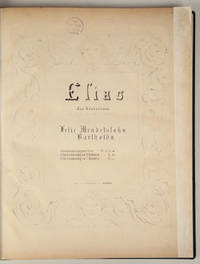
188035203Berlin: N. Simrock PN 4648 1880. Folio. Full black cloth with original publisher's light green printed wrapper with titling within decorative border laid down to upper board. 1f. recto title verso blank 3-207 i blank pp. Text in German.<br /> <br /> Small circular handstamp of the Musik-schulen Kaiser Wien to wrapper title and several pages throughout.<br /> <br /> Binding slightly worn rubbed and bumped; wrapper slightly trimmed and lightly foxed with several minor chips and abrasions to margins. Impression to title slightly light; title and final leaf reinforced with paper tape to gutter and outer edge. Light scattered foxing throughout. First German edition later issue. MWV A25 p. 35. Not in Krause. Catalogue of the Mendelssohnb Papers in the Bodleian Library III 361 earlier issue. Hoboken 10 251 first issue.<br /> <br /> Elias an oratorio to a libretto by Julius Schubring after Kings was first performed in Birmingham on 26 August 1846. Mendelssohn made major revisions to the work following this performance introducing the new and final version in London on 16 April 1847.<br /> <br /> Mendelssohn distinguished himself in many fields and his contributions to sacred choral music are no exception. He was the most prominent advocate for the music of J.S. Bach reviving the St. Matthew Passion in 1829 and helped to reestablish the oratorio by providing two superb examples: St. Paul 1836 and Elijah 1846.<br /> <br /> "Based largely on the account in 1 Kings Elijah relates the chief events in the prophet's life: the curse of the Lord and the seven-year drought Elijah's miraculous revival of the widow's son his confrontation with the Baal worshippers and the lifting of the drought his confrontation with Ahab and Jezebel his flight to the wilderness and encounter with the Lord and his journey to Mt Horeb and ascension to heaven in a flaming chariot. As in St Paul Mendelssohn employed chorales and relied heavily upon choral numbers; noteworthy is the sheer diversity of choruses . In contrast to St Paul Mendelssohn dispensed with the narrator allowing the characters themselves to deliver the dramatic action. Elijah diverges from St Paul too in its broadly conceived musical cohesiveness; in no other work did Mendelssohn concern himself with musical structure on such a large scale." R. Larry Todd in Grove Music Online. N. Simrock [PN 4648] unknown
183835281Bonn: N. Simrock PN 3441 1838. Folio. 21 pp. 4 parts of 4 pp. each title and price to Soprano I part. Engraved. Text in Latin and German. <br /> <br /> SSAA with organ.<br /> <br /> Provenance<br /> Composer E.J. Biedermann 1849-1933 with his signature in pencil to head of score and each part; small oval handstamp of G. Schirmer to foot of title and each part.<br /> <br /> Split at spine; minor creasing; edges slightly worn and cockled. First Edition later issue. MWV B23 p. 51. Not in Krause. Ward Jones III 488 490. Hoboken 10 193.<br /> <br /> One of the most gifted and versatile prodigies Mendelssohn stood at the forefront of German music during the 1830s and 40s as conductor pianist organist and above all composer. His musical style fully developed before he was 20 drew upon a variety of influences including the complex chromatic counterpoint of Bach the formal clarity and gracefulness of Mozart and the dramatic power of Beethoven and Weber.<br /> <br /> Mendelssohn's emergence into the first rank of 19th-century German composers coincided with efforts by music historiographers to develop the concept of a Classic-Romantic dialectic in 18th and 19th-century music. To a large degree his music reflects a fundamental tension between Classicism and Romanticism in the generation of German composers after Beethoven." R. Larry Todd in Grove Music Online. N. Simrock [PN 3441] unknown
184136202Leipzig: Breitkopf & Härtel PNs 5542 5543 5544 1841. 1f. recto lithographic title verso blank 78; 1f. recto lithographic title verso blank 52 pp.; 1f. recto lithographic title verso blank 66 pp. Music engraved throughout. <br /> <br /> First Editions later issues of all three works. MWV P3 op. 21; MWV P7 op. 26; MWV P5 op. 27. Krause 135 143 146. Hoboken first issues only. <br /> <br /> Bound with: <br /> Op. 32. Ouverture zum Märchen von der schönen Melusine . Partitur . Pr. 1 Rthlr. 20 Ngr. Leipzig: Breitkopf & Härtel PN 5688 ca. 1857. 1f. recto title verso blank 72 pp. Engraved. First Edition later issue. Hoboken 10 181. Krause 149. <br /> <br /> Bound with:<br /> Op. 95. Ouverture zu Ruy Blas für grosses Orchester . Op. 95. Pr. 2 Thlr. Partitur No. 24 der nachgelassen Werke. Leipzig: Fr. Kistner PN 1837 1851-52. 1f. recto title verso blank 64 pp. Engraved. First Edition. Hoboken 10 290. Krause 153. <br /> <br /> 19th century mid-tan morocco-backed dark brown textured paper boards raised bands on spine with titling gilt marbled edges light blue endpapers narrow blue silk ribbon marker. <br /> <br /> Binding slightly worn rubbed and bumped. Minor internal wear. An attractive copy of all five of Mendelssohn's concert overtures. <br /> <br /> "One of the most gifted and versatile prodigies Mendelssohn stood at the forefront of German music during the 1830s and 40s as conductor pianist organist and above all composer. His musical style fully developed before he was 20 drew upon a variety of influences including the complex chromatic counterpoint of Bach the formal clarity and gracefulness of Mozart and the dramatic power of Beethoven and Weber.<br /> <br /> Mendelssohn's emergence into the first rank of 19th-century German composers coincided with efforts by music historiographers to develop the concept of a Classic-Romantic dialectic in 18th and 19th-century music. To a large degree his music reflects a fundamental tension between Classicism and Romanticism in the generation of German composers after Beethoven." R. Larry Todd in Grove Music Online. Breitkopf & Härtel [PNs 5542, 5543, 5544] unknown
184440519Leipzig: Fr. Kistner PN 1400 1844. Folio. Modern mid-green boards with original publisher's wrappers laid down to both boards title label gilt to spine. 1f. recto title verso printed excerpt from a letter from Goethe to Mendelssohn 5- 91 i blank pp. Text in German. Engraved. <br /> <br /> With the overture arranged for piano 4-hands. <br /> <br /> Annotations in pencil to several leaves. <br /> <br /> Binding worn and soiled; corners bumped; wrappers with minor loss; free front endpaper slightly creased. Slightly worn and foxed; some corners with minor soiling; blank inner margin of title reinforced with narrow strip of paper; blank lower outer corner of title and following leaf repaired; several leaves with tape repairs to blank margins. Ex-library with small handstamp of the Städische Bühnen Erfurt Bibliothek to verso of title. First Edition. MWV D3 p. 78. Catalogue of the Mendelssohn Papers in the Bodleian Library Oxford III 372. Hoboken Collection Vol. 10 232. Krause pp. 19 28. <br /> <br /> A secular cantata with text by Goethe the present work treats efforts by the Druids to practice their springtime pagan rituals in the face of rising Christian forces. The original version was completed in 1831 first performed at the home of Mendelssohn's parents and then publicly on 10 January 1833 in Berlin at the Sing-Akademie conducted by the composer. It was later revised in 1843 as a programmatic overture.<br /> <br /> "The highlights of the 1843 subscription concerts included the première of the revised version of Die erste Walpurgisnacht on 2 February; among the audience was Berlioz then in the midst of his first concert tour who praised the score for its 'apparent confusion that is art perfected'." R. Larry Todd in Grove Music Online. Fr. Kistner [PN 1400] unknown
184028338AB1840. London Ewer / Addison / Beale and others c.1840 - 1863. Folio. c 180 pages. Modern Hardcover beautiful half morocco with gilt lettering on spine and marbled paper covered boards. Original Softcover engraved scores bound in. Very good condition with only minor signs of external wear. Only three of the scores with some tears one with a dampstain ! Overall an extremely attractive compilation of Mendelssohn's work in a recent mster-binding. Highly collectable and a beautiful gift ! Ask for multiple images. paperback
18607582234 pieces full page titles with decorative text full page music advertisements. Mendelssohn's The Wedding March; Handel's Dead March in Saul; Les Hirondelles Variations Brillantes; Songs: Another Day Silcher's The Mill Wheel English Version Sullivan's The Lost Chord; Overtures: The Bohemian Girl Zampa Der Freischutz Nicolai's The Merry Wives of Windsor Rossini's Guillaume Tell; Airs: Scotch English French Irish Welsh German; Joy Bells; Blumenlied; "The Robin's Return" Caprice; Home Sweet Home; Suite de Danses - No.2 and No.3; Andante in G; Sullivan's The Absent Minded Beggar ; Sydney Smiths' The Lily of the Valley Mazurka; The Last Rose of Summer; Olden Times - March Antiqute; Sousa's The Washington Post March; Air; Les Cloches du Monastere; 'Home' Air; Handel's The Harmonious Blacksmith; March for Piano Solo Published by Joseph Williams, B. Williams, Howey & Co, Boosey & Co; Augener & Co and others hardcover
185836212Leipzig: Breitkopf & Härtel PN 5286 1858. Folio. 1 title 2 blank 3-19 pp. Lithographed.<br /> <br /> Small oval publisher's stamp and Scharfenberg & Luis New York musicseller's stamp to foot of title.<br /> <br /> Disbound. Slightly worn; title detached; music seller's stamp very slightly cropped at lower edge. First Edition later issue. MWV 08. Krause 157 first issue.<br /> <br /> "One of the most gifted and versatile prodigies Mendelssohn stood at the forefront of German music during the 1830s and 40s as conductor pianist organist and above all composer. His musical style fully developed before he was 20 drew upon a variety of influences including the complex chromatic counterpoint of Bach the formal clarity and gracefulness of Mozart and the dramatic power of Beethoven and Weber.<br /> <br /> Mendelssohn's emergence into the first rank of 19th-century German composers coincided with efforts by music historiographers to develop the concept of a Classic-Romantic dialectic in 18th and 19th-century music. To a large degree his music reflects a fundamental tension between Classicism and Romanticism in the generation of German composers after Beethoven." R. Larry Todd in Grove Music Online. Breitkopf & Härtel [PN 5286] unknown
1864303228Leipzig: Hermann Mendelssohn 1864. Fourth Edition. Hardcover. Near fine copy in the original gilt-blocked pictorial cloth. Slightest suggestion only of dust-dulling to the spine bands and panel edges. Remains particularly well-preserved overall; tight bright clean and strong. Physical description; 527 pages. Subjects; Felix Mendelssohn Bartholdn. Leipzig: Hermann Mendelssohn hardcover
186373740Leipzig: Mendelssohn 1863. Gebunden. Mendelssohn unknown
1899551Leipzig 1899. Hardcover. Very Good. 7th ed. In 2 parts one vol. Index. Marbled foredge. Cover slightly rubbed. Illus. with gilt cover & spine. Original binding. <br/><br/> hardcover
18682101070021Leipzig: Vogel 1868. First Edition. Hardcover. Very Good. 19th Century German History 2 volumes. Bound in publisher's blind-tooled navy cloth with gilt lettering. Contemporary patterned end sheets. Hardcover. Good binding and cover. "Als langjahriger Vertrauter des Fürsten Metternich war Gentz in alle Geheimnisse der auswartigen und inneren Politik Oesterreichs eingeweiht. Er war aber nicht dazu angethan um diese Geheimnisse in seinem Busen zu verschliessen". Vogel hardcover
188284811Leipzig : Hermann Mendelssohn 1882. Neunte Auflage. Hardback. Near fine copy in the original gilt-blocked blind-bordered cloth. Slightest suggestion only of dust-dulling to the spine bands and panel edges. Remains particularly well-preserved overall; tight bright clean and strong. ; 373 pages; Description: p. 373. Subjects: Letters - Correspondence - Felix Mendelssohn Bartholdn & Paul Medelssohn Bartholdn. Leipzig : Hermann Mendelssohn hardcover
184227882Soho London: Oct 22 1842. 1842. Good. - sc Small quarto approximately 10 inches high by 8 inches wide. 57 words penned in black ink on a sheet of cream stock. signed "Yours faithfully / J Alfred Novello". With the recipient's name and address penned on the verso. The letter is lightly creased & soiled with a light stain in the blank space to the left of the signature; There is a tiny chip to the top edge. Remnants of gray paper adhere to a strip of mounting tape on the verso where the letter has been removed from an album. Folded 4 times for mailing. Good. <p>Novello writes to "French Esq. / Her Majesty's Chapel Royal / Windsor": "A friend of mine offered me the accompanying 2 vols for 16/- they are not in my way but I thought they might suit you for your autographs - If you like them send me a post office order as the money wd. be acceptable to the party who wants to sell them if not return them to me".<p>Joseph Alfred Novello was the son of well-known organist and composer Vincent Novello and like his father devoted himself to the propagation of good music in England. As a friend and admirer of Felix Mendelssohn he was particularly eager to introduce that composer's work to English audiences. Some years after establishing himself at the age of nineteen as a music publisher in London he invented a system for printing cheap music and succeeded in introducing it in spite of the opposition of his fellow music-sellers. He was active and effective in promoting the progess of the arts science and social betterment. Soho [London]: Oct 22, 1842. unknown
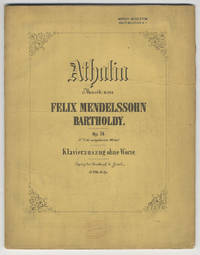
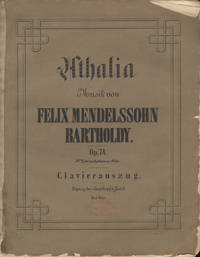
185236207Leipzig: Breitkopf & Härtel PN 7884 1852. Folio. Original publisher's yellow wrappers. 1f. recto title verso blank 3-51 i blank pp. Engraved. Overture with plate number 7899 from the piano-vocal score. With publisher's catalog "Publications Nouvelles pour le Pianoforte" to verso of lower wrapper.<br /> <br /> Wrappers somewhat worn soiled and split. Slightly worn and browned; occasional foxing. First Edition. MWV M16 p. 213. Scarce 1 copy only located in the U.S. at the Carnegie Library Pittsburgh. Not in Krause Catalogue of the Mendelssohn Papers in the Bodleian Library or Hoboken.<br /> <br /> Mendelssohn composed his incidental music for a production of Jean Racine's Athalie 1691 commissioned by King Friedrich Wilhelm IV of Prussia. It was staged for the court at the Charlottenburg Palace in Berlin on 1 December 1845. <br /> <br /> "Though little-known today the music for Athalie merits performance. Especially striking are Mendelssohn's paraphrases of chorales including Ach Gott vom Himmel sieh' darein and in a scene in which the high priest Joad describes a vision of the New Jerusalem Vom Himmel hoch.<br /> <br /> "One of the most gifted and versatile prodigies Mendelssohn stood at the forefront of German music during the 1830s and 40s as conductor pianist organist and above all composer. His musical style fully developed before he was 20 drew upon a variety of influences including the complex chromatic counterpoint of Bach the formal clarity and gracefulness of Mozart and the dramatic power of Beethoven and Weber.<br /> <br /> Mendelssohn's emergence into the first rank of 19th-century German composers coincided with efforts by music historiographers to develop the concept of a Classic-Romantic dialectic in 18th and 19th-century music. To a large degree his music reflects a fundamental tension between Classicism and Romanticism in the generation of German composers after Beethoven." R. Larry Todd in Grove Music Online. Breitkopf & Härtel [PN 7884] unknown
185136208Leipzig: Breitkopf & Härtel PN 7899 1851. Folio. Original publisher's brown wrappers with titling within decorative border. 1f. recto title verso blank 3-93 i blank pp. Engraved. Text in German and French.<br /> <br /> Scharfenberg & Luis New York handstamp to blank lower margin of upper wrapper and again to lower margin of title along with publisher's stamp.<br /> <br /> Wrappers quite worn and chipped; spine reinforced with tape. Slightly browned; edges of some leaves chipped. First Edition later issue. MWV M16 p. 213. Krause 8. Catalogue of the Mendelssohn Papers in the Bodleian Library III 316. Not in Hoboken.<br /> <br /> Mendelssohn composed his incidental music for a production of Jean Racine's Athalie 1691 commissioned by King Friedrich Wilhelm IV of Prussia. It was staged for the court at the Charlottenburg Palace in Berlin on 1 December 1845. <br /> <br /> "Though little-known today the music for Athalie merits performance. Especially striking are Mendelssohn's paraphrases of chorales including Ach Gott vom Himmel sieh' darein and in a scene in which the high priest Joad describes a vision of the New Jerusalem Vom Himmel hoch.<br /> <br /> "One of the most gifted and versatile prodigies Mendelssohn stood at the forefront of German music during the 1830s and 40s as conductor pianist organist and above all composer. His musical style fully developed before he was 20 drew upon a variety of influences including the complex chromatic counterpoint of Bach the formal clarity and gracefulness of Mozart and the dramatic power of Beethoven and Weber.<br /> <br /> Mendelssohn's emergence into the first rank of 19th-century German composers coincided with efforts by music historiographers to develop the concept of a Classic-Romantic dialectic in 18th and 19th-century music. To a large degree his music reflects a fundamental tension between Classicism and Romanticism in the generation of German composers after Beethoven." R. Larry Todd in Grove Music Online. Breitkopf & Härtel [PN 7899] unknown