360 résultats
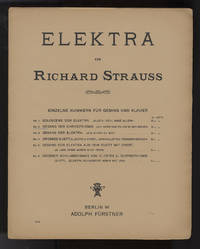
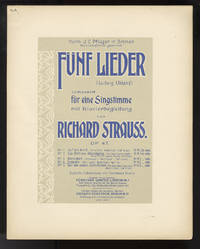
190034538Berlin: Adolph Fürstner 1900. 5 folios with original publisher's wrappers series titling to uppers publisher's advertisements to lowers.<br/><br/>Includes:<br/>No. 1: Auf ein Kind. PN 5798. 5 pp.<br/>No. 2: Des Dichters Abendgang. PN 5802. 11 pp.<br/>No. 3: Rückleben. PN 5796. 9 pp.<br/>No. 4: Einkehr. PN 5796. 9 pp.<br/>No. 5: Von den sieben Zechbrüdern. PN 5166. 23 pp.<br/><br/>With printed dedication to "Herrn J.C. Pflüger in Bremen freundschaftlichst gewidmet." small handstamps to upper left corners of uppers.<br/><br/>Somewhat worn and browned more significantly to no. 1. First Edition first issue of no. 5 the others later issues. TrV 200. Adolph Fürstner unknown books
190124697Berlin: Adolph Fürstner PN A.5206F. 1901. Folio. Quarter dark brown leather with dark brown textured cloth boards original publisher's upper wrapper illustrated by Max Tilke printed in blue red and black laid down to upper. 1f. recto title verso blank i cast list i blank 3-201 i blank. Text in German. Printer's mark to lower right corner of p. 201: "Stich und Druck von C.G. Röder Leipzig." With plate numbers "A.5202.5206 F." to cast list. <br/><br/>Binding slightly worn rubbed and bumped; head of spine slightly defective. Minimally foxed; occasional browning and thumbing; publisher's handstamp to foot of title. First Edition first issue. Trenner 203. Mueller von Asow p. 307.<br/><br/>First performed at the Königliches Opernhaus in Dresden on November 21 1901 with Ernst von Schuch conducting. <br/><br/>"Despite its risqué text Feuersnot boasted distinguished interpreters from the start: in Dresden the cross-grained lovers were Annie Krull and Karl Scheidemantel destined respectively to be Strauss's original Electra and the first Rosenkavalier Faninal in Vienna Leopold Demuth sang the hero while Mahler conducted and Berlin fielded Emmy Destinn as the anti-heroine. Since then at least in Bavaria and adjacent regions the opera has kept a toehold in the repertory." Bryan Gilliam and Charles Youmans in Grove Music Online<br/><br/>Tilke 1869-1942 was a noted German artist and illustrator. Adolph Fürstner [PN A.5206F.] unknown books
190427098Berlin: Adolph Fürstner PN A. 5206 F. 1904. Folio. Dark brown cloth with titling gilt. 1f. recto title verso blank 1 cast list 2 blank 3-201 i blank. Text in German. Printer's mark to lower right corner of p. 201: "Stich und Druck von C.G. Röder Leipzig." With plate numbers "A.5202.5206.5250 F." to cast list. Publisher's handstamp to foot of title.<br/><br/>Signature "F. Nicolics" dated Vienna March 3 1904 in black ink to title.<br/><br/>Binding slightly worn rubbed and bumped. Slightly browned throughout. First Edition second issue. Trenner 203. Mueller von Asow p. 307. The first issue 1901 lacks the third plate number 5250 to the cast list; this number refers to Otto Singer's arrangement for piano without vocal parts.<br/><br/>First performed at the Königliches Opernhaus in Dresden on November 21 1901 with Ernst von Schuch conducting. <br/><br/>"Despite its risqué text Feuersnot boasted distinguished interpreters from the start: in Dresden the cross-grained lovers were Annie Krull and Karl Scheidemantel destined respectively to be Strauss's original Electra and the first Rosenkavalier Faninal in Vienna Leopold Demuth sang the hero while Mahler conducted and Berlin fielded Emmy Destinn as the anti-heroine. Since then at least in Bavaria and adjacent regions the opera has kept a toehold in the repertory." Bryan Gilliam and Charles Youmans in Grove Music Online. Adolph Fürstner [PN A. 5206 F.] unknown books
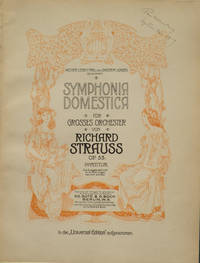
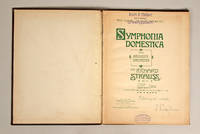
190424642Berlin: Bote & Bock PN 15613 1904. Large octavo. Full leather with titling gilt. i title within decorative border printed in sepia 2 list of orchestral instruments 3-123 i blank pp. <br/><br/>Printed note to foot of title: "In die "Universal-Edition" aufgenommen." No plate number to p. 42.<br/><br/>Former owner's signature in pencil to upper right corner of title: "Paul Weinberg September 1919." <br/><br/>Closely trimmed with loss to plate number on p. 39. First signature partly detached. Slightly browned. First Edition of the study score issued simultaneously with the conductor's score. Trenner 209. Mueller von Asow p. 335. <br/><br/>Composed in 1902-1903; first performed in New York with Strauss conducting on March 21st 1904. "The Symphonia domestica inspired at first even more controversy than Ein Heldenleben. Originally titled Mein Heim: ein sinfonisches Selbst- und Familienporträt the work was always referred to by Strauss as a symphony or symphonic poem and there are indeed four sections that correspond loosely to symphonic movements: introduction presentation of major characters and their themes scherzando child at play his parents' happiness cradle song and Adagio child is put to bed thereafter a parental love scene and finale in the form of a double fugue a new day begins with quarrelling and happy reconciliation." Bryan Gilliam in Grove Music Online. Bote & Bock [PN 15613] unknown books
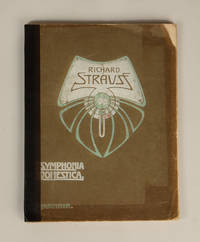
190434526Berlin: Ed. Bote & G. Bock PN 15615 1904. Folio 330 x 265 mm. Contemporary black cloth boards with original publisher's green wrapper with stylized titling laid down to upper. 1 title 79 pp. 1f. blank.<br/><br/>With printed dedication "Meiner lieben frau und unsern Jungen gewidmet" to head of title. <br/><br/>Binding somewhat worn and scuffed; spine lacking; upper mostly detached; handstamps to upper board title and lower flyleaf "Raabe & Plothow ." Slightly browned; a few minor performance markings in pencil. First Edition of this arrangement. TrV 209. Mueller von Asow I p. 335. Ed. Bote & G. Bock [PN 15615] unknown books
190434543Berlin: Ed. Bote & G. Bock PN 15613 1904. Small quarto 260 x 200 mm. Original publisher's decorative olive green wrappers with stylized embossed titling to upper. 1 title 123 pp.<br/><br/>With printed dedication "Meiner lieben frau und unsern jungen gewidmet" to upper margin of title. <br/><br/>Wrappers somewhat worn and scuffed; spine reinforced with black binder's tape; creases and tears with minor loss. Lightly browned. Several performance markings in pencil. First Edition in this format. TrV 209. Mueller von Asow I p. 335.<br/><br/>The Symphonia Domestica premiered in New York at Carnegie Hall on 12 March 1904 by the Wetzler Symphony Orchestra conducted by the composer. Ed. Bote & G. Bock [PN 15613] unknown books
183214221Wien: Tobias Haslinger PN T.H. 6063 1832. Oblong folio. Unbound as issued spine reinforced. i title 2-11 pp. Engraved. <br/><br/>Spine reinforced. Occasional staining light foxing and soiling; paper loss to first leaf repaired with no loss of music. First Edition. Weinmann p. 14. Tobias Haslinger [PN T.H. 6063] unknown books
190934535Berlin W - Paris: Adolph Fürstner 1909. BESL Carl arranger. Folio. Original publisher's brown printed wrappers with series titling to upper. <br/><br/>Includes:<br/>No. 1. Soloscene der Elektra. "Allein! Weh ganz allein" A. 5657.5658 F. 1 title 15 16 advertisement pp.<br/>No. 2. Gesange der Chrystothemis. "Ich hab's wie in der brust" A. 5658.5685 F. 1 title 11 12 advertisement pp.<br/><br/>Wrappers browned and slightly brittle; partially detached. Later issue. TrV 223. Muller von Asow I p. 409. <br/><br/>Elektra premiered in Dresden at the önigliches Opernhaus on 25 January 1909.<br/><br/>"The music of Elektra is often diagnosed as marking an 'advanced' point - i.e. on the way to modernist atonality - from which the composer then staged a prudent inglorious retreat. That bespeaks a prejudice which he never espoused. Though passages in the opera share the queasy harmonic climate of Schoenberg's op.11 no.2 piano piece 1909 Strauss felt no natural urge towards atonality as the Music of the Future. The sporadic 'atonalisms' in Elektra as in his Ophelia songs were meant to convey the exacerbated spiritual condition of his characters not to promote some more radical cause. .The apparent similarities between Elektra and say Schoenberg's atonal Erwartung also 1909 lie in their violent extremes - of vocal line and histrionic moods of dynamics and post-Romantic orchestration. Strauss's score however absolutely presupposes a secure tonal norm against which to measure its harsh disorientating dramatic effects for an audience with late Romantic ears." David Murray in Grove Music Online. Adolph Fürstner unknown books
190824699Berlin: Adolph Fürstner PN A.5654F 1908. Folio. Quarter dark red cloth with decorative paper boards. i title i blank i "Dramatis Personae" i blank 5-250 pp. Photographic transfer from engraved plates. Printer's mark to lower right corner of p. 250: "Stich und Druck von C. G. Röder G.m.b.H. Leipzig." Text in German. With illustration by Lovis Corinth to upper half of page 5. <br/><br/>Annotations instrumental cues vertical lines clarifying rhythm notational corrections indications of cuts etc. in pencil in German. The second digit of the printed price "M 20.-" erased and corrected in pencil. Handstamp of the Munich antiquarian Carl Lischer to foot of title.<br/><br/>Original wrappers with full-page illustration by Lovis Corinth to upper lacking; preliminary leaves frayed at upper edge; Lischer handstamp trimmed. First Edition probable first issue without the additional plate numbers to foot of page 3 and also without the statement "Aufführungsrecht vorbehalten" to foot of page 5. Trenner 223. Mueller von Asow p. 409. <br/><br/>The present copy was apparently used by a rehearsal accompanist.<br/><br/>First performed on January 25 1909 at the Königlichen Opernhaus in Dresden under Ernst von Schuch. <br/><br/>"Elektra. marked the beginning of Strauss's artistic association with Hugo von Hofmannsthal whom he had first met in Berlin in 1899. Having seen Reinhardt's riveting production of Hofmannsthal's Elektra in the autumn of 1905 Strauss was convinced the play would make a compelling opera. Not entirely sure he should compose consecutive tragedies he nonetheless gave in to Hofmannsthal's pleading and vigorously began composing Elektra in the summer of 1906. As he had with Oscar Wilde's Salome he set the play to music which was finished in 1908 and given its première in 1909 as part of a Strauss opera festival in Dresden. Elektra failed to outshine her flashier sister but confirmed Strauss's pre-eminence among German opera composers." Bryan Gilliam in Grove Music Online. Adolph Fürstner [PN A.5654F] unknown books
193521130Berlin: Adolph Fürstner PN A.5654F. 1935. Folio. Original publisher's full gray cloth. i title ii blank iii "Dramatis Personae" iv blank 5-250 pp. Text in German. With illustration by Lovis Corinth to page 5. <br/><br/>Binding very slightly worn and rubbed. Trenner 223. Mueller von Asow p. 409. <br/><br/>First performed on January 25 1909 at the Königlichen Opernhaus in Dresden under Ernst von Schuch. <br/><br/>"Elektra . marked the beginning of Strauss's artistic association with Hugo von Hofmannsthal whom he had first met in Berlin in 1899. Having seen Reinhardt's riveting production of Hofmannsthal's Elektra in the autumn of 1905 Strauss was convinced the play would make a compelling opera. Not entirely sure he should compose consecutive tragedies he nonetheless gave in to Hofmannsthal's pleading and vigorously began composing Elektra in the summer of 1906. As he had with Oscar Wilde's Salome he set the play to music which was finished in 1908 and given its première in 1909 as part of a Strauss opera festival in Dresden . Elektra failed to outshine her flashier sister but confirmed Strauss's pre-eminence among German opera composers confirmed Strauss's pre-eminence among German opera composers." Bryan Gilliam in Grove Music Online. Adolph Fürstner [PN A.5654F.] unknown books
190821175Berlin: Adolph Fürstner PN A.5654F. 1908. Folio. Original publisher's full gray cloth. i title ii blank iii "Dramatis Personae" iv blank 5-250 pp. Text in German. With illustration by Lovis Corinth to page 5. <br/><br/>Binding worn rubbed and shaken. First Edition early issue without the additional plate numbers to foot of page 3 and also without the statement "Auffügrungsrecht vorbehalten" to foot of page 5. Trenner 223. Mueller von Asow p. 409. <br/><br/>First performed on January 25 1909 at the Königlichen Opernhaus in Dresden under Ernst von Schuch. <br/><br/>"Elektra. marked the beginning of Strauss's artistic association with Hugo von Hofmannsthal whom he had first met in Berlin in 1899. Having seen Reinhardt's riveting production of Hofmannsthal's Elektra in the autumn of 1905 Strauss was convinced the play would make a compelling opera. Not entirely sure he should compose consecutive tragedies he nonetheless gave in to Hofmannsthal's pleading and vigorously began composing Elektra in the summer of 1906. As he had with Oscar Wilde's Salome he set the play to music which was finished in 1908 and given its première in 1909 as part of a Strauss opera festival in Dresden. Elektra failed to outshine her flashier sister but confirmed Strauss's pre-eminence among German opera composers." Bryan Gilliam in Grove Music Online. Adolph Fürstner [PN A.5654F.] unknown books
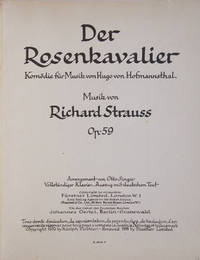
193827099London W.1 . Berlin-Grunewald: Fürstner Limited. Johannes Oertel PN A. 5903 F. et al. 1938. Large folio. Original decorative wrappers. i title i performing rights notice 1 printed dedication to the Pschorr family Strauss's mother's family i blank 3 cast 4 blank 5-442 pp. Prefatory matter and p. 58 in facsimile of the copyist's manuscript. Note to lower right corner of final page of music: "Stich und Druck C.G. Röder Leipzig." Note to foot of title: "Copyright 1910 by Adolph Fürstner - renewed 1938 by Fürstner Limited."<br/><br/>The basic plate number is 5903; several pages carry a second plate number 5929 5931 5932 6000. <br/><br/>Bookplate "ExLibris Reuben Jacobi" to verso of upper wrapper. <br/><br/>Wrappers slightly frayed at edges; spine torn with significant loss and tape repairs to head and tail. Slightly browned; minimally foxed. First Edition later issue. Trenner 227. Müller von Asow p. 468. First issue was 1910. The plate number 6000 refers to the piano-vocal score with French text the other extra numbers to offprints.<br/><br/>In 1933 Otto Fürstner 1886-1958 son of the company's founder emigrated to England and sold the German share of his company to his long-term deputy Johannes Oertel 1879-1961 while continuing his old business from London. Oertel continued used the Fürstner name until ca. 1938 and his own thereafter. Fürstner Limited... Johannes Oertel [PN A. 5903 F. et al.] unknown books
183315081Wien: Tobias Haslinger PN T.H. 6079 1833. Oblong folio. Unbound as issued. 15 pp. Engraved. With decorative title within ruled border. Includes publisher's catalogue. <br/><br/>Contains Der Sanguiniker Der Melancholiker Der Choleriker and Der Phlegmatiker. <br/><br/>Slightly browned. With Fischer overpaste. First Edition. Weinmann p. 12. Schonherr & Reinohl pp. 89-90. Tobias Haslinger [PN] T.H. 6079 unknown books
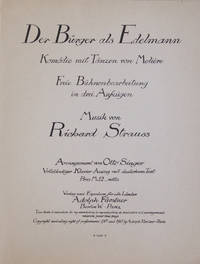
191827094Berlin W. - Paris: Adolph Fürstner PN A.7352.F. et al. 1918. Large folio. Original decorative wrappers printed in dark green and red. 1 title 2 performing rights notice 3 printed dedication by Strauss and Hofmannsthal to Max Reinhardt 4 blank 5 cast i blank 7-125 i blank pp. Prefatory matter in facsimile of the copyist's manuscript. Note to lower right corner of final page of music: "Stich und Druck von C.G. Röder Leipzig."<br/><br/>The basic plate number is 7352. Much of the first two acts has the double plate number 6303.7352 or triple number 6303.6332.7352.; p. 93 act 3 has the odd plate number 7385 only.<br/><br/>Wrappers frayed at edges and spine with some loss to spine. Slightly browned; final signature detached; smudge to p. 42. First Edition of the second version. Trenner 228b. Müller von Asow II p. 599.<br/><br/>Incidental music. First performance of this version at Deutsches Theater Berlin on April 9 1918.<br/><br/>The plates with the numbers 6303 and 6332 are carried over from the original 1912 edition see Müller von Asow II p. 532 which included both the incidental music to Der Bürger als Edelmann and the opera Ariadne auf Naxos first version two works conceived as a double bill and premiered as such at the Kleines Haus in Stuttgart on October 25 1912.<br/><br/>"After Der Rosenkavalier Hugo von Hofmannsthal remained preoccupied with the stylized world of the 17th and 18th centuries especially the work of Molière which had partly inspired the Rosenkavalier libretto. The immediate result was Ariadne auf Naxos 1911-12 a theatrical hybrid combining spoken theatre - a German adaptation of Molière's Le bourgeois gentilhomme Der Bürger als Edelmann with incidental music - and opera. The work first performed in Stuttgart in 1912 fell short of critical acclaim and was revised to greater success four years later when Strauss and Hofmannsthal replaced the play with a lively operatic prologue." Bryan Gilliam in Grove Music Online.<br/><br/>The revised Ariadne of Naxos became a repertory piece; the incidental music to Der Bürger als Edelmann is however rarely performed. Adolph Fürstner [PN A.7352.F. et al.] unknown books
185825793Wien: Carl Haslinger qm. Tobias PN 12196 1858. Oblong folio. Disbound. 1f. title 3-11 pp. Music engraved; title lithographed. <br/><br/>Slightly worn browned and foxed; trimmed with some loss to publisher's names to lower margins; signatures detached; small handstamps of former owner M. C. v. Ameyden v. Duym and Dutch music library to title. First Edition with "Ausgabe zu vier Händen" to title. Weinmann: Josef und Eduard Strauss p. 96. Carl Haslinger qm. Tobias [PN 12196] unknown books
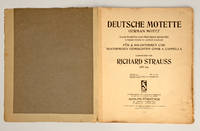
191334554Berlin: Adolph Fürstner PN 7010 1913. Folio. Original publisher's dark gray printed wrappers. 1 title 2 blank 3 dedication to "Professor Hugo Rüdel und dem ausgezeichneten Hoftheatersinchor in Berlin" 4-5 text and translation 62 pp.<br/><br/>With performance markings in pencil and red crayon.<br/><br/>Wrappers considerably worn chipped stained and creased; spine reinforced with black binder's tape; edges reinforced with tape to versos; partially disbound. Uniformly browned; lower outer corners thumbed several torn. First Edition. Scarce. TrV 230. Mueller von Asow II p. 623. <br/><br/>The Deutsche Motette premiered in Berlin on 2 December 1913 conducted by Hugo Rüdel. Adolph Fürstner [PN 7010] unknown books
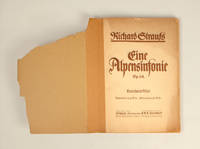
191534549Leipzig: F.E.C. Leuckart PN 7531 1915. Small octavo 240 x 170 mm. Original publisher's brown printed wrappers publisher's advertisement to verso of lower. 1f. recto title verso blank 1f. recto dedication "Dem Grafen Nicolaus Seebach und der Königlichen Rapell zu Dresden" verso instrumentation 3-162 pp.<br/><br/>Wrappers worn and chipped; upper torn with significant loss; spine partially split. Browned; some signatures split. First Edition. TrV 233.<br/><br/>The Alpensinfonie premiered in Berlin on 28 October 1915.<br/><br/>"Despite its philosophical roots Eine Alpensinfonie is outwardly unphilosophical proclaiming with startling beauty the glories of the natural world. It is unparallelled in Strauss's symphonic output both in terms of duration 50 minutes and size requiring over 140 players including offstage brass. Critical reaction after the October 1915 première was mixed; some went as far as to describe it negatively as 'cinema music' a remarkable claim given that film was still a new medium." Bryan Gilliam and Charles Youmans in Grove Music Online. F.E.C. Leuckart [PN 7531] unknown books
183414131Wien: Tobias Haslinger PN T.H. 6706 1834. Oblong folio. Unbound as issued. 1f. title 1-8 pp. Engraved. Decorative title with dedicatee's coat of arms. With Fischer overpaste. <br/><br/>Minor dampstaining. First Edition. Weinmann p. 15. Schonherr & Reinöhl pp. 99-101. <br/><br/>Composed following Strauss's visit to Hungary in 1833. Tobias Haslinger [PN T.H. 6706] unknown books
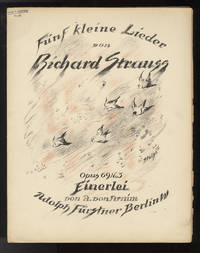
191934542Berlin: Adolph Fürstner PN 7486 1919. Folio. Original publisher's wrappers with lithographic titling and illustration of birds in flight by Stolze printed in black with red highlights to upper. 1 title 2 advertisement 3 text 8 9-10 advertisements pp.<br/><br/>With printed dedication "Frau Mizzi von Grab gewidmet" to head of first page of music.<br/><br/>Wrappers somewhat worn brown and chipped; handstamps "Hoch" and "Made in Germany" to upper left corner of upper. Publisher's handstamp and copyright restriction stamps to p. 4. First Edition. TrV 237. Adolph Fürstner [PN 7486] unknown books
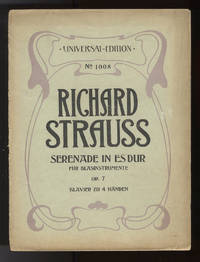
191234550Leipzig: Jos. Aibl PN R.2514.c 1912. Small folio 310 x 240 mm. Original publisher's printed wrappers publisher's advertisement to verso of lower. 1 title 11 pp. Verso or lower wrapper dated XI November 1912.<br/><br/>With printed dedication "Seinem hochverehrten Lehrer Herrn Fr. W. Meyer königl. bayr. Hof-Kapellmeister" to head of title. <br/><br/>Somewhat worn thumbed and chipped; spine partially split. Handstamp to title "Erich Itor & Frida Kahn Collections." Universal Edition reprint of the first edition of this arrangement. UE 1008. TrV 106. Jos. Aibl [PN R.2514.c] unknown books
193129543Berlin: Adolph Fürstner PN A. 7903 F. 1931. Folio. Original publisher's decorative ivory wrappers with titling in ivory on a black ground. i title ii statement regarding performance rights iii dedication iv blank v "Personen" vi blank pp. 5-336. Text in German. <br/><br/>Wrappers very slightly worn. Lower outer corners slightly bumped. A very good copy overall. First Edition second issue. Trenner 255. Mueller von Asow p. 821. Crawford p. 485. With additional plate numbers to foot of pp. ii and v. The dedication leaf not present in the first issue was added to this issue.<br/><br/>First performed at the Staatsoper in Dresden on June 6 1928 with Fritz Busch conducting and in a revised version at the Festspielhaus in Salzburg on August 14 1933.<br/><br/>"Strauss's score is loyally inventive. The 'thematic transformations' are endless the orchestral pictures fresh the pace well varied. If the musical tagging of every dramatic element sounds like period routine the opera has a saving lyrical grace: more relaxed and fluid than either his preceding Hofmannsthal opera Die Frau ohne Schatten or the more recent Intermezzo to his own text." David Murray in Grove Music Online. Adolph Fürstner [PN A. 7903 F.] unknown books
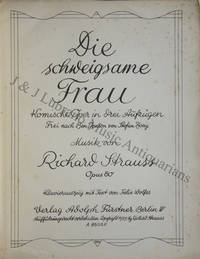
193526092Berlin: Adolph Fürstner PN A. 8303 F.; A. 8303.8308 F. 1935. Large folio. Modern blue cloth with original wrappers printed in dark red and olive green bound in. i title i copyright notice 1f. cast list 460 pp. <br/><br/>The plate number "A. 8303.8308 F." is found on the pages corresponding to the orchestral prelude entitled "Potpourri" pp. 5-16. Printer's note "Stich u. Druck v. Oscar Brandstetter Leipzig-Berlin" to lower margin of final page.<br/><br/>Binding very slightly bumped; wrappers browned. Slightly foxed. First Edition. Trenner no. 265 p. 307. Mueller von Asow IIk p. 922. OCLC no. 5186816.<br/><br/>Die Schweigsame Frau to a libretto by Stefan Zweig after Ben Jonson's play Epicoene was first performed at the Staatsoper in Dresden on June 24 1935. "Despite a notable cast Karl Böhm conducted Cebotari's Aminta the 61-year-old Plaschke's Morosus Martin Kremer's Henry and Matthieu Ahlersmeyer's Barber the opera had a fraught première. Even in 1935 Strauss had to battle with Nazi officialdom to get his Jewish librettist acknowledged on the Dresden Opera handbills whereupon Hitler and Goebbels decided not to attend." The opera was banned after only four performances. David Murray and Bryan Gilliam in Grove Music Online. Adolph Fürstner [PN A. 8303 F.; A. 8303.8308 F.] unknown books
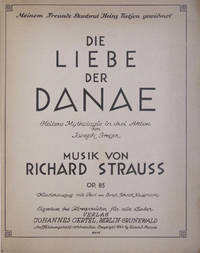
194427105Berlin-Grunewald: Johannes Oertel PN 8403 1944. Large folio. Original orange printed wrappers with decorative titling. 1 title 2 performing rights notice 3 cast 4 blank 5-336 pp. Date of composition printed at conclusion of music: "Garmisch 28. Juni 1940." <br/><br/>Printed dedication to head of title to Heinz Tietjen. <br/><br/>Wrappers slightly worn and soiled; spine slightly frayed. Browned. First Edition. Trenner 278. Müller von Asow p. 1015. <br/><br/>The last opera of Richard Strauss to be produced but not composed. The premiere was planned for the Salzburg Festival 1944 but all theatrical performances were canceled by Goebbels in response to war-time developments. A dress rehearsal with an invited audience including Strauss was held on August 16 1944. The premiere was delayed until August 14 195 again at the Salzburg Festival with the same conductor Clemens Krauss but a different cast.<br/><br/>"As far back as 1920 Strauss's great collaborator Hofmannsthal had proposed Danae as the heroine of a mythological opera. After the writer's untimely death in 1929 the composer. asked Joseph Gregor in 1936 to develop the Danae idea. There was long painful rewriting and as usual the composer wounded his subservient partner by taking outside advice. and thrusting it upon him. The score was finished in June 1940. Strauss was reluctant to see this 'oeuvre posthume' staged during his lifetime and after the 1944 première meant to celebrate his 80th birthday was aborted by Goebbels when the Allies' Second Front threatened he never sanctioned another performance." David Murray in Grove Music Online. Johannes Oertel [PN 8403] unknown books
183622048Wien: Tobias Haslinger PN T.H. 6902 1836. Oblong folio. Unbound as issued. 10 pp. Engraved. With decorative vignette to title. <br/><br/>Edges slightly browned and creased. First Edition. Weinmann p. 17. Schönherr & Reinöhl p. 128. Tobias Haslinger [PN] T.H. 6902 unknown books
183714134Wien: Tobias Haslinger PN T.H. 7061 1837. Oblong folio. Unbound as issued. 10 pp. Engraved. With decorative vignette to title. <br/><br/>Slightly soiled. First Edition. Weinmann p. 18. Schonherr & Reinöhl pp. 140-142. Tobias Haslinger [PN] T.H. 7061 unknown books