Schutz, Bernard,Biblio.com

2 095 résultats
697487-nnew. unknown
2022x-3658357339Vs Verlag Fur Sozialwissenschaften 2022. Paperback. New. 257 pages. German language. 8.27x5.83x0.55 inches. Vs Verlag Fur Sozialwissenschaften paperback
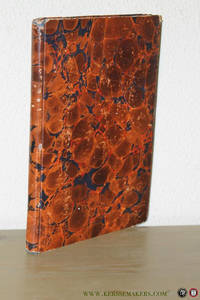
64159Wiesbaden Verlag von Wilhelm Roth. 1853 VIII174S. Mit 1 mehrfach gefalteten Tabelle Reihenfolge der Regenten und 1 gefalteten Karte Gebiet Herzogthums Nassau im Jahre1798. Gebunden in nicht Original marmorierte Papp-Einband ohne Originalumschlag. Gut erhalten. Name / Text / Stempel auf Vorsatzblätter und Titelblatt. Papier minimal stockfleckig. Einband etwas berieben. Siehe Bilder. Wiesbaden, Verlag von Wilhelm Roth unknown
0126836302.Ghardcover. Good. Access codes and supplements are not guaranteed with used items. May be an ex-library book. hardcover
2010x-3531172832Vs Verlag 2010. Paperback. New. 204 pages. German language. 8.20x5.80x0.47 inches. Vs Verlag paperback
3954259486.Gpaperback. Good. Access codes and supplements are not guaranteed with used items. May be an ex-library book. paperback
3531025708.Gpaperback. Good. Access codes and supplements are not guaranteed with used items. May be an ex-library book. paperback
1982Q-0878462112Museum of Fine Arts Boston 1982-01-01. Hardcover. New. In shrink wrap. Looks like an interesting title! Museum of Fine Arts, Boston hardcover
20040789208296Abbeville Press 2004. New/New. <p><strong>Author:</strong> Bernhard Schütz</p><p><strong>Publisher:</strong> Abbeville Press</p><p><strong>ISBN:</strong> 9780789208293</p><p><strong>Release Date:</strong> 2004</p><p><strong>Languages:</strong> English</p><p><strong>Binding:</strong> Hardcover</p><p><strong>Number Of Pages:</strong> 480</p><p><strong>Details:</strong> This unsurpassed survey offers a fresh chronicle of a largely overlooked subject and hundreds of marvelous images many of them newly photographed of more than 150 of the most interesting and best preserved monasteries in Spain Portugal France Great Britain Germany Switzerland Austria Poland the Czech Republic and Italy―all of which are accessible to visitors. Here are unique views of the art and architecture of such treasured places as Mont St. Michel a wondrous Benedictine sanctuary off the coast of Brittany and the fabled pilgrimage site in Assisi founded by St. Francis. In an insightful text the author describes the cultural heritage of each of the monasteries portrayed and provides an introduction to monasticism and to the various orders dating from the early Christian era to the present. In addition the volume offers plans of the sites a glossary and a bibliography. Historians and collectors of great books of art history will be intrigued by this unsurpassed collection of photographs and fascinating account of the artistic glory of European monasteries. Excerpt. © Reprinted by permission. All rights reserved. Excerpt from Great Monasteries of Europe <br>Preface<br> <br>Monasteries are places for monastic life havens for the renunciation of the world for prayer and the eternal praise of God for silence asceticism and obedience. A monastery is the architectural expression of a life ordered by strict rules. Because of the extensive real estate of the complex a monastery could also be a self-sufficient profitable economic enterprise that produced goods for its own use and for sale. This provided some monastic communities with enormous wealth over the years.<br> <br>Monasteries were essential to Europe's history. In the Middle Ages and even into the modern era in certain regions they were among the most important pioneering cultural institutions of the era following antiquity and the migration of nations when the Occident began to form. Monasteries and their monks ensured that Christianity was introduced and established solid roots forming the foundation for the entire culture. Education science and art were all the responsibility of the Church and were disseminated in the cathedral schools and perhaps even more so in the monasteries. Monasteries increasingly became institutions that supported the state: the body politic and the monarchy relied on them and even used them for administrative tasks and other royal services.<br> <br>Over the centuries monasteries yielded tremendous architectural achievements. It is scarcely possible today to sense how important these were since what survives is only fragmentary yet those structures and remains are still greatly admired. The monks almost always sought out charming landscapes for their settlements and it is no coincidence that a brisk tourist trade has developed around monasteries throughout Europe regardless of which period or order produce them.<br> <br>In art too there achievements was immeasurable especially during the Middle Ages. As sites for education science and historiography monasteries usually had several scriptoria for producing books and copying ancient and modern texts thus employing bookbinders calligraphers and miniaturists. Many complexesfor example Tours Reichenau and Fuldawere famous schools for book illumination. Calligraphers and painters were held in such great esteem that they were entitled to include their names or even their portraits in the codices they prepared. Some monasteries maintained workshops for sculpture painting and highly specialized branches of metalwork ranging from gold work to large-format chased or cast objects as was the case in Helmarshausen an der Diemel for example. Nunneries cultivated the textile arts.<br> <br>This book is not intended as an assessment of the spiritual life of monasticismthat would be its own theological themebut primarily it's architecture and in a few selected examples its art. The text summarizes the history of various orders and presents illustrations descriptions and historical background of the important monasteries in order to present the beauty and the variety of the buildings. This picture however is necessarily fragmentary since of course not all monasteries could be included and in many cases little more than the church survives of the original grounds. Those examples have also been represented here however since the church was always the monastery’s most important building. This overview is limited to those countries in Europe where the sphere of activity of the Roman Church was significant and is generally organized by region or country and then geographically. The organization differs somewhat in the chapter about Central Europe as this area was once dominated by the Holy Roman Empire and it seemed more relevant to reflect cultural history rather than current political designations. The Counter-Reformation ordersthe Jesuits for examplehave been left out because they were not monastic orders thus their settlements were not monasteries in the strict sense.<br> <br>The state of monastic architecture today varies widely among individual European countries. In England due to the ecclesiastical policies of Henry VIII nearly everything lies in ruins or was destroyed entirely. France the center of monastic culture during the high Middle Ages still has the greatest density of important monastery buildings from the Romanesque to the Gothic despite the damage done during the French Revolution. Monastic culture in Spain and Portugal developed only after the Reconquista the reconquest from the Moors and in a late period increasingly tended toward richness and splendor. In Italy the picture is very uneven but in general the emphasis was on decoration such as fresco cycles. In the countries of the Holy Roman EmpireGermany the Netherlands and Belgium Switzerland Austria and the Czech Republicmonastic culture ended abruptly with the Reformation. In the Catholic regions of Southern Germany and in the Habsburg lands as far east as Poland however monasteries experienced a unique late flowering that did not take place elsewhere in Europe. Except for several examples the modern era is not covered in the sections on the other European countries.<br> <br>MUNICH<br>Bernard Schütz<br></p> Abbeville Press hardcover
1978Q-0883960281Blue Mountain Arts 1978-02-01. Hardcover. New. New. In shrink wrap. Looks like an interesting title! Blue Mountain Arts hardcover
20081-3639075560Vdm Verlag Dr. Müller 2008. Paperback. New. 84 pages. German language. 8.66x5.91x0.19 inches. Vdm Verlag Dr. Müller paperback
20081-3639103572Vdm Verlag Dr. Müller 2008. Paperback. New. 112 pages. German language. 8.66x5.91x0.26 inches. Vdm Verlag Dr. Müller paperback
2002000041Harry N. Abrams 2002-12-01. hardcover. Very Good. 11x1x13. Hardcover in dust jacket. Pages clean unmarked. Cover and jacket have light wear with some sunning to edges of jacket flaps. Shipped boxed with tracking and signature confirmation. Asst15 Harry N. Abrams hardcover
20001325262PN. New. 2000. Soft Cover. Date is original print. This is a reprint edition . PN paperback
1788505663G. I. Goschen 1788. Second Edition. Hardcover. VERY GOOD. 7 4-250pp. 12mo gray paper over boards with green hand-written spine label. Woodcut to first heading. Ex-libris Bibliotheca Juvenatus P. G. with their stamps to title page. Moderate foxing as typical of this paper very clean and fresh otherwise with tight binding. G. I. Goschen hardcover
20061345816PN. New. 2006. Soft Cover. This is a reprint edition. . PN paperback
20001329035PN. New. 2000. Soft Cover. Date is original print. This is a reprint edition . PN paperback
1992Q-0446393177Grand Central Publishing 1992-06-01. Paperback. New. New. In shrink wrap. Looks like an interesting title! Grand Central Publishing paperback
3838605462.Gpaperback. Good. Access codes and supplements are not guaranteed with used items. May be an ex-library book. paperback
43583742-nnew. unknown
3382057697.Ghardcover. Good. Access codes and supplements are not guaranteed with used items. May be an ex-library book. hardcover
50940166-nnew. unknown
3639334655.Gpaperback. Good. Access codes and supplements are not guaranteed with used items. May be an ex-library book. paperback
3540186336.Gpaperback. Good. Access codes and supplements are not guaranteed with used items. May be an ex-library book. paperback
3368395475.Ghardcover. Good. Access codes and supplements are not guaranteed with used items. May be an ex-library book. hardcover