2 650 résultats
In-12, plein veau marbré de l'époque, dos lisse orné de compartiments cloisonnés et fleuronnés, pièce de titre de maroquin bordeaux, tranches rouges, xii, 356 p. et (4) p. d'approbation et privilège, 2 très grands plans dépliants hors texte. Première édition collective illustrée de 2 très grands plans dépliants des villes de Grave et Mayence. En juillet 1674, les Hollandais mirent le siège pendant 93 jours devant Grave dans le Brabant-Septentrional, ville occupée par les français depuis 1672. Les pertes furent considérables des deux côtés. Fin octobre, le gouverneur de la place, le marquis de Chamilly, reçut l’ordre du roi de se rendre. Ce qui restait de la garnison défila devant l’armée hollandaise qui lui rendit les honneurs et le Prince Guillaume III d'Orange récupéra la ville le 28 octobre 1674. Le siège de Mayence se déroula du 1er juin au 8 septembre 1689, pendant la guerre de la Ligue d’Augsbourg. "Récit méthodique, composé par un témoin oculaire. Exposé par ordre chronologique. Correct, froid, très détaillé et très utile" (Sources de l’Histoire de France, n° 3973). Petite étiquette imprimée à l’époque de la librairie Cellot et Jombert, "Rue Dauphine, la seconde porte cochère à droite par le Pont-Neuf, au fond de la cour". Bel exemplaire, frais, très bien relié à l’époque.
207084Paris, Imprimerie Nationale, 1792 in-8, 15 pp., broché sous couverture factice de papier azur du XIXe s.
69597P., Librairie Militaire Dumaine, 1876, in 8° relié demi-chagrin à coins, dos à nerfs, 80 pages ; rares pâles rousseurs.
244181S.l., 1789 2 tomes en un vol. in-8, [2] ff. n. ch., 175 pp., [2] ff. n. ch., 208 pp., demi-basane blonde à coins, dos à nerfs cloisonné et fleuronné, tranches vertes, gardes fixes de papier rose à motifs fantaisie (reliure de l'époque). Charnières entièrement fendues, coiffes rognées, coins abîmés.
183528453ABErfurt, Müller 1835. Gr.8°. 2 Bll., 876 S. HLdr der Zt mit grünem Rückenschild und Rückenvergoldung. Einband restauriert, geringf. Ergänzung. Teils gebräunt, teils leicht stockfleckig, Vorsätze leimschattig. Zum Ende schwach wasserrandig. (=Vollständiges geographisch-statistisch-topographisches Wörterbuch des preußischen Staates).
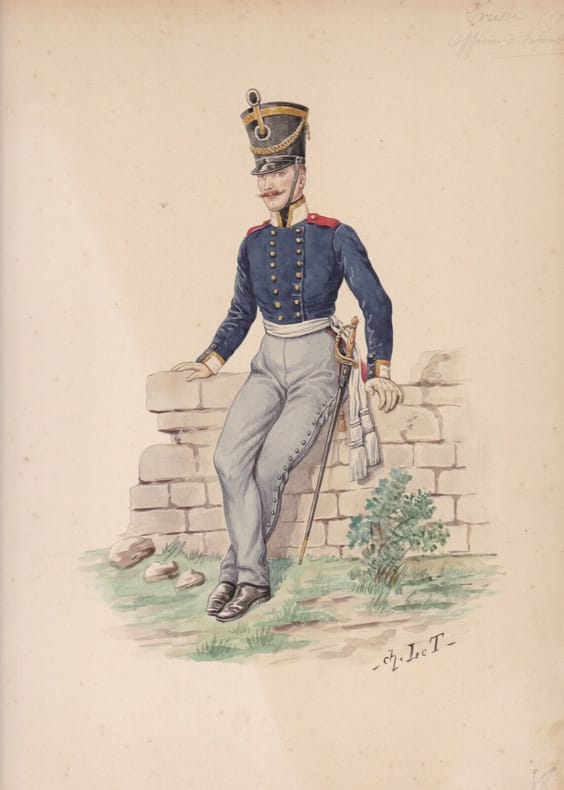
017296Charles Le Tourneur (ou Letourneur), artiste actif vers 1900. Aquarelle originale titrée : Prusse (1812) - Officier d'Infanterie. Dimensions : 315*235mm environ. L'aquarelle a été faite vraisemblablement en 1900 lors de l'Exposition Universelle de Paris où l'Allemagne avait fait une rétrospective des uniformes du XIXe siècle. Aquarelle bien conservée sur un papier cartonné. L'aquarelle étant plus grande que le scan, on ne voit pas les bords. Il peut y avoir de petits manques sur les bords, sans atteinte au dessin. [295]
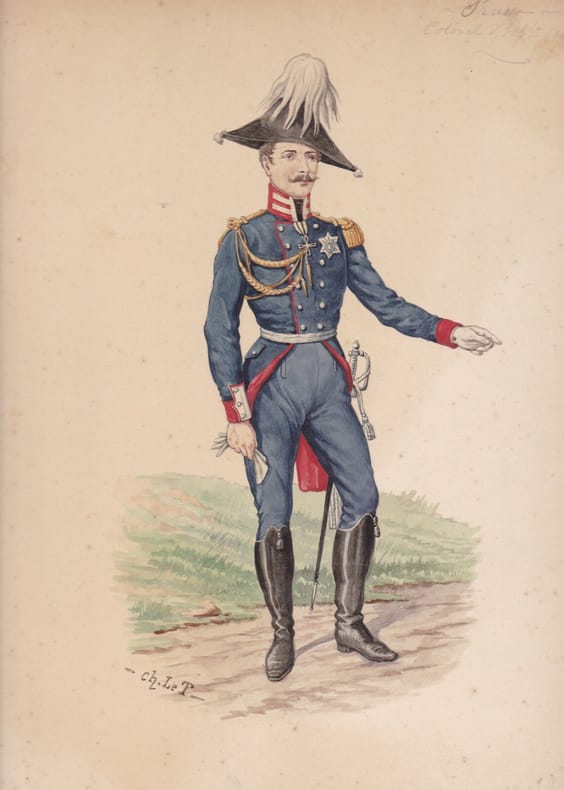
017313Charles Le Tourneur (ou Letourneur), artiste actif vers 1900. Aquarelle originale titrée : Prusse - Colonel d'Infanterie (1812-15) Dimensions : 315*235mm environ. L'aquarelle a été faite vraisemblablement en 1900 lors de l'Exposition Universelle de Paris où l'Allemagne avait fait une rétrospective des uniformes du XIXe siècle. Aquarelle bien conservée sur un papier cartonné. L'aquarelle étant plus grande que le scan, on ne voit pas les bords. Il peut y avoir de petits manques sur les bords, sans atteinte au dessin. [296]
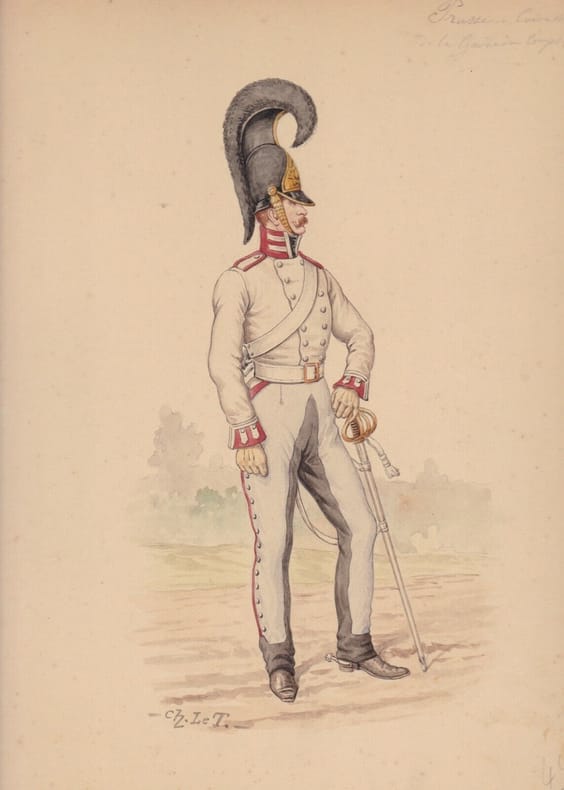
017311Charles Le Tourneur (ou Letourneur), artiste actif vers 1900. Aquarelle originale titrée : Prusse - Cuirassier de la Garde du Corps (1812) Dimensions : 315*235mm environ. L'aquarelle a été faite vraisemblablement en 1900 lors de l'Exposition Universelle de Paris où l'Allemagne avait fait une rétrospective des uniformes du XIXe siècle. Aquarelle bien conservée sur un papier cartonné. L'aquarelle étant plus grande que le scan, on ne voit pas les bords. Il peut y avoir de petits manques sur les bords, sans atteinte au dessin. [296]
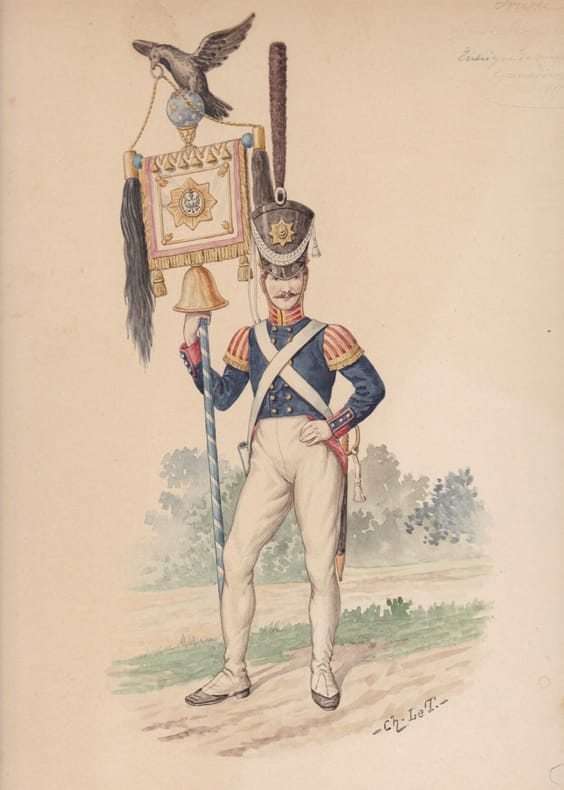
017310Charles Le Tourneur (ou Letourneur), artiste actif vers 1900. Aquarelle originale titrée : Prusse - Garde royale - Enseigne de Musique - Grenadiers en 1815. Dimensions : 315*235mm environ. L'aquarelle a été faite vraisemblablement en 1900 lors de l'Exposition Universelle de Paris où l'Allemagne avait fait une rétrospective des uniformes du XIXe siècle. Aquarelle bien conservée sur un papier cartonné. L'aquarelle étant plus grande que le scan, on ne voit pas les bords. Il peut y avoir de petits manques sur les bords, sans atteinte au dessin. [295]
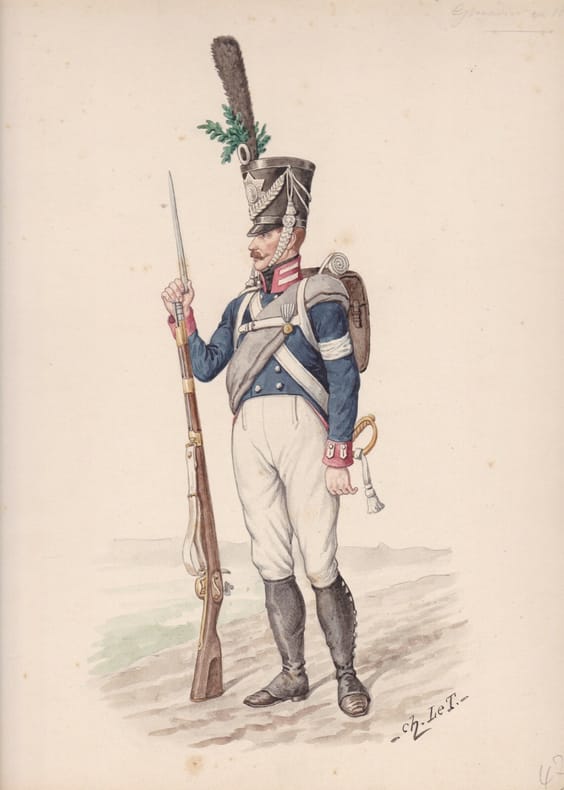
017300Charles Le Tourneur (ou Letourneur), artiste actif vers 1900. Aquarelle originale titrée : Prusse - Grenadier en 1815 Dimensions : 315*235mm environ. L'aquarelle a été faite vraisemblablement en 1900 lors de l'Exposition Universelle de Paris où l'Allemagne avait fait une rétrospective des uniformes du XIXe siècle. Aquarelle bien conservée sur un papier cartonné. L'aquarelle étant plus grande que le scan, on ne voit pas les bords. Il peut y avoir de petits manques sur les bords, sans atteinte au dessin. [296]
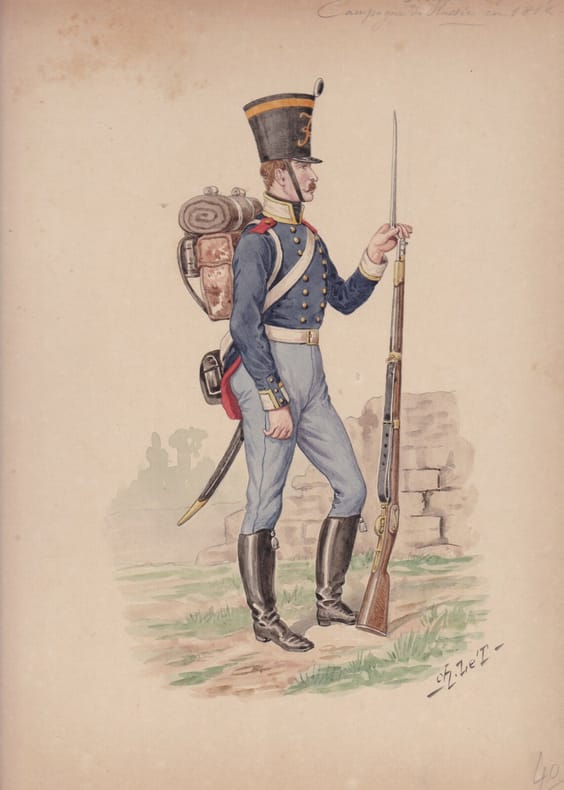
017312Charles Le Tourneur (ou Letourneur), artiste actif vers 1900. Aquarelle originale titrée : Prusse - Infanterie de ligne - Campagne de Russie en 1812. Dimensions : 315*235mm environ. L'aquarelle a été faite vraisemblablement en 1900 lors de l'Exposition Universelle de Paris où l'Allemagne avait fait une rétrospective des uniformes du XIXe siècle. Aquarelle bien conservée sur un papier cartonné. L'aquarelle étant plus grande que le scan, on ne voit pas les bords. Il peut y avoir de petits manques sur les bords, sans atteinte au dessin. [296]
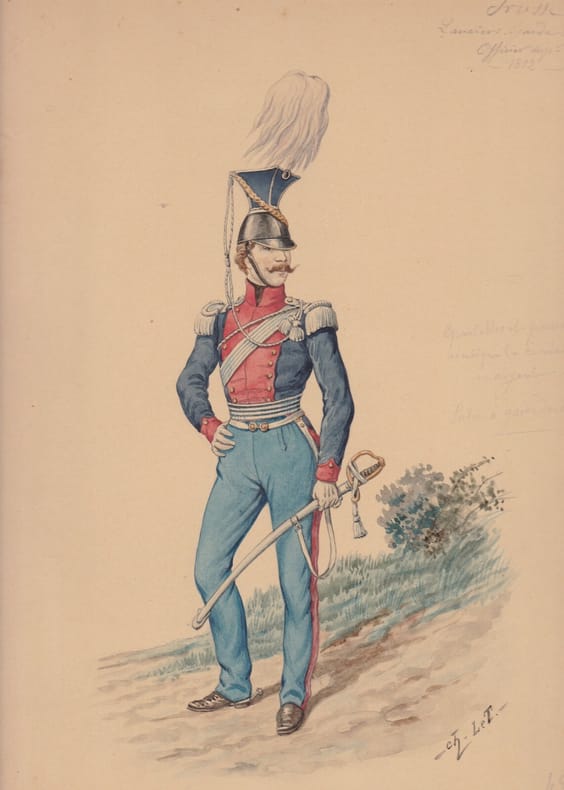
017301Charles Le Tourneur (ou Letourneur), artiste actif vers 1900. Aquarelle originale titrée : Prusse - Lanciers Garde Royale Officier ... 1812 Dimensions : 315*235mm environ. L'aquarelle a été faite vraisemblablement en 1900 lors de l'Exposition Universelle de Paris où l'Allemagne avait fait une rétrospective des uniformes du XIXe siècle. Aquarelle bien conservée sur un papier cartonné. L'aquarelle étant plus grande que le scan, on ne voit pas les bords. Il peut y avoir de petits manques sur les bords, sans atteinte au dessin. [296]
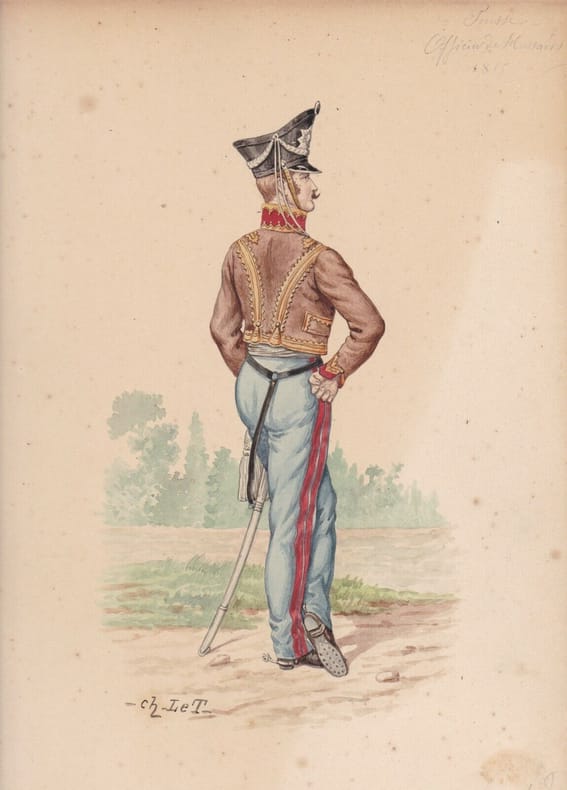
017309Charles Le Tourneur (ou Letourneur), artiste actif vers 1900. Aquarelle originale titrée : Prusse - Officier de Hussards - 1815. Dimensions : 315*235mm environ. L'aquarelle a été faite vraisemblablement en 1900 lors de l'Exposition Universelle de Paris où l'Allemagne avait fait une rétrospective des uniformes du XIXe siècle. Aquarelle bien conservée sur un papier cartonné. L'aquarelle étant plus grande que le scan, on ne voit pas les bords. Il peut y avoir de petits manques sur les bords, sans atteinte au dessin. [295]
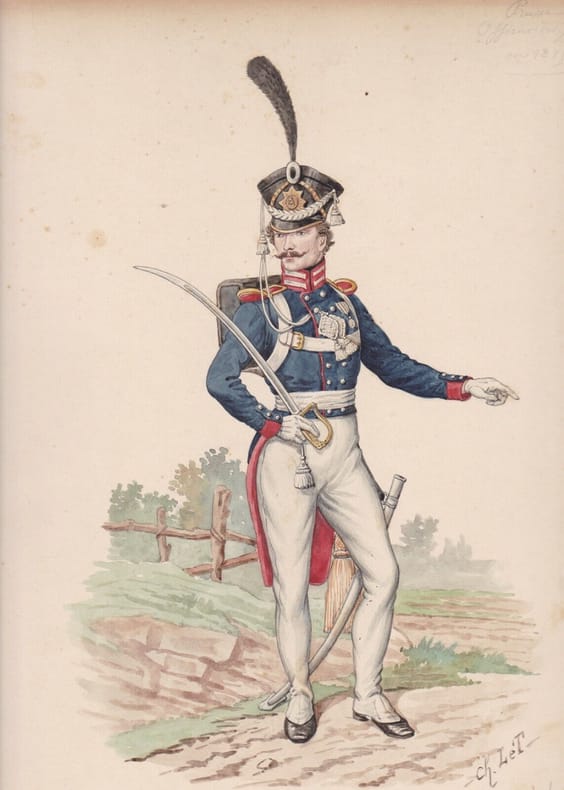
017306Charles Le Tourneur (ou Letourneur), artiste actif vers 1900. Aquarelle originale titrée : Prusse - Officier des Grenadiers en 1815. Dimensions : 315*235mm environ. L'aquarelle a été faite vraisemblablement en 1900 lors de l'Exposition Universelle de Paris où l'Allemagne avait fait une rétrospective des uniformes du XIXe siècle. Aquarelle bien conservée sur un papier cartonné. L'aquarelle étant plus grande que le scan, on ne voit pas les bords. Il peut y avoir de petits manques sur les bords, sans atteinte au dessin. [295]
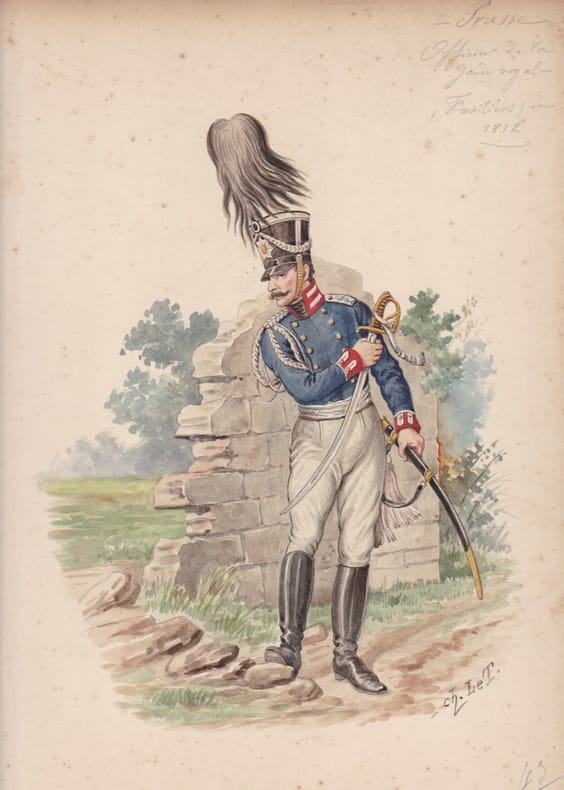
017298Charles Le Tourneur (ou Letourneur), artiste actif vers 1900. Aquarelle originale titrée : Prusse - Officier de la garde royale (fusiliers) en 1812. Dimensions : 315*235mm environ. L'aquarelle a été faite vraisemblablement en 1900 lors de l'Exposition Universelle de Paris où l'Allemagne avait fait une rétrospective des uniformes du XIXe siècle. Aquarelle bien conservée sur un papier cartonné. L'aquarelle étant plus grande que le scan, on ne voit pas les bords. Il peut y avoir de petits manques sur les bords, sans atteinte au dessin. [296]
Fine German Original typescript letter signed 'Souchon', addressed to Capitan, lieutenant colonel Vasif (Wassif) Muhiddin Bey [Kasimpasali]. Wassif Bey was a ship commander of Hamidiye cruiser before Rauf Orbay. 27x21 cm. In German. 1 p. "Kommando der Flotte" letterhead with bilingual in German and Ottoman Turkish. 8 lines. Signed 'Souchon'. This letter includes an indication that it honors the Kaiser (Wilhelm II) with the Iron Cross medal for Commander of Haamidiye, Wassif Bey. "Seine Majestät der Kaiser und König haben Euer Hochwohlgeboren in Anbetracht Ihrer tatkraftigen Arbeit im Interesse der Kriegsbereitschaft und Kriegsbereitschaft und Kriegsbedürfnisse der Marine das Eiserne Kreuz 2. Klasse zu verleihen geruht.". [i.e. His Majesty the Emperor and King have deigned your High Wellbeing to give the Iron Cross 2nd Class to the Navy in view of your hard work in the interest of readiness for war needs.]. Wilhelm Anton Souchon was a German admiral in World War I. Souchon commanded the Kaiserliche Marine's Mediterranean squadron in the early days of the war. His initiative played a major part in the entry of the Ottoman Empire into World War I. Wilhelm Anton Souchon was born on 2 June 1864 in Germany to a family of Huguenot ancestry. In July 1914, hostilities erupted between the Austro-Hungarian Empire and the Kingdom of Serbia. Rear Admiral Souchon, a native of Leipzig, feared being trapped in the Adriatic Sea in the event of other nations joining in the conflict. Because of this, Souchon took his two ships, the battlecruiser Goeben and the light cruiser Breslau, into the western Mediterranean. When World War I began on 4 August 1914, he bombarded the French-Algerian ports of Bône and Philippeville. He successfully eluded British attempts to corner him (see Pursuit of Goeben and Breslau) and on 10 August 1914, his small squadron arrived at the Dardanelles. After two days of negotiations, he was allowed to take his ships to Istanbul where they were subsequently transferred officially into the Ottoman Navy. Souchon was appointed Commander-in-chief of the Ottoman Navy and served in this position until September 1917. This gesture by Germany had an enormously positive impact with the Turkish population. At the outbreak of the war, Winston Churchill caused outrage when he "requisitioned" without compensation two almost completed Turkish battleships in British shipyards, Sultan Osman I and Reshadieh, that had been financed by public subscription. These ships were commissioned into the Royal Navy as Agincourt and Erin, respectively. On 15 August 1914, in the aftermath of Souchon's daring dash to Constantinople, Turkey cancelled their maritime agreement with Britain and the Royal Navy mission under Admiral Limpus, and left by 15 September. The Dardanelles were fortified with German assistance and the Bosporus was secured by the presence of Goeben (now Yavuz Sultan Selim). On 27 September 1914, the Straits were officially closed to all international shipping. On 29 October 1914, Souchon's fleet launched the Black Sea Raid, a naval attack which brought the Ottoman Empire into World War I. His ships laid several sea minefields and shelled the Russian Black Sea ports of Sevastopol, Odessa, and others, destroying the Russian minesweeper, Prut, in the process. British naval units quickly retaliated on Turkish merchant ships off Izmir (Smyrna). On 2 November 1914, Russia declared war on the Ottoman Empire. On 5 November, Britain followed suit and on 12 November 1914, the Ottoman government officially declared war on the Triple Entente. For the next three years, Souchon attempted to reform the Ottoman Navy while conducting a number of raids on Russian shipping, ports, and coastal installations in the Black Sea. Promoted to vice admiral, Souchon was awarded the Pour le Mérite, Germany's highest military order, on 29 October 1916. In September 1917, Souchon returned to Germany. There he received command of the Fourth Battleship Squadron of the High Seas F
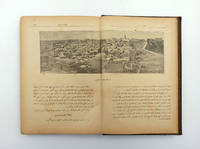
1899055246Istanbul: Sabah Gazetesi / Mihran Matbaasi. AH 1316 1899. 1st Edition . Hardcover. Very Good. 8vo - over 7¾ - 9¾" tall. Fine brown quarter leather bdg. brown boards with decorative embossing. Roy. 8vo. 24 x 17 cm. In Ottoman script Old Turkish with Arabic script. 176 p. 33 unnumbered b/w plates of views of the Middle Eastern cities Kaiser and queen's portraits ills. of their maritime voyages a general view of Beirut a panorama of Jerusalem in two pages The Government House and Lake Tiberia in Beirut a general view of Jaffa churches and castles and Masjid-i Aksa of Jerusalem Idlib the interior of the Umayyad Mosque in Jerusalem The Government House of Jaffa Beirut - Damascus railways street views and architectural buildings from Damascus the market place of Jaffa Bethlehem and the church views of Trablus-Sam i.e. Tripolis ruins of Baalbek and other numerous b/w photos published for only this book. Slight stains on pages a modern repair on a leaf with tape otherwise a very good copy. Bound together with "Eski Sevda" which is a compilation of Turkish tales. First and only edition of this richly illustrated scarce and uncommon book was printed for the German Emperor Wilhelm II and his wife Augusta Victoria the commemoration of the construction of Alman Çesmesi i.e. German Fountain in Constantinople and the first anniversary of the Wilhelm II's travel to the Ottoman Empire in 1898. The fountain's design was drawn by the architect Spitta and constructed by the architect Schoele with the German architect Carlitzik and Italian architect Joseph Anthony working on the project. The fountain was built in Germany and then transported piece by piece to Istanbul reassembled in its current site and officially opened on January 27 1901 on the birthday of German Emperor Wilhelm II. Wilhelm II's voyage to the Levant in 1898 was a state visit that the German Emperor undertook in the Ottoman Empire between 25 October and 12 November 1898. The Kaiser started his journey to the Ottoman Eyalets with Istanbul on 16 October 1898; then he went by yacht to Haifa on 25 October. After visiting Jerusalem and Bethlehem the Kaiser went back to Jaffa to embark on Beirut where he took the train passing Aley and Zahlé to reach Damascus on 7 November. This book is richly illustrated including many views of the cities of this voyage's destinations like Jerusalem Damascus Beirut Beirut Jafa Baalbek etc. On 10 November Wilhelm went to visit Baalbek before heading to Beirut to board his ship back home on 12 November. His visit spurred interest in the German Templer colonies in Palestine. One of the Kaiser's traveling companions Colonel Joseph von Ellrichshausen initiated the formation of a society for the advancement of the German settlements in Palestine named the Gesellschaft Zur Förderung der Deutschen Ansiedlungen in Palästina in Stuttgart. It enabled the settlers to acquire land for new settlements by offering them low-interest loans. A subsequent second wave of German settlers founded Wilhelma named after the Kaiser now called Bnei Atarot in 1902 near Lod Walhalla 1903 near the original Jaffa colony followed by Bethlehem of Galilee 1906. The German Settlement Society successfully encouraged some of the Templars to return to the official national Protestant Church. The non-Templar colony of Waldheim now Alonei Abba was subsequently founded next to Bethlehem of Galilee in 1907 by proselytized Templers now affiliated with the Old-Prussian State Church. The visit resulted in the highest-profile political event in the life of Theodor Herzl considered the founder of Zionism. Through the efforts of William Hechler via Frederick I Grand Duke of Baden Herzl publicly met Wilhelm II three times during the voyage once in Istanbul on 15 October 1898 and twice in Palestine 29 October and 2 November. The meetings significantly advanced Herzl's and Zionism's legitimacy in Jewish and world opinion. Wikipedia. Only one copy in OCLC Library of Congress. Karl Süssheim Collection no. 1300 900684728. Özege 7023 <br/> <br/> Sabah Gazetesi / Mihran Matbaasi., [AH 1316] hardcover
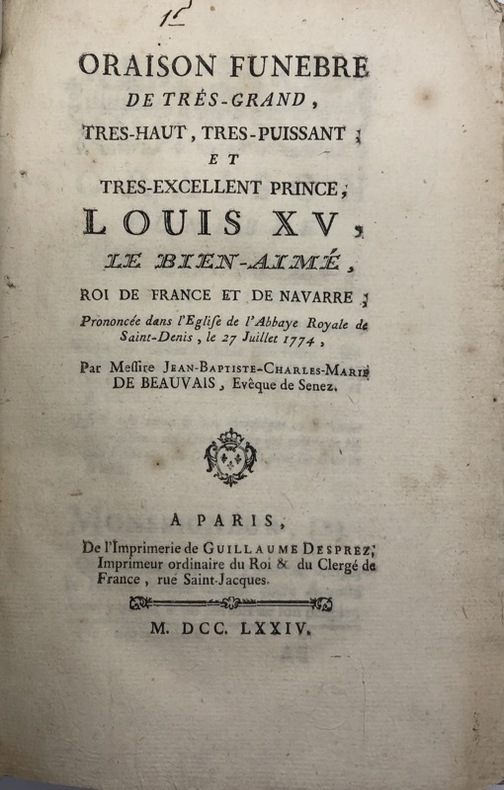
232787Paris, Guillaume Desprez, 1774 in-8, 67 pp., demi-parchemin souple modeste à coins (reliure de remploi du XIXe).
First Edition, 4 advertisement leaves at end, 89, [1], [4]pp., disbound. From a French translation by J. G. Peltier from the German. The French translation, entitled "L'Empire Germanique re?duit en departements sous la pre?fecture de l'e?lecteur de ***********,".
GF100394 pages en 2 feuillets in8 - 25,5x16 cm - ensemble extrait du Trombinospe par Touchatout vers 1870 -
GF20567Gravure originale à l'eau forte et aquatinte - format 13,5 x 13,5 cm sur une feuille de 29,5 x 21 cm - Vers 1820 - bon état malgré quelques petites piqures marginales sans gravité -
GF20544Gravure originale à l'eau forte et aquatinte - format 13,5 x 13,5 cm sur une feuille de 29,5 x 21 cm - Vers 1820 - bon état malgré quelques petites piqures marginales sans gravité -
GF20524Gravure originale à l'eau forte et aquatinte - format 13,5 x 13,5 cm sur une feuille de 29,5 x 21 cm - Vers 1820 - bon état malgré quelques petites piqures marginales sans gravité -
GF13186Photographie 7,5x4 cm - collée sur carton - vers 1900 -
GF13187Photographie 7,5x4 cm - collée sur carton - vers 1900 -