Kobell, Wilhelm von - 1766 Mannheim - München 1855Antiquariat.de

1 322 résultats
595-Eo.J. Aquarell,über Bleistift, auf Bütten. Ca. 27,5:51,8 cm. Ränder ungleich geschnitten, vertikale Mittelfalte geglättet. Provenienz: Privatbesitz München. Literatur: Ausst. Katalog: Handzeichnungen deutscher Meister des 19. Jahrhunderts, Spezialsammlung von Zeichnungen und Radierungen Wilhelm von Kobells, C. G. Boerner, Leipzig, 1928, Liste XLI, S. 3; Wichmann, Wilhelm von Kobell. Monographie und kritisches Werkverzeichnis der Werke. München 1970, Nr. 64 mit Abb. Wichmann datiert die Zeichnung um ?1787?. Mit der Datierung ?um 1787? irrt Wichmann, denn die Zeichnung zeigt Schloß Ehrenburg nach der Vollendung der neugotischen Umgestaltung der Eckpavillons (ursprünglich nach Plänen Schinkels) ab 1817, aber vor der Vollendung des neugotisch gestalteten Turmes über dem Mitteltrakt, also noch in der Gestalt der Zeit vor 1834. Als mögliche Zeit der Entstehung dieser Zeichnung ist also ?um 1818-1834? anzunehmen. (Diese Hinweise danken wir Dr. Klaus Weschenfelder, Veste Coburg, Email vom 3.11.2015). Ein Beleg für einen Aufenthalt Kobells in Coburg in diesen Jahren fehlt bislang.
1598063-A1598. Kupferstich 1598, auf Bütten mit Wasserzeichen: kleiner Wappenschild, rechts unten im weißen Rand mit brauner Feder bezeichnet ?1573?. 24:31,8 cm. Mit Rändchen um die Plattenkante und Stockfleckchen im unteren Rand, sowie leichte Quetschfalte. Literatur: Hollstein 342 (dort andere Größenangabe 20:35 cm) mit dem Monogramm, Datum, Verlegermonogramm ?D.C? (Dominicus Custos, Augsburg), latein. Text und Bezeichnungen in der Platte.
132-Eo.J. Aquarell über Bleistift, mit Bleistiftlinie umrandet, auf Velin. 25:37,5 cm. Kat. 84, Nr. 71. Provenienz: Nachlaß Ludwig Thiersch, München; Sammlung Prof. Richard Jung, Freiburg, (nicht bei Lugt). Verso bezeichnet: ?im L. Thiersch Nachlass Leop. Rottmann um 1860?. Dieser Vermerk bezieht sich auf den in München tätigen Landschaftsmaler L. Thiersch (1825 - 1909). Beide Künstler, Rottmann und Thiersch, waren in derselben Stadt tätig und werden sich wohl gekannt und Arbeiten ausgetauscht haben. Durch diese Provenienz darf die Zuordnung an Leopold Rottmann als sicher gelten. Farbfrisches Aquarell, das in der Landschaftsauffassung dem älteren Bruder, Carl Rottmann (1797 - 1850), verpflichtet ist.
pp. (16), 316, in-8, mezza pelle con angoli e tassello al dorso
448-Eo.J. Bleistift, auf Bütten, rechts oben bezeichnet und datiert ?Grim fec 1813.?. 29:20,5 cm. Verso: Figurengruppe. Bleistiftskizze. - Leicht fleckig, Papier im oberen Bildteil etwas berieben. Literatur: vgl. Stoll 176; nicht bei I. Koszinowski u. Vera Leuschner. Hier ist eine Zeichnung ?Mädchen aus Schliersee, 1813? unter G 35 genannt, die folgende Bezeichnung trägt: ?mit Peter Hess/und Stiller (sic!) am Schliersee?, datiert ?d 12t Juny 1813?. Studie zur gleichnamigen Radierung (Stoll 176). Die Eigenhändigkeit der Zeichnung wurde von Dr. Vera Leuschner, Zierenberg, bestätigt. Provenienz: Sammlung S, nicht bei Lugt. Möglicherweise handelt es sich dabei um die Sammlung des Malers Joseph Karl Stieler (1781-1858), mit den Grimm seit seinem ernsten Aufenthalt in München eine Freundschaft verband; Münchner Privatsammlung.
1310-Co.J. Kaltnadelradierung, 1918, auf chamoisfarbenem Japan, mit blauem Stift signiert und bezeichnet ?Nr 4?. Darstellungsgröße 22,5:31,3 cm, Blattgröße 32,4:52 cm. ? Im linken breiten Rand leicht knitterfaltig. Literatur: Schwarz 348, II (von II). ? Vorzüglicher, vollrandiger Abdruck, tadellos. [2 Warenabbildungen]
5182o.J. - Le canal de Louis du Danube & du Mein. Faltperspektive oder Ziehharmonika-Guckkasten aus 6 (inkl. Abschlussbild, davon 5 mit ausgestanzten Elementen) handkolorierten lithographierten Ebenen. Ohne Ort, Drucker u. Jahr. Montiert in Original-Pappschachtel mit zentralem, rechteckig ausgeschnittenem Blickloch u. handkoloriertem lithographierten Titelschild mit allegorischen u. geographischen Darstellungen. Kastenformat: 13,7 x 22,7 cm. Länge ausgezogen zwischen 50 und 60 cm.
346-Eo.J. Bleistift, auf gelblichem Velin, links unten bezeichnet, datiert und signiert ?Achenthal 1853 F. Eisenlohr.?. 21,5:32,6 cm.
627-Eo.J. Aquarell über Bleistift, um 1835, auf cremefarbenem Velin. 24,5:40,4 cm. - Im Ganzen nicht ganz frisch. Studie eines nah gesehenen Berghangs in herbstlicher Farbigkeit, wie sie für Christian Morgenstern typisch ist. Vergleichsliteratur: J. Lauts/W. Zimmermann, Katalog neuere Meister 19. und 20. Jahrhundert. 2 Bde. Karlsruhe, Staatl. Kunsthalle 1971, Bd. I, S. 173 (Inv. Nr. 2278), Bd. II, Abb. S. 297 unten; Ausst.-Katalog: ?Münchner Landschaftsmalerei 1800-1850. München, Städt. Galerie im Lenbachhaus, 1979, Nr. 401, Farbabb. S. 353: ?An der Amper bei Oberhausen?. ?Im allgemeinen wurden in München bis in die dreißiger Jahre Studien für die Gesamtkomposition der Bilder in Aquarell ausgeführt, während es nur ausnahmsweise Detailstudien gab. Friedrich Pecht spricht in seiner ?Geschichte der Münchener Kunst im neunzehnten Jahrhundert? vom aquarellartig bunten, harten und nüchternen Charakter der gesamten frühen Münchner Malerei. Der eine, schon genannte Weg, auf dem die Freilichtskizze nach München kam, führte über Rom. Beispiele sind die drei Ansichten von der Villa Malta in Rom von Georg von Dillis aus dem Jahre 1818 in der Schack-Galerie in München, die von lichter, flockiger und fernsichtiger Struktur sind. Ihnen haben in München erst in den dreißiger Jahren die aus dem Norden gekommenen Künstler etwas Vergleichbares an die Seite zu stellen. Sie wanderten gemeinsam in die Berge, vor allem nach Berchtesgaden und an die bayerischen Seen, um hier solche Studien vor der Natur zu verfertigen?.?. (Barbara Eschenburg über ?Nordländer in München? in: Ausst.-Katalog: ?Münchner Landschaftsmalerei 1800-1850. München, Städt. Galerie im Lenbachhaus, 1979, S. 111.
123963aafMünchen, Joseph Lindauer, Buchhandlung, (C.T. F. Sauer), 1837, in-4to, 31 S. (+ 1 S.) + 25 lithogr. Tafeln (mit 1 gef. Panorama) von Gustav Kraus, Grün Orig.-Umschl. mit Umrisslithografien in Rotbraun auf beiden Deckeln (lt. Pressler S. 186 »vermutlich von Franz Seitz«).
141074aafMünchen, Joseph Lindauer, Buchhandlung, (C.T. F. Sauer), 1837, in-4to, 31 S. (+ 1 S.) + 25 lithogr. Tafeln (mit 1 gef. Panorama) von Gustav Kraus, Grün Orig.-Umschl. mit Umrisslithografien in Rotbraun auf beiden Deckeln (lt. Pressler S. 186 »vermutlich von Franz Seitz«).
0855-Co.J. Kaltnadel, 1923, signiert, auf Japan. 20:29 cm. ? Verso Papierabrieb an einer Ecke. Literatur: Müller 675. Sehr guter, vollrandiger Abdruck. Im Jahr 1919 kaufte Lovis Corinth ein Grundstück in Urfeld, auf dem seine Frau Charlotte Berend ihm ein Haus baute. Er benannte es mit dem Spitznamen für seine Frau Haus Peter-mann. Das Haus am Walchensee wurde zum Rückzugsort des Künstlers, an dem er vor allem Landschaftsbilder, Porträts und Stillleben produzierte, sich von der aktiven Kunstszene aller-dings auch immer mehr zurückzog. Seine Bilder vom Walchensee waren auch wirtschaftlich ein großer Erfolg. Nach seinen eigenen Worten wurde ?niemals mehr verkauft als gerade nach dem Zusammenbruch. Es wurden einem förmlich die Bilder von der Staffelei gerissen, und niemals blühten die Ausstellungen im ganzen Deutschland mehr denn jetzt.?
1309-Co.J. Kaltnadelradierung, 1920, auf chamoisfarbenem festem Velin, mit Bleistift signiert. Darstellungsgröße 24,5:19,7 cm, Blattgröße 38:28,3 cm. Literatur: Schwarz 432, II (von II). ? Vorzüglicher Abdruck mit leichtem Plattenton, tadellos.
1839150-W1839. Feder und Pinsel in Grau und Bleistift, grau laviert, auf chamoisfarbenem Velin, rechts oben bezeichnet und datiert ?Heilbrunn 27. Sept. 1839.?. 26,3:34,1 cm. In den Rändern ungleich. In der Graphischen Sammlung München befindet sich eine ebenfalls auf 1838 datierte, grau lavierte Bleistiftzeichnung, betitelt ?Oberbayerischer Bergbauernhof?.
348-Eo.J. Bleistift und Deckweiß, auf grautonigem Velin, links unten signiert, betitelt und datiert ?AEKirchner / Partie aus d. Au bei München / d 19ten Septbr. 1838.?, rechts folgende Widmung: ?Kirchner seinem Freund Rottmann 1840?. 15,1 : 27 cm. Verso am Oberrand Rest einer alten Verklebung. Provenienz: Antiquariat Wölfle, München; süddeutsche Privatsammlung.
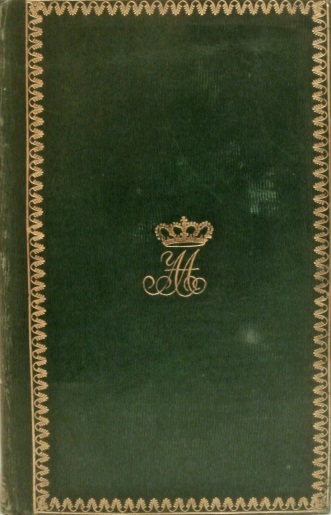
1818156Paris, F. Janet, 1818 ; in-8 de xii pp., 582 pp., maroquin à long grain vert émeraude, chiffre doré couronné au centre des plats, roulette dorée en encadrement, dos lisse orné, pièce rouge, tranches dorées.
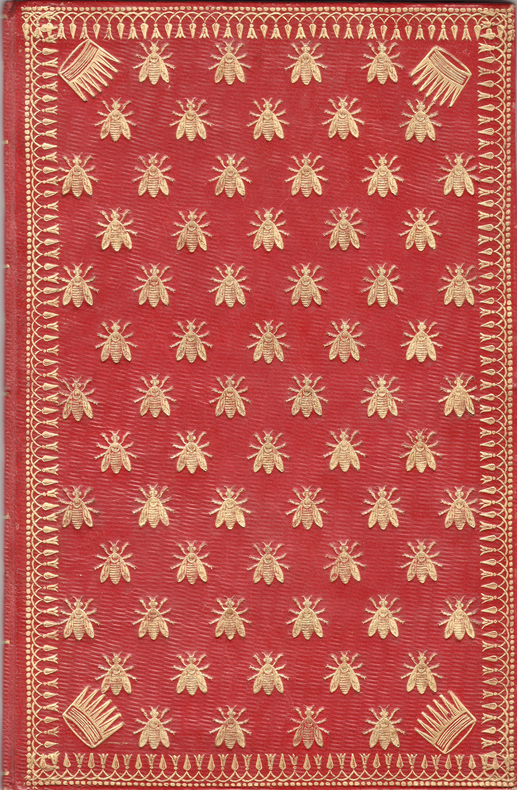
AMA-919Milano, Dalla Tipografia di Giuseppe Borsani, s.d. [1809]. In 8°, plein maroquin rouge de l’époque, plats ornés d’un semis d’abeilles dorées dans un encadrement de roulette avec couronne aux coins, dos lisse orné de filets et de fleurettes dorées, coupes ciselées, étiquette sur le contreplat, non rogné. [12 ff., le premier blanc].
178692581786 Frankfurth und Leipzig [i. e. Nürnberg], in der Grattenauerischen Buchhandlung, 1786. Un volume in-8° (110 x 168 mm) de 374 pages, reliure du début du XIXe siècle en cartonnage bleu, plats ornés de papier marbré, dos lisse orné de filets, pièce de titre jaune. Marges un peu courtes, page de titre brunie et tache angulaire claire sur les premiers feuillets, papier de couverture un peu frotté au do et sur les arêtes. Rare édition originale, imprimée à Nuremberg chez Ernst Christoph Grattenau (1744-1815), qui était franc-maçon et fut aussi membre de lOrdre des Illuminés de Weishaupt. Lindication de Francfort et Leipzig se réfère au fait que louvrage y était vendu en foires.
0808-Co.J. Kaltnadel, 1924, signiert. 15:19,8 cm. Müller 858, mit der typographischen Bezeichnung ?Verlag Ernst Arnold, Dresden? in der Platte, auf chamoisfarbenem Velin. ? Eins von 200 Exx. für die Vorzugsausgabe: Gg. Biermann, Der Zeichner Lovis Corinth. Dresden, E. Arnold 1924.
1616089ADD63Gedruckt durch Nicolaum Henricum Munchen Munich: . 1616 Nine volumes in one. Folio. 350 mm. Collation: Engraved title 10 leaves the last blank 62 p. ; 4 leaves the first blank pp. 63-94; 9 leaves the first blank pp. 95-200; 19 leaves the first blank pp. 201-406; 7 leaves pp. 407-443; 22 leaves pp. 444-728; 4 leaves pp. 729-774; 3 leaves the first blank pp. 775-793; 4 leaves pp. 794-827 6 leaves. Scattered damp stain heaviest on last leaf colophon. Early thumb indexes mostly present. German black letter gothic fraktur type; large woodcut initials; and decorative head and tail pieces throughout. Each sectional title bears Maximilian's large 150 x 185 mm coat of arms. Most impressive too are the six pages with large woodcuts of 10 fish and one lobster. Generally clean and tight. Original full alum tawed pigskin over beveled oak boards binding; nicely tooled in blind; with Maximillian's simple arms in a circle within a 2" diamond. Five raised bands. Original brass clasps present. Early manuscript ownerships; Printed paper ownerships of the Kgl. Bezirksgericht Nurnberg in various places. Several stamped Nazi Eagle ownerships of the Oberlandesgerichts Nurnberg. First Edition of the Codex Maximilianus. Bavaria under Maximilian I 1598-1651 was a country of around 1 million inhabitants with agriculture and salt production a ducal monopoly being the dominant sectors of the economy. It became a key player in the events leading up to the Thirty Years War. In 1608 Bavaria occupied and annexed the hitherto free Imperial and Lutheran city of Donauworth. The action caused the Protestant princes and cities to found the Protestant Union. Bavaria then concluded an alliance with the Austrian and Hungarian Estates. In 1609 Bavaria became the leading force in the newly founded Catholic Holy League an alliance formed against the Protestant Union. Consolidating his governance Duke Maximilian in 1616 introduced a new Bavarian Landrecht Law Code which was a compilation reworking and summation of all the laws and codes. Includes the codes of: Judicial Procedure; Court Laws; State Laws; Police Law; Forestry hunting and fishing regulations; Etc. It became a widespread the model for law and legislation for over 150 years. Stobbe II 366. Very Scarce. Only a handful of copies are recorded in U.S. libraries. PRICE JUST REDUCED! CHEST 2/1 Language: eng. 1st Edition. Hardcover. Very Good. [Gedruckt durch Nicolaum Henricum], Munchen [Munich]: . hardcover
Elephant Folio - over 15" - 23" tall "This book is dedicated to Richard Avedon, Ara Gallant and Giorgio di Sant'Angelo". Volume cartonato, legatura editoriale in tela nera, titoli in bianco al dorso e al piatto anteriore, custodia editoriale, 136 pagine profusamente illustrate in nero e colori con immagini applicate. Esemplare in ottime condizioni. Testo in inglese - english text - box edition. SPEDIZIONE IN 24 ORE DALLA CONFERMA DELL'ORDINE.
16235340Ingolstadii: Ex officina typographica G. Haenlini 1623. Hardcover. Near Fine. 4to 27 x 17.5 cm. 17 ff. 388 pp. recte 386 7 ff. with misnumbered pages at pp. 203-06 243-46 and 260-71 1 full-page engraving 20 x 15.5 the platemark. Bound in contemporary blind-stamped pigskin raised bands boards beveled somewhat scuffed clasps missing. Blue edges small hole repaired on half title and engraving ownership inscription of Andechs Abbey on title page minor browning in some quires. An excellent and unsophisticated copy. First edition of a rare volume of prose and verse glorifying the military exploits of the Prince-Elector Kurfürst of Bavaria Maximilian I 1572-1651 by members of the University of Ingolstadt as compiled by the Jesuit philosopher-theologian Georg Stengel 1584-1651. The Gloria Bellica is an important witness to the intertwining of princely power university politics and religious sectarianism at the onset of the Thirty Years War 1618-48. Published in the year of Maximilian's elevation to Prince-Elector 1623 the book seems to have been an attempt by faculty at Ingolstadt to secure his favor. The increasingly Jesuitical university would be frequently imperiled during the flux of the war and quickly identified Maximilian himself educated by Jesuits as an important military protector. Maximilian's central role in the German Catholic League had been essential in checking the power of the Protestant Union. The volume is especially notable for its full-page prefatory engraving executed by the Augsburg artist Daniel Manasser a highly detailed and elaborate allegory charting Maximilian's martial rise and the praise conferred on him from various secular and sacred sources. Merchants clerics Liberal Arts herself and a throng of lesser citizens crowd together to salute Maximilian as he rides upward on the back of Pegasus toward the Olympian gods reclining in the empyrean; the demigod Hercules mediates between heaven and earth while battling Nessus and the Lernaean Hydra. Flanking Maximilian's ascent are 8 groups from whom he receives "Gloria": his enemies his commanders and soldiers muses and scientists hometown Bavaria the Catholic League the Holy Roman Emperor Ferdinand I the pope and church and indeed Mary Christ and the saints. The text of the Gloria Bellica is arranged as a fuller version of this scheme with 20 chapters each detailing a source Maximilian's glory. OCLC identifies U.S. copies at Harvard Trinity CT Georgetown and Chicago. VD 17 23:231047E; De Backer/S. and VII 1550 32; Lentner 3774; Pfister I 4297; Mario Praz Studies in Seventeenth-Century Imagery Rome: Edizioni di Storia e Letteratura 1975 pp. 503-04. <br/> <br/> Ex officina typographica G. Haenlini hardcover
Leggere gore, pieghe editoriali
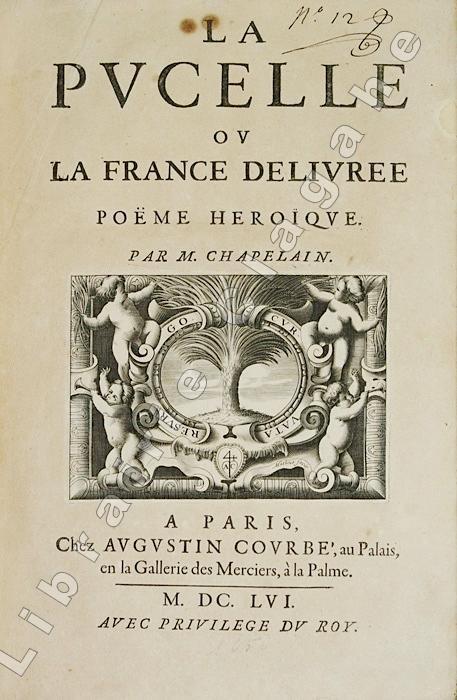
17788Paris, Augustin Courbé (imprimerie Jean Roger), 1656 ; in folio, basane havane, dos refait et plats d'époque conservés, fleurons dorés à l'ancienne ; 1blanc, frontispice, titre ; (6) ff. , portrait de l'auteur, (16) ff. , 522 pp. , (6) ff.
464-Eo.J. Aquarell, über Bleistift, auf bräunlichem Velin, Mitte links monogrammiert und datiert ?F. H. 79.?, verso von zeitgenössischer Hand bezeichnet ?vermutl. Prinzessin Augusta / Franz Heigel.?. 26,6:18,5 cm. Verso am Oberrand Reste alter Verklebung. Provenienz: Arnoldi-Livie, München; süddt. Privatbesitz. Die beiden Porträts sind ganz der biedermeierlich-realistischen Porträtauffassung verpflichtet und zeichnen sich durch feinmalerisches Können und fein abgestimmtes Kolorit aus. Im Auftrag Ludwigs II. entstanden ab 1874 Bildnisse der königl. Prinzen und Prinzessinnen (s. Thieme/Becker Bd. 15, S. 268) - möglicherweise in diesem Zusammenhang auch unsere beiden Porträts.