(BARTLETT, WH). - SICILY W HBiblio.com

201 résultats
185341920London Arthur Hall Virtue & Co. 1853. Royal8vo. Uncut in a very fine orig. full cloth richly gilt spine and covers. Engraved frontispiece engraved titlepage and printed. 8III200 pp. a. 16 pp. of publisher's adv. 1 engraved map textillustr. in woodcut and 30 fine steel-engraved plates with tissue-guards. Text absolutely clean. Plates with some brownspots. <br/><br/><em>First edition. </em> hardcover
1822CJW0802Paris: P. Didot l'ainé second volume Jules Didot l'ainé 1822-26. FIRST EDITION. 641 x 495 mm. 25 1/4 x 19 1/2". Lacking the dedication leaf and subscriber list present in the Abbey copy. Two volumes. Edited by Jean Frédéric d'Ostervald. <br/> Contemporary red straight-grain morocco textured paper boards gilt titling on spine edges untrimmed. One map as called for though the Abbey copy has two and 92 ACCOMPLISHED AND BEAUTIFULLY HAND-COLORED AQUATINT PLATES OF SICILIAN VIEWS. Abbey "Travel" 262; Graesse VI 400; Brunet V 1379. ◆Moderate rubbing to joints and elsewhere covers with some scars other minor problems externally but the original bindings entirely solid--and surprisingly so for such an immense book with so many fabulous pictures to look at. Preliminary leaves and text lightly to substantially foxed a half dozen plates with faint overall browning one tissue guard missing the margins of perhaps half the engravings with foxing usually light though noticeable in three or four cases in the second volume but still a very pleasing copy of a beautifully illustrated book the marginal foxing seldom distracting and the engraved images themselves clear and clean afflicted by neither foxing nor the dreaded offsetting from the text.<br/> <br/> This is an extraordinarily rare copy of one of the most beautiful color plate travel books having to do with Italy. The large and luminous views of Sicily in our two volumes capture the magic of the island as experienced by the traveller of the early 19th century. Sicily's well-preserved Greek temples are of course featured but port scenes Medieval churches picturesque villages and the interior of Etna's crater are also depicted all in exquisite color. The engravings each accompanied by letter press explanations are of great interest and beauty and all but one of them are full-blooded tableaux rather than plans or assemblages of small images. The size of the engraved surface varies on the page as does the distance of the subject from the viewer: we are treated to everything from wide panoramic views to confining inner spaces. While the colors cannot be called pastel they are far from garish with lovely grays typically giving a softness to a scene that often employs subtle shades of yellow blue and green. The plates are memorable for their use of light and shadow to give a convincing feeling of three-dimensionality amidst luminous skies darkened interiors and a number of other variably lit settings. The book was originally published in 24 parts and includes an historical précis by Gigault de La Salle giving an overview of events from antiquity to his own time. Abbey calls the work "the most ambitious of the coloured aquatint books edited by J. F. d'Ostervald" who produced a number of works on the picturesque including two famous oversized editions focusing on regions in France. The book has always commanded a premium price: the unbound sheets were sold at the time of publication for the whopping sum of £34. In his note to the reader Ostervald tells of his search among the portfolios of the artists of Switzerland Germany and England for the perfect materials for this collection. The plates cite the names of the artist and engraver and Abbey notes that "English artists or engravers were responsible for nearly half" of the plates. Among these was Richard Parkes Bonington 1802-28 the tragically short-lived painter whose romantic works were greatly admired by Delacroix. Abbey estimates that about 500 copies of the book were produced and comments that the book is "certainly rare in this country at all events only three copies being reported at auction in the last fifty years." The rarity of the book has not surprisingly increased since Abbey's remark: complete copies with colored plates are still hard to find. P. Didot, l'ainé [second volume Jules Didot l'ainé] unknown
102096846X.Ghardcover. Good. Access codes and supplements are not guaranteed with used items. May be an ex-library book. hardcover
1022270524.Gpaperback. Good. Access codes and supplements are not guaranteed with used items. May be an ex-library book. paperback
18874462Palermo Tipografia dello "Statuto 1887. 1st Edition . Hardcover. . ~ ~ NOTE: THE PRICE OF THIS BOOK IS CURRENTLY REDUCED! ~ ~ . Royal quarto. Pp. 60. Plus 4 engraved plates one folding bound at end. Extended table figure to text. Half-title present. HARDCOVER bound in full grey cloth manuscript lettering to spine; foxed plates age toned some corners dampmarked. In good condition. ~ FIRST EDITION. Pubbicati per cura del R. Commissariato degli scavi e musei di Sicilia. 006-7 <br/> <br/> Palermo, Tipografia dello "Statuto hardcover
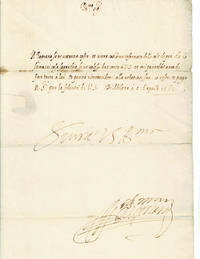
a5840Palermo 1746. Concerning El Principe Corsini whose names are printed at the end of the document. In Italian. 4to. 10x14 inches 8pp. printed. VG plus folded in half ; clean and very bright. . unknown
1994307538N.p.: n.p 1994. One 230 copies this one an author's proof. Illustrations by Piergiorgio Brusegan throughout. 48 pp. 8vo. Red leather with mounted medallion to upper cover. Fine. One 230 copies this one an author's proof. Illustrations by Piergiorgio Brusegan throughout. 48 pp. 8vo. A tribute to the city of Taormina in Sicily. n.p] unknown
1901317105London: Hutchinson 1901. First edition. Illustrated with 17 plates. 1 vols. 8vo. Bound in modern three quarters brown mottled polished calf and marbled boards. Fine. First edition. Illustrated with 17 plates. 1 vols. 8vo. <br/><br/> Hutchinson hardcover
1960ABC_47178Palermo 1960. 5 loose silver gelatin photographic prints on baryta paper ca. 24 x 30 cm all but one with manuscript captions on the reverse. A collection of 5 loose silver gelatin photographic prints showing mob killings funerals and families by Nicola Scafidi 1925-2004 Sicily's most important mafia photographer of his time. The Palermo photographer Scafidi spent much of his career making striking yet chilling pictures of mob killings as almost half of the negatives in his archives were shots of the dark world of the Sicilian mafia.On the back of four of the five photographs is a short caption stating very briefly what we are seeing and sometimes when it happened. All photographs bear the stamp of Scafidi's photographic studio on the back. All but the photograph of Paolino Riccobono have the same address: "Via Marino Stabile no. 171". The address on the photograph of Paolino reads "Via Marino Stabile n. 166". Scafidi moved his studio to no. 166 in 1956 but since this photograph was made in 1961 the photograph must have been printed thereafter. We do not know when Scafidi moved to no. 171 but it was very likely also in the 1960s as the latest dated photographs bears the date 1966 and another shows a 1960 killing. He moved to no. 163 in the same street in 1988 but the present photographs all seem to have been printed in the 1960s.The present small collection of disturbingly gruesome photographs of mob killings in the 1960s by one of Sicily's greatest photo-journalists as printed from his studio shows evidently how the Sicilian mafia was so thoroughly and chillingly intertwined in the Sicilian society touching all levels of society.In very good condition.l Cf. Lee Hockstader Sicilian mafia licking its wounds in: The Washington Post 21 April 1998; Jane Schneider & Peter T. Schneider Reversible destiny: mafia antimafia and the struggle for Palermo 2003 pp. 103-104. unknown
20249004713816Brill 2024. New/New. <p><strong>Author:</strong> Andres Saenz de Sicilia</p><p><strong>Publisher:</strong> Brill</p><p><strong>ISBN:</strong> 9789004713819</p><p><strong>Release Date:</strong> 2024</p><p><strong>Languages:</strong> English</p><p><strong>Binding:</strong> Hardcover</p><p><strong>Number Of Pages:</strong> 268</p><p><strong>Details:</strong> Capital is often depicted as an all-encompassing and abstract social force which seeks to ""subsume"" all of human life. But what in fact is involved in such ""subsumption"" and how might it be resisted Tracing the discourse of subsumption through the work of Kant Hegel Marx and the critical Marxist tradition this book offers a materialist framework for analysing capitalist power. Saenz de Sicilia argues that capitalist subsumption operates at three distinct yet interrelated levels: exchange production and reproduction each characterised by distinct logics of domination and resistance. Conflicts over subsumption at each of these levels lie at the heart of capitalism’s struggle to determine the shapes of human social life. A major intervention into debates surrounding the historical trajectories of capitalism Subsumption in Kant Hegel and Marx: From the Critique of Reason to the Critique of Society systematically refutes the influential thesis that we are now in a stage of ""total"" capitalist subsumption which leaves no space of refuge or resistance. Editorial Reviews Review “In his brilliant genealogy of the enigmatic notion of 'subsumption' from Kant to Hegel to Marx Saenz de Sicilia provides an important contribution to the debate on the 'reversal' of German Idealism into Historical Materialism. He also offers precious insights into the 'hidden abode' of capitalist exploitation more relevant than ever. I highly recommend his book.â€<br> ―Etienne Balibar author of The Philosophy of Marx <br><br> “What does it mean to live under capitalism To have been sometime someplace forcibly brought into it. Saenz de Sicilia lifts the technical term 'subsumption' out of German idealism where it lolls among reflective categories of thought and ontology. He shows how in Marx subsumption becomes a social operation by which non-capitalist things are provisionally and not without resistance obliged to serve capital’s bidding. In this obligation lies a chance to be otherwise.â€<br> ―Paul North editor of Capital: Critique of Political Economy Volume 1 About the Author Andrés Saenz de Sicilia Ph.D. 2016 Centre for Research in Modern European Philosophy Kingston University London is Assistant Professor of Philosophy at Northeastern University London.</p> Brill hardcover
51422561like new. unknown
2023x-1801171629Emerald Publishing 2023. Hardcover. New. 250 pages. 9.00x6.00x0.75 inches. Emerald Publishing hardcover
0365441732.Gpaperback. Good. Access codes and supplements are not guaranteed with used items. May be an ex-library book. paperback
2020x-3030607097Palgrave Macmillan 2020. Hardcover. New. 147 pages. 8.50x6.00x0.50 inches. Palgrave Macmillan hardcover
2015x-3319136739Springer 2015. Paperback. New. 2014 edition. 387 pages. 9.00x6.00x1.00 inches. Springer paperback
1975ANAIS-0398032572Charles C Thomas Pub Ltd 1975-01-01. First Edition. hardcover. Good. 0x0x0. Buy with confidence. Excellent Customer Service & Return policy. Charles C Thomas Pub Ltd hardcover
SONG0398032572Charles C Thomas Pub Ltd 0000-00-00. First Edition. hardcover. Used: Good. 0.00x0.00x0.00. Buy with confidence. Excellent Customer Service & Return policy. Charles C Thomas Pub Ltd hardcover
1997037727Boston MA: Harvard Business School Pres. Hardcover. 1997. 1st Edition. Large 8vo 589pp . Fine in Fine Dust Jacket. B&W Photographs. Signed by both authors on half title . Harvard Business School Pres hardcover
156298780Milan 1562. 1562. - Folio 12 inches high by 8-1/2 inches wide. 1-page on bifolium with a red paper seal. On the 4th leaf with the seal the letter is addressed "APRmo 5 Mons : Vescovo di Cremona". The letter realized in a secretarial hand is dated April 5 1562 from Milan and is boldly signed by Francesco Fernando dÁvalos d'Aquino d'Aragona.<p>Philip II King of Spain and Duke of Milan chose Francesco Fernando dÁvalos to be his envoy at the Council of Trent. He arrived in Trent on March 14 1562 and attended the sessions of the council. He pressed the Spaniards to not offer up anything against the interests of the Holy See. Upon his return to Milan he charged his secretary Ercole Pagnano with the task of generating a report. As the Governor's agent Pagnano had defended the privileges of the Sicilian monarchy and worked with the Spaniards to quell the controversy regarding the jurisdiction of bishops. In this letter to the Bishop of Cremona the Governor is offering Pagnano's report to him. Loosely translated he states that Pagnano is well informed about these things and that "V.S." Your Excellency should be given his account.<p>The letter was once folded into 4 panels and there very minor breaks along 3 of the folds. There is some minor browning especially to one of the folds. <p>An advisor to King Philip II of Spain Francesco Fernando dÁvalos c.1530-1571 took command of the Spanish army in Lombardy and Piedmont succeeding the 3rd Duke of Alba who had become the Governor of Milan. From 1560 to 1563 Francesco Fernando served as the Governor of the Duchy of Milan. He was the viceroy of Sicily from 1568 to 1571.<p>The Bishop of Cremona was born Niccolo Sfondrati in 1535 in the Duchy of Milan. Philip II of Spain appointed him to be a senator in Milan in 1552 and at the urging of the Spanish government the Pope appointed him Bishop of Cremona in 1560. He participated in some of the sessions of the Council of Trent from 1561 to 1563. In 1590 he was one of seven cardinals that were acceptable to be pope by Philip II of Spain. He was elected Pope and took the name Gregory XIV. He died less than a year later in October 1591. Milan, 1562. unknown
A9781487509088Hardback. New. Expanding the historical understanding of the myriad ways in which the transfer of technology and business methods unfolded within East Asia Strands of Modernization examines the translation of technologies among competing developing economies. hardcover
0313325936.Gpaperback. Good. Access codes and supplements are not guaranteed with used items. May be an ex-library book. paperback
20022-2251003819Les Belles Lettres 2002. Paperback. New. bilingual edition. 150 pages. French language. 7.50x5.00x0.75 inches. Les Belles Lettres paperback