3 résultats
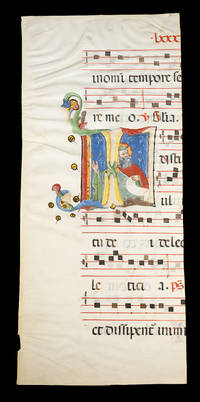
14200123<p>This exquisite miniature is by Cristoforo Cortese the most accomplished Venetian illuminator of the early fifteenth century. Executed during the formative stage of his career it once formed part of a sumptuous Camaldolese Gradual. The bearded prophet set within an initial I is rendered with Cortese's hallmark precision: expressive features painted with delicate strokes highlighted with red-rimmed haloes and radiant yellow tones. These qualities firmly align the work with Cortese's early output before 1420.</p><p>The stylistic vocabulary recalls both Florentine models and Venetian innovations. Cortese clearly drew upon the influence of Don Silvestro dei Gherarducci whose Choir Books for San Michele in Murano 1392–1399 provided prototypes for half-length prophet figures. Yet Cortese's interpretation more vibrant and emotive shows the confident individuality that would earn him recognition as the pioneer of Venetian Renaissance illumination.</p><p>The palette dominated by blues reds and yellows closely parallels related cuttings: a Bust Portrait of a Bearded Man in the Getty's Compendium moralium notabilium MS Ludwig XIV 8 f. 34v; a Saint John the Evangelist in the Victoria and Albert Museum inv. D.637B-1894; and the Entry into Jerusalem at the Fitzwilliam Museum Cambridge Marlay Cutting It. 20. The square notation on the verso written on four-line red staves rastrum 25 mm confirms its liturgical function as part of a choirbook used in monastic chant.</p><p>Provenance:<br />1. USA private collection early 20th Century framing tag S.Schwartz picture frames 128 W 42nd Street New York with a note pasted in the back of the frame "This fragment is old German. The miniature is a perfect work of art. Age no less 500 years.".</p><p>Sister Leaves Known To Exist In:<br />Victoria and Albert Museum Saint Peter initial "C";<br />Free Library of Philadelphia Saints with initials "G" and "S";<br />Additional leaves include the Apostle initial "T" and Standing Saint initial "E" formerly F. G. Zeileis collection sold at Sotheby's;<br />Cambridge Fitzwilliam Museum Entry into Jerusalem initial "D";<br />Museo Civico Medievale Bologna a prophet initial "C";<br />Softer sales—e.g. Prophet initial "V" Sotheby"s; Robert Lehman Collection;<br />Les Enluminures Paris Bearded Bishop initial "S"; Prophet and St. Paul.</p><p>Literature:<br />F. Todini in Una collezione di miniature Italiane vol. II 1994 no. VII;<br />M. Bollati Dalla Bibbia di Corradino a Jacopo della Quercia in Duecento 1997 pp. 128-29;<br />G. Freuler Tendencies of Gothic in Florence: Don Silvestro dei Gherarducci Corpus of Florentine Painting IV.7.2 1997;<br />G. Zeileis Più ridon le carte 2009 no. 11;<br />S. Panayotova "Cristoforo Cortese in Cambridge" in Miniatura. Lo sguardo e la parola 2012 pp. 186-89.</p> Illuminated Gradual on parchment
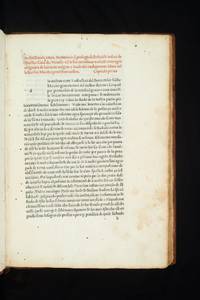
147712052Venice: Filippo di Pietro 1477. CONTEMPORARY WOODEN BOARDS backed with more recent leather no endleaves spine lined with a fragment of a 14th-century vellum manuscript evidence of clasp and catch. <p> FIRST EDITION OF THE LAWS GOVERNING VENICE AND ITS EMPIRE. Not dependent on Roman precedents these laws set the civil and criminal procedures of Europe's longest lived overseas empire - the island republic its mainland holdings immediately to the west and its colonial possessions: the stato da mar.<br /> Reflecting the preeminently commercial character of the Venetian state the majority of these statutes concern real and moveable property contracts pledges debts loans inheritance interest obligations counterfeit merchandise and trading partnerships. The nearly complete overlap in the 15th century of private Venetian seagoing business ventures and state military operations means THE RIGHTS OF WOMEN FIGURE PROMINENTLY IN THE CODE as their male family members were long abroad. Multiple and complex jurisdictions and appellate avenues developed in response to the variety of local statutes customary laws special privileges and feudal jurisdictions of the maritime and mainland states. "The judicial system played a significant role in tying the disparate parts of the maritime state together" O'Connell.<br /> THE VENETIAN MARITIME CODE CONCERNS COMMERCIAL PROJECTS AND MILITARY EXPEDITIONS. These fifty-two articles and their nine supplementary "corrections" deal with towing disabled vessels cargo luggage allowance victualing entering and leaving port arming sailors damage liability manifests transport of pilgrims and cavalry deserters daily rations of water and wine Black Sea voyages and so on. According to Cicogna these statutes were not reprinted.<br /> THIS FOLIO IS THE FIRST NON-LITERARY WORK TO BE PRINTED IN THE VENETIAN DIALECT and the fifth overall. In good condition pale stains worm holes seventeen leaves with neatly repaired worm trail not affecting legibility contemporary manuscript headlines and foliation.<br /> ¶O'Connell Men of Empire: Power and Negotiation in Venice's Maritime State 75 78 80-1 84-90 & 96; Cicogna Saggio di bibliografia veneziana 1206 "Prima e rara edizione" 1241 criminal code & 1263 maritime code; Doumerc "An Exemplary Maritime Republic: Venice at the End of the Middle Ages" in War at Sea in the Middle Ages and the Renaissance edd. Hattendorf & Unger 151-65; Bibliografia delle edizioni giuridiche antiche in lingua italiana I: 5; Manzoni Bibliografia degli statuti.dei municipii italiani I: 529-30; IGI 10143; Gamba Serie degli scritti impressi in dialetto veneziano ed. Vianello 454; ISTC is00724000; Goff S-724.</p> Filippo di Pietro unknown
149325186Nuremberg: Anton Koberger for Sebald Screyer and Sebastian Kammermeister 1493. First Edition with the Latin text the bifolium with fine hand-colouring to the Venice view. This is one of the large double-page city-view woodcuts from the workshop of Mighael Wolgemut and Wilhelm Pleydenwurff beneith 24 lines of text. The view of Venice was adapted from the 1486 woodcut by Erhard Reuwich in the Sanctae Perigrinationes. It is handsomely and finely handcoloured in blues greens yellows reds grays etc. Double-page folio ca. 540 x 364 mm handsomely mounted framed and glazed. Leaves XLIII and XLIIII. In fine condition and very well preserved and presented. FROM THE FIRST EDITION OF THE NUREMBERG CHRONICLE ARGUABLY THE GREATEST ILLUSTRATED BOOK OF THE 15TH CENTURY. The artists Michael Wolgemut the well-known teacher of Albrecht Dürer and his stepson Wilhelm Pleydenwurff have been praised and admired for over five-hundred years for their contributions to one of the monuments of early printing. David Bland calls it "a marvelous book and a landmark in the history of illustration" and through the ages it has more than fulfilled Koberger's prophecy that it would be "the delight of the men of learning and of everyone who had any education at all."<br> HIGHLY IMPORTANT INCUNABLE the “Nuremberg Chronicle†is the most extensively illustrated book of the fifteenth century and after the Gutenberg Bible the most celebrated book printed in the fifteenth century. Its 1809 woodcut illustrations 1164 excluding repeats depict popes saints and other religious figures kings and emperors historical and biblical genealogies mythological and fanciful creatures natural phenomena and views of all the major cities of the known world as well as a brilliant creation sequence. In addition to the full-sheet maps of the world and of Europe twenty-nine city views such as this one span two pages and eight other cuts excluding the xylographic title page are full-page. The colophon explicitly acknowledges the contributions of the artists Michael Wolgemut and Wilhelm Pleydenwurff. Albrecht Dürer was at that time a pupil in Wolgemut's workshop and there is good evidence that he did many of the preliminary drawings for woodcuts and may even have cut some of them see Adrian Wilson THE MAKING OF THE NUREMBERG CHRONICLE. Anton Koberger, for Sebald Screyer and Sebastian Kammermeister unknown