WEGELIN, (Jakob Daniel)Antiquariat.de

73 résultats
1768134814Berlin, Decker, 1768. 1 Bl., 504 S. Mit Titelvignette u. Seitenrahmen in Holzschnitt. Halbleder d. Zeit mit Rückenschild u. Rückenvergoldung (berieben, Ecken bestoßen, Rückdeckel mit Schabstelle). [3 Warenabbildungen]
177014421Roma: Nella stamperia di Marco Pagliarini 1770. Discreto-buon esemplare privo come altri del ritratto del pontefice all’antiporta per il resto completo seppur legato in ordine non corrispondente all’indice con lievi occasionali arrossamenti; brunito il frontespizio calcografico piccola lacuna difetto di cartiera sul margine interno di quello tipografico. Genuina legatura coeva in cartone con dorso in pergamena rivestito di carta marezzata con titoli manoscritti su tassello cartaceo tagli spruzzati in quarto grande cm 33x23 1 carta di antiporta frontespizio calcografico 4 carte non numerate frontespizio dedica prefazione imprimatur pp I-XXVIII Prospettiva glossario 1 carta non numerata indice pp 1-58 saggio di geometria vita dell’autore prefazione testo dei cinque ordini I-IV tavole geometriche I-XXXXI tavole di ordini 10 tavole veduta di vestibolo con al centro figura di Clemente XIV in trono 9 di prospettive. Oltre le tavole due incisioni nel testo vita e prefazione di Vignola e una sul frontespizio iniziali testatine e finalini xilografici. Segnatura: 1 carta di antiporta 4 a-c4 d1 1 A-G4 H1 55 carte di tavole. Discreto esemplare privo come altri del ritratto del pontefice all’antiporta per il resto completo seppur legato in ordine non corrispondente all’indice con lievi occasionali arrossamenti; brunito il frontespizio calcografico piccola lacuna difetto di cartiera sul margine interno di quello tipografico. Bella edizione settecentesca del più celebre e importante trattato di didattica architettonica italiano apparso per la prima volta nel 1562 e divenuto per semplicità ed efficacia dell’esposizione il manuale per eccellenza sulla materia. I Cinque Ordini di Architettura sono qui accompagnati come in altre edizioni da Le due regole della prospettiva pratica annotate «non coi soliti commentari del P. Danti ma con altri affatto nuovi del P. Gaudio delle Scuole Pie e del sig. Francesco Pannini architetto i quali si sono molto più del p. Danti approssimati al gusto e alle capacità de’ moderni giovani studiosi dell’architetura» Comolli; gli autori aggiungono inoltre una dedicatoria una prefazione la vita del Vignola il Saggio di geometria per introduzione allo studio dell’architettura civile e un interessante seppur sintetico Vocabolario de’ Termini di Architettura. Firmati il frontespizio allegorico e una delle vignette nel testo: «Fran. Smuglewicz Polonus del. - Carolus Antonini sculp.» a quest’ultimo Graesse attribuisce tutte le figure. Fowler p. 301; Graesse VII p. 314; Brunet V 1219 «assez bonnes les éditions de Rome 1732 1765 1770»; Comolli IV p. 109 definisce questa edizione «la migliore di tutte» quelle italiane esaminate; Riccardi I 88 I11 «bellissima edizione». Nella stamperia di Marco Pagliarini unknown
171022768Venedig, per Domenico Lovisa, 1710. 8°. Mit gest. Vortitel u. 59 Kupfertafeln (58 num. u. eine unnum. nach Tafel 36), 4 nn. Bll., Pgmt. d. Zt.
17273326987Den Haag, Scheurleer, 1727. 404; 452 S. Pergamentband (beschabt).
175619598CBBerlin, Haude und Spener, 1756. 8°, [16], 96 S und [126 S.] Index, Text: lateinisch und französisch (Dedicatoire), Pappband (Hardcover) der Zeit mit Marmorbezugspapier und blindgeprägter Rückenbeschriftung, Einbandkanten etwas beschabt, Einbandecken leicht bestoßen, Buchrücken oben und unten mit Fehlstellen der obersten Bezugsbeschichtung, Buchrücken mit montiertem Signaturschildchen, Deckelinnenseiten mit Notizen von alter Hand, Vorsatzseite mit Stempel der
1782433917Leipzig, Kummer, 1782. 16 Bl., 632 S., 43 Bl. Mit gestochener Titelvignette. Marmorierter Pappband d. Zeit mit Rückenschild (beschabt u. bestoßen, Vorderdeckel mit Stauchstelle, Rückenschild mit Fehlstelle). [2 Warenabbildungen]
1786027576Didot Fils - Jombert Jeune, Debure L'aîné, Barrois, Brocas, Paris 1786. Leder Sehr gut
1798465610Leipzig, Feind, 1798. XCII, 222, 343 S. Mit je 1 gestochenen Titel- u. Kopfvignette. Halbleder d. Zeit (beschabt u. bestoßen, Rückgelenk eingerissen). [2 Warenabbildungen]
17674468EBRom, Nicolai Roisechii, 1767. 2°. 45,5 cm. 4 Blatt, XXXII, 254 und 252 Seiten. Neue Halblederbände mit illustriertem Bezugspapier. [2 Warenabbildungen]
1742615107Amsterdam, Changuion, 1742. 4to. 6 Bl., 494 S.; 1 Bl., 400 S.; 53 Bl., 523 S., 78 Bl. Index. Mit 2 wiederholten gestochenen Titelvignetten. Pergament d. Zeit mit reicher (vor allem am Vorderdeckel abgeriebener) Rücken- und Deckelvergoldung (angestaubt, Schließbänder fehlen). [3 Warenabbildungen]
17892102030044xbvkLondon, apud T. & T. Payne, MDCCLXXXIX [1789]; Typis Jacksonianis excudebant J. Sammells & M. Ritchie. 2 blank sheets, titlesheet, dedication-sheet, 348 pages, 2 blank sheets; strong fine paper, text in wide blank margins. - Early 19th-century gently structured red and thick full-morocco binding with gilt-sectioned and -titled spine, gilt double-lines at panel-frames and floral ornaments at inner panel-frames, all edges gilt and colourful marbled endpapers; large-8vo.(ca. 24,5 x 15,5 x 3,5 cm; ca. 1,1 kg.).
17653598Rome:: A spese di Niccola Roisecco 1765. THIRD ROISECCO EDITION. The second 3-volume edition 1st 1750. Octavo: 3 vols. 17 x 12 cm. I. a8 A-Z8 Aa-Ss8 Tt-Xx4 Xx4 blank and present. With an engraved frontis. a1 and 19 added plates. II. π1 A-Z8 Aa-Rr8 Ss-Tt4 Vv6. With 20 added plates. III. π1 A-Z8 Aa-Mm8 Nn4 Oo8 With Oo8 blank and present. Bound in three uniform bindings of contemporary patterned paste-paper over cartoncino boards. wear to extremities and spines. Internally this is as close to an immaculate set as I have seen with some deckled edges preserved. The text is bright and clean throughout. The folding engravings are crisp.The three volumes are illustrated with an engraved frontispiece in Vol. I numerous engraved illustrations in the text a folding table and 39 folding engraved illustrations of architectural monuments and sculpture. This set is complete with all engravings called for by Rossetti. Sets such as this with all three volumes complete and with all plates bound in their original bindings are rare on the market. Excellent. A beautiful three-volume set describing and illustrating the ancient medieval Renaissance and Baroque monuments and buildings of Rome. This publication marks the culmination of a long series of developments in illustrated guides to Rome. Beginning with the guidebooks produced by Girolamo Franzini and his heirs in the late 16th-century pilgrims and tourists to the once-again-thriving Eternal City could purchase increasingly more accurate guidebooks to the ancient and modern marvels of Rome. In the late-17th century building on the work of Pompilio Totti Michelangelo and Piervicenzo de Rossi published their "Descrizione di Roma". In subsequent editions the "Descrizione" grew to include the redacted works of various learned authorities. The present three-volume production the third to be published by Gregorio Roisecco is based on the final De Rossi edition of 1727 but has been again expanded to include a third volume. The work comprises two and a half centuries of scholarship. Some of the significant authorities whose works were consulted quoted and extracted for this comprehensive guide include: Bartolomeo Marliani d. 1560 Onofrio Panvinio 1529-1568 Alessandro Donati 1584-1640; Famiano Nardini d. 1661; Cesare Baronio 1538-1607; Alfonso Chacón 1540-1599 Antonio Bosio 1575-1629 and Ottavio Panciroli 16th c. Rossetti 8883; Schudt 208 A spese di Niccola Roisecco, books
17503631Rome:: Gregorio Roisecco mercante di libri in Piazza Navona nella stamperia Puccinelli 1750. THE FIRST EDITION IN THREE VOLUMES. The first Roisecco edition in 2 volumes appeared in 1739. Octavo: 3 volumes:. 16.5 x 11 cm. I. 2 xvi 654 pp. Collation: Ï€2 a8 A-Z8 Aa-Ss8 lacking Ss8 blank and with an added leaf Ii after leaf Ii1. Ï€1 is the engraved t.p. With 19 folding plates of which two are folding maps of ancient and modern Rome. 68 engravings in the text. Vol. II. 2 694 pp. Ï€2 A-Z8 Aa-Rr8 Ss-Tt4 Vv6 Ï€1 is the engraved t.p. With 12 added plates. 82 engravings in the text. Vol. III. 4 523 5 pp. A-Z8 Aa-Kk8 Ï€2 is the engraved t.p. With 1 added plate and a folding letterpress table. 8 engravings in the text. Includes the four-page advertisement for other books sold by Roisecco. I. 2 xvi 654 pp. Collation: Ï€2 a8 A-Z8 Aa-Ss8 lacking Ss8 blank and with an added leaf Ii after leaf Ii1. Ï€1 is the engraved t.p. With 19 folding plates of which two are folding maps of ancient and modern Rome. 68 engravings in the text. Vol. II. 2 694 pp. Ï€2 A-Z8 Aa-Rr8 Ss-Tt4 Vv8 Xx4 Xx4 is blank. Ï€1 is the engraved t.p. With 12 added plates. 82 engravings in the text. Vol. III. 4 523 5 pp. Ï€2 1 A-Z8 Aa-Kk8 Ï€1 is the engraved t.p. 1 is the privilege With 1 added plate and a folding letterpress table. 8 engravings in the text. Includes the four-page advertisement for other books sold by Roisecco. In addition to the 3 engraved title pages the 2 folding engraved maps and the 29 folding engraved plates the three volumes are illustrated with 158 engravings in the text. Vol. I with 82 Vol. II with 68 Vol. III with 8. Bound in matching contemporary vellum bindings silk endbands titles in ink on the spines edges of text block speckled red. Fine copies throughout with some mended tears and minor faults as follows: V. 1: Short wormtrail in gutter of a few signatures at end. V. 2: Short wormtrail in gutter of a few leaves at the beginning and a few signatures at end occasionally touching a letter. V. 3 one leaf browned. A few leaves toned. A beautiful three-volume set describing and illustrating the ancient medieval Renaissance and Baroque monuments and buildings of Rome. This publication marks the culmination of a long series of developments in illustrated guides to Rome. Beginning with the guidebooks produced by Girolamo Franzini and his heirs in the late 16th-century pilgrims and tourists to the once-again-thriving Eternal City could purchase increasingly more accurate guidebooks to the ancient and modern marvels of Rome. In the late-17th century building on the work of Pompilio Totti Michelangelo and Piervicenzo de Rossi published their “Descrizione di Romaâ€. In subsequent editions the “Descrizione†grew to include the redacted works of various learned authorities. The present three-volume production the third to be published by Gregorio Roisecco is based on the final De Rossi edition of 1727 but has been further expanded to include a third volume. The work comprises two and a half centuries of scholarship. Some of the significant authorities whose works were consulted quoted and extracted for this comprehensive guide include: Bartolomeo Marliani d. 1560 Onofrio Panvinio 1529-1568 Alessandro Donati 1584-1640; Famiano Nardini d. 1661; Cesare Baronio 1538-1607; Alfonso Chacón 1540-1599 Antonio Bosio 1575-1629 and Ottavio Panciroli 16th c. Fossati Bellani 704; Olschki Choix 17963; Schudt 207 Gregorio Roisecco mercante di libri in Piazza Navona nella stamperia Puccinelli, unknown books
17018486Trajecti ad Rhenum: Apud Guilielmum vande Water Academiæ 1701. Editio postrema ab innumerabilibus erroribus repurgata. Contemporary vellum professionally repaired front joint with embossed amorial design castle on front & rear board. VG bit of splay to boards/lacking ties/contemporary presentation inscription on blank front fly/early po annotations on Ll1 - Ll3 Tt4 - Vv1. 16 1 - 792 2 815 - 956 32 pp. Index last 16 leaves. Engraved title. Illustrated with 7 inserted copperplate engravings after M1 R2 Bb4 Ff4 Kk1 Xx3 folding Zz2 folding. Tailpieces on Gg1b Yyy4b Nnnn4b Vvvv3a Ppppp4b Vvvvv1b Aaaaaa1a & Ccccc4b. 4to: - A - 5F Ggggg & Hhhhh Iiiii - Gggggg Gggggg4 a blank. <br/><br/> Apud Guilielmum vande Water, Academiæ hardcover books
1723214670London: Printed for Abel Roper 1723. First edition. 6 352 31 pp. 1 vols. 8vo. Original full calf. Spine label intact upper hinge and joint roughly repaired rear hinge and joint cracked. Internally Fine. First edition. 6 352 31 pp. 1 vols. 8vo. Printed for Abel Roper unknown books
1766565Paris: Lacombe 1766. Soft cover. Good. 8vo - over 7¾ - 9¾" tall. 8vo. 19 x 10 cm 58 pp. including title-page first leaf blank. Bound in red marbled wrappers. Title toned and a bit soiled with two small ink-spots not affecting text toning in the margins of some leaves; nevertheless generally good with some leaves uncut and with original deckle edges. Very rare first and sole edition of the first treatise published by the pioneering French mineralogist Jean-Baptiste Romé de L'Isle 1736-1780 and his sole work on marine biology concerning the "movement generation and nature" of the freshwater polyp. In the present work Romé hypothesizes drawing on observations by the naturalist "M. Bazin" that polyps are a kind of living hive built of thousands of tiny separate units 'petits grains' that nonetheless work harmoniously to feed move and regenerate the entire body. Though Romé's hypothesis is not entirely off the mark-polyps may reproduce asexually by budding for instance-it was eventually disproven by the observations of the naturalist Justin Girod-Chantrans 1750-1841.OCLC: No American copies. Lacombe paperback books
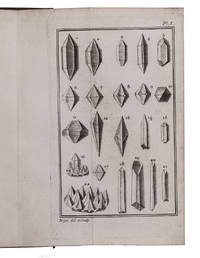
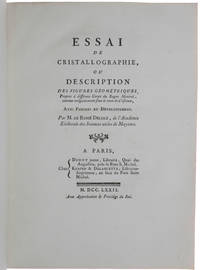
1772899Paris: Didot Jeune; Knapen & Delaguette 1772. <br /> <br /> A landmark work in the history of mineralogy and crystallography by Jean-Baptiste Louis Romé de l'Isle 1736-1790 one of the principal founders of scientific crystallography. Published in Paris in 1772 Essai de Cristallographie represents one of the earliest systematic attempts to classify minerals according to the geometry of their crystal forms rather than solely by chemical composition or external appearance. Romé de l'Isle sought to demonstrate that crystals obey fixed geometric laws helping establish crystallography as a rigorous scientific discipline during the Enlightenment. The work discusses numerous classes of crystals including quartz mica feldspars zeolites metallic crystals pyrites and gemstones accompanied by detailed geometric analyses and descriptions.<br /> <br /> Particularly notable are the engraved folding tables and plates illustrating crystal forms polyhedra and geometric developments. These illustrations provided one of the earliest visual systems for understanding mineral structures and became highly influential among eighteenth-century natural philosophers mineralogists and geologists. The volume includes an extensive bibliography of earlier authors on crystallization and mineralogy reflecting Romé de l'Isle's attempt to synthesize contemporary scientific knowledge. Also present is an attractive engraved armorial bookplate of Lord Sandys adding desirable provenance and evidence of ownership by an eighteenth-century British noble family. A highly important scientific work that marks the transition from descriptive mineralogy to the quantitative study of crystal geometry.<br /> <br /> Condition & Binding: Bound in contemporary full calf with gilt roll-tooled borders marbled endpapers and all edges gilt. Binding remains attractive and solid showing moderate rubbing scuffing and wear to boards corners and spine. Spine lettering has largely faded though decorative tooling remains partially visible. Internally remarkably clean and bright for the period with light scattered foxing and occasional minor spotting. Folding engraved plates and the large folding crystallographic table appear present and in very good condition with no significant tears observed in the supplied photographs. Overall- very good. Didot Jeune; Knapen & Delaguette unknown
1772L3LEN89INLTKParis 1772. 8vo. Didot Knapen & Delaguette Contemporary mottled calf gold-tooled spine with red title-label red edges marbled endpapers. With 2 folding letterpress tables and 10 folding engraved plates I-X. XXXII 427 2 1 blank pp. First edition of an influential work on geometrical crystallography by the French mineralogist Jean-Baptiste Louis Romé de l'Isle 1736-1790 one of the founders of modern crystallography. "In 1772 he published his first important technical work a one volume essay on crystallography in which he identified 110 crystal forms. This was a major expansion upon the work of Linnaeus . The Essai made Romé de l'Isle a prominent name among Parisian scientists of his day" Wilson. Romé is best known for his "law of constancy of interfacial angles" now the first law of crystal habit. The preliminaries contain an annotated bibliography by the author of the principal works on crystals. The plates depict numerous crystal forms as well as some geometric figures.Occasionally some very faint foxing or a small spot. Binding only slightly rubbed along the extremities. Overall in very good condition.l Hoover 2681; Ward & Carozzi 1906; Wilson The history of mineral collecting p. 52. unknown
17725371Paris: Didot jeune and Knapen & Delaguette 1772. First edition. <p>First edition a magnificent and very rare large paper copy both larger and printed on thicker paper than the octavo issue of one of the fundamental works of modern crystallography; it appeared 12 years before Haüy's Essai d'une Théorie sur la Structure des Cristaux. "Very scarce. The Cristallographie ranks as one of the great contributions to the science of crystals. In it Roméde L'Isle attempted to make a comprehensive classification of crystals" Schuh.</p>. A FUNDAMENTAL WORK OF MODERN CRYSTALLOGRAPHY - VERY RARE LARGE PAPER COPY. <p>First edition a magnificent and very rare large paper copy both larger and printed on thicker paper than the octavo issue of one of the fundamental works of modern crystallography; it appeared 12 years before Haüy's Essai d'une Théorie sur la Structure des Cristaux. Romé de L'Isle established that various shapes of crystals of the same natural or artificial substance are all closely related to each other. Measurements he took with a goniometer enabled him to determine that the angles between corresponding faces of a crystal are always the same which earlier had only been described in specific cases in particular by Niels Steno this is often described as the first law of crystallography. In addition he demonstrated that these angles are a characteristic of mineral type introduced the concept of truncation and also enlarged the crystallographic vocabulary. He "identified 110 crystal forms drawing upon Linnaeus who had listed forty and described in minute detail the minerals that exhibited them. He subdivided the various substances into salts stones pyrites and metallic minerals stating that he agreed with Linnaeus that geometrical form is the chief characteristic by which minerals may be classified. Also like Linnaeus he held that saline principles imprinted their own geometrical form upon the earthy constituent of each mineral" DSB. "Very scarce. The Cristallographie ranks as one of the great contributions to the science of crystals. In it Romé de L'Isle attempted to make a comprehensive classification of crystals. By the time he wrote his volume he was extremely familiar with the subject and this work greatly surpassed all previous works in scope and detail. To apply his classification he adopted a morphological approach in which he attempted to relate the diverse forms of crystals of the same substance. As a general morphological concept he introduced the idea of the 'primitive form'. All crystals of the same inorganic substance no matter how different in appearance had a fundamental and common geometrical form - the primitive form - to which their actual crystal shapes related . In this first edition of the Cristallographie Romé de L'Isle identifies 110 crystal forms by which minerals crystallize. Grouped under each of these shapes are describe the minerals that exhibit similar habits including the approximate angles between crystal faces. These forms were all derived from a common saline ingredient in every mineral that worked at a molecular level" Schuh. Pages xii-xxviii contain an annotated bibliography of the principal works on crystals. The only large paper copy listed by ABPC/RBH is the Norman-Freilich copy but our copy is significantly larger than even that copy 265 x 205mm versus 249 x 193mm.</p> <br /> <p>"Romé the son of a lieutenant in the cavalry studied humanities at the Collège Ste. Barbe in Paris. In 1756 he entered the Royal Corps of Artillery and Engineering which he accompanied as a secretary to the French Indies in the following year. From 1758 until 1761 he was in the enclave of Pondicherry French India. When it fell to the English in 1761 Romé was taken prisoner and transported to China where he stayed until 1764 when he returned to France" DSB. </p> <br /> <p>"Romé de L'Isle had started collecting minerals during his travels as a naval officer. Back in Paris after the Indian Wars he was introduced into mineralogy by the apothecary chemist and mineralogist Balthazar Georges Sage 1740-1824 who became his friend. It was very fashionable at the time in Paris to have a mineral collection. The owner of an important private collection Pedro Francisco Davila wanted to sell his. At Sage's suggestion he asked Romé de L'Isle to draw up the inventory. Romé made a very thorough job of it the inventory running up to three thick volumes. This was his first work on mineralogy published in 1767 Catalogue systématique et raisonné des curiosités de la nature et de 1'art qui composent le cabinet de M. Davila. It gave him the opportunity to study crystalline forms in detail and led to his Essai de Cristallographie 1772 .</p> <br /> <p>"The context of the time was not very favourable for such studies for had not the famous French naturalist Buffon written in his Natural history of Minerals volume 1 1783: 'One has pretended that rhombohedra constitute a specific character of calcareous spar without being attention to the fact that some vitreous or metallic substances also crystallize in rhombohedra and that if calcareous spar does crystallize often in rhombohedra it also takes different other forms; and our crystallographers when trying to borrow from geometricians the way to transform a rhombohedron into an octahedron a pyramid or a lens have done nothing more than substitute ideal combinations to the real facts of Nature. This crystallization in rhombohedra like all others will never have a specific character. Not only is there no crystalline form common to different substances but conversely there are few substances which do not present different crystallization forms as shown by the prodigious variety of forms of calcareous spar itself' .</p> <br /> <p>"In the preface Romé noted that 'of the curious phenomena of the mineral kingdom those which struck him most were the regular and constant forms taken by some bodies designated by the name of crystals.' He was encouraged by the works of Linnaeus he added to undertake the study of the angular forms of crystals and of their transformations. Their polyhedral shape was only known from the Ancients only for quartz diamond and a few others and Romé widely extended this observation. Minerals were divided by him into four classes: salts stony pyritic and metallic. For each mineral the most frequent forms observed are described with a reference to Linnaeus's classification in Systema naturae . Steno's ideas relative to the growth of quartz layer by layer are quoted at length and Romé de L'Isle felt that they could be applied to all crystals. The book was a success acclaimed by Linnaeus himself and brought international fame to Romé de L'Isle . The importance of Romé de L'Isle's work was stressed by Haüy who wrote Leçons de Physique 1795: 'To the exact descriptions he gave of the crystalline forms he added the measure of the angles and which was essential showed that these angles were constant for each variety. In one word his crystallography was the fruit of an immense work almost entirely new and most precious for its usefulness.'</p> <br /> <p>"Romé de L'Isle was also the first mineralogist to give a rational description of twins . He described for instance the dovetail twin of gypsum and the feldspars twins. He introduced the term macle to designate a crystal in which 'one half is produced by the inversion in the opposite sense of the other half of the same crystal' - a property which he demonstrated by the concordance of angles" Authier pp. 313-6. </p> <br /> <p>"Romé's friendship with Sage brought him membership in a number of learned societies including the academies of Mainz Stockholm Berlin and St. Petersburg. But it did him no service with the Paris Académie des Sciences which rejected him on the ostensible grounds that he was a mere 'catalogue maker.' It is likely that Romé's controversies with Buffon also played a part in his rebuff by the Academy" DSB.</p> <br /> <p>Freilich sale 460; Hoover 2681; Norman 1847; Schuh Mineralogy & Crystallography: A Bibliography 1469 to 1920 4151; Ward & Carozzi 1906; Wellcome IV p. 553. Authier Early Days of X-ray Crystallography 2013. </p> <br/> <br/> 4to 265 x 205 mm pp. v viii-xxxii 427 3 including half-title with 2 folding letterpress tables and 10 folding engraved plates. Contemporary calf spine gilt in compartments with red morocco lettering-piece red edges. Didot jeune and Knapen & Delaguette unknown
1766565Paris: Lacombe 1766. Soft cover. Good. 8vo - over 7¾ - 9¾" tall. 8vo. 19 x 10 cm 58 pp. including title-page first leaf blank. Bound in red marbled wrappers. Title toned and a bit soiled with two small ink-spots not affecting text toning in the margins of some leaves; nevertheless generally good with some leaves uncut and with original deckle edges. Very rare first and sole edition of the first treatise published by the pioneering French mineralogist Jean-Baptiste Romé de L'Isle 1736-1780 and his sole work on marine biology concerning the "movement generation and nature" of the freshwater polyp. In the present work Romé hypothesizes drawing on observations by the naturalist "M. Bazin" that polyps are a kind of living hive built of thousands of tiny separate units 'petits grains' that nonetheless work harmoniously to feed move and regenerate the entire body. Though Romé's hypothesis is not entirely off the mark-polyps may reproduce asexually by budding for instance-it was eventually disproven by the observations of the naturalist Justin Girod-Chantrans 1750-1841.OCLC: No American copies. Lacombe paperback
176333176-1314Rome Marco Pagliarini 1763. Title with vign. head- and tail-pieces decorative initials. XII 487 pp. 1 blank leaf 108 pp. 12mo. Contemporary boards worn. Rome Marco Pagliarini 1763. First published c. 90 years earlier under the title: Studio di pittura scoltura et architettura this is the first pocket guide for amateurs to the art and architecture of Rome. Aimed at an audience of secular tourists rather than religious pilgrims this guide is organized from the standpoint of geographical rather than devotional convenience. It is of the greatest interest to the historian of Baroque art and architecture as it provides a descriptive inventory of the contents of over 240 churches and monasteries and contains information relevant to attribution building history patronage and contemporary taste. Includes bibliogr. references and indexes. Most copies of this pocket guide were working copies by their very nature and have been used to pieces. According to Schlosser it remained the standard guide to Rome in the eighteenth century and as such was one of the formative sources for the trend of the "Grand Tour".- A clean copy. - Schlosser pp. 544 600; cf. Cicognara 3891; Marco Lattanzi "La prima grande vera guida di Roma" in F. Prinzi ed. Filippo Titti Descrizione delle pitture 1978 pp. 5-10; OCLC 3880564. ART & ARCHITECTURE & ARCHAEOLOGY ; ITALY ; GEOGRAPHY:TRAVEL ; Rome, Marco Pagliarini hardcover
178120101Altona J.D.A. Eckhardt 1781. 4to. Cont. blue boards. Back worn. 1435616 pp. and 15 folded engraved plates of which 3 are maps. Printed on good paper. hardcover
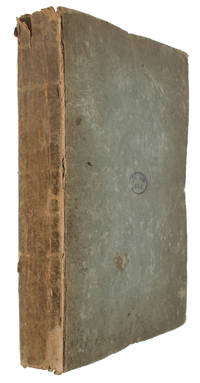
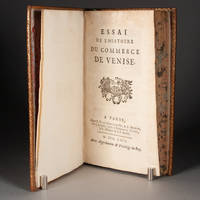
172900518<p>FIRST HISTORY OF VENETIAN TRADE --- xxiv 200 4 p. a8 b4 A-Q8/4 R6 166 x 95 mm --- First and only edition of this history of Venetian trade through 1290 which Barbier attributes to one "Roma"—and which appears to be the first printed survey of Venetian trade altogether. Barbier records the anonymous author's connections in Parisian law and finance but we know little else of him except that he perhaps took his text from a larger three-volume manuscript on the history of business in Italy. ¶ As the history of trade goes few European cities will be as synonymous with the subject as Venice. The Middle Ages saw it become one of the continent's most important ports the vital crossroads of trade between East and West. The author divides his history into three parts: the years 421-697 which he calls the age of the <em>Tribuns</em>; 697-1173 the age of elected doges; and 1173-1290 the age of sovereign doges. He covers the early development of the Rialto Venice's strategic location as a boon for international trade competition in fabric production silk especially—these and many other issues that historians continue to cite in discussions of early Venetian trade. ¶ We fully expected to identify earlier histories of trade in Venice a task we summarily failed at. The author himself complains of "the silence that historians of Venice have kept on this subject" xiij. True enough of the earlier <em>commercio</em> titles in both Cicogna and Soranzo's continuation none could be construed as a comprehensive historical survey of Venetian trade nor have our subject searches in WorldCat turned up anything earlier. Given Venice's tremendously influential role in the history of business the gap this work fills should be an important one. ¶ Hardly a common book and this may be the only copy recorded at auction; it matches the binding description of a copy offered in 2013. --- PROVENANCE: Bookplate removed from the front paste-down and a few efforts at obliterating small marks from the endleaves. --- CONDITION: Contemporary leather spine and board edges tooled in gold; marbled edges and endpapers. ¶ First and last few leaves a little dusty. Leather a bit discolored in spots; front paste-down skinned from removal of bookplate. A nice solid copy in a contemporary binding. --- REFERENCES: Emmanuele Antonio Cicogna <em>Saggio di bibliografia veneziana </em>1847 v. 1 p. 211 #1461; Ant.-Alex. Barbier <em>Dictionnaire des ouvrages anonymes</em> v. 2 col. 209;<em> Kress Library of Business and Economics</em> suppl. p. 196 ¶ Paola Lanaro "Introduction" <em>At the Centre of the World: Trade and Manufacturing in Venice and the Venetian Mainland 1400-1800</em> Toronto: Centre for Reformation and Renaissance Studies 2006 p. 34 "The Venetian Republic is still considered to be one of the first European states to accept the drastic change in mentality and in capitalistic practice brought about by the great maritime commerce between the Levant and the East above all in terms of international commerce in transit"; Edwin S. Hunt and James M. Murray <em>A History of Business in Medieval Europe 1200-1550</em> Cambridge Univ 2005 p. 60 "it was the international merchants who spearheaded the development of the techniques that transformed medieval commerce…The earliest techniques appeared in Genoa and Venice during or even before the twelfth century" 90 "One of the special characteristics of Venice and a source of its lasting power was its role as entrepôt and staple"</p> Pierre Gilles Le Mercier and A. Morin hardcover
17840313-B1784. Radierung, 1748, auf Bütten mit Wasserzeichen: Lilie im Doppelkreis (Hind 3). 24:35,7 cm. Titelblatt, der ?Antichità romane de?tempi della Republica??. Abdruck der römischen Ausgabe, o.J., 1748. Literatur: Focillon 41; Hind 1; Taschen 81; Wilton-Ely 103. - Sehr kräftiger Abdruck mit vollem Rand, die Ränder leicht gebräunt.
17521105871752. In der Platte signiert "Piranesi F." und mit dem gestochenen Titel "Veduta della gran Curia Innocenziana edificata sulk rovine dell` Anfiteatro di StatilinTatiro, cheformano todierno Monte Citorio". Mit der gestochenen Nr. "723" bzw. "39". Ausgezeichneter, gegensatzreicher Druck auf vollrandigem festen Velin. 40,7 x 62,3 cm (Plattengröße). 58,6 x 85 cm (Papier).