CollectifLivre Rare Book

15 résultats
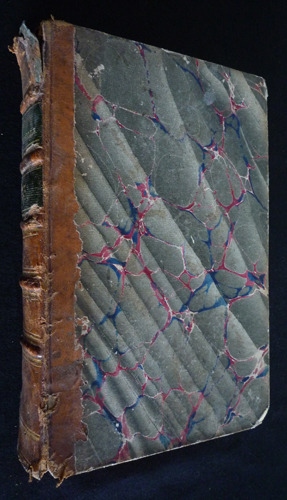
1786fy665Moutard, imprimeur libraire de la Reine Reliure d'éditeur 1786 In-8 (20,5 x 13,5 cm), demi-basane, paginé vj-xxiv et 2-571, tranches rouges ; tome cinquante-unième contenant la fin de l'Histoire de Venise, & le commencement de celle de Florence, jusqu'en l'année 1334 ; mors supérieur frotté, petit manque sur la coiffe inférieure, quelques rousseurs à l'intérieur, bon état général. Livraison a domicile (La Poste) ou en Mondial Relay sur simple demande.
1786fy690Moutard, imprimeur libraire de la Reine Reliure d'éditeur 1786 In-8 (20,5 x 13,5 cm), demi-basane, paginé vj-xxviij et 2-551, tranches rouges ; tome cinquante-troisième contenant la fin de l'Histoire de Florence, & l'Histoire de Pise, Lucques, Sienne, & S. Marin ; mors fendus, petite déchirure du cuir sur le dos, quelques rousseurs et salissures à l'intérieur, état général correct. Livraison a domicile (La Poste) ou en Mondial Relay sur simple demande.
17483100614810xbvk(Paris), 1748. 1 sheet, formerly folded; ca. 24 x 38 cm (sheet), ca. 17 x 21 cm (engraved map).
1714C12In-12, reliure plein cuir de l’époque, dos à cinq nerfs orné (usures aux coiffes et aux coins, taches aux pages de garde finales). 19 + 552 pp. (à noter 8 pages restées blanches en fin d’ouvrage : erreur d’impression).
17737463Vesalia & Leipsic Roeder & Heinsium 1773. 1st Edition . Hardcover. . ~ ~ NOTE: THE PRICE OF THIS BOOK IS CURRENTLY REDUCED! ~ ~ . Small octavo. Pp. 403 1. HARDCOVER bound in contemporary three-quarters calf and marbled boards spine with raised bands gilt morocco lettering-piece to second compartment large gilt fleurons to remainders all edges red; small chip at foot of spine lower board chafed dampmarked with some evidence of worming bit soiled in places. In good condition. ~ FIRST EDITION. Very rare. H-2 OUT <br/> <br/> Vesalia & Leipsic, Roeder & Heinsium hardcover
178920361A Rome, et se trouve à Paris, Chez de Senne, Comte d'Artois, de Senne, 1789. 2 volume in-8 de VIII-271 et [4]-239 pages, cartonnage de papier à la colle, dos lisse, étiquette de titre manuscrite, tranches mouchetées.
1778144722A Leide : Chez Jacques Murray Libraire 1778. First Edition. Hardback. Publisher's engraved device to the title. Finely bound both in modern fine-ribbed cloth with contrasting gilt-blocked red calf labels. Minor shadow stain to the front panel of the initial volume. Scans and additional detail on request. ; 0 pages; Physical desc. : 4 v ; 21 cm ; 8vo. Subject: Netherlands - History. Includes: L'histoire de la Hollande et des Provinces-Unies. Uninked impressed stamp to the title. Notes: Paged continuously; v.1: 2p. L. xxi 3 308p. ; v.2: 2p. L. 307-698p. ; v.3: 2p. L. 701-1062p. ; v.4: 2p. L. 1063-13835p. A Leide : Chez Jacques Murray, Libraire hardcover
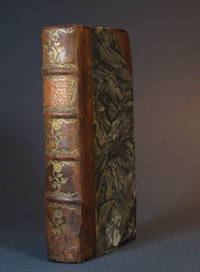
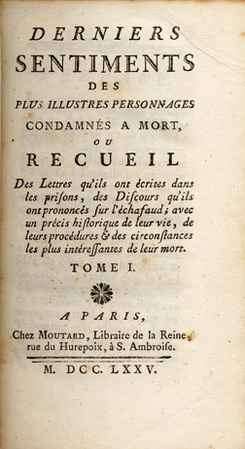
17758715Paris, Moutard, 1775 ; deux tomes, in-12 ; plein veau fauve marbré, dos à nerfs décoré et doré, pièce de titre grenat, tranches rouges (reliure de l'époque) ; (4), XV, (1) (errata), 501 pp. ; (4), 515, (3) pp. ; imprimé par Louis Jorry, rue de la Huchette.
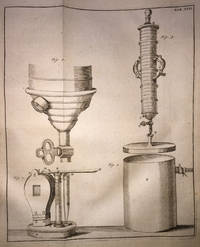
1731S13115Lugduni Batavorum:: Joan. et Herm. Verbeek 1731. 1731. Two parts bound as one. 4to. xvi xlviii vii 193 1; 192 xiv pp. Title printed in red & black 32 engraved folding plates 1 folding table index; margin of p.99 trimmed 1 ¾ x 2" away. some foxing browning of leaves title very browned due to offsetting. Beautifully preserved original mottled calf raised bands gilt spine compartments red leather spine label. Ownership mark on title of "Mr. Al. Liotard." Very good. FIRST EDITION incorporating the first Latin edition of the Saggi di naturali esperienze 1667 prepared by the Accademia del Cimento Florence with substantial additions throughout by Musschenbroek. Musschenbroek was one of the great physical experimenters and lecturers of the eighteenth century and the teacher of Nollet. This book contains the first description of the pyrometer an instrument for measuring the expansion of solid bodies under the influence of heat. Like many of Musschenbroek's books the Tentamina contains fine illustrations and is concerned with experiments in measuring humidity magnets and electricity air pressure the structure of ice heat and cold capillarity optics the motion of sound etc. / "He devised many of his experiments in the process consulting records of other experimenters among them those of the Accademia del Cimento. Musschenbroek translated their accounts into Latin adding reports concerning his own work 1731." :: Encyclopedia. / The work opens with Musschenbroek's Oratio de Methodo Instituendi Experimenta Physica regarding his views on experimental philosophy as inspired by Newton. "Underlying Musschenbroek's lectures demonstrated with experiments was the experimental philosophy the principal source of inspiration was Newton but Galileo Torricelli Huygens Reaumur and others were important to this school." :: DSB IX p. 596. The Accademia del Cimento Academy of Experiments was founded in Florence in 1657. Among the founding members were Borelli Steno Redi Cassini Viviani and Torricelli these final two being disciples of Galileo. This makes the Accademia older than either the Royal Society or the Academie des Sciences. Count Lorenzo Magalotti's text includes accounts of experiments on temperature and air pressure including Torricelli's invention of the barometer the velocity of sound and light phosphorescence magnetism amber and other electrical bodies the freezing of water etc. The many fine plates in this translation illustrate the Accademia's work as well as Musschenbroek's own subsequent experiments. :: Wolf History of science I pp. 55-59.2 parts in 1. / Musschenbroek 1692-1761 professor of natural philosophy and mathematics at Utrecht and later professor of experimental physics at Leyden. He was one of the most celebrated physicists and investigators of his time; the experiments he describes are classics in primary instruction. / "Musschenbroek's earliest account of electricity 1731 the estimable notes to his Latin translation of the Saggi is fuller more circumspect and less coherent than 's Gravesande's which he later entertained favorably. Two curious points emerge from the notes. To resolve the discrepancy between the results of Boyle and Hauksbee who respectively did and did not succeed in generating electricity in vacuo Musschenbroek hit on an unprecedented and prescient idea; remarking that Boyle used amber and Hauksbee glass he concluded that these substances have different electricities. . . The second point concerns repulsion. Musschenbroek records without emphasizing Hauksbee's observation that light bodies are sometimes repelled farther than they are attracted; he squeezes it into a note that also gives an excellent prescription for rubbing the tube :: always end with your hands together :: and a warning about atmospheric humidity. He does not recognize that the Saggi require updating about repulsion and concentrates on the perplexing behavior of screens the opacity of muslin and the transparency of glass." :: J. L. Heilbron Electricity in the 17th and 18th Centuries: A Study of Early Modern Physics 1979 p.242. / Wheeler Gift 276. Not in Bakken. FULL TITLE: Tentamina experimentorum naturalium captorum in Academia del cimento sub auspiciis Serenissimi Principis Leopoldi Magni Etruriae Ducis et ab ejus Academiae Secretario Conscriptorum: Ex Italico in Latinum Sermonem conversa. Quibus commentarios nova experimenta et orationem de methodo instituendi experimenta physica addidit Petrus van Musschenbroek Joan. et Herm. Verbeek, 1731. hardcover books
178745818ABParis, David 1787-91. 4 Bände. 4°. [2] Bll., IV, 258 [recte 254]; 176 S.; [1] Bl., 148; 171 S. Leder der Zeit auf 5 Bünden mit 2 Rückenschildern (numeriert I-IV) und Rückenvergoldung. Kanten und Gelenke berieben, Kapitale etwas bestoßen. Kl. Papier-Rückenschild. Etwas gebräunt (einige Tafeln etwas stärker), stellenweise etwas (stock)-fleckig. 2 Namen am Vorsatz. Band I die ersten 7 Tafeln und Text bis S. 11 mit Wasserrand, Band III eine Tafel etwas wasserrandig. Wenige Tafeln im Plattenrand durch zu starken Andruck eingerissen. Wenige Bll. und Tafeln mit schwacher Knickspur. [4 Warenabbildungen]
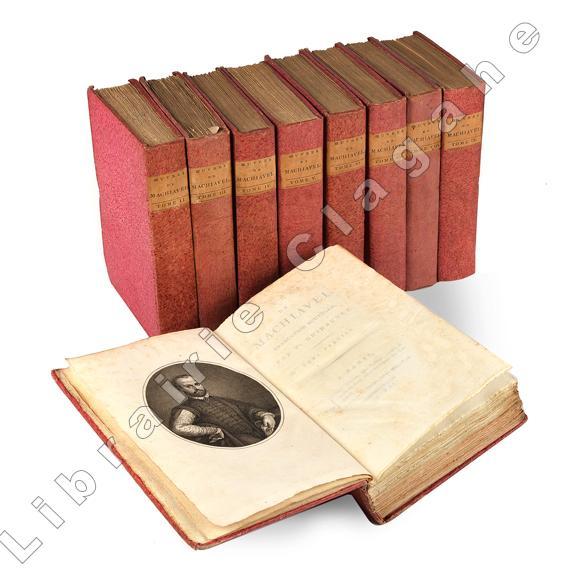
179920337Paris, Potey, Pochard, (imprimerie de Laran), an VII (1799) ; 9 tomes in-8 (210 mm), cartonnage rigide de papier rose à l’éponge, pièce de titre imprimée au dos, non rogné (reliure strictement d’époque) ; CXVII, [1 bl.], [2], 408 ; 384 ; 403 ; 416 ; 448 ; 455 ; 394 pp., [1] ff. bl. ; 370 pp, [1] ff. bl. ; 524 pp., portrait ovale en frontispice ; 7 planches dans “l’Art de la Guerre”, dont deux dépliantes et 2 doubles.
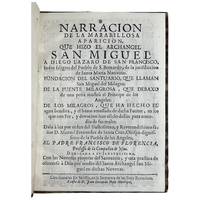
1740365403Sevilla Spain: Imprenta de las Siete Revueltas a costa de D. Juan Leonardo Malo Manrique 1740. Hardcover. Very good. A book by the first Hispanic American author and one of the first published writers born in what is now the United States. The book describes the visitation of the Archangel Michael San Miguel to Diego Lazaro a Mayan Indian in 1631 and the establishment of a sanctuary at San Miguel del Milagros the healing waters there and other miracles observed in the area. <br /> <br /> This is the second edition of Florencia's book. The first edition also published in Seville in 1692 came from the press of Thomas López de Haro; this edition which does not indicate a publication year is dated to 1740 by the Library of Congress.<br /> <br /> The verso of the title page has a full-page print of San Miguel printed inside a decorative type border. The image is signed "Lopez" in the plate possibly indicating the publisher of the first edition or a member of his family which made books for several generations. The plate is usually described as an engraving and there are certain fine details more typical of an engraving. However the image is on the verso of a text page which would be more common with relief printing like a woodcut which can be printed on the same press as type. The letters "Q. S. D." below the image Quis sicut Deus Who is like God the Latin translation of the Hebrew word for Michael appear to be in type and the decorative border appears to be made from four slugs with gaps between them at the corners. This and the lack of a platemark typically found around intaglio prints suggests a relief printing process.<br /> <br /> Florencia St. Augustine Florida 1620 – Mexico 1695 has rarely been considered as an early Hispanic writer. Few no histories of early American writers have considered him although since his first book appeared in 1661 Sabin 24811 he is one of the first people born in the present-day United States to publish a book.<br /> <br /> 8 194 4 pages. Small octavo 5-7/8 by 7-1/2 inches. Second edition. Bound in 19th century quarter sheep over marbled boards. Very good with some fading to the spine; corners somewhat worn. Second gathering of sheets foxed. Imprenta de las Siete Revueltas, a costa de D. Juan Leonardo Malo Manrique hardcover
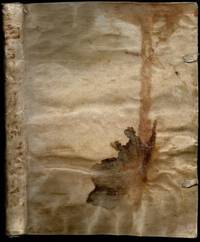
1740CA1210ab<p>81944 pages with full-page engraving on verso of title page. Quarto 7 3/4" x 6" bound in contemporary vellum with edges tinted red. European Americana 740/121; Medina BHA 6467; Palau 92347; Sabin 24815 Second edition first published in 1692.</p><p>Francisco de Florencia was the first Jesuit to be born in the territory that is now known as the United States in the current state of Florida. At the age of twenty-three he entered the Society of Jesus in 1612 and was professor of philosophy and theology at the Colegio Máximo de México. In 1668 he was sent as procurator of his province to Rome and Madrid. He then returned to the Mexican capital where he died in 1695. Of his sixteen works almost all with very baroque titles the <em>History of the Province of the Society of Jesus in New Spain</em> stands out published in Mexico in 1694 where he recorded the missionary work of the priests without making concessions to the Indians whom he almost totally ignores.</p><p>Before entering the Society of Jesus in 1641 at the age of twenty-one he had been a seminarian at the Colegio de San Ildefonso where he later taught Philosophy between 1653 and 1660 lessons he continued to teach at the Colegio Máximo de México between 1660 and 1668. He then held the Vespers chair of Theology. He was chosen to travel to Rome as procurator by the XVII Provincial Congregation together with Ambrosio Adrada rector and master of novices at the Tepotzotlán college. He remained in the Eternal City between 1669 and 1670. He was a man of great credit in the province of Mexico where he stood out for his religious life his letters and his knowledge of the things of the Company in Mexico. After his work in Rome he lived in Seville between 1671 and 1678 with the office of attorney general of the Indies.</p><p>By then there was another procurator before the Madrid Court in such a way that the procurator of the Indies in Seville was in charge of the most immediate matters related to the preparation of the trip of the missionaries to America while the one who resided in Madrid was in charge of all the prior procedures that had to be done before the Royal Council of the Indies. Father Florencia returned to Mexico in 1679 accompanied by reinforcements from Spanish and Italian Jesuits. There in 1680 he was appointed rector of the Colegio del EspÃritu Santo in the city of Puebla de los Ãngeles. He died in Mexico City fifteen years later.</p><p>Francisco de Florencia stood out not only as a preacher but especially as a historian and biographer of the religious who stood out in the province of New Spain as well as of the trajectory of the Society of Jesus in that viceroyalty. Not all of his works were published although his most important work is precisely the <em>History of the Province of the Society of Jesus in New Spain</em>. He also stood out in the study of the apparition of the Virgin of Guadalupe so it is not surprising that he requested the Holy See in 1663 the liturgical feast of this Marian invocation. Without a doubt Francisco de Florencia became the pioneer of Mexican religious history in aspects that were not limited only to the Society of Jesus.</p><p><strong>Condition: </strong></p><p>Minor wear to vellum stain on front wrapper; minor dampstaining near end; early inscriptions on front free endpaper small <em>marca de fuega</em> of a cross on top edge later owner's bookplate on front pastedown else about very good.</p> Siete Revueltas
174038135En Sevilla: En la Imprenta de las Siete Revueltas 1740. 4to 20 cm 8". 8 194 4 pp.; illus. <br><br>Beautifully printed this is the second edition of a major account of a New World wonder by the first Florida-born author Francisco de Florencia 161995 who entered the Jesuit Order in 1642 and became a noted preacher as well as a highly regarded writer.<br>Â Â Â Â First published in 1692 in Seville the Narracion essays the apparition in 1631 of St. Michael to an Indian named Diego Lázaro de San Francisco who lived in Santa María Nativitas on the PuebaTlaxcala border in Mexico. Miracles were attributed to the apparition to the spot of the manifestation and to nearby water as well; the miracles included various forms of spiritual healing including via holy water administered at a distance as recounted here.<br>Â Â Â Â The work received the patronage of Manuel Fernández de Santa Cruz the bishop of Puebla Mexico. It contains a => full-page woodcut of St. Michael offers novenas specific to his chapel and of course gives a full account of the apparition. =>That long account includes a few lines in Nahuatl on p. 119.<br>Â Â Â Â Provenance: 18th-century ownership signature of Francisco Antonio Ximenez del Arenal on front free endpaper. Unidentified marca de fuego on top edge of volume. Handsome 20th-century bookplate of Jose Rodriguez Familiar on front pastedown.<br>Â Â Â Â => There seems to have been NO Mexico-printed edition of this work. <br>Â Â Â Â <br>Â Â Â Â DeBacker-Sommervogel III 798; Palau 92347; Sabin 24815; Alden & Landis 740/121; Medina BHA 6467. Publisher's limp vellum with evidence of ties now perished title in old ink on spine all edges speckled red; stain on front cover and another on rear. Bookplate and markings as above. => Overall a clean crisp copy in very good condition. En la Imprenta de las Siete Revueltas hardcover books
17911909070003Florence: Niccolo Pagni and Giuseppe Bardi 1791 & 1795 1791. First Edition. Hardcover. Good. A Monumental Work of 18th century Italian engraving 2 volumes. Large folios 51 x 35 cm 19 3/4 x 13 in. 1st edition. Bound in contemporary 1/2 vellum over marbled boards. Some cover wear. Rear joint of v.1 cracked. Hinges of v. 2 cracked. Text in Italian and French printed in parallel columns. Collation: v.1 Engraved title frontispiece 64 leaves 60 plates. v.2 Engraved title 62 leaves 60 plates. Many of the plates are printed in colored ink: siena shades of brown or green and blue. 120 artists' portraits. <br> A gorgeous and large format work on Tuscan painting beginning with Guido da Siena and considering all the great painters of Florence such as Buffalmaco Cimabue Giotto Paolo Uccello Andrea Verrocchio Masaccio Fra fifilppo Lippi Andrea del Castagno Pollaiolo Botticelli Leonardo da Vinci Michelangelo Andrea del Sarto Antonio Tempesta Giuseppe Grisoni etc. Carlo Lasinio 1759-1838 was responsible for many of the engravings. Other engravers included: Giovanni Francisco Ravenet Marco Lastri Giuseppe Bardi Niccolo Pagni Matteo Carboni Ferdinando Gregori Gaetano Vascellini and Cosomo Colombini. <br> Refs: "Pregevole opera" Cicognara 3387. Cohen-Ricci 366. Thieme-Becker XXII 404. Brunet II 1095. Graesse II 509. Moreni I 509: "Ciascuno di questi volumi racchiude 60 articoli di notizie di altrettanti pittori toscani scritti in italiano da M.L. promotore di questa eccellente impresa e tradotti in francese da Bartolomeo Renard. Ognuno di essi ha una stampa incisa in rame scelta dalle Opere le piu stimate di quel pittore." <br> Armorial bookplates of Paul Beilby Thompson 1784-1852. Thompson was a Whig MP for Wenlock and East Riding; later made a Baron. <br> This is an oversized or heavy book which requires additional postage for international delivery outside the US. Florence: Niccolo Pagni and Giuseppe Bardi, 1791 & 1795 hardcover