Vredeman de Vries, HansAntiquariat.de

5 résultats
158714992ABAmsterdam, [1587?]. 26 x 35 cm. 6 Bl. mit 11 Kupferstichen. Es handelt sich um die Stiche 2, 3, 4, 6, 7, 8. Auf den Rückseiten der ersten 5 Stiche sind weitere Stiche aufgeklebt: "Dorica", "Ionica" (2 verschiedene), "Corintha" (2 verschiedene) . Neuer Kartoneinband (Softcover) in Einschlagmappe. Folge von 11 Kupferstichen. Nach sorgfältiger Restaurierung (Protokoll wird mitgeliefert) stabiler sauberer Zustand. Seiten teils stärker angefleckt, teils mit kl. angefaserten Fehlteilen., wenige im Bereich der Abb. Vorgebunden ein Blatt mit Schrift und Geheimschriftübungen in rot
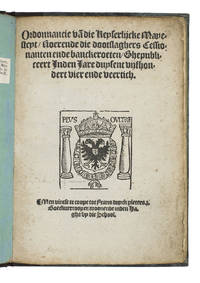
1544ABC_46700The Hague: sold by Frans Duyck Pietersz. colophon: Delft printed by Symon Jansz. 1544. Modern half brown buckram marbled paper sides blue endpapers with an older ca. 1840 front wrapper bound in. 4to. With the woodcut crowned coat of arms of the Holy Roman Emperor Charles V with the order of the Golden Fleece a column on either side and the motto plus oultre on the title-page. Set in 2 sizes of textura gothic type with 2 lombardic initials cast type. First and only edition of a rare ordinance printed in Delft. The ordinance promulgated 19 May 1544 tried to reduce or at least prevent a further rise in crime in Holland and even in other parts of the Holy Roman Empire by addressing the negligence of officers in enforcing the law. It notes that crime rates - from murders to fraud and other smaller incidents - are rising in Holland and across the Holy Roman Empire because officers of the law are failing to do their jobs in the eyes of Holy Roman Emperor Charles V and other lower ranking officials like the stadtholders in the Low Countries. The present ordinance addresses problems concerning the enabling fraudulent behaviour towards creditors of any kind authorities too readily issuing letters permitting deferment of payment resulting in an exorbitant volume of unpaid debts. In total the ordinance contains 40 rules and regulations mainly for officers of the law but also for criminals and others profiting from the lack of law enforcement decreed and published with the intent of bringing down crime rates and reminding officers of their duties. The printer Simon Jansz. in Delft printed the ordinance in two issues the present for Frans Duyck Pietersz. in the Hague and the other with his own imprint Typ. Batava 5796 2 copies.With contemporary marginal annotations and underlining of the text in pen. The second flyleaf is the older front wrapper with an inscription in brown ink on the back: "19 Mei 1544" along with an old catalogue clipping and a few pencilled bibliographical notes. With edges of the leaves slightly frayed slight browning throughout mostly around the edges but overall in good condition.l Petit Pamfletten 1 1882 71; STCN 119453460 2 copies cf. 831527528: Delft issue; Typ. Batava 5797 4 copies cf. 5796: Delft issue; USTC 421160 same 4 copies 1 listed as if it were 2 cf. 421163: Delft issue; not in Knuttel; Kress; Van der Wulp. sold by Frans Duyck Pietersz. (colophon: Delft, printed by Symon Jansz.), hardcover
160011257London: Adam Islip. Good with no dust jacket. 1600. First English Edition. Leather. 10 lacking first blank 804 809-13511354-1403 41 lacking last blank pp. Collates complete save for first and last blanks pagination skips correspond to ESTC 006185333. Impressive thick folio 13" x 8.5" Magnificent modern rebinding in full blindstamped panelled dark leather 5 raised bands to the spine with florettes in the compartments title author and date in gilt. Fore-edge has title written on to be shelved edge out. Renewed end pages with college library bookplate and bookplate of Eric Gerald Stanley 1923-2018 a British Anglo-Saxonist and the Rawlinson and Bosworth Professor at Univ. Of Oxford. Title page with large engraved printer's mark remounted with some repairs an old signature in brown ink with date April 26 1600. Xylographic "The" in the title. Verso of title page has woodcut portrait of Queen Elizabeth and the verso of A4 has a portrait of Livy framed in bay leaves and fruits. Dedication page has upper corner torn and has been restored with loss of text and head woodcut old cellotape repair as well. To the Reader page has corner repaired with no loss some staining p251-255 small ink smear on one page Iiii quire corners restored a few other pages with minor stains or repairs in the corners Cccccc3 has a thin spot/small hole in the margin with no loss of text. Very occasional marginalia. Numerous engraved head and tail pieces type is clear paper is strong and nice. The first English edition of Livy's Roman History translated by Holland considered one of the greatest translators of the Elizabethan era. "His first published translation The Romane Historie 1600 was the first complete rendering of Livy's Latin history of Rome Ab Urbe Condita into English. According to John Considine: 'It was a work of great importance presented in a grand folio volume of 1458 pages and dedicated to the Queen. The translation set out to be lucid and unpretentious and achieved its aim with marked success. It is accurate and often lively and although it does not attempt to imitate the terseness of Latin it avoids prolixity.' " Livy or Titus Livius gives us the Ab Urbe Condita literally "From the Founding" a history of Rome from its very beginnings. The first 10 books are the most famous celebrated for their grandeur -- "it as a panegyrist of Rome and Italy that Livy finds his most memorable expression." Here we learn of the quasi-mythological history of Rome of Aeneas Romulus and Remus and the battles of the early kings of Rome; the Law of the Twelve Tables the wars against the Gauls the Latins and the Samnites and finally the battle -- complete with elephants --between Hannibal's son Hasdrubal and Nero. Livy was known as a supreme master of the Latin language. "His prose was worthy of Cicero's but more subtle more malleable and more lyrical." Livy probably wrote his history of Rome during the reign of Augustus Caesar; it is a fascinating work that in many cases is our only source of numerous aspects of Roman history; with vivid accounts of Tarquin the Proud the Carthagenian Wars and other events from Rome's tumultuous past. A beautiful and important book in a magnificent binding complete save for the front and rear blanks in quite good condition with a nice provenance. ; Folio 13" - 23" tall . Adam Islip hardcover
160021144631600. London: Adam Islip. 1600. Folio. Contemporary English calf covers gilt and ruled in blind to a panel design with gilt arabesque-centrepieces cornerpieces incorporating fleurs-de-lys and crowns see below ties and endpapers renewed corners skilfully restored sometime sympathetically rebacked spine gilt in compartments raised bands ruled in gilt gilt black morocco lettering-piece; pp. x 804 809-1351 1354-1403 43 large woodcut printer's device to title-page woodcut portraits of Elizabeth I to verso of title-page and of Livy to A4v woodcut decorated and factotum initials woodcut head- and tailpieces; contemporary ink marginalia and underlining to 8 pp.; extremities and boards slightly rubbed; bound without first blank final blank partly torn away a little browning mainly to margins occasional stains outer corners of first 3 ff. skilfully restored not affecting text outer corners and lower margin of final 3 ff. reinforced; overall a very good copy. First edition of the first complete translation of Livy into English and the earliest major publication of Philemon Holland 1552-1637 in a handsome contemporary binding possibly from the circle of Henry Frederick Prince of Wales 1594-1612. Holland's Livy his first published translation was the first in a series of unabridged translations of canonical Latin authors that established his reputation as the 'translator generall in his age' Pforzheimer 495. The present work gave English readers their first complete Livy and quickly became one of the most influential classical histories available in the vernacular. 'Holland claimed to have written the whole manuscript with the same pen: ""a monumental pen"" says Fuller which ""he solemnly kept"" and which ultimately was enclosed in silver by a lady of his acquaintance' DNB commemorating the scale and ambition of the undertaking. The translation is frequently cited among the intellectual sources of Shakespeare's Coriolanus. While Thomas North's Plutarch supplied the narrative framework Holland's Livy appears to have contributed a broader political temper to the play one sceptical of purely martial heroism and more attentive to negotiation compromise and civic pragmatism. The work's influence continued well into the seventeenth century; during the English Civil War it was read across ideological divisions - by constitutional theorists such as Sir Francis Nethersole by Leveller writers and by Royalist pamphleteers - for its complex treatment of Rome's transition from monarchy to republican government. Provenance: Possibly from the circle of Henry Frederick Prince of Wales 1594-1612 eldest son and heir apparent of James I widely admired by contemporaries for his learning and intellectual seriousness and the founder of a substantial and carefully assembled library said to have contained more than a thousand volumes. Bindings associated with the prince's collection are known to employ crowned fleur-de-lys badge tools of the same decorative type as those found on the present volume see British Armorial Bindings Online stamps 14 15 23 and 29. The large strapwork centrepiece belongs to a recognised group of high-quality London 'centrepiece' bindings produced for patrons at the upper end of the trade. The workshop responsible appears to have had connections with the printing house of John Bill later King's Printer from 1617 Pearson 'English centrepiece bindings ca. 1560-1640 in Manchester libraries' no. 008g. Pforzheimer 495; ESTC S114001. hardcover
16003113London:: Adam Islip 1600. FIRST EDITION IN ENGLISH and THE FIRST OF PHILEMON HOLLAND’S TRANSLATIONS of ANCIENT AUTHORS. Folio:. 32.7 x 21.7 cm. . 12 804 809-1351 1354-1403 43 pp. Collation: AⶠB-6Fâ¶. with blank A6 and without blank 6F6 This is a very fine copy in contemporary calfskin ruled in gold with decorative tools at the corners of the central compartment and a fine arabesque at the center of the boards gilt. Rebacked with original spine preserved small defects. A very fine copy with minor smudges or inkspots including a fingerprint on p. 655. Marginal tear on p. 623-4 no loss. A woodcut portrait of Queen Elizabeth is printed on the verso of the title page; a second portrait of Livy is printed on A4 verso. This is the first complete rendering into English of the most important Roman historian. The scholar-surgeon Philemon Holland is one of the great literary figures of the twilight years of the Elizabethan age. Like his contemporary John Florio who translated Montaigne’s “Essays†into English in 1599 Holland not only made the works that he translated accessible to English readers but also put his own stamp on those works creating something at once faithful and new. The translations provided a wealth of material for English writers; it is possible that Shakespeare himself read Holland’s “Livy†See Muir The sources of Shakespeare’s plays 1977 p. 238 “Holland's first book the first complete rendering of Livy into English was published in 1600 when he was nearly fifty. It was a work of great importance presented in a grand folio volume of 1458 pages and dedicated to the queen. The translation set out to be lucid and unpretentious and achieved its aim with marked success. It is accurate and often lively and although it does not attempt to imitate the terseness of Latin it avoids prolixity. As part of his book Holland translated two other substantial works—an ancient epitome of Roman history that provides an outline of the lost books of Livy and Bartolomeo Marliani's guide to the topography of Rome—as well as some smaller texts. These were taken from the edition of Livy published in Paris in 1573; by translating them Holland was making available in English a great learned compendium of historical knowledge not simply a single ancient author.â€ODNB Livy’s “History†"Livy's narrative began with the mythic origins of Rome that is with Aeneas' flight from Troy and came down to the death of Drusus Augustus' stepson in Germany in 9 BC. It is possible that Livy's plan interrupted by his death was to reach the death of Augustus in AD 14. "Several times both in the preface and elsewhere Livy refers to the fact that for him the narrating of Rome's glorious past is a refuge from the distress he feels when he comes to narrating more recent and contemporary events the civil war between Caesar and Pompey the subsequent war waged by Octavian soon to be the first Roman emperor Augustus against Marc Antony and Cleopatra. Although he recognizes that the crisis is epochal rather than episodic Livy refuses to focus on that alone; rather he strives to view it within the general context of Roman history. "When Livy turns his gaze to the more than seven centuries that have brought Rome a small city of Latium to mastery of the world he shows reverence almost dismay before such vast time and vast achievements. In evoking that immense journey he feels the pressure of history the weight of the influence that the images of the past exercise upon the consciousness of the present time. These images act as models of social and individual behavior positive and negative; they are invitations to virtue and warnings against wickedness. The mythology of the past in short not only has meaning for contemporary men but also gives meaning to their actions in that it can illustrate through examples their own ideological needs.â€Conte STC 16613; Pforzheimer 495; Luborsky & Ingram English illustrated books 1536-1603 16613 Adam Islip, unknown books