2 268 résultats
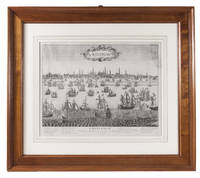
1599DB9FTP3RHVIKAntwerp 1599. Pieter Bast Framed. Large engraved panorama on 2 sheets ca. 27 x 76 cm as assembled. Rare first state of a 16th-century view of Amsterdam as seen from the inlet known as the IJ made by Pieter Bast a Dutch engraver from Antwerp best known for his city map of Amsterdam and this view. "In its amplitude and the sheer audacity of the presentation this engraving is indisputably one of Bast's most significant creations. It is as much a portrait of the harbour of Amsterdam as of the city itself and underscores the unique importance of maritime trade as the principle source of the city's wealth and power". With its distinctive orientation he not only initiated the series of representations of Amsterdam as seen from the IJ but also "established the standard for an entire genre of Dutch maritime painting" Keyes. In 1611 a second state edition was published by Claesz Jansz. Visscher who drastically altered the composition. In very good condition.l Hollstein Dutch & Flemish I p. 168 8; Keyes Pieter Bast 8 and p. 19. unknown
1730E1Q9EQ01U79OAmsterdam: Reinier and Josua Ottens 1730. Mounted and framed. With title in banner at top centre arms of the city at top right city seal at top left and the primary locations with captions. Large engraved panorama on 4 sheets ca. 42 x 218 cm as assembled. Rare large engraved view of Amsterdam as seen from the inlet known as the IJ published by Reinier and Josua Ottens ca. 1730 with numerous ships on the IJ. It's the last state of the view by Jacob Savry published in 1647 and partly updated including the changes made by Visscher in his issue from 1653. Most obvious are the changes on the east part of the city with several new buildings including ''s Lands Zeemagazijn' now known as the Netherlands Maritime Museum.Washed and with one minor professional restoration near the title. Very good copy of a beautifully executed an detailed view of Amsterdam.l D'Ailly Profielen 186; De Vries Atlas van Amsterdam 14; cf. D'Ailly Profielen 55 & 74. Reinier and Josua Ottens, unknown
196339265New York: NAACP Legal Defense and Educational Fund but never published 1963-1964. LIKELY THE ONLY COMPLETE COPY OF THIS EXTRAORDINARY and extraordinarily rare! PUBLICATION THE MASTER COPY OF THE FIRST MANUAL FOR PURSUING CIVIL RIGHTS CASES PRESERVED BY JACK GREENBERG WHO CONCEIVED OF THE PROJECT. Volume I: viii 1-198 198/1-14 199-375 pp; Volume II: vi misnumbered viii but complete 377-487 487/1-78 488-606 606/1-24 607-723; 725-817 602/1-58. Jack Greenberg initiated this project shortly after taking the reins of the NAACP Legal Defense Fund which being non-profit had already detached itself from the for-profit N.A.A.C.P. As Greenberg notes in the preface civil rights law was becoming a specialty like other branches of the law and thus needed specialized guidebooks. The Fund's lawyers guided by the principles set forth in these manuals went on to win virtually all of the important cases of the civil rights era. Only a few dozen copies were issued and most of them lack some or all of the important interpolations see collation. Furthermore since this manual was printed for use in a seminar and issued in three-ring binders sections were often removed. And finally the third volume was issued last in a tiny edition and is exceptionally rare. Fortunately Jack Greenberg preserved a complete copy with all of the interpolations for personal reference. Upon his retirement as a Columbia Law School professor in 2015 at age 90 he gave this set to his son. 4to. In the original leatherette three-ring binders all of which are perfectly functional. Some wear to binders but still solid. Internally FINE AND BRIGHT with a few manuscript corrections in Greenberg's hand. AN ABSOLUTELY CENTRAL DOCUMENT FOR THE HISTORY OF THE CIVIL RIGHTS MOVEMENT AND OF ALL LATER CIVIL RIGHTS LITIGATION. <br/><br/> NAACP Legal Defense and Educational Fund (but never published) hardcover
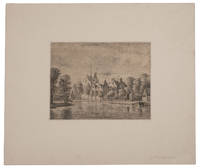
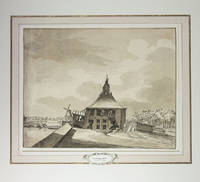
91MGUB7YLZSDNetherlands 1740. Mounted in passepartout. A view in brown ink with light and dark grey watercolour washes on laid paper 16.5 x 21.5 cm with a manuscript caption at the head. Attractive view in brown ink with grey washes of the picturesque Kostverloren manor on the Amstel River just outside Amsterdam. The manor was originally built at the end of the 15th century. In 1650 it was severely damaged by fire but it was soon restored. In 1822 Kostverloren was razed. The manor was famously depicted by Rembrandt Ruisdael and also by Abraham Rademaker 1676/77-1735 one of the most important topographic artists of his day. Rademakers drawing closely matches the present view in style and shows the exact same scene from the trees on the left to the smaller house on the right. The only difference is the season: the trees depicted here are much fuller.Slightly foxed but otherwise in good condition.l Cf. Blokland & Dumas de kasteeltekeningen van Abraham Rademaker C58. unknown
1660ABC_49405Amsterdam 1660. In a passe partout framed in a modern wooden frame. Engraving: ca. 38.5 x 50 cm; frame: 66.5 x 76 cm. Rare large engraved view of Amsterdam as seen from the inlet known as the IJ. The work is captioned in French and includes a numbered legend for the buildings in the background. According to d'Ailly it must have been engraved between 1660 and 1668 as it shows the Oost-Indisch Zeemagazijn a large warehouse built by the Dutch East India Company between 1660-1663 but not the Lutheran Church which was built in 1668. The present engraving is not signed but is very similar to a slightly later view of Amsterdam by French engraver Pierre-Alexandre Aveline 1656-1722. It bears the same caption and legend and has a nearly identical background but differs in the typography cartouche and the amount of ships in the foreground. The present state is exceptionally rare as we have not been able to trace any other copies of it in sales records and only three in literature.The engraving is slightly creased the upper right corner has been professionally repaired. Otherwise in very good condition.l D'Ailly E. A. Repertorium van de profielen der stad Amsterdam en van de plattegronden der schutterswijken 98 3 copies; cf. d'Ailly 101 and 102 Aveline view. unknown
1710DIV012in 8 ( 18x 12 cm) 201 Fol / pages 5470 (H) 1710 (c) frontispice gravé ,papier en bel état ,tranches dorés reliure sur haies de bois ,fermoirs métalliques présent . Un plat parfaitement séparé du volume En portugais Very rare 2nd second edition of the only treatise on Hebrew laws and customs written in Portuguese language and printed for the Portuguese Sephardic communities in Northern Europe. Treasure of Jewish Laws that the people of Israel must know and observe composed by Rabbi Hacham Menasseh ben Israel in Amsterdam, 1st edition 1647; and this 2nd edition in 1710. In 8. º (18x12 cm) (v) -201 - (iv) folium. Binding (worn out at edges) contemporary full calf gilt at spine. Engraved frontispiece. Contains title page to Third Part (Of feasts and fasts throughout the year, the people of Israel must know and observe) and the Last part (in which contains all the precepts, rites and ceremonies concerning to a perfect economy dedicated to the very noble and magnificent lords Abraham and Ishak Israel Pereyra). MENASSEH BEN ISRAEL was born in Lisbon in 1604. Very young of age he went to Amsterdam with his father, Joseph ben Israel, and became a disciple of Haham Yshac Uziel. In 1622 he was appointed professor of the Portuguese Jewish community in Amsterdam and, four years later, he founded the first Hebraic typography in Amsterdam; printing small books in Portuguese, Spanish and Hebrew languages. Menasseh had a decisive contribution in reopening England to the Jewish people, closed since the time of King Edward Ist. He went personally to London and had talks with Cromwell who gave him an honorific pension he never profit of. Menasseh died in 1658 after returning from London. He was portrait by Rembrant. Inocêncio VI, 211. 'In a book dealer which trade was new and old books, I found a complete copy of the Treasure. I've never seen another. '
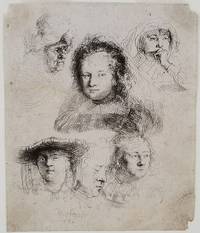
181523646Amsterdam 1815. In this etching Rembrandt has depicted his wife Saskia surrounded by six other subjects of different ages including his mother. The etching is reminiscent of a sketchbook page in which the artist practices different facial expressions and the fall of drapery on his subjects. Saskia receives the most detailed study with very fine lines used to draw her curls and a thin headdress. Each figure looks out in a different direction. <br /> <br /> There are approximately 125-225 known impressions of this work many posthumous. Nowell-Usticke B365. This impression is pre-1815 signed by the french printseller Naudet in 1801. This impression predates the 1815 restrike.<br /> <br /> Signed on the verso by the early Parisian print seller Naudet - "Chez Naudet Md au Louvre 1801". The "Md" is an abbreviation for 'Marchand" merchant. See Maberley Joseph "The Print Collector: An Introduction to the Knowledge Necessary for Forming." 1880 p.84 and Fagan Louis "Collectors' Marks" 1883 p. 73. There are several prints held in the Fitzwilliam Museum Cambridge with Naudet inscriptions one being "Two boys blowing bubbles. Bartsch 365; Hollstein White and Boon 365. 5 x 6 1/16". Usticke's second state of 2 with the horizontal scratches between the head of Saskia and the turbaned head in profile upper left. With slight loss on three corners and a small closed tear. Signed in the plate "Rembrandt f 1636" in the bottom left the "f" somewhat faint. unknown
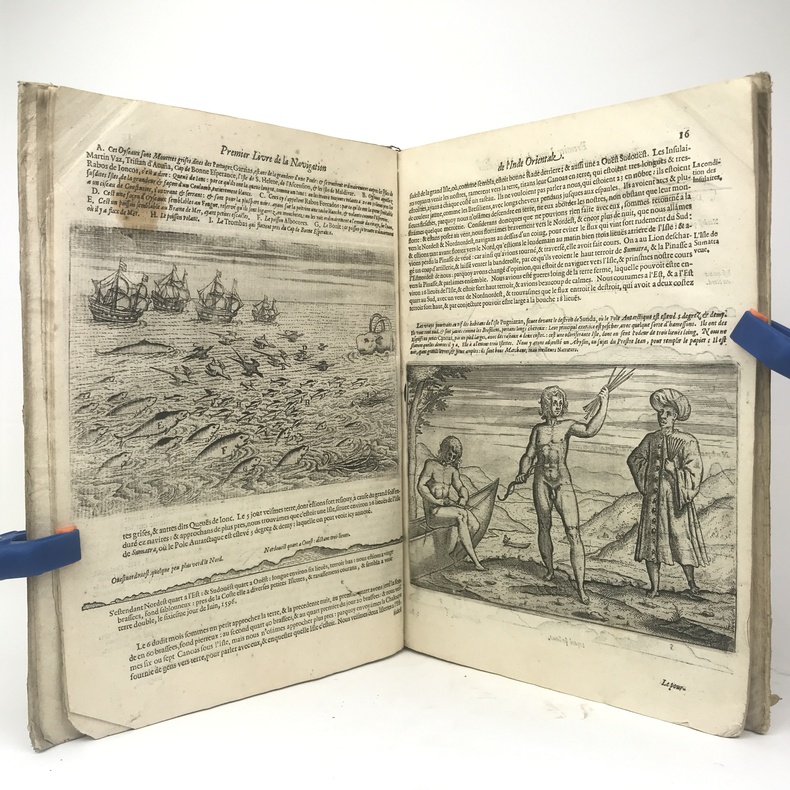
1609PHO-11431 volume in-folio (33 x 23 cm), vélin rigide parchemin (reliure de l'époque), dos lisse titré à l'encre, nombreuses écritures manuscrites sur les plats, 5 à 53-[1] feuillets. Page de titre, 3 premiers feuillets et feuillets 51 et 52 manquants, charnière fendue ,mouillure sur 5 ff et manque de papier en marge , galerie de vers avec manque. Seconde édition française, illustrée de 55 gravures sur bois in-texte.
1860ABC_50131Amsterdam: printed by R. de Vries for François Buffa & Sons 1860. Original brown blind-stamped wave-grained cloth with the title and imprint information lettered in gold on the front board in a rococo frame yellow endpapers. Oblong ca.16.4 x 24.6 cm. per leaf. The panorama is made up of 8 numbered lithographed views printed in monochrome with beige tone block. The viewer looks southward from the IJ over the city from the Oosterdok eastern dock and the Oosterkerk eastern church along the docks and wharfs via the recognisable towers of several churches and the view of the Royal Palace to the Westerdok western dock a large factory and the Blauwhoofd the northwestern-most bulwark of the city. Extremely rare leporello-style bound copy of a lithographic panorama of Amsterdam printed in monochrome with a beige tone block after drawings by Johan Conrad Greive 1837-1891 and lithographed by Ruurt de Vries Jr. 1813-1874.A remarkably precise and atmospheric profile of Amsterdams IJ waterfront extending from the Lijnbanen to beyond the Blaauwhoofd. The principal buildings are identified beneath each plate. The panorama captures in extraordinary detail the eastern docks the Oosterdok and Westerdok areas and numerous landmarks including the Zeemagazijn Admiraliteitsmagazijn Oosterkerk Zuiderkerk Oude Kerk the Dam with the Royal Palace and Nieuwe Kerk Westerkerk Noorderkerk and the bustling shipping of the IJ. A distant suggestion of Haarlems St Bavos Church may be discerned on the horizon.Greives meticulous urban draughtsmanship is akin to painting with the precision of photography. He later became chairman of Arti et Amicitiae and was celebrated for his highly detailed views of cities and rivers.The present example is preserved in a true leporello concertina binding: the front and back boards are not joined at the spine but are attached only to the first and last leaves of the accordion-folded sheets.This work is extremely rare: we have located only two other bound copies both held at the University of Groningen. Curiously of the related publication Panorama de Rotterdam likewise illustrated by J.C. Greive and published by François Buffa & Sons only a single surviving copy is recorded also at the University of Groningen. We have traced another copy of the Rotterdam panorama at the House of European History.The work has been cut slightly short touching the plate numbering and is slightly foxed throughout. Otherwise in very good condition.l d'Ailly Repertorium 278; Rijksmuseum object no. RP-P-1905-1045 RP-P-1905-1043 RP-P-1905-1039; WorldCat 64777818 2 copies; cf. for the Panorama De Rotterdam WorldCat 64777862 1 copy; more about the Buffa company: Landwehr Studies in Dutch books with Coloured Plates published 1662-1875 1976 pp. 62-66. [printed by R. de Vries for] François Buffa & Sons, hardcover
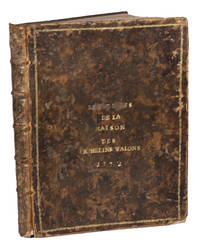
1772A81EC98HI9JLAmsterdam: David Pierre Humbert 1772. Near contemporary gold-tooled marbled calf with the title lettered in gold on the front board gold-tooled board edges marbled endpapers gilt edges. Large 4to 21.5 x 27 cm. With an engraved vignette on the title page and a divisional title page for the Prieres a l'usage de la maison des orphelins walons on leaf I3r. Further with 2 woodcut headpieces. Very rare work with the rules and regulations of the orphanage and elderly home institutions of the Walloon Protestant Church at Amsterdam in 1772. It is divided in 15 chapters each giving the regulations for the staff the physician the regents the guards etc. and the orphans and elderly. The preface contains the history of the "Hospice Wallon" from 1630-1772. On page 69 and onwards the prayers in use at the house are given. At the end a list of the regents male and female from 1631 until 1771 is present. This copy is interleaved with blank leaves a few with manuscript annotations in ink. In 1631 the Walloon community bought 3 houses at the Laurierstraat where they founded their orphanage. Eventually these buildings became to crowded and in 1669 the first stones were laid for another building at the corner of the Vijzelgracht in Amsterdam. In April 1671 the orphans moved to the new building now Maison Descartes.With manuscript annotations in black ink on the verso of the blank leaf between leaves A1 and A2 in the text on A2r and on the verso of the blank leaf between leaves C1 and C2; the other interleaved leaves remain blank. The binding is somewhat rubbed the fore edge and part of the fore edge margin of the last third of the leaves are stained and some offsetting on the letterpress leaves of the text on the surrounding letterpress pages this happened before the blank leaves were bound in. Otherwise in very good condition.l STCN 310471796 3 copies; WorldCat 461252717 1154627392 3 copies. David Pierre Humbert, unknown
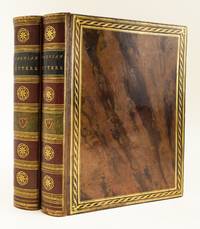
1798ST15948London: T. Cadell jun. & W. Davies 1798. First Illustrated Edition to which is prefixed a geographical index. 290 x 225 mm. 11 1/2 x 8 3/4". Two volumes. Edited by Thomas Birch. <br/> HANDSOME EARLY 19TH CENTURY MARBLED CALF BY J. FRÖDING OF AMSTERDAM his ticket on front free endpaper covers framed by thick and thin rules and bead-and-feather chain roll smooth spine of dark red straight-grain morocco gilt in a Neoclassical style with panels formed by chain and Greek key rolls containing sunburst centerpiece encircled by garlands one green and one black morocco label gilt-hatched turn-ins marbled endpapers all edges gilt. With frontispiece portraits of Philip and Charles Yorke 11 engraved busts of famous Athenians and a folding map of Greece. For the binder: Van Leeuwen "Dutch Decorated Bookbinding in the 18th Century" I 714. ◆Boards tending to splay slightly joints faintly rubbed the leaves immediately adjacent to the map a bit browned occasional mild foxing or tiny rust stains but AN EXTREMELY ATTRACTIVE COPY--clean and fresh internally with generous margins and in a stately lustrous binding.<br/> <br/> This is an especially pleasing copy of the definitive edition of an epistolary novel comprising a group of fictional letters purportedly written during the Peloponnesian War and featuring a notably handsome binding by Amsterdam artisan Jonas Fröding. Begun as an academic exercise among friends headed by Philip Yorke second Earl of Hardwicke 1720-90 and his brother Charles 1722-70 "Letters" was edited by the historian Thomas Birch 1705-66 with contributions from Henry Coventry John Green Samuel Salter the bluestocking scholar Catherine Talbot 1721-70 Daniel Wray George Henry Rooke John Heaston and John Lawry. After a private printing in 1741 of just 10 copies a second edition of 100 copies appeared in 1781 after several of the original participants had died and sparked what Britannica calls "a considerable vogue" for this and other works of historical fiction. A pirated Dublin edition was issued in 1792 to capitalize on this popularity but it was suppressed by Hardwicke's heir and superseded by our very attractive large-format 1798 printing done under the third Earl of Hardwicke's direction with an added geographical index engraved plates and a map. Stockholm-born binder Jonas Fröding ca. 1763-1808 was registered as a burgher in Amsterdam in 1794 at which time Jan Storm van Leeuwen believes he was working as an apprentice for the Crevenna Bindery a prestigious workshop that produced high-quality bindings for bibliophiles on their old and valuable books. One such client was the Italian-Dutch merchant by whose name the bindery was known Pieter Crevenna. In 1803 Fröding was received into the bookbinders' guild and set up his own workshop where he continued to use several roll tools from the Crevenna stock. While none of our rolls matches Crevenna rolls exactly two of them bead-and-feather Greek key are very similar to Crevenna rolls IX and XXV van Leeuwen I 715-16 and the overall design is quite like van Leeuwen fig. 239 a 1795 binding of tree calf by the Crevenna bindery with a gilt design in a Neoclassical style; that work would have been done during the time van Leeuwen believes Fröding was an apprentice there. Sadly Fröding's career lasted just five years; he died in Amsterdam in 1808. Not surprisingly given the brevity of his working life bindings by Fröding are uncommon in the marketplace. This work is seen for sale from time to time but our copy stands out because of its particularly attractive binding. T. Cadell jun. & W. Davies unknown
AMA-992Paris, Fasquelle, 1911. In 12, bradel demi-box noir, papier peint à la main, couvertures et dos conservés (Reliure de Delapierre). [2 ff.], 300 pp.
1772BCGB6MMFQHCTNetherlands 1772. Ca. 23 x 29 cm. Original pen drawing. A very nice and historically interesting drawing by Caspar Jacobsz. Philips 1732-1789 the well known Amsterdam draughtsman engraver and etcher art historian author and publisher together with two engravings. Although the two prints do not mention the name of Caspar Philips as inventor they probably were made after the drawing described above or an earlier version of it and its pendant in the Amsterdam city archives. Very fine copies all under passe-partouts.l Cf. Muller historieplaten 4224a and 4227b. unknown
1719F5OGBDYNZ8OAAmsterdam: Gerard Valk 1719. Very large engraved folding plan comprising 1 1/2 sheets measuring 46 x 83 cm as assembled engraved by Danckert Danckertsz. and his father after drawings by Jacob Vennekool including the two hemispheres of the world map and a celestial map of the constellations of the northern hemisphere each 10 cm in diameter. Very large engraved plan showing the extraordinary cartographic mosaic floor of the Burgerzaal of the Amsterdam City Hall designed by Jacob van Campen with a celestial map in the centre and the magnificent map of the world in 2 hemispheres on either side. The engraving was first published in 1661 and the map shows Tasman's recent discoveries in Australia and Tasmania and depicts California as an island. Many discoveries from his second voyage remained otherwise unpublished until the end of the 17th-century. This engraved representation is all that is left of this cartographical work of art. Wear caused by people walking on the mosaic meant it had to be restored about a hundred years later. When in turn this restoration was damaged the two hemispheres were filled in with plain marble slabs without pictorial representation.The drawing of the floor was made by Jacob Vennekool who worked closely with Van Campen and since his drawings were first published even before the building was completed they may reflect Van Campen's plan more closely than the finished building itself. They also of course show it before the alterations made at various times in later years.Slightly wrinkled in the right margin one fold reinforced and a few tiny spots otherwise in very good condition.l Cf. BAL 533 1st Dutch ed.; Fowler 77 & 274 1st Dutch ed.; Berlin Kat. 2235 1st French ed. Gerard Valk, unknown
17110030381711 Amstelaedami [Amsterdam], Excudit Franciscus Halma, 1711. In-quarto (208 X 258) maroquin vert, triple encadrement de filet doré sur les plats, filets dorés en place des nerfs, urnes dorées dans les compartiments, coupes filetées, tranches jaunes (reliure de lépoque) ; (1) f. blanc, frontispice gravé, titre avec vignette gravée, 10 ff. (dédicace, préface et élégie), 502 pages, (14) pp. (index), (2) ff. blancs.
192629577Amsterdam, Frederik Muller & Cie., 1926. 4° (35 mal 27 cm), 10 S. + Planches 22 Abb.; Sous la direction de Ant. W. M. Mensing (Frederik Muller & Cie.); in französicher Sprache, Ex Libris-Klebereste a. Vorsatz, Bezahlung per PayPal möglich , we accept PayPal, Regalspuren am Fußschnitt, Einband beschabt und stark bestoßen und eingegraut mit min. Einrissen, altersbedingte Bräunungen, Gebr.sp., kartoniert
200133840West Nyack New York U.S.A.: Cambridge Univ Pr. New. 2001. Hardcover. 0521593417 . FREE UPGRADE to Courier/Priority Shipping Upon Request - IN STOCK AND IMMEDIATELY AVAILABLE FOR SHIPMENT - FLAWLESS COPY - AVAILABLE IMMEDIATELY WHY WAIT -- 552 pages -- Choose us for the information you need -- DESCRIPTION: -- Although antidepressants have helped millions worldwide a substantial proportion of patients fail to respond or remit. There is little published information available to clinicians for diagnosis and management of treatment-resistant depression causing them to make difficult decisions regarding treatment options with very limited data. The editors and their internationally distinguished team of contributors have set out to address this problem giving a critical assessment of all aspects of treatment-resistant depression: causes epidemiology comorbidity evaluation and treatment. This timely book will be invaluable to clinicians neuroscientists researchers and graduate students. -- SYNOPSIS: -- Contributors offer a critical assessment of all aspects of treatment- resistant mood disorders addressing causes epidemiology comorbidity evaluation and treatment. The volume begins with chapters addressing the clinical problem of treatment-resistant mood disorders followed by discussion of the biological basis including the psychoneuroendocrine aspects the role of estrogen for women sleep abnormalities structural and functional brain imaging and immunologic factors. Next various treatment approaches are covered including SSRIs drug combination strategies thyroid augmentation and cognitive therapy and psychosocial interventions among others. Special populations are then covered followed by two final contributions addressing economic and ethical issues. Of likely interest to clinicians neuroscientists researchers and graduate students. -- Contributors: -- Daniel Souery Olivier Lipp Julien Mendlewicz Jeffrey S. McCombs Glen L. Stimmel Rita L. Hui T. Jeffrey White Owen M. Wolkowitz Victor I. Reus Barbara B. Sherwin Anna Sluzewska Janusz Rybakowski Jay D. Amsterdam Terence A. Ketter Christopher J. Bench Mark S. George Tim A. Kembrell Robert M. Post Martin P. Szuba Antonio T. Fernando Geralyn Groh-Szuba John P. OReardon Lawrence H. Price Linda L. Carpenter Steven A. Rasmussen William Boyer Richard Bunt Russell T. Joffe David Bakish Cynthia L. Hooper Max Fink Jan Scott Robert J. DeRubeis Adelita Segovia Kelly N. Botteron Barbara Geller Paul A. Newhouse Jaskaran Singh Zachary N. Stowe Pamela McCreary Claudia Baugh Alexis Llewellyn Jonathan E. Alpert Isabelle T. Lagomasino Jan Fawcett Paul Root Wolpe Arthur Caplan Mark A. Frye Kirk D. Denicoff Andrew Speer Susan R. B. Weiss Gabriele S. Leverich Mady Hornig Stanley S. Harris Sr Amy Hostetter Isabelle Massat -- with a bonus offer-- . Cambridge Univ Pr hardcover
36449AB(Brüssel), (F. Foppen), o.J. Quer-8°. Mit 134 von 139 Kupf.-Taf. Pgt. Rü.-Sch. u. verg. Rü.-Tit. Ber.u. stark fl. Gebr. u. etw. fl. Guter Zustand.
1631VT - LA - HAY336421631. Amsterdam Hendrick Laurentsz - ghedruckt ter Goude par Iaspar Tournay Anno 1631. relié plein vélin ivoire d'époque. Vélin défraîchi légèrement ondulé sur le dernier plat et avec quelques petits trous et taches brunes ; page de titre salie et fragilisée avec petit manque de papier en coin inférieur ; légères traces de manipulation en tous coins inférieurs ainsi que fins plis en coins supérieur ; faible mouillure de la page de titre à la page 5 et toutes tranches salies sinon reliure très solide et intérieur très frais de cet introuvable ouvrage. format : 165/95 cm. avec un portrait gravé en page de titre un ex-libris collé sur le premier contreplat au nom de Bibliothèque de J. P. T. Heuchel Médecin à Cernay et aussi en dessous un texte écrit en néerlandais à l'encre marron ancienne 8 gravures hors-texte et 8 dessins dans le texte ; avec aussi une lettrine et un cul-de-lampe. unknown
Buon esemplare contenente 100 vedute di Amsterdam. Peter Schenk, o Pieter Schenck (Elberfeld, 26 dicembre 1660 (battezzato) – Lipsia o Amsterdam, 1711 o 1713), è stato un incisore, editore e cartografo olandese del secolo d'oro di origine tedesca. Dimensioni dell' incisione: 31 x 20. Rarissimo. Cartonato editoriale, esemplare un po' sciolto.
192551610Amsterdam The Netherlands: A. Mak. As New. 1925. Paperback. FREE UPGRADE to Courier/Priority Shipping Upon Request IN STOCK AND IMMEDIATELY AVAILABLE FOR SHIPMENT - Pages tight to spine - Text in French. Prices realized recorded in pencil in margins of many of the lot descriptions. Among the artists represented: Troyon Th. Rousseau Rembrandt Frans Hals F. Guardi and many others. -- with a bonus offer-- . A. Mak paperback
192532870Amsterdam: A. Mak. As New. 1925. Paperback. FREE UPGRADE to Courier/Priority Shipping Upon Request - IN STOCK AND IMMEDIATELY AVAILABLE FOR SHIPMENT - AS NEW THE TEXT BLOCK IS PRISTINE CLEAN UNMARKED AND IN EXCELLENT CONDITION - - 541 lots; text in French. Many black and white plates. Among the artists represented: Magnasco F. Bol Charles Daubigny and many others. -- with a bonus offer-- . A. Mak paperback
192632426Amsterdam: A. Mak; Grande Salle De Ventes. As New. 1926. Paperback. FREE UPGRADE to Courier/Priority Shipping Upon Request - IN STOCK AND IMMEDIATELY AVAILABLE FOR SHIPMENT - TIGHT TO THE SPINE - Text in French; 1180 lots; many black and white illustrations. Among the artists represented: Jacob de Wit; P. Claesz; de Hoogh de Hooch ; J. Ruysdael Ruisdael ; and many others. Prices realized recorded next to descriptions of some lots. -- with a bonus offer-- . A. Mak; Grande Salle De Ventes paperback
193937860Amsterdam: Bernard Houthakker Et F. W. H. Hollstein. As New. 1939. Paperback. FREE UPGRADE to Courier/Priority Shipping Upon Request IN STOCK AND IMMEDIATELY AVAILABLE FOR SHIPMENT - Prices realized recorded in margins; PON cover. 332 lots a number of which are illustrated in black and white. Among the artists represented: Rembrandt Watteau Tiepolo Masolino A. Van de Velde and many others. Text in French. -- with a bonus offer-- . Bernard Houthakker Et F. W. H. Hollstein paperback
196439569Institut Neerlandais; Rijksmuseum Prentenkabinet. As New. 1964. Paperback. FREE UPGRADE to Courier/Priority Shipping Upon Request IN STOCK AND IMMEDIATELY AVAILABLE FOR SHIPMENT - TEXT PRISTINE--- COMPLETE TWO 2 VOLUME SET Catalogus & Afbeeldingen -- Text in Dutch. 207 works catalogued in first volume; 168 black and white plates illustrating many of these works in the second volume. Among the artists represented: David; Prud'hon; Greuze; Lancret; Watteau; Vouet; and others. -- with a bonus offer-- . Institut Neerlandais; Rijksmuseum Prentenkabinet paperback