46 résultats
176027730PARIS 1760 une vue d'optique en couleurs, GRAVÉE A L'EAU-FORTE ET AQUARELLE SUR PAPIER DE FORMAT: 49 x 34,5 cm., 1760 PARIS sans nom d'Editeur,
1750R98672Amsteldam [Amsterdam], by Theodorus Krajenschot 1750 [8] + 60 + [4] pp., met volblad titelgravure in goede staat, 22cm., contemporaine blinde omslag (achterkant ontbreekt), vage vochtkring op titelblad, tekst helder en in goede staat, R98672
1710DIV012in 8 ( 18x 12 cm) 201 Fol / pages 5470 (H) 1710 (c) frontispice gravé ,papier en bel état ,tranches dorés reliure sur haies de bois ,fermoirs métalliques présent . Un plat parfaitement séparé du volume En portugais Very rare 2nd second edition of the only treatise on Hebrew laws and customs written in Portuguese language and printed for the Portuguese Sephardic communities in Northern Europe. Treasure of Jewish Laws that the people of Israel must know and observe composed by Rabbi Hacham Menasseh ben Israel in Amsterdam, 1st edition 1647; and this 2nd edition in 1710. In 8. º (18x12 cm) (v) -201 - (iv) folium. Binding (worn out at edges) contemporary full calf gilt at spine. Engraved frontispiece. Contains title page to Third Part (Of feasts and fasts throughout the year, the people of Israel must know and observe) and the Last part (in which contains all the precepts, rites and ceremonies concerning to a perfect economy dedicated to the very noble and magnificent lords Abraham and Ishak Israel Pereyra). MENASSEH BEN ISRAEL was born in Lisbon in 1604. Very young of age he went to Amsterdam with his father, Joseph ben Israel, and became a disciple of Haham Yshac Uziel. In 1622 he was appointed professor of the Portuguese Jewish community in Amsterdam and, four years later, he founded the first Hebraic typography in Amsterdam; printing small books in Portuguese, Spanish and Hebrew languages. Menasseh had a decisive contribution in reopening England to the Jewish people, closed since the time of King Edward Ist. He went personally to London and had talks with Cromwell who gave him an honorific pension he never profit of. Menasseh died in 1658 after returning from London. He was portrait by Rembrant. Inocêncio VI, 211. 'In a book dealer which trade was new and old books, I found a complete copy of the Treasure. I've never seen another. '
170910925Amsterdam, Janssonius-Waesberg, 1709. Neue, überarbeitete und erweiterte Ausgabe (Editio nova revisa et emendata) 16° (10-15 cm). 5 Bll., 580 S. Pergament der Zeit
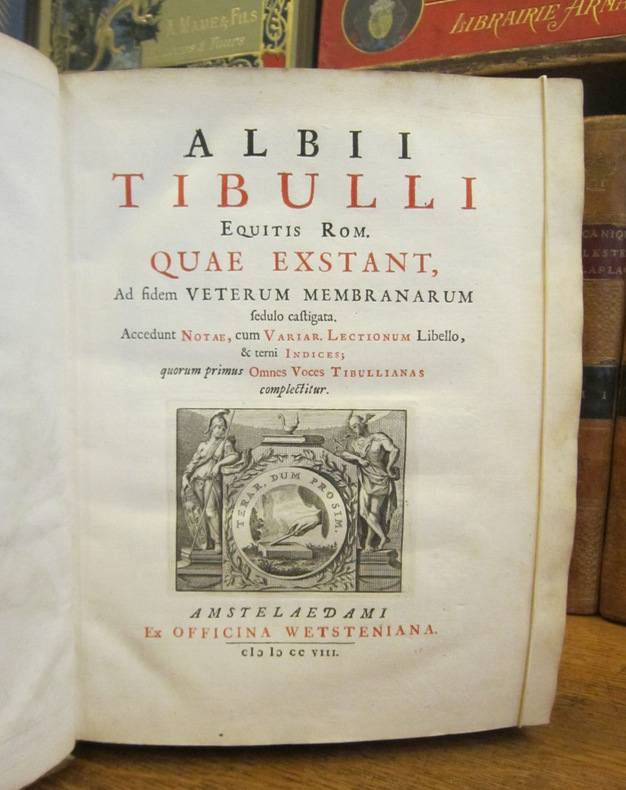
1708000312Amstelaedami (Amsterdam) Ex Officina Wetsteniana (Wetstein) 1708
1785N120722Amsterdam, gedrukt voor rekening der uitgeevers 1785 46pp., 20cm., tekst is helder en in goede staat, N120722
1774N120724Amsterdam, by T. Crajenschot & J.A. Crajenschot 1774 30 + [2] pp., met gegraveerd vignet op titelblad, vlekje op titelblad, tekst helder en in goede staat, N120724
1786119466(Leipzig), (1786). Plattengröße: 395 x 290 mm. Blattgröße: 475 x 310 mm.
180011303[um 1800]. 50 x 44 mm. Kupferstich, rückseitig Montagereste, leicht fleckig.
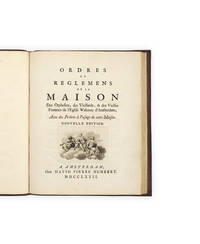
1772A81EC98HI9JLAmsterdam: David Pierre Humbert 1772. Near contemporary gold-tooled marbled calf with the title lettered in gold on the front board gold-tooled board edges marbled endpapers gilt edges. Large 4to 21.5 x 27 cm. With an engraved vignette on the title page and a divisional title page for the Prieres a l'usage de la maison des orphelins walons on leaf I3r. Further with 2 woodcut headpieces. Very rare work with the rules and regulations of the orphanage and elderly home institutions of the Walloon Protestant Church at Amsterdam in 1772. It is divided in 15 chapters each giving the regulations for the staff the physician the regents the guards etc. and the orphans and elderly. The preface contains the history of the "Hospice Wallon" from 1630-1772. On page 69 and onwards the prayers in use at the house are given. At the end a list of the regents male and female from 1631 until 1771 is present. This copy is interleaved with blank leaves a few with manuscript annotations in ink. In 1631 the Walloon community bought 3 houses at the Laurierstraat where they founded their orphanage. Eventually these buildings became to crowded and in 1669 the first stones were laid for another building at the corner of the Vijzelgracht in Amsterdam. In April 1671 the orphans moved to the new building now Maison Descartes.With manuscript annotations in black ink on the verso of the blank leaf between leaves A1 and A2 in the text on A2r and on the verso of the blank leaf between leaves C1 and C2; the other interleaved leaves remain blank. The binding is somewhat rubbed the fore edge and part of the fore edge margin of the last third of the leaves are stained and some offsetting on the letterpress leaves of the text on the surrounding letterpress pages this happened before the blank leaves were bound in. Otherwise in very good condition.l STCN 310471796 3 copies; WorldCat 461252717 1154627392 3 copies. David Pierre Humbert, unknown
1772H6178<p><strong>Very rare set of regulations governing the charitable house for orphans and the elderly</strong> <strong>founded by the Walloon Church in Amsterdam in 1631 with manuscript additions updating the lists of its male and female governors up to 1795.</strong></p><p>Established in 1586 the Walloon Church in Amsterdam purchased a building in 1631 to house orphaned girls and boys from the local Walloon community moving to larger premises forty years later and extending its remit to cover the elderly poor from the 1680s.</p><p>These regulations detail the duties of the house's governing body which comprised four male and four female regents 'widows or married women members of our church honourable pious prudent serious and of suitable age' as well as those of the 'Father' and 'Mother' of the house who were to regard the orphans 'as their own children' and of the house doctor supervisors who were to be lenient except in cases of 'drunkeness impurity or blasphemy' seamstresses who taught the girls sewing and read the Bible with them and baker. The schoolmaster was tasked with overseeing morning prayers and daily lessons as well as encouraging the orphans to read and write and administering corporal punishment.</p><p>The detail provided on the care of those unable to support themselves is quite fascinating. The orphans who were all below the age of thirteen were obliged to speak French rather than Dutch and were not permitted to promise themselves in marriage to each other during their time in the orphanage! Girls enjoyed an extra hour in bed compared to the boys. The establishment could maintain up to thirty-two men over the age of fifty who received three meals a day and were allowed to drink beer but not strong liquor to smoke albeit only outside and to sit by the fireside in winter. The elderly widows were not permitted to drink <em>eau de vie</em> and were to ensure that all fires and candles were extinguished before bedtime to avoid accidents.</p><p>The work ends with various morning and evening prayers for use by the community and a chronological list of male and female regents from 1631 to 1772 which in this copy has been updated in neat manuscript to cover the period up to 1795. These additions comprise an additional fifty names with their dates of office together with a note regarding extraordinary measures adopted between December 1789 and February 1790.</p><p><strong>No copies traced in the UK or US.</strong> OCLC finds copies in the BnF and in three Dutch libraries only.</p><p><em>Physical description:</em><br />4to pp. viii 91 15 2 blank; engraved vignette to title woodcut headpiece; slight cockling; a very good copy in contemporary mottled calf gilt border to covers spine gilt in compartments upper cover lettered in gilt 'Reglemens de la maison des orphelins Walons' board edges roll-tooled in gilt marbled endpapers; light wear to extremities a few small abrasions to upper cover; manuscript additions to the lists of Régens and Régentes at the end.</p><p><em>References:<br /></em>STCN 310471796.</p> David Pierre Humbert
1742002465Amsterdam, Bernard, 1742
1773R120723Amsterdam, by Theodorus Crajenschot 1773 [Vervolg van titel: "ter gelegenheid van de jaarlyksche gedachtenisse, en plechtige feestvieringe van het hoogwaardig, heilig, en aanbidlyk Amsterdamsche Wonder-Sacrament"], 33 + [3] pp., met gravure van het Sacrament op titelblad & gravure op p.3, 20cm., tekst helder en in goede staat, N120723
17895129396Amsterdam, ohne Verlag (=Wien: Georg Philipp Wucherer) 1789. 94; 87, (1 weiße); 222 Seiten. 8° (19 x 12 cm). Halblederband der Zeit mit rotem, goldgeprägtem Rückenschild, Lederecken, Marmorpapierbezug und rot gefärbtem Schnitt.
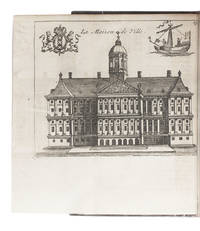
1719F5OGBDYNZ8OAAmsterdam: Gerard Valk 1719. Very large engraved folding plan comprising 1 1/2 sheets measuring 46 x 83 cm as assembled engraved by Danckert Danckertsz. and his father after drawings by Jacob Vennekool including the two hemispheres of the world map and a celestial map of the constellations of the northern hemisphere each 10 cm in diameter. Very large engraved plan showing the extraordinary cartographic mosaic floor of the Burgerzaal of the Amsterdam City Hall designed by Jacob van Campen with a celestial map in the centre and the magnificent map of the world in 2 hemispheres on either side. The engraving was first published in 1661 and the map shows Tasman's recent discoveries in Australia and Tasmania and depicts California as an island. Many discoveries from his second voyage remained otherwise unpublished until the end of the 17th-century. This engraved representation is all that is left of this cartographical work of art. Wear caused by people walking on the mosaic meant it had to be restored about a hundred years later. When in turn this restoration was damaged the two hemispheres were filled in with plain marble slabs without pictorial representation.The drawing of the floor was made by Jacob Vennekool who worked closely with Van Campen and since his drawings were first published even before the building was completed they may reflect Van Campen's plan more closely than the finished building itself. They also of course show it before the alterations made at various times in later years.Slightly wrinkled in the right margin one fold reinforced and a few tiny spots otherwise in very good condition.l Cf. BAL 533 1st Dutch ed.; Fowler 77 & 274 1st Dutch ed.; Berlin Kat. 2235 1st French ed. Gerard Valk, unknown
1720D84DQOR1MSG6Amsterdam: Paul de la Feuille 1720. Contemporary gold-tooled mottled calf with a red morocco title label lettered in gold on the spine gold-tooled board edges and red sprinkled edges. 8vo. Ad 1 with 28 engraved illustrations on 24 folding leaves including 20 illustrations of Amsterdam's most famous buildings and 4 leaves showing Dutch and European flags printed on both sides of the paper. Further with a small woodcut vignette on the title page one woodcut decorated initial and one woodcut headpiece. Ad 2 with a woodcut floral vignette on the title page and typographical tables in the text. 2 works in 1 volume. With: 2 Tarif general des Provinces Unies pour les droits d'entrée & de sortie que payent les marchandises tant en ce païs qu'à la Mer Baltique au passage du Sont.Amsterdam Paul de la Feuille 1718. Enlarged third and best edition - the first with running text instead of dialogues - of an interesting description of the city of Amsterdam together with a work containing the tariff rates for import and export of all kinds of goods and merchandise imposed by the Dutch Republic in alphabetical order. Also included are the tariff rates imposed in the Sont entrance of the Baltic sea and the last ordinances on the subject dated 1652 and 1655.The first edition of the Guide was published in Amsterdam by Daniel de la Feuille in 1701 and was mostly bound together with an edition of the Tarif of 1707 a second edition was printed in 1709.The plates show the most important buildings of the city such as the city hall now the Royal Palace of Amsterdam the stock exchange the main churches the 4 city gates the buildings of the Dutch East India Company VOC the Portuguese Synagogue etc.; the plates with the flags are from Fokkens' L'Art de Blason.Some minor dust soiling along the edges of the leaves the folding plates and quire K are slightly browned. Otherwise in very good condition.l Kress library S.2892; Ad 1: Nijhoff & V. Hattum 117; STCN 300355386 3 copies; WorldCat 65353974 838244431 46615043 313124792 46652734 1159002974 122306935 433419188 886395040 17 copies; cf. Cat. Goldsmith I10831 ed. 1772; not in Einaudi; ad 2: STCN 180657542 7 copies. Paul de la Feuille, unknown
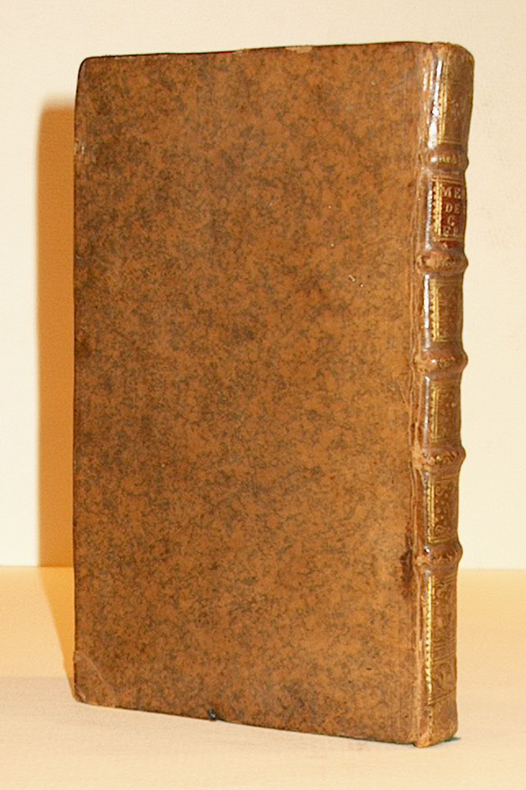
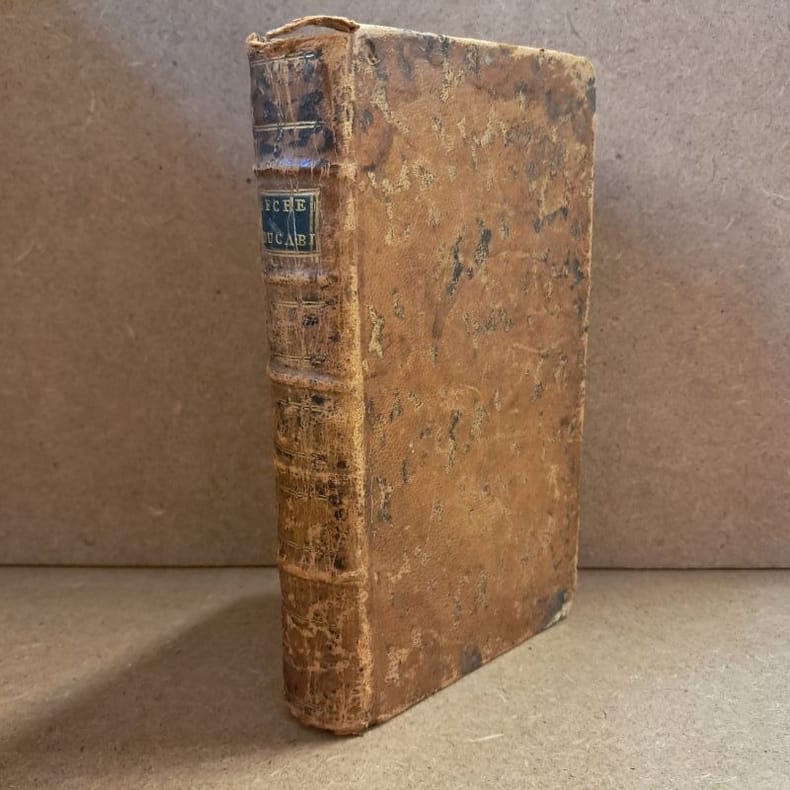
17546021754 - reliure - A Amsterdam, chez Pierre Paupie - Avec Permission - Ouvrage non daté (1754) - In-12 (17 x 10 cm), reliure plein cuir, avec cinq nerfs au dos, filets dorés et pièce de titre "Secre du cabi", tranches décorées - VIII + 368 pages - Titre complet de l'ouvrage : Le nouveau secrétaire du cabinet, contenant des lettres sur différents sujets. Avec la manière de bien les dresser. Les Compliments de la Langue Françoise, les Maximes & Conseils pour plaire & se conduire dans le monde. Nouvelle édition revue, corrigée & augmentée d'un Recueil de Lettres choisies propres aux Négociants plus étendu que le précédent - A PROPOS : Cet ouvrage s’inscrit dans une tradition ancienne de manuels destinés à l’enseignement de l’art épistolaire et des bonnes manières. Au XVIIIe siècle, ces ouvrages combinaient guide de correspondance, code de civilité et traité de savoir-vivre. Cette édition, publiée à Amsterdam par Pierre Paupie, semble être une réimpression ou une variante d’un texte initialement diffusé entre 1710 et 1730. Bien que certaines versions paraissent anonymes, plusieurs catalogues attribuent l’œuvre à René MILLERAN
17704105936Amsterdam: Z. Chatelain & Fils; Arkstee & Merkus; Mark Michel Rey 1770. Mit 3 gestochenen Titelvignetten von N.v.D. Meer Jun. Kl. 8° (16 x 11 cm). Geflammter, brauner Lederband der Zeit mit schönem goldgeprägtem Deckelrahmen mit Eckfleurons, floraler Rückenvergoldung und marmoriertem Schnitt mit wellenförmiger Goldpunzierung sowie marmoriertem Vorsatzpapier. [Hardcover / fest gebunden].
1729002106Amsterdam Herman Uytwerf 1729
1773002381Amsterdam E. Van Harrevelt 1773
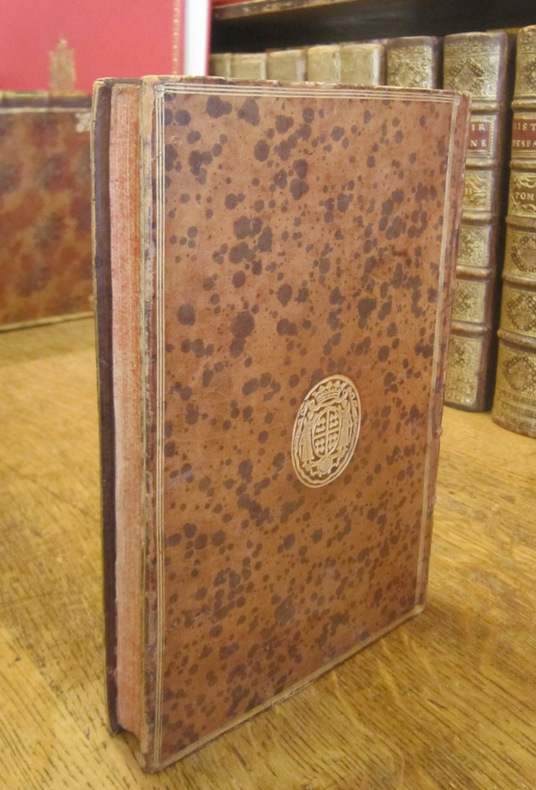
17110030381711 Amstelaedami [Amsterdam], Excudit Franciscus Halma, 1711. In-quarto (208 X 258) maroquin vert, triple encadrement de filet doré sur les plats, filets dorés en place des nerfs, urnes dorées dans les compartiments, coupes filetées, tranches jaunes (reliure de lépoque) ; (1) f. blanc, frontispice gravé, titre avec vignette gravée, 10 ff. (dédicace, préface et élégie), 502 pages, (14) pp. (index), (2) ff. blancs.
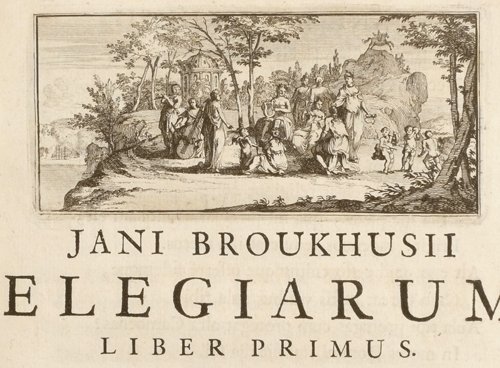
17102501100018xbvkAmsterdam, Offizin Hendrik Wetstein, 1710. Copperplate-titlepage, printed titlepage in red and black with woodblock flower-bucket; (8) 315 pages, 1 blank sheet; ALL ON UNTRIMMED PAPER. - Vellum-binding with gilt-titled red spinelabel; small-8vo.(ca. 16 x 9 x 2 cm).
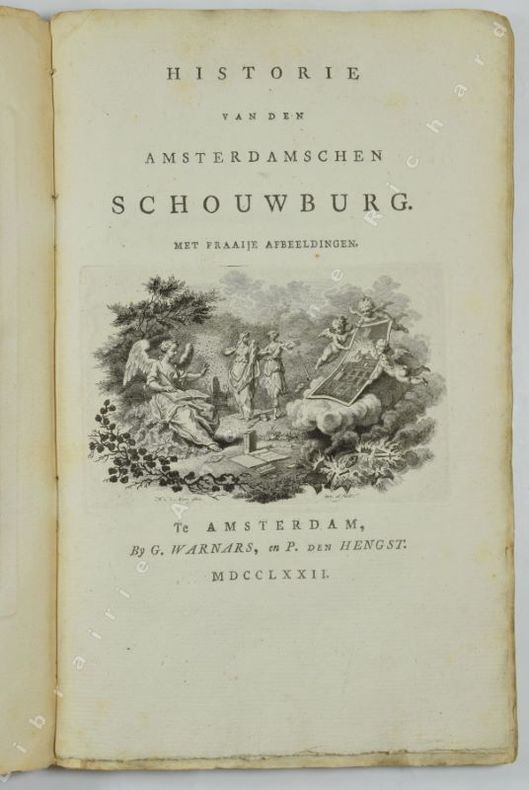
17725342Amsterdam, G. Warnars, en P. Den Hengst, 1772. 221 x 134 mm, (4) ff. : faux-titre, titre, (1) f. : Verklaaring..., (1) f. : Bericht van de Uitgevers, 80 pp., (6) ff. , 4 pp. : "Vier fraaije konstiplaten, Verrnende den Ongelukkigen Brand van den amsterdamschen Schouwburg., 4 pp. : Vier fraaije Konstiplaten, van het nieuwe Gebouw des Amsterdamschen Schouwburgs", ex-libris "Jacobi Theodori Boelen anno 1876 nati" contrecollé sur contreplat, 1 planche gravée en frontispice, 1 grande vignette gravée sur la page de titre, sans les planches-doubles annoncées, texte seul sous couvertures d'attente.
1774002365Amsterdam et Paris Delalain 1774
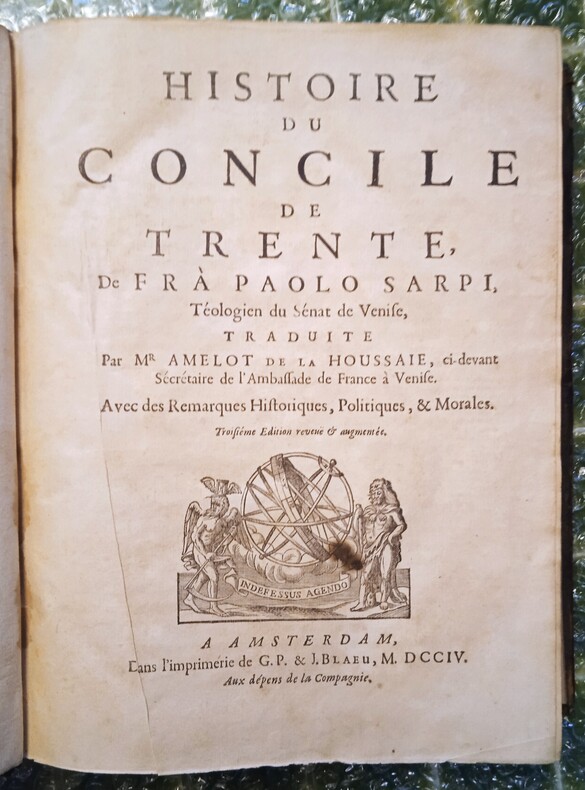
1704R56Amsterdam, Dans l’Imprimerie de G. P. & J. Blaeu, 1704. Un fort volume in-4° (21 x 26,5 cm), reliure de l’époque pleine basane marron, dos à 5 nerfs, coiffe supérieure arasée, petit manque à la coiffe inférieure, dorures un peu estompées, plats légèrement frottés mais reliure solide et bon état général. [23] ff. + 800 pp. + [23] ff. Papier avec des rousseurs uniformes de manière inégale au long de l’ouvrage, présence de quelques rares petites taches, notamment une en page de titre (de brûlures ?). Aucune page manquante ni déchirée. Belles lettrines.