9 941 résultats
In-8 (191 x 120 mm), plein maroquin rouge de l'époque, dos lisse entièrement orné d'une guirlande de fleurons dorés, plats encadrés de triples filets d'encadrement avec fleurons d'angle, armes de Marie-Antoinette dorées au centre, roulette sur les coupes, dentelle sur les chasses, tranches dorées, 24 p., (1) f. blanc. Précieux exemplaire aux armes de Marie-Antoinette: l’éloge funèbre de sa propre mère l’archiduchesse d’Autriche, dont la reine de France était l’une des seize enfants. Fille aînée de l’empereur Charles VI, Marie-Thérèse d'Autriche (Vienne, 1717-1780) est entrée dans la mémoire collective comme l’une des grandes monarques de son siècle. L’auteur de cet éloge est le juriste et homme de lettres Joseph von Sonnenfels (1732-1817). Issu d’une famille juive convertie au christianisme, il est l’un des principaux représentants autrichiens de la doctrine du despotisme éclairé. Il avait amorcé une triple carrière d’enseignant, d’homme de lettres et de juriste sous Marie-Thérèse, qui le nomma au Conseil de Bohême, puis à la Cour d’Autriche et au Conseil d’étude et de censure. Le traducteur Pierre Alexandre de Rivals, ancien Garde du Roi, devint sous-lieutenant de Maréchaussée de Bourgoin en Dauphiné en 1789. (Cf. M.-A. Arnould, "Les oraisons funèbres de Marie-Thérèse" in 'Bulletin de la Classe des lettres et des sciences morales et politiques', T. 66, 1980, p. 455-486). WorldCat ne recense que 5 exemplaires de cet ouvrage dans le monde: un à Harvard, quatre à la BnF. Un de ces exemplaires de la BnF possède une reliure aux armes du comte de Vergennes, dédicataire de cet ouvrage. Les armes frappées ici figurent à l’identique sur les reliures de plusieurs exemplaires appartenant à Marie-Antoinette conservés au château de Versailles dont: 'Les Lacunes de la philosophie', par François Louis d’Escherny (1783), reproduites sur le site du château: lescarnetsdeversailles.fr/2020/04/les-lectures-de-marie-antoinette/. Quelques infimes épidermures. Très bel exemplaire.
06-Go.J. Öl auf Holz, rechts unten signiert ?O. Piltz? sowie zusätzlich auf der rechten Grabplatte ?O. Piltz München?. 54,5:36 cm. Gerahmt. Vermutlich um 1890 auf einer Studienreise nach Tirol entstanden. Literatur: Wohl identisch mit Bötticher Nr. 63 ?Vor dem Hochaltar?, aus der Sammlung Adolf von Liebermann, versteigert in Berlin, bei J.M. Heberle, 12.03.1894. Vergleichsliteratur: C. Bantzer: Hessen in der deutschen Malerei. Hrsg. Von A. Baeumerth. Marburg, Hitzeroth, 1993, S. 85 f., Abb. des Gemäldes ?Taufe in der Kirche zu Cappel?.
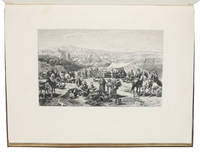
1885K3NAZ0R8AJUJVienna: Imprimerie Imperiale et Royale de la Cour et de lÉtat 1885. Contemporary calf richly gold-tooled front board spine label gilt edges. Folio. With 37 etched plates. First and only edition in French. Archduke Rudolf set out on his tour of the Middle East in 1881 travelling first from Vienna to Miramar Corfu Alexandria and Cairo. From there the group sailed up the Nile to Aswan and Memphis then journeyed on to Port Said the Suez Canal the Red Sea and the Holy Land returning to Vienna from Haifa via Cattaro Kotor Ragusa Dubrovnik and Trieste. This outstanding and unique copy in a sumptuous Viennese binding in immaculate condition was created for Anton Ritter von Beck 1812-95 then director of the governments Imperial printing office in Vienna.With a long inscription by the translator the Baron de Montandin to "Monsieur le Hof Rath Anton Chevalier Von Beck" on the flyleaf dated Vienna 28 February 1885. Some slight stains in the guards of the etchings otherwise a very clean copy.l Hamann Habsburger-Lexikon pp. 415 ff.; ÖBL IX pp. 315 ff.; Wurzbach VII pp. 145 ff. Imprimerie Imperiale et Royale de la Cour et de lÉtat, unknown
136062aafFranckfurt am Main, Matthaeum Merian, 1649 (= 1656), in-Folio, Mit Kupfertitel (etwas knapp beschnitten) + Seite 3 bis 155 (recte 145 - S. 103 bis 110 übersprungen ohne Verlust) + 6 Bl. + 52 S. + 4 Bl. / 14 S. + 1 Bl. Illustriert mit 165 Darstellungen auf 119 meist dplblgr. Kupfertafeln.- Angebunden: (Ders.). Topographia Windhagiana, Das ist: Aygentliche Delineation, oder Contrafactur... mit Beschreibung beyder Herschafften Windhaag und Reichenau. Ebda. 1656. 18 S. + 5 S. (+ 1 S.). Ill. mit 38 Darstellungen auf 21 Tafeln. Pergamentband der Zeit. (insges. schönes Exemplar).
184202-G1842. Öl auf Leinwand, links unten signiert und datiert ?F.C. Kiaerskou 1842.?, verso bezeichnet ?i Noerheden af Inspruck F C Kiaerskou 1842.?. 34,5:49 cm. Mit Vergolderrahmen. Mit zwei kleinen Retuschen, sonst gut erhalten.
111678aafPartenkirchen, o.J., um 1878, Imp.-folio (68x51 cm), Mit 20 Fotografien (27x39 cm) von Bernhard Johannes auf bedrucktem Karton montiert u. mit montierter Legende. 2 Bll. Widmung u. Vorwort u. 20 Bll. Erläuterungen, in blindgeprägter Or.-Lwd-Mappe mit goldgeprägtem Deckeltitel u. Schliessbändern.
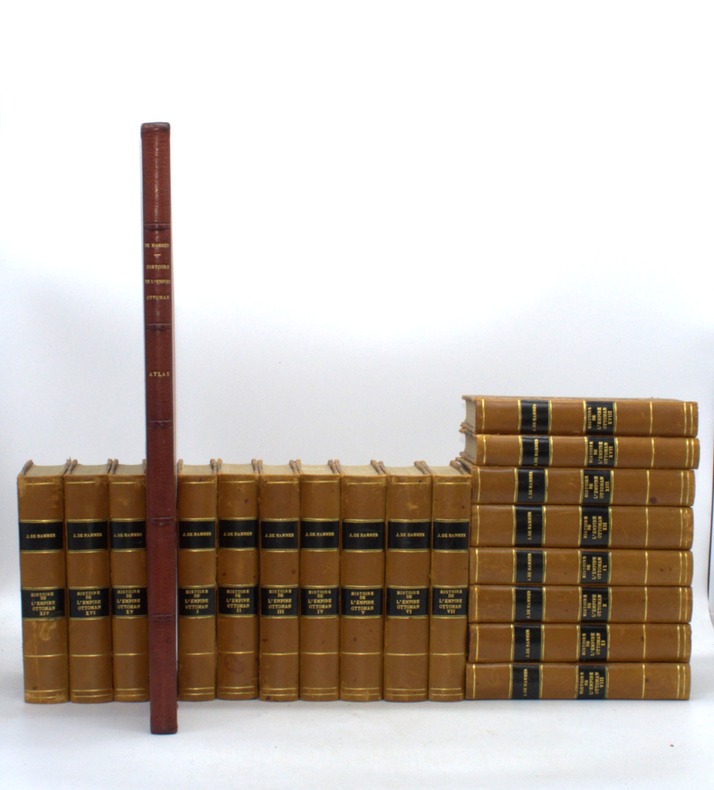
1835PHO-1982Paris, Bellizard, Barthes, Dufour et Lowell ; Londres, Bossange, Barthes et Lowell ; Saint-Petersbourg, Fd. Bellizard et Cie, 1835-1844. 18 volumes de texte in-8 et un atlas in-folio. TEXTE : 18 volumes in-8, relié demi basane et coins moderne, dos lisse orné avec pièces d’auteur, titre et tomaison noires, frottements et épidermures, défauts d’usage, rousseurs dans le texte, tampon et étiquette du relieur. ATLAS : Paris. Bellizard, Dufour etc. 1844. Imprimé chez Thierry Frères. Demi basane et coins à long grain grenat, dos à nerfs avec titre et auteur, In-folio (520x345mm), IV-82pp.-40 planches, il est composé du Commentaire sur l’Atlas de l’Empire Ottoman, d'une liste des cartes, d'une carte générale de l'Empire Ottoman (690x550mm), de 22 cartes particulières (dont une sur 2 feuilles) (815x850), de 13 plans de batailles ou de siège, et de 4 plans de villes dont un grand plan dépliant de Constantinople (690x670mm), le plan de Vienne est en 2 états, par G. Heck et Plée et gravé par U. Muschani, roussurs éparses, 2 cartes uniformément brunies avec réparations, mouillure claire en marge, tache sur les 16 premiers feuillets en tête et en fin d’ouvrage en pied. Provenance : collection de S.A.R. le Prince Osman Ibrahim d'Égypte (1951-2025), fils de S.A.R. le Prince Amr Ibrahim d'Égypte et de S.A.I. la Princesse Nejla Hibetullah Sultan (Necla Osmanoğlu) de Turquie, petite-fille du dernier calife Abdulmejid II et du sultan Mehmed VI, avec sa marque au tampon.
10850Wien / Baden bei Wien, Gesellschaft für vervielfältigende Kunst / Verlag Rudolf Rohrer, 1889 bis 1938. 39 volumes (36 in-folio et 3 in-4). Les 5 premiers pleine percaline brune, titre et décors dorés et noirs aux dos, premiers plats richement décorés (doré, noir et à froid), plats biseautés, tranches dorées pour le volume 5. Du 6e au 36e, pleine toile grège d'éditeur, titre et décors rouges jusqu'au 23e, vert pour les suivants, tranches marbrées ou teintées. Les 3 volumes in-4 sont reliés pleine percaline bordeaux, titre doré aux dos, têtes dorées (plats un peu tachés). La toile de certains volumes est un peu poussiéreuse. Intérieur très frais, quelques rousseurs extrêmement rares, 1 planche et 1 cahier déboîtés. Les années 1909, 1917 et 1918 non reliées mais sous cartonnage toilé normal, 1917 en 3 numéros / 2 cahiers (sur 4 / 3), 1918 en 3 numéros / 2 cahiers (sur 4 / 3).
1515C510<p>Venice: Jacobus Pentius for Melchior Sessa and Petrus de Ravanis 15 July 1520 4to 210 x 150mm Full Contemporary Calf Gilt Device within gilt frame with ornate gilt cornerpieces gilt border on upper and lower covers rebacked replacing original spine Large woodcut of an astronomer and Sessa's device on title many woodcuts illustrating signs of the zodiac gods of antiquity celestial spheres and astrological predictions woodcut initials.<br /><br />A Fine Copy of the Second edition of the Compilatio by the 13th-century astronomer Leopold of Austria. Primarily a work of astrology the sixth book concerns meteorology both from a theoretical and a practical point of view and thus includes for example folkloric methods of weather prediction.</p><p>Although virtually nothing is known of the author the work was influential in the late Middle Ages being cited by the great astronomer Pierre d'Ailly and admired by Regiomontanus who proposed to edit an edition of the work.</p><p><em> Adams L-516</em>; <em>BLSTC Italian assigning it to Pencio p.375 718.f.8; Sander 3948; Essling 2081; Houzeau and Lancaster 4783.</em></p> Melchior Sessa and Petrus de Ravanis
176952694Wien: Johann Thomas Edlen von Trattnern 1769. First Edition. Folio pp. xvi 282 lvi Illustrated with 27 engravings in the text & 3 folding engraved plates included in the pagination. One of the plates was misfolded and is consequently slightly frayed at the lower edge with an old paper repair at the foredge not affecting the print area. Woodcut and typographic ornaments and initials. Text in German black letter with glosses in Latin. Bound in contemporary calf spine gilt little rubbed and recently rebacked red edges. Woodblock printed end papers. Some toning to the text The binding is a little rubbed but still a very good crisp and clean copy. Laid in: MARIA THERESA; EMPRESS. Autograph Note Signed "Maria Theresia" on black rimmed mouring paper to paymaster Mayer in German concerning her son's pension requesting 500 ducats or sovereigns and in a postscript written at lower edge and vertically at upper edge adding that the letters would follow in the evening. 1 page 12mo mourning stationery; some staining affecting signature but still legible folds. Vienna circa 1776. Maria Theresa was the eldest daughter of emperor Charles I and of Elizabeth Christina of Brunswick. At the death of her father in 1740 she became the sole heiress of his dominions of the house of Austria. Upon her accesion to the throne the neighboring countries tried to capture parts of the empire which led to the Wars of Austrian Succession which finally concuded with the treaty of Aix-la-Chapelle in 1748. This is the famous criminal code of Maria Theresa which used torture as a means of "eliciting truth." Her insticts were absolutist and she would allow nothing that limited state power even as she reformed the education system and worked to better the lives of her citizens. And she did not forbid torture. Torture was only to be used in capital and very serious criminal cases. Included in this volume are very graphic illustrattions of instruments of torture thumb-screws stocks racks burning candles leg vices winches the Viennese shoe! with detailed and precise instruction of their use. According to the Britannica this edition was suppressed by Prince Kaunitz chancellor of the state and an advisor to the Empress. Torture was formally abolished in the empire in 1776. Maria Theresa Walburga Amalia Christina was the only female ruler of the Habsburg dominions and the last of the House of Habsburg. Maria Theresa and her husband Francis I Holy Roman Emperor had sixteen children including Queen Marie Antoinette of France. Maria Theresa was the absolute sovereign . She promulgated financial and educational reforms promoted commerce and the development of agriculture and reorganised Austria's ramshackle military all of which strengthened Austria's international standing. Johann Thomas Edlen von Trattnern unknown books
1808226305Wien, Aus Der Kaiserl. König. Hof- Und Staatsdruckerey, 1808.
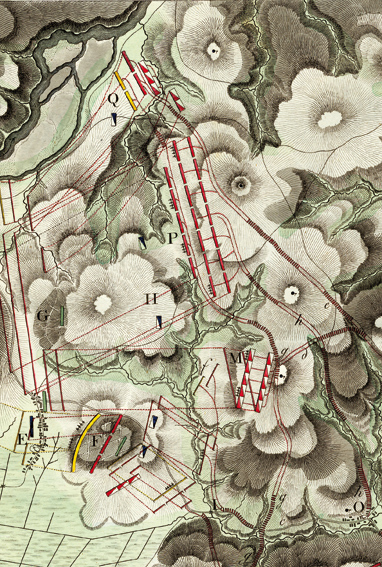
1808MUSun[AU71Vienna: Aus Der Kaiserl. König. Hof- Und Staatsdruckerey 1808. 1808. folio. pp. 2 p.l. 169. 25 folding engraved maps with partial hand-colour by Joh. Renard 5 with onlays. contemporary marbled bds. spine label chipped. in paper slipcase worn. First Illustrated Edition of this work devoted to the principals of the art of war and their practical application for the generals of the Austrian army. The series of twenty-five detailed battle plans some with onlays depict proper troop formations in various situations. F. Vienna: Aus Der Kaiserl. König. Hof- Und Staatsdruckerey, 1808. unknown
95636aaf31x25 cm, 1) kl. ovales Reliquienmedaillon aus Silber mit Glasfenster und Beschriftung „Ex Oss: S. Franc: Bor:“, mit Zeugnis auf Papier, vorgedrucktes Formular mit gestochenem Bischofswappen, handschriftlich ausgefüllt u. unterschrieben, Medaillon und Zeugnis unter Glas mit ornamentaler Textilrahmung mit Stütze zum Aufstellen auf Rückseite, dazu zwei Klosterarbeiten in ähnlicher Textilrahmung: 2) Gouache-Miniatur von Johannes d. Täufer mit Stickerei, Goldborten sowie polychromen Glasperlen, Stoffblumen, Draht und Pailletten. 3) ovales Stoffmedaillon mit Glasperlen u. goldfarbenem Draht u. Pailletten auf Purpurgrund mit Goldbrokatverzierungen, guter Zustand, an den Ecken Textilrahmen teilw. etwas ausgefranst, es liegt auch ein Dossier mit einer kurzen Dokumentation zum Heiligen u. den Jesuiten bei (Ausdrucke u. Fotokopien),
301-Eo.J. Aquarell über Feder in Grau und Bleistift, auf bräunlichem festem Bütten. . 26,2:37 cm. Ein stilistisch und farblich sehr verwandtes Blatt zeigt eine topographisch nicht näher bestimmbare ?Hügellandschaft mit Bäumen, Wiese und Hang?, ebenfalls in unserem Besitz (vgl. Kat. 105, Nr. 36 und ist mit ?29 Aug. 72.? datiert.
1769elala199Vienna: Johann Thomas Edlen von Trattnern 1769. 1769. folio. pp. 8 p.l. 282 lvi. 27 engravings in the text & 3 folding engraved plates incl. in pagination. woodcut ornaments & initials. full contemporary dark brown morocco lettered in gilt on upper cover: Constitutio Criminalis Theresiana Spectans Ad Antiquam Civitatem Voitsbergensem 1773 Antonius Josephus Schilcher P.T. Judex Civitatis Voitsberga bit rubbed some browning & foxing marginal dampstain to last section containing engravings folding plates dampstained & repaired -1 with some loss of text. Inscribed on front blank: "Mathias SchuemackerSuperioris Austriae Jo. J. Syndrins Voitsberga 1773". First Edition of the famous criminal code of Maria Theresa which redefined torture as "a subsidiary means of eliciting truth". Torture could be applied to obtain confessions only in cases where condemnation would have involved capital or severe corporal punishment. A remarkable publication including graphic illustrations of instruments and methods of torture thumb-screws stocks racks burning candles leg vices winches the Viennese shoe with detailed and precise instructions on their use. According to the Encyclopaedia Britannica 11th Edn. this illustrated edition was suppressed by Prince Kaunitz chancellor of state and advisor to the Empress a few days after its appearance. Torture was formally abolished in the empire in 1776. Signed by Authors. 1st Edition. Vienna: Johann Thomas Edlen von Trattnern, 1769. hardcover
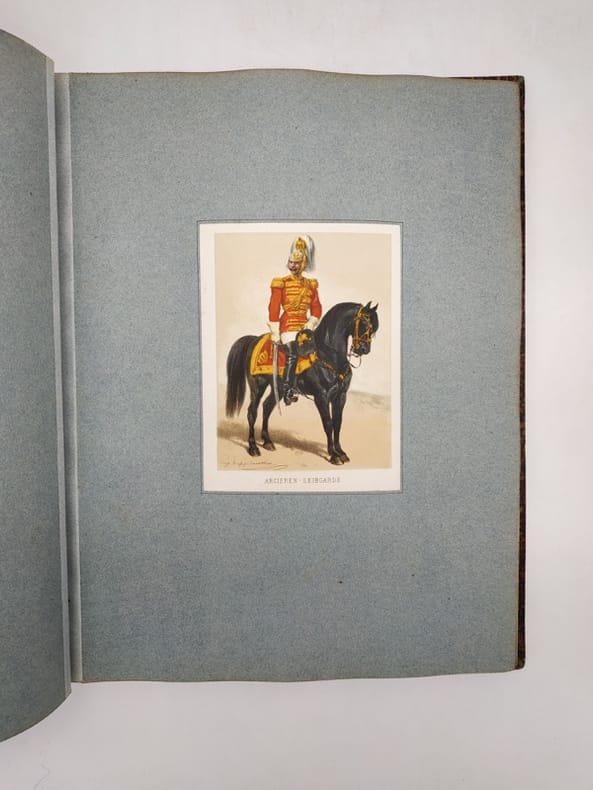
1889AUST0256Frankfurt a. M., Honsack 1889. 4°, jeweils 1 Titelbl., 1 Stahlstichverz.; 179 (statt 200) Stahlstiche, spätere hochrote Leinenkassetten m. RüSch., sehr guter Zustand.
289-Eo.J. Aquarell, auf festem bräunlichem Zeichenpapier, links unten bezeichnet ?Untere Erzgraben... Ettal?, rechts unten signiert und datiert ?Leop Rottmann 1852?. 29,9:50,3 cm. - Zwei Einrisse im linken Teil der Darstellung sind sauber restauriert und von vorne nicht sichtbar, kleine Restaurierung in der linken unteren Ecke. Farbfrisches Aquarell und typische Arbeit Leopold Rottmanns. Der in der Bezeichnung erwähnte ?Erzgraben? ist ein Nebenfluß des Alpbachs.
176957355Wien: Johann Thomas Edlen von Trattnern 1769. First Edition. Folio pp. xvi 282 lvi Illustrated with 27 engravings in the text & 3 folding engraved plates included in the pagination. Some foxed and toned lacks the front flyleaf. Bound in very rubbed contemporary calf still a very good tight copy. Woodcut and typographic ornaments and initials. Text in German black letter with glosses in Latin. Bound in contemporary calf spine gilt little rubbed and recently rebacked red edges. Woodblock printed end papers. Some toning to the text The binding is a little rubbed but still a very good crisp and clean copy. Maria Theresa was the eldest daughter of emperor Charles I and of Elizabeth Christina of Brunswick. At the death of her father in 1740 she became the sole heiress of his dominions of the house of Austria. Upon her accesion to the throne the neighboring countries tried to capture parts of the empire which led to the Wars of Austrian Succession which finally concuded with the treaty of Aix-la-Chapelle in 1748. This is the famous criminal code of Maria Theresa which used torture as a means of "eliciting truth." Her insticts were absolutist and she would allow nothing that limited state power even as she reformed the education system and worked to better the lives of her citizens. And she did not forbid torture. Torture was only to be used only is capital and very serious criminal cases. Included in this volume are very graphic illustrattions of instruments of torture thumb-screws stocks racks burning candles leg vices winches the Viennese shoe! with detailed and precise instruction of their use. According to the Britannica this edition was suppressed by Prince Kaunitz chancellor of the state and an advisor to the Empress. Torture was formally abolished in the empire in 1776. Maria Theresa Walburga Amalia Christina was the only female ruler of the Habsburg dominions and the last of the House of Habsburg. Maria Theresa and her husband Francis I Holy Roman Emperor had sixteen children including Queen Marie Antoinette of France. Maria Theresa was the absolute sovereign . She promulgated financial and educational reforms promoted commerce and the development of agriculture and reorganised Austria's ramshackle military all of which strengthened Austria's international standing. Johann Thomas Edlen von Trattnern unknown books
180815548Wien, Aus der Kaiserl. Königl. Hof-Und Staatsdruckerey (Vienne, Imprimerie de la Cour et de l'État), 1808 ; in-folio ; bradel de papier marbré, pièce de titre vert foncé (reliure de l'époque) ; (4), 169 pp., 25 cartes et plans gravés par Johann Renard, Kilian Parheimer, Ant. Benedict et Heironymus Benedicti, entièrement aquarellés, 1 accompagnée de 2 détails et 5 avec des détails mobiles qui permettent de suivre les mouvements dans le temps.
In-4°; cc. (10), pp. 140, cc. (2), nota di possesso ms al front.; pelle contemporanea, ai piatti stemma dorato del convento parigino dei Minimi, 'Charitas. Conventus. Parisiensis. Minimorum'. Dorso reaturato. Alla seconda pag. ritratto ad acquaforte del Cav. Ciro Spontone incisa da Sadeler. 1 tav. ripiegata incisa su legno con l'albero genaelogico dei reggenti d'Ungheria da Attila 'Flagello di Dio'; nel testo 4 incisioni su legno a piena pagina, che raffigurano lo sviluppo della stirpe francese di Carlo Magno e degli Unni, l'albero dei re francesi e polacchi che regnarono in Ungheria a partire da Carlo Martello, le armi di Mattia Corvino, la stirpe dopo Ferdinando e Anna fino a Rodolfo(dove si legge "Bunt. fec."), le corone e i medaglioni con i nomi dei re, testate e finalini. Infine la vita e le gesta di Rodolfo II, il grande ed eccentrico collezionista di meraviglie al cui gusto sembrano ispirarsi le numerose xilografie di questo rarissimo figurato bolognese. Ciro Spontone fu un prolifico scrittore politico ma si occupò anche di scienze esoteriche, è una figura non secondaria del nostro seicento a cui Benedetto Croce ha dedicato numerose pagine. Questa edizione, che è la prima, appare essere di notevole rarità e non compare nei repertori bibliografici. Ottimo elemplare. Un esemplare in B.M. II, pag. 864.
155-Wo.J. Bleistift, auf gelblichem strukturiertem Papier, rechts unten signiert ?T. Blau?. 27,3:26,5 cm. Insgesamt etwas stockfleckig. Virtuos-atmosphärischer Ausschnitt einer Parklandschaft, der, wie von der Künstlerin bekannt, von einem mächtigen Laubbaum hinterfangen wird.
STLB0079Wien, Vlg. d. Ersten Wiener Volksbuchhdlg. gr.-4°, mit zahlr., tls. farb. Abb., HLn. d. Zt., berieben, Kanten berieben, Ecken leicht bestoß., Buchblock des 1. Bandes lose, sonst insges. guter Zustand. Dietzel-Hügel 1191. Unter diesem Titel als Nachfolge bzw. Vorläuferzeitschrift der "Glühlichter" zwischen 1896 u. 1910 erschienen. Das illustrierte sozialdemokratische Satireblatt richtete seine Polemiken vor allem gegen Lueger und die Christlichsozialen, aber auch gegen Adel u. Klerus. - So komplett höchst selten.
351-Eo.J. Pinsel in Braun und Grau, über Bleistift, auf Bütten mit Wasserzeichen: C & I Honig, links unten bezeichnet ?Vöslau?, rechts unten signiert und datiert ?Fischbach. 1821.?. 23:30 cm. Einriß im unteren Bildteil und winziges Löchlein hinterlegt. Provenienz: Sammlung Ferdinand Rudolf Hintze, Stettin, nicht bei Lugt. Bildmäßig durchgeführte Zeichnung aus der frühesten Schaffensphase des Künstlers.
1851STLD0090München, Cotta (1851). Quer-Folio, 1 lithogr. Titel, 24 lithogr. Taf. m. Textblättern, OHLn., stärker berieb., Ecken u. Kanten berieben, vord. Deckel fleckig. Blätter leicht stockfleckig, Textbll. tlw. zerknittert, randrissig u. staubrandig. Die Abbildungen zeigen Szenen aus dem italienischen Aufstand gegen die Habsburger: Reitergefechte, Straßenkämpfe, Belagerungen in norditalienischen Städten. Lipperheide Qc 20.
197062503ABStuttgart. London. Reykjavik., Edition Hansjörg Mayer., 1970. 23 x 17 cm. [256] S. OKarton mit verleimter Papp-Manschette mit Montagen., 62503AB Auflage 1000 Exemplare. Buch am Rücken berieben, am oberen Kapital 1 cm Abrieb des Bezugspapier. Sonst sehr gutes Exemmplar. Gesammelte Werke Band 11.