PortugalBiblio.com
671 résultats
1390296601.Gpaperback. Good. Access codes and supplements are not guaranteed with used items. May be an ex-library book. paperback
0332369811.Gpaperback. Good. Access codes and supplements are not guaranteed with used items. May be an ex-library book. paperback
033266726X.Ghardcover. Good. Access codes and supplements are not guaranteed with used items. May be an ex-library book. hardcover
0666650268.Ghardcover. Good. Access codes and supplements are not guaranteed with used items. May be an ex-library book. hardcover
0428672043.Ghardcover. Good. Access codes and supplements are not guaranteed with used items. May be an ex-library book. hardcover
0332653676.Ghardcover. Good. Access codes and supplements are not guaranteed with used items. May be an ex-library book. hardcover
1162040769.Ghardcover. Good. Access codes and supplements are not guaranteed with used items. May be an ex-library book. hardcover
0332673014.Ghardcover. Good. Access codes and supplements are not guaranteed with used items. May be an ex-library book. hardcover
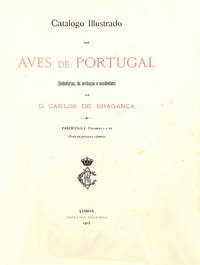
1105NM001<p>Sedentárias de arribação e accidentaes. Por D. Carlos de Bragança. Faciculo I: Estampas I a 20 Texto em portuguez e francez. Lisboa. Imprensa Nacional. 1903. Seguido de: <strong>CATALOGO ILLUSTRADO DAS AVES DE PORTUGAL</strong>. Sedentárias de arribação e accidentaes. Por D. Carlos de Bragança. Fascículo II: Estampas 21 a 40 Texto em portuguez e francez. Lisboa. Imprensa Nacional. 1907</p>_x000d_<p>In fólio de 32x25 cm. Obra em 2 volumes em um publicados respectivamente em 1903 e 1907.</p>_x000d_<p>Encadernação da época com lombada e cantos em pele com finos ferros a ouro na lombada e nas pastas.</p>_x000d_<p>Exemplar apresenta as capas anteriores e posteriores de cada um dos fascículos. Cortes das folhas aparados e carminados apenas à cabeça. Apresenta nas guardas um ex-libris de bibliófilo da época.</p>_x000d_<p>Cada um dos fascículos ilustra 20 espécies de aves. Estampas pintadas por Enrique Casanova sob orientação do rei D. Carlos e nalguns casos por si aguareladas.</p>_x000d_<p>Cada estampa/espécie apresenta o nome científico e o nome comum em cinco idiomas diferentes seguido do seu estatuto migratório e abundância fazendo-se também uma referência ao local de captura das aves ilustradas em cada estampa e por vezes a outros locais onde o Rei terá observado ou capturado aves dessa espécie.</p>_x000d_<p>D. Carlos cedo começou a organizar uma colecção de pássaros por si abatidos e destinados a formar um 'Museu Ornitológico'. Aos 24 anos o Rei começou a escrever a Ornitologia de Portugal que foi corrigindo constantemente com grande rigor científico. Em 1893 com 30 anos de idade decide publicá-la com o título <em>Catálogo Ilustrado das Aves de Portugal</em> entregando a Albert Girard a área científica ficando Enrique Casanova seu professor de desenho responsável pelas estampas. No entanto D. Carlos esteve presente em tudo com o seu saber e a sua arte. A obra destinou-se a ser publicada pela Imprensa Nacional - Casa da Moeda em fascículos ilustrados com 20 estampas cada. O 1º fascículo saiu em 1903 e o 2º em 1907.</p>_x000d_<p>Dom Carlos I rei de Portugal nasceu em 1863. Ao longo da sua juventude viajou por várias cortes europeias. Numa dessas viagens conheceu Amélia de Orleãs princesa de França e filha primogénita do Conde de Paris. Depois de um breve noivado desposou-a em Lisboa em Maio de 1886. O reinado de D. Carlos foi caracterizado por diversas crises políticas. O rei era dotado de uma grande sensibilidade artística que o levou a dedicar a maior parte do seu tempo a um conjunto diferenciado de actividades destacando-se a pintura a ornitologia estudo das aves e a oceanografia. D. Carlos foi um apaixonado por fotografia sendo o autor de uma grande parte do espólio da família real. O rei foi um pintor de talento com grande capacidade expressiva e uma técnica apurada demonstrando uma profunda sensibilidade na temática marinha. Assinava por vezes as suas obras com o nome 'Carlos Fernando. Recebeu prémios internacionais de instituições como a Sociedade Zoológica de Londres Sociedade Oceanográfica do Golfo de Biscaia ou o Museu História Natural entre outros.</p>_x000d_<p>Em 1985 foi publicado um fac-simile da obra e foi adicionado um terceiro volume ou suplemento que contém mais 53 estampas de desenhos até então inéditos também de passeriformes no entanto sem qualquer texto.</p>_x000d_<p>Enrique Casanova foi um pintor espanhol Saragoça 1850 - Madrid 1913 que veio para Portugal em 1880 tornando-se professor de pintura do príncipe D. Carlos e do infante D. Afonso em meados de Maio de 1881 tarefa que se prolongaria até Setembro de 1884. Outros membros da família real foram também alunos de desenho e de pintura de Casanova cujos ensinamentos influenciaram as obras artísticas de D. Maria Pia D. Luís e D. Amélia. Casanova fez parte do círculo restrito da Corte acompanhando-a nas suas viagens e estadias. Enrique Casanova foi um artista polivalente na sua produção cerâmica escultórica pictórica e gráfica. A aguarela foi a técnica mais utilizada na pintura. A sua mestria a técnica e o realismo das suas aguarelas possibilitou que um século mais tarde o Palácio Nacional da Ajuda as tomasse como fonte para a reconstituição das suas salas. No âmbito da ilustração colaborou também com a rainha D. Amélia e com o arquitecto Raul Lino nas ilustrações para o livro O Paço de Sintra 1903.</p>_x000d_<p>EN Dim.: In folio 32x25 cm.</p>_x000d_<p>Work in two volumes published in one in 1903 and 1907 respectively.</p>_x000d_<p>Binding: Contemporary half-calf with gilt tools on spine and boards.</p>_x000d_<p>Copy with both front and back covers of each booklet. Trimmed red top edges. It has an ex-libris of a contemporary bibliophile on the endpapers.</p>_x000d_<p>Each booklet contains 20 illustrations of bird species. The prints are painted by Enrique Casanova under the orientation of king D. Carlos and in some cases watercoloured by him.</p>_x000d_<p>Each print/species has its scientific name and common name in five different languages followed by its migratory status and quantity with reference to the place the birds were captured and sometimes to other places where the King had observed them or captured. D. Carlos started early to organize a collection of birds caught by him aiming to create an Ornithological Museum.At 24 years of age the King started to write the Ornithology of Portugal that he kept correcting with scientific accuracy. In 1893 age 20 he decides to publish it under the title Illustrated Catalogue of the Birds of Portugal handing the scientific part to Albert Girard and to Enrique Casanova his drawing teacher the responsibility of the prints. Nevertheless D. Carlos was always present with his knowledge and art. The work was printed by Imprensa Nacional - Casa da Moeda in illustrated booklets each with 20 prints. The first booklet was edited in 1903 and the second in 1907.</p>_x000d_<p>D. Carlos I king of Portugal was born in 1863. Throughout his youth he travelled to several European Courts. In one of those travels he met Amelia of Orleans princess of France and first daughter of the Count of Paris. After a short engagement he married her in Lisbon on May 1886. The reign of D. Carlos was marked by several political crises. The king was quite artistic which led to him doing several different activities mainly painting ornithology and oceanography. D. Carlos was also a passionate photographer being the author of the most part of the collection of the royal family. He was also a talented painter very expressive and with a sharp technique showing a profound sensibility in the sea themes. He sometimes signed is works with the name 'Carlos Fernando. He received international awards from different institutions like the Zoological Society of London Oceanographic Society of the Bay of Biscay or the Natural History Museum among others.</p>_x000d_<p>A facsimile of the work was published in 1985 and it was added a third volume that contains another 53 prints unpublished till then also of birds but with no text.</p>_x000d_<p>Enrique Casanova Saragoza 1850-Madrid 1913 was a Spanish painter who came to Portugal in 1880 becoming the painting teacher of D. Carlos and Prince D. Afonso in mid-May 1881 a task he would perform until September of 1884. Casanova also taught other members of the royal family and his teachings influenced the artistic works of D. Maria Pia D. Luís and D. Amélia. Casanova was part of the restrict circle of the court travelling with them. He was a versatile artist producing ceramics sculptures paintings and printings. Watercolour was his most used technique in painting. His mastery the technique and realism of his watercolours allowed one century later the National Palace of Ajuda to use them to the restoration of the rooms. As an illustrator he also worked with the Queen D. Amélia and the architect Raul Lino on the illustrations for the book <em>O Paço de Sintra</em> 1903.</p>_x000d_<p> </p>_x000d_<p> </p> M-8-D-28 hardcover
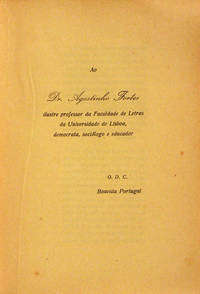
1908RL158<p>Ensaio Crítico. Livraria Central Editora. Lisboa. 1930.</p>_x000d_<p>De 20x14 cm. Com 196 págs. Brochado.</p>_x000d_<p>José Boavida Portugal 1889-1931 foi um jornalista e amigo de Fernando Pessoa com o qual colaborou no mesmo jornal. Esta foi uma obra publicada no final da sua vida.</p> I-106-G-37 unknown
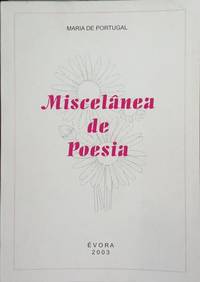
2508RS076<p>Fundação D. Manuel Mendes da Conceição Santos. Évora. 2003.</p>_x000d_<p>De 21x145 cm. Com 72 págs. Brochado. Exemplar com dedicatória da autora a irmã e ao cunhado na folha de rosto.</p> SACO RS667-03 unknown
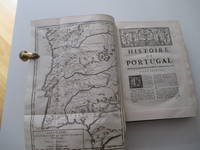
173519061AB1735. 2 volumenes Paris Chez Pierre-Francois Giffart 1735 26 : 19 cm. 14 leaves 783 pages; 18 leaves 844 pages with three many folded maps. Contemporary calf spine richly decorated in gold 2 back labels. The history of Portugal by Nicolas de La Clede 1689-1736 describes from the beginning the customs and wars of the Lusitians there state during the domination of the Romans the invasion of the Goth and Moors the creation of the state of Portugal under the reign of Henry and Alfonse until the reign of Rey Jean V. "On n' a rien de plus complete ni de plus exact sur ce royaume. L'origine les moeurs et las usages des Portugais les differentes revolutions qu'ils ont éprouvées leurs conquètes dans les Indes y sont rapportées avec autant de Fidélité que d'exactitude" Querand Biographie universelle. - Title with small stamp ocassionally in the lower right part small stains; the beautiful binding only a bit rubbed. unknown
1678200041AG1678. Paris Sanson d'Abbeville 1678. Original hand-coloured engraving. Plate Size: 53.6 cm x 41.7 cm. Sheet Size: 61.8 cm x 46.5 cm. Original map. In very good condition. Faint signs of browning to map. Minor paper imperfections to the outer margins. Small stain to map near centre-fold. A richly detailed map showing the northern part of Portugal. Relief on map depicted pictorially and border inlaid with longitudinal and latitudinal details The map is dominated by three rivers: the Tajo Tagus in the south the Douro and the Minho further north. The Spanish kingdom and regions such as Leon are included and the great city of Salamanca can be seen. The lower part of the map runs out before the Tagus estuary empties into the Atlantic at Lisbon. The ornamental title cartouche is in the lower right corner of the map. Off the coast is a large warship flying the coat-of-arms Kingdom of Portugal and the Algarves. The sails of the boat carry Latin text commemorates the commercial and maritime exploits of King John IV in Africa Arabia Ethiopia Persia India and Brazil. Nicolas Sanson 20 December 1600 7 July 1667 was a French cartographer termed by some the creator of French geography in which he's been called the "father of French cartography." The French school of Geography was unprecedented in its attention to precision and scientific detail and discarded much of the decorative embellishments of previous maps as irrelevant. From Sanson's time in the second half of the seventeenth century until the latter part of the eighteenth century French geographical conceptions were more influential than those put forward by any other nation. He was tutor to Louis XIII and Louis XIV. Sanson published over 300 maps. In 1692 Hubert Jaillot collected Sanson's maps in an Atlas nouveau. Wikipedia unknown
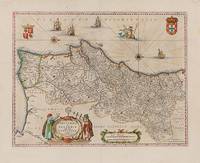
1640200017AG1640. Amsterdam Guiljelmum et Joannem Blaeu 1640. Original hand-coloured engraving. Plate Size: 49.6 cm x 38.1 cm. Sheet Size: 58 cm x 47 cm. Original map. Very good condition. Map orientated with north facing to the right. Some very minor traces of spotting near edges. Signs of foxing in top right corner of map. Minor chip and tear near lower left corner of sheet. Centre fold as issued. Latin text on reverse. Koeman II 6300 "Parte septentrional do Reyno de Portugal". By N. Sanson with P. Mariette 1678; onde Coll. P. 104. Border with longitudinal and latitudinal information. A richly detailed and very interesting map showing the Kingdom of Portugal and the Algarves. Relief shown pictorially with rivers mountains and major and minor settlements depicted through keys. The kingdoms of the Algarves and Portugal are delineated - as are other internal political sub-divisions. The major urban centres are highlighted with red colouring. In the lower part of the map a decorative title cartouche is accompanied by two elaborately dressed scholars performing navigational exercises with their sextant and cross-staff: their gazes directed to the armillary sphere. Another cartouche encases a dual scale. Off the coast 4 naval vessels are pictured illustrating the rich maritime history and naval power of Portugal. Amid the ships a trident-wielding Neptune is depicted astride a Renaissance-style dolphin. The coat-of arms of the Kingdom of Portugal and the Algarves are pictured in the map's top right and left corners respectively. Two ornamental orientation keys can also be seen just off the coast. Fernando Alvares Seco c.1561-85 was a Portuguese mathematician and cartographer who made the first known map of Portugal. It was engraved by Sebastiano del Re and published in Rome in 1561. Abraham Ortelius 1527-98 later reprinted the map in his Theatrum Orbis Terrarum Theater of the world which was first published in May 1570. World Digital Library unknown
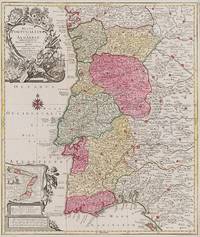
1762200016AG1762. Augsburg Georg Friderich Lotter 1762. Original hand-coloured Engraving. Plate Size: 49 cm x 57.7 cm. Sheet Size: 51.6 cm x 59.6 cm. Original map. Very good condition. Clean and crisp. Map orientated to the North. Slight roughness to top right corner edge. Border with longitudinal and latitudinal information. A richly detailed and very interesting map showing the Kingdom of Portugal and the Algarves. Relief shown pictorially with rivers mountains and major and minor settlements depicted through keys. The internal subdivisions of the kingdom are also highlighted as are the religious bishoprics and Archdioceses administrative areas of the Catholic Church. Lisbon is shown at the mouth of the 'Tajo' Tagus River. Cartouche in lower left corner decorated with Classical allusion encloses inset map showing the coastal region of Brazil then a Portuguese colony. The Captaincies of Brazil which were the administrative divisions and hereditary fiefs of the colony are delineated. Interior of Brazil carries inscription 'Brasilia Regnum in America Merido' with allegorical scene with native figures. Relief shown pictorially with rivers mountains and settlements depicted. Beneath inset map are map legends and a triple bar scale. Large decorative title cartouche located in the top left corner of map. Portugal's tradition of maritime exploration and conquest and naval strength are alluded to with the depiction of the canon lances accompanying the coat-of-arms of the House of Aviz and naval vessels and the mythological figure in the foreground. Above the title lies the coat-of arms of the Kingdom of Portugal and the Algarves. The year that the map was published 1762 saw the Seven Years War spread in the Iberian Pennisula as Franco-Spanish forces staged an unsuccessful invasion of Portugal which was then in alliance with Britain. Tobias Lotter was a German publisher and engraver who married the daughter of the elder Matthaus Seutter in Augsburg. Largely under his own responsibility but still under Seutter Lotter created the 'Atlas Minor' which was created between 1740 and 1744. He engraved many of Seutters maps and eventually succeeded to the business in 1756 becoming one of the better-known cartographers in the eighteenth-century German School. After his death the business was carried on by his son M.A. Lotter. Wikipedia unknown
1915198359Lisboa : Imprensa Nacional 1915. First Edition. Hardback. Original wrappers bound in contemporary gilt-blocked leather over 1/4 marble boards. Slightest suggestion only of dust-dulling to the spine bands and panel edges. Remains particularly well-preserved overall; tight bright clean and strong. Slight tear to spine. ; 8vo 8"" - 9"" tall; 149 pages; Physical description.: 149 p. 28 cm. Subject: Portugal Politics 1847-1910. Language: Portuguese. Lisboa : Imprensa Nacional hardcover
0366148206.Gpaperback. Good. Access codes and supplements are not guaranteed with used items. May be an ex-library book. paperback
0366148397.Ghardcover. Good. Access codes and supplements are not guaranteed with used items. May be an ex-library book. hardcover
139016795X.Ghardcover. Good. Access codes and supplements are not guaranteed with used items. May be an ex-library book. hardcover
0332721892.Ghardcover. Good. Access codes and supplements are not guaranteed with used items. May be an ex-library book. hardcover
0366110802.Gpaperback. Good. Access codes and supplements are not guaranteed with used items. May be an ex-library book. paperback
0366152165.Ghardcover. Good. Access codes and supplements are not guaranteed with used items. May be an ex-library book. hardcover
1390167747.Gpaperback. Good. Access codes and supplements are not guaranteed with used items. May be an ex-library book. paperback
0428622917.Ghardcover. Good. Access codes and supplements are not guaranteed with used items. May be an ex-library book. hardcover
1396538569.Ghardcover. Good. Access codes and supplements are not guaranteed with used items. May be an ex-library book. hardcover