23 résultats
151354087Strasbourg. 1513. Originalt tresnitt. Arkets størrelse : 60 cm X 425 cm. Norsk. <br/><br/><em>“Martin Waldseemüller a highly accomplished scholar of geography merged the science of mapmaking and the art of printing in his 1513 atlas one of the most groundbraking documents in the history of cartography. He intended this atlas as a new edition of Ptolemy’s Geographia but included the addition of 20 modern maps which were not based upon the tradition of Ptolemy. Waldseemüller’s use of a quadratic plane projection was also a noteworthy advance.â€Martin Waldseemüller 1470-1520.Liten rift ved nedre marg. Et lite ormehull i venstre marg. Et par slitasjer i øvre marg. </em> unknown
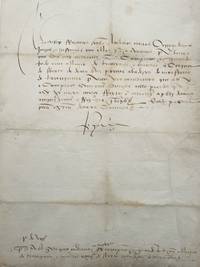
151529861515. . Folio 215 × 287 mm. Folded. Tears at foldings with small holes lightly affecting a few words. A tear at the lower half at the right edge with no effect to the text. Otherwise in fine condition. 1 page signed letter on paper in Portuguese. Manuel I King of Portugal’s signed letter to the Female Monastery of Santa Maria de Tarouquela.<br /> In his letter Manuel I advising the monastery of Santa Maria of Tarouquela to obey better the Benedictine <br /> the rules. “In 1514 we see the first signs of the autophagy process in which this monastery had been involved since the very beginning — an autophagy that resulted from its physical isolation from its size and its intrinsically family-related nature. The Benedictine habit was not even ruling the nuns’ habits anymore as we may infer from the intervention of King Manuel I 1495–1521 who asks the abbess of Arouca from the Cistercian order to put an end to that situation of neglect. The connection to Arouca despite the different rules is probably a result of a geographical proximity that allowed surveillance and after some time the emergence of an almost filial status that was preserved in Tarouquela until its extinction. In fact it is by mentioning the isolated nature of a place “where little was done to serve†God − a location and status that was similar to that of other female institutes Vairão Vila do Conde Vila Cova Vila Nova de Gaia TuÃas and Rio Tinto Gon- domar − that the sale king ordered their fusion in a single monastic house to be built in Porto†Machado 2014. Eventually the nuns of Tarouquela were transferred to the convent in Porto in 1536.<br /> Literature: Machado R. ed.: Route of the Romanesque Rota do Românico. Lousada: Centro de Estudos do Românico e do Território 2014. p. 194. unknown
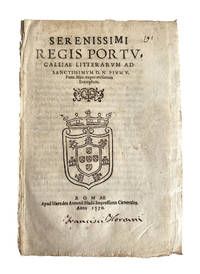
15705000917Rome: apud Haeredes Antonii Bladii 1570. In excellent original condition. Small quarto 4 leaves the last blank; woodcut device on title; page numbers in ink from an earlier binding within a volume; in a later plain wrappers binding and a folding case. <p><p>Extremely rare printed letter from King Sebastian of Portugal to Pope Pius V in which the king asks for more priests especially Jesuits stressing the significance of Portuguese conquests in the Far East in the process detailing the number of ships laden with treasure and trade goods arriving daily in Lisbon.</p> <p>The strategic relationships between the rulers of Portugal and Spain with the papacy were crucial in the discovery and colonisation period. The splitting of the new world enacted by the treaty of Tordesillas left the Portuguese and Spanish eager to exploit any advantage that could be gained and often the evangelisation of pagan natives was used to justify territorial ambitions; it was often in these pious terms that the pope was lobbied for his support.</p> <p>This letter from Sebastian is an excellent example of the sort of lobbying that took place. Donald Lach has written extensively about the nature of the exotic in the East Indies and the Far East describing how these printings often encompass exotic subjects for which monarch and pope both had a taste. In his relations with Pius V's namesake and predecessor for example Sebastian had been asked for and had promised a pair of elephants for the papal menagerie see Lach II 1 150n.</p> <p>The printing of letters and diplomatic orations such as this formed a critical part of the lobbying. Important records of the significance accorded to the new world it seems that they were generally printed in small numbers for limited circulation hence the tiny survival rate of any of these early works with this example particularly uncommon: USTC records five copies four of them in Italy and WorldCat adds another at Yale while the last copy that we can identify on the market was that offered by Maggs Bros in 1935.</p> <p>---</p> <p>At Sebastian's death fighting the Moors in north Africa the destiny of Portugal changed completely and from then on she would be under Spanish sway. "When at last she found herself again a free and independent state 1640 the sceptre of the Indies had passed irrevocably to Holland and England' Penrose p. 75. Nonetheless Sebastian still occupies a most important position in Portuguese history in which he has been compared with King Arthur or Barbarossa: he was known as the "sleeping king" who would mysteriously return at Portugal's time of great need. 'He would then be known by symbolic names: O Encoberto The Hidden One who would return on a foggy morning to save Portugal; or as O Desejado The Desired. The legend was vigorously promoted through the massive circulation of popular rhymes trovas written by Bandarra. Even as late as the 19th century Sebastianist peasants in the Brazilian sertão believed that the kings would return to help them in their rebellion against the "godless" Brazilian republic.' Wikipedia.</p> <p>Pius V reigned from 1566 to 1572: his reign was largely pre-occupied with the war against the Turks - the battle of Lepanto was won the year after this publication. In 1570 Goa was attacked by the Indian army but the Portuguese successfully defended it. Also in 1570 Sebastian issued orders that the Brazilian Indians used for slavery should be released from captivity.</p> </p> . Provenance: Early ink ownership inscription on title "Francisci Morani" sp. apud Haeredes Antonii Bladii unknown
157664844Antwerpen, Christophe Plantin, 1576. 8°. Mit Holzschn.-Druckermarke a. Titel u. 233 blattgr. Textholzschnitten. 529 S., 7 Bll. (das letzte weiß), Etw. späterer Ldr.-Bd. (17. Jhd.) a. 5 Bünden m. Rückenverg., goldgepr. Rückenschild u. Rotschnitt.
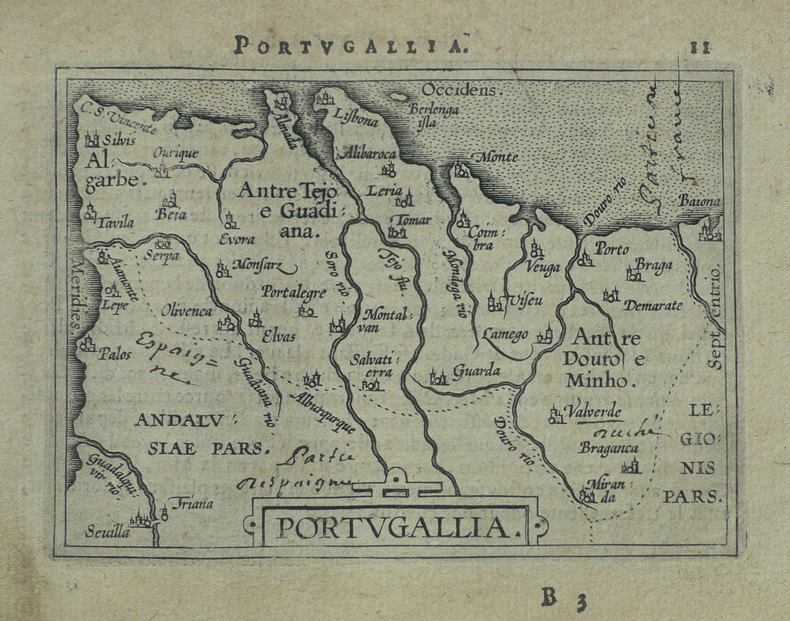
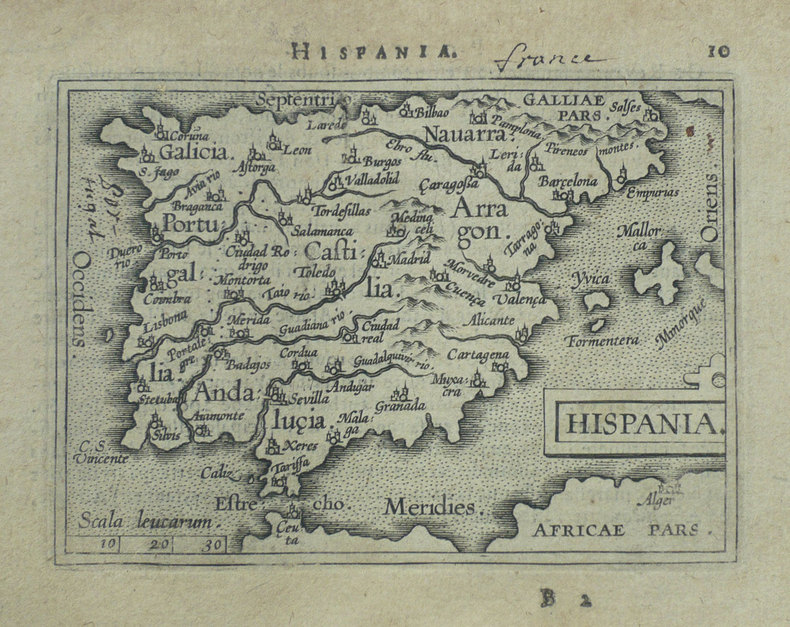
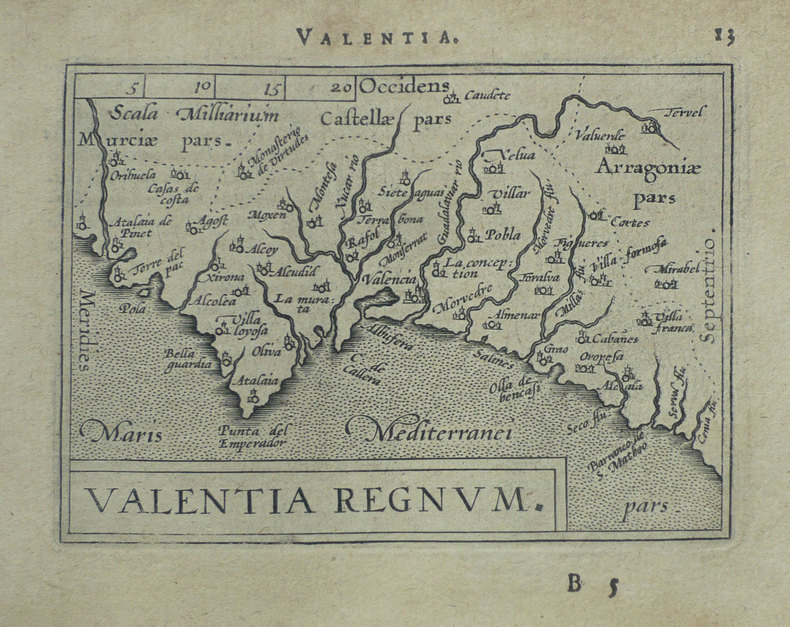
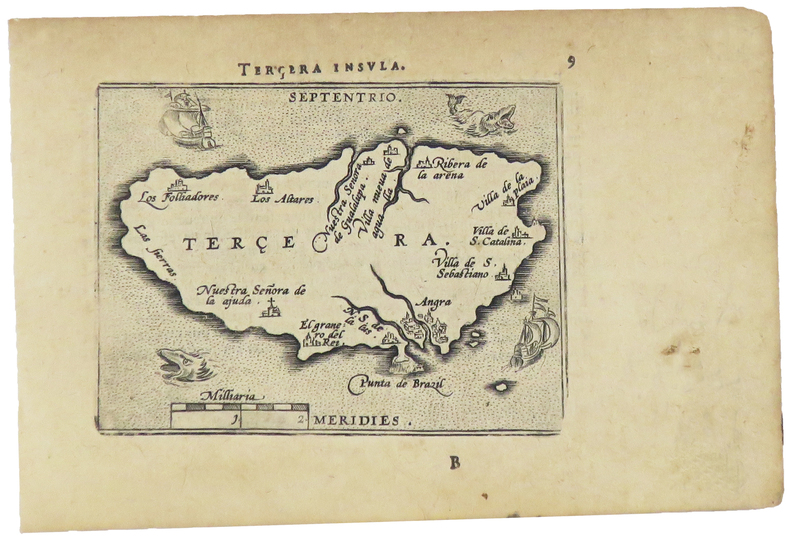
1598LBW-1384Anvers 1598 81 x 106 mm.
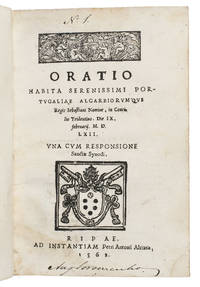
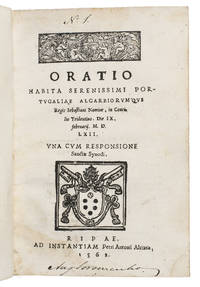
1562ABC_47938Ripae = Riva del Garda Italy 1562. 4to 18.2 x 13.4 cm. Pietro Antonio Alciatis Mid 19th-century marbled paper wrappers. With the woodcut coat-of-arms of the Medici popes and a woodcut head-piece on the title-page 2 large woodcut decorated initials in the text a woodcut head-piece at the start of the text and two ornaments at the start and end of the text. 1 1 blank 6 pp. Rare copy of the speech written in name of King Sebastião of Portugal 1554-1578 for the Council of Trent 1545-1563. The speech was given on February 9 1562 in front of the bishops and other attendants of the council when King Sebastião was just 8 years old. The speeches provided by the Kings of the European nations were to be measured carefully as the position taken by the Church in many matters carried geo-political changes; not a century ago the Pope had granted a large portion of the South American territories to Portugal through the Treaty of Tordesillas a line that took centuries to properly determine. It is unknown who wrote this speech but it is often attributed to Giovanni Strozzi active 1547-1562 who wrote another similar work. The text makes clear that the kings of Portugal have always been good Christians and promises that Sebastião will be as well. The last page contains the response from the Synod. This work rarely appears on the market.The Council of Trent was an ecumenical council of the Catholic Church held in reponse to the Protestant Reformation. There were 25 sessions over the course of 18 years. The attendants discussed the Church's doctrine and teachings in order to clarify them and defined what it considered to be heresies. The council had a long-lasting impact on religion in Europe through the numerous apologetic and polemical documents and decrees that resulted from it.With a manuscript note on the recto of the first blank flyleaf: "Indice" and two manuscript notes on the title-page "No. 1" at the head of the title-page and "Aug. Soromenho" at the foot of the title-page. With slight water-staining in the top and bottom margins of the leaves very slightly browned throughout. Otherwise in very good condition.l Adams vol. II 1953; USTC 850992; cf. BM Italian p. 619 different ed. unknown
1562ABC_47938Ripae = Riva del Garda Italy: Pietro Antonio Alciatis 1562. Mid 19th-century marbled paper wrappers. 4to 18.2 x 13.4 cm. With the woodcut coat-of-arms of the Medici popes and a woodcut head-piece on the title-page 2 large woodcut decorated initials in the text a woodcut head-piece at the start of the text and two ornaments at the start and end of the text. Rare copy of the speech written in name of King Sebastião of Portugal 1554-1578 for the Council of Trent 1545-1563. The speech was given on February 9 1562 in front of the bishops and other attendants of the council when King Sebastião was just 8 years old. The speeches provided by the Kings of the European nations were to be measured carefully as the position taken by the Church in many matters carried geo-political changes; not a century ago the Pope had granted a large portion of the South American territories to Portugal through the Treaty of Tordesillas a line that took centuries to properly determine. It is unknown who wrote this speech but it is often attributed to Giovanni Strozzi active 1547-1562 who wrote another similar work. The text makes clear that the kings of Portugal have always been good Christians and promises that Sebastião will be as well. The last page contains the response from the Synod. This work rarely appears on the market.The Council of Trent was an ecumenical council of the Catholic Church held in reponse to the Protestant Reformation. There were 25 sessions over the course of 18 years. The attendants discussed the Church's doctrine and teachings in order to clarify them and defined what it considered to be heresies. The council had a long-lasting impact on religion in Europe through the numerous apologetic and polemical documents and decrees that resulted from it.With a manuscript note on the recto of the first blank flyleaf: "Indice" and two manuscript notes on the title-page "No. 1" at the head of the title-page and "Aug. Soromenho" at the foot of the title-page. With slight water-staining in the top and bottom margins of the leaves very slightly browned throughout. Otherwise in very good condition.l Adams vol. II 1953; USTC 850992; cf. BM Italian p. 619 different ed. Pietro Antonio Alciatis, unknown
159460434Erfurt, Jakob Singe, 1594. 4°. 12 nn. Bll. (das letzte weiß), Geheftet (ausgebunden).
159515169BB(Amsterdam, Hondius, 1595). Bildgrösse ohne Rand: 37,5x51,5 cm. Kolorierte Kupferstichkarte mit 2 kol. Rollwerk-Kartuschen am Unterrand. Mit Rand 40x53 cm. Rechts unten knapp beschnitten. Papier gebräunt.
1560902232AGBasel:, Petri, [um 1560]. Holzschnitt 25,5 x 34,5 cm, Blattgröße 31 x 41 cm.
1598LBW-1404Anvers 1598 82 x 107 mm.
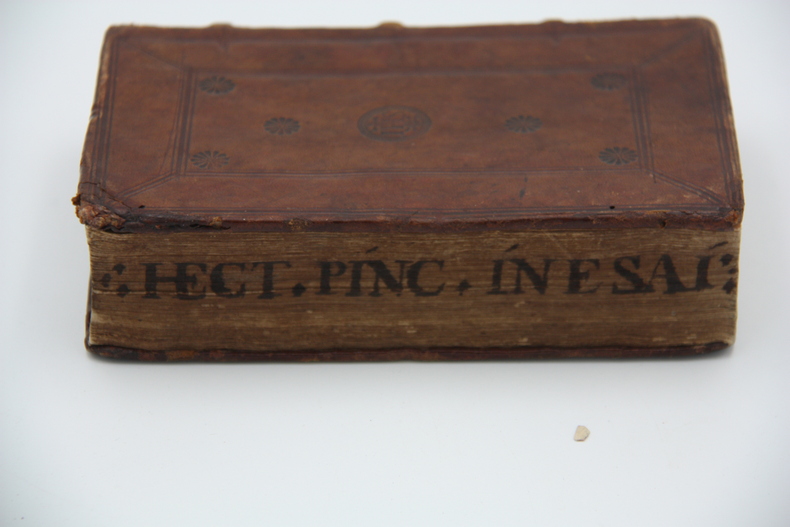
1570LRB214In-4° [signature B en p.9], plein veau estampé, dos à nerfs fouettés, coiffes absentes, tranchefiles présentes. Une inscription en tête du plat recto tend à montrer que la reliure est d'époque. Titre repris en gouttière à l'encre. Quelques piqûres insignifiantes sur une quinzaine de feuilles en fin de volume, pas d'atteinte au texte , inférieures à 2 mm
1570902862AGInnsbruck, [um 1570]. Kupferstich, Bild 44 x 38,5 cm (hoch), Blattgröße 53,5 x 40 cm.
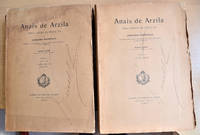
1519biblio28Academia das Sciências de Lisboa. 1915 - 1919. First Edition 2 Vols. 4to. Biblioteca do Dr. Laureano Barros 5299. Avila Perez 6637. Vol I lii; 498 pp; one folding map & 5 B&W photographs hors texte. Vol II xix 563 pp. FIRST EDITION. Please contact me ramrozzi@yahoo.fr<br /><br /><br /><br /> Academia das Sciências de Lisboa paperback
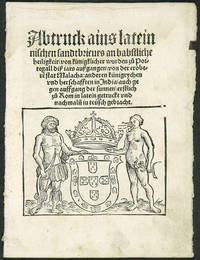
1513WRCAM38334Strassburg: Matthias Hüpfüff 1513. 7 leaves including woodcut titlepage illustration 3 1/4 x 4 1/2 inches plus final integral blank leaf. Quarto. Dbd. leather tab on fore-edge of first leaf. Slight soiling and dampstaining in margins. A very good copy. In a half morocco and cloth box. An extremely rare German translation of a newsletter first issued in Latin and published in Rome in 1513 reporting the Portuguese conquest of Malacca in 1511 and describing its rich potential as a commercial center. No copies of this seven-leaf edition are recorded in OCLC or RLIN and only a single copy of another 1513 German translation printed in Augsburg and consisting of five leaves is located in the U.S. at the James Ford Bell Library. However the British Library holds copies of both translations and the imprint information for this edition is based on Robert Proctor's research on German books in the British Museum. <br> <br> The letter from Manuel I to Pope Leo X relates the conquest of Malacca by Portuguese military commander Afonso de Albuquerque in June 1511. In addition to providing details of this victorious battle the report includes descriptions of the wealth to be found in the region and the importance of the city as a trading nexus. In particular the text emphasizes how courteously the merchants were treated in order to ensure future commerce. Albuquerque's voyages and military exploits between 1503 and 1515 were instrumental in consolidating Portugal's expansion to India and Malaya. The present pamphlet also records his actions after he departed Malaya and returned to Goa in 1512. These include descriptions of skirmishes with the Moors and embassies to other parts of India and Asia related to the payment of tribute to the Portuguese crown. As in the descriptions of Malacca the potential wealth to be found in the region is emphasized. <br> <br> While the text of the pamphlet is entirely about the East Indies the titlepage contains one of the earliest illustrations of an American Indian. This woodcut shows a native man and native woman on either side of an armorial shield immediately below a royal crown. The naked woman with a flowering plant in her left hand holds the bottom of the crown with her other hand as the man steadies the shield with his left hand and grasps a bow with his right hand. The man with full beard wears a feather crown skirt and leg decorations. This woodcut is exactly the same as that illustrating the titlepage of an earlier German newsletter reporting Portuguese activities in the East Manuel I's GESCHICHTE KURTZLICH DURCH DIE VON PORTUGALIEN IN INDIA MORENLAND UND ANDERN ERDTRICH published in Nuremburg circa 1507. This portrayal of the man in turn appears to be derived from images of South American Indians found in an illustrated Vespucci broadside printed in Nuremberg circa 1505- 1506 see EUROPEAN AMERICANA 505/11 and illustrated on the cover of the Wolfenbüttel exhibition catalogue and broadsides based on Vespucci's third voyage printed in Augsburg circa 1505-1506 EUROPEAN AMERICANA 505/13 and 505/14. The publisher of the present work also issued an illustrated edition of Vespucci in 1505 but not this one see Church 22 for a reproduction. At this early time Europeans might well have supposed that the East Indians of Malacca and the natives Vespucci encountered in the New World were the same people. All of these broadsides and pamphlets including the present work were published within seven or eight years in three different centers of German printing. <br> <br> A remarkably rare early German newsletter reporting on Portuguese military and commercial activities in Malacca and India. No copies on OCLC or VD16; a single copy located at the British Library. PROCTOR INDEX OF GERMAN BOOKS 1501-1520 IN THE BRITISH MUSEUM p.31 no. 10035. BELL M125 variant translation 5 leaves. OCLC 35837666 variant translation 5 leaves James Ford Bell only. HOWGEGO A43 Albuquerque. PENROSE SALE 156 for woodcut illustration in the 1507 Nuremburg GESCHICHTE. ref. DEÃÂK PICTURING AMERICA 4 illustrated broadside ca. 1505 ref. GLASER ENGRAVED AMERICA p.16 illustrated Vespucci broadside 1505-6 ref. EXHIBITION OF THE DUKE AUGUST LIBRARY WOLFENBÜTTEL; THE NEW WORLD IN THE TREASURES OF AN OLD EUROPEAN LIBRARY 1976 see cover illustration and entry 3 ref. Matthias Hüpfüff hardcover books
1598LBW-1403Anvers 1598 81 x 107 mm.
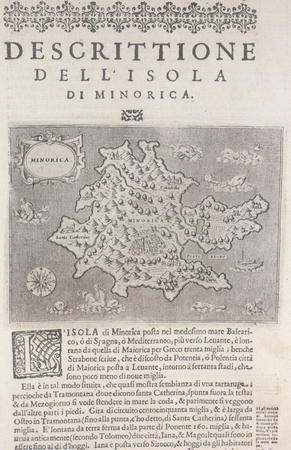
1576LBW004f2Venise 1576 105 x 142 mm.
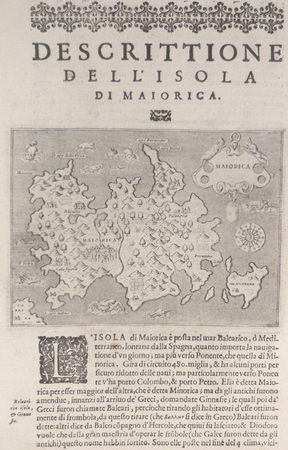
1576LBW004f8Venise 1576 104 x 143 mm.
1598LBW-1499Anvers 1598 81 x 104 mm.
1572LBW0621b[Cologne, 1572]. 351 x 497 mm.
1572LBW0621c[Cologne, 1572]. 351 x 497 mm.
1598LBW-1398Anvers 1598 80 x 102 mm.
1598LBW-1400[Anvers, 1598]. 82 x 103 mm.