Jammes (Francis) : [Manuscrit. Exemplaire unique]Livre Rare Book

1 551 résultats
193320863S.d. (circa 1933-1934); in-folio en feuilles, couverture rempliée gris clair illustrée, chemise demi velin et pièce de titre en cuir, titre doré, papier à la cuve multicolore et doré en forme de feuillage, étui de même ; 86 feuillets non chiffrés, le dernier blanc ; couverture et 50 aquarelles originales de Barta, dont 3 hors-texte.
1653elala1607Saros-Patak Hungary: Typis Illustrissimae Principis Excudebat Georgius Renius 1653. 1653. folio. pp. 1 p.l. 582. old vellum overlapping fore-edges recased vellum soiled ties wanting 3 small library rubberstamps some scattered foxing & browning. In June 1606 Archduke Matthias in the name of the Emperor Rudolph II concluded the Treaty of Vienna with the rebellious Hungarians by granting extensive concessions and in November of the same year he concluded the truce of Zsitvatörök with the Sultan Ahmed I. "By the peace of Vienna Stephen Bocskay obtained religious liberty and political autonomy the restoration of all confiscated estates the repeal of all unrighteous judgments and a complete retrospective amnesty for all the Magyars in royal Hungary besides his own recognition as independent sovereign prince of the enlarged Transylvania. This treaty is remarkable as being the first constitutional compact between the ruling dynasty and the Hungarian nation. Almost equally important was the twenty years truce of Zsitvatörök negotiated by Bocskay between the emperor and the sultan which established for the first time a working equilibrium between the three parts of Hungary with a distinct political preponderance in favour of Transylvania The emperor on the other hand was freed from the humiliating annual tribute to the Porte on payment of a war indemnity of 400000 ". Encyc. Britan. 11th Edn. The text of the two treaties pp. 30 is followed by the articles of various Hungarian statutes and ordinances dating from 1608 to 1649 pp. 31-582. The BM copy contains further articles for 1659 not present here. Saros-Patak [Hungary]: Typis Illustrissimae Principis Excudebat Georgius Renius, 1653. hardcover
197069451ABZumikon (Schweiz)., Editions Pyra AG / Victor Vasarely., o. J. [1970]. 10,2 x 10,2 x 66 cm., 69451A Winzigste Bereibungen und minimalste Klebeschatten auf einer Seite, sonst guter bis sehr guter Zustand.
193943670Budapest: Pesti Lloyd-nyomada 1939. First edition. Softcover. vg. Folio. 26pp. published unbound. Original cream stapled wraps with title printed in black to back cover protected by modern mylar. To the Honorable Upper and Lower House of the Parliament. Respectful petition of the representatives of the Hungarian Jewish community concerning "Bill No. 72. regarding the restriction of Jews in public and economic life". <br /> <br /> Official petition of the Hungarian Jews regarding the bill of the Second Anti-Jewish Law No. IV:1939. The Second Anti-Jewish Law was one of a series of anti-Jewish measures passed by the Hungarian Parliament between 1938 and 1941 and the first Hungarian law providing a "racial" definition of the Jewish status according to the Nuremberg Race Law of 1935. Besides of other severe deprivations it sets a ceiling of six percent reduced from twenty of Jews being allowed to work in various financial and commercial professions as well as industrial enterrises employing more than ten persons. It also excluded the Jews from state administrations and jurisdiction prohibited Jews from teaching high school reenacted the Numerus Clausus at universities and partly rescinded their right to vote.<br /> <br /> Bill No. 702 the Second Anti-Jewish Law was drafted by István Antal state secretary of the Ministry of Justice and Pál Teleki Minister of Religion and Education and was presented for debate before Parliament on December 23 1938. The petition aimed to sway Parliament to disapprove the law claiming it being unconstitutional and delinquent in view of legal equality human rights and the Divine Law and furthermore relinquishing social justice and threatening national unity the emancipation granted by the laws of 1849 and 1867 in short it was deemed to be against the national interest of Hungary. The petition was unsuccessful the bill was approved by Parliament and was signed into law on May 5 1939 effecting the Hungarian Jewry severely with more than 90 thousand Jews losing their jobs and thus lowering the living conditions of approximately 220000 people significantly. Braham R.: The Second Anti-Jewish Law in: The Politics of Genocide: Holocaust in Hungary New York Columbia University Press 1981 pp. 147–156. Scarce important historical document with institutional holdings recorded only in Hungary. Text in Hungarian with slight rubbing to covers. Else in very good condition. Pesti Lloyd-nyomada unknown
196959361Budapest Hungary: Ernst Muzeumban. As New. 1969. Paperback. FREE UPGRADE to Courier/Priority Shipping Upon Request IN STOCK AND IMMEDIATELY AVAILABLE FOR SHIPMENT - AS NEW THE TEXT BLOCK IS PRISTINE CLEAN UNMARKED AND IN EXCELLENT CONDITION - - Text in French and Hungarian. 116 pp. With 43 ills. 20 x 23 cm. -- with a bonus offer-- . Ernst Muzeumban paperback
196558663Budapest Hungary: Galerie Nationale Hongroise. As New. 1965. Paperback. FREE UPGRADE to Courier/Priority Shipping Upon Request IN STOCK AND IMMEDIATELY AVAILABLE FOR SHIPMENT - AS NEW THE TEXT BLOCK IS PRISTINE CLEAN UNMARKED AND IN EXCELLENT CONDITION - - Text in Hungarian; introduction in Hungarian and French. 60 pp. With 15 ills. 23 x 20 cm. -- with a bonus offer-- . Galerie Nationale Hongroise paperback
196859030Budapest Hungary: Magyar Nemzeti Galeria. As New. 1968. Paperback. FREE UPGRADE to Courier/Priority Shipping Upon Request IN STOCK AND IMMEDIATELY AVAILABLE FOR SHIPMENT - AS NEW THE TEXT BLOCK IS PRISTINE CLEAN UNMARKED AND IN EXCELLENT CONDITION - - Text in Hungarian. 100 pp. With 369 ills. 23 x 20 cm. -- with a bonus offer-- . Magyar Nemzeti Galeria paperback
196959362Budapest Hungary: Szepmuveszeti Muzeum. As New. 1969. Paperback. FREE UPGRADE to Courier/Priority Shipping Upon Request IN STOCK AND IMMEDIATELY AVAILABLE FOR SHIPMENT - AS NEW THE TEXT BLOCK IS PRISTINE CLEAN UNMARKED AND IN EXCELLENT CONDITION - - Text in French and Hungarian. 258 pp. With 50 ills. 24 x 20 cm. -- with a bonus offer-- . Szepmuveszeti Muzeum paperback
In-4°; pp. (8) 472, legatura coeva in piena pergamena con titolo manoscritto al dorso. Storico francese, estensore di cronache e traduttore, Casimir Freschot fu autore prolifico, visse a Roma e a Bologna, scrisse anche opere in italiano. Qui la storia di Ungheria inizia dal 370 e si dipana attraverso i re e le guerre fino alla presa di Buda nel 1686.
1688101185Antwerp: Henry van Dunwalt and Gaspar Bouttats 1688. Oblong 12mo. 40 engraved plates portrait of Joseph I and town views by Gaspar Bouttats. 49 1 pp. Bound with: CORONELLI P.M. Courte Description du Royaume de la More'e et des Places Maritimes. Antwerp: Henry van Dunwalt and Gaspar Bouttats nd. 30 engraved plates portrait of Fransisco Morosini town views and plans maps by P.M. Coronelli. 23 1 pp. Contemporary stained calf red morocco spine label spine gilt in compartments with raised bands; areas of loss to leather on covers title-page mounted a few stray purple ink stains plates lightly finger-soiled with occasional small closed to tears and wear a few plates trimmed close. Henry van Dunwalt and Gaspar Bouttats hardcover
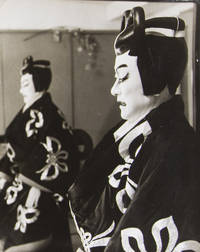
196541653Budapest: NP 1965. Original photographs. Hardcover. vg. Oblong folio 13 3/4 x 20". 30 tissue-guarded leaves. Original string-bound and gilt-ruled blue cloth. <br /> <br /> Created by the Japanese Embassy in Budapest Hungary this unique photo-album contains 66 original silver gelatin prints depicting Japan's spectacular natural and architectural landmarks as well as various aspects of its traditional art and culture Japanese dolls Bunraku Noh and Kabuki Theatres and faith Buddhism. <br /> <br /> In order of appearance the photographs featured in this album are the following:<br /> <br /> Recto of first leaf - The Sankeien Garden 2 photographs: Opened to the public since 1906 the Sankeien Garden is a vast classical Japan garden covering over 175000 square meters which exhibits a number of historic buildings from across Japan. These buildings include a three storied pagoda located high up on a hill deep inside the garden. This pagoda originally constructed in Kyoto in the mid-1400s was relocated to Sankei-en in 1914. The entire garden was once the private home of Tomitaro “Sankei†Hara 1869-1939 an extremely wealthy silk merchant. <br /> Verso of first leaf - Yomeimon Gate at the Nikko Toshogu Shrine 1 photograph: Designated a National Treasure and one of the most beautiful gates in Japan Yomeimon Gate is said to have been given the name “Main Gate of the Imperial Court.†It is also called “Gate of the Setting Sun†because one could gaze upon it all day and never tire. It is covered with over 500 carvings depicting traditional anecdotes children playing sages and wise men. <br /> Recto of second leaf - The Kofuku-ji Temple 1 photograph: Kofuku-ji is a Buddhist temple that was once one of the powerful Seven Great Temples in the city of Nara. The structure is one of the eight Historic Monuments of Ancient Nara inscribed on the UNESCO World Heritage List. - The Himeji Castle 1 photograph: : Located in Himeji Hyogo Prefecture this hilltop Japanese castle complex is regarded as the finest surviving example of prototypical Japanese castle architecture. It comprises a network of 83 buildings with advanced defensive systems from the feudal period.<br /> Verso of second leaf - Traditional bronze Japanese lanterns at a temple in Kyoto.<br /> Recto of third leaf - Osaka Castle 2 photographs: Located in Chuo-ku Osaka the castle is one of Japan's most famous landmarks as it played a major role in the unification of the country during the 16th century of the Azuchi-Momoyama period. <br /> Verso of third leaf - The Sarusawa Pond behind Kofuku-ji Temple at cherry blossom time 1 photograph; - A winter-view of a Japanese lake with a bridge in the background 1 photograph.<br /> Recto and verso of fourth leaf - Matsumoto Castle 3 photographs: Located in the city of Matsumoto Nagano Prefecture the building is one of Japan's premier historic castles along with Himeji Castle and Kumamoto Castle. It was completed in the 16th century and since then has maintained its original wooden interiors and external stonework. At verso is a photograph of the castle ground with the bridge moat and pond. <br /> Recto of fifth leaf - Himeji Castle 1 photograph: See recto of second leaf; - A view of the Hirosaki Castle at cherry blossom time. Built in 1611 the building is a hirayama-style Japanese castle and was the seat of the Tsugaru clan.<br /> Recto of sixth leaf - Himeji Castle 2 photographs. One view of the castle during spring-time and one view of the same castle during winter-time.<br /> Recto of seventh leaf - Todaiji Temple 1 photograph: One of Japan's most fanous and historically significant temples and a landmark of Nara Todaiji Temple was constructed in 752 as the head temple of all provincial Buddhist temples of Japan. Its influence grew so powerfully that the captital was moved from Nara to Nagaoka in 784 in order to lower the temple's influence on government affairs; Himeji Castle 1 photograph: Another view of this spectacular castle already featured in the two previous leaves. <br /> Recto of leaf 8 - An unidentified Japanese temple / shrine 1 photograph; - A stone garden 1 photograph.<br /> Recto of leaf 9 - The Osaka Castle and pond 2 photographs: See recto of third leaf.<br /> Recto of leaf 10 -The garden of the Katsura Imperial Villa Kyoto and the Kintai-Kyo Bridge: a historical bridge built in 1673 and located in the city of Iwakuni Yamaguchi Prefecture. The structure spans the Nishiki River in a series of five wooden arches 2 photographs.<br /> Recto of leaves 11 to 17 - Various temples with rock zen gardens moss gardens and ponds 14 photographs.<br /> Recto of leaves 18 and 19 - Various terraced rice fields 3 photographs and a wheat field 1 photograph.<br /> Recto of leaf 20 - Lake Aoki with the Hakuba Mountain Range in the background and Miho Beach with Mt. Fuji in the background 2 photographs.<br /> Recto of leaf 21 - Kegon Falls and Lake Chuzenji 2 photographs. Located near the city of Nikko Tochigi Prefecture the falls were formed when the Daiya River was rerouted by lava flows. In 1927 the Kegon Falls was recognized as one of the "Eight Views" which best showed Japan and its culture in the Showa period. Lake Chuzenji is a scenic lake created 20000 years ago when Mount Nantai erupted and blocked the river.<br /> Recto of leaf 22 - Snow-capped Mount Fuji 2 photographs. One photograph with one of the five lakes surrounding Mt. Fuji in the foreground; the second photograph with Fuji City in the foreground.<br /> Recto of 23rd leaf - Two photographs: One depicting a busy road near one of the five lakes surrounding Mt. Fuji; The second shows a snow-capped Mt. Fuji with a ropeway in the foreground.<br /> Recto of leaf 24 - Scenes of Kabuki theatre 2 photographs. A classical Japanese dance-drama Kabuki theatre is known for the stylization of its drama and for the elaborate make-up worn by some of its performers. <br /> Recto of leaves 25 - Scenes of Noh Theatre 2 photographs. Noh theatre is a traditional Japanese theatrical form and one of the oldest extant theatrical forms in the world. Wearing masks Noh performers are simply storytellers who use their visual appearances and their movements to suggest the essence of their tale rather than to enact it. <br /> Recto of 26th leaf - Hakata Ningyo Japanese dolls 2 photographs. The Hakata Ningyo are clay dolls manufactured in Hakata Northern Kyushu island. Their origin goes back to the beginning of the Edo period around 1615. <br /> Recto of 27th leaf - Bunraku puppets 2 photographs. Bunraku is the traditional puppet theatre of Japan. It started of as popular entertainment for the commoners during the Edo Period in Osaka and evolved into artistic theater during the late 17th century. Along with Noh and Kabuki it is recognized as a UNESCO Intangible Cultural Heritage. Bunraku puppets are about one-half life size and each is operated by three performers: a principal operator and two assistants. Strings are not used but rather the puppeteers co-operate to maneuver the limbs eyelids eyeballs eyebrows and mouths of the puppets thereby producing life-like actions and facial expressions. The puppeteers are in full view of the audience but are dressed in black to symbolize that they are to be taken as "invisible". <br /> Recto of leaves 28 - Scenes of Noh Theatre 2 photographs. See leaf 25. <br /> Recto of leaf 29 - Scenes of Kabuki theatre 2 photographs. See leaf 24. <br /> The last three photographs at verso of leaf 29 and recto of leaf 30 depict: <br /> 1 A sculpture of Amida a celestial buddha described in the scriptures of Mahayana Buddhism executed by Jocho and located in Byodo-in a Buddhist temple in the city of Uji Kyoto Prefecture. <br /> 2 The Alamy Great Buddha of Nara in the Daibutsuden Big Buddha Hall in Todaiji a Buddhist Temple complex located in the city of Nara. <br /> 3 The Great Buddha bronze statue in the temple of Kotokuin located in the city of Kamakura Kanagawa Prefecture. <br /> Each silver gelatin print measures appr. 9 3/4 x 8". Some have a tipped-in typed caption in English at verso and bear the stamp of the Japanese Embassy in Budapest Hungary. <br /> <br /> Photo-album and original photographs in very good condition. NP hardcover
176155398Vienna: Typis Georgii Ludovici Schulzii Typographi Academici 1761. Folio. 14 388 22 pp. Copper-engraved title vignette 3 copper-engraved maps in text 1 large folding copper-engraved map woodcut engraved decorated & historiated initials & tail-pieces. Contemporary mottled boards rebacked in brown calf minor bumping & wear to corners some scuffing & edgewear ex-lib markings on title w/ “Dupl.†annotation at foot of title†still a VG clean copy with wide margins and w/ ownership markings on front pastedown of Leo Szemere pseud. Peter Bolt and noted Austro-Hungarian bookplate collector dated 1920. First edition of this significant early history offering a broad comparative analysis of the movements and impact of the Huns Avars Sarmatians and other nomadic peoples across Asia Central Asia and into Europe from 210 A.D. to 997. Bolstered not only with many original documents from late antiquity and maps but also drawing upon the influential histories and researches of the French Orientalists such as Joseph de Guignes massive history of Central Asia drawing upon Chinese historical sources. The well-executed large folding map shows the Hun Empire stretching from northern China above the Great Wall northern Tibet and across the steppes of Central Asia into Central Europe. Pray 1723-1801 was an Hungarian Jesuit historian who was the imperial historiographer of Empress Maria Theresa whose collection of more than 2100 volumes manuscripts and documents was donated to the Empire and was rewarded by Emperor Joseph II with an allowance of 400 florins for supporting Hungary’s claims to lands lost to the Ottoman Empire. See: Graesse V 435; Wurzbach XXIII 225; Gabor Klniczay The Myth of Scythian Origin and the Cult of Attila in the Nineteenth Century Multiple Modernities: Ancient Histories in Nineteenth Century Cultures 2011 pp. 195-197. Typis Georgii Ludovici Schulzii, Typographi Academici, hardcover
in 4, pp. 38; 49. Bella legatura in pergamena. Rarissima edizione originale di questa descrizione storica di Sirmio, (oggi Mitrowitz), sulla Sava, piccola citta' dell' Ungheria, sotto il dominio dell'Impero austriaco. Spessso venne confusa con Sirmione (Bocca). Esiste anche una traduzione italiana dell'anno successivo. In questa edizione l'autore si firma come Giuseppe Cinesia di Fermo, pseudonimo che scompare nella seguente traduzione italiana. Esemplare estremamente fresco. . Dizionario di erudizione storico - ecclesiatica. XLVIII, p. 2645; Vinciana, 990; Lozzi, 5183; Bibl. Picena, p. 112; Melzi, Anonime e Pseudonime, I, 207.
c4802Vindobonae, Typis Ionnis Thomae de Trattnern, 1766 ; 1 volume in-8° plein maroquin rouge de l' époque, dentelle encadrant les plats avec fer à la grenade aux angles, motif de 4 fers à la grenade au centre des plats, dos à nerfs orné de filets et petits fers dorés , avec en place du titre la date 1772 dorée (année de l'ex-libris manuscrit), intérieur des plats de papier dominoté à motif floral rouge et vert, tranches dorées; 377pp.,1p.nch. 9 planches dépliantes. Ex-libris manuscrit "Aloysius Billieux" daté de 1772 sur la première garde blanche( année de la reliure de l' ouvrage).
181064074CB[Pestini (Budapest), Verlag Trattner, 1810]. Quer-4°. 23 x 38 cm. [1], 79, 20, 8 Blatt. Kartonierter Interimsband mit in Geweband eingefasstem Rücken. [7 Warenabbildungen]
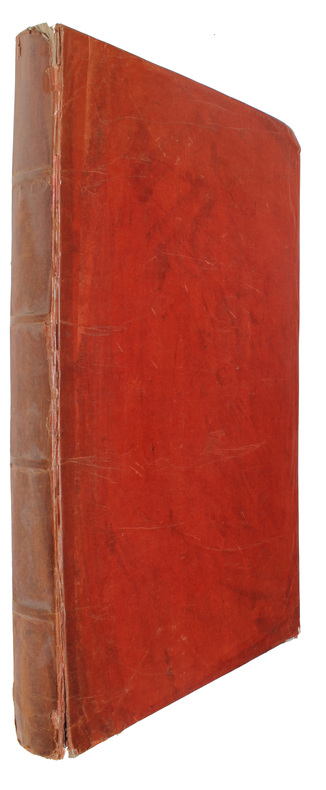
Two volumes bound together in a beautiful mid-18th-century binding. The first work is an extremely important exegesis of the Apocalypse; the second is an explication of everything related to the sacraments. [8] leaves; 481, [11] pp; [4] leaves; XII, 466, [2] pp publisher's catalogue. Beautifully printed on fine paper. Attractive woodcut ornaments throughout. P. [482] of the first work features a stunning full-page woodcut depicting the second coming. Thick folio. Bound in full speckled calf, spine elegantly gilt in six compartments, parchment spine label. Some superficial wear to binding, more wear to head and tail of spine, but structurally solid and very attractive. INTERNALLY BRIGHT AND FINE, PAPER VERY WHITE, WITH NO DEFECTS.
(1945) . Original Illustrated Paper Wrappers, Small 8vo, 216 pages. Eredeti borítóval. Includes 9 powerful original linocut illustrations, and cover design, by Shagra Weil. Also includes a bit of music.Title translates as "The Yellow Book. Data on the War Losses of Hungarian Jewry. 1941-1945." One of the earliest book about the Hungarian Holocaust. Published by Hechaluc (Hehalutz), the Zionist resistant movement, whose legendary headquarters was located at the Üvegház (Glasshouse) in Budapest, a former glass-store. During the Holocaust about 3000 people found shelter there and it was the center for producing fake identification documents to save Hungarian Jews from persecution. Shraga Weil (Ferenc Ferdinánd; 1918-2009) was a Hungarian born Israeli painter. He studied at the Academy of Art in Prague and École des Beaux Arts in Paris. During WWII he was active in the Zionist underground movement in Budapest, working in the workshop for forging documents. After the war he sailed for Palestine on an illegal immigrant ship and became a member of Kibbutz Ha'ogen where he lived until his death. In 1959 Weil was awarded the Dizengoff Prize for painting. He created the doors of the main entrance to the Knesset building and the President's residence in Jerusalem. Weil painted the wooden panels in the Israeli Hall at the Kennedy Center. Sándor Groszmann (Alexander Grossmann, Ben Erec; 1909-2003) was a journalist and publisher, one of the main activists of the Hungarian Zionist movement and co-founder of "Hashomer Hatzair" in Hungary. He was one of the leaders at the "Glasshouse". "When the argument arose about whether to absorb more Jews into the 'Glass House' as they might endanger the lives of those already living there, he said: 'For the sake of one hundred thousand Jews it is worth to endanger our own lives'". (Gur, D.; 2007). After the liberation he was the secretary of JDC (American Jewish Joint Distribution Committee) in Budapest and member of the board of the Hungarian Zionist Association and of the "Eretz-Israel" office. In 1949 he left Hungary and after living in Austria and Israel he settled down in Switzerland where he started to publish books and the periodical "Jöv?" (Future). [Bibl.: Gur, D.: Brothers for Resistance and Rescue. The Underground Zionist Youth Movement in Hungary during Word War II. Jerusalem-New York, 2007; Cohen, A.: The Halutz Resistance in Hungary, 1942-1944. New York, 1986.]. Paper aged, Very Good Condition. (holo2-125-27) xx
185911608Paris Librairie Nouvelle 1859 demi-chagrin rouge. in-12, (2ff.), 348pp., (1f. errat.),
8277Paris, Revue Neuf, 1952. In-4 de [84]pages, pleine toile rouge, premier plat orné d'un portrait au trois quart de Brassaï, dos passé, coiffe supérieure à peine frottée.
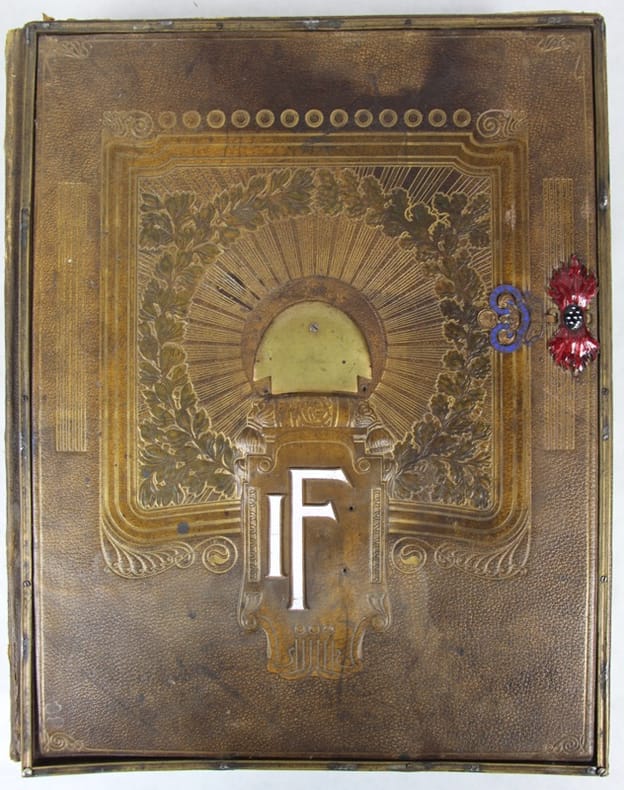
189937323Leipzig, Budapest, Vienne, Maximilien Herzig 1899 In-folio, plein chagrin brun, dos à nerfs, premier plat dans un cadre métallique, orné et décoré à froid autour d’une couronne et du monogramme IFJ en métal, le monogramme rehaussé de blanc manque la lettre J, fermoir factice rehaussés rouge, bleu et blanc, rosaces de support en laiton aux coins en second plat une rosaces manque, XXIV- 322 pp. Deux titres frontispice couleurs, ornements décoratifs des table, Illustrations à toutes pages, nombreuses à pleine page, une à double page, certaines sous serpente légendée, en noir ou sépia, 35 lithographies hors-texte sur onglet, certaine sous serpente lég. Large humidité en pied aux hors-texte le frontispice et le titre en couleurs sont préservés, deux ff. et une planche déliés. Brunissures marginales éparses.
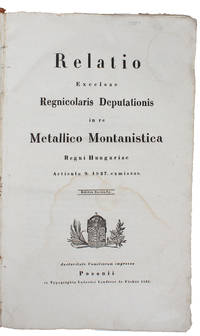
183148694Posonii Ludovici Landerer de Fúskút 1831. Folio. Uncut in contemp. boards. Small tears at spine ends. A faint dampstain to titlepage. VIII5716235 pp. Internally fine and clean. <br/><br/><em>The work gives the official articles privileges relating tothe mining industry in Hungary as well as giving the regulations for mining constructions. The work is in Latin. </em> hardcover
183148694Posonii, Ludovici Landerer de Fúskút, 1831. Folio. Uncut in contemp. boards. Small tears at spine ends. A faint dampstain to titlepage. VIII,57,16,235 pp. Internally fine and clean.
18366138Mit besonderer Rücksicht auf die bestehende Dampfschiff-Fahrt auf diesem Flusse. Mit 1 gefalt. Tabelle u. einer teilkolor. lithogr. Stromkarte von Alexander Pitsch auf zwei mehrfach gefalt. Blättern. Wien, C. Gerold, 1836. Kl.-8vo. (13,3 x 10,5 cm). X, 102 S. Typographischer Orig.-Pappband.
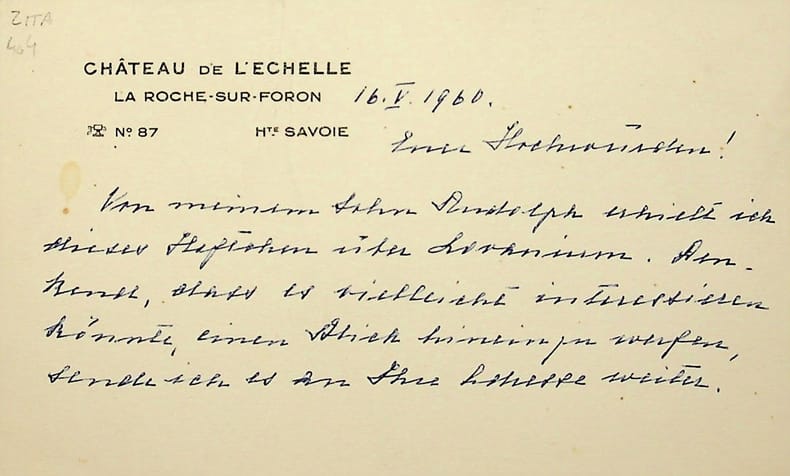
018181Zita de Bourbon-Parme (1892-1989), princesse de Parme, impératrice d'Autriche, reine de Hongrie. L.A.S., Château de l'Echelle, 16 mai 1960, 2p in-12. Carte en allemand. Rare autographe. [420]
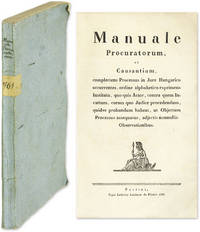
1828593391828. Pest 1828. First edition. Pest 1828. First edition. Rare Hungarian Treatise on Civil Actions and Defenses Hungary. Manuale Procuratorum et Causantium: Complectens Processus in Jure Hungarico Occurrentes Ordine Alphabetico Exprimens Instituta Quo Quis Actor Contra Quem Incattum Coram quo Judice Procedendum Quidve Probandum Habeat Ut Objectum Processus Assequatur Adjectis Nonnullis Observationibus. Pest: Landerer de Fuskut 1828. ii 172 4 pp. Octavo 8-1/4" x 5-1/4". Original plain publisher wrappers early hand-lettered title and private-library shelf label to spine. Light soiling and shelfwear and a few minor inkstains minor wear to spine ends and corners. Some toning to text light foxing in a few places minor worm holes near center of final three leaves are rear cover. Early owner signature to front pastedown interior otherwise clean. $650. First edition. This treatise on civil actions and defenses went through two later editions in 1835 and 1841. All are rare. OCLC locates 3 copies of the first edition in North America Harvard Law School Library of Congress UC-Berkeley Law School. unknown