8 690 résultats
Broché. 87 pages.
1998R200076367LAROUSSE. VERS 1998. In-4. Relié. Bon état, Couv. convenable, Dos satisfaisant, Intérieur frais. 159 pages. Nombreuses photos et/ou illustrations et cartes en couleurs et noir et blanc, dans et/ou hors texte.. . . . Classification Dewey : 942-Angleterre
193983836London: United Kingdom Home Office 1939. Presumed First Edition First printing. Wraps. Fair. Format is approximately 6 inches by 9.5 inches. 16 pages including covers. Illustrations. Cover worn and soiled with some edge tears creasing and chipping. It gives instructions on how to position and put together an Anderson Shelter. The shelter was sunk into the ground and is a logical precursor to the Cold War Fallout Shelters. This work includes a Description of the Shelter information on the Locations of the Shelter The Excavation Erection of the Shelter Covering the Shelter and then Finishing the Shelter off. Illustrations go from page 6 through 16 Among the aspects addressed in the illustrations are methods for drainage Terraced Houses Semi-detached Houses Illustration of major individual parts Erecting the back arch Frame arrangement Views from the inside and completion of the earth cover. Air raid shelters are structures for the protection of non-combatants as well as combatants against enemy attacks from the air. They are similar to bunkers in many regards although they are not designed to defend against ground attack but many have been used as defensive structures in such situations. Before WWII the U.K. had difficulty choosing the location of air raid shelters. During WWII many types of structures were used as air raid shelters such as cellars German Hochbunkers basements and underpasses. The U.K. began building street communal shelters as air raid shelters in 1940. Anderson shelters designed in 1938 and built to hold up to six people were also in common use in the U.K. Indoor shelters known as Morrison shelters were also in use. Prior to World War II in May 1924 an Air Raid Precautions Committee was set up in the United Kingdom. For years little progress was made with shelters because of the apparently irreconcilable conflict between the need to send the public underground for shelter and the need to keep them above ground for protection against gas attacks. In February 1936 the Home Secretary appointed a technical Committee on Structural Precautions against Air Attack. By November 1937 there had only been slow progress because of a serious lack of data on which to base any design recommendations and the Committee proposed that the Home Office should have its own department for research into structural precautions rather than relying on research work done by the Bombing Test Committee to support the development of bomb design and strategy. This proposal was eventually implemented in January 1939. They also decided to issue free to poorer households the Anderson shelter and to provide steel props to create shelters in suitable basements. The Anderson shelter was designed in 1938 by William Paterson and Oscar Carl Karl Kerrison in response to a request from the Home Office. It was named after Sir John Anderson then Lord Privy Seal with special responsibility for preparing air-raid precautions immediately prior to the outbreak of World War II and it was he who then initiated the development of the shelter. After evaluation by David Anderson Bertram Lawrence Hurst and Sir Henry Jupp of the Institution of Civil Engineers the design was released for production. Anderson shelters were designed to accommodate up to six people. The main principle of protection was based on curved and straight galvanized corrugated steel panels. Six curved panels were bolted together at the top so forming the main body of the shelter three straight sheets on either side and two more straight panels were fixed to each end one containing the door—a total of fourteen panels. A small drainage sump was often incorporated in the floor to collect rainwater seeping into the shelter. The shelters were 6 feet high 4.5 feet wide and 6.5 feet long. They were either buried 4 ft deep in the soil and then covered with a minimum of 15 inches of soil above the roof or in some cases installed inside people's houses and covered with sandbags. When they were buried outside the earth banks could be planted with vegetables and flowers that at times could be quite an appealing sight and in this way would become the subject of competitions of the best-planted shelter among householders in the neighborhood. The internal fitting out of the shelter was left to the owner and so there were wide variations in comfort. Anderson shelters were issued free to all householders who earned less than £5 a week equivalent to £320 in 2020 when adjusted for inflation. Those with a higher income were charged £7 £440 in 2020 for their shelter. One and a half million shelters of this type were distributed between February 1939 and the outbreak of war. During the war a further 2.1 million were erected. Large numbers were manufactured at John Summers & Sons ironworks at Shotton on Deeside with production peaking at 50000 units per week. The Anderson shelters performed well under blast and ground shock because they had good connectivity and ductility which meant that they could absorb a great deal of energy through plastic deformation without falling apart. Because of the large number made and their robustness many Anderson shelters still survive. Many were dug up after the war and converted into storage sheds for use in gardens and allotments. United Kingdom, Home Office paperback
194574899London: United Kingdom The Admiralty Naval Intelligence Division 1945. Presumed First Edition First printing. Hardcover. Good. xiii 1 416 pages. Frontis illustrations. Illustrations. Maps. Diagrams. Fold-outs. Conversion Tables. Indexes. Large color folding map in rear pocket Compiled and drawn by N.I.D.5 1945. Cover has wear and soiling. Corners a bit rubbed. Cloth torn at bottom of spine rear board. Some endpaper discoloration. This was prepared by the Oxford sub-centre of the Naval Intelligence Division under the direction of Lieut.-Colonel K. Mason Professor of Geography at the University of Oxford and was the work of a number of contributors whose names are on p. 347. The book was for the use of persons in H. M. Service only and must not be show or made available to the Press or to any member of the public. Fep has stamped statement "To be kept under lock and key when not in use." There is also a longer stamped statement entitled Conditions of Release what amplifies the control conditions for this item. In 1915 a Geographical Section was formed in the Naval Intelligence Division to write Geographical Handbooks on various parts of the world. The purpose of these handbooks was to supply by scientific research and skilled arrangement material for the discussion of naval military and political problems as distinct from an examination of the problems themselves. The old handbooks had been extensively used in the Second World War but experience showed both their value and their limitations. The old series did not cover many of the countries closed affected by the Second World War. There a new series was initiated resulting in a new set of books produced in the Naval Intelligence Division by trained geographers drawn largely from the Universities. The books follow in general a uniform approach and are illustrated by numerous maps and photographs. These are designed first to provide for the use of Commanding Officers information in a clear and comprehensive form about countries they may interact with. Secondarily these works supplied material for orientation lectures on the country for a variety of naval personnel. United Kingdom, The Admiralty, Naval Intelligence Division hardcover
1952RO40001031Amiot-Dumont. 1952. In-8. Broché. Etat d'usage, Couv. convenable, Dos satisfaisant, Papier jauni. 303 pages.. . . . Classification Dewey : 942-Angleterre
PARIS, Amiot Dumont - 1952 - In-8 - Broché - .Couverture illustrée des portraits d'Albert et de Victoria - Tableaux généalogique xdes Saxe-Cobourg & famille d'angleterre (recollés) - 304 pages + Table - correct
24585PARIS, Amiot Dumont - 1952 - In-8 - Broché - .Couverture illustrée des portraits d'Albert et de Victoria - Tableaux généalogique xdes Saxe-Cobourg & famille d'angleterre (recollés) - 304 pages + Table - correct
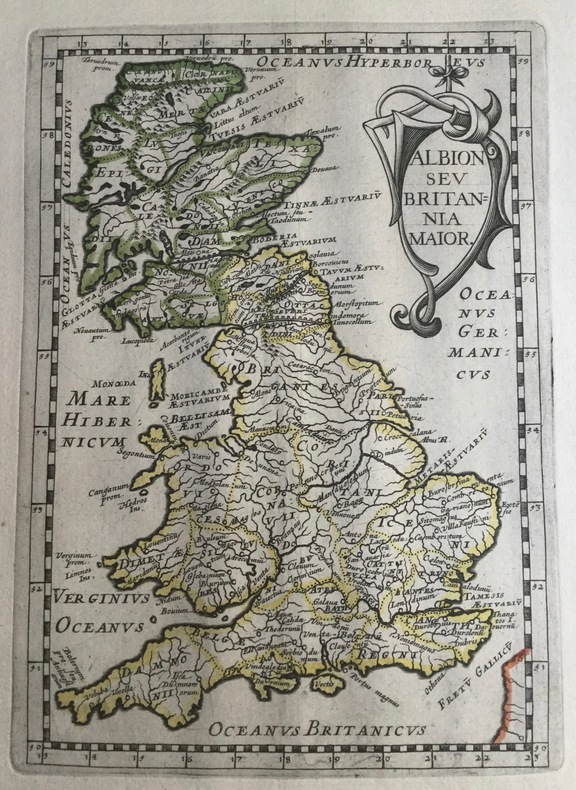
1653UUI-10081Carte géographique de format 28,5/34,5 cm (pour la planche), 21/16 cm (pour la carte). Issue du rare atlas de Briet : "Theatrum geographique Europae veteris", Pierre Mariette, 1653. Papier légèrement jauni, bon état général, bel exemplaire. Frais d'envoi 7 euros sur la France, 15,05 UE et Suisse, entre 19,60 et 26,70 euros pour le reste du monde, à spécifier selon zone. Possibilité de remise en mains propres sur Paris, n'hésitez pas à me contacter avant de passer commande. Twitter : @Pontneuf06.
121013aafSt. Gallen, Hausmann, 1948, in-8°, Frontispiz-Porträt + XVII + 131 S. + 12 Tafeln, Original-Pappband.
9468aafSt. Gallen, Hausmann, 1948, gr. in-8°, XVII + 131 S. + 5 Tafeln, Original-Broschüre.
16392Paris, Au bureau de la Revue britanniques, 1830. In-8, 279 pp., demi-veau rouge de l'époque, dos lisse romantique orné de filets et d'arabesques dorés (petits manques au coins, légère insolation du dos, frottements rousseurs, décharges sur les serpentes).
RO80039167COLIN Armand & Cie.. Non daté. In-4. En feuillets. Etat d'usage, Livré sans Couverture, Dos satisfaisant, Intérieur frais. Paginé de 167 à 178. Nombreuses illustrations en noir et blanc dans le texte. Pages détachées.. . . . Classification Dewey : 942-Angleterre
1990506801990 Editions Gallimard / nrf, collection "Bibliothèque de la Pléiade" - 1990 - In-12, reliure plein cuir marron, dos lisse orné de filets dorés horizontaux, avec pièce de titre en dorée, signet jaune, tranche de tête teintée orange, sous jaquette Rhodoïd, sans emboîtage - 365 pages - 313 illustrations
54334Liverpool, Brown & Rawcliffe no year, about 1890, 220x310mm, Cartonnage de l’éditeur. Leporelo contenant 30 vues de différents format.
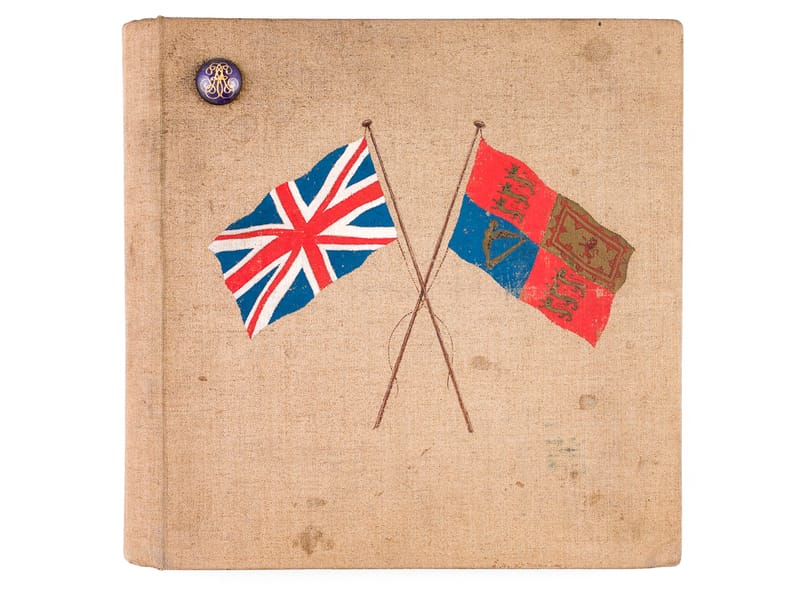
191063670Album photographique pleine toile format 27 x 28 cm, drapeaux peints en plat, un bouton d'uniforme rapporté au premier plat, 37 photos format carré 21,5 x 21,5 cm : St James's Street 7 heures 1/2 du matin : La musique des Horse Guards - Les Hussards ; Les "6th Rifles" ; La Musique des Horse Guards ; Les Horse Gards le Drummer en tête ; L'Infanterie. L'automobile qui verse le sable sur le parcours ; Le défilé a commencé, les soldats des régiments d'Infanterie portent le canon du fusil baissé en signe de deuil. La foule compacte et respectueuse. Des draperies violettes ou noires à toutes les fenêtres ; Les Scott Guards ; Les Gordon's Highlanders ; L'Artillerie ; Les Hussards ; Les Life Guards ; Des Princes Indiens et des représentants des Colonies ; Lord Fisher of Kilverstone saluant le drapeau suivi des Amiraux ; Les "Blue Jackets" ; Le Duc de Norfolk saluant le drapeau. Etant Earl Marshall de la Cour par droit héréditaire, ce fut lui qui fut chargé d'organiser toutes les solennités depuis la mort du Roi et le cortège d'aujourd'hui ; Les généraux : Sir Charles Douglas. Lord Kitchener, Lord Roberts, Sir Evelyn Wood, les 3 FieldMarshall anglais ; Les représentants allemands des régiments dont le Roi était Colonel ; Les attachés militaires étrangers ; Les représentants autrichiens des régiments dont le Roi était Colonel ; "The Gun carriage" sur laquelle est drapée "The Union Jack" et l'Etendard Royal. Les couronnes royales sont posées sur des coussins ; Le chien du Roi "Caesar" conduit par un Ecossais ; Le cheval du Roi avec les bottes mises à l'envers ; Les Souverains et Princes étrangers suivent : l'Empereur d'Allemagne. Le Roi George V. Le Duc de Conaught. Le porte étendard royal ; Le trompette royal ; Grand-Duc de Hesse, Roi du Danemark ; Les Princes du Sang : Le Duc d'Aoste ; La voiture de la Reine Mary ; La voiture des Princes ; Les "Life Guards" qui ferment le cortège ; Retour à la caserne des troupes ("Life Guards", Artilleurs, Hussards, Musique de l'Infanterie, Trumpetter [ English translation : St James's Street 7:30 a.m.: The Band of the Horse Guards - The Hussars; The "6th Rifles"; The Band of the Horse Guards; The Horse Guards the Drummer in the lead; Infantry. The car that pours the sand on the course; The procession has begun, the soldiers of the infantry regiments carry the gun barrel lowered as a sign of mourning. The compact and respectful crowd. Purple or black draperies on all windows; The Scott Guards; The Gordon's Highlanders; Artillery; The Hussars; The Life Guards; Indian Princes and Colonial Representatives; Lord Fisher of Kilverstone saluting the flag followed by the Admirals; The "Blue Jackets"; The Duke of Norfolk saluting the flag. Being Earl Marshall of the Court by hereditary right, it was he who was responsible for organizing all the solemnities since the death of the King and the procession of today; Generals: Sir Charles Douglas. Lord Kitchener, Lord Roberts, Sir Evelyn Wood, the 3 English FieldMarshalls; The German representatives of the regiments of which the King was Colonel; Foreign military attaches; Representatives from regiments of which the King was Colonel; "The Gun chariot" on which is draped "The Union Jack" and the Royal Standard. The royal crowns are placed on cushions; The King's dog "Caesar" led by a Scotsman; The King's horse with the boots turned upside down; Foreign Sovereigns and Princes follow: the Emperor of Germany. King George V. The Duke of Conaught. The royal standard bearer; The Royal Trumpet; Grand Duke of Hesse, King of Denmark; The Princes of the Blood: The Duke of Aosta; Queen Mary's Carriage; The Princes' car; The "Life Guards" who ferment the procession; Return to Troop Barracks ("Life Guards", Gunners, Hussars, Infantry Band, Trumpetter ]
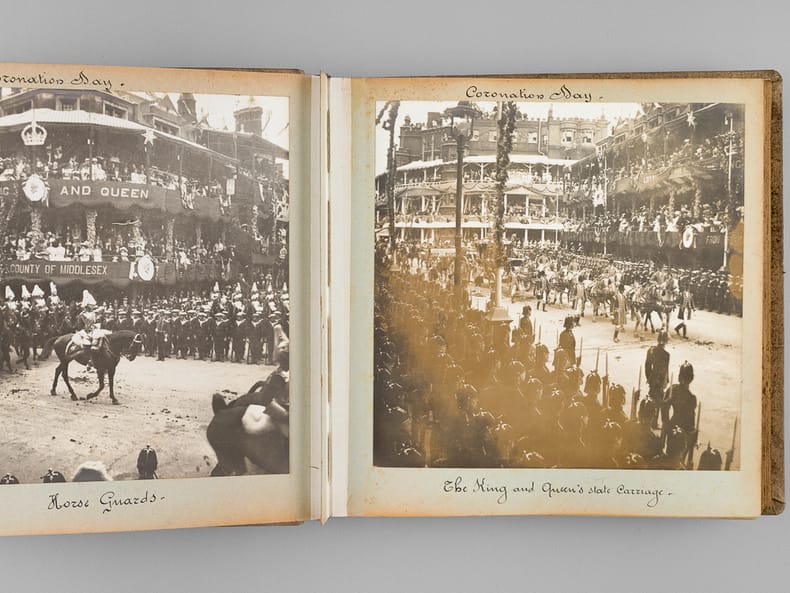
191163669Album photographique pleine toile format 27 x 28 cm, armes royales peinte en plat, 52 photos format carré 21,5 x 21,5 cm : Coronation Day : Territorials. Naval School - Life Guard drumms - Life Guards Engineers - Life Guards Band - Indians - Lord Mayor, King's Staff - Duke of Fife - Horse Guards - The King and Queen's state Carriage - The cream coloured poneys - Lord Roberts - Prince of Wales's carriage - Kronprinz and Kronprinzess of Germany's carriage - Prince's carriage - Speakers' carriage - Beef eaters - St Paul's Procession : Hussars - Infantry Band - Lancers Band - Canadians - Scot Greys Band - Indian Princesses - Indians Officers - Colonel Stratford, Colonel Staig, Sir Hedworth Lambton - Blue Jacketts - The King and Queen - Duc of Theh, Prince Louis of Battenberg, Sir Evelyn Wood, Prince Arthur - Duke of Connaught - Duke of Fife - Foreign Representation - Cannon Street : Sir Edward Henty Head of the Police - Canadian - Premier of Canada - Sir Alfred Coringto General Commander of London - King and Queen with Prince of Wale and Princess Mary - Oxford Street : The King's Outriders - The King and Queen carriage - Captain Arthur Wood of the Cameronans - Cold Stream Guards Major Marker
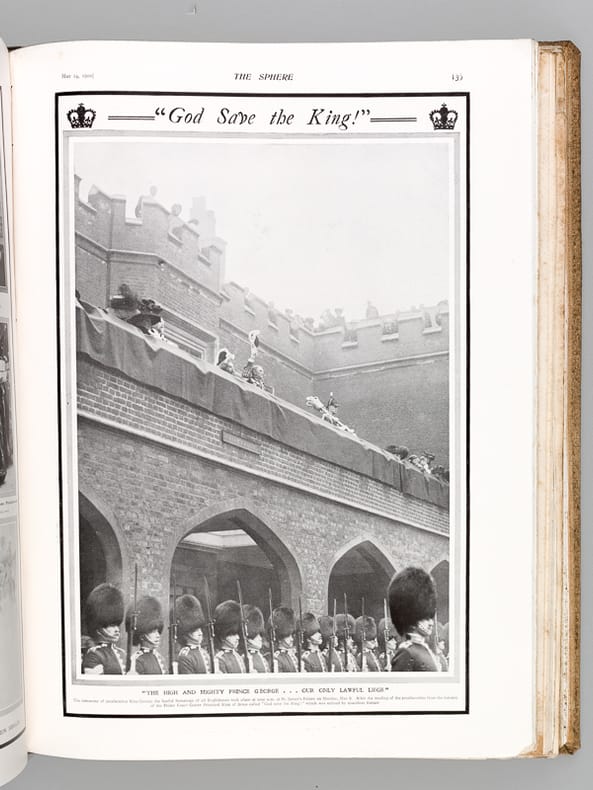
1910636711 vol. in folio reliure pleine toile grise, format 42 x 33 cm, blason collé au premier plat avec devise "Dieu et mon droit", Album Souvenir des Funérailles du Roi Edouard VII. Recueil de Journaux et Documents - Souvenir Album of the Funeral of King Edward VII. Collection of Newspapers and Documents : The Daily Mirror. N°2048 20 May 1910, 16 pp. : The Kaiser arrives - Evening Standard and St James Gazette n°26794 May 19, 1910 : Kaiser's arrival, 20 pp. ; Official Programme of the Funeral Procession of his late Majesty King Edward VII, Friday May 20th 1910, 4 ff. ; ; The Sketch Double number May 11 1910. The Death of King Edward VII ; The Graphic Specla Number 2110A May 11, 1910, The Life of King Edward VII ; The Graphic. An illustrated weekly newspaper. Saturday May 14, 1910. King George V driving to St James's Palce to hold his first council ; The Sphere, n° 538, May 14, 1910 : Edward VII 1841-1910 ; The Illustrated London News double number. May 14, 1910, n° 3708 ; The Graphic. An illustrated weekly newspaper. n° 2112 Saturday May 21, 1910 : King Adward last sleep at Buckingham Palace ; Black & Whit May 21st 1910. A Nation in Mourning. In Memoriam ; The Graphic 2112A May 24 1910. Funeral of Edward VII ; The Sphere. n° 540 May 28, 1910 : Funeral Number. Edward the Peacemaker
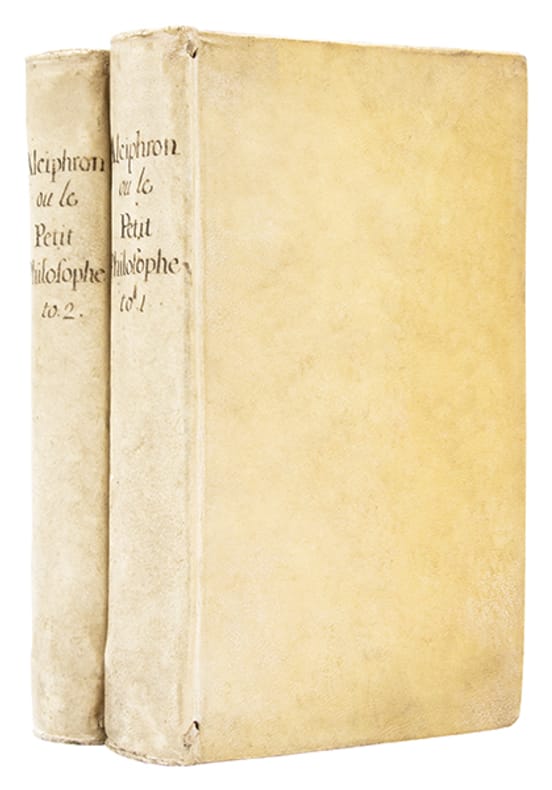
388732 volumes in-12 (168 x 98 mm), plein vélin rigide de l'époque, dos titrés à la plume, (8), 372, (10) p. et (2), 218, (6), 133, (15) p., planche gravée dépliante de figures géométriques au tome I. La Haye, P. Gosse & J. Neaulme, 1734.
27893Tours, Mame, 1865, in 8° relié pleine percaline violette de l'éditeur, dos orné, tranches dorées, 235pp. ; frontispice ; qq. très rares rousseurs ; premier et dernier cahiers déboités ; dos passé.
44256aafOxford, Alden, 1906, sm. in-8°, key.plan of the Univ. City inside first cover + 14 leaves of richly illustr. publicity + 1 frontispice + VIII + 148 p., richly ill. with drawings and photographs + noumerous nn. plates + 20 p. publicity + 1 colouredfolded map orig. green cloth.
in-12°, 235 pages, broché, couv. Bel exemplaire. [CA-11]
grand in-8°, 503 pages, tabl. geneal., -, index, broche, couverture illustree plastifiee. Bel exemplaire [CA32-1]
L'Arc, n°71, 1978. In-8 carré broché, 96 pp. Quelques illustrations. Etat neuf.
1985102217New Haven and London, Yale University Press 1985 In-4 25,5 x 19,5 cm. Broché, premier plat de couverture illustré, VI-350 pp., 200 illustrations en noir & blanc dans et hors-texte, notes, sources, bibliographie. Exemplaire en très bon état.
98351Paris Didier 1844 et 1842 1 vol. relié 2 ouvrages reliés en un vol. in-12, veau chocolat, dos lisse orné d'un décor doré en long, encadrement doré sur les plats estampés d'un décor à froid, coins et coupes guillochées, tranches dorées, 295 et 312 pp., 8 gravures hors-texte. Quelques rousseurs et dos passés, mais bonne reliure de l'époque.