Wales, WilliamBiblio.com
3 188 résultats
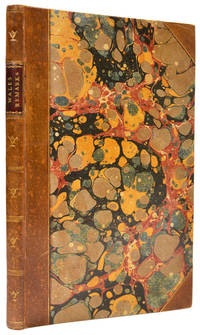
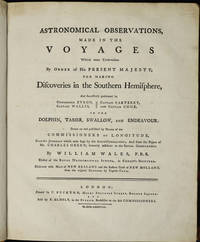
178828294London: C. Buckton and sold by P. Elmsly 1788. ARGUABLY ONE OF THE RAREST PUBLICATIONS ON COOK’S FIRST VOYAGE. This example appears to be an unrecorded early issue as pages 93 & 96 are printed back-to-back and pages 94 & 95 are omitted. It is sold with a corrected issue of the complete text 1788 with pages 94 & 95 printed. <br /> <br /> This is the first scientific publication relating to Captain Cook’s first voyage on HMS Endeavour 1768-1771 to the Pacific. Officially it was to observe the transit of Venus in the South Pacific but secretly it was to search for the mythical Southern Continent. In the process Cook became the first European to set foot on New Zealand and the east coast of New Holland or Australia. Of all the works associated with the First Voyage this is one of the rarest. Only two examples of this work are recorded at auction on Rare Book Hub since 1985. It was not in the Parks collection arguably one of the finest in living memory on the works of Cook. It was also not in the libraries of Davidson or Parson’s. It includes two large charts representing the east coast of Australia and New Zealand much improved from those published in John Hawkesworth’s official account of the first voyage.<br /> <br /> William Wales bap.1734-96 was an English mathematician and astronomer. In 1768 the Royal Society sent him to Hudson Bay to observe a transit of Venus in June 1769. His observation were the first scientific measurements to be made in Canada and were taken at the Prince of Wales Fort. Whilst there he computed a series of tables for calculating longitude using chronometers. In 1772 he was appointed to the second voyage 1772-75 of Captain James Cook. He replaced his brother-in-law the astronomer Charles Green 1735-71 who had died on the return leg of the first voyage. His meticulous attention to detail is noted in his frustration ‘I begin to despair …of doing any thing to the Purpose here and yet I am such a slave to it that I have scarce time to eat’. Suarez noted that in Malekula he took 32 sets of observations and at Tanna 45! He was able to correct the longitude of the South Island of New Zealand placing it 40 minutes further west an error at Cook Strait of about 34 miles. Cook himself wrote in his journal that ‘Mr Wales whose abilities is equal to his assiduity lost no one observation that could possibly be obtained’ ODNB.<br /> <br /> This resulted in the more often found ‘The Original Astronomical Observations’ 1777 publishing the findings. Of that book Davidson wrote in 1970 that it was ‘as important as it is rare … I have not noted a copy for sale in recent years and should a copy become available it would certainly arouse great competition between collectors …’. He then became responsible for publishing the same from the results of Cook’s first voyage based on the observations of Cook Clerke and Green. Wales would become Master of Mathematics at Christ’s Hospital in 1775 and served on the Board of Longitude until his death in 1798.<br /> <br /> This example appears to be an unrecorded early issue as pages 94-95 are omitted 93 and 96 are printed back-to-back. The signature of this leaf is Bb and there is no Bb2. The next leaf paginated 97 bears the signature Cc as expected. The title page of the second copy is identical to the first as are all the other text pages with some slight variation in the darkness of the impression. In the second copy Bb is complete with the pages numbered 93-96 and CC begins on page 97. Pages 94 to 95 are continuations of the discussions about longitude begun on page 93. At this point Captain Cook's log was near the entrance of the harbour of Rio Janiero sic. The entire work is a detailed analysis of what the longitudinal readings are and should be referencing Capt. Cook's and Mr. Green's observations. <br /> <br /> The two charts are engraved by James Basire 1730-1802 who was the son of Isaac Basire 1704-68 also an engraver. He was clearly regarded in some standing as he was named engraver to the Society of Antiquaries in 1759 and to the Royal Society in 1770. That of the east coast of New Holland extends from Point Hicks in the south to the tip of Cape York with accompanying track of the ‘Endeavour’. The book records the observation not only of Cook but his predecessors in the Pacific; John Byron on the Dolphin 1764-66 Samuel Wallis on the Dolphin 1766-68 and Philip Carteret on the Swallow 1766-69. The final third of the book is on ‘Deductions from the Observations’. An extremely rare work of great significance. Beaglehole 1955-67 I p. cclxiv; Beddie 1970 719; Davidson 1970; ESTC T141525; not in Ferguson 1975; not in Hill 1974; Holmes 1952 71; Howgego 2003 W3; ODNB; Sabin 1868-1936 101029; Suarez 2004 pp. 133-5; not in Tooley Australia 1979; Worms & Baynton-Williams 2004. <br /> <br /> The printer's error volume - Small folio 285 x 235 mm. in nineteenth century half calf marbled paper boards spine with ornate gilt bands with ornate gilded green leather title label small area of professional restoration to upper and lower portions of spine yellow edged. With typographic title Contents Errata Introduction pp. 4 xii 4 146 text block 286 x 232 mm with two large folding engraved maps unrecorded early issue printers’ error of pp. 94-95 omitted some foxing on pp. ix-xii tear without loss to p. 59 otherwise in very good condition. <br /> <br /> The complete text volume lacking the two maps - Small folio 305 x 242mm with typographic title Contents Errata Introduction pp. 4 xii 4 146. Text block 297 x 233 mm. Lacking the two folding maps. Rebound in full brown morocco gilt title untrimmed. Library stamp of the Royal Observatory on the title page only. C. Buckton and sold by P. Elmsly unknown
1489ABC_49705Colophon: Strasbourg 1489. Small folio. Printer of the 1483 Jordanus de Quedlinburg = Georg Husner Modern vellum reusing an old manuscript antiphonary leaf. Printed in Gothic type in 2 columns with 52 lines to the page and a headline. 79 ll. First Strasbourg edition of the earliest printed work to mention chess published several years before William Caxton's famous work. Primarily intended as a manual for priests it is a collection of extracts intended to provide moral lessons and examples for the edification of both the rich and poor. It uses classical auctoritates and exempla with great accuracy offering readers the possibility of citing sources and texts that they themselves had never actually consulted. The long passage on chess serves as one of the moral lessons or admonitions for statesmen.The section on chess can be found in part 1 distinctio 10 chapter 7 here folio e6r and e6v. In the typical chess symbolism of the Middle Ages the author compares life to a chess game: "Mundus iste totus quoddam scaccarium est cuius unus punctus est albus et alius niger" all the world is a chessboard which is chequered white and black ending with the caution that if a man falls into sin "in isto scaccio dyabolus dicit eschack" in this game of chess the devil says Check. It describes the moves of the pieces in symbolic terms explaining that the King can move in all directions because his will is law etc. The Queen following the Medieval rules of the game is described as only being allowed to move one square diagononally. Although 6 editions of the work appeared in the 15th century the chess passage is supposedly only included in the first edition printed by Ulrich Zell in 1472 and the present fifth edition.The work is divided in seven parts which each offer admonitions for a different social group including princes churchmen and scholars. The whole of the third part deals with education and gives a good insight into later medieval pedagogics. Separate passages deal with the instruction of students priests and physicians. The final part discusses aspects of death and how one should prepare themselves for this event.Johannes Gallensis or John of Wales d. ca. 1285 was a Franciscan theologian who taught at the Universities of Oxford and Paris. He wrote several well-received Latin works primarily preaching aids in the late-thirteenth century. With his Communiloquium he intended to provide preachers of his time with material for moral edification setting a focus on the ancient writers and making them familiar with their obligations and moral patterns of behaviour. The work was incredibly popular in its time as it was translated into six languages and survives in numerous manuscript copies.The title page is slightly soiled occasional minor foxing lacking the final blank. Otherwise in good condition.l BMC I p. 138; Goff J 332; GW M13987; Hain-Copinger 7444; ISTC ij00332000; Proctor 649; not in IDL. hardcover
98574London printed for J. Nourse opposite Catherine-Street Strand 1778. . First edition. 8vo 22 x 14 cm ii 110 pp. expert marginal restoration to last six leaves affecting 4 words on last page now in ink facsimile a couple on the penultimate and page numbering to the others old staining to title and first leaf of text well bound in modern half-calf gilt red morocco label a well margined copy untrimmed on the fore-edge and other than the defects mentioned a good clean example. <br /> One of the rarest items concerning the Second Voyage. 'Wales who was the astronomer in the Resolution challenges the accuracy of a number of the statements in George Forster's account of Cook's Second Voyage and speaks in very disparaging terms of the elder Forster' Holmes. The errors in the work were apparently only very minor but there was considerable ill feeling directed towards the Forsters by some members of the expedition. It may be said that those who were inclined to support Lord Sandwich's shabby treatment of the elder and younger Forster were prominent among those only too ready to accuse the German scientists of all kinds of misdeeds. <br /><br />On page 48 the words 'and his son' have been inked out as in all known copies.<br /> Beddie 1292; Hocken 19; Holmes 30; Sabin 101031; not in Hill. London, printed for J. Nourse, opposite Catherine-Street, Strand, 1778. unknown
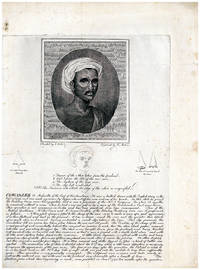
179451824Bombay 1794. <p>Wales James 1746/47 - 1795. Cowasjee a Mahratta of the cast of husbandmen . . . Engraving by Robert Mabon d. 1798 after Wales. Bombay March 1794. 394 x 298 mm.; plate mark measures 343 x 248 mm. Creased horizontally and vertically with a few minor marginal tears along folds left and bottom margins trimmed to the platemark light foxing and toning but very good.</p> <p> Extremely Rare Possibly Unique Legendary First Published Account of the Indian rhinoplasty operation best known from the famous "B.L." letter published in October 1794 in the Gentleman's Magazine see Garrison-Morton.com 5735.1. "The earliest version of this report was a copperplate print published in folio in Bombay on March 20 the same year 1794" Gnudi & Webster p. 310; it predates the "B.L." letter by seven months. </p> <p> The engraving is exceedingly rare-this is the first copy we have ever seen or handled in our six decades in the trade and we have found no other copies recorded in either North American or European libraries. The Wellcome Library has only W. Nutter's engraving of Wales's Cowasjee portrait also extremely rare published in London in 1795.</p> <p> Zeis writing in the 1860s cited only one copy of the Bombay print which he found at the Bibliothek des Herzoglichen Collegium Anatomico-Chirurgicum in Braunschweig. A catalogue of the library published in 1865 lists the print on page 180 under no. 1633; the catalogue's preface includes the following note on p. vi:</p> <p> "Ferner wird hier der sehr seltene 1794 in Bombay erschienene Kupferstich aufbewahrt welcher den kunstlichen Wiederersatz einer vorstümmelt gewesen Nase an dem Gesichte des Ochsentreibers Cowasjee darstellt. Derselben hat der Oberwundarzt Zeis in seinem Werke gebührend gewüdigt und davon etliche photographische Copien anfertigen lassen welche einegen Bibliotheken zum Geschenke gemacht sind."</p> <p> Also kept here is the very rare copperplate engraving published in Bombay in 1794 which shows the artificial replacement of a mutilated nose on the face of the bullock driver Cowasjee. The chief surgeon Zeis has paid due tribute to it in his work and had several photographic copies made of it which have been donated to certain libraries.</p> <p> Whether the original print that Zeis saw or the photographic copies he had made still exist is uncertain. We have found no reference to the Bibliothek des Herzoglichen Collegium Anatomico-Chirurgicum dating beyond the first decades of the 20th century nor have we found any record of Zeis's "photographic copies" of the engraving. During World War II Braunschweig was attacked by Allied aircraft in 42 bombing raids and it is entirely possible that portions or all of the collections at the Bibliothek were destroyed.</p> <p> Zeis quotes an imprint line at the foot of the engraving: "Bombay. Published by J. Wales as the Act directs 20. March 1794." Our copy in which the entire platemark is visible does not include this imprint even though there is ample room for it below the text. Zeis may have been in error or our version of the plate may have been printed before the addition of the imprint.</p> <p> Cowasjee who worked for the British Army had his nose and one of his hands cut off while a prisoner of Tipu Sultan during the third Anglo-Mysore War 1790-92. In 1793 his nose was successfully reconstructed by an Indian surgeon using the so-called Indian or Hindu method in which the surgeon builds a new nose from a live graft of skin cut from the patient's forehead but left attached at the end nearest the nose. This method of rhinoplasty was then unknown in the West. </p> <p> Two British surgeons stationed in Bombay Thomas Cruso and James Findlay observed Cowasjee's operation and publicized the event in a local newspaper. Ten months later James Wales a Scots artist living in India documented Cowasjee's post-surgical appearance in a portrait which was then engraved by Robert Mabon and published in the present print.</p> <p> Exactly why this operation was first published in England in a popular magazine rather than a surgical journal is unclear. However that is what happened. News of Cowasjee's rhinoplasty operation was first published in England via the "B.L." letter to the Gentleman's Magazine whose author has been identified as British engraver Barak Longmate 1768-1836. Longmate undoubtedly had access to the Mabon engraving printed in Bombay as the print's descriptive text beneath Cowasjee's portrait is virtually identical to that in the "B.L." letter; the only difference barring minor variations in punctuation and spelling is the abbreviation "H.E.I. Company" in the engraving for the letter's "Honorable East India Company" and the name "Dr. James Findlay" instead of "Dr. James Trindlay." The engraving's text is unsigned but was likely written by one of the British surgeons observing the operation. Catalog der Bibliothek des herzogl. Collegium anatomico-chirurgicum zu Braunschweig 1865 p. vi; no. 1633. Gnudi & Webster The Life and Times of Gaspare Tagliacozzi pp. 309-310. E. Zeis The Zeis Index and History of Plastic Surgery tr. Thomas Patterson no. 463. </p> . unknown
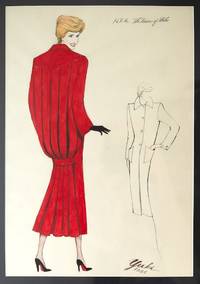
52679London: n.p. 1990. Generally fine. Series of four concept drawings and studies for dresses and other outfits designed for H.R.H. The Princess of Wales including two for Diana's 1986 state visit to Japan. Throughout her public life when visiting foreign countries Diana would commission native designers to create custom dresses and other fashions for her to wear. Gnyuki Torimaru Yuki had been on the London fashion scene since the 1970s having previously worked for the London fashion house Rembrandt as well as designers Norman Hartnell Michael of Carlos Place and Pierre Cardin before striking out on his own. His work was noted for its simplicity; known as a "master of drapery" Watson according to the V&A: "his designs have always been body-conscious and he is admired both for his craftsmanship and for the fact that his designs suit larger as well as smaller women." His clothes appeared on the covers of VOGUE and his clients already included Jerry Hall Bianca Jagger Twiggy and Farrah Fawcett when Diana approached the Japanese-born designer on the recommendation of Lady Drogheda to design a dress for the princess's upcoming 1986 state visit to Japan. <br /> <br /> Diana's arrival in Japan was widely anticipated with the United Press describing the country's "'Countdown to Camelot' . with publishers rushing into print a flood of books and magazines featuring page after page on Diana's progress from plump teenager to fashion leader." The arrival of the prince and princess was a seismic event: "Nearly 100000 people cheered Britain's Prince and Princess of Wales as they drove in an open-air limousine through the streets of Tokyo this afternoon a spectacle rare indeed for a nation accustomed to a more cloistered and reticent imperial family" NEW YORK TIMES. <br /> <br /> The culmination of the visit would be a banquet Diana and Charles attended with Emperor Hirohito. For this dinner Yuki presented Diana with several eveningwear options. She eventually chose a sweeping blue gown that exhibited Yuki's trademark pleats and drape. The dress led to a "renaissance" Watson for the designer and a variation on this gown is present in these sketches as is a color study for an overcoat for the same trip. Also present are two later dress designs dated 1987 and 1990 testifying to the ongoing relationship between this innovative designer and Diana. <br /> <br /> A rare collection of concept drawings for couture designed for one of the great fashion icons of the 20th century. 16'' x 11'' image area; 21.25'' x 16'' framed all. Four original pencil drawings one hand-colored on lightweight paper. Each titled signed and dated by Yuki. All on acid-neutral card in elegant contrasting mount professionally glazed and archivally framed. Tiny chip to edge of one frame. n.p. unknown
1852WRCAM16070Nashville 1852. Two volumes. viii374 i.e. 376; vii376pp. plus thirty-one plates. Later three-quarter black morocco and cloth spines gilt. Corners lightly worn. Ownership inscription on verso of each frontispiece bookplate on rear pastedowns. First volume with ink stamp on pastedown and titlepage. Lightly foxed. Some light wear and soiling. Very good. A very rare complete set of this interesting and important Tennessee periodical containing all twelve articles entitled "Early History of the Southwest" which constitute the main interest of the magazine for modern readers. After the magazine ceased publication with the December 1852 issue the editors followed their intention stated in their last editorial and gathered all of the narratives into a book issued in January 1853 entitled INDIAN BATTLES MURDERS SEIGES sic AND FORAYS IN THE SOUTH- WEST. ".This was a collection of narratives by various authors. These had appeared separately as articles in the SOUTH WESTERN MONTHLY MAGAZINE printed in Nashville during the years 1851-52. The magazines are considered frontier periodicals of extreme rarity - the 1853 book.is all but unobtainable. Apparently few copies of the book were printed judging from the very few times one finds records of its sale." - Allen. The actual first appearances in print of all of the items in the book are the periodical versions. <br> <br> Articles include "Sketch of the Captivity of Col. Joseph Brown" "The Indian Massacres in the Vicinity of Bosley's Spring." "Indian Murders around Nashville - Narrative of John Davis Esq." "Scalping of Thomas Everett and his two sisters near Buchanan's Fort." "Indian Battles and Murders - Narrative of General Hall" "Perils attending emigration from Virginia to the West.burning of Sigler's Fort. Narrative of John Carr" "The levy of men sent out from North Carolina.narrative of Mr. Samuel Blair" "Narrative of John Rains" "Massacre at Cavet's Station." Virtually all of the narratives describe Indian fights in Tennessee between the 1780s and the War of 1812. <br> <br> An important rarity of Indian warfare on the Old Southwest frontier. This set has a remarkably large number of plates; other sets we know of have far fewer. All seem to be remainders from New York publications used as illustrations without regard to text. HOWES W30 ref. ALLEN RARITIES 47. ALLEN IMPRINTS 3160. hardcover books
H137Sydney C. Potter Government Printer 1893-1901. 7 Textb‰nde in 8 gebunden wie erschienen und 1 Kartenband der zu Band 1 gehˆrt welcher ausschliefllich James Cook und seinen Reisen gewidmet ist. Inhalt der gesamten Reihe: Vol. I Part 1. Cook 1762-1780 Vol. I Part 2 Phillip1783-1792. Vol. 2. Grose and Paterson1793-1795. Vol. 3. Hunter 1796-1799 Vol.4. Hunter and King 1800 1801 1802. Vol.5 : King 1803 1804 1805. Vol.6. King and Bligh 1806 1807 1808. Vol.7. Bligh and Macquarie 1809 1810 1811. Pro Band zw. 500 und 700 Seiten. Mit zahlreichen Faksimiles von Originaldokumenten und- briefen. Einheitlich gebundene dekorative Ganzlederb‰nde der Zeit mit jeweils 2 goldgepr‰gten R¸ckenschildern und R¸ckenvergoldung. Dazu goldgepr‰gte doppelte Deckelfileten dazwischen kleine goldgepr‰gte Vignetten. Steh- und Auflenkantenvergoldung. Kl. 4∞. Eine schˆne sehr gut erhaltene Reihe mit ausgezeichneter Provenienz: Das Set wurde f¸r die Bibliothek von Sir John See der von 1901-1904 Premierminister von New South Wales war gebunden. Die B‰nde tragen am unteren R¸ckenende dezent in Gold aufgedruckt seinen Namen mit Rang: "The Honourable Sir John See K.C.M.G." Der zum Cook-Band gehˆrige Atlasband im Quart-Format und im Original-Leinen mit goldgepr‰gtem Deckeltitel. Der gesamte erste Band der Reihe und dazu der Kartenband sind James Cook gewidmet. Eine immense Quelle ersten Ranges die Dokumente und Briefe von Cook und den engsten Personen aus seinem Umfeld sowie Ausz¸ge aus Logb¸chern und Tageb¸chern Cooks und seiner Mitreisenden Hicks Forwood Pickersgill Clerke Wilkinson Bootie und Samwell enth‰lt. Unersetzlich als Erg‰nzung zu den "Historical Records of New Zealand". Details zu Volume 1 Part 1 Cook 1762-1780: Sydney C. Potter Government Printer 1893. XLII einschl. Vortitel und Titel 526 Seiten. Mit 1 Frontispiz einigen Tafeln und zahlreichen teils gefalteten Faksimiles. Der dazugehˆrige Atlasband tr‰gt den Titel: Historical Records of New South Wales. Cook. 1762-1780. Facsimile of Charts To accompany Vol. 1 Part 1. Mit 9 gefalteten Karten Z‰hlung reicht bis 10 da das Titelblatt des Originalbandes im British Museum das als Faksimile hier zus‰tzlich mit eingebunden ist als Nr. I gez‰hlt wird. Zus‰tzlich eine in der Numerierung nicht mitgez‰hlte 3-teilige Faltkarte der Ostk¸ste Australiens. unknown
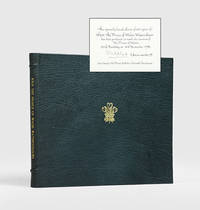
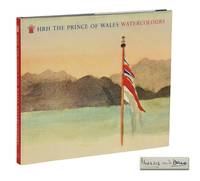
189458Boston: Little Brown and Company 1991. Signed by the king Signed limited edition number 77 of 100 copies signed by Charles III and specially bound to mark the occasion of his 50th birthday with sales benefiting the Prince of Wales's Charitable Foundation. King Charles III is a keen amateur artist and writes in his introduction to this collection of his watercolours that "I have tried in these pages to convey something of the part that painting plays in my life. In many ways it helps to keep me reasonably sane and if it doesn't appeal to the critics then it's just too bad! I only hope that those who are rash enough to thumb through this book may be helped to discover what infinite beauty and delight there is in the details of God's creation". Queen Elizabeth The Queen Mother contributed the preface. Oblong quarto. Colour illustrations throughout. Original green morocco by Sangorski & Sutcliffe-Zaehnsdorf gilt stamp to rear pastedown spine lettered in gilt between two raised bands gilt Prince of Wales insignia to front cover gilt ruled turn-ins marbled endpapers gilt edges. Without the slipcase. A fine copy. hardcover
140946434London: Little Brown and Company 1991. First Edition. Near Fine/Near Fine. First edition first printing. Signed by the then Prince Charles now King and Diana Princess of Whales on the half title page. Bound in publisher's dark gray cloth stamped in silver with royal emblem to upper board. Near Fine with bumped corners in a Near Fine unclipped dust jacket with light wear at extremities. A rare monograph of Prince Charles' art work that includes 70 color reproductions of his watercolor paintings from a five year period. Royal family signatures are quite scarce. Little, Brown and Company unknown
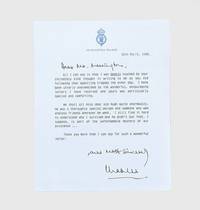
198816340928 March 1988. I still find it hard to understand why I survived and he didn't The future King Charles III writes with grief and shock after his close friend Major Hugh Lindsay was killed in an avalanche at Klosters in 1988 where Charles narrowly escaped with his own life. "Dear Mr. Marrington All I can say is that I was deeply touched by your incredibly kind thought in writing to me as you did following that appalling tragedy the other day. I have been utterly overwhelmed by the wonderful encouraging letters I have received and yours was particularly special and comforting. We shall all miss dear old Hugh quite enormously. He was a thoroughly special person and someone who won endless friends wherever he went. I still find it hard to understand why I survived and he didn't but that I suppose is part of the unfathomable mystery of our existence. Thank you more than I can say for such a wonderful letter. Yours most sincerely Charles". Hugh Lindsay was Equerry to Elizabeth II and a close friend of Charles. Charles and Diana regularly vacationed at the Klosters ski resort in Switzerland and in March 1988 were joined by Lindsay and others. An avalanche on the 14 March swept Lindsay off a precipice. Charles was on the same slope but avoided the avalanche. He afterwards was part of the group which dug out Lindsay who was pronounced dead on arrival after being airlifted to a Davos hospital. The event received worldwide media attention with Charles widely reported as being in shock. Much popular writing has placed the event as deepening the divide between Charles and Diana claiming that Diana blamed Charles for the event as he led the group down a challenging slope despite an avalanche warning earlier that day. Diana formed a close friendship with Lindsay's widow Sarah Horsley in the weeks following the disaster. The episode "Avalanche" in the Netflix series The Crown focuses on the disaster. The letter dated two weeks following the event and one week following Lindsay's funeral was written in response to the condolences of Robert Morrington 1900-1992 a long-serving member of the royal staff. Marrington served the Royal Family throughout his long life joining their staff in October 1925 and retiring in 1973 having served four monarchs. From 1939 he was tapissier in charge at Sandringham a position also held by his father. He remained in contact with the Royal Family after his retirement and the Queen sent a wreath to his funeral see notice in Lynn Advertiser 11 December 1992. Marrington collected various mementoes of the Royal Family including letters from Charles relating to the birth of Prince William and his marriage to Diana. These were sold by his family after his death with this letter appearing at auction in 2005 and gathering some press attention including coverage by the Daily Mail "Heartfelt letter from Prince Charles goes under the hammer" 9 June 2005. Typed letter signed 253 x 207 mm on the Prince of Wales's Kensington Palace letterhead. Light creasing from handling almost imperceptible adhesion on verso where formally mounted. A very good example. unknown
1915237831Windsor 1915. 24 gelatin silver prints many being enlarged duplicates some later; captioned in type some captioned on rear in Edward's hand. Folio. In close slipcase. 24 gelatin silver prints many being enlarged duplicates some later; captioned in type some captioned on rear in Edward's hand. Folio. Includes: Princess Mary 4; the Hon. Sybil "Portia" Cadogan 2; Prince Henry with the same; Princess Mary with the Hon. Sybil Cadogan and others 2; George V with the Hon. Harry Stonor and Lord Milner Frogmore Gardens; Princess Mary with Mrs. Sneyd and the Hon. Harry Stoner; George V Queen Mary and Princess Mary inscribed by the Prince of Wales "Mama Papa Mary"; Princess Mary and Queen Mary inscribed by the Prince of Wales "Mary Mama" and on the reverse "Windsor Aug 1915 on the castle terrace unknown books
1915237831Windsor 1915. 24 gelatin silver prints many being enlarged duplicates some later; captioned in type some captioned on rear in Edward's hand. Folio. In close slipcase. 24 gelatin silver prints many being enlarged duplicates some later; captioned in type some captioned on rear in Edward's hand. Folio. Includes: Princess Mary 4; the Hon. Sybil "Portia" Cadogan 2; Prince Henry with the same; Princess Mary with the Hon. Sybil Cadogan and others 2; George V with the Hon. Harry Stonor and Lord Milner Frogmore Gardens; Princess Mary with Mrs. Sneyd and the Hon. Harry Stoner; George V Queen Mary and Princess Mary inscribed by the Prince of Wales "Mama Papa Mary"; Princess Mary and Queen Mary inscribed by the Prince of Wales "Mary Mama" and on the reverse "Windsor Aug 1915 on the castle terrace unknown
1957mon0000156037Quaritch 1957-01-01. Hardcover. Acceptable. in x in x in. Quaritch hardcover
180925207London: Published as the Act directs by Thos. Daniell Howland Street Fitzroy Square 1809. Aquatint by Thomas Daniell after James Wales coloured by hand on 'Whatman' wove paper. Do Tali' the remarkable two storied cave complex from Plans of Hindoo Excavations in the Mountain of Ellora.<br/> <br/>This plate was engraved by Thomas Daniell after a drawing by James Wales in 1803 and is from the part of Oriental Scenery known as "Hindoo Excavations in the Mountain of Ellora near Aurangabad". The huge complex of cave temples was actually begun by Buddhists in the 6th century eventually including Hindo and Jain temples as well. The Daniells' Oriental Scenery is considered one of the finest illustrated works on India. Thomas Daniell and his nephew William spent nine years in India making studies sketches and drawings of the scenery architecture and antiquities that graced the countryside. They then devoted a further thirteen years to publishing their remarkably accurate aquatints. In Britain the impact was explosive. A cult of Indian architecture landscaping and interior decoration arose with the Royal Pavilion at Brighton as its centerpiece. The Daniells gave the English public their first accurate look at the exotic sub-continent. Their great achievement still lies in their ability to blend the picturesque with the real resulting in images that capture the European taste for the sublime landscape while still remaining faithful to their subjects. The Daniells brought the romance of the English landscape to the antiquities of India and provided England with an accurate vision of this wondrous country. The sixth part of Oriental Scenery is twenty-four plates based on drawings by James Wales primarily of the excavations at Ellora. The title of this section was Hindoo Excavations in the Mountain of Ellora near Aurungabad in Decan. The mountain contains 34 "caves" that were created to serve as monasteries and temples for Buddhists Hindus and Jains each religion having several spaces. Do Tal here called Dotali was one of the Buddhist "caves". It is three stories high and was built in the 8th century.<br/> <br/>Abbey Travel II.420 no. 122; Martinelli and Michell India: Yesterday and Today p. 210 no. 143; cf. Lowndes I p.588; cf. RIBA 799-804; cf. Sutton The Daniells 1954 p.156; cf. Tooley 172. Published as the Act directs by Thos. Daniell, Howland Street, Fitzroy Square unknown books
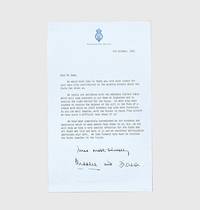
19811646017 October 1981. We have quite a difficult task ahead of us In the months following their wedding Charles and Diana write to thank a contributor for his donation to the Duchy of Cornwall's official wedding gift of a mahogany library table. "Dear Mr Skam We would both like to thank you very much indeed for your most kind contribution to the wedding present which the Duchy has given us. We really are delighted with the mahogany library table which will look splendid in our home at Highgrove and is exactly the right period for the house. We were also most touched to receive the balance of the gift in the form of a cheque with which we shall probably buy some more furniture. As you can well imagine with two houses to equip from scratch we have quite a difficult task ahead of us! We have been completely overwhelmed by the kindness and generosity which so many people have shown to us but as you will know we have a very special affection for the Duchy and all those who live and work in it and we therefore particularly appreciate your gift. We look forward very much to visiting the Duchy together in the future. In Charles' hand: Yours most sincerely Charles and Diana's hand: Diana". Typed letter 329 x 201 mm Buckingham Palace embossed stationary at head. Slight handling creasing very good. unknown
1891ABE-EBAY-205728107206Paris: Charpentier 1891. Hardcover. Good. Lettres de Mon Moulin par Alphonse Daudet. Édition Définitive. Paris: Charpentier 1891. Half-leather. This book has been meticulously hand-illustrated in watercolor by George Canning Wales the marine artist and architect as a gift to his sister Alice Stratton Wales. There are a total of 27 paintings on the pages. After graduating from MIT and working for a time for Peabody and Stearns George C. Wales traveled to Europe in the summer of 1891 in the company of Dwight Blaney and spent a year traveling and painting. The creation of this volume most likely dates to that period. He eventually returned to Boston in autumn 1893 after a spell in Kansas. The date on the ownership/presentation illustration on the second front endpaper is 1894. The paintings range from small vignettes to full-page; most are somewhere in the middle. The majority are black and white several are in color. The spine tips and particularly hinges show some wear scuffs and slight chips. The pages are very yellowed; there are scattered small closed edge-tears one notable open margin tear a small corner hanging by a thread; occasional minor blemishes. Charpentier hardcover
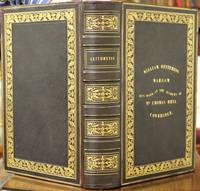
1824B4408c. 1824. Very good condition. Binding: elaborately bound in contemporary full morocco with broad floral borders in gilt ruling gilt lettering to central panel of upper board. Gilt paneled spine in 5 compartments of raised bands with intricate gilt devices and gilt lettering. Inner gilt dentelles and marbled pasted and free endpapers. All edges gilt. Notes: An unusually large and very finely bound record of Betterton's instructions in Arithmetic and a Course of Book-keeping. The work includes geometry and geometrical proofs with the practical applications to carpenters joiners plasterers glaziers masons and plumbers. Also the measuring of land and mapping including ‘Dimensions of Certain enclosures in the County of Chester.’ Thomas Rhys is recorded as running his academy from 1816-1824<br><br>A Divisional leaf is dated in Manuscript 1829 and was probably inserted when the book was bound as the two sections are written on slightly different sizes of paper. Paper watermarked first section 1822 second section 1818. Size: Thick Small Folio 205mmx Illustration: 560 pages and 232 pages with calligraphic headings numerous text diagrams and several hand colored charts.<br> Category: Book Manuscript; Book Science & Technology; hardcover
190898743Sydney: W.A. Gullick Government Printer 1908. First Edition. Hardcover. Very Good. Sydney W.A. Gullick Government Printer 1908. Large oblong quarto colour-pictorial title leaf verso blank plus 72 flush-cut full-page gelatin silver photographs each 350 × 275 mm mounted back-to back to form 36 gilt-edged leaves with the images bleeding off all edges. Original full calf gilt later rebacked and recornered in calf a little worn; in very good condition the contents are in excellent order. The broad coverage of the State comprises captioned images of public buildings 12 and street scenes 8 of Sydney; ports and harbours 6 including 3 of Newcastle; north coast farms 8; mines and other industries 10; timber 7; livestock 8; agriculture 6; and leisure 7. Although the album was issued in 1908 it contains a number of images from much earlier negatives. W.A. Gullick, Government Printer hardcover
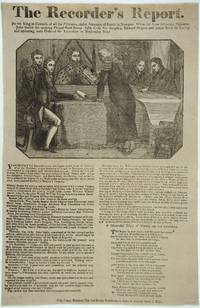
182327894London: Pitt Printer Wholesale Toy and Marble Warehouse 1823. First printing. Ephemera. Very good overall. A broadside that reviews the sentences of several prisoners in September and October of 1823. The fate of the four men in the headline was death. In a similar style to a court calendar the broadside reviews the sentences of several prisoners some of them not guilty. <br /> Another prisoner Susan Courtney alias Elizabeth Jones born 1 January 1796 originally transported June 1817 on the "Friendship" for 14 years for the crime of "coining". She was again transported Sep. 1824 on the "Grenada" to serve a life sentence for "returning from transportation." convictrecords dot com au see the 4th paragraph. <br /> Broadside 13-1/2†x 8-3/4†text in two columns below headline and large woodcut vignette. Main text followed by six stanzas of verse titled “A Mournful Copy of Verses On the Occasion.†Slt. toned faint horizontal fold line otherwise vgc. No copies located on OCLC Library Hub or Trove. Pitt, Printer, Wholesale Toy and Marble Warehouse, unknown
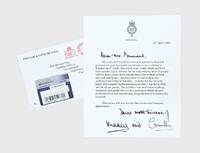
200516460021 April 2005. The marriage of Charles and Camilla The future King and Queen write to Tom Burnard Facilities Officer at the Guildhall in Windsor thanking him for his work on their wedding which he helped host 12 days earlier. Charles writes "Dear Mr. Bernard My wife and I wanted to write and express our heartfelt gratitude for your invaluable contribution to our wedding in Windsor on 9th April. The whole event would simply not have been possible had it not been for the extraordinary team of people with all their various skills and attributes who worked so hard and such long hours - not least when we had to defer the wedding from Friday to Saturday - to make the day the truly happy and uniquely memorable occasion that it was for us both and for all our guests. The seamless way in which everything worked to such perfection will be a permanent tribute to your professionalism and commitment alongside that of everyone else involved. This comes with our warmest best wishes and immense appreciation. Yours most sincerely Charles and Camilla". The wedding of Charles and Camilla was a deliberately low-key affair in the comparatively modest setting of Windsor Guildhall. It was the first time a member of the royal family married in a civil ceremony to avoid controversy over Camilla's previous divorce if a Church of England wedding was held and also likely reflecting concern over public hostility to Camilla in the aftermath of the breakdown of Charles and Diana's marriage. The wedding was delayed 24 hours - as the letter mentions - due to the funeral of Pope John Paul II. Typed letter 234 x 186 mm on stationery of the couple's Birkhall estate. With original envelope. Original folding creases from insertion into envelope and light handling creasing envelope roughly opened; in very good condition. unknown
192784573Goodspeed. As New. 1927. Hardcover. FREE UPGRADE to Courier/Priority Shipping Upon Request - IN STOCK AND IMMEDIATELY AVAILABLE FOR SHIPMENT - AS NEW THE TEXT BLOCK IS PRISTINE CLEAN UNMARKED AND IN EXCELLENT CONDITION - - - Corresponds to ASIN: B000KF3YLM. LIMITED EDITION. 129 pages 75 illustrations; 4to. -- with a bonus offer-- . Goodspeed hardcover
192784572Goodspeed. As New. 1927. Hardcover. FREE UPGRADE to Courier/Priority Shipping Upon Request - IN STOCK AND IMMEDIATELY AVAILABLE FOR SHIPMENT - AS NEW THE TEXT BLOCK IS PRISTINE CLEAN UNMARKED AND IN EXCELLENT CONDITION - - - Corresponds to ASIN: B003TKGJTY. LIMITED EDITION. 129 pages 75 illustrations; 4to. -- with a bonus offer-- . Goodspeed hardcover
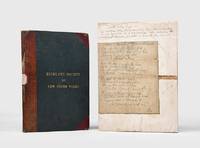
1880167580Sydney: 1880-85. Rabbie Burns in Australia A unique manuscript book recording the meetings of the first six years of the Sydney Burns Club together with a scarce facsimile printing of Burns's original manuscript for the poem "Scots Wha' Hae" presented to the Highland Society of New South Wales in the 1890s. Together these items offer a fascinating insight into the preservation and promotion of Scottish culture in late 19th-century Australia. The minute book is written across 50 pages with several additional manuscript pages loosely inserted. Following the club's foundation in 1880 the club hosted Burns Night celebrations arranged concerts of Scottish songs and campaigned for a memorial statue to the poet in Sydney which was unveiled in 1905. The first entry records the club's inaugural meeting on 10 September 1880: "This evening a number of gentlemen. members of the Highland Society of N.S.W. met at the Rooms Waterloo Chambers to take into consideration the desirability of forming a Burns Club. Mr A. Kethel was voted to the Chair and explained fully the good to be derived from the study of the works of Burns and other Scottish authors". The facsimile of "Scots Wha' Hae" is inscribed at the head of the first page "A replica of the Original Copy - printed privately for the Town Council of Edinburgh - Copy belonging to Baillie J. Murray presented by him to this Society" with the society's ink stamp on the final page. We can trace only one other copy of the facsimile held by the State Library of Victoria. Burns wrote the lyric poem in 1793 in response to the trial of Glasgow lawyer Thomas Muir of Huntershill who was convicted of sedition and deported to Botany Bay Sydney. It takes the form of a speech by Robert the Bruce and in the manuscript is titled "Bruce's address to his troops at Bannockburn". The poem has long served as the unofficial national anthem of Scotland. Folio 314 x 212 mm. Contemporary red half calf black pebble-grain cloth sides spine and front cover lettered in gilt paper label to spine lettered "Sept. 1880/85" in manuscript marbled endpapers and edges. Together with a single bifolium facsimile folded to 352 x 257 mm. Book rubbed and lightly worn at extremities one page torn with some loss; facsimile slightly soiled with a few short closed tears and traces of old tape removal; very good condition. hardcover
Abundant black and white illustrations and reproductions of photos. Features: Two Men's Madness - six lives and a fine ship, the Frank N. Thayer, are lost through the unaccountable frenzy of two Indians; In Wildest Ireland - A.W. Cutler describes and photographs "unspoilt" regions of the Emerald Isle - with many fascinating photos; The Guardian of the Line - the ordeal undergone by a humble railway-crossing keeper's wife in Lithuania on the Russian Front; In Search of the Unknown Land - The tragic story of the Stefansson Arctic Exploration Expedition, twelve-page article including many photos; The Tales of Golab Khan - some amusing stories of Indian life; The Airman's Escape - two British aviators raid a Bulgarian town, then one is shot down and must be rescued by his companion; From Job To Job Around the World - part VI - Two American wanderers make there way through the Holy Land to Constantinople - with photos; The Trouble at Crib No. 2 - a tug-boat fireman recounts an exciting story of a winter rescue on the Great Lakes; Australia's Water Miracle - article and photos describe how the Government of New South Wales has created a miracle of irrigation; The Story of Count Seilern - A Tragedy of the Hapsburgs; Alpine Acrobats - A vivid account, illustrated by some very remarkable photographs, of the first ascent of the needle-like "Cigar Rock" in the Italian Alps; Lovely one-page illustrated ad by Canada Steamship Lines promotes their Niagara to the Sea all-water route; and more. pp. 4 [ads], [3], 290-385, 7-32 [ads]. Unmarked with moderate wear. Soiling to back cover. Covers beginning to loosen, otherwise a sound vintage copy of this exceptional issue.. Book
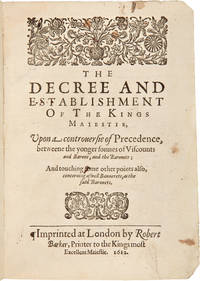
1612WRCAM38441London: Robert Barker 1612. 114pp. with woodcut vignettes above and below title and at end of text woodcut royal arms above beginning of text on p.1. Small quarto. 20th-century boards gilt leather label. Large illustrated bookplate of legendary bookseller John Howell on front pastedown. Titlepage slightly soiled with a few ink spots. Outer corners of text block trimmed diagonally. Light dampstaining and soiling. Contemporary ink inscriptions including proper names in margins of pp.6 7 14 some smeared at an early date. Additional contemporary inscriptions on p.14 in blank spaces between printed text. Lacking leaf A1 recto blank except for signature mark within vignette verso blank and leaf C2 recto and verso blank. A good copy housed in a half-morocco slipcase spine gilt erroneously noting "inscription by Francis Bacon". A royal decree issued by King James I confirming that baronets holders of hereditary titles awarded by the crown were to be ranked below the younger sons of Viscounts and Barons. The practice of awarding baronetcies was introduced by James I in 1611 and this decree was issued in response to a "controversie which did arise upon an inference only out of some dark words contained in the Letters Patents of the said Baronets." This copy has numerous contemporary ink inscriptions in English on three pages some of which were smeared and are now mostly illegible at an early date. The remainder of the inscriptions include proper names single words and partial sentences. STC 9234. ESTC S105542. Robert Barker hardcover books