182 résultats
1890c2311100201xbvkParis, imprimé par autorisation de M. le Garde de Sceaux, à L'Imprimérie National, M DCCC XC.(1890); Lithograph printed by L. Léchaudel. 26 singleside printed large-paper cardboard-sheets, incl. 1 coloured plate; large-4to.(ca. 32 x 25 cm, few plates slightly smaller ca. 31 x 24 cm).
186276434Lima: N.p. 1862. Original manuscript title or deed to the Hacienda San Jacinto in the Nerena Valley of Coastal Peru. While the estate is named after a Hispanic saint San Jacinto its origin dates back to pre-Inca times. Evidence of this is the remains of cultural settlements in Punkuri Kiske and Cerro Blanco. The Spanish Crown gave this land to the Jesuits in 1720 who introduced sugarcane as part of the agricultural production in this part of Peru. They also took it away from the Jesuits in 1767.Folio. 151 leaves with manuscript on both sides of each leaf i.e. 352 pp. Each leaf bears the required tax stamp the equivalent of a notary stamp at that time and each leaf is written on paper bearing the same watermark. Each leaf also bears a blind-stamp of a seal in the inner margin of each recto. Written in a numerous hands but all quite legible. Original full brown sheepskin with gilt spine lettering and devices pattern endpapers. Like a ready made binding used for legal purposes as the text block in considerably smaller than the binding. Altogether in very nice condition.This is the original transfer title for an estate of great importance and size in one of the most fertile parts of coastal Peru the Narena Valley. It consisted of 700 fanejadas of land about 1200 acres and all that stood upon it; primarily the sugarcane and alfalfa fields but houses tools farm animals furniture etc. In fact it seems that the original name for the property still bore and can be seen on the first page of this manuscript the word "Canaverales" which is a euphemism for sugarcane. This mammoth 302-page manuscript is basically an inventory of literally everything on those 1200 acres. The detail on the inventory is incredibly extensive; every table horse cow frying pan etc is listed and priced. It was first laid out as a sugarcane plantation in 1720 by the Jesuits. The Jesuits were expelled from the New World lands and missions in 1767 by the Spanish crown with King Charles III ordering their removal from all Spanish territories including the Americas due to growing political pressure against the order; the Franciscans largely took over the operation of the missions after the expulsion. When all their lands were confiscated by the Spanish government as happened throughout Latin America the Hacienda likely went through a number of hands. It was well regarded as a solid and lucrative sugarcane plantation and would have been considered a prize acquisition. We can find no history of the buyer named on this deed Santiago Sanchez but that is likely due to the fact that Spanish people have last names that can be written in a variety of combinations. But we do know that he paid 8697 pesos for it and that was a very considerable sum for the time indeed enough to place someone in a wealthy or influential social position. The most curious thing in the inventory which is lengthy and detailed in the extreme is the list of slaves. Ostensibly President Ramon Castilla y Marquezado declared slavery abolished in 1854 yet here we have a document that clearly affixes values to each and every slave and the prices paid for each by Sanchez. Prices ranged from 0 to 500 pesos. And there were a large number of them. Staring on p. 68 of the inventory we find them all listed and they are broken down into a variety of categories. Indigenous people African people male female young old and & "Inservibles" translates as "useless people". All slaves were examined by Dr. Antonio Manriquez surgeon and the most common reasons for being deemed "inservible" included: old age hernias ulcers and missing limbs. Their value was deemed to be zero. After being examined by physician the value accorded to each was dependent on their ability to work the farm. Surprisingly African slaves were valued less than local peoples this may have been due to the language issue. It should be noted that the slaves constituted a large portion of the total price paid. So it seems that this document gives lie to the previously believed fact that slavery was abolished in Peru in 1854. But we do not find this surprising as the gulf between the monied class and the populace was great and with no ability to enforce decrees from the central government the aristocracy likely just did whatever they pleased. Apparently Santiago Sanchez was ill-equipped to manage so many people and such a large piece of land as we know that in 1868 a Scotsman by the name of Henry Swayne bought the Hacienda San Jacinto an turned it into a profitable enteerpise by his humane attitude towards the farmers. "The hacienda or estate of San Jacinto was anciently one of the largest and finest in the valley of Nepeña; but before its purchase by Mr. Swayne a few years before our visit it had very much run down. It was deserted by the negro slave soon after their emancipation; the dwellings had fallen out of repair" The Fife Post. It remains a very lucrative farming operation to this day.We conferred with a native Spanish speaker and an individual who is fluent in Spanish and this report is the result. We might be incorrect but it is doubtful and in any case it is a fine 19th century manuscript deed to a large and valuable parcel of land in 19th century Peru. N.p. unknown
1820WRCAM41113Lima: Casa de Ninos Expositos 1820. 825pp. Folio. Modern three-quarter calf and marbled boards. Some minor scattered foxing. Very good. Manifesto published on the eve of Peruvian independence. San Martin invaded Peru in September of 1820; negotiations between San Martin and Viceroy Pezuela took place shortly thereafter at Miraflores. These proved fruitless however since San Martin would only cooperate if Peru was declared an independent state which the Viceroy refused to do. Pezuela was deposed in January of 1821 and San Martin officially declared Peruvian independence on July 28 1821. Two copies in OCLC at the National Library of Chile and at Duke University. MEDINA LIMA 3436. PALAU 148928. OCLC 55280051 55974863. Casa de Ninos Expositos hardcover books
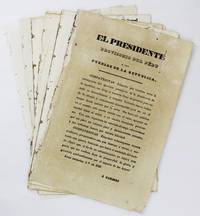
18305862Various places in Peru 1830. Good. Seven broadsides and bifolia totaling 14pp. with each sheet measuring approximately 11.5 x 7.5 inches. Previously bound with stabholes and residue at left margin. Moderate worming affecting some text but not sense. Minor tanning and soiling. A group of seven highly ephemeral and seemingly unrecorded military broadsides and bifolia reports from Peru dating to the country's war with Gran Colombia from 1828 to 1829 and just after. The conflict stemmed from a border dispute after independence was gained in 1820 and 1821 with the boundary left relatively undefined. The Armistice of Piura formally agreed in September 1829 recognized Guayaquil and its surrounding area as a part of Gran Colombia and accorded Peru recognition of its modern-day northern provinces. The documents present here include an exhortation by Peruvian President Agustin Gamarra to support the prospective peace a report on the state of the Peruvian treasury in Trujillo during the midst of the conflict a bulletin concerning military developments in April 1829 addressed to the armed forces a patriotic broadside printed in Arequipa and a congratulatory address to the army printed on the day of armistice. The titles of these works none of which are individually recorded in OCLC are as follows:<br /> <br /> 1 Gamarra Agustin. El Presidente Provisoria del Peru a los Pueblos de la Republica. Lima: September 1 1829.<br /> 2 Peru. Estado Que Manifiesta las Cantidades Acopiadas por Esta Administracion Pral. del Tesoro Público del Departamento de la Libertad en el Presente Mes de Junio. Trujillo: June 20 1829.<br /> 3 Bermudez Pedro. Ejercito Peruano. Boletin No. IV. Piura: April 1 1829.<br /> 4 Gamarra Agustin. El Presidente de la Republica a los Pueblos. Lima: September 5 1830.<br /> 5 Peru. Queja Que Interpone ante el Respetable Tribunal de la Opinion Pública el Ciudadano Evaristo Encina Capitan Graduado de Ejercito Cóntra José Policarpos Hernandes. Trujillo: Imprenta de la Municipalidad 1829.<br /> 6 Peru. Gratis. Desahogo Patriotico. Arequipa: Imprenta Libre 1829.<br /> 7 Cerdeña Blas. El Comandante en Jefe al Ejercito. Piura: September 9 1829. unknown
18680012009Macao Macau China Havana Cuba: Chinese Coolie Ship Manifest. Fair with no dust jacket. 1868. Non-Book. On offer is a tremendous San Salvadorian ship manifest recording the names and information of 622 Chinese men who were transported from the port of Macau to Havana Cuba to complete their indentured servitude as coolies working for Cuban sugar plantation owners. This manifest is for the January 25 1868 sailing of the Peruvian Galley the America. This sailing was captained by Cpt Ferreiro for the Compania Maritima del Peru. This sailing was under the San Salvadorian flag. The ship arrived in Macau on May 20 1868. 610 coolies departed Macau and 607 arrived in Cuba. This manifest was signed on January 241868 by Henrique W. Pearce a Macao-based emigration agent. It was also signed the day before departure on January 241868 by The Consul General of His Majesty José de Alguilar. The America had previously been used as a coolie ship called Red Rose under the British flag and under the Italian flag as the America. The America completed a total of seven coolie voyages transporting a total of 4703 Chinese passengers. The Chinese coolie trade a system of indentured labor that targeted young poor Chinese men operated from 1847-1874. Throughout this period African slavery was slowly being abolished around the world. The coolie trade was initiated by Britain and was eventually dominated by both Britain and the United States of America. Chinese coolie laborers were sent to work in British American and Spanish colonies and the nature of the trade changed throughout its 27-year operation due to social and political pressures. The coolie trade took place in large part between the shipping port in Macao now a part of China then under Portuguese rule and Havana Cuba then under Spanish control. As Macau was under Portugese rule at the time of the coolie trade they transported coolies on their vessels frequently and many of the manifests were written in Portuguese and/or Spanish. To learn more about the Chinese coolie trade and its importance in world history click here to read our in-depth research blog on the topic. This departure manifest measures 8.5x13.5 inches. It contains 18 pages of writing 9 front and back over 10 physical pages. Folded together. Significant bending with some tears at the crease lines. Some pages are fragile with some pages becoming detached from the total document however the document does remain in tact. Legible. Overall Fair. Citation: Asome J. 2020. Coolie ships of the Chinese diaspora 1846-1874. Proverse Hong Kong. ; Manuscripts; 8vo 8" - 9" tall; Signed by Author . Chinese Coolie Ship Manifest unknown
1831PHO-2405Paris, Arthus Bertrand, 1831-1840, 20 tomes reliés en 10 vol. in-8 (21 × 12,5 cm), demi-veau fauve marbré à coins, super-libris doré, dos à nerfs ornés, pièces de titre rouges et de tomaison vertes, tranches mouchetées rouge (reliure anglaise du XIXe s). Aux contres-plats, étiquette pour cote. Petites rousseurs. Légers frottements aux reliures. Provenance « Society of Writers to His Majesty’s Signet », célèbre association privée d’avocats écossais, fondée en 1594.
188046404219Berlin, Asher, 1880-87 ; 3 volumes in-folio, en feuilles sous portefeuilles toile verte d’éditeur. faux-titre, titre, 7 ff. (table des planches), 16 ff., 37 ff. en regard des planches - 2 ff., 13 ff., 59 ff. en regard des planches - 2 ff., 29 ff., 45 ff. - 141 planches lithographiées, la plupart en couleurs.ÉDITION ORIGINALE et PREMIER TIRAGE de cette publication rarissime, surtout complète des 141 planches comme c’est le cas ici.Sublimes lithographies montrant les momies, vêtements, bijoux, ustensiles, ossements découverts lors de ces fouilles.Portefeuilles abimés, quelques pâles rousseurs.