189 résultats
18971115205Washington, Government Printing Office, 1897. 4to. 120, 326 S. (durchgeh. pag.) m. 83 Textabb., 81 Taf. (16th Annual Report of the Bureau of American Ethnology to the Secretary of the Smithsonian Institution 1894 - '95). OLwd (bestoßen u. etwas fleckig, Gelenke gelockert, kl. St. verso Titel).
188771806Couverture souple. Broché. 16 pages. 23 x 31 cm. Couverture factice. Rousseurs.
1847WRCAM41208Lima 1847. 371pp. Removed from a bound volume. Last page is foxing lightly. Text is bright and clean. Signatures of the two authors on the second to last page. Very good. San Roman was the President of the Council of State from 1845 until 1849. This document is a list of acts and resolutions made by the council. San Roman went on to become the President of Peru in 1862. This copy is signed in ink by both San Roman and his Secretary Flores on the second to last page. unknown books
1851WRCAM41121Lima: Imprenta de J. M. Masias 1851. 21pp. Removed from a bound volume. Light foxing otherwise good. Detailed justification for the actions of the Legislature in the 1850-51 session. Imprenta de J. M. Masias unknown books
1845WRCAM41137Lima 1845. 18pp. Quarto. Dbd. Light foxing throughout text else very good. A refutation of charges brought against Manuel Menendez by Benito Laso. Menendez was the President of Peru several times between 1841 and 1845. Includes several letters in support of Menendez. unknown books
189618621Lima Imprenta de El País 1896. Paperback. Good. 92p. wrps. Includes reorganization of the Customs Service. Lima, Imprenta de El País paperback
185418641Lima Imprenta del Gobierno 1854. Hardcover. Good. 114; 26p. disbound but tight. Lima, Imprenta del Gobierno hardcover
183618639Arequipa Imprenta del Gobierno 1836. Hardcover. Good. 23p. disbound but clean and tight; small marginal burn marks to top edge from edge-branding to bound volume. Decree of Andrés Santa Cruz who numbered "Protector del Estado Sud-Peruano" among his many offices and distinctions. A previous contemporaneous owner has signed his name with rubrication three times on verso of title and once beneath the colophon. Arequipa, Imprenta del Gobierno hardcover
1839WRCAM46551Lima: Jose Masias 1839. 35iv pp. Dbd. Spine reinforced with tape. Underlining on titlepage some contemporary annotations to text. Moderate worming light soiling. About good. Funeral observances for Fray Jose Ramon Rojas de Jesus Maria a Franciscan priest known as "El Padre Guatemala." Fray Rojas served in the city of Ica Peru. This work contains several poems and a funeral oration. Only one copy in OCLC at Harvard. Jose Masias unknown books
188146401178Madrid, Hernandez, 1881-1897 ; 4 vol. In-4, Demi chagrin rouge, caissons dorés, chiffre doré sur les plats. Reliure de l'époque. - CLIV; 216; CLIX - XLIX; 242; CLVIII - XL;276; CLXXV - VII; 45.CCXLIII pp. - collection très précieuse de relations anciennes sur les Andes et le Pérou : 62 relations pour la plupart du XVI° et quelques unes du XVII° publiées avec un important appareil de notes, d'appendices, rapports officiels, lettres, etc… 1 Carte hors texte en couleurs sur double page. Bel exemplaire au chiffre de L.A Barbet. Petits manques de page en marge de 2 ff. sans atteinte au texte. Petites usures à la reliure.
186276434Lima: N.p. 1862. Original manuscript title or deed to the Hacienda San Jacinto in the Nerena Valley of Coastal Peru. While the estate is named after a Hispanic saint San Jacinto its origin dates back to pre-Inca times. Evidence of this is the remains of cultural settlements in Punkuri Kiske and Cerro Blanco. The Spanish Crown gave this land to the Jesuits in 1720 who introduced sugarcane as part of the agricultural production in this part of Peru. They also took it away from the Jesuits in 1767.Folio. 151 leaves with manuscript on both sides of each leaf i.e. 352 pp. Each leaf bears the required tax stamp the equivalent of a notary stamp at that time and each leaf is written on paper bearing the same watermark. Each leaf also bears a blind-stamp of a seal in the inner margin of each recto. Written in a numerous hands but all quite legible. Original full brown sheepskin with gilt spine lettering and devices pattern endpapers. Like a ready made binding used for legal purposes as the text block in considerably smaller than the binding. Altogether in very nice condition.This is the original transfer title for an estate of great importance and size in one of the most fertile parts of coastal Peru the Narena Valley. It consisted of 700 fanejadas of land about 1200 acres and all that stood upon it; primarily the sugarcane and alfalfa fields but houses tools farm animals furniture etc. In fact it seems that the original name for the property still bore and can be seen on the first page of this manuscript the word "Canaverales" which is a euphemism for sugarcane. This mammoth 302-page manuscript is basically an inventory of literally everything on those 1200 acres. The detail on the inventory is incredibly extensive; every table horse cow frying pan etc is listed and priced. It was first laid out as a sugarcane plantation in 1720 by the Jesuits. The Jesuits were expelled from the New World lands and missions in 1767 by the Spanish crown with King Charles III ordering their removal from all Spanish territories including the Americas due to growing political pressure against the order; the Franciscans largely took over the operation of the missions after the expulsion. When all their lands were confiscated by the Spanish government as happened throughout Latin America the Hacienda likely went through a number of hands. It was well regarded as a solid and lucrative sugarcane plantation and would have been considered a prize acquisition. We can find no history of the buyer named on this deed Santiago Sanchez but that is likely due to the fact that Spanish people have last names that can be written in a variety of combinations. But we do know that he paid 8697 pesos for it and that was a very considerable sum for the time indeed enough to place someone in a wealthy or influential social position. The most curious thing in the inventory which is lengthy and detailed in the extreme is the list of slaves. Ostensibly President Ramon Castilla y Marquezado declared slavery abolished in 1854 yet here we have a document that clearly affixes values to each and every slave and the prices paid for each by Sanchez. Prices ranged from 0 to 500 pesos. And there were a large number of them. Staring on p. 68 of the inventory we find them all listed and they are broken down into a variety of categories. Indigenous people African people male female young old and & "Inservibles" translates as "useless people". All slaves were examined by Dr. Antonio Manriquez surgeon and the most common reasons for being deemed "inservible" included: old age hernias ulcers and missing limbs. Their value was deemed to be zero. After being examined by physician the value accorded to each was dependent on their ability to work the farm. Surprisingly African slaves were valued less than local peoples this may have been due to the language issue. It should be noted that the slaves constituted a large portion of the total price paid. So it seems that this document gives lie to the previously believed fact that slavery was abolished in Peru in 1854. But we do not find this surprising as the gulf between the monied class and the populace was great and with no ability to enforce decrees from the central government the aristocracy likely just did whatever they pleased. Apparently Santiago Sanchez was ill-equipped to manage so many people and such a large piece of land as we know that in 1868 a Scotsman by the name of Henry Swayne bought the Hacienda San Jacinto an turned it into a profitable enteerpise by his humane attitude towards the farmers. "The hacienda or estate of San Jacinto was anciently one of the largest and finest in the valley of Nepeña; but before its purchase by Mr. Swayne a few years before our visit it had very much run down. It was deserted by the negro slave soon after their emancipation; the dwellings had fallen out of repair" The Fife Post. It remains a very lucrative farming operation to this day.We conferred with a native Spanish speaker and an individual who is fluent in Spanish and this report is the result. We might be incorrect but it is doubtful and in any case it is a fine 19th century manuscript deed to a large and valuable parcel of land in 19th century Peru. N.p. unknown
1845WRCAM45147N.p. but Lima 1845. Broadside 13 x 17 1/2 inches. Old folds. Significant wear at several folds repaired on verso. Minor loss. Some chipping and small tears at edges. Contemporary manuscript notations. About good. Broadside list of senators for the Peruvian Senate in 1845 delineated by district. Nineteen names are present with blanks left vacant for four more; three of the names present are completed in manuscript. Each man's profession is also listed. A bit worn but still interesting. unknown books
182520419- Une feuille 20 x26 cm. Légères rousseurs.
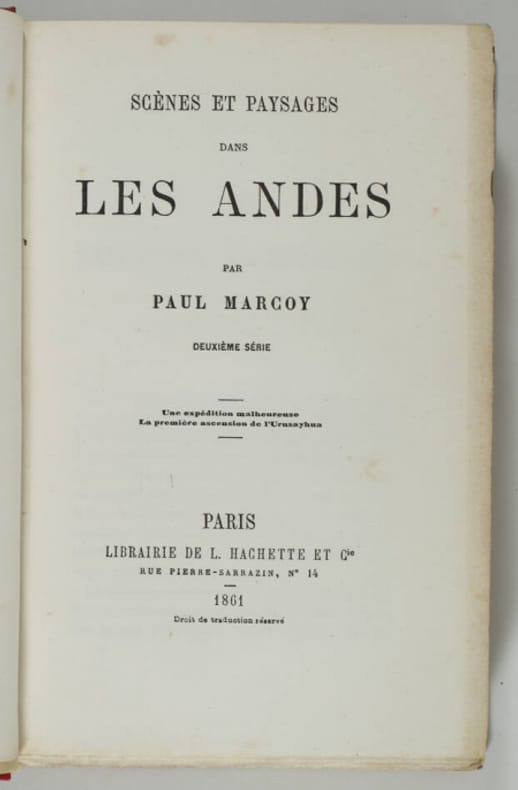
186110182Paris, Librairie de L. Hachette et Cie, 1861. 890 g 2 volumes in-12, demi percaline rouge, [2] ff., 423 pp., [2] ff.; [2] ff., 331 pp., [2] ff.. Tome I: Le dernier fils du Soleil; Une nuit de Noël à Tiabaya; Une cérémonie nautique au bord du lac de Titicaca; Les sources de l'Apurimac; Les ruines d'Ollantaytampu. Tome II :Une expédition malheureuse; La première ascension de l'Urusayhua. Paul Marcoy est le pseudonyme de Laurent Saint-Cricq (1815-1887) qui a fait plusieurs voyages en Amérique du Sud. Reliure signée de A. Poilleux. Quelques petits points de rousseurs. . (Catégories : Voyages, Amérique du Sud, Pérou, )
185346402356Paris, Michel Lévy, 1853 ; in-12, demi-chagrin rouge, filets et points dorés, tranches jaspées. (Reliure de l’époque) VIII pp., 472 pp.ÉDITION ORIGINALE. Ce sont 12 récits : Le premier - Ismael er-Raschydi - se déroule en Égypte, les autres en Patagonie, Inde, La Réunion : - Une chasse aux nègres marrons - texte d’abord publié en 1845 dans la Revue des deux Mondes, signalé par Ryckebusch 6365 ; au Chili, au Canada - La Peau d’Ours, Souvenirs des bords de la Sabine -, en Chine, au Pérou, Malabar, Coromandel...Théodore Pavie, né à Angers en 1811 est surtout connu comme orientaliste. Dans sa jeunesse il avait visité les deux Amériques, l’extrême Orient où il apprit le chinois, le sanscrit et d’autres langues asiatiques. Ces récits, pour la plupart publiés dans la Revue des deux Mondes, concernent ces voyages. Pavie a traduit divers textes chinois, des fragments du Mahabhârata, et de savants textes historiques orientaux. Au sujet de Th. Pavie en Asie, voyez l’intéressant article que Numa Broc consacre à ce grand voyageur dans Dict. des explorateurs II, Asie pp. 368-369. il cite ce livre.Exemplaire bien relié. Qq. rousseurs.
185346402440Paris, Michel Lévy, 1853 ; in-12, demi-chagrin noir, dos à nerfs, tranches jaspées. (Reliure de l’époque) VIII pp., 472 pp.ÉDITION ORIGINALE. Ce sont 12 récits : Le premier - Ismael er-Raschydi - se déroule en Égypte, les autres en Patagonie, Inde, La Réunion : - Une chasse aux nègres marrons - texte d’abord publié en 1845 dans la Revue des deux Mondes, signalé par Ryckebusch 6365 ; au Chili, au Canada - La Peau d’Ours, Souvenirs des bords de la Sabine -, en Chine, au Pérou, Malabar, Coromandel...Théodore Pavie, né à Angers en 1811 est surtout connu comme orientaliste. Dans sa jeunesse il avait visité les deux Amériques, l’extrême Orient où il apprit le chinois, le sanscrit et d’autres langues asiatiques. Ces récits, pour la plupart publiés dans la Revue des deux Mondes, concernent ces voyages. Pavie a traduit divers textes chinois, des fragments du Mahabhârata, et de savants textes historiques orientaux. Au sujet de Th. Pavie en Asie, voyez l’intéressant article que Numa Broc consacre à ce grand voyageur dans Dict. des explorateurs II, Asie pp. 368-369. il cite ce livre.Exemplaire très frais.
1883HIST1073Paris, Libreria de Garnier Hermanos 1883. gr.-8°. Front.-Portr., VIII, 352 S., OGLdr. mit Rückengoldpräg., gut erhalten, nur geringst stockig. In spanischer Sprache
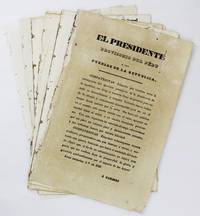
18305862Various places in Peru 1830. Good. Seven broadsides and bifolia totaling 14pp. with each sheet measuring approximately 11.5 x 7.5 inches. Previously bound with stabholes and residue at left margin. Moderate worming affecting some text but not sense. Minor tanning and soiling. A group of seven highly ephemeral and seemingly unrecorded military broadsides and bifolia reports from Peru dating to the country's war with Gran Colombia from 1828 to 1829 and just after. The conflict stemmed from a border dispute after independence was gained in 1820 and 1821 with the boundary left relatively undefined. The Armistice of Piura formally agreed in September 1829 recognized Guayaquil and its surrounding area as a part of Gran Colombia and accorded Peru recognition of its modern-day northern provinces. The documents present here include an exhortation by Peruvian President Agustin Gamarra to support the prospective peace a report on the state of the Peruvian treasury in Trujillo during the midst of the conflict a bulletin concerning military developments in April 1829 addressed to the armed forces a patriotic broadside printed in Arequipa and a congratulatory address to the army printed on the day of armistice. The titles of these works none of which are individually recorded in OCLC are as follows:<br /> <br /> 1 Gamarra Agustin. El Presidente Provisoria del Peru a los Pueblos de la Republica. Lima: September 1 1829.<br /> 2 Peru. Estado Que Manifiesta las Cantidades Acopiadas por Esta Administracion Pral. del Tesoro Público del Departamento de la Libertad en el Presente Mes de Junio. Trujillo: June 20 1829.<br /> 3 Bermudez Pedro. Ejercito Peruano. Boletin No. IV. Piura: April 1 1829.<br /> 4 Gamarra Agustin. El Presidente de la Republica a los Pueblos. Lima: September 5 1830.<br /> 5 Peru. Queja Que Interpone ante el Respetable Tribunal de la Opinion Pública el Ciudadano Evaristo Encina Capitan Graduado de Ejercito Cóntra José Policarpos Hernandes. Trujillo: Imprenta de la Municipalidad 1829.<br /> 6 Peru. Gratis. Desahogo Patriotico. Arequipa: Imprenta Libre 1829.<br /> 7 Cerdeña Blas. El Comandante en Jefe al Ejercito. Piura: September 9 1829. unknown
1874104164P., Michel Lévy frères, Girard et Boitte, 1874, in-12, xvi-308 pp, cartonnage toile grise décorée de l'éditeur Girard et Boitte, titres et motifs floraux en noir au 1er plat et au dos, qqs rares rousseurs, bon état
185634252Paris Michel Lévy frères 1856 in-16 broché, couverture imprimée
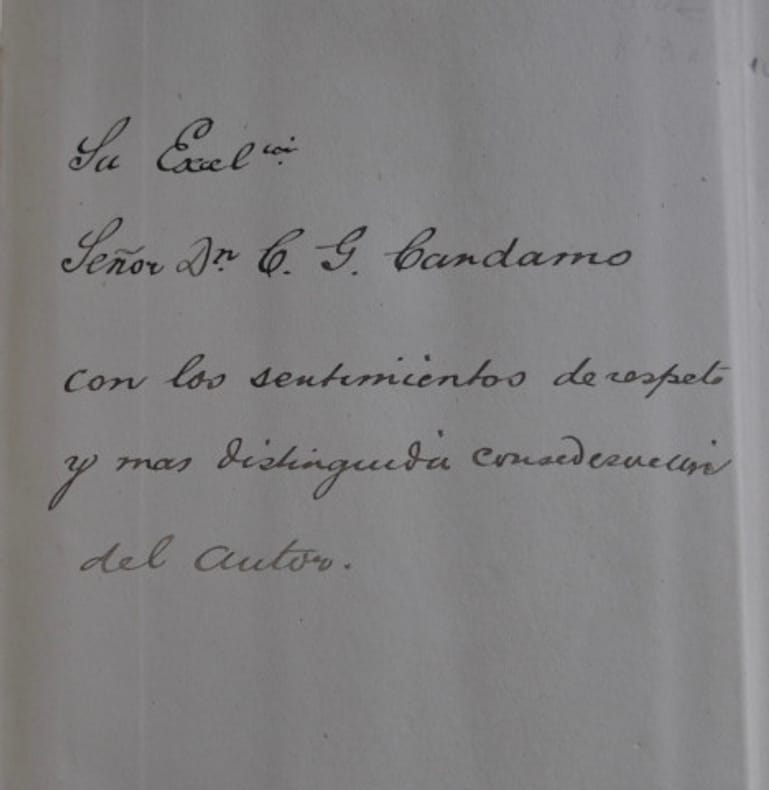
188846401041London, Wyman, 1888 ; in-12, plein chagrin beige, encadrement filet doré, armes du Pérou sur les plats, tranches dorées, dentelles intérieures dorées. (Reliure de l'époque). Luxueuse publication dédiée au Général Caceres président du Pérou. 30 planches hors texte, la plupart étant des vues et scènes gravées su bois, des cartes dépliantes et 2 photographies originales, dont celle du président Caceres. Grande carte dépliante en tête de volume. Précieux exemplaire spécialement relié en plein chagrin aux armes du Pérou, avec un ENVOI AUTOGRAPHE de l'auteur à son Excellence C. G. Candarno.
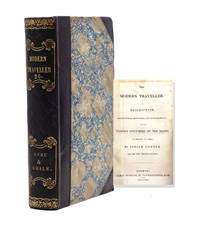
1830319997London: James Duncan 1830. 3 plates & 1 folding map as frontispiece. 2 vi2 340pp. 1 vols. 12mo. Half contemp. calf. VG. 3 plates & 1 folding map as frontispiece. 2 vi2 340pp. 1 vols. 12mo. <br/><br/> James Duncan unknown
1886326027London no date (ca. 1886). Blatt / Sheet ca. 14,5 x 23,5 cm, mit Erläuterungsblatt / with explanation sheet, Papier etwas gebräunt, teils etwas fleckig / braunfleckig, Kanten teils bestoßen / knickspurig / teils mit minimalen Läsuren, ansonsten gut erhaltenes Blatt; Erläuterungsblatt knickspurig und etwas braunfleckig / Coloured lithography, paper a bit browned and partially stained, edges a bit bumped and partially with very slight damages, else fine; explanation sheet battered and a bit spotted.
1887186209Lefever frères Louvain, Imprimerie Lefever, 1²887. Plaquette In-8 brochée, 17 pages. Bon état
1854ZB568420Washington 1854. 53 pp issued as 33d Cong. 1st Sess. HR 347; light extraction roughness at spine light but large damp stain throughout self wrappers; the memorialists find Peruvian guano to be miraculously effective on their depleted soil but are being gouged by an odious Ango-Peruvian monopoly their suggestion that Peru cede a guano island to the United States was impractical but efforts were made to reduce prices. - If you are reading this this item is actually physically in our stock and ready for shipment once ordered. We are not bookjackers. Buyer is responsible for any additional duties taxes or fees required by recipient's country. Washington unknown