[BRÉSIL] FROGER, FrançoisLivre Rare Book
7 résultats
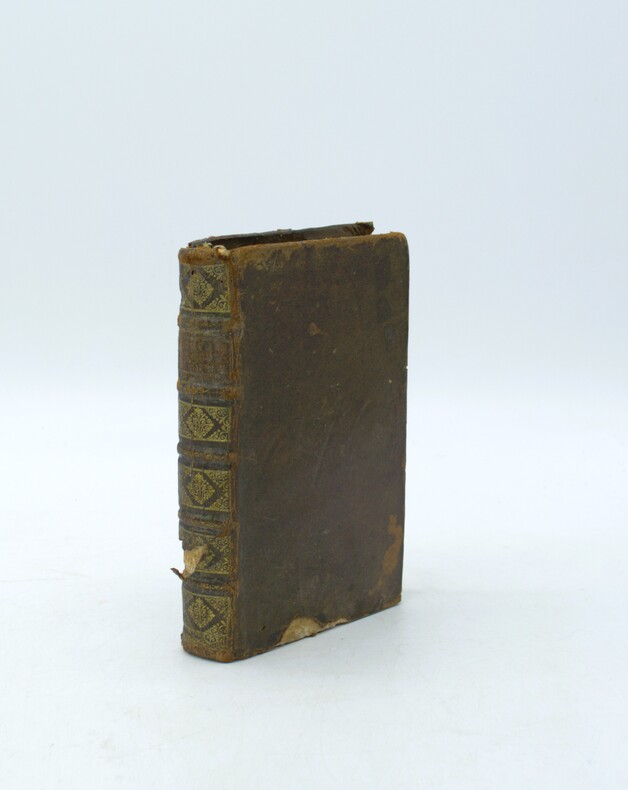
169985131Amsterdam, chez les héritiers, d'Antoine Schelte, 1699, in-12, titre-frontispice, [6] ff, 227 p, veau moucheté brun de l'époque, dos à nerfs doré, tranches mouchetées, Seconde édition de cette relation de voyage effectué par Jean Baptiste de Gennes et narrée par Froger, un ingénieur et hydrographe. Elle débute par un joli frontispice et vingt-huit planches gravées hors-texte, certaines dépliantes, dont la recherchée vue de Rio de Janeiro. L'auteur y décrit et dépeint autant les paysages que la faune, la flore ou le traitement des esclaves et des populations locales par les colons. Le but de cette expédition était de créer une colonie française au détroit de Magellan et malgré l'échec de cette installation, elle reste la première relation d'un voyage français au détroit ainsi qu'une source fort intéressante pour l'histoire et la géographie des régions décrites. Sabin, VII, 26002; Leclerc, 219. Restauration Couverture rigide
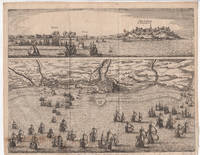
165244394Amsterdam: Jodocus Janssonius 1652. Very good edges reinforced on verso light soiling mostly to margins minor foxing dampstained along bottom edge image clean. 1 sheet. Copper engraved map. 11.75 x 13.5 inches. Double-page copper engraved plate from "Fredrick Hendrick Van Nassauw Prince Van Orangien Zyn Leven En Bedryf." page 128. Labeled "Fig. 10 Fol. 100" in top left corner. The two views depict the 1630 attack on the Portuguese city of Olinda in Brazil by the Dutch.<br /> <br /> When Spanish Crown and the Kingdom of Portugal formed a dynastic union 1580-1640 uniting the entire Iberian peninsula as well as their colonies the Dutch saw their opportunity to take advangage of Portuguese weakness by attacking their colonies occupying large sections of Brazil including the whole Brazilian northeast and in 1630 capturing Recife and Olinda in the captaincy of Pernambuco the largest and richest sugar-producing area in the world. [Jodocus Janssonius] unknown
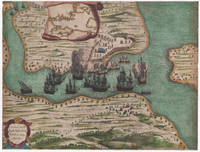
165244393Amsterdam: Jodocus Janssonius 1652. About very good margins cut to neat line edges lightly browned and soiled few small chips along edges two small tears repaired on th verso some staining on reverse image sharp. 1 sheet. Hand-colored copper-engraved map. 11 x 14.5 inches. Double-page copper engraved plate from "Fredrick Hendrick Van Nassauw Prince Van Orangien Zyn Leven En Bedryf." page 31. Labeled "Fol. 23" along bottom edge. Image Depicts the Dutch fleet under Piet Heyn capturing the fort at the entrance to the Baia de Todos os Santos.<br /> <br /> When Spanish Crown and the Kingdom of Portugal formed a dynastic union 1580-1640 uniting the entire Iberian peninsula as well as their colonies the Dutch saw their opportunity to take advangage of Portuguese weakness by attacking their colonies occupying large sections of Brazil including the whole Brazilian northeast and in 1630 capturing Recife and Olinda in the captaincy of Pernambuco the largest and richest sugar-producing area in the world. [Jodocus Janssonius] unknown
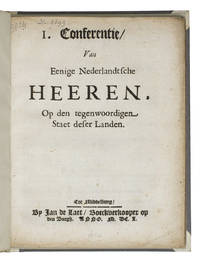
1650ABC_46896Middelburg 1650. Small 4to 19.5 x 15 cm. Jan de Laet 20th-century half vellum dark grey laid-paper sides paper spine-label with the letterpress title reading up the spine light grey laid endpapers. 34 pp. An anonymous political tract in the form of a conversation between four fictional gentlemen Van Blyenberg Van Sorgdal Van Vraegwel Van Weetburgh whose names suggest happiness concern questioning and knowing respectively. It begins with a reference to the onverwachte en haestige unexpected and sudden death of the Prince of Orange meaning Willem II Prince of Orange and Count of Nassau stadtholder of the Dutch Republic from 1647 to his death from the plague on 6 November 1650 at the age of twenty-four. In 1649 Admiral Witte de With commander of the Dutch West India Companys WICs fleet fighting the Portuguese in Brazil came into dispute with the WIC and returned to the Netherlands against orders arriving in April 1650. Stadtholder Willem II and the States General supported the WIC against De With and sentenced him to death. Although events in Brazil greatly influenced the politics debated in the present pamphlet and the former governor of Brazil is a central figure in it only Alden & Landis appear to have recognised it as Brasiliana or Americana. This is the first known publication of the Middelberg bookseller Jan de Laet who published two more pamphlets in 1655. Slightly browned and with a 2 mm hole in 1 leaf nearly removing the letter e in eygen but otherwise in very good condition and only slightly trimmed with some deckles preserved on the fore-edge. Binding also very good. A fascinating discussion of the future of the Netherlands after the unexpected death of stadtholder Willem II proposing the former governor of Brazil as successor a respected ruler who never attained that position.l Alden & Landis 650/62; Knuttel 6899 & 6899a; STCN 830027661; USTC 1026235; not in Borba de Moraes; Bosch; Rodrigues. hardcover
1698PHO-2187Paris, dans l'Isle du Palais, G. Saugrain, 1698.Grand in-12, 6ff.-219pp., veau époque, dos à nerfs orné, manque au dos et aux plats, coins usés, frottements, ex-libris sur la page de garde et manuscrit au titre. Exemplaire sans les planches.
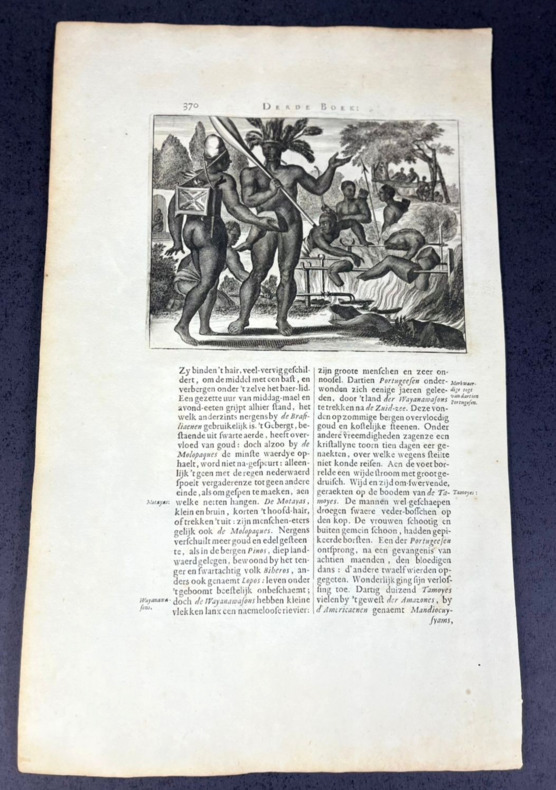
16710534Ensemble de 4 pages du livre "De Nieuwe en Onbekende Weereld of Beschryving van America en 't Zuid-Land" (Le Monde nouveau et inconnu ou description de l'Amérique et du Sud) publié en 1671 à Amsterdam. Pages 369-70, 397-8, 469-70 et 533-4. Chaque feuillet (380 x 236 mm) présente une gravure remarquable : un barbecue cannibale, où des indigènes font rôtir des morceaux d'être humain ; un paysage avec des animaux fantastiques, dont un singe doté d'une tête d'homme barbu ; une scène de combats entre colons hollandais et indigènes, ces derniers brandissant des têtes coupées plantées sur leurs lances ; un autre barbecue cannibale avec un combat en arrière-plan. Texte en néerlandais sous les gravures et au verso. Ouvrage majeur de l'époque, associant le récit du compilateur Arnoldus Montanus au talent artistique et fantastique du dessinateur-graveur et éditeur Jacob Meurs, le livre fut rapidement traduit en anglais et en allemand. Une bonne partie du livre était dédiée au Brésil, où les Hollandais ont longtemps tenu les Portugais en échec. Cité par Asher, New Netherland 14 ; Borba de Moraes p. 586 ; Church 613 ; Howes M733 ; Phelps Stokes I:142-143 and VI:262 ; Sabin 50086. ****************************************** A set of four pages from the book "De Nieuwe en Onbekende Weereld of Beschryving van America en 't Zuid-Land" (The New and Unknown World or Description of America and the South), published in 1671 in Amsterdam. Pages 369-70, 397-8, 469-70, and 533-4. Each page (380 x 236 mm) features a remarkable engraving: a cannibal barbecue, where natives roast pieces of human beings; a landscape with fantastical animals, including a monkey with a bearded man's head; a scene of fighting between Dutch settlers and natives, the latter brandishing severed heads planted on their spears; another cannibal barbecue with a fight in the background. Text in Dutch below the engravings and on the back. A major work of the time, combining the narrative of the compiler Arnoldus Montanus with the artistic and fantastical talent of the draftsman-engraver and editor Jacob Meurs, the book was quickly translated into English and German. A good part of the book was devoted to Brazil, where the Dutch had long held the Portuguese in check. Cited by Asher, New Netherland 14; Borba de Moraes p. 586; Church 613; Howes M733; Phelps Stokes I:142-143 and VI:262; Sabin 50086.
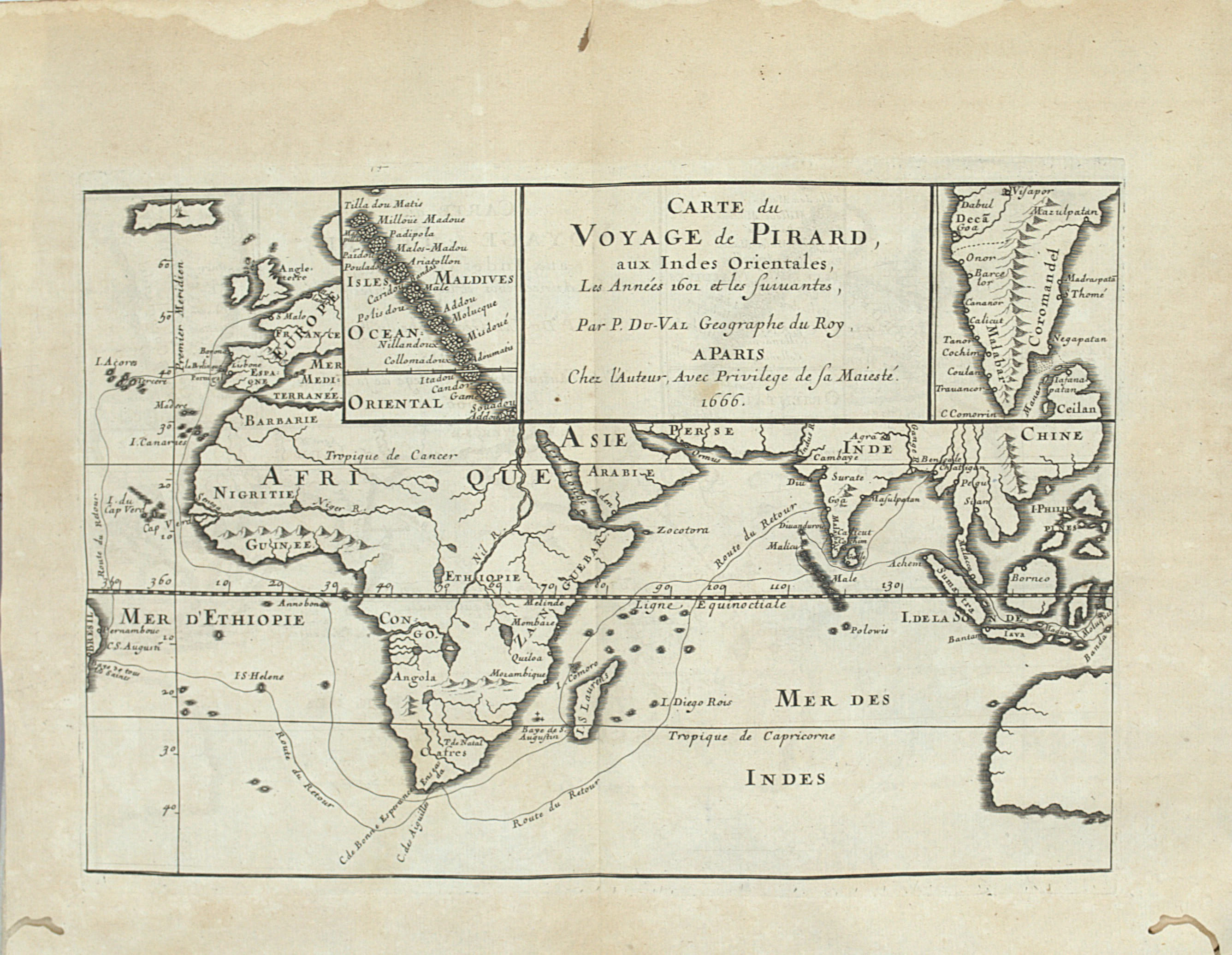
1679PHO-2525A Paris, Chez Louis Billaine, 1679. In-4° ; 5ff.-1 carte h.-t.-repl.-327 pp.-218 pp.-144 pp.-12ff., veau époque, dos à nerfs orné avec titre. Manque au dos et charnières, coins usé, travail de ver sur les 17 premiers et 30 derniers feuillets, petite mouillure angulaire, titre bruni, feuillet « Au lecteur » déchiré sans manque, brunissures. L’une des meilleures descriptions des Maldives et une importante description de Goa.