Borregales, GermanAntiquariat.de
U.R.S.S. et O.I.T.
194055273BBGenève, Courrier de Genève, juillet, 1940. 8°. 127 p. Broché.
1 082 résultats
8611CELIB, 1974 - In-4 - Broché - Frontispice - 144 + 26 & 5 cartes PP HT - Très propre
CELIB, 1974 - In-4 - Broché - Frontispice - 144 + 26 & 5 cartes PP HT - Très propre
194055273BBGenève, Courrier de Genève, juillet, 1940. 8°. 127 p. Broché.
194055273BBGenève, Courrier de Genève, juillet 1940 8°. 127 p. Broché.
16x12. 190p.
Roma, 1963, 3 febbraio, copertina illustrata a colori in fascicolo originale completo di pp. 40 de "La Tribuna illustrata" .
Caracas, Editorial Tiempo Nuevo, 1972. 4to. menor; 278 pp., 2 hs. Cubiertas originales.
Milano, 1932, 8vo stralcio con copertina posticcia muta, pp. 495/498 con una figura, 4 illustrazioni ed una tavola fotografica. - !! ATTENZIONE !!: Con il termine estratto (o stralcio) intendiamo riferirci ad un fascicolo contenente un articolo, completo in se, sia che esso sia stato stampato a parte utilizzando la stessa composizione sia che provenga direttamente da una rivista. Le pagine sono indicate come "da/a", ad esempio: 229/231 significa che il testo è composto da tre pagine. Quando la rivista di provenienza non viene indicata é perché ci è sconosciuta. - !! ATTENTION !!: : NOT A BOOK : “extract” or “excerpt” means simply a few pages, original nonetheless, printed in a magazine. Pages are indicated as in "from” “to", for example: 229/231 means the text comprises three pages (229, 230 and 231). If the magazine that contained the pages is not mentioned, it is because it is unknown to us.
Milano, 1927, 8vo stralcio con copertina posticcia muta, pp. 663/676 con una cartina e 17 illustrazioni fotografiche. - !! ATTENZIONE !!: Con il termine estratto (o stralcio) intendiamo riferirci ad un fascicolo contenente un articolo, completo in se, sia che esso sia stato stampato a parte utilizzando la stessa composizione sia che provenga direttamente da una rivista. Le pagine sono indicate come "da/a", ad esempio: 229/231 significa che il testo è composto da tre pagine. Quando la rivista di provenienza non viene indicata é perché ci è sconosciuta. - !! ATTENTION !!: : NOT A BOOK : “extract” or “excerpt” means simply a few pages, original nonetheless, printed in a magazine. Pages are indicated as in "from” “to", for example: 229/231 means the text comprises three pages (229, 230 and 231). If the magazine that contained the pages is not mentioned, it is because it is unknown to us.
19x13. s.pp. N.318.
Milano, 1963, stralcio con copertina posticcia muta, pp. 845/860 con fotografie e tavole fotografiche. - !! ATTENZIONE !!: Con il termine estratto (o stralcio) intendiamo riferirci ad un fascicolo contenente un articolo di rivista, sia che esso sia stato stampato a parte utilizzando la stessa composizione sia che provenga direttamente da una rivista. Le pagine sono indicate come "da/a", ad esempio: 229/231 significa che il testo è composto da tre pagine. Quando la rivista di provenienza non viene indicata é perchè ci è sconosciuta. - !! ATTENTION !!: : NOT A BOOK : “estratto” or “stralcio” means simply a few pages, original nonetheless, printed in a magazine. Pages are indicated as in "from” “to", for example: 229/231 means the text comprises three pages (229, 230 and 231). If the magazine that contained the pages is not mentioned, it is because it is unknown to us.
19x13. 125p.
Caracas, Faculdad de Derecho, 1971, in-8, brossura editoriale, pp. 114, [6]. Dalla "Colleccion Trabajos de Ascenso", n°2.
français 0 1882 p. 193 à 208 (16 p.). Fascicule orig., extrait de la série TOUR DU MONDE de l'année et semestre indiqués. Gravures ou photographies in-t et h-t. Format 21 x 29cm. Ex. collé en couverture d'attente, illustrée, carton rouge ou vert. Bonne présentation. TOUR-DU-MONDE VOYAGES VENEZUELA GUARAOUNOS.
Milano, 1929, 8vo stralcio con copertina posticcia muta, pp. 913/917 con 3 illustrazioni fotografiche. - !! ATTENZIONE !!: Con il termine estratto (o stralcio) intendiamo riferirci ad un fascicolo contenente un articolo, completo in se, sia che esso sia stato stampato a parte utilizzando la stessa composizione sia che provenga direttamente da una rivista. Le pagine sono indicate come "da/a", ad esempio: 229/231 significa che il testo è composto da tre pagine. Quando la rivista di provenienza non viene indicata é perché ci è sconosciuta. - !! ATTENTION !!: : NOT A BOOK : “extract” or “excerpt” means simply a few pages, original nonetheless, printed in a magazine. Pages are indicated as in "from” “to", for example: 229/231 means the text comprises three pages (229, 230 and 231). If the magazine that contained the pages is not mentioned, it is because it is unknown to us.
Milano, 1931, 8vo stralcio con copertina posticcia muta, pp. 29/32 con 7 illustrazioni fotografiche. - !! ATTENZIONE !!: Con il termine estratto (o stralcio) intendiamo riferirci ad un fascicolo contenente un articolo, completo in se, sia che esso sia stato stampato a parte utilizzando la stessa composizione sia che provenga direttamente da una rivista. Le pagine sono indicate come "da/a", ad esempio: 229/231 significa che il testo è composto da tre pagine. Quando la rivista di provenienza non viene indicata é perché ci è sconosciuta. - !! ATTENTION !!: : NOT A BOOK : “extract” or “excerpt” means simply a few pages, original nonetheless, printed in a magazine. Pages are indicated as in "from” “to", for example: 229/231 means the text comprises three pages (229, 230 and 231). If the magazine that contained the pages is not mentioned, it is because it is unknown to us.
197127662Radebeul, Neumann Verlag, 1971. Gr.8°; 191 Seiten, zahlr. Textabbildungen, zahlr. (teils farbige) Fotos auf Tafeln; Orig.-Leinen mit OU Schutzumschlag leicht gerändert/ randrissig. Papier der Textseiten gleichmäßig gebräunt
Concejo Municipal del Distrito de Sucre, 1981, 21 x 23,5 cm., numerosas ilustraciones fotográficas a toda página, 248 págs. (Ejemplar con hojas desprendidas).
Caracas, Ministerio de Agricultura y Cría, 1949. 4to. mayor; 1 lámina con dos reproducciones fotográficas, 18 pp. Con 14 fotografías entre el texto y un gran mapa plegado sobre la utilización de las tierras. Cubiertas originales.
1992ROD0028057Guide Arthaud. 1992. In-8. Cartonnage d'éditeurs. Bon état, Couv. convenable, Dos satisfaisant, Intérieur frais. 263 p. - Quelques photographies couleurs pleine page.. . . . Classification Dewey : 987-Venezuela
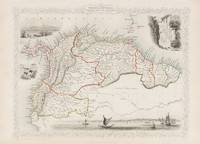
18512008AG1851. London & New York J & F. Tallis 1851. Original steel engraving / Vintage map. Drawn and engraved by John Rapkin. Partly hand-coloured. Plate Size: 32.7 cm x 24.9 cm. Sheet Size: 37.4 cm x 27.3 cm. Vintage 19th century map in very good condition. John Tallis 7 November 1817 3 June 1876 was an English cartographic publisher. His company John Tallis and Company published views maps and atlases in London from roughly 1838 to 1851. Tallis set up as a publisher with Frederick Tallis in Cripplegate in 1842; the business moved to Smithfield in 1846 and was dissolved in 1849. From 1851 to 1854 Tallis operated as John Tallis and Company. He started The illustrated news of the world and national portrait gallery of eminent personages in 1858 selling it for £1370 in 1861; it folded in 1863. Wikipedia The most important project John Tallis undertook was the 'Illustrated Atlas' from 1851. The original map we offer here was part of this exceptional Atlas and all the maps it contained are still today considered as the last reminder of an era of lavish map production. Tallis worked the project together with John Rapkin 1815-1876 and it was Rapkin's style and talent that we have to thank for when we marvel at these maps today. What makes these maps so special is the detail of engraved vignettes that surround the map and often show indigenous scenes people in their environment and even more so historical buildings or historical views of towns and cities architecture and landscape. The project of 'The Illustrated Atlas' was designed to be finished just in time for the anxiously awaited "Great Exhibition of the Works of Industry of All Nations" or The Great Exhibition sometimes referred to as the Crystal Palace Exhibition in reference to the temporary structure in which it was held was an international exhibition that took place in Hyde Park London from 1 May to 11 October 1851. It was the first in a series of World's Fairs exhibitions of culture and industry that became popular in the 19th century and it was a much anticipated event. The Great Exhibition was organized by Henry Cole and Prince Albert husband of the reigning monarch Queen Victoria. It was attended by numerous notable figures of the time including Charles Darwin Samuel Colt members of the Orléanist Royal Family and the writers Charlotte Brontë Charles Dickens Lewis Carroll George Eliot and Alfred Tennyson. Music for the opening was under the direction of Sir George Thomas Smart and the continuous music from the exhibited organs for the Queen's procession was "under the superintendence of William Sterndale Bennett". Wikipedia unknown
0260713554.Ghardcover. Good. Access codes and supplements are not guaranteed with used items. May be an ex-library book. hardcover
0656880082.Ghardcover. Good. Access codes and supplements are not guaranteed with used items. May be an ex-library book. hardcover
139023049X.Gpaperback. Good. Access codes and supplements are not guaranteed with used items. May be an ex-library book. paperback