MareMagnum

172 résultats
Roma, Società Editrice Dante Alighieri, 1900, fascicoli 10 legati in 8 (ci sono due numeri doppi), in-8, br. editoriale, pp. 620, in paginazione continua tra i fascicoli. Tra le numerose memorie segnaliamo: Pietro Gribaudi "La Patagonia, secondo recenti studi", Umberto Pagani "Su alcune sorgenti di gas nel Bolognese", Olinto Marinello "Primi materiali per la storia della cartografia marchigiana", Giuseppe Toni "La Lunda e i suoi popoli", B. Gilardi "La Corsica", C. Puini "Viaggio nel Tibet del p. Ippolito Desideri", ecc., ecc. Buone condizioni. L'annata:
22581'From the Christian Times.' London Dated 10 May 1852. For the context see Gardiner's entry in the Oxford DNB. Gardiner's disastrous last mission to Patagonia ended with his death on 6 September 1851 as the last of the seven missionaries to starve to death on Picton Island. No other copy of the present item has been traced either on OCLC WorldCat or on COPAC. 4pp 16mo. Bifolium. Well printed. In fair condition lightly aged and worn and folded several times. At the end of the poem is the author's pseudonym the Greek letter delta with the date 'May 10 1852.' Monologue in blank verse by 'Captain Allan sic Gardiner' who is 'seen lying near a boat in the latest stage of exhaustion'. The poem begins: 'Once more I am myself again. Once more As calm as free from pain as clear in mind As in the days of health I gaze around And ask What hope' The poem is preceded by the following note by the 'Editor': 'We had designed to ask especial attention to the touching narrative of Captain Gardiner's Patagonian Mission and to have given expression to our sentiments upon that great undertaking. If it had prospered we should have heard nothing but commendation of the motives which planned and the indomitable fortitude which achieved so perilous an expedition: it failed and therefore it is subjected to obloquy. Such is the state of the world in its estimate of human action and such it has been from the days of Nelson - when he disobeyed orders at Copenhagen and would probably have been shot if success had not been his apology - to the present hour. We give insertion with much pleasure to the following touching lines.' Four footnotes in small print one of them very long with reference to 'Captain Morshead's report'. '(From the Christian Times.)' [London] Dated 10 May 1852. unknown
190334686Monaco: Imprimerie de Monaco 1903. First edition. Illustrated with 71 figures in text 14 plates. pp. vii 342. 1 vols. 4to. Original paper covered boards. Lightly rubbed at extremities else a Fine unopened copy. First edition. Illustrated with 71 figures in text 14 plates. pp. vii 342. 1 vols. 4to. The stature of the indigenous Patagonians was observed by Magellan and became legendary in Europe. Verneau's monograph drawing upon collections brought to Europe by the comte H. de La Vaulx in the 1890s is divided into three sections: a brief discussion of anthropological evidence found in the historical record; a detailed consideration of the physical characteristics of indigenous Patagonians; and an in-depth ethnographic study. An important work of scholarship. Imprimerie de Monaco unknown
Roma, Società Geografica Italiana, 1896, 8vo stralcio con copertina posticcia muta, pp. 240/242. - !! ATTENZIONE !!: Con il termine estratto (o stralcio) intendiamo riferirci ad un fascicolo contenente un articolo, completo in se, sia che esso sia stato stampato a parte utilizzando la stessa composizione sia che provenga direttamente da una rivista. Le pagine sono indicate come "da/a", ad esempio: 229/231 significa che il testo è composto da tre pagine. Quando la rivista di provenienza non viene indicata é perché ci è sconosciuta. - !! ATTENTION !!: : NOT A BOOK : “extract” or “excerpt” means simply a few pages, original nonetheless, printed in a magazine. Pages are indicated as in "from” “to", for example: 229/231 means the text comprises three pages (229, 230 and 231). If the magazine that contained the pages is not mentioned, it is because it is unknown to us.
Milano, 1926, stralcio con copertina posticcia muta, pp. 17/26 con una cartina e 15 fotografie. - !! ATTENZIONE !!: Con il termine estratto (o stralcio) intendiamo riferirci ad un fascicolo contenente un articolo di rivista, sia che esso sia stato stampato a parte utilizzando la stessa composizione sia che provenga direttamente da una rivista. Le pagine sono indicate come "da/a", ad esempio: 229/231 significa che il testo è composto da tre pagine. Quando la rivista di provenienza non viene indicata é perchè ci è sconosciuta. - !! ATTENTION !!: : NOT A BOOK : “estratto” or “stralcio” means simply a few pages, original nonetheless, printed in a magazine. Pages are indicated as in "from” “to", for example: 229/231 means the text comprises three pages (229, 230 and 231). If the magazine that contained the pages is not mentioned, it is because it is unknown to us.
First edition, [4],viii,257,[1]pp., with half-title and engraved frontispiece, cont. half calf, marbled paper boards, hinges slightly cracked, head and foot of spine worn with some light worming to raised bands, marbled paper on lower board peeling, but overall internally a clean and bright copy. Of the first work Hill notes "This account of John Byron's circumnavigation is usually ascribed to midshipman Charles Clerke, who later sailed on all three of Captain Cook's voyages...". Of the second work, Byron was midshipeman aboard the Wager when it was wrecked off the Chilean coast, and he provides a vivid account of the privations endured by the survivors. The author's grandson Lord Byron drew upon the Narrative as a source for his epic poem 'Don Juan'. Hill, 311 & 232.
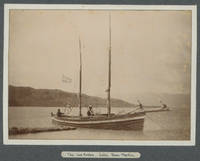
1890List01108Mostly Patagonia 1890. Printing-out paper prints the images measuring 3 1/4x4 1/2 to 4 1/4x6 inches and the reverse each with a caption written on a label affixed to the mount below the prints. 4to blue pictorial cloth. 1890s. In this bound photo album forty-six photographs document a group traveling from pastoral locations in northern Argentina to breathtaking views at the southern tip of the continent. The photographs were taken by an accomplished photographer and handwritten captions in English provide brief descriptions of the locations and people documented. Apparently a member of an exploration commission the photographer and his team travel first from Bahia Brazil to Buenos Aires and La Pláta then on to the southern tip of the continent and back up the continent through remote lakes and mountains on both sides of the Chilean/Argentinian border.<br /> <br /> While the photographer’s name and nationality are not clear from the album there are two photographs with a Sr. Moreno who is likely the Argentinian explorer Francisco ‘Perito’ Moreno. The photographs of “Sr. Moreno†bear a clear resemblance to photographs of Francisco Moreno and they are taken in La Plata which is where Moreno was the first director of the natural history museum Museo de La Plata. On the album page following the one with photographs of Sr. Moreno there are photographs of the Museo de La Plata building and grounds. Museo de La Plata was established in 1884 and Moreno’s personal collection of 15000 pieces formed the core of the original collections Farro. In order to fill the exhibit rooms he sought more materials and carried out collecting campaigns in Patagonia. At times he hired naturalists to travel into remote parts of Patagonia to gather samples of flora fauna geology and artifacts of indigenous people’s culture Farro. Museo de la Plata was exhibiting anthropological remains and indigenous material culture at the same time that Argentina was expanding into indigenous territory Farro. In this way Museo de la Plata was not just a natural history museum it was also a force of colonialism. <br /> <br /> Not only was Argentina in the process of colonizing Patagonia but also it sought to claim and maintain territory in relation to Chile. A sixty year boundary controversy between Argentina and Chile resulted in the Treaty of 1881 in which the two countries agreed for the first time on the boundaries in Patagonia Perry. Even after 1881 vague language in the treaty that the boundary be “the most lofty peaks that divide the waters†extended the dispute until 1902 Perry. Because Patagonia had not been colonized extensively scientific exploration of the region was tied with nation-building and establishing these borders. In 1896 the Argentinean government appointed Moreno as the Expert Representative in the border dispute with Chile. He led commissions of naturalists and surveying engineers through the disputed border regions along the Andes Mountains Museo de La Plata n.d. Moreno’s work had parallels in Chile’s attempts to establish borders too: “Through the work of these explorers the state was able to.draw up laws and decrees regarding environmental destruction and more effectively defend its position in the limits conflict with Argentina†Etchegaray 2018. <br /> <br /> We do not know whether the exploration commission in this photo album was affiliated with Moreno the collections of Museo de la Plata or the boundary controversy. However given the route to the tip of the continent and the back up along the newly established border it seems possible that this commission could have played some role – whether directly or indirectly – in the process of exploration and nation building occurring at that time. <br /> <br /> References<br /> <br /> Etchegaray J. L. 2018. Cataloging the nation: Explorations and the incorporation of North Patagonia into the Chilean National Ordering 1856-1902 Thesis San Francisco State University. In AS36 2018 HIST .E83. http://dspace.calstate.edu/handle/10211.3/213510<br /> <br /> Farro Máximo E. n.d. The Business of Museums: Towards a History of Collections in La Plata’s Museum 1888-1906 – World Archaeological Congress. Retrieved June 15 2021 from https://worldarch.org/world-archaeological-bulletin/the-business-of-museums-towards-a-history-of-collections-in-la-platas-museum-1888-1906/<br /> <br /> Ryan C. 2011. Indigenous possessions: Anthropology museums and nation-making in Argentina 1862–1943 Ph.D. The University of Wisconsin - Madison. Retrieved June 15 2021 from http://www.proquest.com/pqdtglobal/docview/885379045/abstract/E55A419FE8D54C0DPQ/1<br /> <br /> Museo de La Plata. n.d. Retrieved July 2 2021 from https://www.museo.fcnym.unlp.edu.ar/museo. unknown
Very Good Turkish, Ottoman (1500-1928) Original color map. Elephant folio. (59x75 cm). In Ottoman script. [OTTOMAN MILITARY MAP of PATAGONIA and FALKLAND ISLANDS: ROUTE of DRESDEN] Alman kruvazörü Dresden'in takîbi ve tahrîbi. SMS Dresden cruiser's routes between 1913-1915 (World War 1) on the Patagonian shelf; western shores of South America, Patagonia and Falkland Islands. Dresden spent much of her career overseas. After commissioning, she visited the United States in 1909 during the Hudson-Fulton Celebration, before returning to Germany to serve in the reconnaissance force of the High Seas Fleet for three years. In 1913, she was assigned to the Mediterranean Division. She was then sent to the Caribbean to protect German nationals during the Mexican Revolution. In mid-1914, she carried the former dictator Victoriano Huerta to Jamaica, where the British had granted him asylum. She was due to return to Germany in July 1914, but was prevented by the outbreak of World War I from doing so. At the onset of hostilities, Dresden operated as a commerce raider in South American waters in the Atlantic, then moved to the Pacific Ocean in September and joined Maximilian von Spee's East Asia Squadron. Dresden saw action in the Battle of Coronel in November, where she engaged the British cruiser HMS Glasgow, and at the Battle of the Falkland Islands in December, where she was the only German warship to escape destruction. She eluded her British pursuers for several more months, until she put into Robinson Crusoe Island in March 1915. Her engines were worn out and she had almost no coal left for her boilers, so the ship's captain contacted the local Chilean authorities to have Dresden interned. She was trapped by British cruisers, including her old opponent Glasgow. The British violated Chilean neutrality and opened fire on the ship in the Battle of Más a Tierra. The Germans scuttled Dresden and the majority of the crew escaped to be interned in Chile for the duration of the war. The wreck remains in the harbor; several artifacts, including her bell and compass, have been returned to Germany.
13964607Paris: Musée de l'Homme, Museum National d'Histoire Naturelle, 1962 in-4, nombreuses illustrations. Broché. Très bon état, cachet. Sommaire: Jacqueline DELANGE, Les arts anciens de la plaine du Tchad. - Annette LAMING-EMPERAIRE, Travaux archéologiques en Amérique du Sud. - Jacques MILLOT et Yvette LAPLAZE, Les felana malgaches. - Marie-Louise PASQUINO, Un costume finnois du XIIe siècle. - Monique ROUSSEL de FONTANES, Une exposition de papiers découpés polonais.
13967484Paris: Musée de l'Homme, Museum National d'Histoire Naturelle, 1972 in-4, pp. 75-254, nombreuses illustrations. Broché, cachet, très bon état.
Mm 315x450 Fascicolo in folio di pp. 8 con prima e ultima carta illustrate a colori, alcune illustrazioni in nero nel testo, vignette di Gandolin. Fioriture. SPEDIZIONE IN 24 ORE DALLA CONFERMA DELL'ORDINE.
Mm 300x400 "A selection of 40 photos from the recently published book ARGENTINA. Collection LANDS AND PEOPLE OF AMERICA" - Portfolio con 40 riproduzioni fotografiche di, tra gli altri, Fulvio Roiter, Cesare Gerolimetto e Pierre-Yves Dhinaut. Copia in ottime condizioni, spedizione in 24 ore dalla conferma dell'ordine.
In-8 p. (mm.220x145), 2 volumi in 1, mz. pelle coeva (piatti con mancanze), fregi e tit. oro al dorso. L’opera, con testo su due colonne, molto ben illustrata da complessive 68 (su 74) tavole inc. in rame e numerate (poste alla fine del volume), è così composta: - "Chili, Paraguay, Uruguay, Buenos Aires" di Famin C., pp. (4),99;63; con 24 tavv, dedicate al Cile e 16 al Paraguay che raffigurano: usi e costumi, flora e fauna locali + 1 cartina geografica, ripieg., dedicata alle provincie unite del Rio della Plata (Paraguai, Uruguai e Chili). - "Patagonia, Terra del Fuoco ed isole Maluine" di La-Croix F., pp. 92 (incluso l’Indice), con 5 tavv. + la relativa cartina geografica, ripieg., numer. I. e II. - "Storia e descrizione delle isole dell’Oceano" di Bory di Saint-Vincent e Lacroix F. (con proprio frontesp., 1842), pp. 183 (Indice incluso). Questo secondo vol. è così suddiviso: Isole Orcadi - Shetland - Feroe - Normanne (Jersey, Guernesey, Serk e Aurigny) - Terranuova (San Pietro e Miquelon) - Bermude - Crozet - Galapagos - Revilla Gigedo. Fanno seguito le "Regioni circompolari" di Lacroix F., da p. 185 a 343 (incluso Indice), costituite da: Polo Artico - Islanda - Groenlandia, con 21 tavv. che raffigurano i nativi, loro abitazioni e vedute. Volume della Collana “L’Universo o Storia e descrizione di tutti i popoli, loro religioni, costumi, usanze, ecc. Con aloni, 8 tavv. ingiallite, ma complessivam. discreto esemplare.
18813035R. Worthington 1881. Good. Dixie was a fascinating woman far ahead of her Victorian times. She was a writer war correspondent and enthusiastic feminist. Dixie fought for equality of the sexes from soccer to the monarchy. Here she recounts her travels to Patagonia as the sole woman in the expedition. R. Worthington unknown
In ottime condizioni, storia e geografia di 50 anni fa. Prima edizione. Rilegato
Mm 130x180 Brossura editoriale di 201 pagine, in condizioni pari al nuovo. SPEDIZIONE IN 24 ORE DALLA CONFERMA DELL'ORDINE.
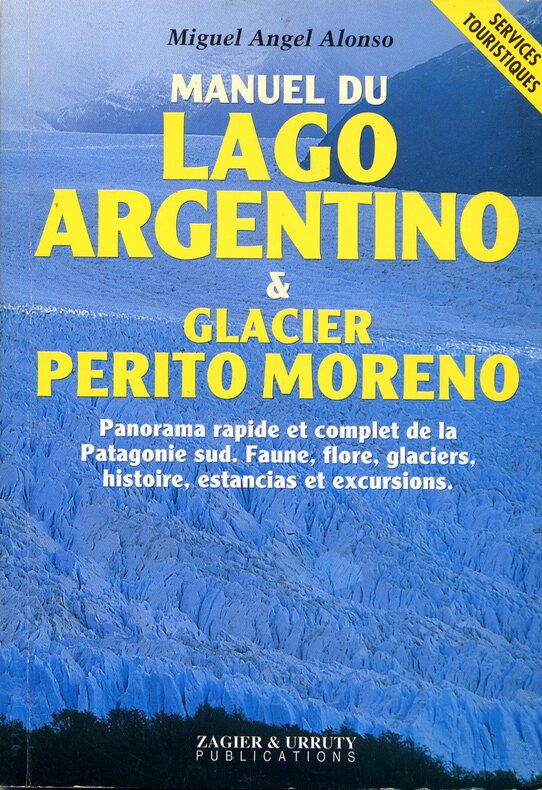
2006L1850Zagier & Urruty publications, 1994, 2006, 160 p.
1750PHO-538Les deux ouvrages reliés en un vol. in-4(245x200) Demi veau, dos à 5 nerfs orné avec pièce-de-titre , tranches rouges. (Reliure moderne). Ouvrage orné de vignettes et de 32(sur 34) cartes et planches gravés dont des cartes dépliantes. [1 f blanc], XXIV-363 pp / [2 ff n. ch], XVI-185 - xivpp (table des matières), [1 f blanc]. Exemplaire en bel état intérieur carte et texte.
1751PHO-1784Amsterdam, Arstee & Merkus,1751. XIV-330 pp., relié plein cuir moderne bleu, auteur et titre au dos, sans les cartes et gravures, page de titre renforcée et sans la vignette, page 101/102 manquante (ici en copie).
1756PHO-2159Lyon, chez les Frères Duplain, 1756. In-4° (25,5x19,5cm), 1f.-xvi-185 pp.- xiv pp. (table des matières), veau marbré époque, dos à nerfs orné de lions et oiseaux avec pièce de titre grenat, lions et oiseaux aux coins des plats, tranches rouges, doubles filets aux coupes, très légères rousseurs, coiffe sup. arasée, mouillure très claire, manque la page de titre Illustré d’une vignette gravée sur cuivre en tête du texte, d’après Delamonce.
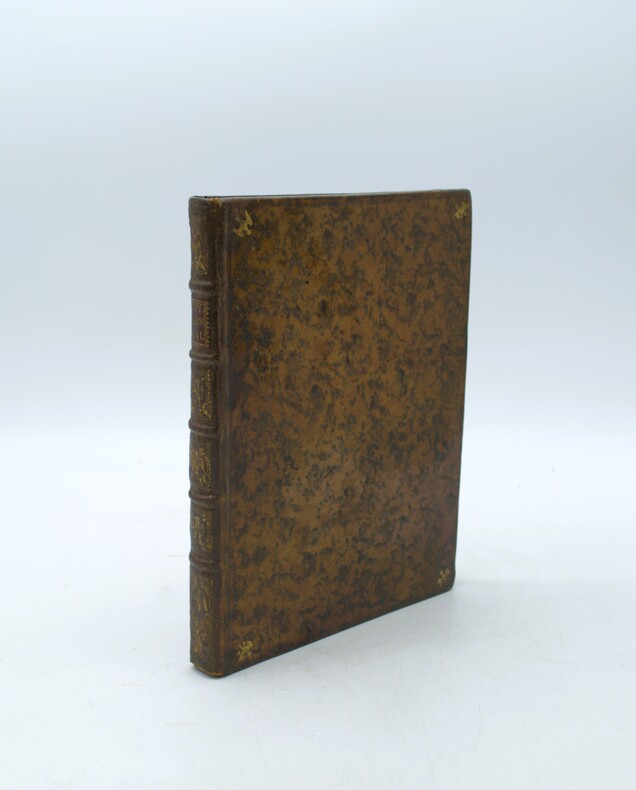
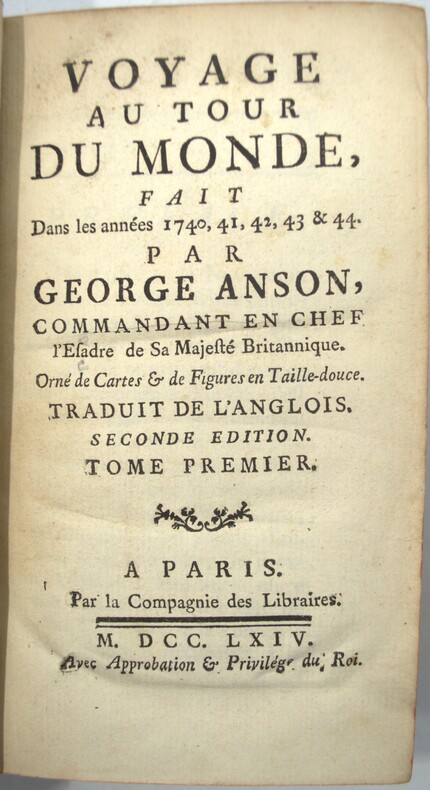
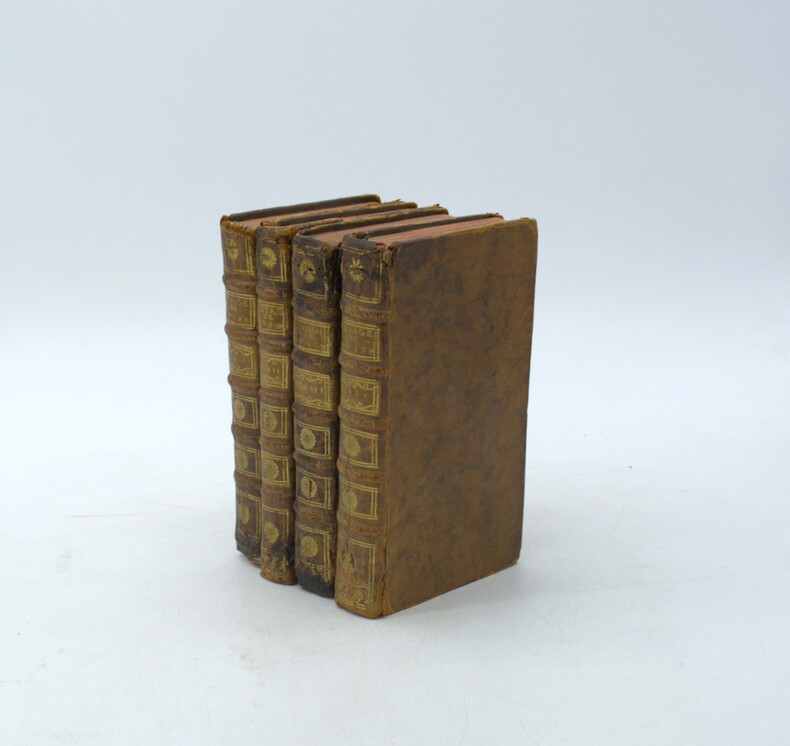
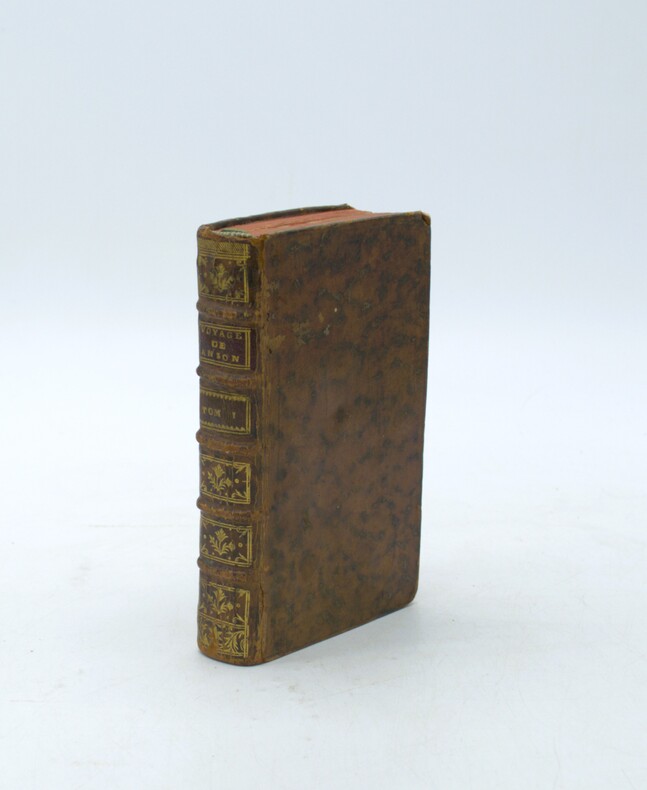
1764PHO-2242Paris, Par la Compagnie des Librairies, 1764. 4 volume in-12 (17x10cm), veau marbré époque, dos cinq nerfs, caissons dorés fleuronnés, tranches rouges. Frottements, coins usés, coiffes arasées, charnières fendillées, manques au dos. Reliures avec différences. Illustré de 25 planches (34) dépliantes dont une mappe monde indiquant la route de l’expédition.
PHO-2244Paris, Quillau, Delorme, Leloup. 3 tomes en 4 volume in-12 (17x10cm), veau marbré époque, dos cinq nerfs orné avec titre et tomaison, tranches rouges. Frottements, coins usés, coiffes abimée, mouillures au tome 2, charnières avec défauts. Exemplaire sans planches.
1750PHO-2245Paris, Quillau, Delorme, Leloup. 1 (4) volume in-12 (17x10cm), veau marbré époque, dos cinq nerfs, caissons dorés fleuronnés, pièces de titre et tomaison grenat, tranches rouges. Frottements, coins usés, coiffe sup. arasée, une planche volante. Illustré de 7 planches dépliantes dont une mappe monde indiquant la route de l’expédition et la Californie en Île.
Acquaforte originale su rame, mm. 174x424 parte incisa + ampi marg. bianchi con didascalie. Opera tratta dall'opera di George Anson "Un viaggio intorno al mondo"
Tratta dal “A Voyage round the word. In the Years MDCCXL, I, II, III, IV. By George Anson, Esq; Now Lord Anson...” (London, printed for the Author, 1749). Incisione in rame all'acquaforte (incisa da R. W. Seale), b/n, cm 52 x 50 circa (alla lastra), cartiglio in basso a destra, margine graduato su tutti i lati. Sono segnalate tutte le località che dal Brasile scendono fino alla Patagonia e alla Terra del Fuoco con Cape Horn e le Isole Falkland. Anson George (1697 – 1762). Usuali pieghe editoriali, strettissimi margini, molto buono lo stato di conservazione. .