64 résultats
20002-0850925770Commonwealth Secretariat 2000. Paperback. New. 289 pages. 9.50x6.00x0.75 inches. Commonwealth Secretariat paperback
1932HALL510223Paperback. 1932. 44 to 224pp plates & maps card covers London 1932-1961. Very good ex-library copies. . paperback
10739London: Published by His Majesty's Stationery Office. Printed by Darling and Son Ltd London. 1913. Folio 59 pp. Stitched. In original blue printed wraps. Good on lightly-aged paper in lightly-worn wraps. Title ends: '. by the Honorary Correspondents of their Commercial Intelligence Branch in those Colonies. Presented to both Houses of Parliament by Command of His Majesty.' Title-page carries shelf-mark and stamp of the Bibliotheque du Palais de la Paix. Scarce. London: Published by His Majesty's Stationery Office. Printed by Darling and Son, Ltd, London. 1913. paperback
2024BN240990HACHETTE BNF 2024. 2024. Softcover. Bulletin officiel de la Guyane française <br/><br/>Bulletin officiel de la Guyane française Guyane HACHETTE BNF paperback
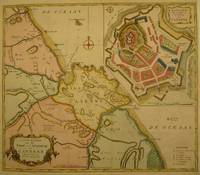
#[13617]Amsterdam Isaac Tirion ca. 1760. Engraved map contemporary coloured by hand with a large inset plan of the fortified town and castle to the upper right corner. Ca. 39 x 43 cm. A fine detailed map of Cayenne with many locations identified per key: sugar and coffee works indigo plantations the locations of native villages and a farmstead. An inset plan depicts the plan of the city with the cathedral parade ground Jesuit college hospital and the fortress. The region was not colonized until 1604 when the French founded their first settlement. It was soon destroyed by the Portuguese but the French colonists returned in 1643 and founded Cayenne. They were forced to leave once more following the attacks by the local Indigenous population. In 1664 France finally established a permanent settlement at Cayenne. Over the next decade the colony changed hands between the French Dutch 1658-1664 and 1676 and English before being restored to France. It was used as a French penal colony from 1854 to 1938. Koeman AN III Tir4. unknown
1925810841925. Manuscript report on on the recto sides only of 15pp of lined notepaper to the secretaries of a combined mining venture based out of Number 8 Old Jewry London. A few small dogears and creases some age toning of the paper and the fact that it's written in pencil make it a little tricky to decipher at times although a partial transcript is included from a previous collector. A very good <br /> A hand-written preliminary report which nevertheless contains a wealth of logistical and local detail regarding the business of pitching camp supply lines sickness boring results and assay findings depths propected gravel assessments depth of survey records etc. Comments regarding the local labor supply place the whole exploit firmly into the realm of exploitation with phrasing like ".the riff-raff of coastal negroes who are unstable - lazy and contemptuous of authority." A fascinating and ephemeral piece of industrial colonial history. Wray himself seems to have been a widely traveled mining surveyor with some of his recorded work being not only across Africa but also the Koorboora mining region of Queensland Australia among others. unknown
10091Trent House Main Street Georgetown British Guiana 10 June 1947. One page folio fold marks good condition. She has approached Dingwall as someone who could help make conditions in British Guiana better known in England. She refers to the enclosure of "Resolutions" from public meetings identifying herself as the wife of a King's Counsel "who has acted as a judge on the Supreme Court Bench of this Colony." They need help to take on the merchants who are standing in the way of improving the standard of living. "The extreme poverty of the working classes of this Colony makes it imperative that steps be taken to bring down the cost of living . . ." She notes that copies of the enclosures have been sent to Dr Edith Summerskill Quintin Hogg The Secretary of the Colonial Fabian Society F.A. Fulfordof the Editorial Staff The Catholic Herald. Accompanied by15 typewritten pages folio comprising Resolutions formed at public meetings: Resolution I four pages refers to '"blackmarket and corrupt" practices of a large section of the Mercantile Community "some of whom are members of the Georgetown Chamber of Commerce." She then covers the supply of basic foodstuffs flour split peas salted butter salt fish condensed milk and the effects of corrupt practices on various trades and others resolving that the "unfair monopoly" should be removed and action taken against the culprits. Resolution 2 2pp. outlines circumstances forced on the colony by war exigencies seven years of black marketing and hoarding etc. resolving that an Officer to support a Committee should be appointed to represent consumers. Resolution 3 making statements which lead to the resolution that an enquiry should be made into the cost of living that quota restrictions should be removed or a new quota system put in place and current quotas investigated. With: seven pages last one damaged with some loss of text of copy correspondence including documentation of business being stifled by corruption and an analysis of price rises on essential foodstuffs clothing and soap between 1938 and 1947 including comments on the black market etc. Trent House, Main Street, Georgetown, B[ritish] G[uiana], 10 June 1947. hardcover
26080The Times and the Globe London. Four letters by 'NIGER' to the Globe dated 29 and 30 January 9 February and 2 March 1850. Four letters to The Times two apiece from 'NIGER' and 'JACOB OMNIUM' dated in October and November 1850. A contemporary manuscript note to the present item reveals for the first time the identity of ‘Niger’ one of the two correspondents of whose letters it consists. And minor manuscript corrections to the last of the four letters would seem to suggest the involvement of the author. This is Sir James Robert Carmichael 1817-1883 2nd Bart who was intimately connected with British Guiana through his father Sir James Carmichael-Smyth 1779-1838. Having served from 1829 as governor of the Bahamas where he abolished the flogging of female slaves Carmichael-Smyth had been appointed governor of British Guiana in June 1833. According to Carmichael-Smyth’s entry in the Oxford DNB he ‘arrived at Georgetown Demerara shortly before the emancipation of slaves when much depended on the governor. Unmoved by the reckless hostility of a section of the planters Carmichael-Smyth by a firm impartial and vigorous government won the confidence of the slaves. He so closely supervised every department of government that as he himself observed he could sleep satisfied that no person could be punished without his knowledge and sanction. Carmichael-Smyth died suddenly at Camp House Georgetown Demerara of ‘brain fever’ after four days’ illness on 4 March 1838; he was widely esteemed and his death much regretted.’ The other correspondent ‘Jacob Omnium’ is Thackeray’s friend Matthew James Higgins 1810-1868 whose entry in the Oxford DNB states: ‘In 1838–9 he visited British Guiana where he later inherited the Alliance estate after the death of his mother and repeated the visit in 1846–7. This experience enabled him to keep his estate in good order during the critical period which followed the abolition of slavery and to put the case for the West India planters in defence of the protective sugar duties. He wrote four effective pamphlets upon the difficulties of the sugar-producing colonies in 1847 and 1849.’ The material consists of eight long letters in small print to the Globe and The Times laid down on nine foolscap 8vo pages over six leaves extracted from an album. The total length of text in 7-inch wide columns is 430 cm. In good condition lightly aged and worn on worn leaves. The first four letters from ‘Niger’ to the editor of the London newspaper the Globe are on the subject of ‘British Guiana and Governor Barkly’. These four are dated 29 and 30 January 9 February and 2 March 1850. ‘NIGER’ is identified in a contemporary hand at the end of the first letter as ‘Sir J R Carmichael’. The last four letters are an somewhat intemperate exchange in The Times of two letters apiece between ‘NIGER’ writing from London on 30 October headed ‘A WORD TO WEST INDIA PROPRIETORS’ and 12 November and ‘JACOB OMNIUM’ writing from Lombard Street on 10 and 16 November. At the start of the first of his letters to the Globe Carmichael states his position: ‘Mr Barkly has earned so high a reputation among men of all parties both in his late position in Parliament and in the discharge of his present arduous functions in Guiana that he may well afford to despise the bitter revilings of disappointed faction; but the article in question contains allegations so unfair ungenerous and unscrupulous in their nature that I consider the public should be made acquainted with the true state of the case at issue between the Morning Chronicle and the Governor of Guiana.’ This he proceeds to do presenting a mass of detail including some taken from ‘the lastest accounts’ he has received from ‘the West India mail’. In the first of his letters to The Times Carmichael discusses ‘the treatment the unfortunate race of Africa hae met with at the hands of the white man’: ‘I have known a slave to be destroyed by torture and a fine inflicted on the overseer as a punishment; but these thank God are tales of a bigone day. My only object in alluding to them is to point out to the West India proprietors that they have been guilty of a great and sad dereliction of duty of which they are now reaping the unavoidable punishment. They have treated the colonies as hotbeds from whence to forcec money into their pockets; they have forgotten what they owed to those whose toil supplied their wants and luxuries’. Higgins responds: ‘All that “Niger†says concerning the unhappy fate of the slaves in the British West Indies in bygone days may for all I know be most accurate. I cannot however divine why he has reverted to it. . Without disputing the accuracy of his picture of West Indian cruelty and West Indian mismanagement under the obsolete system of slavery I submit that it is . unfair and irrelevant to endeavour to introduce it into the present question between Lord John Russell and the free-labour sugar-growers’. In his last letter Higgins complains: ‘Your correspondent “Niger†preserves a great advantage over me. He well knows who I am the nature of my connexion with the colonies and the habits of my family and he very skilfully and I think somewhat unhandsomely turns the minutest points of that knowledge to his advantage whilst he carefully preserves his own incognito affording me no clue whereby I may infer what manner of man my assailant is.’ While acknowledging ‘Niger’ to be ‘a very able partisan’ Higgins concludes by accusing him of ‘doing his best to throw dust in the eyes of the British nation’. See Scan. I've yet to find an example of Carmichael-Smyth's handwriting to make a judgment on the signature. The setting out of the articles suggests a personal interest even file copy. The Times and the Globe, London. Four letters by 'NIGER' to the Globe dated 29 and 30 January, 9 February and 2 March 1850. Fou unknown
179930444Londres no printer 1799. Near cont. hcloth. A little rubbed. 6IV183 pp. Engraved portrait of Barthelemy. Halftitle and portrait loose. Halftitle soiled and browned. Large copy but slightly browned. At end a part of another work withbound. <br/><br/><em>There exists different print bearing the same year 1799 A second edition was issued also in 1799. - Sabin: 67627. </em> hardcover
1799311123London: printed for J. Wright 1799. First English edition. 4 215 pp. 8vo. Contemporary sprinkled calf morocco spine label lettered in gilt. Some rubbing to binding small split to front joint minor marginal worming at beginning. First English edition. 4 215 pp. 8vo. Narrative of the exile of several French revolutionaries to the penal colony of Cayenne in Guiana giving account of travel in the colony and of the voyage residence and escape. Sabin 67630 printed for J. Wright unknown
20663No place. Three of the signatures are dated from January 1932 the other two are undated. The five signatories are: Sir Alfred Claud Hollis 1874-1962 Governor of Trinidad and Tobago 1930-1936 and author of a historical account of Spanish Trinidad; his wife Enid Mabel Hollis née Longman Lady Hollis 1888-1939; Sir Edward Brandis Denham 1876-1938 Governor of British Guiana 1930–1935 and Jamaica 1935–1938; Sir Thomas Reginald St Johnston 1881-1950 Governor of the Leeward Islands 1929-1936; Sir William Charles Fleming Robertson 1867-1937 Governor of Barbados 1925-1932. On one side of a 13.5 x 16.5 cm leaf of cream paper torn from an autograph album. In good condition lightly aged. Three of the governors have signed in a column towards the centre of the page: 'Claud Hollis Governor Trinidad 17.1.32 Edward . Denham . Govr. British Guiana. 26.1.32. Reginald St. Johnston. Govr. Leeward Islands.' Hollis's wife has signed to the right of her husband's signature in the top right-hand corner: 'Enid Hollis' and beneath her signature in an extremely close hand is the signature of 'W. C. F Robertson. Govenor Barbados 31.1.32'. No place. Three of the signatures are dated from January 1932, the other two are undated. unknown
216661Amsterdam: Blaeu n.d. With contemporary coloring. Large Cartouche hand-colored upper rigt "Guiana sive Amazonum Regio." Signed "Guiljelmus Blaew" lower right. 1 vols. 15-3/4 x 20 inches. Mounted and framed. With contemporary coloring. Large Cartouche hand-colored upper rigt "Guiana sive Amazonum Regio." Signed "Guiljelmus Blaew" lower right. 1 vols. 15-3/4 x 20 inches. Blaeu unknown
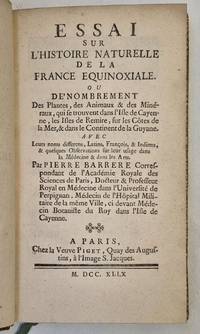
346<p>FRENCH GUIANA. BARRÈRE Pierre Essai sur l'histoire naturelle de la France équinoxiale ou Dénombrement des Plantes des Animaux & des Minéraux qui se trouvent dans l'Isle de Cayenne les Isles de Remire sur les Côtes de la Mer & dans le Continent de la Guyane Paris Piget 1741.<br />8° XXIV 216 pages 4 leaves ; contemporary calf.</p><p><br />The first monograph on French Guiana's natural history<br />First edition ; one of the scarce large paper copies mentioned by Sabin. Pierre Barrère 1690-1755 was a French physician and botanist from Perpignan. His thesis on the medical uses of botany attracted the attention of Antoine de Jussieu who put forward his name to the French regent Philippe d'Orléans. He was sent to French Guiana "France équinoxiale " as the King's physician and botanist in Cayenne from 1722 to 1725 to look for medecinal plants. During his stay in the colony he collected plants roots fruits and seeds as well as rocks and minerals which were incorporated into Jussieu's herbarium. After an epidemic of yellow fever he returned to France where in 1741 he published this work on the natural history of Cayenne and Remire in which he compiled a very complete alphabetical list of the plants of this part of the world - he referred to the nomenclature of Tournefort and Plumier - as well as the fauna and minerals. This book was followed by another entitled Nouvelle Relation de la France équinoxale in 1743.</p><p>Provenance: Jean-Baptiste Benoît Eyriès 1767-1846 geographer printer/editor and slave trader printed bookplate; Rémi Valdemar Chardey 1813-1900 collector from Le Havre who purchased part of the former's library at its posthumous sale.</p><p>Pritzel 425; Sabin 3603; Leclerc 1511: "This work is more difficult to find than the Relation de la France Equinoxiale by the same author."</p>
18372252821837. Watercolor on paper. 19 x 26 cm. 7-1/2 x 10-1/4 inches. Matted. Watercolor on paper. 19 x 26 cm. 7-1/2 x 10-1/4 inches. Adriaan David van der Gon Netscher was a member of the Netscher family a Dutch military family that traces its heritage back to the 1600s. <br /> <br /> Adriaan David was a naval officer honorably discharged in 1848 and a member of the Court of Police in British Guyana where he painted this striking little watercolor of the Public Building. unknown