Foreign Ministry of ArgentinaBiblio.com
89 résultats
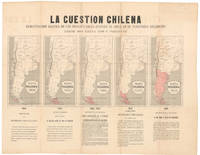
1878NL-02415<p><strong>Argentinian propaganda map of Chile's advance into Patagonia.</strong></p><p>This is an anonymous and undated propaganda map prepared by Argentina's Foreign Ministry for dissemination among potential allies on the American continents. It regards the conflict known as the "East Patagonia Tierra del Fuego and Strait of Magellan dispute" or "Patagonia Question" which was a territorial dispute between Chile and Argentina during most of the 19th century for more context see section below.</p><p>The sheet centers on five maps which are distinguished only by the varying size of the swathe of red that is meant to outline Chile's encroachment into Argentine Patagonia. The expansion process began in 1843 with only a few small islands and tiny peninsulas in the western part of the Strait of Magellan but by 1847 Chile was claiming the entire Strait as its own. The expansion continues in three subsequent phases each documented with its own map until 1876 when the territory in dispute consists of virtually all of Patagonia or the southern half of Argentina. Each of the intermediary stages in the quintet of displayed maps is dated and the territories in question are highlighted in red. Under each phase are noted the years in question as well as a brief explanation of the particulars of each phase of the expansionall of it from an Argentine perspective of course.</p><p>The Argentinian Foreign Ministry designed the map as a means of visualizing what Argentina considered the ongoing encroachment by Chile on Argentine territory. The broadsheet highlighted the blatant nature of Chilean territorial claims.</p><p>Because of this background and purpose the sheet was only distributed in limited circles making it a rarity today. The only institutional example of this map in the United States was presented to the US Minister to Argentina Thomas Ogden Osborn by the Argentine Minister of Foreign Affairs to serve precisely the purpose for which it was designed. The United States did indeed get involved and played a key role in the ensuing treaty negotiations 1879-1881.</p><p><strong>Census</strong></p><p>This sheet is rare likely because it was never produced in large quantities to begin with. There is only a single example of this sheet in US institutions. This document is located in the National Archives NAID: 5675669 and is the same sheet that Thomas Ogden Osborn sent to US Secretary of State William M. Evarts in 1880 following his role as US mediator in the negotiations for the 1881 Boundary Treaty that ended the conflict.</p><p>The only other institutional example we have been able to identify is held in the <em>Biblioteca Nacional de España</em> OCLC no. 431564806.</p><p><strong>Context is Everything</strong></p><p><em>The Strait of Magellan dispute and the "Patagonia Question" 18421881</em></p><p>The "Patagonia Question" was a nineteenth-century sovereignty dispute between Chile and Argentina over the southernmost lands of South America i.e. East Patagonia the Isla Grande de Tierra del Fuego and the strategically vital Strait of Magellan. Its roots lay in the messy inheritance of Spanish colonial jurisdictions and centuries of imprecise royal decrees that left overlapping claims along the entire Andean-to-Atlantic sweep. Both countries gradually sought to translate old legal claims into an effective national occupation: Chile concentrated on the Pacific channels and the Strait. At the same time Argentina pushed settlement eastward across the pampas and into Chubut.</p><p>Tensions hardened during the mid-1800s. Chile's deliberate occupation of the Strait of Magellan symbolized by the 1843 expedition that founded Fuerte Bulnes and formally took possession of the strait alarmed Buenos Aires and was the source of repeated diplomatic protests. Argentina in turn fostered new settlements established informal alliances with indigenous leaders and ensured a significant naval presence to assert influence on the Atlantic coast. By the 1870s both states were populating adjacent zones and commissioning maps and legal arguments to buttress their claims. This map is one such example from the Argentine side.</p><p>The trigger for a negotiated containment and ultimately a resolution of the conflict came in December 1878 when Chile and Argentina signed the FierroSarratea agreement. This was an interim pact that postponed a final delimitation and established arbitration procedures to avoid a fully fledged armed conflict. Chile quickly ratified the agreement but Argentina's Congress never gave its final approval causing it to collapse as a comprehensive settlement. The outbreak of the War of the Pacific 18791884 in which Chile fought Peru and Bolivia made rapid de-escalation with Argentina diplomatically urgent. Chile wished to avoid a second front. At the same time Argentina was engaged in the "Conquest of the Desert" on its southern frontier pushing it to resolve this old conflict as well.</p><p>The crisis was finally resolved by the <em>Boundary Treaty of 23 July 1881</em>. The treaty adopted a practical formula: north to the 52°S parallel the boundary would follow the highest Andes watershed; south of 52°S the agreement recognized Chilean sovereignty over the Strait of Magellan and assigned islands and Tierra del Fuego between the two states according to specified meridians and channels. Crucially the treaty neutralized the Strait of Magellan and guaranteed free navigation to all nations; a provision that allowed international passage through the strait and prevented any single power from controlling it.</p><p>US involvement in the dispute was modest. Washington did not act as an official guarantor or principal mediator in the 1881 settlement. However diplomatic records and dispatches confirm that the situation was under close observation and US diplomats regularly reported to their superiors on the crisis's development and its regional implications especially for shipping routes. Formal third-party arbitration and boundary adjudications were carried out by various state actors notably Britain or by various bilateral protocols. In short the U.S. was an interested observer rather than a decisive actor in both the dispute and its resolution.</p><p>The conflict illustrates how colonial legal ambiguities competing settlement policies and the strategic value of a single waterway combined to produce a long fraught boundary contest. The 1881 Boundary Treaty negotiated under the shadow of other regional wars and mediated by pragmatism rather than legality integrated competing claims into a workable frontier and ensured the neutrality of the Strait of Magellan for international shipping.</p><p>Condition Description</p><p>Good. Wear and toning along fold lines.</p> Foreign Ministry of Argentina
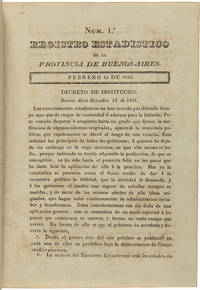
1823WRCAM36918Buenos Aires: Imprenta de la Independencia 1823. 208193-20031pp. Nos. 1-12. Nos. 1-10 paged continuously pages of No. 11 misnumbered pages of No. 12 numbered correctly 1-31 for second year of publication. The first eleven numbers were issued monthly February through December 1822; the twelfth issue was published March 1823. Contemporary diced sheep black leather label stamped in gilt. Outer joints and spine worn. Minor foxing and dampstaining. Very good. The extremely rare initial twelve issues of the first statistical register for the province of Buenos Aires. The publication was created by government decree on December 13 1821 reprinted here in the first issue published on February 15 1822. The REGISTRO ESTADISTICO. was charged with publishing statistics documenting conditions throughout the province with additional causes notes and observations. The issues are a fascinating compilation of facts and figures regarding all aspects of life in Buenos Aires in the early period of independence. On a regular basis data concerning geography meteorology the movement of populations and hospitals were recorded. Other areas documented in these issues include commerce means of production and education including courses taught at the university. <br> <br> An extremely rare government publication documenting the political economy of Buenos Aires in the early 1820s. OCLC lists nine locations for the register but only Cornell for the earliest issues. SABIN 68831. PALAU 253761. Imprenta de la Independencia hardcover books
1809PHO-1737Paris, J.G. Dentu, 1809. 3 volumes TEXTE, 2 vol. in-8°,[2]-xii-385, [2]-427 pp. , brochage d’attente orange, étiquette avec titre au dos, quelques frottement. ATLAS, 1 vol. in-4° (290x225),12 planches sous serpente en couleurs et une carte de Lapie, reliure d’attente, titre sur le plat, dos manquant, coutures apparentes, la carte est volante et datée de 1829, elle provient d’un autre ouvrage
1808314806London: the author 1808. First edition. Engraved folding map and 3 folding plates. viii 216 pp with errata mounted at leaf at end. 8vo. Antiqued calf. Title and following leaf soiled and neatly repaired maps trimmed or with edgewear rear hinge separated at second work wrappers of second work chipped. First edition. Engraved folding map and 3 folding plates. viii 216 pp with errata mounted at leaf at end. 8vo. Sabin 103672; Palau 375051. Bound with: Paz José C. Estudios sobre Instituciones Libres. Buenos Aires: La Prensa 1876 the author unknown books
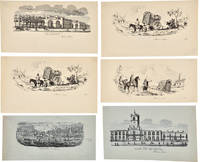
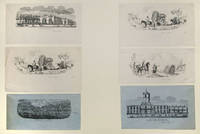
1855WRCAM41253Buenos Aires: R. Kratzenstein 1855. Lithographs on average 3 1/2 x 6 1/2 inches on slips of blue or white paper likely clipped from the top of pictorial letter sheets. Light edge wear. Very good. Matted. An attractive group of lithographic vignettes of scenes in and around Buenos Aires. These images were published by Rodolfo Kratzenstein who was one of the leading lithographers in Buenos Aires from the mid- 1850s and are likely from pictorial letter sheets issued by his firm in that period. One illustration shows a long stretch of the cityscape of Buenos Aires from the harbor and several ships are shown in the choppy waters of the port. Other images show the "Casa de Justicia" the courts and the "Palermo" neighborhood. Two other images one of them here in two examples show scenes in the countryside outside Buenos Aires both of them depicting men on horseback dealing with wagons in difficult terrain. Pictorial letter sheets from Argentina are uncommon and these are attractive images. R. Kratzenstein unknown books
185522646Buenos Aires: R. Kratzenstein 1855. Lithographs measuring on average 3 1/2 x 6 1/2 inches on slips of blue or white paper likely clipped from the top of pictorial letter sheets. Light edge wear. Very good. Matted. An attractive group of lithographic vignettes of scenes in and around Buenos Aires.<br/> <br/>These images were published by Rodolfo Kratzenstein who was one of the leading lithographers in Buenos Aires from the mid-1850s and are probably from pictorial letter sheets issued by his firm in that period. One illustration shows a long stretch of the cityscape of Buenos Aires from the harbour and several ships are shown in the choppy waters of the port. Other images show the "Casa de Justicia" the courts and the "Palermo"neighborhood. Two other images one of them here in two examples show scenes in the countryside outside Buenos Aires both of them depicting men on horseback dealing with wagons in difficult terrain. Pictorial letter sheets from Argentina are uncommon and these are attractive images. R. Kratzenstein unknown books
1823WRCAM46583Buenos Aires 1823. 4pp. Folio. Minor wear to top edge. Very good plus. In this message to Congress Rivadavia Interior Secretary and Garcia Treasury Secretary announce the recognition of Argentine independence by the United States and discuss relations with other South American countries. They also report to Congress on the condition of internal security and defense the treasury taxes debt medical sciences etc. Rivadavia later served as the first president of the Provinces of Rio de la Plata from 1826-27. Rare with one copy in OCLC at the British Library. unknown books
1890c2311100201xbvkParis, imprimé par autorisation de M. le Garde de Sceaux, à L'Imprimérie National, M DCCC XC.(1890); Lithograph printed by L. Léchaudel. 26 singleside printed large-paper cardboard-sheets, incl. 1 coloured plate; large-4to.(ca. 32 x 25 cm, few plates slightly smaller ca. 31 x 24 cm).
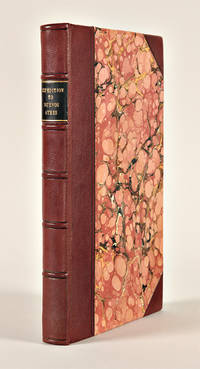
1808WRCAM41553London 1808. viii2161pp. plus four folding maps. Antique-style three-quarter calf and marbled boards. Minor offsetting and foxing on titlepage and other leaves facing maps. Old library stamps on first two leaves; contemporary ownership inscription on titlepage. Errata slip pasted to verso of titlepage. Very good. Untrimmed. In 1807 Gen. John Whitelocke was sent to the Rio de la Plata with a large force. His goal was to reinforce British troops already operating there and in Argentina and to seize Buenos Aires a move designed to open up the markets of South America to British commerce and replace those lost on the Continent by Napoleon's blockade. Despite his large force Whitelocke proceeded cautiously and ineptly further hampered by bad weather. The assault on Buenos Aires was met by civilian as well as military resistance when the British had expected local merchants to welcome them with open arms. Craufurd commanded a light brigade which led the attack on Buenos Aires and successfully achieved its objectives. However a large part of the attacking force was cut off and forced to surrender while Whitelocke napped in his tent and Craufurd's brigade was ordered to surrender with the rest of the British force. Santiago Liniers the Spanish commander proposed a truce if the British would promise to withdraw in two months but said he could not answer for the safety of the prisoners if the attack was renewed. Feeling that the object of the expedition was now untenable Whitelocke accepted those terms. The British withdrew to Montevideo and then to England losing what might have been a foothold in South America. Whitelocke was the subject of the greatest scorn on returning to England where he was court-martialed and cashiered. Though this work is sometimes attributed to Gen. Whitelocke the accusatory and wounded tone of the narrative makes that unlikely. SABIN 103672. PALAU 375051. HALKETT & LAING 1 p.164. DNB online. hardcover books
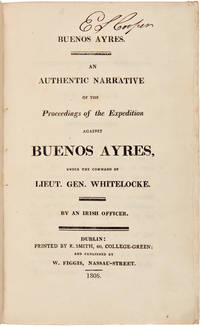
1808WRCAM35054Dublin: Printed by R. Smith and published by W. Figgis 1808. 109pp. 20th-century three-quarter morocco and cloth spine gilt. Shelf mark plate of Markree Library on front pastedown signature of E.S. Cooper on titlepage. A very good copy. An anonymous account by a field officer relating the unsuccessful British attempt under Lieut. Gen. Whitelocke to recapture Buenos Aires in 1807. The articles of the treaty ceasing hostilities between the Spanish and the British signed on July 7 1807 are included. Following this narrative the author provides a "brief description of the country and a short account of such circumstances as came under our observation in those parts we passed through." OCLC records only three copies. NAYLOR 26. ALBERICH 1210. Printed by R. Smith and published by W. Figgis hardcover books
1822WRCAM36917Buenos Aires: Imprenta de los Expósitos 1822. 5397pp. Nos. 1-23 plus supplement to No. 22 paged continuously. Quarto. Contemporary three-quarter sheep and marbled boards spine gilt. Outer joints and corners worn. A few pencil annotations. Occasional minor foxing. A very good copy. An extremely rare copy of the complete first volume of the most important Argentinean periodical of the early independence period. Edited by Florencio Varela Juan Cruz Varela and Ignacio Núñez the issues include news miscellaneous notices and short literary pieces in verse and in prose. CENTINELA was published weekly and then biweekly in 1822 and 1823. The two years of the periodical consist of seventy-two numbers and three supplements. This first volume is complete with twenty-three numbers and one supplement. Extremely rare. OCLC records four copies at New York Public the John Carter Brown Library the British Library and the Ibero- Amerikanisches Institute in Germany. PALAU 51467. OCLC 50151967. Imprenta de los Expósitos hardcover books
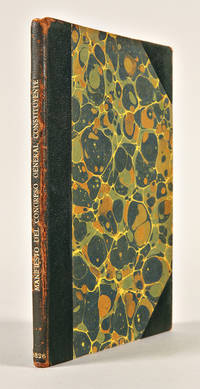
1826WRCAM37321Buenos Aires: Imprenta Argentina 1826. 12pp. Small quarto. 20th-century three-quarter morocco over marbled boards spine gilt. Edges and spine lightly worn upper outer joint moderately worn. Contemporary number inscription in top margin of first page of text. Lower right corners of first two leaves chipped. Moderate age-toning and foxing. A good copy. An extremely rare tract concerning the development of the Argentine constitution in the early republican period of that nation. In April 1819 a constitution was approved establishing a congress with two legislative branches and an elected chief executive. Due to the local political situation however that constitution was not fully enacted. A new constitution promoting a centralized system of government was eventually drafted in 1826. This manifesto of the government's constitutional commission presented to the Argentine representatives reviews various aspects of the 1819 Constitution and proposes changes to be effected in the new document. <br> <br> An extremely rare publication concerned with the early constitutional period in Argentina. OCLC locates only a single copy in the national Library of Chile. PALAU 148972. OCLC 55255075. Imprenta Argentina hardcover books
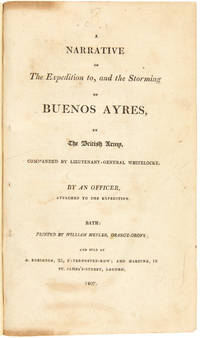
1807WRCAM35048Bath: William Meyler 1807. 238pp. plus one engraved plan. Modern half roan and boards spine gilt. Occasional minor foxing; minor titlepage repair with no loss of text. A very good copy with engraved bookplate of P. Francis K.C.B on front pastedown. An anonymous straight-forward account of the British attack on Buenos Aires in 1807 written "without any flourishing or prolix declamation on the calamities of war the effects of courage or the pursuit of wealth and fame." The unidentified author includes extensive details on the final engagements leading to the defeat of the British troops under Lieut. Gen. John Whitelocke by the Spanish citizen army of Creoles and peasants under the command of Santiago de Liniers. The plan and accompanying printed explanation of the plate assist in visualizing the narrative of the battle described in the text. Forced to withdraw from Buenos Aires after this defeat Whitelocke was court- martialed and cashiered. An intriguing record of the British engagement in Buenos Aires with an unusual Bath imprint for such a work. OCLC records only five copies. SABIN 51805. ALBERICH 1247. William Meyler hardcover books
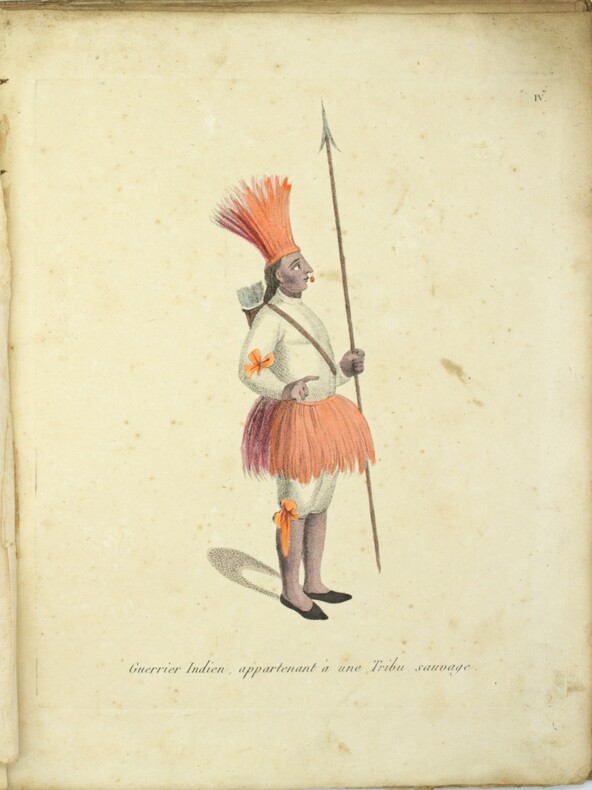
18585533S.l., 1858-1864 (pour la plupart) 1858 1 vol in-4° oblong (225 x 300 mm.) de: 35 ff. de dessins (les 6 derniers sur papier teinté); 3 ff. manuscrits ajoutés. Demi-chagrin noir d'époque, dos lisse orné en long d'un motif doré, titre doré « Album » sur le premier plat, tranches dorées.