Cynthia ArgentineBiblio.com

612 résultats
1637384238.Glibrary. Good. Access codes and supplements are not guaranteed with used items. May be an ex-library book. unknown
1331504309.Gpaperback. Good. Access codes and supplements are not guaranteed with used items. May be an ex-library book. paperback
0267668031.Ghardcover. Good. Access codes and supplements are not guaranteed with used items. May be an ex-library book. hardcover
0259596736.Gpaperback. Good. Access codes and supplements are not guaranteed with used items. May be an ex-library book. paperback
0331857146.Ghardcover. Good. Access codes and supplements are not guaranteed with used items. May be an ex-library book. hardcover
0332211800.Ghardcover. Good. Access codes and supplements are not guaranteed with used items. May be an ex-library book. hardcover
1391945166.Gpaperback. Good. Access codes and supplements are not guaranteed with used items. May be an ex-library book. paperback
139194528X.Ghardcover. Good. Access codes and supplements are not guaranteed with used items. May be an ex-library book. hardcover
1390718662.Gpaperback. Good. Access codes and supplements are not guaranteed with used items. May be an ex-library book. paperback
0366239031.Gpaperback. Good. Access codes and supplements are not guaranteed with used items. May be an ex-library book. paperback
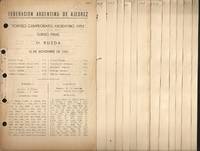
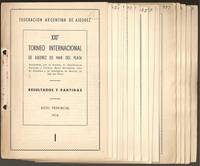
1954C133221 unpaginated tournament bulletins approximately 84 pages with tables. Octavo 8 1/2" x 5 1/2 bound in individual bulletin wrappers. First edition.<br /><br />The Second South American Zonal Chess Tournament took place in the Hotel Provincial in Mar Del Plata Argentina from April 3 through May 10 1954. It included the strongest players from Argentina Bolivia Brasil chile Paraguay Peru and Uruguay. The participants Oscar Pano from Argenitna captured first with 17.5 points just coming off his World Junior Champion ship the previous year. Capturing second only a half point behind was Miguel Najdorf also representing Argentina. Shared third and fourth was Herman Pilnik and Carlos Guimard with scores of 16.5 and both from Argentina. Erich Eliskases anther Argentinian emigre held sole fifth a half point behind. A point behind him was Hector Rosetto. Tied for seventh through ninth was Bernardo Wexler Emilio Dodero and Raul Sanguineti a full three and half points behind Rosetto in sixth. Tenth was Ruben Shochron with with the same number of points 10. Eleventh and twelfth was shared between Ruperto Schroder and Carlos Maderna a half point behind. Walter Cruz as sole thirteenth with 9 points. Fourteenth and fifteenth was a tie with Francisco Benko and Mariano Castillo. Again shared sixteenth and seventeenth was Lorenzo Balza and Joao de Souza Mendez with scores of 7.5. Finishing descending order was Jose Perez Alcocer followed by Cidar Humerez and tied Walter Estrada and Eduardo Salomon with Carlos Jauregui placing last. Oscar Pano Herman Pilnik Miguel Najdorf and Carlos Guimard and were the representatives of this zonal who finished third eight twelfth and thirteenth respectively in the Interzonal. Oscar Pano and Herman Pilnik went on to finish ninth and tenth in the Candidates which Vasily Smyslov and went on to beat Mikhail Botvinnik for the world championship.<br /><br /><b>Condition:</b><br /><br />Some edge wear with bumped corners four punch holes to edges some occasional notations else a very good set. Federacion Argentina de Ajedrez, Mar del Plata paperback
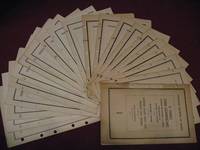
1955C1450<p>19 unpaginated tournament bulletins approximately 55 pages with tables. Octavo 8 1/2" x 5 1/2 bound in individual bulletin wrappers. First edition.<br /><br />The first Argentine Chess Championship was held in 1921. The Champion's title was granted after victorious or drawn match between previous champion and challenger a winner of <em>Torneo Mayor</em>. The matches were done away in 1950 year except for 1952. From 1953 the tournament was changed to an all-round invitation although in many cases it was played with the Swiss system.</p><p>The 33rd championship was played in 1955 with Miguel Najdorf the victor in a twenty player contested event. Hector Rossetto was a clear second with a score of 14.5 one and half points behind the leader followed by Erich Eliskases at 13.5.<br /><br /><strong>Condition:</strong><br /><br />Edge wear occasional notes punch hole to hinges hand drawn cross table indicating game pages else a very good copy.</p> Federation Argentina de Ajedrez paperback
1958C1412<p>15 unpaginated daily bulletins each 3 pages. Octavo 8" x 5 3/4" issued in wrappers. First edition.<br /><br />Mar del Plata has a rich history of chess tournaments including their international chess tournament and open tournament. There is also an annual city tournament which had its first edition in 1946 and reached its 62nd edition in 2007. The international tournament started off in 1928 but only in the period from 1941 to 1970 was it a truly international tournament with considerable reputation. After 1970 only seven international tournaments have been played. The 1951 1954 1969 and 2001 editions were zonal tournaments. The 1958 contest was held at the Hotel Provincial in Mar del Plata. and is part of an iconic beachfront complex built in 1946 by the celebrated architect Alejandro Bustillo.</p><p>Eighteen contenders battled for the trophy and placed in descending order: Bent Larsen from Denmark capture first with 12 points ahead of William Lombardy from America with 11. In a three way tie for third was Oscar R. Panno Erich Eliskases and Raul Carlos Sanguineti from Argentina. In Sixth was Hermann Pilnik from Argentina with 9. In seventh with 8 points was Jaime Emma another Argentinian contestant. Eighth was Hector Rossetto a local contender at 7.5. Tied for ninth was Alberto Foguelman and Enrique Reinhartd with scores of 7. Eleventh was Fernando Casas and Rene Letelier each with 6.5. In descending order of finishing were Julio Sumar with 5; Alfredo Olivera with 4.5; Jorge Behrensen with 4 and Jorge Pelikan at 3.5.<br /><br /><strong>Condtion:</strong><br /><br />A number sequence written in had at the top corners of pages some rust stain to two hole punch two bulletins number eleven; however one is actually twelve at hinge else a very good set.</p> Federation Argentina de Ajedrez paperback
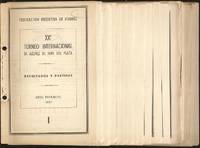
1957C1364<p>17 unpaginated daily bulletins each 8 to 10 pages. Octavo 8" x 5 1/2" issued in wrappers. First edition.<br /><br />Mar del Plata has a rich history of chess tournaments including their international chess tournament and open tournament. There is also an annual city tournament which had its first edition in 1946 and reached its 62nd edition in 2007. The international tournament started off in 1928 but only in the period from 1941 to 1970 was it a truly international tournament with considerable reputation. After 1970 only seven international tournaments have been played.1 The 1951 1954 1969 and 2001 editions were zonal tournaments. The 1957 contest was held at the Hotel Provincial in Mar del Plata. and is part of an iconic beachfront complex built in 1946 by the celebrated architect Alejandro Bustillo. Eighteen contenders battled for the trophy and placed in descending order: Paul Keres from Estonia first with a full point over Miguel Nadjorf of the host country with 15. Alexander Kotov from the Soviet Union and Oscar Panno from Argentina tied for third and fourth at 13. William Lombardy from the United States captured clear fifth 11.5. Raul Sanguinetti was a point behind him in sixth. Miguel Cuellar Gacharna of Colombia scored 8.5 for clear seventh. Eighth ninth and tenth was shared with Fernando Casas Hector Rossetto and Erich Gottlieb Eliskases a half point behind. In the sole spot of eleventh was Alfredo Esposito at 7.5 followed closely by Eugene Albert a half point behind. In Thirteenth through sixteenth a four way tie with Bernardo Wexler Jorge Behrensen Carlos Incutto and Walter Ader Hausman each with 5.5. Tied for the last two spots were Jose Thiago Mangini and Fernando Rubio Aguado each a point and half behind.<br /><br /><strong>Condition:</strong><br /><br />Light edge wear two hole punch at hinge some writing on the back page of volume 17 else a very nice set.</p> Federation Argentina de Ajedrez paperback
1912ZB485037Buenos Aires: Robles Herrando y Cia 1912. 12mo 18 pp. rules and regulations of this Masonic philanthropic organization; paper wrappers and title age toned but not fragile. - If you are reading this this item is actually physically in our stock and ready for shipment once ordered. We are not bookjackers. Buyer is responsible for any additional duties taxes or fees required by recipient's country. Buenos Aires: Robles, Herrando y Cia, unknown
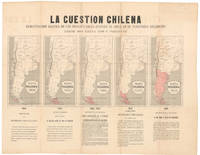
1878NL-02415<p><strong>Argentinian propaganda map of Chile's advance into Patagonia.</strong></p><p>This is an anonymous and undated propaganda map prepared by Argentina's Foreign Ministry for dissemination among potential allies on the American continents. It regards the conflict known as the "East Patagonia Tierra del Fuego and Strait of Magellan dispute" or "Patagonia Question" which was a territorial dispute between Chile and Argentina during most of the 19th century for more context see section below.</p><p>The sheet centers on five maps which are distinguished only by the varying size of the swathe of red that is meant to outline Chile's encroachment into Argentine Patagonia. The expansion process began in 1843 with only a few small islands and tiny peninsulas in the western part of the Strait of Magellan but by 1847 Chile was claiming the entire Strait as its own. The expansion continues in three subsequent phases each documented with its own map until 1876 when the territory in dispute consists of virtually all of Patagonia or the southern half of Argentina. Each of the intermediary stages in the quintet of displayed maps is dated and the territories in question are highlighted in red. Under each phase are noted the years in question as well as a brief explanation of the particulars of each phase of the expansionall of it from an Argentine perspective of course.</p><p>The Argentinian Foreign Ministry designed the map as a means of visualizing what Argentina considered the ongoing encroachment by Chile on Argentine territory. The broadsheet highlighted the blatant nature of Chilean territorial claims.</p><p>Because of this background and purpose the sheet was only distributed in limited circles making it a rarity today. The only institutional example of this map in the United States was presented to the US Minister to Argentina Thomas Ogden Osborn by the Argentine Minister of Foreign Affairs to serve precisely the purpose for which it was designed. The United States did indeed get involved and played a key role in the ensuing treaty negotiations 1879-1881.</p><p><strong>Census</strong></p><p>This sheet is rare likely because it was never produced in large quantities to begin with. There is only a single example of this sheet in US institutions. This document is located in the National Archives NAID: 5675669 and is the same sheet that Thomas Ogden Osborn sent to US Secretary of State William M. Evarts in 1880 following his role as US mediator in the negotiations for the 1881 Boundary Treaty that ended the conflict.</p><p>The only other institutional example we have been able to identify is held in the <em>Biblioteca Nacional de España</em> OCLC no. 431564806.</p><p><strong>Context is Everything</strong></p><p><em>The Strait of Magellan dispute and the "Patagonia Question" 18421881</em></p><p>The "Patagonia Question" was a nineteenth-century sovereignty dispute between Chile and Argentina over the southernmost lands of South America i.e. East Patagonia the Isla Grande de Tierra del Fuego and the strategically vital Strait of Magellan. Its roots lay in the messy inheritance of Spanish colonial jurisdictions and centuries of imprecise royal decrees that left overlapping claims along the entire Andean-to-Atlantic sweep. Both countries gradually sought to translate old legal claims into an effective national occupation: Chile concentrated on the Pacific channels and the Strait. At the same time Argentina pushed settlement eastward across the pampas and into Chubut.</p><p>Tensions hardened during the mid-1800s. Chile's deliberate occupation of the Strait of Magellan symbolized by the 1843 expedition that founded Fuerte Bulnes and formally took possession of the strait alarmed Buenos Aires and was the source of repeated diplomatic protests. Argentina in turn fostered new settlements established informal alliances with indigenous leaders and ensured a significant naval presence to assert influence on the Atlantic coast. By the 1870s both states were populating adjacent zones and commissioning maps and legal arguments to buttress their claims. This map is one such example from the Argentine side.</p><p>The trigger for a negotiated containment and ultimately a resolution of the conflict came in December 1878 when Chile and Argentina signed the FierroSarratea agreement. This was an interim pact that postponed a final delimitation and established arbitration procedures to avoid a fully fledged armed conflict. Chile quickly ratified the agreement but Argentina's Congress never gave its final approval causing it to collapse as a comprehensive settlement. The outbreak of the War of the Pacific 18791884 in which Chile fought Peru and Bolivia made rapid de-escalation with Argentina diplomatically urgent. Chile wished to avoid a second front. At the same time Argentina was engaged in the "Conquest of the Desert" on its southern frontier pushing it to resolve this old conflict as well.</p><p>The crisis was finally resolved by the <em>Boundary Treaty of 23 July 1881</em>. The treaty adopted a practical formula: north to the 52°S parallel the boundary would follow the highest Andes watershed; south of 52°S the agreement recognized Chilean sovereignty over the Strait of Magellan and assigned islands and Tierra del Fuego between the two states according to specified meridians and channels. Crucially the treaty neutralized the Strait of Magellan and guaranteed free navigation to all nations; a provision that allowed international passage through the strait and prevented any single power from controlling it.</p><p>US involvement in the dispute was modest. Washington did not act as an official guarantor or principal mediator in the 1881 settlement. However diplomatic records and dispatches confirm that the situation was under close observation and US diplomats regularly reported to their superiors on the crisis's development and its regional implications especially for shipping routes. Formal third-party arbitration and boundary adjudications were carried out by various state actors notably Britain or by various bilateral protocols. In short the U.S. was an interested observer rather than a decisive actor in both the dispute and its resolution.</p><p>The conflict illustrates how colonial legal ambiguities competing settlement policies and the strategic value of a single waterway combined to produce a long fraught boundary contest. The 1881 Boundary Treaty negotiated under the shadow of other regional wars and mediated by pragmatism rather than legality integrated competing claims into a workable frontier and ensured the neutrality of the Strait of Magellan for international shipping.</p><p>Condition Description</p><p>Good. Wear and toning along fold lines.</p> Foreign Ministry of Argentina
2000104107Buenos Aires: Fundación Argentina Solidaria / Fond Art 2000. 1st ed. Paperback. Used; Like New. 4to wrps 114 12p. color plates color photos. "La platería rural o gauchesca con los recados para el caballo los cuchillos facones dagas; el mante con amplia difusión en todos los niveles sociales y culturales; la platería civil-religiosa se aunan para ortogar un sello de identidad argentino". Printed on coated stock. Fundación Argentina Solidaria / Fond Art paperback
0845100874New. hardcover. New. Satisfaction Guaranteed or your money back. hardcover
8416233683.Gpaperback. Good. Access codes and supplements are not guaranteed with used items. May be an ex-library book. paperback
1332552285.Gpaperback. Good. Access codes and supplements are not guaranteed with used items. May be an ex-library book. paperback
1991029351Santa Fe Argentina: Government of the Province of Santa Fe 1991. Hardcover. Fine/Near Fine/Slipcase Very Good . 4to - over 9¾" - 12" tall. 127pp.; HB blk.emboss w/gilt; fine condition w/cleantight pgs. DJ gray w/red&white; fine. Slipcase white w/red&blk.; some rub w/lt.wear. Profile of Santa Fe Argentina from the Undersecretary of Planning's office. illus. <br/> <br/> Government of the Province of Santa Fe hardcover
0260157279.Ghardcover. Good. Access codes and supplements are not guaranteed with used items. May be an ex-library book. hardcover
19732091202133000753Tokuma Bookstore 1973. Soft Cover. Fine. Number of books: 1 Tokuma Bookstore paperback
45217326like new. unknown
ria9781291798807_inpHardcover. New. New Book; Fast Shipping from UK; Not signed; Not First Edition; N/A hardcover