[Uruguay]. [Slave Trade]Biblio.com
1 294 résultats
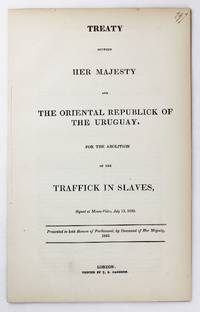
18426316London: T.R. Harrison 1842. Near fine. 38pp. stitched. Very minor bumps to top edge of first leaf light dust-soiling to outer leaves. A very rare treaty between Queen Victoria’s Britain and the “Oriental Republick of the Uruguay†printed in both English and Spanish in two parallel columns throughout. According to the text the parties were “mutually animated by a sincere desire to co-operate for the utter extinction of the barbarous Traffick in Slaves.for the special purpose of immediately attaining this object so far as relates to the total and final abolition of the Slave Trade of the Oriental Republick of the Uruguay.†The treaty is comprised of fourteen original articles plus three annexes totaling forty-six additional articles and four additional articles at the end covering a host of issues pertaining to the suppression of the slave trade. These issues included enforcement procedures the establishment of “Mixed Courts of Justice†“Regulations in respect to treatments of liberated negroes†and much more. With regard to slaves found on international vessels the two nations hoped for “permanent good treatment and a full and complete emancipation according to the humane intentions of the Parties of the Treaty.â€<br /> <br /> The present treaty was part of a larger effort by the British Crown to put an end to the transatlantic slave trade in the first half of the 19th century; at this same time Britain had reached terms on a similar treaty with the Republic of Texas and other nations. The document is signed at the end in type by J.H. Mandeville and Jose Ellauri representatives of the two countries who originally signed the treaty at Montevideo on July 13 1839; the present work was “Presented to both Houses of Parliament by Command of Her Majesty†in 1842 likely due to bureaucratic delays. Uruguay would have been an important ally for Great Britain in monitoring the seas against the transatlantic slave trade given its position opposite the South Atlantic Ocean from West Africa. OCLC records just a single physical copy of this treaty at the University of Arizona.<br /> <br /> Cundall 2854. T.R. Harrison unknown
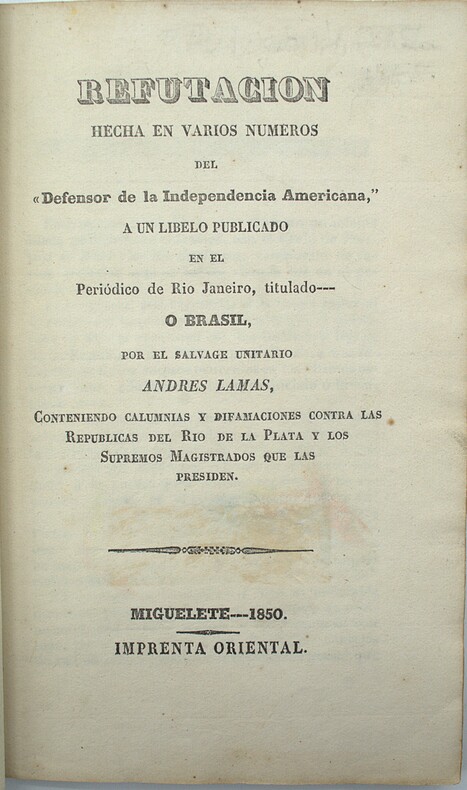
1850PHO-2494Miguelete, Imprenta oriental, 1850, in-12 (20x13,5cm), 147pp., brochage papier postérieur, étiquette de titre manuscrit au plat.
226885Paris, A. Cadart, s.d. (vers 1875) in-4, titre et 40 planches gravées à l'eau-forte, signées, en partie numérotées et généralement légendées, demi-chagrin olive, dos lisse orné de filets dorés, tranches mouchetées de rouge (reliure moderne).
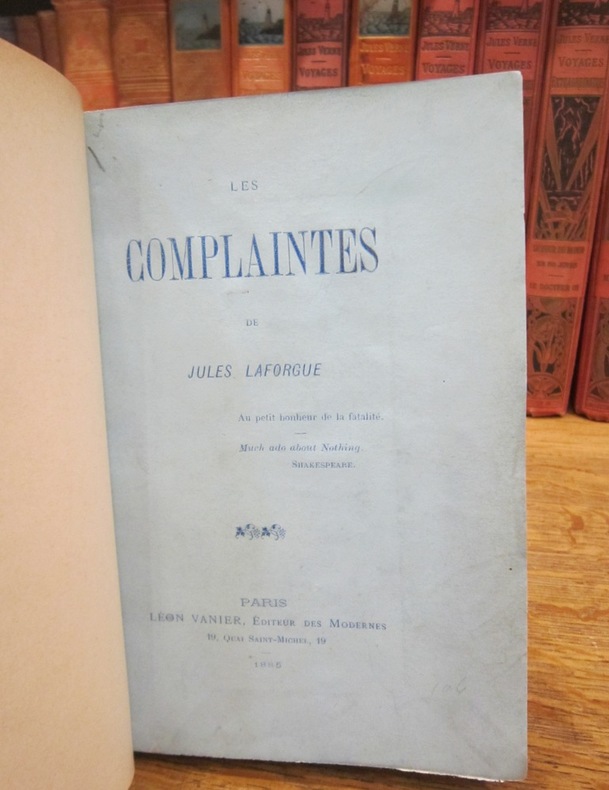
1885003201Léon Vanier, 1885
1925227551925. Latin America SS Resolute voyage photograph album 1925 documenting a steamship journey through Central and South America during the interwar expansion of international maritime tourism following the opening of the Panama Canal in 1914. The photographs record port cities landscapes and civic landmarks encountered along the Pacific and Atlantic coasts of Latin America during a period when luxury liners increasingly connected North American travelers with destinations across the hemisphere. By the 1920s transisthmian canal travel had reshaped global shipping and passenger routes allowing cruise itineraries to combine Caribbean Pacific and South American destinations within a single voyage. The album preserves visual evidence of these emerging travel circuits while also documenting major urban and cultural centers of the region during a period of modernization and expanding hemispheric exchange.<br /> <br /> Photo album compiled during the 1925 voyage of the steamship SS Resolute containing approximately 150 original silver gelatin photographs mounted to black album leaves and captioned in white ink. Contemporary red leatherette album titled "Photographs" in gilt and bound with red cord. Photographs measure approximately 3 x 4 inches to 4 x 6 inches. The photographs document the vessel's route through Panama and the Canal Zone before continuing along the Pacific coast of South America and returning through the Atlantic basin. Numerous photographs depict Panama City and the Panama Canal including views of the Culebra Cut and Gold Hill major engineering features of the canal project completed little more than a decade earlier. Other sections of the album record urban and harbor scenes in Cartagena Colombia including colonial architecture and waterfront activity. Photographs from Peru show Lima's Plaza de Armas the bullring at Miraflores and rural Andean valleys near Arequipa with terraced agricultural landscapes and local communities. Images from Chile capture the steep hills and harbor districts of Valparaíso along with coastal plazas and naval vessels near El Morro. Additional photographs from Argentina depict major civic spaces in Buenos Aires including Plaza San Martín and Plaza de Mayo documenting the monumental architecture and modernizing urban landscape of the city during the 1920s.<br /> <br /> The steamship SS Resolute operated as a passenger liner serving long distance routes during the interwar expansion of luxury cruising and international tourism. Voyages such as the one recorded in this album reflected the growing accessibility of transcontinental travel made possible by the Panama Canal and by the increasingly global network of commercial steamship lines linking the Americas. Mild toning consistent with age; mounts and binding well preserved. Overall very good condition. The photographs collectively document a hemispheric itinerary connecting canal infrastructure colonial port cities Andean landscapes and rapidly modernizing capitals offering a visual record of the cultural and geographic environments encountered by travelers during the height of the steamship era. unknown
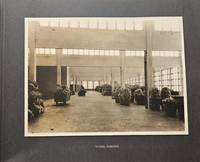
List3132Montevideo Uruguay N.d. Photo album with thirty-six captioned photos measuring 6 ¾ x 9 ¼ inches mounted on heavy cardstock. Album embossed “INDUSTRIA LANERA DEL URUGUAY S.A. / ILDU / MONTEVIDEO URUGUAYâ€. Photos with fine contrast two missing; slight wear to mounts and album; else Near Fine. Industria Lanera del Uruguay is a Montevideo-based wool manufacturing company that was founded in 1933. Offered here is a photo album likely from the late 1950s to mid-1960s showcasing ILDU’s high-tech factory—an introductory page from the album claims that ILDU had “a policy of yearly replacements†of equipment to keep “abreast of all technological improvementsâ€. The photos which are all captioned document the worsted wool manufacturing process from sorting and scouring to dyeing and weaving; the laboratories that test the product’s moisture level tensile strength and so on; and the luxurious “sample room†where gentlemen examine the finished product while relaxing in leather armchairs.<br /> <br /> Textiles especially wool made up a large percent of the Uruguayan manufacturing sector before 1960. Though manufacturing was slow to start because of a small population and political instability in the country and because so much of the country’s open space was taken up with ranching there was a massive boom in wool manufacturing in particular between the 1930s and 1950s.1 ILDU was one of the largest worsted wool companies in the ‘30s and is still operational today.<br /> <br /> Of interest to historians of South America’s manufacturing history.<br /> <br /> 1 Magdalena Bertino “La industria textil uruguaya 1900–1960†América Latina en la historia económica 31 June 2009: 99–126. unknown
In-8 gr. (mm. 252x165), 4 voll., cartonato moderno, conserv. copp. originali, pp. (2),332; 275,(3); 514; 588. Riccamente illustrati f.t. da complessive 6 carte geografiche più volte ripieg. e 97 tavole (di cui 15 ripieg.) litografiche in tinta e a colori relative a: vedute di località, ritratti degli abitanti dei luoghi visitati, scene di vita quotidiana, costumi, etc. Il vol. I, comprende un fascicolo di 16 pagine che riproduce i "Diagrammi delle pressioni barometriche e temperature minime e massime giornaliere" e alcuni disegni eseguiti dal cav. Massuero che rappresentano curiose antichità americane, ossia manufatti e oggetti raccolti durante il viaggio, fra cui degli scheletri umani”. Prima edizione. “Carlo De Amezaga (1835-1899), nato a Genova da una famiglia proveniente dalla Spagna. Arruolatosi volontario come marinaio di quarta classe nel 1848, entrò in servizio effettivo nella marina sarda il 10 febbr. 1849, come allievo di pilotaggio a bordo del veliero "Sofia".. Di notevole importanza è il viaggio di circumnavigazione attorno al globo della corvetta "Caracciolo", che il D. guidò fra il 1881 e il 1884, raccontandone poi le vicende e indicandone i principali risultati raggiunti in un'ampia relazione ("Viaggio di circumnavigazione della Regia Corvetta "Caracciolo" (comandante C. De Amezaga) negli anni 1881-82-83-84, I-IV, Roma 1885-1886). La spedizione partì da Napoli il 27 nov, 1881 e, toccando Cagliari, Gibilterra, Madera, San Vincenzo, Pernambuco, Rio de Janeiro, Santa Catarina, approdò a Montevideo il 3 marzo 1882. Il viaggio venne ripreso l'11 maggio alla volta di Possession Bay, Santa Elisabetta, Punta Arenas, Voces Bay, Wood's Bay, Boria Bay, Palia Cove, Sholl Bay, Fortune Bay, Colombine Bay, Puerto Bueno, Bahia Rayo, Bahia Caracciolo, Lecky Inlet, Chacabuco, Eden Harbour, Conner Cove, Hale Cove, Port Otway, Ancud, Lota, Valparaiso e Callao, dove giunsero l'8 ottobre. Ebbe inizio a questo punto il viaggio di istruzione lungo le coste del Perù, dell'Ecuador e della Colombia, che si svolse fra il 2 dicembre 1882 e il 10 aprile 1881 quando rientrarono a Callao dopo aver toccato Ancon, Chimbote, Mal Abrigo, Pacasmayo, Guayaquil, Panamá, Taboga, Paita, Guayaquil, Puná e Paita. Lasciata poi definitivamente Callao l'11 giugno 1883, rientrarono in patria il 9 settembre, sbarcando a Venezia, dopo aver toccato Papeete, Papetai, Vaiaré, Suva Figi, Sydney, Townsville, Thurday, Banda, Amboyna, Macassar, Singapore, Pulo Penang, Atcheen, Point de Galle, Mahé, Aden, l'isola di Perim, Assab, Beylul, Porto Tor, Suez, Ismailia, Porto Said, Candia e Brindisi. Le miglia percorse complessivamente furono 35.374, di cui 16.292 a vela” (così Diz. Biograf. Ital.,XXXIII, pp. 226-227). Ben conservato.
332591 page in8 - Très bon état -
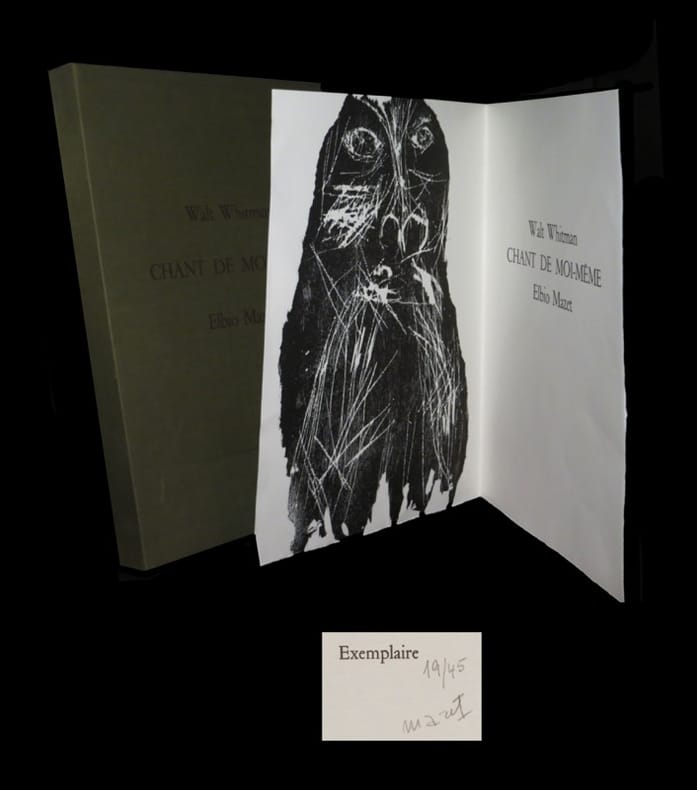
198330037S.l., (Centre international de recherche et diffusion de la gravure sur bois), (1983). Un vol. au format in-folio (382 x 282 mm) de non paginé, en feuilles, sous coffret de pleine percaline satinée olive, titre frappé à l'oser lie-de-vin au premier plat.
A beautiful and highly original livre d'artiste, with text by MÈresse 10 large full-page hors-texte original prints by Mazet (5 woodcuts and 5 embossings). Edition limited to 50 numbered copies printed on extremely fine, thick Arches wove paper and signed by the author and the artist. This copy with a long, poetic presentation inscription from MÈresse to AndrÈ Lagrange, signed in pencil and dated 1983. Folio. Loose as issued in cloth folding case. FINE AND BRIGHT.
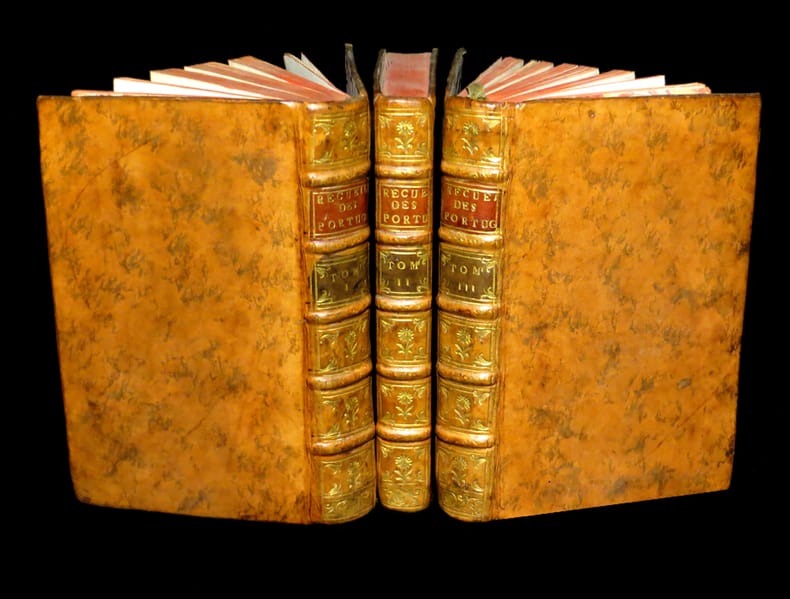
176019587A Amsterdam, chez M. [Marc] Michel Rey, 1760 et 1761. 3 vol. au format pt in-12 (163 x 104 mm) de 138, 48 pp. , f. n.fol., 275 pp. et 2 ff. n.fol. ; 1 f. n.fol., 241 pp. et 2 ff. n.fol. ; 108, 239 pp. et 4 ff. n.fol. Reliures uniformes de l'époque de plein veau glacé et marbré blond, plats jansénistes, dos à nerfs ornés de filets gras à froid, roulette dorée sur les nerfs, doubles caissons d'encadrement dorés, larges fleurons dorés, pièces de titre de maroquin acajou, pièces de tomaison de maroquin anthracite, titre doré, tomaison dorés, palette dorée en queue, dentelle dorée sur les coupes, toutes tranches rouges.
346382 pages in8 - Très bon état -
332582 pages in8 - Très bon état -
Pages 354-440 plus 24 pages of nice vintage advertisements. Features: The Bullet-proof Scotchman - an adventure of John Mundell in the Pampas of Uruguay; ; A Woman's Travels in Unknown Asia - part I - wonderful photos in China; An Exciting Trading Trip - efforts to trade with a warlike tribe in East Africa; Some Strange WWI Escapes from Germany - part II; Interesting photo and short article of Dog Rib Indians in Canada receiving their annual grant of one pound, as well as presents, from the Canadian government; Among the Wild Tribes of Darien - exploring the native tribes of Panama - with great photos; Stories of the War - Thirty Hours in No Man's Land - in WWI an Australian trooper on the Western Front is wounded and must make his way back to his own lines; Siringa's Last Battle - a native boy helps in one of the first fights in German East Africa, A Week in a Lens Dungeon - McLean and Ebbs of the 87th Canadian Battalion hid in a cellar for a week before making their way back to their lines; Miraculous Escapes from Sunken Submarines; An Adventurous Hunt After Man-eating Crocodiles - in Victoria Nyanza; The Mountain Warriors of France - excellent photos; The Zulu Love Medicine - part II of what happend when Zulus killed an Englishman to use his body for love medicine; Wonders of Northern Syria - article with many great photos of architectural remains; Carter's Exoneration - a stirring story of the Australian Mounted Police. Great multi-page advertising feature on the Waterproof Products Corporation. Average wear. Small protective pieces of tape at each end of backstrip. Binding intact. Unmarked. A sound vintage copy. Book
1871644231871. Early Printing of Uruguay's Civil Code Uruguay. Codigo Civil de la Republica Oriental del Uruguay. Paris: Rosa Bouret 1871. xxiii 542 pp. Octavo 8-1/2" x 5". Contemporary quarter morocco over pebbled cloth with blind-stamped panels large gilt arms of Uruguay to front board Raised bands gilt title and gilt ornaments to spine marbled edges and endpapers. Moderate rubbing to extremities with light wear to spine ends and joints corners bumped cracks to text block between front free endpapers and adjacent endleaves. Moderate toning to text light foxing in places internally clean. Ex-library. Location label to spine small inkstamp to title page. A nice copy of a rare title. $450. Second edition. With index. Originally published on 1 January 1868 this code is based for the most part on the Chilean Civil Code the Spanish Civil Code and the Code Napoleon with material drawn from with Roman canon and Spanish law. OCLC locates 2 copies worldwide neither in North America. unknown
1871644231871. Early Printing of Uruguay's Civil Code Uruguay. Codigo Civil de la Republica Oriental del Uruguay. Paris: Rosa Bouret 1871. xxiii 542 pp. Octavo 8-1/2" x 5". Contemporary quarter morocco over pebbled cloth with blind-stamped panels large gilt arms of Uruguay to front board Raised bands gilt title and gilt ornaments to spine marbled edges and endpapers. Moderate rubbing to extremities with light wear to spine ends and joints corners bumped cracks to text block between front free endpapers and adjacent endleaves. Moderate toning to text light foxing in places internally clean. Ex-library. Location label to spine small inkstamp to title page. A nice copy of a rare title. $450. Second edition. With index. Originally published on 1 January 1868 this code is based for the most part on the Chilean Civil Code the Spanish Civil Code and the Code Napoleon with material drawn from with Roman canon and Spanish law. OCLC locates 2 copies worldwide neither in North America. unknown books
1886586691886. Uruguay. Codigo de Comercio de la Republica Oriental del Uruguay: Nueva ed. Oficialmente Legalizada. Con las Reformas y Aclaraciones Promulgadas Hasta Enero de 1886 y Con una Tabla Analitica para Abreviar su Consulta y Facilitar el Estudio del Derecho Comercial. Montevideo: Imprenta de la Nacion 1886. xxii 2 392 pp. Royal octavo 10" x 7". Contemporary cloth blind frames to boards gilt title and blind fillets to spine patterned endpapers. Some rubbing to extremities spine ends and corners worn chip near center of spine small tear to rear joint cracks at beginning and end in text block which is secure. Light browning to text internally clean. Ex-library. Location label to spine annotations to front endleaves small inkstamps to title page. $450. First issue of this revision. OCLC locates 3 copies in North American law libraries Harvard SMU University of Michigan. unknown
1886586691886. Uruguay. Codigo de Comercio de la Republica Oriental del Uruguay: Nueva ed. Oficialmente Legalizada. Con las Reformas y Aclaraciones Promulgadas Hasta Enero de 1886 y Con una Tabla Analitica para Abreviar su Consulta y Facilitar el Estudio del Derecho Comercial. Montevideo: Imprenta de la Nacion 1886. xxii 2 392 pp. Royal octavo 10" x 7". Contemporary cloth blind frames to boards gilt title and blind fillets to spine patterned endpapers. Some rubbing to extremities spine ends and corners worn chip near center of spine small tear to rear joint cracks at beginning and end in text block which is secure. Light browning to text internally clean. Ex-library. Location label to spine annotations to front endleaves small inkstamps to title page. $450. First issue of this revision. OCLC locates 3 copies in North American law libraries Harvard SMU University of Michigan. unknown books
In 8° (17,3×11 cm); (2 b.), 48, 13, (3 b.) pp., 34, (2 b.) pp. Legatura novecentesca in piena pergamena semi-floscia. Esemplare in buone-ottime condizioni di conservazione. Prima edizione italiana e probabilmente, prima in assoluto, di questo interessante scritto di interesse americano. Della stessa opera, esistono diverse edizioni, una in francese (stampata a Parigi nel 1758), due in portoghese (stampate a Lisbona nel 1758 e nel 1759) e almeno tre in italiano (una del 1757, una del 1758 stampata a Siena e una del 1759 stampata a Lugano). L’opera presenta nella seconda parte la “ Breve di Nostro Signore PP. Benedetto XIV e decreti di S. M. Fedelissima”. Il “Manual Bibliographico de Estudos Brasileiros” n.° 4429, riferendosi all’edizione portoghese pubblicata nel 1759 scrive “Este escrito atribuido ao Marques de Pombal, minstero de D. Josè I, rei de Portugal e grande adversario dos Jesuitas, é un panfleto contra a Companhia … Este documento, apesr de seu tom apaixonado e muito parcial contra os Padres, é muito importante para a historia de um dos episodios maximos da vida e das atividades da Companhia de Jesus no Brasil”. Henry Stevens, Rare Anericanam n° 1326 descrive l’edizione italiana stampata a Lisbona nel 1758 dicendo” The original Portuguese Edition appeared at Lisbon in the same year (1758), and there was a edition in French, issued at Paris, also in 1758”. Oggi sappiamo che almeno un’edizione, questa, uscì già nel 1757 in lingua italiana. La seconda parte dell’opera contiene altri due scritti la “Deduzzione abbreviata degli ultimi fatti, e Procedure de’ Religiosi Gesuiti in Portogallo, e degli intrighi da essi macchiati nella Corte di Lisbona; scritta da un Ministro ben informato” e la “Breve di Nostro Signore PP. Bendetto XIV e Decreti di S. M. Fedelissima”. L’opera è un’importante pamphlet antigesuitico per attaccare i componenti della Compagnia di Gesù per la creazione delle celebri “Reducciones” , piccoli nuclei di cittadini, sopratutto nel Paraguay (ma anche in Cile, Uruguay, Bolivia, Argentina e nella Nuova Granada”), in parte autonomi dal potere centrale, da utilizzare come basi per l’evangelizzazione delle popolazioni indigene. L’idea iniziale era quella di creare realtà simili a quelle occidentali ma prive dei lati negativi di queste quali la depravazione, la corruzione, la lotta per il potere ecc. La fine delle Riduzioni fu l’inevitabile conseguenza delle lotte fra spagnoli e portoghesi, per il controllo del Sud America risolto nel 1750 con il Trattato di Madrid che sanciva i confini dei due imperi. Questo provocò migrazioni di popolazione. I gesuiti come i Guaranì non accettarono il trattato. I gesuiti ottennero dal sovrano spagnolo, dopo il pagamento di enormi ricchezze, di lasciare che l’opera di evangelizzazione potesse andare avanti con i metodi fino ad allora utilizzati basati sui valori religiosi e culturali ma impossibile fu ottenere lo stesso dal sovrano portoghese per i rapporti, già fortemente deteriorati con i gesuiti. Questa mancanza di accordi portò allo scoppio di diversi scontri, fino al definitivo inizio, di quella che sarebbe poi passata alla storia come la Guerra Guaranì che imperversò dal 1750 fino al 1756. Nel frattempo, in Europa, i gesuiti subirono fortissimi attacchi diffamatori con la pubblicazione di libelli e opere diffamatorie che puntavano a discreditare la Compagnia di Gesù agli occhi dei popoli europei. Prima edizione, assai più rara di tutte le edizioni edite nel 1758. Rif. Bibl.: IT\ICCU\CFIE\037507 che descrive questa edizione del 1757 priva però la “Deduzione, abbreviata degli ultimi, e Procedure …ecc., l’Avvertimento e la Breve di Nostro Signore PP. Benedetto XIV e decreti di S. M. Fedelissima); Borba de Moraes, II/ppp. 184-5, Palau, XVI/n. 260622; Parenti, Falsi Luoghi, p. 112; Henry Stevens, “Rare Americana” n° 1326, descrive però l’edizione italiana stampata a Lisbona nel 1758.
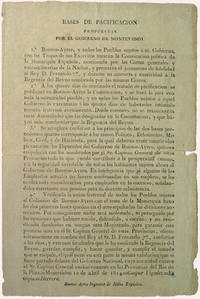
181437081Buenos Ayres: Imprenta de Niños Expòsitos 1814. First edition. Old horizontal fold with a few thin tears a few minor chips at the margins; lightly toned a good copy. Broadside. 1 pp. 4to. Dated Montevideo 12 de Abril de 1814. The proposal for the peace by the government in Montevideo including the oath of allegience to Fernando VII was rejected by the Provincias Unidas de la Plata. OCLC shows two copies: JCB and BN Chile. Furlong: IV 3045-6. Zinny: BibliografÃa histórica p.113 No. 8. Imprenta de Niños Expòsitos unknown books
191894777Buenos Aires: Talleres de la Casa Jacobo Peuser 1918. marginal wear in boards; water stain in verso wrps; o/w v.g. and clean copy. plus 7 color tipped-in color plates incl. 1 ex-libris w/ tissue overlays illus. deckled edges color pict. wrps. loose as issues in embossed decorations and gold stamping on frt. boards. The present artist book by Carlos Reyles is one of 2 volumes of the narrative fiction written during the early years of WWI and inspired in the literary form of a mimetic dialogue where two Olympian gods discuss liberty justice and the imperialist intentions of Germany. Color illustrations by Gregorio López Naguil b. Argentina 1894-1953. Naguil formed part of the "grupo de larue Bagneux" in París and then to Mallorca 1913 where he met and worked with Roberto Montengro from Mexico and other artists from Argentina and Mexico during the teens and early 1920s. Both artists adopted Orientalism in their work. López Naguil returned to Argentina in 1915 he returned to settle in Mallorca after the war ended between 1919-1922 when Diego Rivera accompanied by Angelina Beloff Mary Blanchard and Jacques Lipchitz visited and lived there . During the period in Argentina he became a tireless promoter of the aritsts he knew in Paris and Mallorca and while enhancing the footprint of the nouveauy graphic illustration in Argentina. He illustrated Plus Ultra the most important illustrated magazine of the period. Upon his return of Mollorca from 1919-1922 he continued his work with many artists including Montenegro. Both of these artists developed the book arts along similar lines. López Naguil returned to Buenos Aires as the director/designer for the Teatro Nacional Cervanted and from 1950 until his death at the Teatro Colón. SCARCE. [Talleres de la Casa Jacobo Peuser] unknown
Madrid, Imprenta de la Viuda de Manuel Fernandez, 1755. 4to.; 2 hs., XVI pp., 398 pp. y un mapa plegado, grabado en cobre, que muestra las misiones jesuitas en la India. Encuadernación en pergamino, de la época. Parte destacada del presente volúmen esta formada por las "Cartas" del Padre Sebastian Rasle (1658-1724) en las Misiones del Canadá, entre los Indios Abenakis, en Norridgewock, en el Rio Kennebec, en tiempo de las luchas contra los ingleses de New England, a manos de los cuales murió finalmente tras haber sido puesta a precio su cabeza. Su prestigio y fama entre los Abenakis fue imperecedero, su conocimiento de su lengua y costumbres impresionante, como lo prueba el manuscrito de su "Diccionario de la Lengua Abenaki", milagrosamente conservado hasta hoy en la Biblioteca del Harvard College y publicado en 1835. Otra interesante relación es la que contiene el viaje y estancia en el Tibet entre 1716 y 1721 del Padre Ippolito Desideri. No menor es el interés del Informe de la Visita de Fray José Peralta, Obispo de Buenos Aires, a las Misiones jesuítas del Paraguay en 1743.
1856533Montevideo: Libreria Nueva 1856. Very good plus. 38pp. plus final blank. 16mo. Stitched as issued. Minor wear and soiling. Unrecorded Uruguayan currency converter designed to assist with the revaluation of gold which was passed in 1856. Under the new legislation the onza de oro was revalued from 16000 to 15360 and the patacon to 960 centesimos. The present work is a series of tables converting patacones to pesos with overall relative values indicated on the final page. Rare and ephemeral designed for use and eventual discard when the monetary system changed again less than ten years later. OCLC locates only two other works by this publisher. Not in Estrada. Libreria Nueva unknown books
187621160Montevideo 1876. 7 1 pp. Original printed wrappers with vignette of a steamboat on front cover light dustsoil minor wear signature of William H. Poole of New Bedford Mass. on both wraps. Light uniform tanning minor foxing. Very Good. <br /> <br /> The last page contains the Tariff for the pilots of the port. Signed in type by Ernest Courtin Montevideo June 20 1876. "Masters of vessel having coloured persons on board are to give an exact account of them whether they be included in the Muster Roll or not and to point out such as are slaves." <br /> Not located on OCLC as of November 2013. unknown
187621160Montevideo 1876. 7 1 pp. Original printed wrappers with vignette of a steamboat on front cover light dustsoil minor wear signature of William H. Poole of New Bedford Mass. on both wraps. Light uniform tanning minor foxing. Very Good. <br/><br/> The last page contains the Tariff for the pilots of the port. Signed in type by Ernest Courtin Montevideo June 20 1876. "Masters of vessel having coloured persons on board are to give an exact account of them whether they be included in the Muster Roll or not and to point out such as are slaves." <br/>Not located on OCLC as of November 2013. unknown books