(CONTI Anita) / GIRAULT-CONTI LaurentLivre Rare Book

2 800 résultats
2009CANADAAAA959420320Paris, Editions du Chêne, 2009, 23 x 27,5, 192 pages sous couverture rempliée illustrée. Photographies noir & blanc (et couleurs). Introduction de François Bellec.
1991LFA-126730446Un ouvrage de 172 pages, format 220 x 275 mm, illustré, relié simili-cuir sous jaquette couleurs, publié en 1991, bon état
1967LFA007f8N° 956 - 5 août 1967 - numéro complet - bon état
26935A Cologne, & se trouve à Paris, Chez Nyon, 1772. With engraved frontispiece. xliv, 436 pp. 8vo. Contemporary marbled calf, spine gilt withr aised bands, label with gilt lettering, slightly rubbed, some discolouring, marbled edges. Sabin 20201; Leclerc 453; Muller 975 (all listing the first edition). Second edition, first published in 1767. This work is largely based on a manuscript by P. Champion, Jesuit, who had started having a life of Palafox printed, but the impression was stopped. Dinouart says in his preface he was happy in being able to procure the entire mansucript of Champion which enabled him to complete the life of the celebrated bishop (Sabin).Juan de Palafox y Mendoza (June 26, 1600 - October 1, 1659), a Spanish politician, administrator, and Catholic clergyman in 17th century Spain and viceregal Mexico. Palafox was the Bishop of Puebla (1640-1655), and the interim Archbishop of Mexico (1640-1642). He also held political office, from June 10, 1642 to November 23, 1642 as the Viceroy of New Spain. He lost a high-profile struggle with the Jesuits in New Spain, resulting in a recall to Spain, to the minor Diocese of Osma in Old Castile. In 1639 Philip IV nominated him, and Pope Urban VIII appointed him, as Bishop of Puebla de los Ángeles in viceroyal Mexico. Puebla de los Ángeles was the second largest city in the Viceroyalty of New Spain (viceroyal México) then, and is the present day City of Puebla. He was consecrated at Madrid on December 27, 1639. As bishop, Palafox arrived in Veracruz on June 24, 1640. He was in the company of the new Viceroy of New Spain, Diego López Pacheco, 7th Duke of Escalona, whom he had gotten to know during the voyage. That same ship brought an Irishman, William Lamport, known in New Spain as Don Guillén de Lombardo y Guzmán, who played a role in political turmoil during the 1640s. Palafox was also named Visitador (royal inspector, representative of the king), to investigate the two previous viceroys.Palafox founded the Biblioteca Palafoxiana on September 5, 1646, stocking it with five thousand books of science and philosophy. He also founded the Dominican Convent of Santa Inés, the Colleges of San Pedro and San Pablo, and the girls school Purísima Concepción. He amended the by-laws of the seminary of San Juan, and worked diligently on completing the cathedral, which was dedicated April 18, 1649. As bishop, Palafox y Mendoza distinguished himself by his efforts to protect the Native Americans, forbidding any methods of conversion other than persuasion. - Small stamp on page v: Toulouse 1777, and a scribbled name . A good copy.
27205A Paris, Chez Cellot & Jombert, 1778. [2], 452, [4, Privilege du Roi, Fautes à corriger, blank] pp. 12mo. Contemporary marbled calf, spine richly gilt in compartments, label with gilt lettering, red edges, a nice copy. Sabin 21037; Leclerc 868; Faÿ 11; Howes D.528; Monaghan, French Travellers in the United States, 580B; Muller 1597; not in Streeter sale; not in Kress; not in INED; Echeverria, Mirage in the West, p. 74; Echeverria & Wilkie, 778/20; Chadenat i, 813. First edition of this important work dealing with the War of Independence of the British colonies. An early French account of the Revolution, published about the time of the French entry into the war on the side of the Americans. "Day-by-day account of events from Gage's arrival at Boston until French recognition" - Howes. The author favours free trade with the American colonies, which had just been officially recognised as an independent state. Pp. 433-450 contain: Traité d'amitié et de commerce conclu entre le Roi et les Etats-Unis de l'Amérique septentrionale, le 6 février 1778 and U.S. Declaration of Independence: Declaration des Répresentans des Treize Provinces-Unies de l'Amérique, assemblées en Congrès-Général, le 4 juillet 1776 (pages 340-351.)
18768A Amsterdam, Chez J.L. de Lorme, 1704. Title printed in red and black. With 1 folding table. (10), 317, (1) pp. 12mo. Contemporary calf, spine gilt with raised bands, red label with gilt lettering. Kress 2421; Goldsmiths 4038; Einaudi 1626,note; Sabin 98172n; Alden & Landis 704/56; Echeverria & Wilkie 704/7; not in Howes; not in Streeter; not in Leclerc; not in Muller; not in JFBL. The best edition, with extensive notes added. One of at least 7 editions published in 1704. Originally published in 1703. As a matter of fact there never was an English edition, but the author apparently preferred to pass it off as such to avoid problems with the authorities, since he represented the French court as an ambassador in The Hague. Anti-British work that surveys British trade and commerce in Europe and that with the American colonies and the Indies predicting that the Navigation Acts will result in revolt and independence for the British North American colonies. "Sets out the advantages and disadvantages of the Spanish War of Succession to Great Britain's commercial interests, together with the advantages to Spain of free trade in her colonies. This work is remarkable as containing a distinct prophecy of the revolt of the American colonies from Great Britain" (Encyclopaedia Britannica Online).
27078A Paris, Chez Jean-Baptiste Coignard, 1720. With 6 engraved plates, four of which are folding and including a plan of Lima. Two parts in one volume. xxxv, [1, blank], 282, 244, [2] pp. 12mo. Nineteenth-century half morocco, spine with raised bands and gilt lettering, marbled boards. European Americana 720/78; Sabin 21437; James Ford Bell Library D354; Gove, The Imaginary Voyage in Prose Fiction, p. 233; Conlon 20:394; not in Echeverria & Wilkie; Goldsmiths' 5610; not in Kress or Einaudi. First edition of this scarce book which, although suggesting to be an account of a voyage to South America, is actually a work of fiction. Durret himself claims that it was based on an account by the "Sieur Bachelier" to which he only added notes and of which improved the style. This however is not correct, the work is by Durret. "Chapter 17 of the first part and chapter 19 contain descriptions of Santa Catharina and Brazil in general. The letter is signed "Durret," but the account is by Bachelier, a surgeon. Father Labat believes this was an imaginary voyage" (Borba de Moreas, i, p. 281)."Récit, selon Barbier, plein de bévues et de contradictions, car D. l'aurait fait sans sortir de chez lui. Détails sur les moeurs, et sur les coutumes nuptiales de Malte, du Maroc, des Canaries, du Brézil, du Chili, du Pérou, de Madagascar, etc." (INED 1678.)"Contains useful information on the products of the South American coast" (James Ford Bell Library). - Title page cut short at foot and outer margin.
18735No place, 1772. 2 works bound in 1 volume. 151, (5, publisher's catalogue) pp.; 156, 3 pp. 12mo. Contemporary marbled calf, spine gilt in compartments, gilt lettering, marbled edges. First work: Fay 10.; Sabin 25583; cf.: Kress B.122 (incomplete copy); Goldsmiths 11761 (lacking last 5 pp.); this edition not in Einaudi. Second French edition, first published in 1777. The translation is by F.A. Quétant & J.B. Lecuy. The work had a tremendous and instaneous appeal as a sort of gospel of the virtues of bourgeois thrift and common sense (see at length: Echeverria, Mirage in the West.) Includes, apart from "La Science ...." also: 'Interrogatoire de M. Franklin devant le Parlement d'Angleterre' (translated by P.S. Dupont de Nemours), followed by 'Constitution de la République de Pensylvanie, telle qu'elle a été établie par la Commission générale de Philadelphie, au mois de juillet 1776' and followed by 'L'interrogatoire de M. Penn à la Barre du Parlement au mois de novembre de la même année.'Second work: INED 2863; not in Kress; not in Higgs; not in Einaudi; not in Goldsmiths. First edition. Etienne Silhouette, to a certain extent influenced by the ideas of Fr. Quesnay, was controleur-général des finances in 1759. He planned to tax the land property of the nobility and to reduce pensions, which provoked his disgrace. - With label J.S. Dussi on front paste-down. A very nice copy.
15440A La Haye, Chez Pierre de Hondt, 1739. Titles printed in red and black, with folding table on two sheets and 1 engraved plate. 6 volumes in 3. (2), 204 pp.; (2), 312 pp.; (2), 208 pp.; (2), 286 pp.; (14), 294 pp.; (18), 246 pp. Small 8vo. Modern overlapping vellum, red morocco labels. Kress 4447; Goldsmiths 7712; Einaudi 3728; INED 1553; Mattioli, 2247; Conlon 39:427; JFBL M162; European Americana, 739/191; not in Sabin. The only edition of this important work. An account of the financial operations of John Law and his 'Compagnie des Indes', including a great number of important memoirs, letters patent, decrees, declarations, etc. Barthélemy Marmont du Hautchamp (1682 - ab. 1760) was an admirer of John Law's system and his book is not written without partiality but has yet been recognized as the best contemporary history of the system and its most precious source. John Law's operations began with the foundation in 1716 of the 'Banque Générale', soon afterwards renamed 'Banque Royale'. This was followed by the scheme of colonization known as 'Mississippi scheme' in the 'Compagnie des Indes' which, by absorbing various other chartered companies, acquired the monopoly on the trade to America, Africa and China. Moreover, the company obtained the monopoly of tobacco, the control of the mint, the payment of the national debt, and the farm of the taxes. Within a few years Law's companies thus got almost complete control over France's overseas trade, its currency and public finances, to the extend that Law's companies at one point owned more than half of the then known United States. In 1719 the 'Compagnie des Indes' and the 'Banque Royale' were united, and the promising outlooks of the new company lead to an unprecedented speculation in its shares. As known the bubble burst in 1720, cash payments were suspended and Law fled from the country, leaving behind ruined many of his former supporters.The last 2 volumes contain the full texts of the 'mémoires', 'letters patentes', 'édits', 'déclarations', 'arrêts', etc., mostly by the Conseil d'État, as well as many other documents of which many are dealing with the 'Compagnie d'Occident', and the 'Compagnie des Indes Orientales et de la Chine', on which documents the author based this thorough and important history.Marmont du Hautchamp was born in Orléans and fermier des domaines in Flanders. He was also the author of the famous and very rare Histoire générale et particulière du visa (also published in The Hague, in 1743) which also dealt with the activities of John Law and the Mississippi bubble.
19871718PANTIN. ICARE. 1987. IN-4 BROCHE (24 X 32 CENTIMETRES ENVIRON) DE 172 PAGES, COUVERTURE ILLUSTREE EN COULEURS, CORRESPONDANT AU NUMERO 120, 1987/1, DE LA REVUE. BON ETAT.
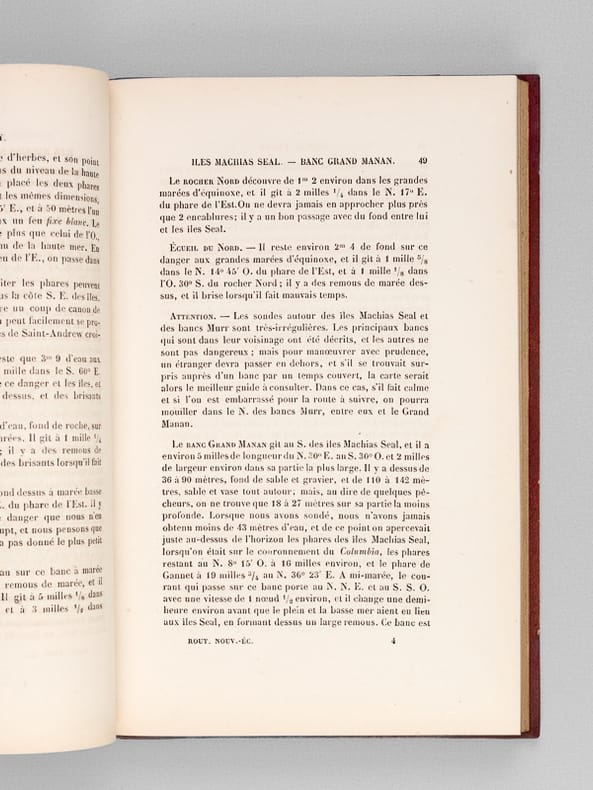
186163663[ Traduction par A. Le Gras ], 1 vol. in-8 reliure de l'époque demi-chagrin rouge à coins dos orné, double filet doré en mors et coins, coll. Dépôt des Cartes et Plans de la Marine, Imprimerie Administrative de Paul Dupont, 1861, 2 ff., IV-196 pp.
199166634Henri Veyrier, coll. « Kronos », n° 10 1991 Tome 2 seul. In-8 broché 24 cm. Très bon état d’occasion. Poids sans emballage : 560 grammes.
199166636Henri Veyrier, coll. « Kronos », n° 10 1991 Tome 3 seul. In-8 broché 24 cm. Très bon état d’occasion. Poids sans emballage : 560 grammes.
16022La Haye, 1755-1756, 180x120mm, 456pages, broché. Non rogné, cachet noir sur la page de titre.
24270A Amsterdam, Et se trouve à Paris chez Duchesne, 1756. xlvii, (1), 352 pp. 12mo. Contemporary marbled calf, spine richly gilt with raised bands, red label with gilt lettering, red edges. Echerverria & Wilkie 56/40; Sabin 75520; Chadenat 4121; JFBL S61; INED 4034; Higgs 1501; Kress 5567; Conlon 56:1257; not in Goldsmiths; not in Einaudi. First edition, and very rare, of this work which discusses in 18 letters and at the moment the Seven Years' War was about to start, the consequences of the presence of various European nations in North America with the aim to find some sort of balance of power between the various colonizing European nations, to avoid a war and to encourage commerce and trade. 'There are several issues of this edition occasioned by cancellanda (D4-5, D11-12, E10, G11, and I5-8, all of which are present in this copy). No copy is known, however, that is not a mixture of both canellanda and cancellantia: thus, what the original text was as first printed is problematic. (.....) In the two BN copies, (....), the imprint date has been alterted in manuscript to read M.DCC.LVII. (This is also the case with the present copy where the second 'I' has been added in manuscript.) This is a series of letters dated July-September 1756, forming an essay on international power politics with special reference to European colonial systems in America' (Echeverria & Wilkie).'Intéressant pour l'origine de la guerre du Canada' (Chadenat). 'A consideration of Europe's involvement in North America with a view to establishing a balance of power among the colonizing nations which would eliminate war and encourage commerce' (JFBL). 'Déterminer la nature des divers équilibres propres aux différentes colonies septentrionales et méridionales des peuples de l'Europe, en étudiant les variations de leurs cultures, leur commerce, leur population, leurs différentes distances, etc.' (INED). - Contemporary signature and author's name in blank portion of title.
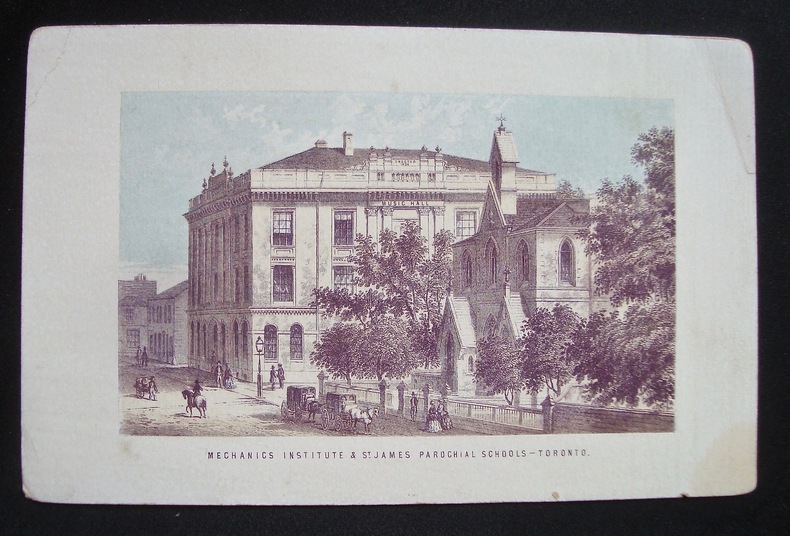
34336Chromolithograph of Mechanics institute & St. James parochial scholls (Toronto) : 4,7x2,8 inches (size of engraving) - 6,45x4,01 inches (size of the card) - undated (circa 1860) and unsigned (maybe printed by Currier & Ives) -
34339Chromolithograph of Normal scholl building (Toronto) : 4,7x2,8 inches (size of engraving) - 6,45x4,01 inches (size of the card) - undated (circa 1860) and unsigned (maybe printed by Currier & Ives) -
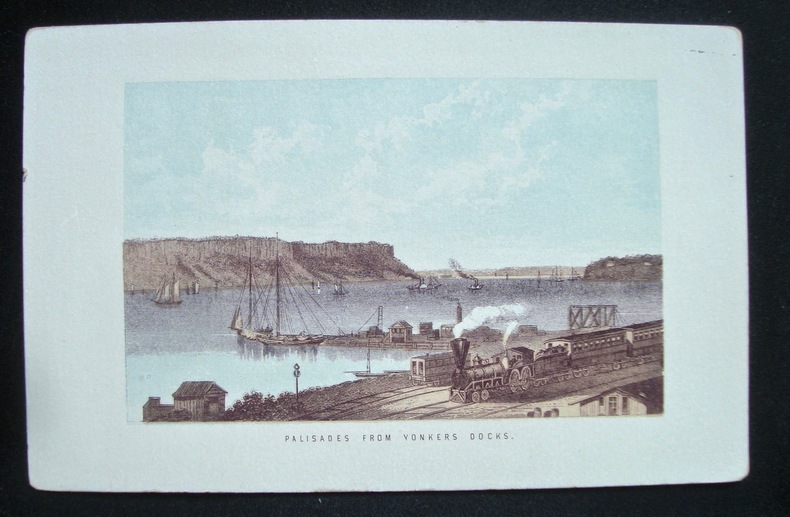
34332Chromolithograph of Palisades from Yonkers docks (Toronto) : 4,7x2,8 inches (size of engraving) - 6,45x4,01 inches (size of the card) - undated (circa 1860) and unsigned (maybe printed by Currier & Ives) -
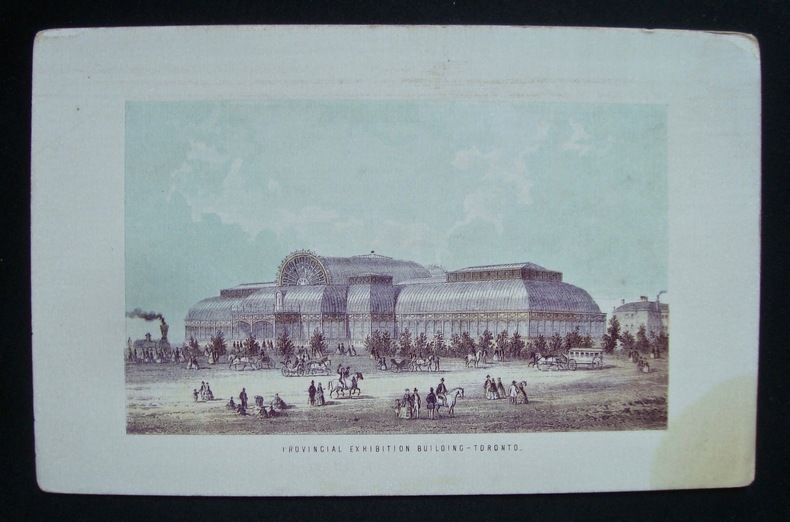
34333Chromolithograph of Provincial exhibition building (Toronto) : 4,7x2,8 inches (size of engraving) - 6,45x4,01 inches (size of the card) - undated (circa 1860) and unsigned (maybe printed by Currier & Ives) -
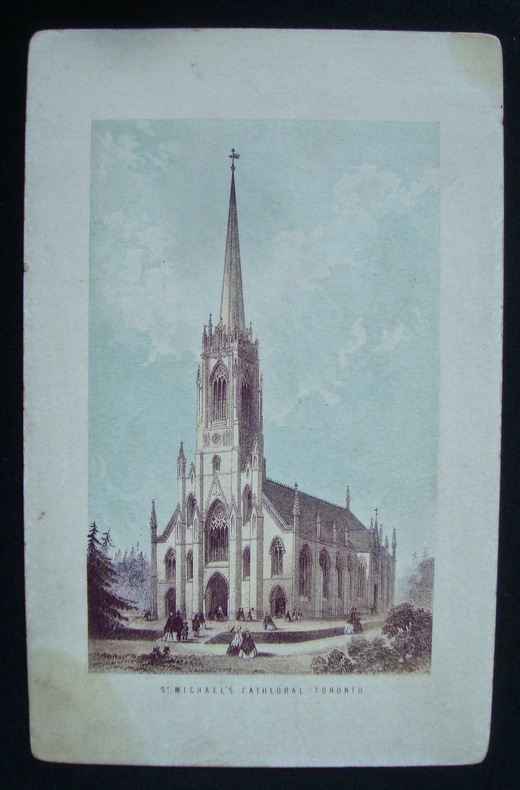
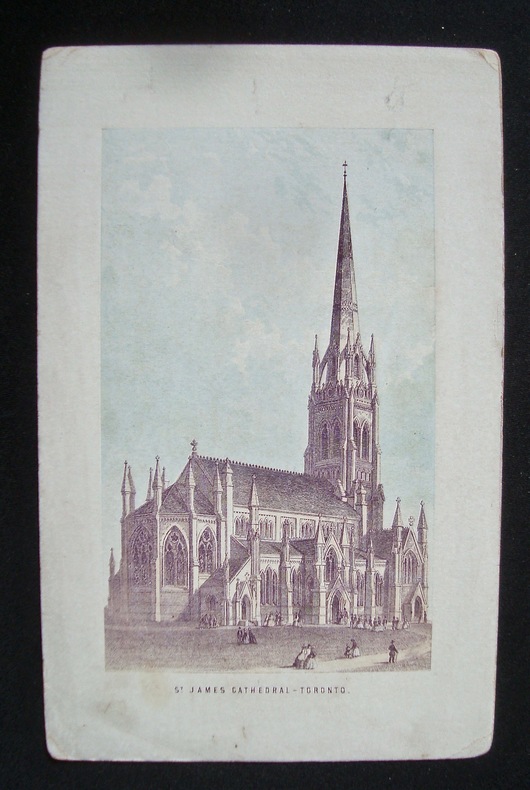
34334Chromolithograph of St. Michael's cathedral (Toronto) : 4,7x2,8 inches (size of engraving) - 6,45x4,01 inches (size of the card) - undated (circa 1860) and unsigned (maybe printed by Currier & Ives) -
34335Chromolithograph of St. Michael's cathedral (Toronto) : 4,7x2,8 inches (size of engraving) - 6,45x4,01 inches (size of the card) - undated (circa 1860) and unsigned (maybe printed by Currier & Ives) -
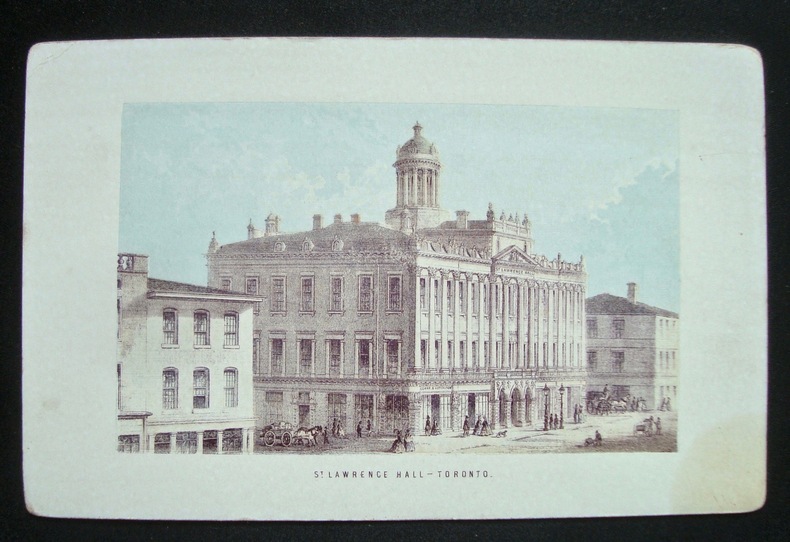
34340Chromolithograph of St. Lawrence Hall (Toronto) : 4,7x2,8 inches (size of engraving) - 6,45x4,01 inches (size of the card) - undated (circa 1860) and unsigned (maybe printed by Currier & Ives) -
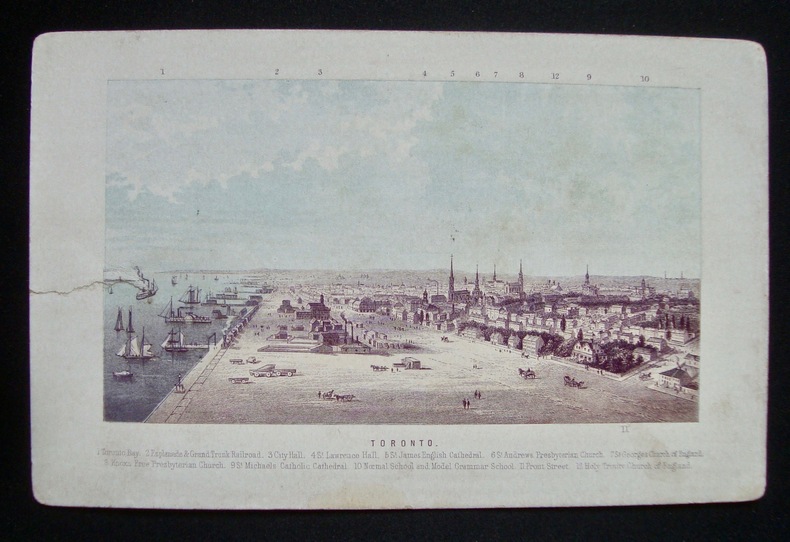
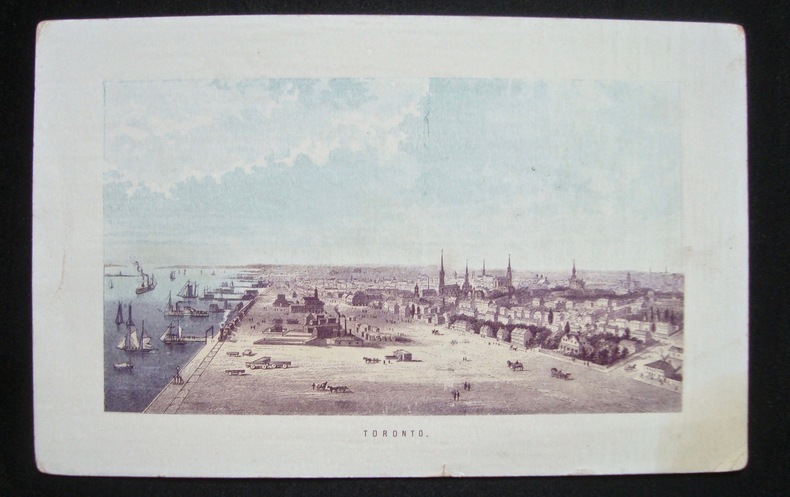
34337Chromolithograph of Toronto : 4,7x2,8 inches (size of engraving) - 6,45x4,01 inches (size of the card) - undated (circa 1860) and unsigned (maybe printed by Currier & Ives) -
34343Chromolithograph of Toronto : 4,7x2,8 inches (size of engraving) - 6,45x4,01 inches (size of the card) - undated (circa 1860) and unsigned (maybe printed by Currier & Ives) -
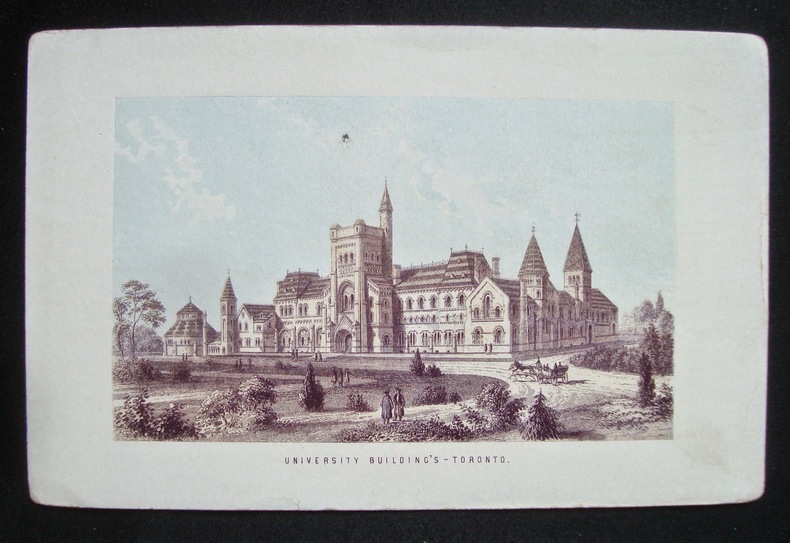
34338Chromolithograph of University building's (Toronto) : 4,7x2,8 inches (size of engraving) - 6,45x4,01 inches (size of the card) - undated (circa 1860) and unsigned (maybe printed by Currier & Ives) -