DIÈREVILLE Nicolas de:Livre Rare Book
64 résultats
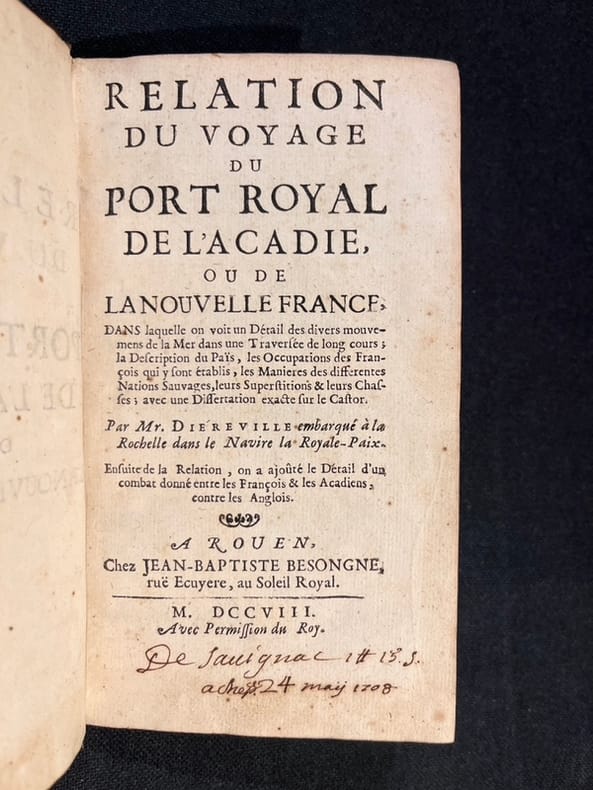
170820836A Rouen, chez Jean-Baptiste Besongne, 1708. In-12 de [14]-236-[2]-7 pages, plein veau brun, dos à nerfs orné de filets et fleurons dorés, roulette dorées sur les coupes, tranches mouchetés rouge.
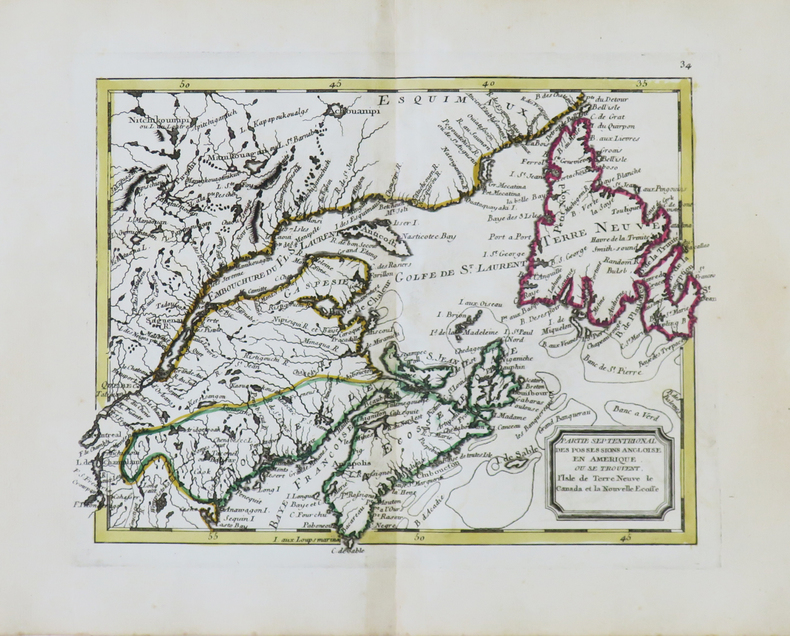
1791LBW-4851[Paris, Mondhare, 1791]. 200 x 258 mm.
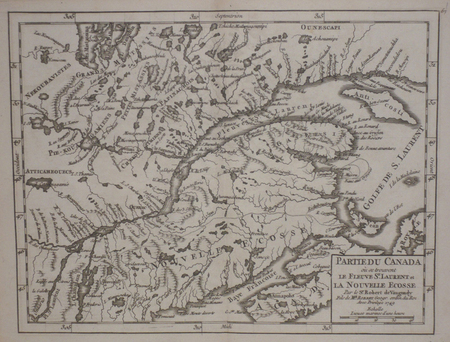
1749LBW024d41749 165 x 216 mm.
1796elala1784Quebec: William Vondenvelden 1796. 1796. 4to. pp. 2 p.l. 16 blank leaf. text in French & English on opposite pages. modern wrs. Order in council enforcing the terms of Jays Treaty 1794. The Treaty arranged reciprocal concessions regarding trade and commerce between the United States and British North America and provided for the appointment of a commission to settle the north-eastern boundary and for the withdrawal of British troops from American territory. Tremaine 994. Dionne I 40. Lande 552. TPL 692. Vlach 40. Vlach IP 66. Quebec: William Vondenvelden, 1796. unknown
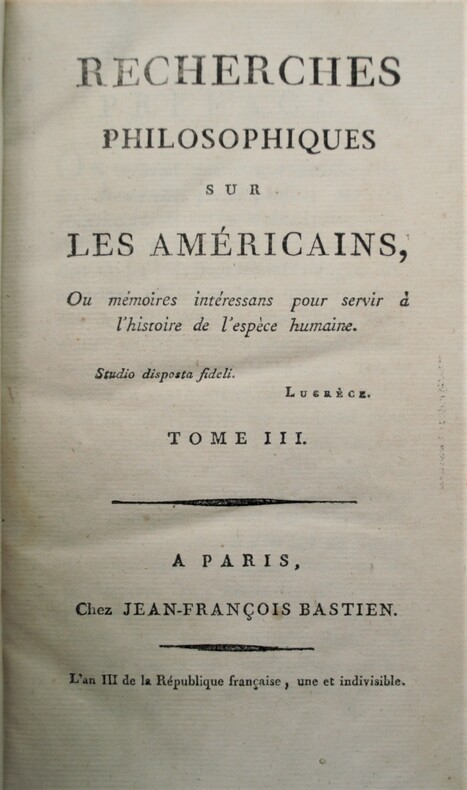
1795PHO-1044Paris : Bastien, An III. (1795) 7 volumes in-8 ; AVEC , PAUW recherches philosophiques sur les Américains , An III , 3 volumes in-8 , XIV-421pp, 475pp,482pp. AVEC : PAUW : Recherches philosophiques sur les Égyptiens et les Chinois. Paris : Bastien, An III, 2 volumes in-8, carte dépliante (déchurure sans manque), XVIff,472pp , 466pp; AVEC : PAUW : Recherches philosophiques sur les Grecs. Paris : Bastien, An III, 2 volumes in-8 , XVI-400pp,366pp . Reliure d’époque en basane marbrée, dos lisse orné avec titre et tomaison , quelques manques de cuir , petit travail de ver sur 10ff ,Tome 1.
178910440A Londres et se trouve à Paris, Chez Le Jay fils et Maradan, 1789. In-8 de XVI-336 pp., veau havane marbré, dos lisse orné, pièce de titre en maroquin vert, tranches rouges (reliure de l'époque).
178018820genève pellet 1780 -in-4 une carte ancienne gravée sur cuivre (Copper etching) en noir par André, gravée par Arrivet. Format : 31 x 20,5 cm, pour illustrer l'uvre de l'Abbé Guillaume-Thomas Raynal intitulée "l'Histoire philosophique et Politique des Etablissemens et du Commerce des Européens dans les Deux Indes", pli central horizontal normal venant d'un atlas( horizontal centerfold), 1780 Genève Pellet Editeur,
178018819genève pellet 1780 -in-4 une carte ancienne gravée sur cuivre (Copper etching) en noir par André, gravée par Arrivet. Format : 31 x 20,5 cm, pour illustrer l'uvre de l'Abbé Guillaume-Thomas Raynal intitulée "l'Histoire philosophique et Politique des Etablissemens et du Commerce des Européens dans les Deux Indes", pli central horizontal normal venant d'un atlas( horizontal centerfold), 1780 Genève Pellet Editeur,
176311860Londres, sans nom, 1763 ; 8 tomes in-12 ; demi-chagrin vert-sapin, dos lisses à grand décor de rinceaux et roses dorés, 4 faux-nerfs dorés, palette en queue, tranches marbrées multicolores (reliure du tout début XIXe) ; VIII, LX, 415 ; (4) en tête à chaque volume ; VIII, 560 ; IX, 566 ; VI, 454 ; VIII, 484 ; VI, 477 ; VI, 483 ; VI, 375, (1) pp. ; chaque tome a sa propre table alphabétique ; 2 portraits gravés par Legrand au tome 1er.
1760PHO-12672 ouvrages en un vol. in-12, rel. d'époque, plein cuir marbré ,dorure sur les coupes, dos à 5 nerfs, caissons ornés de fleurons dorés, titre dans une pièce de cuir marron, trois tranches rouges. Rousseurs, mouillures , manque la pièce de titre, coiffe sup. usé et fente intérieure
1783ZNC-280Amsterdam, & se trouve à Paris, rue et Hotel Serpente, 1783, in-8°, 476 pages, demi-basane marron (reliure du XIXe siècle)
1784LBW-9055Paris, Imprimerie Royale, 1784. In-4 de (2) ff., xxiv-80-26-32-28 pp. ; maroquin rouge, dos à nerfs orné, pièce de titre de maroquin vert, filets dorés encadrant les plats, armes au centre, tranches dorées (reliure de l'époque).
1780PHO-2207Nyon l’Ainé, Paris, 1780, 2 vol. in-12 de XIV - XVIII -389 pp. et 1 f.- 352 pp., relié plein veau marbré époque, dos à nerfs orné avec pièces de titre et tomaison, tranches rouges, petits manques au dos, coiffes sup. arasées, coins usés, légères épidermures.
171132615London: Timothy Goodwin. Good. 1711. First English Edition; First Printing. Softcover. University library withdrawal bound In plain brown paper wraps with double blank endpapers. All library markings reside on these covers/endpapers except for typed accession number and small university stamp to blank verso of title page. Contents are crisp and quite bright with only occasional light foxing. "Printed for Tim. Goodwin at the Queen's Head against St. Dunstan's Church Fleetstreet 1711." First English translation of the original Latin of 1574. First page past the newer paper covers are the half-title page: "Franco-Gallia translated by the author of the Account of Denmark." Last page is the one marked 144. One advertisement on verso of half-title page. Very scarce 1711 first English translation. ; 144 pages . Timothy Goodwin paperback
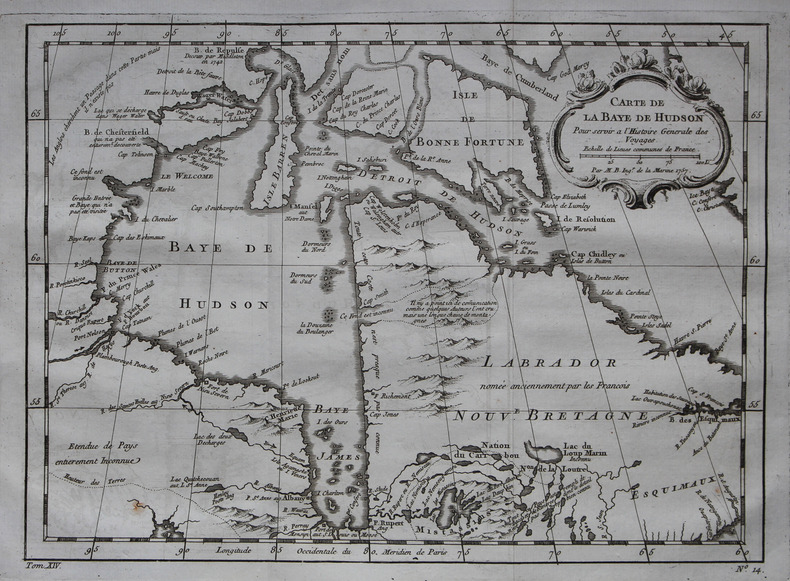
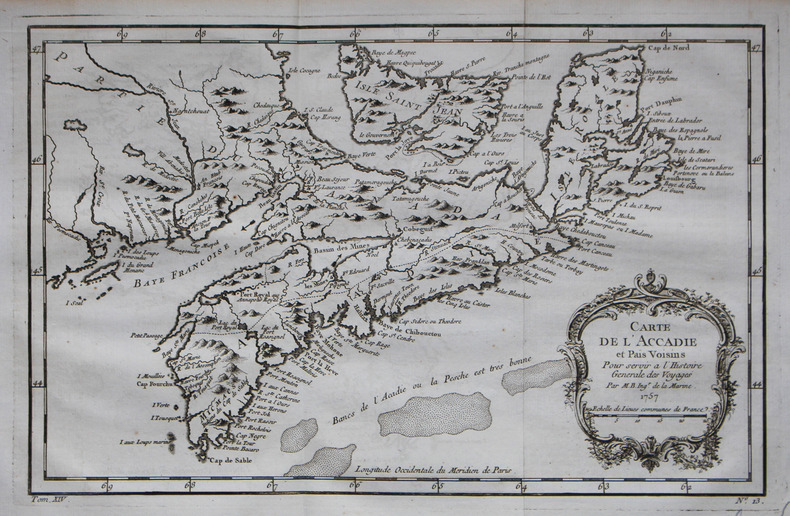
1757LBW-29521757. 220 x 302 mm.
1757LBW-29471757. 209 x 329 mm.
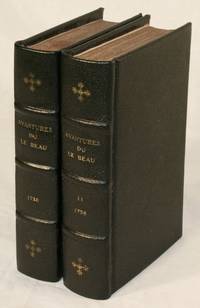
173814194Amsterdam: Herman Uytwerf 1738. First Edition. Hardcover. Good. Two volumes pp. xiv 370 6; 430 6 with six folding plates and a folding map. Modern full-leather with marbled endpapers. Title pages clipped at upper and lower edges; damage with losses to three plates repairs to back of map; all else very good. Le Beau was transported from France to Quebec in 1729 probably on a charge of libertinism. According to his own account he was appointed a clerk in the Beaver Office and then chief clerk in the King's warehouses. Bored and depressed he stole gunpowder from the warehouses and set off for New England. A warrant for his arrest was issued but he escaped encountering many perils natural and human before he reached Boston and eventually sailed for Holland. His ensuing work on his adventures in North America includes much detail on Huron Iroquois and Algonquin customs but its style has been dubbed fanciful. Howes L-167 describes the work as "a basically veracious narrative from competent authorities though somewhat romanticised." The Dictionary of Canadian Biography argues that Le Beau "deserves credit for painting an exact picture of the customs and character of the Canadians" noting that "the best chapters are those that discuss the habits of beaver and the religious ideas of the Indians." Siebert #14; Field 229; Sabin 39582. Herman Uytwerf hardcover books
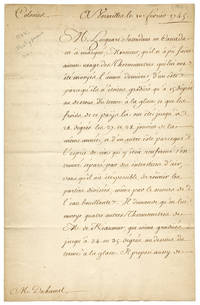
1745WRCAM51842Paris 1745. 2pp. on a folded sheet. In French. Previously folded. Two small holes along folds of blank leaf. Light foxing and tanning. Very good. An entertaining letter written in 1745 by French minister Jean-Frédéric Phélypeaux Comte de Maurepas to scientist Henri-Louis Duhamel du Monceau at Versailles requesting on behalf of Gilles Hocquart the Intendant of New France in Canada that new thermometers and other scientific instruments be sent to Quebec. The author notes that although the old thermometers were graded to measure temperatures down to -15° on the Réaumur scale it had in fact only recently been -27° or -28°. Even if the thermometers had been able to measure temperatures that low according to Maurepas the cold had caused the measuring liquid inside the instruments to separate permanently rendering them useless in any event. He therefore asks that four new Réaumur thermometers capable of measuring down to - 35° be sent along with several astronomical instruments for making navigational observations. unknown books
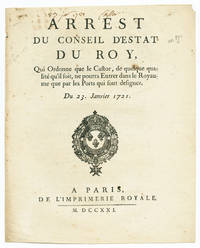
1721WRCAM13347Paris 1721. 4pp. Quarto on a folded folio sheet. Light soiling. Contemporary inscription. Very good. A French royal decree concerning the importation of Canadian beaver pelts into France. This is a variant of the issue listed by Wroth; OCLC locates only one copy at Harvard which appears to be Wroth 890. Not in EUROPEAN AMERICANA. Rare. <br> <br> From the library of Cardinal Étienne Charles de Loménie de Brienne 1727-94 Minister of Louis XVI Archbishop of Toulouse and of Sens. A friend of Voltaire and a member of the Académie Française Brienne wielded significant power as as head of the Finance Ministry which earned him many enemies. He died in prison during the French Revolution despite having renounced Catholicism in 1793 presumably as an attempt to save his life. WROTH ACTS OF FRENCH ROYAL ADMINISTRATION 890 ref. MAGGS FRENCH COLONIZATION OF AMERICA 224 this copy. OCLC 70682396 ref. unknown books
1774WRCAM11950London 1774. pp.1899-1904. Folio. Dbd. Very good. with: AN ACT FOR AMENDING AND EXPLAINING AN ACT. London. 1775. pp.1227-29. Folio. Dbd. Very good. These acts proposed to pay for the court system in Quebec and Canada by putting a duty on hard liquor and charging licensing fees. unknown books
175222438London: Printed for J. Payne and J. Bouquet 1752. First Edition. 8vo pp vi 84 95 with 3 folding maps. Bound in full mottled calf with gilt rules. Small bookplate "Lavington" on front pastwdown and one "From the Wilberforce Library Backsettown" on front free endpaper. Frontis map slightly misfolded but overall a near fine copy. Robson was a former employee of the Hudson's Bay Company who had worked as a surveyor and "Supervisor of the Buildings" i.e. construction superintendent. His experiences convinced him that the Company was mismanaging its holdings so badly that all of northern North America would soon be taken over by the French. Hill 1477 describes this account as one of the earliest and certainly the fullest of works that had hitherto been published on the Hudson Bay Territory" and explains that "Robson with a sound knowledge of the locale and of the personnel of the Hudson's Bay Company condemned the company for its failure to promote enterprise and development in its lands." The first 84 pages are the narrative the remaining portion of the book is an appendix giving an account of the discovery of Hudson's Bay and English activities there. The maps are: "A Draught of Nelson & Hayes's Rivers" Plate I "A Draught of Churchill River" Plate II and "Plans of York and Prince of Wales's Fort" Plate III which also includes an illustration of two snowshoe designs. Field 1312; Graff 3532; Sabin 72259; Smith 8728; Streeter VI 3648 TPL 217 Lande 1418. Printed for J. Payne and J. Bouquet unknown
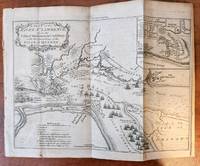
1759182869London: The London Magazine 1759. 1st Edition . No Binding. Very Good/No Jacket. Disbound from the London Magazine for November 1759. 9-1/2 x 7 in plus plain border of approx 1/4 inch. Originally folded into 4 panels. In very good condition with only minor discolouration. One insert "A Plan of the Action gained by the English near Quebec Sep.13.1759." A very nice copy. <br/> <br/> The London Magazine unknown
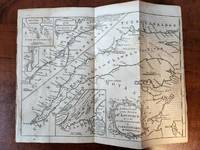
1759182868Londom: The London Magazine 1759. 1st Edition . No Binding. Very Good/No Jacket. Overall size 10x7.25 in. plus approx. 1/4 in. border on all four sides. From an engraving for the London Magazine September 1759 edition. Originally folded into 4 panels. Disbound but retaining the complete map. Includes three inserts: The Traverse or Passage from Cape Torment into the South Channel of Orleans Isle; A Continuation of the River St. Lawrence from Quebec to Lake Ontario; The Seven Islands. Light discoloration in places but overall a nice clean example. <br/> <br/> The London Magazine unknown
1795E0029<b>Samuel Hearne was the first European to make an overland excursion across northern Canada to the Arctic Ocean</b><br /><br />xliv458 pages with two of four engraved plates after drawings by the author both folding and four of five folding engraved maps. Quarto 11 3/4" x 9 3/4" bound in full leather with raised spine bands and gilt lettering to spine. HillI page 141. Sabin 31181 First edition.<br /><br />Manuscript journal was found by La Pérouse when he captured Fort Albany; later one of his conditions of surrender was that it be published. Samuel Hearne 1745 – November 1792 was an explorer fur-trader author and naturalist. He was the first European to make an overland excursion across northern Canada to the Arctic Ocean In 1774 Hearne built Cumberland House for the Hudson's Bay Company its first interior trading post and the first permanent settlement in present Saskatchewan. From 1769 to 1772 Hearne was employed in north-western discovery searching especially for certain copper mines described by Indians as "Far-Away-Metal River". These copper mines were found in the Barren Lands where the ground is permanently frozen to within a few inches of the surface creating in many areas vast stretches of mosquito- and fly-infested swamp during the summer thaw. For this reason it was decided that travel in winter was preferable. His first attempt began on 6 November 1769. The large size of the expedition and too much European equipment being carried led to the desertion of his Indian guides and the failure of the expedition. His second commencing 23 February 1770 failed because his quadrant was broken and much of his equipment was stolen. Learning from the mistakes of the first two expeditions Hearne contrived to travel as the only European with a group of Indians led by the great chief Matonabbee. The group also included eight of Matonabbee's wives to act as beasts of burden in the sledge traces camp servants and cooks. This third expedition set out in December 1770 in order to reach the Coppermine River in summer by which he could descend to the Arctic in canoes. Matonabbee kept a fast pace so fast they reached the great caribou traverse before provisions dwindled and in time for the spring hunt. Here all the Indian hunters of the north gathered to hunt the vast herds of caribou migrating north for summer. A store of meat was laid up for Hearne's voyage and a band of warriors joined the expedition. Matonabbee ordered the women to wait for his return in the Athabasca country to the west. The Chipewyans were generally a mild and peaceful people however they were in a state of conflict with the Inuit. A great number of Indians joined Hearne's party to accompany them to the Coppermine River with intent to murder Inuit who were understood to frequent that river in considerable numbers.2 On July 14 1771 they reached the Coppermine River a small stream flowing over a rocky bed in the "Barren Lands of the Little Sticks". A few miles down the river just above a cataract were the domed wigwams of an Eskimo camp. At 1am on July 17 1771 Matonabbee and the other Indians fell upon the sleeping Eskimo in a ruthless massacre. Approximately twenty men women and children were killed; this would be known as the Massacre at Bloody Falls. A few days later Hearne was the first European to reach the shore of the Arctic Ocean by an overland route. By tracing the Coppermine River to the Arctic Ocean he had established there was no northwest passage through the continent at lower latitudes. This expedition also proved successful in its primary goal by discovering copper in the Coppermine River basin. However an intensive search of the area yielded only one four-pound lump of copper and commercial mining was not considered viable. Matonabbee led Hearne back to Churchill by a wide westward circle past Bear Lake in Athabasca Country. In midwinter he became the first European to see and cross Great Slave Lake. Hearne returned to Fort Prince of Wales on 30 June 1772 having walked some 5000 miles and explored more than 250000 square miles.<br /><br />Condition:<br /><br />Rebound in attractive leather with raised spine bands. Lacks frontispiece map and two plates. Plate I A North West View of Prince of Wales's Fort and Plate IV A Winter view of the Athapuscow Lake. Some internal spotting. Small repair to title page and verso and front free end paper edge else a better than very good copy. Printed for A Strahan and T Cadell hardcover books