201 résultats
179423252New York: Childs and Swaine 1794. 4to. Folding table frontis 230 2- Table of Contents pp. Bound in contemporary plain wrappers spotted tattered. Stitched. Scattered foxing to a small number of leaves and several leaves with a slight horizontal crease. Otherwise a clean and bright text widely margined Very Good. <br/> offered with TRANSACTIONS OF THE SOCIETY INSTITUTED IN THE STATE OF NEW- YORK FOR THE PROMOTION OF AGRICULTURE ARTS AND MANUFACTURES. PART III. Albany: Loring and Andrews. 1798. xli 1 blank 126 3 pp. Broken stitching hence loose. Chipping at blank margins Good.<br/><br/> The second and third of four Parts published by this learned Society. Each Part -- issuing in 1792 1794 1798 and 1799-- is a separate imprint. Part II begins with a folding Table of 'Meteorological Phenomena Observed in the Cupola of the Exchange at the Lower Part of Broad-Street in the City of New-York'. It prints the Address to the Society of its President Robert Livingston who deplores the fact that Americans "are habitually led to form exalted ideas of Britain and degrading ones of America." He rebuts this false notion. Also printed is Livingston's 'Experiments and Observations on Lucerne' an essay on 'The Manner of Taking Porpoises at the East End of Long-Island' and several other reports.<br/> Part III includes Addresses by James Kent and Samuel Mitchell and a number of essays. <br/>Evans 27400 34221. NAIP 028160 9 w005741 8. Not in Rink. Childs and Swaine unknown books
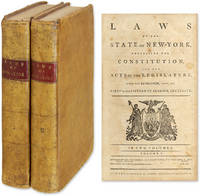
179232550New York: Thomas Greenleaf 1792. Two volumes: 4 511 1 blank; 4 521 1 blank 14- Subscribers pp as issued. Later library cloth with gilt-lettered morocco spine labels some chipping old institutional rubberstamps on title leaf scattered spotting Good. <br/> offered with LAWS OF THE STATE OF NEW-YORK COMPRISING THE CONSTITUTION AND THE ACTS OF THE LEGISLATURE SINCE THE REVOLUTION FROM THE FIRST TO THE TWENTIETH SESSION INCLUSIVE. IN THREE VOLUMES. New York: Greenleaf. 1797. 4 98 1 99-100 1 8 107-160 1 160-258 5 260- 354 3 356-500 1 504-525 1 pp as issued. Matching library cloth with gilt-lettered morocco spine labels some chipping old institutional rubberstamps on title leaf scattered spotting Good. <br/><br/> These are the first editions of Greenleaf's printing of the Laws. The third volume which issued in 1797 prints the laws of the sixteenth through the twentieth sessions; AAS apparently does not own it. The long list of Subscribers printed in the second volume includes the great men of the times: Aaron Burr George and De Witt Clinton several Livingstons Elias Hicks and a host of other attorneys. Greenleaf reprinted all three volumes together in 1798. <br/> Greenleaf's Preface explains that he had been "engaged to publish a cheap Edition of the Revised Laws". A 1789 folio edition published by Hugh Gaine had been too expensive for the folks. Volume I which "contains all the Laws to the eleventh Session has one Session more than is comprised in the first Volume of Gaine's Edition." He emphasizes that "The Types and Paper were manufactured in this State.The Types are not so perfectly Regular as those from the London Foundaries which have been improving for Centuries-- but no Cash went to London for them-- and our infant Manufactures ought to be encouraged that they also may improve." <br/>Evans 24602 32555. NAIP w033259 w016519. Thomas Greenleaf unknown books
1853WRCAM54449New York 1853. 96pp. plus large color folding map. 18mo. Original printed wrappers. Light wear to wrappers. 20th-century bookplate on front pastedown. Light tanning and foxing heavier to initial leaves. Very good. A scarce edition of this attractive guide to mid-19th-century New York City. The volume contains extensive descriptions and numerous illustrations of the sights as well as a street directory and information on travel within the city and to neighboring locales. It includes further information on attractions in Queens Brooklyn and Staten Island. The work also contains a large and detailed color folding map of Manhattan below 90th Street. <br> <br> OCLC locates only six holdings of this edition; an attractive copy of an ephemeral item in original wrappers. unknown books
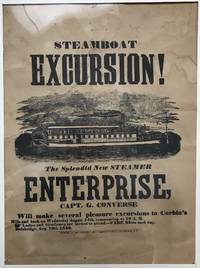
1850517Bainbridge N.Y.: Chenango Free Democrat Office 1850. Very good. Broadside 15.75 x 12 inches. Matted. Light even tanning. An attractive illustrated broadside dated August 10 1850 advertising a short trip up the Susquehanna River from Bainbridge to Corbin's Mills scheduled for August 14. "Ladies and gentlemen are invited to attend - fare 25 cents each way." This broadside was printed at the office of the Chenango Free Democrat a free soil paper that would last from 1849 to 1850. The wonderful large wood engraving signed "Clarkson" shows the steamboat smoke billowing from her stacks the American flag fluttering in the breeze behind and passengers on the upper and lower decks. The Susquehanna flows through the center of Bainbridge but we could not locate a place named Corbin's Mills in the area at that time though the Corbins were a prominent family in the area and a lumber mill by the same name appeared about two decades later. Scarce with no listings in OCLC for this or similar items. Chenango Free Democrat Office unknown books
1792592511792. Early Post-Revolutionary Compilation of New York Laws New York. Laws of the State of New York Comprising the Constitution And the Acts of the Legislature Since the Revolution From the First to the Fifteenth Session Inclusive. New York: Printed by Thomas Greenleaf 1792. Two volumes. iv 511 1 pp.; iv 521 15 pp. Octavo 8" x 4-3/4". Contemporary varnished sheep blind fillets lettering pieces and black-stamped volume numbers to spine. Light rubbing to extremities corners bumped light fading to spines minor chipping to spine head of Volume 1 hinges starting. Toning to text light browning and negligible foxing in places internally clean. $950. Only edition. With the state constitution a digested index and subscriber list that includes Aaron Burr Edward Livingston and other prominent New Yorkers of the period. This was the second compilation of New York's laws published since the Revolution and the first octavo edition. This format was chosen to make this edition more affordable. 1400 subscriber copies were issued. Complete in itself a third volume was added to this set in 1798. Babbitt Hand-List of Legislative Sessions and Session Laws 350. unknown books
1831D13063Albany: Croswell and Van Bethuysen 1831. Hardcover. Very Good. Contemporary red morocco gilt-stamped lettering on spine "Rules and Orders / 1831" and upper board "John Van Buren / Ulster"; 24mo 125x84mm; pp. 212 1 calendar plus 3 floor plans of the Senate and Assembly 3 folding maps see below. Binding a little scuffed here and there; spine a touch darkened; upper board flaring it would seem that the plates were added by the owner. Some foxing; closed tears along the creases of folding plates. A scarce volume OCLC locates just 6 copies not overly specific in their cataloging -- the most detail we can find is a copy which includes "2 folded leaves of plates illustrations map." This copy includes much more and additionally bears some handwritten notes on the plates -- presumably all by John Van Buren who also adds his ownership signature and a decoration to the front paste-down. Plates include: folding map of the City of Troy labelled by hand with notes locating landmarks; folding floor plan of the assembly dated by hand 1834; small hand-colored folding map of the city of Albany; folding floor plan of the assembly printed date 1831 presumably original to this volume; small folding floor plan of the Senate chamber printed date 1831 presumably original to this volume; large hand-colored folding "Map of the State of New York and the Surrounding Country" by David H. Burr printed date of 1829. <br/><br/>John Van Buren 1810-1866 was an American lawyer and politician. He served as Attorney General of New York and Democratic Party Leader. He was the subject of much innuendo even after his death -- rumored to have lost $5000 his father's home Lindenwald and his mistress the very popular Elena "America" Vespucci descendent of Amerigo Vespucci to George Parish of Ogdensburg New York in a card game at the LeRay Hotel in Evans Mills New York. This story has not been verified but it plagued Van Buren's reputation. He has also been credited with the semi-humorous saying "Vote early and vote often". Croswell and Van Bethuysen hardcover books
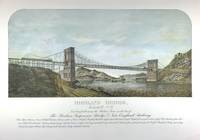
18851775New York: L.W. Ahrens Co 1885. Very good plus. Chromolithograph 21.5 x 28 inches. Matted. Minor wear soiling and a couple of modern pencil annotations at lower corners. A fine image of a proposed railroad bridge across the Hudson River just north of Peekskill New York. Plans to build a bridge over the Hudson River at the site between Fort Clinton and Anthony's Nose had been made as early as 1868. A contract was signed the following year and construction was expected to commence rapidly on the Hudson Highland Suspension Bridge. The purpose of the bridge was to provide a railroad toward Derby Connecticut enabling the supply of coal and iron for industry in the Lower Naugatuck Valley. By 1887 reports suggested the bridge would be finished in two years but by 1896 it was still unfinished when the Hudson Suspension Bridge and New England Railway Company reincorporated as the Hudson Highland Bridge and Railway Company. As a result of the long depressions including stock market crashes of 1873 and 1893 the bridge remained unfinished and the charter for construction expired in 1916. In March 1922 the state authorized the creation of the Bear Mountain Hudson River Bridge Company to complete the project. The bridge was opened on November 27 1924 and was the longest suspension bridge span in the world at the time but looked markedly different from the proposed bridge in this lithograph which bears a passing resemblance to the Brooklyn Bridge. L.W. Ahrens Co unknown books
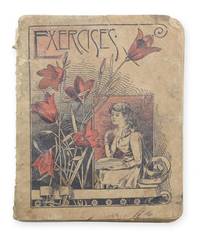
189018000New York January 1 1890 to August 31 1890. Covers worn corners worn smudged and foxed throughout; Edward clipped a portion of one leaf with a loss of some text; in good condition but legible and sound. Lined composition book in original pictorial wrappers entitled "Exercises" 8.25 x 6.75 inches 138 pages. A detailed entertaining legible observant daily account of life in Manhattan for a 20-year-old carpenter going to night school attending union rallies spending evenings playing harmonica and reading early Jehovah's Witness literature swimming in the North River looking for work in slack times or negotiating salaries with bosses and showing curiosity about the hurly-burly of cultures and commerce in New York. The diary includes his penciled ownership note to the head of the second page E. W. Hussey 265 W. 32nd St. N. Y. City; Edward appears to live with his brother Stephen W. Hussey called Walter to distinguish him from their father the English-born carpenter Stephen and mention in the text of family members like Ida taken with clues to his brother's birth in Philadelphia and close personal ties to Monmouth County New Jersey the family often visits the shore at Oceanic further help determine the identity of the diarist and his family relations. Edward generally works six days a week noting in his daily entries his specific jobs. Edward spends much of the first part of the year fixing up what would be the townhouse of prominent socialite Mrs. Brockholst Cutting at 99 Madison Avenue; among other jobs he also works in the shop turning out balusters or building book shelves helps pull down an illegal shack or fitting out a cigar store at 786 9th Avenue--this last an unpleasant job as Edward notes on April 15: "fitting out cigar store etc. 1 day. This fellow that is taking the store is a bad man a gambler pool man and Louisiana Lottery man and a shameless man." Indeed Edward's sense of moral duty seems to run deep; he records his daily reading faithfully often stopping up at the Cooper Union reading room or the Apprentices' Library or ordering cheap books from Ogilvie he is willing to spend a whopping three dollars however on a copy of the popular physiology and marriage manual Cowan's Science of a New Life which he reads and then passes along to his older sister Mary; he outlines at one point his displeasure over his new Webster's Abridged Dictionary no maps no illustrations no biographies or notes his daily reading up on phrenology or geometry or how to be a better carpenter or regular reading from the Bible or from the Charles Taze Russell's works Millennial Dawn or Zion's Watch Tower. On March 24 he makes up his mind to give handbills advertising Millennial Dawn and Zion's Watch Tower to a friend to distribute and later loans a friend an entire year's run of the Watch Tower--or as he usually refers to it in his diary Z.W.T. Edward also reads popular literary papers like Argosy and various daily papers mentioning at one point an "Extra" on the botched Kemler execution with his tastes seeming to run to Pulitzer's World--though the general tenor of yellow journalism prompts him to note ruefully on June 27 "There seems to be nothing but bad women and bad men in the papers lately." Hussey further betters himself by attending night school through April when he finally gets a diploma under the tutelage of long-time New York educator William J. Goldey ca. 1828-1907 often participating in formal class debates recorded in his diary such as the one held the evening of February 7 when Edward took the affirmative on the question whether organizations are beneficial to the working man: "the majority were in favor of Organization also the regular debaters of the Aff. had the better of the debate because they were on the right side perhaps partial." Edward also attends a mock-congress held by Goldey on March 28 "the subject handled was that there should be an Amendment to the Constitution to admit women suffrage! Ladies were present some laughable scenes were pictured the vote Neg. 16 Aff. 11." Edward also shows an interest in labor organizing attending a lecture on Feb. 5 "on the Labor movement for the last 20 yrs. by L. Sanial i.e. the Socialist Labor journalist Lucien Saniel a frenchman: very good" or writing about a carpenters' strike against an employer on Feb. 21 or detailing his attendance at a May Day rally at Union Square the effects of the 8-hour day debate on his brother's prospects taking a walk over to the 42nd St. station on August 10 to take a look at a strike or his visit on July 6 to the Cloakmakers Union Hall on Suffolk Street there had been a riot and police beatings against strikers a few days previous though Edward notes "I saw no signs of distress whatever men where there talking a good deal in Hebrew. I then walked out read W. W. Weekly World a little while sitting on stoop near Ridley's dry hood store in the side st's it was litteraly sic swarming with Jews all trading in there sic own way for it was not the sabbath with them." The changing demographics of New York City and the influx of Jews comes up several times in Hussey's diary and he shows a welcome tolerance--even noting one Friday on July 11 "I took a run out tonight to see if I could attend a Jewish church but found none." On a boat ride back from Monmouth County New Jersey on August 7 Edward notes "on the voyage up I had quite a chat with a small about 40 yr. old Jew from Manasquan N. J. quite agreeable of course smooth of tongue he seemed to take a little liking to me as I am not bigoted against Jews he with another was going Bro'lyn N. Y." Edward then buys a watermelon and has soft shell crabs for dinner. Throughout the account runs the thread of a young man pulled between the obligations of adulthood he notes arguments with his father to whom he gives 80% of his wages until he comes of age and turns 21 in August of 1890 and the pleasures and pull of his youthful pursuits snowball fights with his younger sister blowing soap bubbles with children helping his younger brother on the velocipede and a few veiled and elided references to the perils of his masturbation habits; throughout this account he is clearly attuned to the attractions and textures of daily street life in New York: trips uptown to walk across the Harlem River or over into Weehawken to pick flowers or wild fruit attending meetings of evangelists like Moody or DeWitt Talmage or trying to get a drunk in the Bowery safely into a lodging house or helping another "Drunken fellow" who instead "sat down on steps throwing up etc. got a policeman to take him to R. House so he could sleep it off" or perhaps more enjoyably watching a Barnum & Bailey circus parade from the roof of his building or taking an excursion down to Philadelphia and seeing the "Cracked Bell" and Baldwin's Locomotive Works this trip given in fine detail or paying ten cents on the street to hear an Edison phonograph play three songs including the "McGinty Song" or reporting on his brother's base ball team or his own efforts in ball-throwing contests or his trying out of a street-corner demonstration "lung tester." Edward swims in the North River the latter-day Hudson takes long walks through the city and on occasion takes in an art exhibition or competes for the affections of young Ida Murphy. The diary closes with his efforts to get a satisfactory photographic portrait to send to friends and family; a gem tintype portrait in a folk thread-and-pin frame found with the diary is likely a portrait of Edward himself. Census records later put Edward in Bayonne N. J. in 1900 with a wife named Johanna. Her parents were both natives of Austria. By 1910 he is found in Union N. J. where his profession is given as a barn builder and he lives with Johanna their adopted daughter Helen both of Edward's parents and Johanna's mother Henrietta Bronston. In all a remarkable and perceptive record of a bright thoughtful working-class young man taking full advantage of the street life of Manhattan and of improving his mind. January 1, 1890 to August 31, unknown books
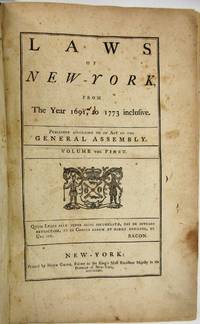
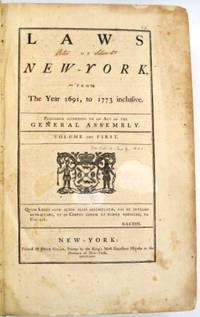
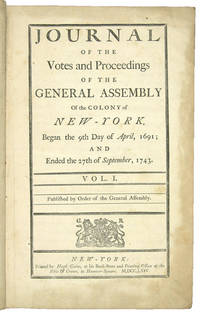
177430509New York: Hugh Gaine 1774. Folio two volumes in one continuously paginated. Pages iv 420; 4 421-835 i.e. 833 1 errata as issued. Title vignette of the State Seal Reilly 941. Some spotting generally in the margins; occasional toning. Small square cut from blank bottom section of the last text page. Very Good in modern blue buckram with gilt spine title. With a typed letter signed by M.J. Walsh of Goodspeed's taped to front pastedown dated August 6 1952. <br/><br/> Peter Van Schaack the editor signs the Preface in type. This comprehensive compilation of laws commences with the First Assembly in 1691. It ends with the Sessions of the Twenty-Ninth Assembly in 1773 which passed a statute making defacing statues of the King a crime. The Acts encompass the broad spectrum of the requirements of a developing society including a number of laws regulating the behavior of slaves and the institution of slavery. <br/>Evans 13467. Hugh Gaine unknown books
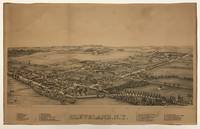
18901534Troy N.Y.: L.R. Burleigh 1890. Good. Lithograph 16 x 25 inches. Lightly but evenly tanned. Some light scattered soiling primarily to caption area. Rare and early view of Cleveland New York located on the northern shore of Oneida Lake just north of Syracuse. At the time the village of Cleveland had a population of about 800 souls -- a bit more than it does today -- and was centered on glass manufacture. The legend at the bottom of the sheet identifies twenty-seven numbered buildings including the Union Glass Works and the Cleveland Glass Works both on the outskirts of town. Other labeled buildings include four churches a school the station of the New York Ontario & Western Railroad a hotel and several other local businesses. Rare. OCLC locates two copies at the State library of New York and the Library of Congress. Reps 2482. L.R. Burleigh unknown books
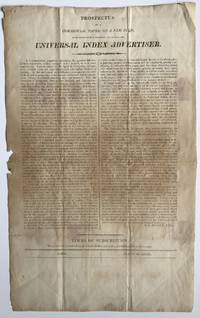
1860550New York 1860. Very good. Broadside 15.75 x 9.75 inches. Old folds some minor loss and chipping. Rare broadside prospectus for the New Universal Index Advertiser a business newspaper in New York. The Universal Index Advertiser promoted itself as a paper that focused on the interests of business above all else without "those great names which have so violently agitated the American world." The prospectus touts a novel new order of arrangement in which organization would follow the plan of "dictionaries indexes concordances." and would classify its contents like such and organize its listing of commodities alphabetically by the commodity and then the name of the seller rather than the other way around as had been done. Intended to be published daily the paper would cost $12 a year; the bottom of the sheet is left blank for subscriber information. Despite its grand claims to revolutionize the format of the newspaper we can find no evidence that the Advertiser ever went to press. We do find a single copy of the broadside at the New-York Historical Society. unknown books
20051655912005. Goodrich Lloyd and Abigail Booth Gerdts. Record of Works by WINSLOW HOMER. 5 Volumes in 6. Volume 1: 1846 through 1866 Volume 2: 1867 through 1876 Volume 3: 1877 to March 1881 Volume 4.1: 1881 through 1882 Volume 4.2: 1883 through 1889 Volume 5: 1890 through 1910. 4tos cloth. New York Spanierman Gallery Goodrich-Homer Art Education Project 2005-2014. Now available for the first time as a complete set. hardcover books
177426611New York: Hugh Gaine 1774. Folio two volumes in a contemporary calf binding some rubbing hinges firm but each has small separation at the top. Raised spine bands somewhat faded spine lettering. Pages iv 420; 4 421-835 i.e. 833 1 errata as issued. Contemporary signature of Peter Silvester on title page. Occasional light tanning light wear two lightened spots on title page not affecting any type. Very Good. <br/><br/> Peter Van Schaack the editor signs the Preface in type. This comprehensive compilation commences with the First Assembly in 1691. It ends with the Sessions of the Twenty-Ninth Assembly in 1773 which passed a statute making defacing statues of the King a crime. The Acts encompass the broad spectrum of the requirements of a developing society including a number of laws regulating the behavior of slaves and the institution of slavery. <br/>Evans 13467. ESTC W6510. Hugh Gaine unknown books
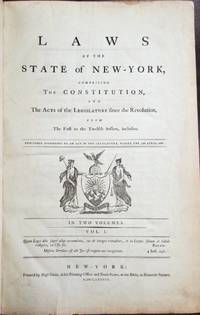
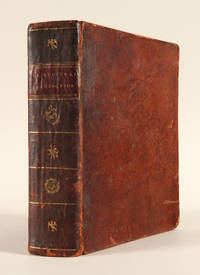
178931069New York: Printed by Hugh Gaine 1789. Large folio. 10 3/4" x 15 1/2". Two volumes in 20th century binder's cloth with gilt-lettered morocco spine labels. Vol. I: 3 1 blank 336 11-Index 1 blank xii 1 1 blank; Vol. 2: 1-title 1 blank 471 1 blank 17-index 1 blank pp. Volume 1 is lacking the final blank leaf. A clean and bright text. Very Good. <br/><br/> Samuel Jones and Richard Varick compiled this book "which comprehends the Constitution and the public Statutes of this State from the Revolution to the End of the Twelfth Session of the Legislature." Volume I opens with the 1777 New York Constitution. The Statutes through 1789 are printed all under the reign of the long-serving Governor George Clinton. Revolutionary Acts-- such as raising five Continental Battalions Lotteries regulating the militia treatment of deserters-- are included. Several Acts concerning New York's efforts gradually to eliminate slavery are here: barring slave importations after June 1 1785 for purposes of sale penalizing purchase of slaves or trading or selling liquor to slaves; criminal slave codes and other laws reflecting the existence of slavery in New York. Acts concerning Quakers respect their scruples against bearing arms. Many civil criminal governmental and commercial laws are printed all with a detailed index. <br/>Evans 22012. II Harv. Law Cat. 204. Printed by Hugh Gaine unknown books
176437800New York: Hugh Gaine 1764. First edition. Original full sheep five raided bands red morocco spine label lettered in gilt. Boards very worn front board detached repaired owner's bookplate Historical Society stamp on title and a few leaves first two blanks and first three leaves browned and ragged at the edges two small holes from erasure of name on title leaf one just nicking the V in Votes old but expert repairs to edges of first dozen leaves worming to the margins of about a dozen middle leaves affecting a few words on one leaf only last leaf ragged with a few worm holes affecting a few letters last two blanks lacking portions of lower corner and ragged occasional light dampstaining mostly marginal otherwise leaves clean and impressions sharp. Good. iv 840 2. Signed in type by the editor Abraham Lott Junr. Signed in manuscript "Bound by Rob. McAlpine" at the conclusion of the preface. Contains the added leaf with the "Act of Parliament for reversing the Attainder of Jacob Leisler Jacob Milbourne and Abraham Governeur who were executed for not delivering the Fort at New York to Richard Ingoldsby 1690" Sabin. Evans states that this leaf is "often lacking." Page numbers 665-666 omitted from pagination. Evans 9756. Sabin 53719. ESTC W6332. Marke p. 80. Larned 161. Hugh Gaine hardcover books
56060New York: Nov. 5 1930. Reproduced architectural pen-and-ink drawing an unattributed lithograph of the floor 24 x 28 inches mapping work stations and labeling pneumatic tube stations drinking fountains ticker sending stations a ticker and a "telescope & reflector." In addition a "money desk" is prominently located near the center of the floor directions are given to the "entrance to the board room" and a "members smoking lobby" is marked in one corner; three sides are marked "Wall Street" "Broad Street" and "New Street." Glazed and framed. A little rippling to the surface but a very good example. 2661. <br/><br/> unknown books
1799WRCAM29108New York & Albany: Childs & Swaine/Loring Andrews 1799. Four volumes bound in one. xiii31222; 2302; xli11264; 6178pp. plus plates. Quarto. Contemporary calf ornate gilt spine gilt maroon morocco label. Internally bright and clean. Very good. A fine run of the first four parts of this pioneering society's publication including numerous useful articles on the arts and agriculture. <br> <br> 1 Part I. The first volume of this eminent record of the advancement of arts and agriculture with a folding table useful for determining the flowering of certain fruits and the oration of Dr. S.L. Mitchill delivered before the Society. <br> <br> 2 Part II. With a lengthy treatise by Robert Livingston regarding his experiments with the feed clover lucerne. <br> <br> 3 Part III. Contains Noah Webster's interesting treatise on raising potatoes. <br> <br> 4 Part IV. Includes two important treatises by Livingston on the improvement of the steam engine and the making of paper. <br> <br> Each part contains numerous other articles on agriculture and related sciences in America. Together this collection of important papers marks one of the earliest efforts of New York to advance its mostly agrarian economy especially since many tracts of land granted as rewards during the Revolution were now becoming stable farm land. All issues of the TRANSACTIONS. are relatively rare and certainly more so as collected here. EVANS 24605 27400 34221 35935. RINK 20. Childs & Swaine/Loring Andrews unknown books
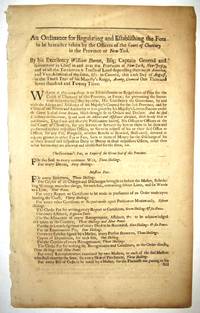
1710WRCAM39062New York: Printed by William Bradford 1710. 20pp. Folio. Dbd. Light scattered foxing. Very good. A rare early Bradford imprint. This list is expanded from an earlier version of the same year giving Gov. Robert Hunter's comprehensive table of administrative fees for the various offices and courts of New York and New Jersey printed by William Bradford the "pioneering printer of the English middle colonies" and first printer of New York. This early edition of Hunter's ordinance was published at the beginning of his remarkably popular governorship of New York an office he held until 1719. Later editions of the ordinance were published with the LAWS. of New York in 1713 and 1719; the present edition was reprinted separately in 1716 Evans 1848 but signed "Ro. Hunter" at the end instead of "R. Hunter" as it is here. Also in this edition line 9 of the caption title ends "&c." Rare with only eight copies recorded at six institutions in ESTC. EVANS 1482. ESTC W11521. Printed by William Bradford unknown books
172328535New York: Printed by William Bradford 1723. 4 pp folio. Caption title as issued. Loose and lightly toned else Very Good. Housed in a modern cloth binder with gilt-lettered spine title. <br/><br/> This rare item is the first statute establishing New York chancery fees thus curing "the Inconveniences that may thereby ensue" from their absence. No Chancery Officer "shall exact demand or ask any greater or other Fee or Fees" than the amounts enumerated herein. These regulations limit the "Governour's Fees as Keeper of the Great Seal of this Province" as well as fees of Masters Registers Clerks Examiners Solicitors and other officers. <br/> This is an early effort to curb the exercise of arbitrary power by hungry court officers. Governor Burnet signs in type at the end.<br/>Evans 2468. ESTCP W34081 7- AAS Huntington Columbia Harvard NY Hist. Soc. Brown HSP. Not in Cohen. Printed by William Bradford unknown books
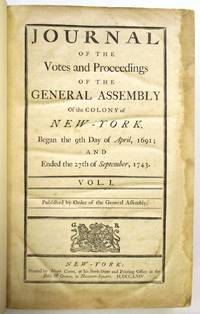
176624264New York: Hugh Gaine 1766. Volume I: iv 840 2 pp. Folio printed in double columns. Text generally clean occasional foxing or tanning. Several errors in page numbering but text consecutive and complete Very Good. <br/> Volume II: 2 811 1 blank viii pp. Folio printed in double columns. Text generally clean occasional foxing or tanning blank margins of last index leaves chipped. Very Good in attractive matching modern half calf raised spine bands gilt-lettered spine title on black morocco.<br/><br/> "First edition of the most important legal collection of its time and a cornerstone of New York and American colonial history" Jenkins. "Edited by Abraham Lott" Sabin. Marke says "The constitutional history of New York can be followed in" this offering and Larned calls it "important." Included in Volume I is the last leaf which Evans says "is often lacking" reversing the attainder of Jacob Leisler and others "who were executed for not delivering the Fort at New York to Richard Ingoldsby 1690" Sabin. <br/> Although Journals of New York General Assembly Sessions had been published annually this is their first compilation. <br/>FIRST EDITION. Evans 9756 10418. Marke 80. Larned page 10 #161. Sabin 53719. Hugh Gaine unknown books
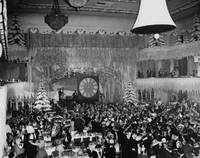
1904D12720New York 1904-c.1950s. Hardcover. Very Good. Collection of 182 b/w or sepia photographs silver prints; ranging in size from about 7x9 to 11x14 inches; mounted in two albums or loose sometimes with heavy cardstock mount or paper backing from having been removed from an album see below; offers exteriors views of the hotel from construction to completion and interior views of private and public rooms in the hotel from its construction in 1904 to a later remodel in perhaps 1935 the hotel was remodeled again in 1949 but these images don't seem to extend that late -- there are just a few images showing the Sheraton-Astor when it was briefly bought and renamed in 1954. The collection breaks down as follows: Large album of 42 mounted photographs from around the newly-opened hotel circa 1904 almost all credited in mount and negative to Joseph Byron of New York a few to Drucker & Co. half morocco oblong folio; lacking front board several photographs removed /// Large album of 33 later Hotel Astor photographs c. 1933 linen-backed signed in the negative by "Byron Co." /// 12 large Byron photographs of the hotel about 11x14 inches most mounted most worn and/or faded /// Disbound album of 28 Drucker & Co. photographs of the hotel some showing second-phase construction 1908 and undated /// Group of 67 8 x 10 inch photographs of the hotel some of them after being renamed the Sheraton-Astor in 1954 by William F. Howland 20 Empire Photographers 10 and miscellaneous or unknown photographers 37 circa 1920s-1950s. <br/><br/>Built at a cost of $7000000 on land leased from William Waldorf Astor great-grandson of John Jacob Astor the fur trader the 11-story 35000-square-feet Hotel Astor was designed in the French Renaissance "Beaux Arts" style by architects Charles W. Clinton and William H. Russell who imitated many features from the old Waldorf-Astoria on 34th Street. The Hotel Astor opened in September 1904 dazzling guests with its enormous public rooms most decorated with themes. A year later the elaborate roof garden was opened. The former site of the hotel the block bounded by Broadway Astor Plaza West 44th Street and West 45th Street is now occupied by the high-rise 54-story office tower One Astor Plaza. hardcover books
1764WRCAM28821New York: Hugh Gaine 1764. Two volumes. 48402; 28118pp. Thick folio. Contemporary calf. Heavily scuffed spines worn. Internally clean. Good. In worn half blue morocco slipcases red gilt morocco labels. These two massive volumes record the complete proceedings of the New York Assembly from the establishment of William and Mary's rule through the end of 1765. An invaluable source for New York. According to Evans the act for reversing the attainder of Jacob Leisler and others the appendix leaf in the first volume is usually lacking. EVANS 9756 10418. Hugh Gaine unknown books
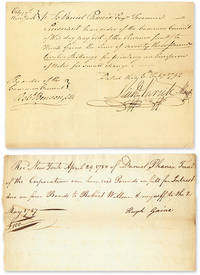
1789688571789. New York: Hugh Gaine 1789. 2 vols bound in one. New York: Hugh Gaine 1789. 2 vols bound in one. Handsome 1789 Folio Edition of New York Laws with Two Interesting Laid-In Manuscript Notes New York. Jones Samuel 1734-1819 Compiler. Varick Richard 1753-1819 Compilers. Laws of the State of New-York Comprising the Constitution And the Acts of the Legislature Since the Revolution From The First to the Twelfth Session Inclusive. Published According to an Act of the Legislature Passed the 15th April 1786. New York: Printed by Hugh Gaine 1789. Two volumes bound as one. iv 336 12 xii 2; ii 471 17 pp. Two laid-in manuscript notes 5-3/4" x 8" 6" x 8." Folio 10" x 15". Contemporary calf blind fillets to boards "Leonard Bronk" gilt-stamped to center of front board rebacked retaining existing spine with raised bands and lettering piece spine ends repaired hinges mended. Light rubbing to boards and extremities moderate rubbing to board edges corners bumped. Moderate toning light foxing in a few places offsetting to margins of preliminaries and rear endleaves. $3500. The first volume of collected New York laws printed after the ratification of the U.S. Constitution and the second issued after the American Revolution the 1789 compilation contains laws passed 1778 through 1789 regulating such topics as governance mortgages debtors land slaves New York City criminal and marital law rape liquor and exports. Also includes an interesting law in King's county Brooklyn and Queen's county Queens establishing a 40 shilling fine to those carriages traveling from the City of New York that fail to give right of way to carriages going toward the city. Also includes the Constitution of the State of New York passed April 20 1777. The laid-in notes are quite interesting. The first is a contract between New York City Mayor Richard Varick and Hugh Gaine dated February 7 1792. It directs the city treasurer to pay Gaine 73 pounds for "printing an emission of notes for small change." Issued two months before the establishment of the U.S. Mint this note is essentially an authorization by the State of New York to issue fractional currency. The U.S. Constitution prohibited states from issuing paper money but it appears that a few states and municipalities issued notes or at least authorized them in the early 1790s. Backed by the faith and credit of the issuer these notes f. unknown books
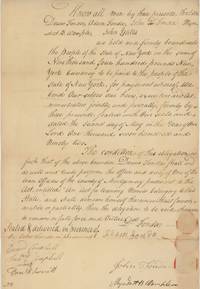
73244An archive of hundreds of letters bills receipts and other legal documents from the family of Academy Award-winning actress Jane Fonda dating from 1786 to 1880. This branch of the Fonda family traces its roots back to New York in 1651 when Jellis Fonda migrated from the Netherlands with his wife and four children. His grandson Douw Jellis Fonda 1700-1780 is considered the founder of the Dutch village now named Fonda about 30 miles west of Albany. He lived a long and prosperous life as a farmer and merchant but was killed at age 79 during a raid by the British Army aided by the Mohawk Indians.<br/><br/>This collection includes two early hand-drawn property maps of some of the Fonda-owned lands. One of the undated maps completed for John Fonda shows part of Mayfield with lots drawn and numbered. The second map also undated shows acreage for the heirs of A. Fonda except 150 acres sold to John C. Smith and 100 acres sold to David and Samuel Loomis.<br/><br/>The earliest material in this collection is connected to Douw Jellis Fonda's six children and grandchildren following the American Revolution. They were leaders in their community serving as judges state elected officials and military officers. There are five handwritten legal documents signed by various members of the family related to the payment of bonds associated with the appointment of loan officers and treasury officials for Montgomery County between 1786 and 1792. At the conclusion of the war the New York Legislature passed laws placing taxes on land and personal estates of all inhabitants in order to defray war expenses discharge its debts and support the state government. Supervisors of each county appointed individuals to "superintend" the raising of taxes within their respective counties. These documents include:<br/><br/>April 19 1786 three-page document signed by Judge Jellis Fonda on pages two and three concerning a 12000-pound bond for the appointment of Peter Schuyler as one of the Montgomery County loan officers<br/><br/>May 9 1786 document of three pages concerning Jellis Fonda's bond in the amount of 12000 pounds for the appointment of his son Douw Fonda as one of the Montgomery County loan officers<br/><br/>January 8 1787 document of one and a half pages concerning Adam Fonda's bond in the amount of 5000 pounds providing surety for Douw Fonda as treasurer of Montgomery County<br/><br/>June 29 1791 one-page document signed by Adam Fonda and Douw Fonda providing 4000 pounds as surety for John Yates to be the treasurer of Montgomery County<br/><br/>May 2 1792 document of two and a quarter pages signed by Douw Fonda Adam Fonda and John Fonda providing a 9400 pounds surety bond for Douw Fonda as a Montgomery County loan officer<br/><br/>This collection also includes a group of documents associated with Henry Fonda 1766-1828 who fought in the War of 1812 and was appointed Brigadier General of the 11th Infantry in 1820. During 1807 1816 and 1819 he was a member of the New York State Legislature representing the Fourth Senatorial District of Tryon County. This collection includes two printed broadsides headed "Brigade Orders" issued by him calling regiments to rendezvous and parade "for military exercise and improvement" in 1826 and 1828. There are also 20 handwritten bills and receipts dating from 1792 to 1824 for various items he purchased ranging from flannel to gin and three holographic legal documents for funds he was owed. An additional four letters in the collection were written to Henry addressed variously as major colonel and general dating from 1813 to 1828. Among them is a three-page letter from Daniel Cockstock dated March 6 1826 contemplating the impacts of various new stage routes in the region.<br/><br/>Another group of more than 120 letters receipts and other documents is connected to Henry's brother Peter Fonda 1802-74 who was a merchant and hotel keeper ran a stagecoach for a period worked as a contractor and helped build roads in the community. There are several letters about his stagecoach work including seat reservations purchasing horses schedules and even lost luggage. On January 4 1832 he received a letter about Theophilius Williams' lost trunk. "I understand by a letter from him that he left a description of it at your house offering five dollars to the finder which I will send to you immediately if found together with all accompany expenses incurred in the search and pay your bill for the same whether found or not if you will give your assistance" Levi Williams wrote.<br/><br/>Among the letters is one from Peter's wife Gertrude written to him in 1838 while he was in Rome building a bridge across the Mohawk River. "I want you to look out for yourself.don't depend on others you may lose keep your people sober." she wrote. A handwritten contract with officials from Rome dated January 1839 outlines the specifications for the bridge. He is also among a dozen men listed on a 1862 patent included in this collection for an improvement in pumps.<br/><br/>A variety of other miscellaneous documents are provided in the archive including:<br/><br/>An 1870 poll book for Fonda Montgomery County. The first eight pages are printed and provide a "plan of organization and action" to "effect change of administration at the President election of November 1872." Voters names are listed on six pages with P.H. Fonda's at the end.<br/><br/>A printed receipt completed in manuscript issued by the state of New York treasurer's office on April 9 1816 to Simon Vedder for Douw Fonda<br/><br/>An eighth page handwritten receipt dated December 20 1790 received from Adam Fonda<br/><br/>A one-page handwritten poem by Lavina Fonda dated June 9 1816 written on the death of a schoolmate<br/><br/>A small note signed by Adam Fonda dated September 17 1838 requesting Peter Fonda pay $15 to Robert Bahanan<br/><br/>A printed document with holographic notes for the lease of property dated October 9 1855 and signed by Aminta K. Fonda<br/><br/>Supreme Court calendar for the September 1863 term 16 pages in sewn wraps with P.H. Fonda's name written in pencil along the top of the cover<br/><br/>A quarter-page handwritten document dated October 25 1854 listing the person living in Fonda who are exempted from payment of teachers wages in District 8 of Mohawk<br/><br/>The materials are all generally toned stained and creased from former folds but otherwise in very good condition. unknown books
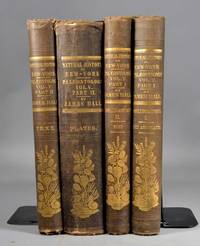
1842763301842. THE NATURAL HISTORY OF NEW-YORK. Albany Thurlow Weed 1842. NY Appleton & Co. and Wiley & Putnam 1843-1894. Folio. 30 volumes. Zoology in VI parts bound in 5 volumes; Botany in 2 volumes; Mineralogy one volume; Geology in 4 volumes; Paleontology in VIII parts bound in 13 volumes; Agriculture in 5 volumes. Maps and a wealth of lithographic plates of birds flowers fruit landscape panoramas geological sections etc. mostly hand-colored. Boards off volume I otherwise condition varies from good to fine. All but two volumes in original publisher's cloth with gilt vignettes. Complete descriptions and collations on request. Rare Complete. unknown books