238 résultats
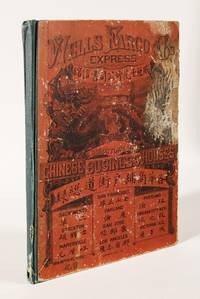
1882319779San Francisco: Britton a& Rey 1882. 146pp. text in English and Chinese. Original half green cloth and pictorial orange paper boards with a lithographic vignette of a dragon and harbor. Boards rubbed paper discolored and scraped along outer edge of front board discolored along outer edge of rear board. Cloth torn at lower spine hinges cracked but holding by cloth. Several instances of Wells Fargo & Co.'s Express red-ink stamp with text in English and Chinese characters. Old tideline along outer edge of many leaves. Very good. 146pp. text in English and Chinese. Rare Directory of Chinese Businesses in the West Published in the Year of the Exclusion Act. The third and last in a series of directories of Chinese businesses published by Wells Fargo this edition issued in the year of the Chinese Exclusion Act of 1882 which prohibited Chinese laborers from entering the United States. This edition is more than half again as long as the 1878 edition which has only 86pp. The first edition of 1873 is only nine pages in length.<br/><br/>Attractively printed by the firm of Britton & Rey the leading lithographers in San Francisco the text is in English and Chinese characters and lists hundreds of Chinese-owned businesses in San Francisco Oakland Sacramento San Jose Stockton Marysville and Los Angeles many of those businesses on a street called "Negro Alley"; as well as Portland Oregon; Virginia City Nevada; Victoria British Columbia; and Denver. The directory not only demonstrates the expansive reach of Chinese communities in the West but also how their businesses were tied to the ever-expanding Wells Fargo Company. Several pages in this copy are stamped with a bilingual logotype: "Ship Money and Goods by Wells Fargo & Co's Express."<br/><br/>The name and address of each merchant is given and in many cases the nature of the business is listed as well. San Francisco businesses take up more than half the text but it is notable to see the wide variety of business ventures undertaken by Chinese in the American West. Among these are laundries merchants druggists cigar factories "slipper" and shoe factories ladies' underwear tailors restaurants doctors Chinese and Japanese imports boarding houses barbers morticians butchers general merchandise jewelers and more. Among the more interesting businesses are employment offices a clam dealer pawn broker junk dealers and opium dealers. The smaller and more remote towns - such as Marysville Portland and Virginia City do not give business types as often and Chinese consulates and missions are also listed.<br/><br/>"Very rare" - Quebedeaux who notes two copies in private collections one of which may be the present copy formerly in the McClatchy family collection and apparently formerly owned by Western historian and novelist Stuart Lake. OCLC locates five copies at the California Historical Society the Autry Museum the Bancroft Library the Library of Congress and the Huntington Library. Rocq adds the copy at the Wells Fargo library in San Francisco and there is also a copy at Yale. Cowan P.175 Note. Cowan Chinese Question 472. Rocq 12764. Quebedeaux 101 Britton a& Rey unknown books
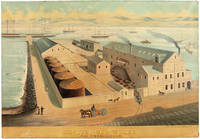
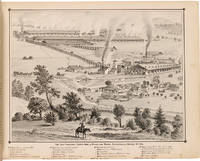
1883WRCAM448311883. Oil on canvas 18 x 26 inches on original wooden stretcher with letters in lower margin after the lithographed view of the same title published by Bosqui. Very good. "Edward Bosqui was born in 1833 in Montreal of French descent. When he was about seventeen years old he decided to go to California. He went by way of Panama where like a good many others who headed for the Gold Rush in those days he became stranded. He worked his way up through Mexico a hazardous trip but young Bosqui survived the many hardships.He arrived in San Francisco in the latter part of 1850 and his first job was as cashier of the first bank to be established there. Afterwards he served as General Fremont's secretary. He first went into the printing business in 1859 at Clay and Leidesdorff Streets and stayed at that location for thirty-nine years. Bosqui did bookbinding as well as printing and lithography.He printed the EVENING BULLETIN in the early days of its existence and did a great deal of commercial label work" - Peters. <br> <br> The Arctic Oil Works was established on a Bay side pier between 17th and 16th streets in 1883 to produce refined oils from seals whales and elephant seals. Soon after opening it became the largest oil refinery on the West Coast. In 1902 the oil works became incorporated as part of Standard Oil. <br> <br> The painting is quite similar to the scarce lithographed view produced by Bosqui although more Impressionistic in style and without quite as much detail. The spelling mistakes in the address of the works "Potrcro" instead of Potrero and in the address of the offices "ZB" instead of 28 further suggest this painting to be after the lithographed view. The painting however shows considerable age is on the original stretcher and dates from the late 19th century. PETERS CALIFORNIA ON STONE pp.60-61. J. Russell Harper EARLY PAINTERS AND ENGRAVERS IN CANADA p.39. unknown books
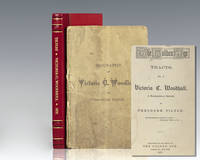
1871125391New York: Published at the Office of The Golden Age 1871. First edition of Tilton's biography of American suffragette Victoria Woodhull published shortly before she became the first woman to campaign for President of the United States. 12 mo original wrappers stitched as issued publisher's advertisement at rear. In very good condition. Housed in a custom cloth chemise and half morocco slipcase. Victoria Woodhull first made her reputation as a supporter of free love by which she meant the freedom to marry divorce and bear children without social restriction or government interference and as one of the only female newspaper publishers Woodhull & Claflin's Weekly with her sister Tennessee Claflin. She soon became an activist for women's rights and labor reforms and in a pivotal 1871 speech argued that the 14th and 15th amendments already covered women's suffrage. She decided to run for president in 1872 backed by the Equal Rights Party whose convention nominated Frederick Douglass for Vice President although he did not participate in the convention or acknowledge the nomination. While she obviously lost--and indeed could not have won constitutionally due to her age--Woodhull became one of the most powerful women's rights advocates of her day. This contemporary biography was written by Theodore Tilton a close friend of many within the movement. In 1872 Tilton confided in Elizabeth Cady Stanton that his wife was having an affair with Henry Ward Beecher. Tilton sued Beecher for alienation of affection and a salacious trial commenced. Woodhull abandoned her friendship to splash the scandal across the pages of Woodhull & Claflin's Weekly. Woodhull was arrested for obscenity and then acquitted--events that gave rise to the Comstock Laws of 1873 arguably the nation's most powerful and successful attempt at censorship. Woodhull emerged from the debacle with fewer friends--Susan B. Anthony for example disagreed with her behavior entirely--but nevertheless managed to retain her reputation as a leading supporter of women's rights and as an early American female politician. Published at the Office of The Golden Age hardcover books
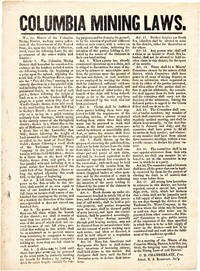
1853WRCAM46036Columbia Ca.: Gazette Print 1853. Broadside 10 3/4 x 8 inches. Printed in three columns. A bit of light foxing mostly in margins. Near fine. In a folding cloth clamshell case spine gilt. A rare broadside printing of the laws of the Columbia Mining District in California in 1853 created and enforced by the miners for their own self-government. The seventeen articles all deal with regulations for mining and claims. The first nine set out rules for making and operating claims. The next three address foreign ownership of claims. Article 10: "None but Americans and Europeans who have or shall declare their intentions of becoming citizens shall hold claims in this district." Article 11: "Neither Asiatics nor South Sea Islanders shall be allowed to mine in this district either for themselves or for others." Article 12 sets out a punishment for any miner who sells a claim to an Asian or a Polynesian. The final five articles set out rules for enforcing the laws including the creation of a Miners Committee and a system of binding arbitration. According to the text the laws were adopted "at a meeting of the Miners of the Columbia Mining District held Oct. 1st 1853." and the laws are signed in print by "C.H. Chamberlain Pres." and "R.A. Robinson Sec'y." <br> <br> "The item is of basic importance.as an example of how the California miners - or men beyond the reach of government anywhere else in our States and Territories for that matter - banded together and enacted and enforced codes of law for their own protection" - Eberstadt. The COLUMBIA GAZETTE which printed this broadside was according to Kemble the second newspaper to operate in Columbia starting operations in the fall of 1852. The first newspaper in the area the COLUMBIA STAR apparently printed only two or three issues in October-November of 1851 before the printing press was destroyed by vandals. <br> <br> Greenwood locates only three copies at the California Historical Society and the Bancroft Library and the Streeter copy which was sold at the Clifford sale in 1994. Rocq lists a copy at the Huntington Library. OCLC adds copies at Yale Library of Congress University of California at San Diego Stanford and DeGolyer Library at Southern Methodist University. A rare and interesting example of the search for order in the tumult of the gold rush. <br> <br> The Streeter copy sold to Howell for $550 in 1968. It later reappeared in the sale of California collector Henry Clifford in 1994. GREENWOOD 381. ROCQ 15427. EBERSTADT 131:105. STREETER SALE 2735. CLIFFORD SALE 26. OCLC 29876358. Gazette Print hardcover books
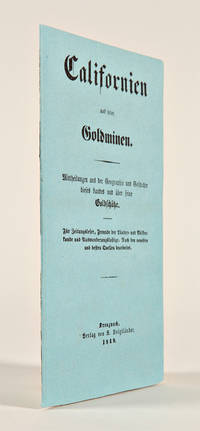
1849WRCAM52151Kreuznach: R. Voigtlander 1849. 32pp. Printed blue wrappers rear wrapper original front wrapper in facsimile. Small corner repairs to rear wrapper. Some foxing two ink stamps on titlepage. Else very good. In a half morocco slipcase and cloth chemise. The first edition of an exceedingly rare Gold Rush pamphlet printed in the hallowed year of that epochal event. "Like many guidebooks for Europeans this pamphlet gives general information on California's physical features history and 'Notes for Emigrants' on the gold discovery. The portion on California's gold riches consists primarily of an article reprinted from the KOELNER ZEITUNG of January 14 1849 which in turn summarizes R.B. Mason and others. The guide mentions the many German settlers in the Sacramento Valley and speaks proudly of Captain Sutter" - Kurutz. <br> <br> Only four institutions worldwide report a copy of this book: the California State Library the University of California at Berkeley Yale and the State Library in Berlin. It is even more difficult to encounter at auction this copy being the only one on record to pass through the rooms. COWAN II p.102. HOWES C43 "aa." KURUTZ 112. SABIN 9984. R. Voigtlander hardcover books
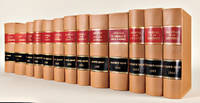
1864WRCAM17621San Jose i.e. New York session 1 New York session 2 San Francisco session 4 & Sacramento sessions 5-15 1864. Thirty-nine volumes. Various bindings of contemporary sheep and later cloth red and black leather labels. Condition ranges from rather rough to very fine many with contemporary and later ownership inscriptions including those of Joseph W. Walkup and the Placer HERALD. Second volume of appendix for thirteenth session has the titlepage in facsimile. A good run of these foundation California legal works including the following: <br> <br> 1st Session Journal of Legislature 1850; 2nd Session Journal of Legislature 1851; 4th Session Journal of Assembly 1853; 5th Session Journal of Assembly 1854; 5th Session Journal of Senate 1854; 6th Session Appendix to Assembly Journal 1855; 6th Session Journal of Senate 1855; 7th Session Journal of Assembly 1856; 7th Session Appendix to Assembly Journal 1856; 7th Session Journal of Senate 1856; 7th Session Appendix to Senate Journal 1856; 8th Session Journal of Assembly 1857; 8th Session Appendix to Assembly Journal 1857; 8th Session Journal of Senate 1857; 8th Session Appendix to Senate Journal 1857; 9th Session Journal of Assembly 1858; 9th Session Journal of Senate 1858; 9th Session Appendix to Senate Journal 1858; 10th Session Journal of Assembly 1859; 10th Session Appendix to Assembly Journal 1859; 10th Session Journal of Senate 1859; 11th Session Journal of Assembly 1860; 11th Session Journal of Senate 1860; 11th Session Appendix to Senate Journal 1860; 12th Session Journal of Assembly 1861; 12th Session Appendix to Assembly Journal 1861; 12th Session Journal of Senate 1861; 12th Session Appendix to Senate Journal 1861; 13th Session Journal of Assembly 1862; 13th Session Journal of Senate 1862; 13th Session two-volume appendix to Journals of Senate and Assembly 1862; 14th Session Journal of Assembly 1863; 14th Session Journal of Senate 1863; 14th Session single- volume appendix to Journals of Senate and Assembly 1863; 15th Session Journal of Assembly 1864; 15th Session Journal of Senate 1864; 15th Session single-volume appendix to Journals of Senate and Assembly 1864. <br> <br> Many of these volumes are quite hard to come by. An almost complete run such as this would be well nigh impossible to assemble. GREENWOOD 167 ref. WAGNER CALIFORNIA IMPRINTS 148. hardcover books
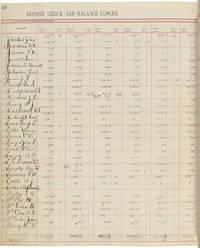
1890WRCAM55054Elsinore Ca 1890. Eighty numbered sections of six pages each comprised of leaves with folding flaps interleaved with narrower leaves totaling 480pp. Folio ledger. Half tan morocco and calf boards spine gilt with raised bands. Somewhat rubbed and worn corners bumped some staining to boards. Inner hinges reinforced. Occasional ink spills throughout fingerprints and occasional toning to lower corners of most pages no loss of text. Very good. Ink blotter with the name of "S.A. Stewart / Agent/Elsinore / Cal." laid in. This is an early ledger from the first bank established in Elsinore California and one of the first banks in southern California. The Exchange Bank of Elsinore was founded in 1887 by Franklin H. Heald one of the three investors who established the town of Elsinore. The city was officially incorporated the following year as the seventy-third city in California originally Elsinore was in San Diego County but the city became part of Riverside County upon its creation in 1893. The Bank of Elsinore was founded soon after and in 1890 the two banks merged to become the Consolidated Bank of Elsinore making this possibly the last ledger of the original Exchange Bank. <br> <br> This ledger tracks the funds of some of the more prominent southern California businesses and individuals of the time including Machado & Co. owned by descendents of José Agustin Machado who held Mexican land grants throughout Alta California including the Ranchos of La Ballona Santa Laguna and Santa Rosa. Also featured in the ledger is Horace McPhee publisher of the SANTA PAULA CHRONICLE W.G. McVicar owner of one of the early clay companies in southern California S.A. Stewart the agent named on the blotter mentioned above and later president of the Consolidated Bank of Elsinore several businesses and churches the local Masonic Lodge the Santa Rosa Cattle Company the Ladies Aid Society the TRANSCRIPT newspaper and the aforementioned Bank of Elsinore. Among the most significant customers of the bank was the Equality Colony part of the Southern California Colony Association founded by John W. North and others to cultivate grapes and semi-tropical fruits in the region which subsequently kicked off a new "gold rush" as horticulturalists and investors flocked to the area to be part of the new and rapidly growing citrus industry. <br> <br> This extensive banking ledger is a vital financial record of economic agricultural and population growth in southern California in the late 19th century. hardcover books
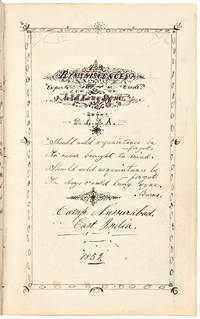
1860WRCAM39351Camp Nusseerabad India. 1860. 121pp. of manuscript text about 15500 total words. Original three-quarter calf and marbled boards. Boards edgeworn and lightly rubbed. Internally quite clean neat and legible. Very good. An interesting unpublished manuscript this is a novel in the form of an autobiography purportedly written by an American-born soldier in the British Army stationed in India in the late 1850s and early 1860s. The author describes his youth and early adulthood culminating with an account of his adventures hunting grizzlies in Gold Rush-era California. The chapter on Grizzly hunting in California called "Westward Ho" is copied with a few small adaptations from an article that appeared in the November 1857 issue of HARPER'S NEW MONTHLY MAGAZINE called "The Grizzly Bear of California." The remainder of the text develops several themes over the course of the work including the author's strained relationship with his wealthy father his youthful disillusionment with a career as a lawyer his friendship with a charming rogue named "Twadle" and his unsuccessful pursuit of love. The work also gently lampoons the character of the idle rich. It is unknown whether these other portions of the manuscript are also adapted from other published works or whether they are the product of the author's own imagination. Either way this manuscript is a very interesting example of mid-19th- century imaginative fiction and literary adaptation and worthy of further study. <br> <br> According to prefatory material this text was written in 1859-60 by Douglas D. Lindsay who identifies himself as a member of Company 7 of Her Majesty's 83rd Regiment stationed in East India at "Camp Nusseerabad." On a preliminary page he writes: <br> <br> "These 'Reminiscences of Auld Lang Syne' were written and presented by the author to his friend and gossip Thomas Smith of Her Majesty's 83rd Regiment and who in times to come as he glances over these pages will recall to mind the writer and 'wish him well wherever fate may have led him'; and he in turn will often think of his quondam friend while far at sea or in the deep piney woods of his native land." <br> <br> In several instances in the text Lindsay disrupts the narrative to offer asides to Smith providing a sort of post-modern authorial commentary on the proceedings. In a letter at the end of the text dated July 23 1860 Lindsay promises Smith that he will write a second volume "in which I propose giving you a few more passages from my experience in America - North - West and South intermixt with some jottings about the sea slavers smugglers etc. etc." It is not known whether "Lindsay" ever wrote this second volume. <br> <br> In the prefatory chapter Lindsay gives a sketch of his early life claiming to have been born "of a very ancient family who are said to be descended in right line from the Prodigal Son." He writes that he did not have a good relationship with his father and most of the assistance in his life was given to him by his deceased mother's brother. Lindsay says he eventually went to "the law school of old Y." later revealed to be Yale from which he graduated with a lofty idea of the law and jurisprudence. These beliefs were quickly deflated when he moved to the unnamed state's capitol city and set to work as a lawyer. Finding himself quickly in debt and unhappy he quit the law and moved back home. The next chapter in the book is entitled "A Screw Loose" and begins with Lindsay arguing with his father and being kicked out of the house. He departs leaving behind him most of his expensive wardrobe and ventures out in search of a friend named Twadle: <br> <br> "A young literary gentleman who was continually occupying the handsomest apartments he could find which he invariably vacated after a month of luxury. He was of a sanguine temperament and I will do him the justice to say that he always intended at the time of taking his rooms to pay for them. But so many extraordinary and unforeseen circumstances intervened between the day of his induction and pay-day that when that period arrived he regularly found himself in a state of unprecedented pecuniary depletion." <br> <br> Twadle was living in New York at the time and he and Lindsay decide to have a meal at Delmonico's. Of course they do not have enough money to pay the bill but Lindsay is rescued by his ever-helpful uncle who just happened to be dining there that evening. His uncle then takes Lindsay to his home welcomes him as a part of the family and gives him a job in his engineering firm. In the next chapter titled "Love Struck by Lightening" Lindsay describes his landlady's attempts to introduce him to eligible young women and his courtship with Sophia Walter daughter of a former governor. The romance fails when Lindsay discovers that his love has false teeth which horrifies him. <br> <br> The penultimate chapter comprising forty- one pages of the manuscript entitled "Westward Ho" is set in California during the Gold Rush era and is largely copied or adapted from a HARPER'S article of November 1857 called "The Grizzly Bear of California." Large portions of the manuscript are copied verbatim from the published article while in other places Lindsay makes adaptations or particularizes the story to himself. For example he mentions a "Hindoo Bear" in one passage and changes the name of the Grizzly hunter from "Colin Preston" in the published article to "Nathan Walker" in his manuscript. He also intersperses original passages which add to the story among the copied text. <br> <br> The section begins with Lindsay and a friend leaving Manhattan aboard a steamer bound for Chagres and then crossing the Isthmus of Panama. Lindsay then goes up the coast to Acapulco where he "secured passage in a crazy old polacca rigged schooner which was bound direct to San Francisco." The schooner is wrecked off the California coast with Lindsay as the only survivor. Next comes a long discussion of the California Grizzly and the "coastal range" in which it dwells followed by a recounting of Lindsay's providential escape from the shipwreck. He is rescued by a bear hunter called "Nathan Walker" "Colin Preston" in the original HARPER'S story a native of Arkansas who is described at great length. The rest of the chapter is filled with tales of Walker's bear- hunting exploits discussions of the nature of the Grizzly and the recollection of bear hunts in which the author participated with Walker often at great risk to his own life. <br> <br> In the final chapter comprising twelve pages and called "The Man in the Drab Coat" Lindsay tells a story of meeting an old Yale classmate of his in the Russian River gold diggings. His friend Robert had been quite successful in the mines saving some $5000 but was gravely ill and soon died. Lindsay promises him that he will collect all his money and deliver it to Robert's mother in the East. On his way home Lindsay stops in New Orleans and loses all of his own money in the gambling halls and leaves the city saddled with debt. Back in Troy New York he considers drawing on his friend Robert's money using it as a gambling stake to win back the money he lost in New Orleans. Late one night cold and seemingly hallucinating he is visited by a devilish figure "the man in the drab coat" who so frightens Lindsay that he resolves to give all Robert's money to his family as he had promised. <br> <br> An interesting work of adaptive and imaginative fiction meriting further research. hardcover books
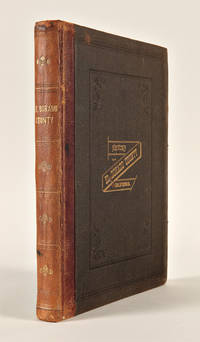
1883WRCAM51913Oakland: Paolo Sioli 1883. 8272pp. plus forty-nine plates including illustrated titlepage fourteen of them affixed to full-sheet sheets the rest printed on the full-sheet. Quarto. Original half pebbled leather and cloth boards stamped in gilt and blind neatly recased spine gilt edges marbled. Spine leather rubbed and faded. Two ownership inscription on front flyleaf recto. Occasional small stains and dust soiling but generally clean internally. Very good. The first history of this California county which contains the site of Sutter's Mill where James Marshall discovered gold in 1848 sparking the California Gold Rush. The text includes a long history of the county from the Spanish period through the Mexican- American War and the discovery of gold. The mining industry is thoroughly treated as are internal improvements immigration town histories criminal activities Indian troubles secret societies and much more. The text also contains biographies of prominent citizens many of whom are featured in the accompanying plates as are several prominent homes and farms. Little is known of publisher and compiler Paolo Sioli who does not appear to have produced any other books. This work is scarce and is patterned on the better known California county histories published by Thompson & West and others. Not in Cowan. An important visual and historical record of this county. HOWES E87 "b." ROCQ 1754. Paolo Sioli hardcover books
1880WRCAM55696Oakland: Thompson & West 1880. 234pp. including colored "Map of California Nevada Utah and Arizona" plus eighty-three full-page or double-page lithographs the first included as part of the pagination. Oblong quarto. Original half sheep and green cloth stamped in blind and gilt spine gilt. Hinges reinforced corners neatly repaired front and rear end leaves with some neat tissue repairs at the edges. Titlepage and two contents leaves with a mended vertical tear not affecting text. Final text leaf with a small tear in the outer margin not affecting text. Very good. A magnificent illustrated history of Nevada County California. The wonderful lithographs ably show how in just thirty years the area that had been a rough and tumble center of gold rush activity was transformed into a lovely group of communities in the Sierra Nevada foothills. The illustrations show private residences with neatly tended yards and gardens courthouses and other public buildings hotels newspaper offices mining companies banks foundries factories general stores breweries jewelers druggists lumber yards liveries mines and much more. Two of the lithographs relate to the Donner Party disaster which occurred nearby and other plates give historic representations of the area. One interesting plate shows Louis Siebert's Vineyard & Soda Works while the double-page illustrations include views of the Providence Gold & Silver Mining Company; the Idaho Quartz Mine; St. Patrick's Church & Mt. Saint Mary's Convent in Grass Valley; and Bird's Eye Canyon. Most of the illustrations are of locations in the largest cities in the county - Nevada City and Grass Valley - though the smaller towns of Truckee You Bet Rough & Ready North San Juan Sweetland Cherokee and Lake City are also represented. The text includes a long and detailed history of the county with information on gold mining the Donner Party biographical information on John Sutter and other leading men of the area etc. <br> <br> These atlases are often found in very rough condition usually lacking plates. The present copy is complete and in very good condition and provides an important visual and historical record of growth and community building in rural northern California in the late 19th century. Scarce and very desirable. COWAN p. 452. HOWES N60 "b." ROCQ 5957. NORRIS CATALOGUE 2834 "very rare". Thompson & West hardcover books
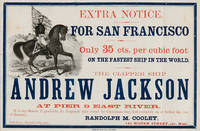
1861WRCAM55613New York: Nesbitt and Co. 1861. Illustrated handbill 6 1/4 x 9 1/2 inches sight printed in red blue and black. In fine condition. Matted and framed. A rare and attractive handbill advertising the services of the Andrew Jackson a clipper ship bound for San Francisco in late 1861. This is a large handbill much larger than the typical clipper ship card and has a wonderful image of Andrew Jackson astride his horse with the American flag behind. The illustration of Jackson was drawn by George F. Nesbitt who also printed this handbill. <br> <br> The Andrew Jackson was a 1679 ton medium clipper built in Mystic in 1855. She was a fast sailer but contrary to what the handbill would imply she didn't set any records on any of her passages. At the time of the voyage advertised here December 16 1861 she was helmed by a Captain Johnson. It is interesting that this voyage to California was scheduled at a time when naval action in the Civil War was ramping up: the USS Constitution arrived at Ship Island at the mouth of the Mississippi River carrying the 26th Massachusetts Regiment to New Orleans; Great Britain began its embargo on U.S. exports; and the naval blockade of the Confederate coast was beginning to show results. Despite the turmoil of the war the handbill states that the ship would depart "by Christmas day but certainly on or before the 1st of January." The clipper ship Andrew Jackson was sold to the British in 1863 and was lost in the Gaspar Straits in 1868. A rare survival. Nesbitt and Co. unknown books
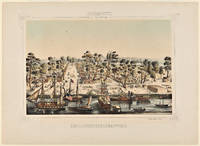
1851WRCAM31449Berlin: J. Hesse 1851. Handcolored lithographic print 19 1/2 x 14 1/2 inches. Minute browning and edge wear in margins. Color bright and clean. Very good. Archival matting and protected with mylar sheet. Variant issue without priority of this delightful early view of Sacramento showing the city inland from the harbor complete with bustling streets and wharf. In the harbor are two ships flying American flags one steamer and what is presumably a Mexican vessel. One large building facing the water is adorned with an elephant across the upper portion of its facade. The elephant figured prominently in the gold rush mythos. Those who said they "saw the elephant" meant that they had been there and seen the big show as in "went to the circus and saw the elephant". Thus an early example of California billboard advertising. The print was most likely extracted from the German MAGAZIN IN BERLIN. and has an unrelated image on the verso. Reps locates only four copies. A rare California view. REPS VIEWS &VIEWMAKERS 218. J. Hesse unknown books
186329955Sacramento: Printed by A. Badlam 1863. 8vo. 8 5/8 x 5 1/2 inches. 21-142pp plus 26pp of preliminary ads printed on yellow red and green paper and additional ad in the rear complete. Publisher's roan-backed boards with advertisements on both covers and endpapers worn<br/> <br/>An early Sacramento business directory published in California during the Civil War.<br/> <br/>An invaluable source of information from the period with advertisements for a wide-range of businesses including shippers wine merchants surgeons dentists and druggists printers and bookbinders photographers grocers hardware dealers and more. Besides the alphabetical directory the work includes a brief history of Sacramento as well as information on the state county and city offices local institutions as well as post offices and stage routes. Scarce with only five examples cited by OCLC with only one being outside of California.<br/> <br/>Rocq 6528. Printed by A. Badlam unknown books
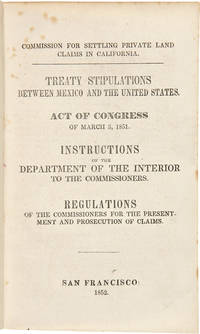
1852WRCAM46581San Francisco 1852. 20pp. Modern paper boards gilt leather label. Three bookplates on front endpapers. A touch of light foxing and a faint vertical crease. Very good. One of the bookplates on the present copy is that of the noted Vermont collector Hall Park McCullough. A seminal collection of documents under which California land claims were considered and one of the earliest and rarest San Francisco imprints on that issue. California came under American control during the Mexican- American War and attained statehood in 1850. One of the most vexing legal questions in the 19th-century history of the state was the status of lands that had been granted by the former Spanish and Mexican governors. These "ranchos" at times amounted to thousands of acres and questions of their ownership were quite contentious despite the provisions of the Treaty of Guadalupe Hidalgo to respect all Mexican land titles. This volume contains the text of the pertinent articles from the Treaty of Guadalupe Hidalgo the text of the 1851 Congressional Act establishing a Commission to investigate the cases the instructions to the Commissioners and the regulations under which they operated. <br> <br> "This is the foundation document under the terms of which all California land claims were first adjudicated" - Streeter. "One of the earliest local publications with reference to Mexican land claims" - Cowan. Greenwood locates eleven copies including the Streeter copy. <br> <br> An incredibly rare early California statehood tract. Only two copies have appeared at auction since the Streeter sale in 1968. COWAN p.375. GREENWOOD 362. STREETER SALE 2726. NORRIS CATALOGUE 1996. COHEN 9587. OCLC 191282311. hardcover books
186738094Nevada i.e. Nevada City California: Daily Gazette Book and Job Office 1867. 8vo. vi 6 424pp. Tipped-in ad slip between pages 184 and 185. Contemporary purple morocco<br/> <br/>Provenance: E.G. Waite of Gregory & Waite Grocers Nevada City bookplate name in gilt on upper cover<br/> <br/>The first Nevada County directory the first history of the county as a whole and the first book printed in Nevada County.<br/> <br/>First edition of this "notable compendium of early source material similar in import to the county histories of Thompson and West" Wheat. The work also includes sketches of the towns and mining camps a directory of the residents including their occupations as well as statistics of mining and other resources and a plethora of fascinating advertisements. Bean's history and directory is quite scarce and contains a great wealth of early material on this vitally important mining region. A substantial essay is given over to mining gold from quartz deposits which as the author notes has been the subject of numerous false starts. "Bean's history and directory is by far the best-known of all California directories. One of the great 'standard' county histories it is in the minds of many collectors dealers historians and libraries one of the most valuable - content wise - of all directories published in the United States" Quebedeaux.<br/> <br/>Cowan II p 170; Graff 219; Howes B-278; Wheat Books 13; Quebedeaux 36; Streeter Sale 2913. Daily Gazette Book and Job Office unknown books
1866WRCAM17607New York San Francisco & Sacramento 1866. Sixteen volumes. Contemporary legal sheep leather labels. Some volumes with tender or almost detached hinges. Contemporary and later ownership inscriptions including those of Walter Norris of Salinas Lucas F. Smith of Santa Cruz Victor L. Hicks Wright & Wright of San Francisco and Fred V. Wood of Oakland. Overall a very good set. A complete run of the first editions of the statutes of California during her formative years. As the third and fourth volumes are very rare it is extremely difficult to find a consecutive run of these early laws. At this early stage of California legal printing any given state printer was not kept for long. Those represented herein are as follows: J. Winchester first volume; Eugene Casserly State Printer second volume; G.K. Fitch & V.E. Geiger Co. State Printers third volume; George Kerr State Printer fourth volume; B.B. Redding State Printers fifth and sixth volumes; James Allen State Printer seventh and eighth volumes; James O'Meara State Printer ninth and tenth volumes; Charles T. Botts State Printer eleventh and twelfth volumes; Benj. P. Avery State Printer thirteenth and fourteenth volumes; O.M. Clayes State Printer fifteenth and sixteenth volumes. <br> <br> There is an interesting note to the printing history of the statutes. According to Wagner the Governor refused to acknowledge Casserly as state printer at the end of the 1851 session and instead appointed G.K. Fitch to the position. Fitch turned over all state printing copy to be done in New York. Casserly brought the matter to court and won back his position as state printer whereupon the already printed statutes were sold to him in a compromise agreement. Casserly then proceeded to have new titlepages added to the statutes that had been printed in New York and added errata slips and an index. All subsequent laws were printed in California. COWAN p.610 ref. GREENWOOD 167 ref. WAGNER CALIFORNIA IMPRINTS 147 149 150 ref. hardcover books
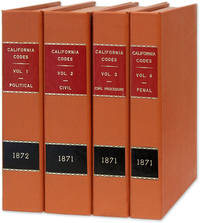
1872688091872. Sacramento 1871-1872. 4 Vols. Sacramento 1871-1872. 4 Vols. California's Field-Based Codes of 1872 California. Haymond Creed 1836-1893. Burch John C. 1826-1885. Lindley Charles. Revised Laws of the State of California: In Four Codes: Political Civil Civil Procedure And Penal. Volume I: Sacramento: T.A. Springer State Printer 1872; Volume II-IV: Sacramento: D.W. Gelwicks State Printer 1871. Four volumes. Complete set. Lacking the 2 tables one of consanguinity the other a schematic overview of the civil code. Octavo 8-3/4" x 5-1/2". Contemporary three-quarter law calf over marbled boards raised bands and red and black lettering pieces to spines. Some rubbing and a few minor scuffs to boards heavier rubbing to extremities with wear to spine ends and corners boards detached a few endleaves detached and lightly edgeworn card-pocket residue to front pastedown of Volume I. Light to moderate toning a few early owner signatures to front endleaves of Volumes I and II later library stamps to title pages other library marks to versos. Volumes housed in recent buckram clamshell cases with red and black lettering pieces. $3000. First edition Volume I was published last. Volume I: Political Code; Volume II: Civil Code; Volume III: Code of Civil Procedure; Volume IV: Penal Code. Based on David Dudley Field's New York Field Codes these volumes comprise the proposed code of laws for the state of California. The codes were adopted in 1872. The Political Code is no longer in force but the other three remain the fundamental basis of California law. Babbitt Hand-List of Legislation Sessions and Session Laws 25. unknown books
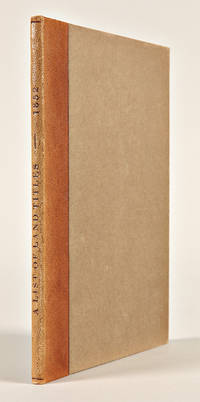
1852WRCAM46585San Francisco: Monson Whitton & Co. 1852. 43pp. Modern half calf and plain paper boards. Text lightly age-toned. Extensive early pencil notes see below. Very good. The Thomas W. Streeter copy with his bookplate on the front pastedown and his pencil notes on the front free endpaper. A very significant publication indicating that from the earliest days the United States government would contest the validity of claims to land in California that had been granted before statehood. <br> <br> California came under American control during the Mexican-American War and attained statehood in 1850. One of the most vexing legal questions in the 19th-century history of the state was the status of lands that had been granted by the former Spanish and Mexican governors. These "ranchos" at times amounted to thousands of acres and questions of their ownership were quite contentious despite the provisions of the Treaty of Guadalupe Hidalgo to respect all Mexican land titles. In 1851 the U.S. Congress created a three-person commission to consider the validity of land claims each of which would ultimately be challenged by the U.S. government. The list of land title cases at the end of this volume the first to have been printed shows that 247 cases were presented to the courts in the year after the Commission was created. "This pamphlet states the first official acts of the land commissioners. The list of land claims at the end gives the names of the attorneys on which a former owner has penciled in many instances the final action of the commissioners" - Streeter. Of the three original commissioners Harry I. Thornton was a frequent upholder of the validity of the claims against the interests of the U.S. government and was removed from the Commission in 1853. <br> <br> Not in Cohen or Sabin. This copy was bought at the Streeter sale for $300 in 1968 by Warren Howell who asked $1000 for it shortly thereafter. He sold it to a private California collector from whom the Reese Company acquired it. STREETER SALE 2725 this copy. COWAN p.374. GREENWOOD 364. Monson, Whitton & Co. hardcover books
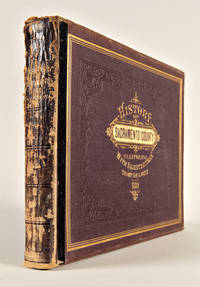
1880WRCAM38805Oakland: Thompson & West 1880. 294pp. plus two colored maps one folding and 216 lithographic plates several with more than one illustration eight of them double-page. Oblong quarto. Original half sheep and cloth stamped in gilt and blind spine stamped in gilt. Spine and hinges rubbed and scuffed boards moderately worn at edges. Long closed tear in folding map and one text leaf else internally very clean and fresh and in near pristine condition. A magnificently illustrated comprehensive history and description of Sacramento. While the text provides a history of the city from its settlement to the date of publication the illustrations provide excellent views of numerous key buildings. Included are the state capitol courthouses the Sacramento Brewery the Arcade Hotel the offices of the Sacramento Bee and other newspapers the Sacramento Seminary cattle ranches farms lumber yards merchants mills Breuner's furniture shop the county hospital and much more. Homes of several prominent citizens are shown including Mrs. E.B. Crocker's mansion her main residence as well as a smaller - yet still grand - home a block away the opulent home of Albert Gallatin and the ranch of cattle baron Frederick Cox. Scores of more modest homes in the city and country are shown as well including the residences of several farmers and ranchers in what was once open countryside but is now part of Sacramento's suburban sprawl. One map is of California and surrounding states while the folding map shows Sacramento County. An exhaustive effort designed to attract additional residents and businesses to California's booming capital and providing an unequalled visual record of Sacramento in the late 19th century. COWAN p.548. HOWES S9 "b." ROCQ 6512. NORRIS CATALOGUE 3351. Thompson & West hardcover books
1881WRCAM50288San Diego 1881. Folding map 23 1/2 x 34 3/4 inches folded to 8 1/4 x 4 1/2 inches. Minor separations at crossfolds a couple short fold separations ink stamp on front. Else very good. A rare blueprint map showing the harbor of San Diego along with a scaled map of the U.S. from northern California east to Boston south to Charleston South Carolina and west to Sonora Mexico; with a grid of the property of the San Diego Land & Town Co. in National City a small city within San Diego and including the "Terminal Grounds" of the railroad. Heliographed by O.N. Sanford in San Diego. Frank A. Kimball was the agent for California Southern or the San Diego Land & Town Co. in National City and the front cover bears his ink stamp. Rare with only three copies on OCLC at Yale the University of California San Diego and the Sacramento Public Library. Not in Rocq. OCLC 54146621 35291187 34434276. unknown books
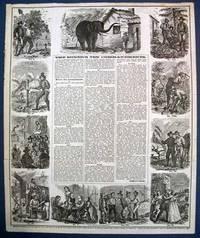
185334042San Francisco: Sun Print 1853. 1st separate issue Baird 167; Clifford 180. Subtle age toning to extremities. Fold lines which are a bit tender & starting at the edges. Still a respectable VG copy. 1 sheet of lined light blue laid paper folded once vertically. Text printed p. 4 in 3 columns with a surrounding border of 11 wood engraved vignettes of mining-camp life as drawn by Harrison Eastman. Eastman's images portray the temptations which the commandments exhort the miners to resist such as gambling drinking staking false claims stealing fighting lying etc. 11-1/4" x 9-1/4" <br/><br/>"Thou shalt have no other claim than one." "Thou shalt not go prospecting before thy claim gives out." "Thou shalt not steal a pick or a shovel or a pan from thy fellow miner; ." "Thou shalt not tell any false tales about 'good diggings in the mountains' to thy neighbor ." "Thou shalt not commit unsuitable matrimony." So declares 'The Miner's Ten Commandments.' These divine rules of the California Gold Rush came about in the early 1850s when keeping the Sabbath became a point of issue in Placerville and other mining regions. Such religious observance was favored by James Hutchings but not so by many other residents. Their lack of spiritual reverence was lampooned along with many other shady miner practices by Hutchings in this famous and subsequently oft-imitated parody of the Ten Commandants. The work was first published 4 June 1853 in the Placerville Herald and this the first separate publication. For more detailed history of this piece see Kruska's HUTCHINGS Chapter 5. Sun Print unknown books
1828WRCAM43468Mexico 1828. Broadside 16 3/4 x 12 1/2 inches. Old folds. Slight wear and a few closed tears at edges. Very good. In a half morocco and marbled boards folding box spine gilt. A scarce broadside enumerating the number of troops and officers which were needed for posts in California. The various posts are listed including San Francisco Monterrey Santa Barbara San Diego and Loreto as well as frontier forces. The number of soldiers called for at each is given as well as physicians and surgeons inspectors etc. The annual budgets for the forces are also provided. Signed in print at the end: "F. Castro." This broadside is sometimes found with an accompanying printed circular announcement not present here. hardcover books
1869WRCAM48140Sacramento: H.S. Crocker & Co. 1869. 62752pp. including index and in-text advertisements. Original half pigskin and printed paper boards spine gilt. Boards quite rubbed scuffed and soiled. Rear blank endpaper lacking. Final text leaf index leaf torn in upper outer corner not affecting text. Several instances of early ink or pencil marginalia. Toned scattered foxing. Good. The near completion of the transcontinental railroad saw Sacramento's population increase by twenty-five percent in a year from sixteen thousand to twenty thousand in early 1869. This is the third of three Sacramento directories by Draper between 1866 and 1869 and includes information not only on the city but on the surrounding county as well. Descriptions of several small townships are included such as Alabama Brighton Cosumnes Dry Creek Granite Natoma Sutter and more and the names of resident voters are listed. Also included is a table of depots of the Central Pacific Railroad distances from Sacramento and the location of telegraph stations. "Very rare" - Quebedeaux. QUEBEDEAUX 57. ROCQ 6515. HOWES D487 1866 Draper directory. H.S. Crocker & Co. hardcover books
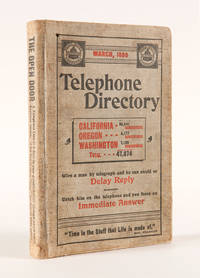
1899WRCAM56200San Francisco: Pacific States Telephone Companies 1899. 4vi2vii-viii4942pp. Original printed buckram boards. Small hole drilled through front and rear boards for hanging. Boards soiled and edge worn remains of adhesive to rear pastedown bookplate affixed to rear pastedown. Minor soiling and tanning to text small tear in upper part of pp. 493-94 affecting a few letters of text. Very good overall. Scarce telephone directory for California Oregon Washington and northern Idaho advertising listings for all 47874 subscribers often including addresses. The front pastedown provides instructions for how to use the telephone and make calls along with advice on telephone etiquette and how to contact non-subscribers. Although the telephone had been around for over twenty years at this point people apparently still benefited from the advice to "speak in a moderate tone and directly into the transmitter with the lips as close as possible to the mouthpiece." Likewise callers are advised to be clear about who they are and whom they are calling: "Much friction and annoyance will be avoided if this simple plan is carried out." <br> <br> After a few pages with information on long distance and line rates there is a "Supplemental List" for San Francisco dated April 1 1899 and printed on pink paper. Between pp.vi-vii of this supplement facing a page titled "Chinese Exchange" is a yellow leaf printed in Chinese on one side. The final leaf and rear pastedown have additional information on features available to subscribers and printed in black and red on the rear board is a map of the coverage area highlighting the "21000 miles of copper wire" running up and down the west coast. <br> <br> The directory begins with San Francisco listings organized alphabetically by subscriber and then covers the rest of California - Acampo to Zaca - alphabetically by city. Next are Oregon listings printed on pink paper and arranged alphabetically by city. Washington follows again arranged alphabetically by city; and then the final two pages include listings for sixteen towns in north Idaho. <br> <br> The invention of the telephone by Alexander Graham Bell in March 1876 created a new and swiftly-developing commercial market for rapid communication. Less than a year later the first newspaper report was delivered over the phone. The invention of the microphone in 1877 paired nicely with the new telephone technology and the Bell Telephone Company was born in July of that year. The first telephone directory in the U.S. was issued in New Haven Connecticut seven month later in February 1878 and the second directory in the U.S. was issued in San Francisco in June 1878. <br> <br> OCLC lists five copies of this March 1899 issue: Yale damaged Sacramento Public Library L.A. County Natural History Museum and the Nevada State Library. OCLC 55676511 19667877 29785821. Pacific States Telephone Companies hardcover books
188231379San Francisco: B. F. Alley 1882. xi 509 48pp. plus woodcut frontispiece and eleven other woodcut portraits. Later half calf and contemporary sheep gilt morocco spine label edges sprinkled brown. Ownership inscription on front endpaper recto scattered manuscript notations in pencil several on portraits. Final contents page tipped in.<br/> <br/>A rare history of Tuolumne County California covering a variety of topics.<br/> <br/>It recounts the foundation of its towns by miners arriving from the East in the summer of 1848 at the beginning of the California Gold Rush and contains a chronology of important events and a section of biographies for significant county figures. The volume also provides lurid accounts of various crimes committed including lynchings robberies and murders as well as of natural disasters and mining accidents. A significant portion of the book is dedicated to the county's mining history and its geology as well as its the promotion of its agricultural resources. Includes a portrait and brief biography of Samuel Clemens Mark Twain who spent time around the mines in California as a reporter during the Civil War and apparently stayed in Tuolumne County during the winter of 1864-65 where he wrote "The Celebrated Jumping Frog of Calaveras County." "One of the rarest of all California histories. with only a few copies in existence" - Norris.<br/> <br/>Adams Six-Guns 2248; California Local History 15345; Cowan II p. 646; Howes l71 "b"; Norris Catalogue 3968. B. F. Alley unknown books