508 résultats
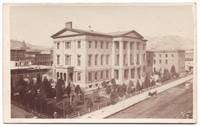
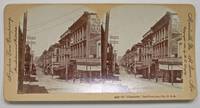
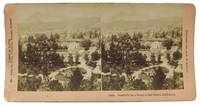
189547619Littleton N. H.: B. W. Kilburn Photographer & Publisher 1895. Now housed in an archival sleeve. Some modest wear & soiling to card with a few smudges to the verso. Top of images a bit faded aspects of the town itself quite sharp. A VG example. Albumen stereo image of San Rafael from an elevated perspective mounted to peach-colored card stock. Lettering in black ink. Verso with publisher imprint. Oblong format: 3-1/2" x 7". Concave. Rounded corners. <br/><br/>San Rafael was incorporated in 1874 and is named after the Archangel Raphael the Angel of Healing. B. W. Kilburn, Photographer & Publisher unknown books
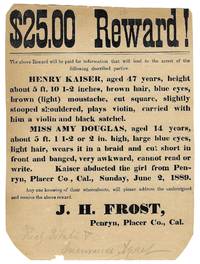
18891461Penryn Ca 1889. About very good. Broadside 9 x 6.75 inches. Trimmed unevenly corners clipped lightly tanned. Contemporary pencil notation at bottom of sheet. Broadside advertising a reward for the arrest of Henry Kaiser for the abduction of Miss Amy Douglas taken from the little town of Penryn in Placer County on Sunday June 2 1889. Kaiser is described as "aged 47 years height about 5 ft. 10 1-2 inches brown hair blue eyes brown light moustache cut square slightly stooped shouldered plays violin carried with him a violin and black satchel." Miss Douglas is described as well: "aged 14 years about 5 ft. 1 1-2 or 2 in. high large blue eyes light hair wears it in a braid and cut short in front and banged very awkward cannot read or write." The reward is offered by a J.H. Frost and a pencil note seems to indicate that he was a real estate and insurance agent. A newspaper article from the San Francisco Chronicle of June 24 1889 relates that the two eloped. Kaiser was a divorcé and the son of a well-known winemaker in the area. The two were located in Portland Oregon having unsuccessfully tried to gain a marriage license due to Amy's young age. Another article indicates that Amy fled cruelty at home her father having consented to her marrying Kaiser when she turned sixteen. In any case Kaiser was discharged from criminal prosecution having been found to have acted honorable with regards to the girl. An interesting story and the broadside is unrecorded. unknown books
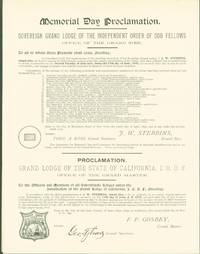
1900290194Independent Order of Odd Fellows I.O.O.F. 1900. Poster. 4 sheets 8.5 x 11 inches printed in black on white. Insignia of Grand Lodge of the State of California on all 4 sheets. The Memeorial Day proclamations are to honor those lodge members in California who have died in the past year. The May 1900 sheet deals with rules governing 'Official Certificates' and 'Dispensations' in California. The October 8 1900 sheet deals with requests for contributions to assist with relief for victims of the flooding in the coast of Texas. First edition first printing. Near fine copies. 3 sheets have 2 holes punched at top edge.<br> Independent Order of Odd Fellows (I.O.O.F.) unknown
186670879San Francisco CA: Lawrence & Houseworth 1866. Photograph. Near Fine. Lawrence & Houseworth unknown
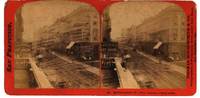
189344953San Francisco Ca: Thomas Houseworth & Co 1893. Orange stiff-stock card mount. Rounded corners. Light wear to edges of mount. Photograph clear & sharp. VG. One photograph with the two views dome top captions printed in black. 3-1/2" x 7" <br/><br/>Images show Montgomery St. from the vantage point of a south-facing balcony. Thomas Houseworth & Co unknown books
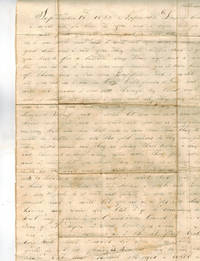
1855007164Sacramento California 1855. Manuscript. Very Good. No Binding. HOLOGRAPH LETTER SIGNED. Two manuscript letters in ink both on ruled paper with folding creases the 1855 letter 8" x 12 1/2" with single spaced writing both sides approx. 500 words. The 1856 letter 15" x 10" folded in half to make 4 pp. approx. 300 words with small blindstamp top left corner depicting an eagle. The earlier letter is headed "September 18th 1855 Naperville Dupage County Illinois" and ends "Michael direct your letters Nevada County Nevada post office California". George writes to his brother Michael in Naperville that he has "seen a good dele sins i rote you they last letter" including a hundred "inshins" and some "Buffellow". He adds that "we had good luck all they way of may we left Council Bluff" and that he is not home sick yet. He then talks of the gold mines river mining what they are paying and the cost of things such as board "from five to ten dollars a week" "Beaf" "wors 15 to 20 cents" and "potato" "4 cent per pound". He adds that he intends to have some gold before he comes home and that "girls are not so plenty here as they are in state". He closes by asking his brother to write him and to remain at home in Illinois to care for their parents. The 1856 letter headed Sacramento august 3th 1856 informs his brother that he is well and "down to Sacramento now" working on a farm feeding a "schrasing" thrashing machine and that "they times is verry hard in California now". He adds that he had some money "stole" while he was in the mountains but since coming down into the valley he was making money and will send some home soon. The letter ends with George wishing to see them all soon and that he is not home sick. The third page of the letter bears a drawing of a wing or leaf eleven smaller versions of the same image interspersed on page 2. A fascinating testimonial on California during the gold rush written in a strong hand and in a wonderful vernacular style by a good observer. unknown
1855007164Sacramento California 1855. Two manuscript letters in ink both on ruled paper with folding creases the 1855 letter 8" x 12 1/2" with single spaced writing both sides approx. 500 words. The 1856 letter 15" x 10" folded in half to make 4 pp. approx. 300 words with small blindstamp top left corner depicting an eagle. The earlier letter is headed "September 18th 1855 Naperville Dupage County Illinois" and ends "Michael direct your letters Nevada County Nevada post office California". George writes to his brother Michael in Naperville that he has "seen a good dele sins i rote you they last letter" including a hundred "inshins" and some "Buffellow". He adds that "we had good luck all they way of may we left Council Bluff" and that he is not home sick yet. He then talks of the gold mines river mining what they are paying and the cost of things such as board "from five to ten dollars a week" "Beaf" "wors 15 to 20 cents" and "potato" "4 cent per pound". He adds that he intends to have some gold before he comes home and that "girls are not so plenty here as they are in state". He closes by asking his brother to write him and to remain at home in Illinois to care for their parents. The 1856 letter headed Sacramento august 3th 1856 informs his brother that he is well and "down to Sacramento now" working on a farm feeding a "schrasing" thrashing machine and that "they times is verry hard in California now". He adds that he had some money "stole" while he was in the mountains but since coming down into the valley he was making money and will send some home soon. The letter ends with George wishing to see them all soon and that he is not home sick. The third page of the letter bears a drawing of a wing or leaf eleven smaller versions of the same image interspersed on page 2. A fascinating testimonial on California during the gold rush written in a strong hand and in a wonderful vernacular style by a good observer. . HOLOGRAPH LETTER SIGNED. Manuscript. Very Good. books
186074708Downieville CA: N.p 1860. Original 4-page letter from H. I. Thornton Jr. to his mother and dated August 3rd of 1860. Contemporary lined blue paper with each page measuring 7 3/4 x 9 7/8 inches. Written in a very legible hand. Expected fold-lines and one short marginal tear else and excellent letter filled with California politics before the Civil War.Harry I. Thornton Jr. was born and raised in Alabama in a highly distinguished family; his father was Alabama Supreme Court Judge and his uncle John J. Crittenden of Kentucky was a United States Senator for four terms. Harry Jr. came to California in 1854 and immediately took up his law practice in Nevada City. Soon thereafter he moved to Downieville in Sierra County. He was enormously popular and in 1857 was elected District Attorney. As his popularity grew he was soon induced into running for State Senator. He did and won. This letter is to his mother telling of his political wishes and hesitations. He tells her that the incumbent Kirkpatrick has endorsed him and that he thinks winning the elections is an actual possibility. He writes - "All considered I am wavering. I will leave the matter open until the / comes in from Washoe which will be next week. it is more likely I will be lured off by the trumpet call of this war into the Constitutional Rights of the States and the People of the States against the dangerous sectional doctrines of Douglass-ism and Republicanism." He also writes much about the Platform of John Breckinridge for President. In a lighter vein he writes - "A burglar entered my room and stole my watch and $.50 from my pocket. I awoke and flushed the felon and gave chase had no forearm or could have shot him and have finally lost my pet my old companion." Thornton did win the election.When the Civil War broke out Thornton gave a famous speech on the Senate floor in Sacramento defending the South. Along with many other Democrats in office at that time he quit his position after his speech and left for the South to join the Confederacy. He was promoted rapidly eventually making the rank of Colonel. After the war he removed to Nevada and teamed up with John Garber to form the most powerful law firm in the state. N.p unknown
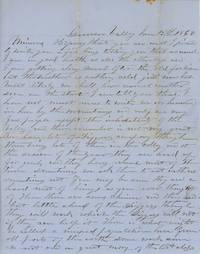
1860List3317Likely Plumas County California 1860. Single four-page letter measuring 7 ½ x 9 ½ inches. Folded with some small tears at folds; excellent. A letter from “Charly†to his wife or fiance written in January of 1860 from “Ganser possibly sic Valley†likely in Plumas County California. Located in the Sierra Nevada Plumas County contained a number of mining towns following the California gold rush; however Charly does not specify his line of work or discuss any particulars. Instead—besides inquiring after the health of family and friends and considering when he would return home—Charly discusses the other residents of the valley. He writes:<br /> <br /> “I can tell you that I have not much news to write we are hemmed in here by the mountains and only see very few people except the inhabitants of the valley and their number is not very great we have lots of Digger company though there being lots of them in the valley and at this season of the year they are hard up for grub and they hang round most of the time sometimes we ask them to eat with us sometimes not You may be sure they are a hard nest of beings as you ever thought of them there are sorry Chinese and they are but little ahead of the Diggers though they will work which the Diggers will not if they can help it There is what might be called a mixed population here from all parts of the earth some work some do not and there are a great many of the last classâ€.<br /> <br /> “Digger†is a derogatory term applied to several Indigenous peoples in the region referring to their diet of root vegetables. In this part of California they would likely have been Northern Paiute or Mono people. Following the US’s acquisition of California and especially after the discovery of gold these groups were decimated by murder enslavement and disease; an 1896 article notes that the Plumas area had proportionally more survivors of American depredations.1<br /> <br /> Of interest to historians of the late gold rush especially relations between Anglo-Americans and other races.<br /> <br /> 1 Mabel L. Miller “The So-Called California ‘Diggers’†Popular Science Monthly 50 December 1896 201–214. unknown
188934051Sacramento: Young 1889. First Edition. 283pp. illustwo schools as frontis. Orignal gold stamped cloth upper edge of front cover shows some wear Not in Cowan Young hardcover books
186932728Virginia City California 1869. Paper. Very good. Approx. 8" x 3" check with printed green borders information and 2 stamps. Check is drawn on the account and signed by Isaac L. Requa. The information printed on the check is "Gould & Curry Silver Mining Company W. C. Ralston Treasurer. Agency of the Bank of California Virginia City. The written date is Aug 3 1869. <br /> <br /> Requa was a mining engineer early Oakland pioneer and later President of Oakland Bank and Savings. unknown
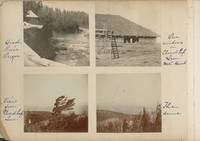
1890List2871Oregon Washington and California 1890. One forty-two page photo album with 9 ½ x 7 inch pages; 109 total photographs with eighteen 4 x 7 inch and larger and ninety-one 3 ½ x 3 ½ inch. Larger photographs captioned on negative and likely purchased while smaller ones are original. Album pages with chipping at corners and some repair with tape; photographs with some wear and very good to excellent contrast; overall very good to excellent. A photo album from two trips taken by an unknown tourist one around the Pacific Northwest and the other in central and southern California with written captions describing location and subject matter. The California trip starts in San Francisco and includes shots of Monterey “Mexicans at Los Angeles†and many of the Santa Barbara Mission and San Diego. <br /> <br /> The Pacific Northwest photos show scenery around Mts. Hood and Rainier including from the recently-built Cloud Cap Hotel; the Columbia River Paradise Valley American Lake and others. There are also shots of the Hotel Groe built in 1893 and Kernahan home in Pierce County Washington – James Kernahan was one of the earliest Euro-Americans to homestead in the region arriving in the area in the late 1880s. The Kernahan family is mentioned in an account told by John Muir’s photographer of summiting Mt. Rainier with John Muir in 1888.1 Further towards Rainier there are shots of the Longmire buildings built in about 1884.<br /> <br /> Four interesting shots from Puyallup also in Pierce County are worth mentioning. Two show hops fields one a line of tents identified as belonging to the “Indians†and one of an “Old Indian woman†standing barefoot on train tracks. Before 1892 growing hops drove the economy of Pullyup; Indigenous people would travel from the US and Canada to Pullyup to work the harvest.2 These photographs likely postdate the hops crash.<br /> <br /> Of interest to historians of the Pacific Northwest and California and especially of Pierce County Washington.<br /> <br /> 1 “John Muir’s Ascent of Mt. Rainier As Recorded by his Photographer A. C. Warner†The Mountaineer 50 no. 1 1956: 38–45.<br /> 2 Hans Zeiger “Indigenous Hop Pickers in Western Washington†HistoryLink October 3 2021 https://www.historylink.org/file/21295. unknown
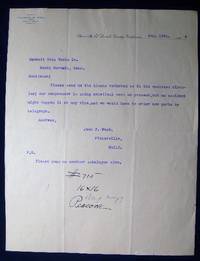
189824068Placerville California: Pocahontas Mine 1898. Typed letter on the Pocahontas Mine letterhead dated Jan. 19th 1898 to the Norwalk Iron Works Company of South Norwalk Conn. asking for compressor parts & catalog; the mine was using the Norwalk equipment at the time; approx. 8 1/2"x 11" size; old fold lines; light wear; in very good condition. Manuscript. Not Bound. Very Good. Pocahontas Mine Paperback books
189344484Meadville Pa: Keystone View Company 1893. Pale peach stiff-stock card mount. Rounded corners. Light wear to mount. Photograph clear & sharp. Verso with "Marilyn Blaisdall" neatly inked to one edge along with a few other penciled prior owner annotations. VG. One photograph with the two views dome top. Verso with 10 lines of printed text describing Chinatown "Here 40000 Chinamen are huddled together in quarters which would not accommodate one fifth that number of Americans." 3-1/2" x 7" <br/><br/>Image shows the Sing Fat Bazaar building to the right. Keystone View Company unknown books
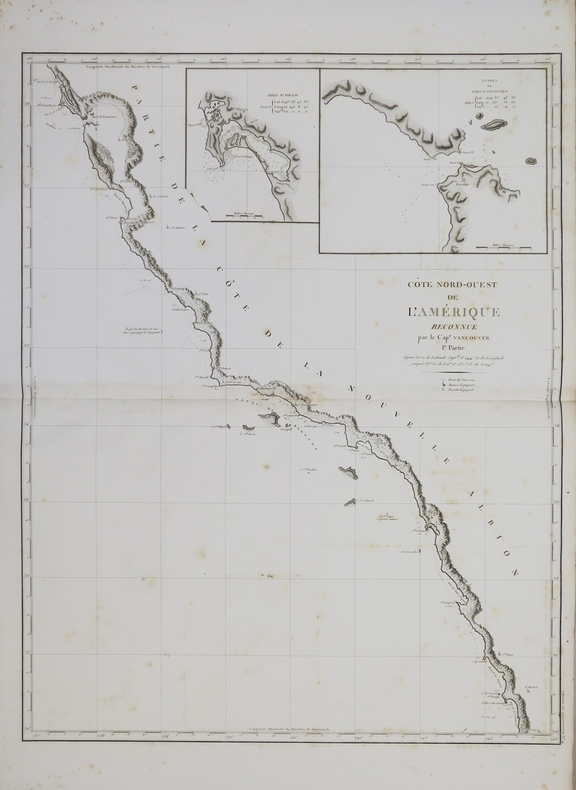
1820LBW-3716[1800-circa 1820]. 765 x 612 mm.
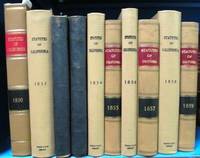
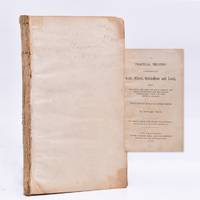
1859298771859. The bindings are generally tight with some inner hinges reinforced. Binding styles and paginations vary: some legal buckram others sheep; some with morocco spine labels others issued without spine labels. Several volumes include folding tables. The majority have the usual institutional marks which are rarely obtrusive. Occasional text spotting and light wear but generally clean and Very Good.<br/><br/> The stated printing locations are San Jose and San Francisco for the first two Sessions but these were actually printed in New York. The third and fourth Sessions were printed in San Francisco the others in Sacramento. <br/> These volumes present the earliest legal history of the State of California. The First Session includes not only the Statutes enacted but the Treaty of Peace with Mexico and documents supplementary thereto the 1849 California Constitution the U.S. Constitution with amendments and other foundation enactments. Joint Resolutions Index Table of Contents for each Session are printed along with the Laws. The 1852 and 1853 volumes are evidently rare. The Statutes deal with all the significant events of that interesting ten-year period: the settlement of the State the development of infrastructure and unfolding of commercial life the multiple social and political institutions the Gold Rush immigration the political strife that engulfed the Nation and all other aspects of early Statehood. <br/>FIRST EDITIONS. Greenwood 167 note. Cowan California 610. Wagner California Imprints 147 149 150. unknown books
1899WRCLIT83220London & New York: John Lane the Bodley Head 1899. Slate blue cloth ruled and lettered in gray t.e.g. others untrimmed. Portrait. Bookplate. Moderately shaken and rubbed 1899 San Francisco ownership inscription on half-title; just a sound copy. First edition. "The daughter of a wealthy San Francisco pioneer a victim of her own impulsiveness and indiscretion meets her downfall through drink" - Baird & Greenwood. BAIRD & GREENWOOD 104. WRIGHT III:156. John Lane the Bodley Head hardcover books
1899WRCLIT83219London & New York: John Lane the Bodley Head 1899. Slate blue cloth ruled and lettered in gray t.e.g. others untrimmed. Portrait. Bookplate. Very slightly shaken but a very good copy. First edition. "The daughter of a wealthy San Francisco pioneer a victim of her own impulsiveness and indiscretion meets her downfall through drink" - Baird & Greenwood. BAIRD & GREENWOOD 104. WRIGHT III:156. John Lane the Bodley Head hardcover books
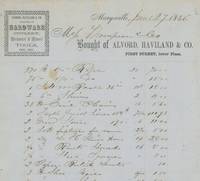
1860List2417Marysville 1860. Marysville 1850s-1860s the bulk mid-1850s. A collection of documents including eleven receipts three manuscript legal documents four manuscript documents relating to land claims; five partially printed documents relating to land claims; two letters from the US Land Office in Marysville 1858 regarding land claims; six billheads from Marysville firms with receipts for a range of goods some illustrated; one letter from Marysville written in 1853 concerning a death in a family. Generally fine condition. Fine. A mini-archive or assemblage of documents relating to the early Euro-American citizens of Marysville and its environs in the 1850s. The population of Marysville grew quickly after the town’s incorporation to 10000 by the mid-1850s due to its strategic location close to the gold fields but the levee system put in place to control flood damage limited the town’s growth beyond this initial phase. The documents here relate to Marysville in this early period of growth and include several quitclaim land deeds as well as illustrated billheads. As a group they offer an ephemeral record of the city in its early period with the legal documents and deeds showing the means with which the area was settled. A well preserved group overall. unknown
188231379San Francisco: B. F. Alley 1882. xi 509 48pp. plus woodcut frontispiece and eleven other woodcut portraits. Later half calf and contemporary sheep gilt morocco spine label edges sprinkled brown. Ownership inscription on front endpaper recto scattered manuscript notations in pencil several on portraits. Final contents page tipped in.<br/> <br/>A rare history of Tuolumne County California covering a variety of topics.<br/> <br/>It recounts the foundation of its towns by miners arriving from the East in the summer of 1848 at the beginning of the California Gold Rush and contains a chronology of important events and a section of biographies for significant county figures. The volume also provides lurid accounts of various crimes committed including lynchings robberies and murders as well as of natural disasters and mining accidents. A significant portion of the book is dedicated to the county's mining history and its geology as well as its the promotion of its agricultural resources. Includes a portrait and brief biography of Samuel Clemens Mark Twain who spent time around the mines in California as a reporter during the Civil War and apparently stayed in Tuolumne County during the winter of 1864-65 where he wrote "The Celebrated Jumping Frog of Calaveras County." "One of the rarest of all California histories. with only a few copies in existence" - Norris.<br/> <br/>Adams Six-Guns 2248; California Local History 15345; Cowan II p. 646; Howes l71 "b"; Norris Catalogue 3968. B. F. Alley unknown books
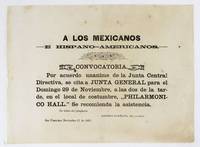
18635596San Francisco: La Voz de Mexico 1863. Very good. Broadside 7.75 x 10.75 inches. Central vertical fold minor creasing light tanning and scattered foxing. A very rare broadside calling a combined meeting of the juntas patrióticas of San Francisco community organizations of Californios and Mexican expatriates convened to support Benito Juarez against the French in the war with Napoleon III. The text announces a meeting at San Francisco’s Philharmonic Hall on Sunday November 29 1863 at 2p.m. Juntas patrióticas like this grew out of a tradition of Latino volunteer organizations in California originally started in 1825 to organize celebrations for Mexican independence. Established in many towns over the following years they continued to promote Mexican culture and traditions after California was annexed by the United States. This largely apolitical role changed however in the face of the twin threats of the Civil War and the French Intervention in Mexico:<br /> <br /> "Despite a time lag of four to eight weeks the newspapers carried stories about the French incursion into Mexico. California's Latinos learned about the landing of the Triple Alliance in Veracruz to collect debts contracted by previous administrations the agreement of Soledad in which President Benito Juarez pled national bankruptcy and asked for an extension the withdrawal of the English and Spanish forces on the strength of Juarez's promises and the menacing French presence continuing after the Spaniards and English had departed. In May 1862 events took a serious turn when the French broke off diplomatic relations with Mexico complaining of 'outrages of which the victims have been French subjects' living in Mexico.<br /> <br /> "But then on May 5 1862 there was a sudden flash of hope -- the outnumbered ragtag Mexican army repelled the seemingly inexorable French advance at Puebla sending the French troops victors of Crimea Sebastopol and the Italian campaign reeling back to Orizaba to lick their wounds. When the news reached California the Spanish-language headlines were enthusiastic: 'Hurrah for Mexico!! Hurrah for independence!!.' For California's Latinos U.S. citizens and immigrants alike this news was a bracing tonic. Suddenly they were part of a force to be reckoned with. Their peers at Puebla had taken a daring stance and had emerged victorious against the odds. Spontaneously Latino residents of the gold country town of Columbia in Tuolumne County celebrated 'our triumph against the French' by firing artillery salutes singing patriotic songs and toasting Mexico's success. Dozens of cities responded and dozens of juntas were formed in the next few months to raise funds to help repel the French invaders from Mexico" – Hayes-Bautista.<br /> <br /> Funneled through a Junta Central Directiva headquartered in San Francisco juntas across California and Nevada raised funds which were sent across the border to the Republican government usually in excess of $1000 every two weeks. This flyer was printed by one such junta known as the Sociedad Patriótica Mexicana and informs its members that the Junta Central Directiva has called a general meeting of all the local juntas on November 29 1863. This was a particularly dark time for the Mexican government in exile – the French had occupied Mexico City in June officially proclaimed the Second Mexican Empire in July and Maximilian was offered the throne at the start of October. This document was most likely printed by La Voz de Méjico a tri-weekly Spanish-language paper centered in San Francisco which became the unofficial organ of the regional juntas. A pencil note on the verso of this copy reads "Mass meeting called to contradict the lies of paper's enemies and newspaper reports this is what I referred to in my 2 notation." A rare piece of ephemera evidencing the active social and political role played by Mexican-American community organizations in the late-19th century. We locate only two recorded copies held by the Bancroft Library and UC Santa Barbara.<br /> David E. Hayes-Bautista et al. "Empowerment Expansion and Engagement: Las Juntas Patrióticas in California 1848-1869" in California History Vol. 85 No. 1 2007 pp.4-23. [La Voz de Mexico?] unknown
189356869Salem OR: Buren & Hamilton 1893-1904. 4to. 90 mylar sleeve leaves unnumbered. containing 403 invoices shipping & waybills TLS ALS TL copy letters and more many of which appear on steel-engraved letterhead many printed on colour-tinted paper often shipping and weight bills still retaining original stamps a few mailing envelopes a number of check receipts many w/ manuscript and stamped autographs others w/ corrections and/or annotations in ink or pencil; also included are actual samples of velvet fabrics wallpapers and textured colour sample papers printing sample for perforated business card. All preserved in recent 3-ring cloth binder stamping on front cover. An exceptional archive of original letters invoices waybills business cards and receipts all documenting the thriving business of Buren & Hamilton at the end of the Gilded Age and beginning of the Progressive Era in Salem Oregon in the aftermath of the 1893 economic crash. Drawing from suppliers in California just a few years before the San Francisco Earthquake & Fire the company also sourced from Seattle WA New York and Chicago. Portland was the manufacturing and industrial hub of Oregon as can be seen in these invoices and receipts: such companies as The Columbia Chair Company Dealers who sold chairs office chairs and rockers from 309-311 Front St. shipped rocking chairs and office chairs to Salem in 1903; Henry Jenning & Sons located at 172-174 First St. shipped a load of leather oak chairs in 1903; J.G. Mack & Co. located at 86 & 88 Third St. in Portland supplied velvet rugs oil cloths and lamp shades in 1903; while the A. Merle Co. and McCord & Work located on Water St. supplied brass and iron bed frames the same year. Buren & Hamilton also sourced mattresses and sacks of recycled denim cotton “Shoddy†from Peters & Roberts Furniture Co. for mattresses; and purchased often from the Portland Mattress & Upholstery Co. at 18-20 Front St. which supplied wool-combed coverings mattresses mattress tops from 1900-1904 -- their factory would be gutted by fire in 1907. Many of the items were shipped down the Willamette River on the Oregon City Transportation Co. ships with a note from 1904 indicating the company had completed a sale of odd sized mattresses to them; numerous Southern Pacific Oregon Division freight bills; as well as a shipment on the SS Oregonian via the American-Hawaiian Steamship Co. of five crates of chair seats from Marshall Field & Co.In addition it appears that Oregonians in and around Salem purchased heavily from the store luxury goods such as beveled mirrors framed artwork sleek wallpapers velvet fabrics tapestries oriental rugs and more. Many of the invoices letters waybills and documents record many items supplied by the storied W.P. Fuller & Co. of San Francisco & Sacramento CA as well as their subsidiary in Portland OR. They were main suppliers of beveled and mirrored glass on the Pacific Coast which often had to be imported from England into the U.S. and several of the orders in 1899-1901 note that the company was having issues supplying such pieces to Buren & Hamilton due to labor difficulties finally sourcing mirrors from Pilkington Bros. English Picture Glass. They occasionally canceled orders and the Fuller Co. writes in 1901 over a canceled order of “deadening felt.†The W.P. Fuller Co. explain that “your reasons for wishing to cancel your order are not considered sufficient to justify us in doing so . . . †and that they were aware that “some of our competitors are circulating unjust and untrue reports concerning us all the time.†Included amongst these letters are samples of cotton backing for carpets and even three original samples of wallpaper. There are also present a number of letters and invoices from the firm of Tozer & Son which took over the W.P. Fuller Wallpaper division about 1901 with letters present making that announcement. Of additional interest are the many invoices letters and waybills back and forth with the storied Schussler Bros. on 119-121 Geary St. Star King Building in San Francisco detailing many of the popular framed and matted photographs and images for Salem shoppers. These encompassed the “Lone Indian†which were often reproductions of the iconic End of the Trail sculpture by James Earle Fraser; Athletes Dutch Windmills Shakespeare prints of assorted types and sizes Lone Arab a Chinese print a boxing series of matted “Deal of a Fellow†Madonna Artotypes -- typically reproductions of Raphael’s Madonna and Taber art photos. Many of the letters bill heads and invoices sport steel engraved architectural vignettes documenting buildings which would be destroyed in the 1906 San Francisco Earthquake & Fire as well as many of the business records for those companies. One of the freight bills bears the photographic letterhead of the Chicago & North-Western Railway Co. dated 1904. Another significant supplier was the D.N. & E. Walter & Co. of San Francisco which supplied linoleum flooring fabrics and more for Buren & Hamilton from 1899-1904 and even includes in one of the letters a piece of the red velvet fabric they no longer carried.Buren & Hamilton was originally founded in the late 1880’s by A.T. Yeaton as a furniture/undertaker business later sold to A.B. Buren and finally sold to Max O. Buren and Clarence Hamilton who operated at three locations along Commercial St. including Greenbaum’s Building at 298 Commercial the building at 136 Commercial 340 Court St. now Sid’s Furniture. Clarence bought out Max Buren’s shares in 1916 becoming the C.S. Hamilton Furniture Co. and operating until it was sold to Rubenstein’s in the 1960’s. See: Norma Hamilton Cochran Historic Businesses -- Hamilton Furniture Salem History Matters March 17 2017; New Stationery Department of Schussler Brothers San Francisco The American Stationer Vol. LIV 1903 pp. 4-5; John Caldbick Panic of 1893 and its Aftermath HistoryLink Essay 20874 Oct. 1 2019. Buren & Hamilton, hardcover
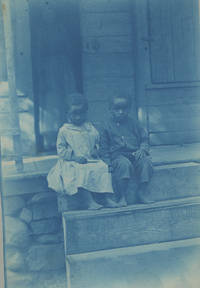
1880List1314Northern California 1880. 4to one album in burgundy cloth the other oblong brown pebbled cloth. Seventy-one sepia-toned and cyanotype photographs most measuring 6 ½ x 4 ½ inches. Near fine with some light wear to albums photographs very good or better with very good contrast some showing a hint of fading. A very early pair of vernacular photograph albums centering on the experiences of a wealthy family in San Francisco Monterey and the surrounding areas in the late 1880s. The bulk of the images show the family and their unidentified circle in domestic scenes with the vernacular architecture and landscapes of the Bay Area on full display. Other images show landmarks including Golden Gate Park the Francis Scott Key monument various views of the first Hotel del Monte in Monterey which would burn in 1887 dating the photographs to the period prior to the fire. The album also includes photographs of African American families. <br /> <br /> The image quality is generally quite strong and the photographer was either a professional assembling the album which includes many portraits of family and presumed friends for themselves or the work of a highly skilled amateur. The Initials on the front pastedown are “M.J.R.†though this could be a later owner. The albums were from the estate of the muralist Clara Fargo Thomas who was a resident of New York and could possibly have been from one of her family members though we are unable to glean much detail from the contents. The few annotations offer little clues one just reading “5/11/89 - Golden Gate Park†and another identifying a house as 509 Webster St. in San Francisco though the typical Victorian architecture and sloped street of the house suggest it could have just been a photograph of San Francisco’s unique architecture. <br /> <br /> The photographs of the people give insight into the lives of the new wealthy class of San Francisco residents of the late 19th century with others interestingly showing rural scenes and people. The photographer also had an eye for the flora of the region which is displayed throughout. It is unclear what the relationship of the African-American subjects was to the photographer and why they appear in the album. Overall a compelling group of images and the earliest example of vernacular photograph albums of California images we can find in the trade. unknown
1883166754San Francisco: A. Roman 1883. 17x12 cm pp. i-ix x-xv xvi 17 18-216 217-219: ads 220: blank flyleaves at front and rear inserted frontispiece original red cloth front panel stamped in black and gold spine panel stamped in gold rear panel stamped in blind floral patterned endpapers. Second edition enlarged. A new edition of A YOUTH'S HISTORY OF CALIFORNIA FROM THE EARLIEST PERIOD OF ITS DISCOVERY TO THE PRESENT TIME San Francisco: A. Roman & Company 1867. The 1867 edition is uncommon. "Among the earliest schoolbooks relating exclusively to California. The author Louise Palmer Heaven wrote a number of children's books under different pseudonyms" Howell. Heaven was a popular contributor to OVERLAND MONTHLY and the author of "indifferent novels" Walker San Francisco's Literary Frontier whose best known work is CHATA AND CHINITA 1889 a novel set in Mexico. Cowan 1933 p. 456. Sabin 55495. California news agent's stamp on the front and rear flyleaves. Cloth worn at edges a sound good copy. A nice copy overall. #166754 A. Roman unknown books
186027304San Francisco: Towne & Bacon Book and Job Printers 1860. First edition. Woodcut illustrations. Pp. 133. 1 vols. 12mo. Disbound some light marginal soiling else a very good copy with the signature of M. Standish of Boston on the endpaper. First edition. Woodcut illustrations. Pp. 133. 1 vols. 12mo. Towne & Bacon, Book and Job Printers unknown