[Louisiana]Biblio.com
158 résultats
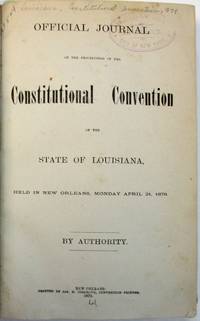
187936489New Orleans: Jas. S. Cosgrove Convention Printer 1879. 337 1 blank 156 pp plus two folding tables. Each page printed in two columns. Bound in buckram with gilt-lettered morocco spine labels light rubberstamp on title page. Clean text. Very Good. Last leaf with a tear affecting about five letters of a two-page report in the Appendix concerning drainage and taxation in the City of New Orleans.<br /> <br /> The Convention dominated by white Democrats returned Louisiana to Home Rule. It was consumed with issues of State debt financial auditing bonds and the public treasury. One delegate expressing his colleagues' deep resentment of Reconstruction asserted that "the deplorable gloomy and painful condition of Louisiana must be the result of the most barefaced prostitution of power the most barefaced abuse of sacred trusts and the most infamously corrupt application of the people's money" page 298. The Journal a day-by-day account of these Proceedings does not print the Constitution. <br /> Not in Marke Harv. Law Cat. Thompson. Jas. S. Cosgrove, Convention Printer unknown
18116624AWien, Bauer, 1810/1811. 8°. Bde. 1 und 2 von 3 Bdn. 336, 360 Seiten. Mit 2 gestochenen Frontispizen. Pappbände der Zeit mit Rückenschildern. Rücken etwas angestaubt, sonst tadellos.
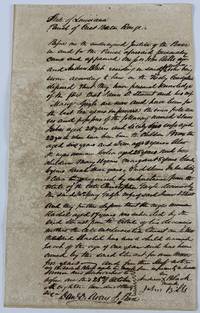
183613107East Baton Rouge Parish LA: October 25 1836. 1p. on a single folded sheet integral blank docketed on verso. Old folds moderate toning and foxing short closed tear along one fold line a few small instances of ink burn. Overall good condition. An interesting document of legal testimony involving numerous named slaves in Louisiana in 1836 ranging in age from one year to almost thirty years of age and including seven children. According to the docketing the document is effectively a "Title to Slaves." The deponents were two local citizens John Bills and Andrew Black who had "personal knowledge of the fact that James D. Stuart and his wife Mary Gayle are now and have been for the last ten years & upwards the bona fide owners and possessors of the following named slaves: Juba Aged 25 and Sicily his wife aged 22 to whom have been born the children Braxton aged six years and Dan aged 3 years. Also the negro woman Celia aged 28 years and her children Mary 11 years Margaret 8 years Charley 6 years Sarah three years which slaves Juba Sicily & Celia were acquired by inheritance from the estate of Christopher Gayle. And they further depose that the negro woman Rachel aged 17 years was inherited by the said Stuart from the estate of his deceased mother.and that the said Rachel has now a child named Jacob of the age of one year." The document is signed by Black Bills and the Justice of the Peace Daniel D. Avery. Documents involving slave inheritance of and subsequent ownership by not one but both members of a marriage are exceedingly rare. October 25 unknown
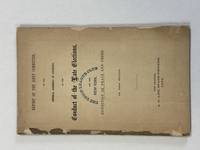
186841040New Orleans LA: A.L. Lee State Printer 1868. 68pp. Stitched without wrappers. Old rubberstamp of Union League Club New York. A few shallow blank extremity chips. Good. <br /> <br /> During the election year 1868 "White gangs roamed New Orleans intimidating blacks and breaking up Republican meetings" Foner Reconstruction 342. Other Parishes experienced the same story; in St. Landry a mob "invaded the plantations killing as many as 200 blacks.Unable to hold meetings and fearful that attempts to bring out their vote would only result in further massacres Georgia and Louisiana Republicans abandoned the Presidential campaign" Id. <br /> The Republican Party controlled Louisiana's General Assembly. Its Report is a frightening picture of violent resistance to Reconstruction describing "a state of lawlessness terrorism and crime that is unparalleled in any civilized country." Not only are the "desperate and infamous characters" who directly perpetrate the violence responsible; blameworthy also is "that large and respectable class of the people of the State. . . who refrain studiously from any efforts to restrain or bring them to justice." The Report is a detailed Parish-by-Parish examination of atrocities. <br /> FIRST EDITION. Thompson 1226. A.L. Lee, State Printer unknown
187636046Washington DC: Smithsonian Institution. Collins Printer Philadelphia 1876. First Edition. Hardcover. Good. Folio. 1 x 171 pages 1 page blank. Illustrated. Custom half leather binding with green morocco leather corners and spine. Raised bands gilt decorations and gilt lettered title on the spine. Reddish marbled end sheets. Top edge gilt. Original outer printed wraps preserved. Leather is rubbed and scuffed head and base of the spine and on the corner edges. Light edge wear to the boards. Interior contents clean. <br /> <br /> This copy has a one page letter dated October 19 1870 pasted on the right front flyleaf. The letter written on a Liverpool Hotel letterhead was addressed "My Dear Brother" and signed by Joseph Jones. Contents of the letter relate to Joseph Jones visit in Liverpool. Armorial bookplate of Charles C. Jones Jr. located on the front paste down. Charles C. Jones Jr. was a Georgia historian and author. Smithsonian Institution. Collins, Printer, Philadelphia hardcover
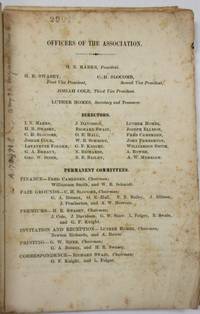
186737280New Orleans: Printed at the Commercial Bulletin Job Office 1867. 60 25- advertisements 3 blanks pp. Original printed yellow wrappers some extremity chipping. Originally stitched now loosened. Illustration on rear wrapper: 'Front Entrance Gentilly Road. Several institutional stamps scattered foxing and dusting. The final 25 pages are advertisements from various commercial enterprises mostly from New Orleans. Good.<br /> <br /> The Report announces Louisiana's entry into the post-War New South displaying its "improvements" in agriculture and the "Mechanic Arts." The advertisements alone demonstrate impressively Louisiana's determined recovery from the War. <br /> Officers Directors and Committee Members are listed after the title page. The Fair's President was the merchant I.N. Marks. "As indicated by his name ISAAC N. MARKS is of Hebrew descent and is a distinguished representative of his highly favored race but contrary to the usual customs of that people he has adopted the Christian faith. This change in his creed is due to the independent manner of thought which has characterized him from his boyhood and has ever made him master of his personality in the domain of both his sentiments and business. Mr. Marks is a native of South Carolina having been born at Charleston on the 5th of May 1817. At the age of nineteen he came to New Orleans and linked his career with that of his adopted city then lacking much of the greatness and grandeur which to-day places her a queen among cities" online 'Genealogy Trails History Group Orleans Parish <br /> The pamphlet records Louisiana's first Fair after the War's end in late November 1866. An essay explains its establishment and inauguration in late November 1866. "The mellow light of an Indian Summer's sun shone down." The various exhibits are listed followed by Marks's Address lamenting the "long and disastrous war leaving in its desolated path ruin upon every side; agriculture paralyzed; commerce languishing; a well-regulated labor system grown venerable in its usefulness and its humane tendencies suddenly and violently destroyed." Other Addresses call for immigration manufactures agricultural improvements and modernization.<br /> Not in Thompson which records later fairs of this Association. OCLC 24446596 1- Historic New Orleans Collection as of December 2020 but not collating the 25-page advertisement section. Printed at the Commercial Bulletin Job Office unknown
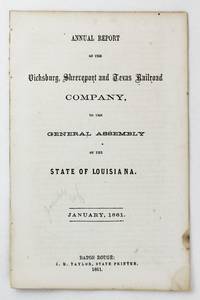
18616313Baton Rouge: J.M. Taylor 1861. About very good. 7pp. Disbound. Minor edge wear small dampstains at lower right corner. Minor tanning and faint foxing. Scarce report for the Vicksburg Shreveport and Texas Railroad issued in the same month that Louisiana seceded from the United States. This edition details the construction completed up to January 1861 and encourages the state legislature to continue funding the project given the context of secession -- "Event are beginning to justify the policy of the State in extending aid to the full extent of Constitutional ability to the various railroads with its boundaries. As a means of military defense this road is of great importance to the state. If any emergency should make it necessary to concentrate a body of armed men in any of the parishes on the Mississippi the citizen-soldiers from the more populous upland parishes may be carried over it from Monroe in a few hours." OCLC notes several institutions with small runs of this report but most seem to lack this January 1861 issue. J.M. Taylor unknown
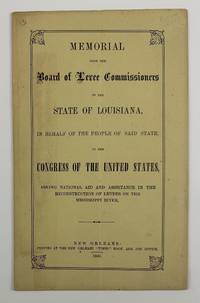
18663572New Orleans 1866. Very good. 12pp. Original printed wrappers sewn. Minimal soiling light edge wear to wrappers. Vertical center crease throughout. Light even toning to text otherwise very clean. A scarce work issued by the Reconstruction government of the state of Louisiana seeking funds from the United States Congress to make repairs to the Mississippi River levees "together with its tributaries the Arkansas and Red rivers." The Board of Levee Commissioners was seeking federal aid because the state of Louisiana had become so impoverished by the end of the Civil War stating here that "The State crippled as she is in her resources is still making herculean efforts to protect her citizens." Before the war argues the Board the state as well as the proprietors of the lands along the Mississippi River were able to maintain the levees albeit "at an immense outlay of labor and money" but "at a time of general prosperity when labor was abundant and cheap." In other words slave labor was formerly employed to maintain the levees and now that the people of Louisiana can no longer use slaves the state wants make the federal government pay literally. One passage in the work even discusses in detail the impact of slaves and free persons of color who have abandoned thirteen parishes which are now "almost altogether desolated." The report cites census and crop yield data to make the point that without this practically free labor force as well as the cotton sugar molasses and corn they produced the labor and economic impact on Louisiana of taking away a free labor force was onerous.<br /> <br /> Works by the Board of Levee Commissioners are rather rare in institutions with just eight copies of the present work in OCLC at LSU Tulane the University of Alabama the Library of Congress the Minnesota Historical Society Library Duke the Rutherford B. Hayes Presidential Center and UT-Austin. unknown
189578199New Orleans: Louisiana Historical Society. Very Good. 1895. Hardcover. Ex-library in 10 volumes in 5 bound in maroon library buckram measuring 8 3/4 x 6 inches - bright contents with several illustrations. . Louisiana Historical Society hardcover
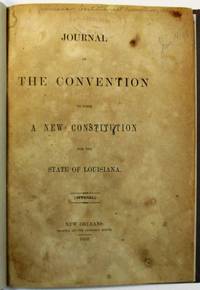
185236379New Orleans: Printed at the Crescent Office 1852. 100pp. Toned with some foxing light rubberstamp on title page. Upper blank corners of last two leaves renewed couple of small holes in last leaf affecting about five letters. Good in modern boards.<br /> <br /> The new Constitution mandated that "the Legislature shall apportion the representation among the several parishes and election districts on the basis of the total population. A representative number shall be fixed and each parish and election district shall have as many Representatives as its aggregate population shall entitle it to." This meant that in apportioning representatives slaves would be counted in determining the "total population" even though the franchise was limited to adult white males. The legislative deck was thus stacked in favor of election districts with large slaveholding plantations; and the interests of that segment of the State would dominate governmental councils.<br /> This provision created significant opposition to the proposed Constitution which was adopted by the narrowest of margins. Many called it "anti-republican" arguing that it reflected "a calculated effort to reduce the political power of regions where the black population remained sparse" Hyde Pistols and Politics 70 LSU Press: 1996.<br /> The Journal records the Convention's daily proceedings during July 1852 and prints the proposed Constitution. <br /> Jumonville 2151. Thompson 1300. Cohen 3106. Not in Harv. Law Cat. or Marke. Printed at the Crescent Office unknown