LouisianaABAA
129 résultats
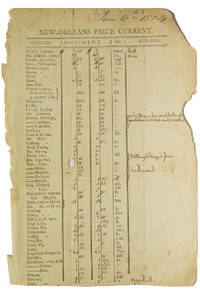
1804319786New Orleans 1804. 2p. partly-printed handbill with holograph additions. Folio. Lower margin trimmed close chips at edges. 2p. partly-printed handbill with holograph additions. Folio. A very early item accomplished by an American merchant in New Orleans just a year after the Louisiana Purchase. The handbill alphabetically lists approx. 80 commodities from Beef to Wines with a range of their prices accomplished in manuscript. The early owner of the present document has also included some manuscript notes on the trading; e.g. "dull" "rather falling in price" and "in demand."<br/><br/>Although several later New Orleans commercial newspapers would carry the above title we find no record of this handbill from years immediately following the Louisiana Purchase. unknown books
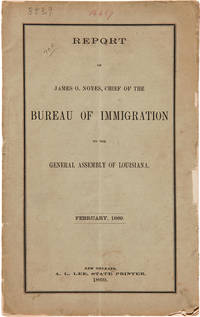
1869WRCAM55594New Orleans: A.L. Lee State Printer 1869. 30pp. Original printed wrappers. Soft vertical crease throughout wrappers somewhat chipped mild soiling. Small stain to upper corner of titlepage and following leaf otherwise text evenly toned. Withal a very good copy. A scarce and interesting report that is tantamount to a Reconstruction-era promotional for the state of Louisiana with commentary on emancipated African Americans in the state. The dramatic social revolution caused by the Civil War Emancipation and Reconstruction is reflected in the present work. After the Civil War Confederate nationalistic passions had not cooled sufficiently to encourage settlement in Louisiana. In fact immigration seemed to be headed the other way with "an emigration of thousands of our best citizens to the North" according to the report. <br> <br> Now however "an era of good feeling seems to be at hand." A diversifying society an abundance of crops and respect for "the political opinions" of northern immigrants are all bringing positive changes to Louisiana. Emphasizing the necessity of peaceful race relations Immigration Bureau Chief James Noyes counsels the former plantation owners "Never did any one people under the sun owe a greater debt of gratitude to another than do the property owners of Louisiana to the blacks just released from the hardships of slavery.The wonderful progress they have already made is the best possibly augury for their future." The wrapper title reads REPORT OF JAMES O. NOYES CHIEF OF THE BUREAU OF IMMIGRATION TO THE GENERAL ASSEMBLY OF LOUISIANA. <br> <br> Quite uncommon with OCLC recording just nine physical copies - seven under the title on the titlepage and two under the wrapper title. OCLC 82805252 10640135 82805252. A.L. Lee, State Printer unknown books
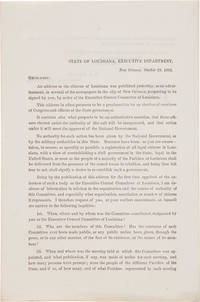
1863WRCAM55510New Orleans 1863. 2pp. printed on a folded quarto sheet. Faintest toning at bottom edge else fine. An interesting New Orleans imprint encapsulating the tensions between Northern political forces and indigenous conservative political actors during the brief Free State movement in Confederate Louisiana. Here George F. Shepley military governor of Louisiana from 1862 to 1864 rebukes Conservative Unionists H.H. Pugh E. Ames and J.Q.A. Fellows of the "Executive Central Committee of Louisiana." They had issued what "in effect purports to be a proclamation for an election of members of Congress and officers of the State government." Shepley pronounces such a proclamation void writing that "no authority for such action has been given by the National Government or by the military authorities in this State." Further Shepley demands the organizers of the committee answer a series of questions about the who what when where and why's of the committee's existence. <br> <br> The Executive Central Committee in Louisiana was a conservative organization that sought to re-institute the original American Constitution in Louisiana mainly to restore slavery and lobbied Abraham Lincoln on the matter in the summer of 1863. Of course Lincoln did not comply siding with the more radical Free State Committee and insisting on a new constitutional convention for Louisiana followed by new elections before Congress met in early December. The present document surely came about as a reaction to efforts by the Executive Central Committee to get their way before a new Constitution based on eventual Reconstruction the Emancipation Proclamation and new elections could be drafted and approved. Lincoln's efforts at a new constitution and elections for Louisiana continued into 1864 and came to fruition for a brief time with new elections in late February and a new constitution ratified by public vote in September. This new political landscape for Louisiana was short-lived however as the U.S. Congress refused to seat the Louisiana delegation in December 1864. <br> <br> Not in Jumonville or Thompson and with no copies in OCLC. An illuminating entry in the brief Free State movement in Louisiana during the Civil War. unknown books
1808WRCAM31953New Orleans: Bradford & Anderson 1808. viii1451pp. Dbd. Many leaves and signatures loose. Moderate browning. Contemporary ownership signature and stamp on titlepage. Good. An early printing of session laws from the Territory of Orleans admitted to the Union four years later as Louisiana. Printed in both English and French. A rare New Orleans imprint. OCLC locates only five copies. JUMONVILLE 173. FOOTE p.4. McMURTRIE NEW ORLEANS 131. SHAW & SHOEMAKER 15813. THOMPSON 1083. MACDONALD CHECKLIST OF SESSION LAWS p.70. OCLC 24446395. Bradford & Anderson unknown books
1868700681868. Louisiana's Reconstruction-Era Constitution Louisiana. Constitution Adopted by the State Constitutional Convention of the State of Louisiana March 7 1868. Printed by the New Orleans Republiean sic In Accordance with a Resolution of the Constitutional Convention Adopted March 7th 1868. New Orleans: Printed at the Republican Office 1868. 22 pp. Octavo 9-1/2" x 5-1/2". Stab-stitched pamphlet in plain wrappers bound into to later library cloth. Some soiling light shelfwear. Moderate toning and light foxing to text faint dampstaining to margins of a few leaves library stamps and marks to title page and its verso. $750. Louisiana's 1868 constitution instituted the criteria necessary for readmission to the Union. It eradicated the Black Codes of 1865 removed property qualifications for holding office and disenfranchised former Confederates. Indicating support for the Fourteenth Amendment which would be ratified on July 9 1868 the constitution granted full citizenship to African-American men with equal civil and political rights. It also banned segregated public schools and segregated accommodations on public transportation. This constitution was the First in Louisiana's history to include a bill of rights. These rights were severely diminished in Louisiana's 1879 constitution which followed the end of Reconstruction. Babbitt Hand-List of Legislative Sessions and Session Laws 152. unknown books
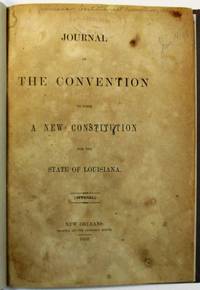
185236379New Orleans: Printed at the Crescent Office 1852. 100pp. Toned with some foxing light rubberstamp on title page. Upper blank corners of last two leaves renewed couple of small holes in last leaf affecting about five letters. Good in modern boards.<br/><br/> The new Constitution mandated that "the Legislature shall apportion the representation among the several parishes and election districts on the basis of the total population. A representative number shall be fixed and each parish and election district shall have as many Representatives as its aggregate population shall entitle it to." This meant that in apportioning representatives slaves would be counted in determining the "total population" even though the franchise was limited to adult white males. The legislative deck was thus stacked in favor of election districts with large slaveholding plantations; and the interests of that segment of the State would dominate governmental councils.<br/> This provision created significant opposition to the proposed Constitution which was adopted by the narrowest of margins. Many called it "anti-republican" arguing that it reflected "a calculated effort to reduce the political power of regions where the black population remained sparse" Hyde Pistols and Politics 70 LSU Press: 1996.<br/> The Journal records the Convention's daily proceedings during July 1852 and prints the proposed Constitution. <br/>Jumonville 2151. Thompson 1300. Cohen 3106. Not in Harv. Law Cat. or Marke. Printed at the Crescent Office unknown books
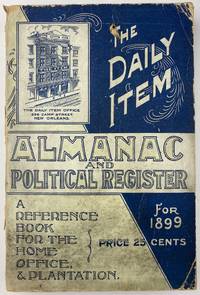
18991837New Orleans: The Daily Item 1899. About very good. 600pp. Original printed pictorial wrappers. Extremities worn covers rubbed and lightly soiled. Some slight worming heavier at front of text. Light tanning and wear. A rare New Orleans almanac full of facts and figures on a wide array of subjects ranging from Queen Victoria's income to information on the Texas petroleum industry. With numerous advertisements for businesses across the country including a woodcut depicting the publisher's premises. The publication appears to have been rather short-lived appearing from 1897 to 1900. An interesting and eclectic volume designed to be an all-purpose ready reference for the average man. OCLC locates four serial holdings for this title all in the South. The Daily Item unknown books
1853WRCAM31934New Orleans: J.L. Sollée 1853. 44pp. Original printed wrappers. Minute wear to wrappers. Internally clean. Very good. A rare New Orleans printing of DON JUAN. with the text printed in English and French. OCLC locates only two copies and Jumonville adds one more. JUMONVILLE 2268. OCLC 24437616. J.L. Sollée unknown books
1828WRCAM31957New Orleans: Benjamin Levy 1828. First volume only of two. iv688pp. Contemporary plain boards rebacked in period style. Original spine remnants laid in. Faint dampstain in upper margin throughout. Overall internally clean. Contemporary ownership signature on rear board later ownership signature on front free endpaper later ownership stamp on front board. Overall very good partially unopened and untrimmed. The first volume only of this comprehensive listing of the laws of Louisiana from 1804 to 1828. Also issued in French the same year. Scarce. COHEN 5664. SABIN 42228. AMERICAN IMPRINTS 38099. JUMONVILLE 629. FOOTE p.179. KORN 130. Benjamin Levy hardcover books
186737280New Orleans: Printed at the Commercial Bulletin Job Office 1867. 60 25- advertisements 3 blanks pp. Original printed yellow wrappers some extremity chipping. Originally stitched now loosened. Illustration on rear wrapper: 'Front Entrance Gentilly Road. Several institutional stamps scattered foxing and dusting. The final 25 pages are advertisements from various commercial enterprises mostly from New Orleans. Good.<br/><br/> The Report announces Louisiana's entry into the post-War New South displaying its "improvements" in agriculture and the "Mechanic Arts." The advertisements alone demonstrate impressively Louisiana's determined recovery from the War. <br/> Officers Directors and Committee Members are listed after the title page. The Fair's President was the merchant I.N. Marks. "As indicated by his name ISAAC N. MARKS is of Hebrew descent and is a distinguished representative of his highly favored race but contrary to the usual customs of that people he has adopted the Christian faith. This change in his creed is due to the independent manner of thought which has characterized him from his boyhood and has ever made him master of his personality in the domain of both his sentiments and business. Mr. Marks is a native of South Carolina having been born at Charleston on the 5th of May 1817. At the age of nineteen he came to New Orleans and linked his career with that of his adopted city then lacking much of the greatness and grandeur which to-day places her a queen among cities" online 'Genealogy Trails History Group Orleans Parish <br/> The pamphlet records Louisiana's first Fair after the War's end in late November 1866. An essay explains its establishment and inauguration in late November 1866. "The mellow light of an Indian Summer's sun shone down." The various exhibits are listed followed by Marks's Address lamenting the "long and disastrous war leaving in its desolated path ruin upon every side; agriculture paralyzed; commerce languishing; a well-regulated labor system grown venerable in its usefulness and its humane tendencies suddenly and violently destroyed." Other Addresses call for immigration manufactures agricultural improvements and modernization.<br/>Not in Thompson which records later fairs of this Association. OCLC 24446596 1- Historic New Orleans Collection as of December 2020 but not collating the 25-page advertisement section. Printed at the Commercial Bulletin Job Office unknown books
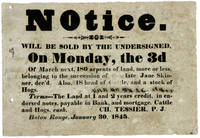
1845WRCAM36605Baton Rouge La 1845. Broadside 6 1/2 x 9 1/2 inches. Moderate dampstaining and age-toning. Contemporary annotation partially covered over in contemporary ink. Two small holes in margin not affecting text. A good copy. An unrecorded mid-19th-century Louisiana broadside advertising the sale on March 3 1845 of 180 arpents approximately 153 acres which belonged to the heirs of the late Jane Skinner and eighteen head of cattle and an unspecified number of hogs. The terms for purchase are also noted: "The Land at 1 and 2 years credit in endorsed notes payable in Bank and mortgage. Cattle and Hogs cash." The notice is signed in print "Ch. Tessier" possibly a justice of the peace and dated Baton Rouge January 30 1845. A rare Louisiana advertising broadside; no copies recorded in Hummel or OCLC. unknown books
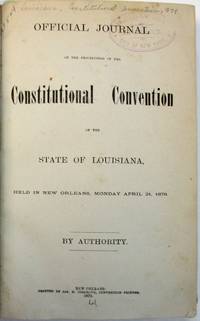
187936489New Orleans: Jas. S. Cosgrove Convention Printer 1879. 337 1 blank 156 pp plus two folding tables. Each page printed in two columns. Bound in buckram with gilt-lettered morocco spine labels light rubberstamp on title page. Clean text. Very Good. Last leaf with a tear affecting about five letters of a two-page report in the Appendix concerning drainage and taxation in the City of New Orleans.<br/><br/> The Convention dominated by white Democrats returned Louisiana to Home Rule. It was consumed with issues of State debt financial auditing bonds and the public treasury. One delegate expressing his colleagues' deep resentment of Reconstruction asserted that "the deplorable gloomy and painful condition of Louisiana must be the result of the most barefaced prostitution of power the most barefaced abuse of sacred trusts and the most infamously corrupt application of the people's money" page 298. The Journal a day-by-day account of these Proceedings does not print the Constitution. <br/>Not in Marke Harv. Law Cat. Thompson. Jas. S. Cosgrove, Convention Printer unknown books
180311298Washington 1803. 5pp later stitching. Light wear Very Good. <br/> offered with SUPPLEMENTARY REPORT.RELATIVE TO THE MEANS BY WHICH THE MAIL MAY BE CONVEYED WITH GREATER DISPATCH THAN AT PRESENT BETWEEN THE CITY OF WASHINGTON & NATCHEZ AND NEW ORLEANS.12TH JANUARY 1804. READ AND REFERRED TO A COMMITTEE OF THE WHOLE HOUSE ON MONDAY NEXT. 1804. 4pp later stitching light wear. Very Good. <br/><br/> "The late cession of Louisiana by France to the United States renders it an object of primary importance to have the nearest and most expeditious mode of communication established between the city of Washington and the city of New Orleans the capitol of that province." The Committee thus urges a post road from Washington "to pass through or near the Tuckabachee settlement to the Tombigby settlement in the Mississippi territory and from thence to New Orleans. And further that a post road ought also to be established from the said Tombigby settlement to Natchez." Recognizing however that the route includes "a distance of nearly four hundred miles wholly uninhabited by citizens of the United States" in the Mississippi Territory the Committee adds that the precise route cannot be determined "until this unimproved territory has been explored." <br/>FIRST EDITIONS. AI 5472 3 7633 2. unknown books
186433590Natchitoches LA: Printed at the "Times" Office- Louis Dupleix Proprietor 1864. 48pp printed in English only as issued. Disbound old institutional rubberstamp on blank portion of title page. Else Very Good.<br/><br/> A scarce Confederate imprint which the Times Office also issued in a more common version with English and French on opposite pages. Much material on the prosecution of the War.<br/>Parrish & Willingham 2992 1- LNHC only. For the English-French printing see P&W 2991 11 locations. Printed at the "Times" Office- Louis Dupleix, Proprietor unknown books
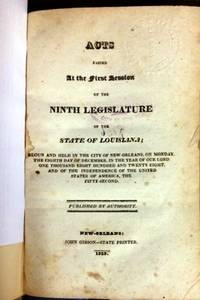
182829714New Orleans: John Gibson- State Printer 1828. 211 1 blank; 199 1 blank pp. The 1827 Acts are bound in later cloth with morocco spine labels and an old law library gilt stamp at base of spine; bookplate on front pastedown; text lightly to moderately toned or foxed. Good. The 1828 Acts are bound in original attractive full calf with gilt-lettered morocco spine label. A couple of rubberstamps bookplate on front pastedown front and rear pastedowns worn. Good. <br/><br/> English and French are on facing pages in each volume. The First Session passed acts prescribing the mode of private emancipation an act relative to runaway slaves the organization of the City of New Orleans into wards; establishment of a consolidated planters association of Louisiana; and various laws on internal improvements civil and criminal law. <br/> The Second Session repealed an Act which had prohibited entry of slaves into the State for purposes of sale and passed several statutes improving river and canal transportation incorporating "a society of Israelites" incorporating other associations like the New Orleans Jockey Club. Each Session includes an Index and Titles of Acts.<br/>Jumonville 600 625. AI 29537 3 33906 3. John Gibson- State Printer unknown books
1825WRCAM53386New-Orleans: M. Cruzat 1825. 241pp. Dbd. Moderate toning and foxing. Good. The official state publication of laws passed by the seventh legislature of Louisiana in its first session printed in English and French on facing pages. Only five copies located by OCLC at Yale Michigan Minnesota North Carolina and Historic New Orleans. JUMONVILLE 457. SHAW & SHOEMAKER 21249. M. Cruzat unknown books
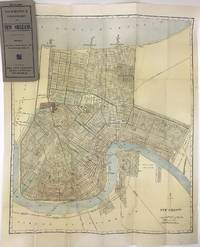
19081418New York 1908. Very good plus. Folding map 23 x 19 inches folded to 7.5 x 3.5 inches. Original grey printed card covers. Minor wear to covers a few small spots of foxing and wear to map. Handsome map of New Orleans printed in color with the canals railroads and electric street car lines highlighted. The map depicts the city from Lake Pontchartrain to the Mississippi showing minimal settlement south of the river primarily in the neighborhood of Algiers. Audubon Park Metairie Cemetery the city park and fair grounds are all highlighted as are many other smaller squares cemeteries and green spaces including the Oakland Driving Park today the New Orleans Country Club's golf course. At the time New Orleans was a city of about 300000 people. The present map shows that most of the neighborhoods along the Mississippi were traversed by "electric railways" with one line traveling north to the lake and terminating at West End while one line operated on the south side of the river. There are also numerous railroads delineated and several ferries crossing the river. A detailed look at the streets of New Orleans at the turn of the century. We locate fewer than ten copies in OCLC. unknown books
1812WRCAM40147Washington City 1812. 32pp. Dbd. Lightly foxed some chipping along spine- edge. Slight tanning to text. Good. The constitution of the State of Louisiana as accepted by the United States for entry into the Union. Louisiana's 1812 constitution was modeled after that of Kentucky providing for a two-house legislature and extensive executive powers. Only adult white males who paid taxes could vote which instantly disqualified two-thirds of the adult white male population and of course all nonwhites and women. The appeal for statehood was particularly urgent as the War of 1812 was unfolding. The Orleans Convention writes in January "Motives of peculiar urgency connected with the repose and security of the people of this territory have induced them to solicit of the executive that the constitution herewith transmitted may be immediately laid before Congress so as to be acted on without delay at their present session." Louisiana was the eighteenth state to enter the Union. SHAW & SHOEMAKER 27252. unknown books
1890WRCAM49909New Orleans: L. Soards Publisher 1890. 338pp. Publisher's blue cloth gilt. Some insect damage light soiling spine ends and corners a bit frayed. Endpapers stained. Text toned but clean. A good copy. An early directory and guide book for the city of New Orleans. Includes address listings for both private residences and businesses advertisements for a wide variety of retailers a section for "Hints on Etiquette" floor plans for various opera houses and theaters and more. Illustrated with an occasional stock image in the advertisements. Rare with only two copies in OCLC at the New Orleans Public Library and the University of Texas at Austin. A delightful guide to the Big Easy. L. Soards, Publisher hardcover books
182932551New Orleans: John Gibson- State Printer 1829. 200 21 1 blank pp. Modern library cloth some soiling text with scattered spotting and light institutional marks on title page. Good. <br/><br/> "English and French on facing pages" Jumonville. With a List of Acts Index and the 1812 Constitution of Louisiana. Among the Acts passed are an 18-section slave registration statute; a state printing contract for Benjamin Levy; and various laws on the militia internal improvements land titles civil and criminal law. <br/>FIRST EDITION. Jumonville 665 3. AI 39326 3. John Gibson- State Printer unknown books
180320071Washington 1803. 5 3 blanks pp. Disbound some loosening Very Good. <br/><br/> "The late cession of Louisiana by France to the United States renders it an object of primary importance to have the nearest and most expeditious mode of communication established between the city of Washington and the city of New Orleans the capitol of that province." The Committee thus urges a post road from Washington "to pass through or near the Tuckabachee settlement to the Tombigby settlement in the Mississippi territory and from thence to New Orleans. And further that a post road ought also to be established from the said Tombigby settlement to Natchez." <br/>FIRST EDITION. AI 5472 3. OCLC 54186405 1. unknown books
180425033Washington 1804. 6 2 blank pp. Disbound and lightly toned. Very Good. <br/><br/> The Senate proposed these Amendments to the House Bill providing for extension of the laws of the United States to the Louisiana Territory purchased from France forming a part of the earliest legislation concerning this newly acquired expanse. <br/>AI 7428 1- DLC. OCLC locates three copies AAS Yale Cambridge under two accession numbers. Not in BEAL. unknown books
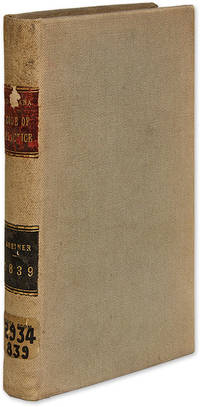
1839700551839. Greiner's Annotated Edition of the Louisiana Code of Practice Louisiana. Greiner Meinrad Editor. Code of Practice of the State of Louisiana Containing Rules of Procedure in Civil Actions; With an Abstract of the Decisions of the Supreme Court Placed Under the Appropriate Articles in the Code; To Which is Appended the Laws Creating the City Court And the Laws Relative to Justices of the Peace. New Orleans: M. Greiner 1839. xx 281 pp. Octavo 8-1/2" x 5-1/4". Later library cloth red and black calf lettering pieces and paper shelf label to spine endpapers added. Light shelfwear and soiling slight darkening to spine. Moderate toning to text slightly heavier in places light edgewear to preliminaries light soiling and library stamp to title page "8063" in tiny hand to verso. $350. First edition. Intended as a practical edition for lawyers Greiner's annotated edition of the code was somewhat overshadowed by Upton's edition which appear in the same year. It was well-received however and had a second edition in 1844. Not in Cohen. Jumonville Bibliography of New Orleans Imprints 1057. unknown books
1821WRCAM53730New Orleans 1821. 155159pp. Modern legal buckram gilt morocco labels. Minor shelf wear. Rockwell Kent-illustrated bookplate on front pastedown obliterated contemporary signature on titlepage small hole in titlepage costing no text uneven foxing. Good. A pair of works recording the laws for two sessions of the Louisiana legislature in the early 19th century. Printed in English and French on facing pages. The laws address issues relevant to the state including incorporating Catholic parishes improving navigation within the state defining the powers of the mayor of New Orleans and also incorporating the city itself granting privileges to the Louisiana State Bank and much more. Both works are scarce. JUMONVILLE 335 374. hardcover books
1831008897Thibodeauxville 1831. Unbound. Good. This two-page folded letter measures 16" x 9.75" unfolded. The cover has no postmark nor rate mark so it is likely it was carried outside of official post office channels. The letter's paper is supple but it has developed splits along several folds so quite fragile. <br /><br />In this letter the Thibodeauxville Justice of the Peace seeks information about two men James Stewart and Joseph R. King he has arrested for horse theft and the probable murder of a watchmaker: <p style="margin-left:3%; margin-right:3%;">"There was a complaint . . . there were two men James Stewart and Joseph R King . . .of Suspicious Character that there were strong circumstances . . . they were guilty of Murder or horse stealing and probably both. . . . They started from Iberville with an old Dutchman a clock or watch repairer. . . . About two miles below Plaquemine the horse threw the Old man . . . and they took his horse . . . and Saddlebags and threw the old mans tools into the Mississippi. . . . The horse was found . . . and King and Stewart were arrested and are now in jail. I shall feel under obligations to any man that will give me information of the Old man whether he is dead or living or any other information that will serve to an expose the crimes which Stewart and King may have committed." <p>I could find no record that King and Stewart were ever brought to trial. Also neither name appears on the historical list of Louisiana executions. This does not mean that the pair were not convicted of murder. In the 1830s <br /><br />Louisiana was one of three states Alabama and Tennessee being the other two that changed their laws to give juries the complete discretion to sentence convicted murderers to punishments short of death. Some see Banner <i>The Death Penalty: an American History</i> have suggested that this was so that juries which at the time were composed only of white men could take race into account when they handed down sentences. Perhaps . . . but only two men were executed in Louisiana in 1831 one white and one black. <br /><br /> books