468 résultats
188929203Detroit: John F. Eby & Co. Book and Job Printers 1889. 21 3 blank pp. Original printed orange wrappers institional rubberstamps a few small chips stitched. Bottom outer corner of text lightly chewed. Else Very Good. John F. Eby & Co., Book and Job Printers unknown books
189029204Detroit: John F. Eby & Co. Book and Job Printers 1890. 21 3 blank pp. Original printed grey wrappers tanned a few small chips rear wrap detached stitched. Bottom outer corner of text lightly chewed. Good to Very Good John F. Eby & Co., Book and Job Printers unknown books
187329197Boston: Wright & Potter State Printers 1873. 65 3 blank pp. Original printed blue wrappers institutional rubberstamp on front wrap stitched. Occasional dampstaining in margins of text lightly age toned. Very Good. Wright & Potter, State Printers unknown books
187229196Boston: Wright & Potter Printers 1872. 59 1 blank pp. Original printed purple wrappers chipped large dampstain institutional rubberstamp on front wrap stitched. Light dampstaining of first two leaves of text. Good to Good. Wright & Potter, Printers unknown books
187729198Detroit: Daily Post Book and Job Printing Establishment 1877. 1-title 1 blank 1 1 blank 24pp. Original printed tan wrappers minor dustsoiling and wear stitched. Text quite clean. Very Good. Daily Post Book and Job Printing Establishment unknown books
187429222Boston: Wright & Potter State Printers 1874. 61 3 blank pp. Original printed purple wrappers institutional rubberstamp on front wrap stitched. Lightly age toned. Very Good. Wright & Potter, State Printers unknown books
187829199Detroit: Daily Post Book and Tribune Book and Job Printing Establishment 1878. 23 1 blank pp. Original printed tan wrappers some browning along edges stitched. Minor wear at bottom outside edges of text. Else Very Good. Daily Post Book and Tribune Book and Job Printing Establishment unknown books
184228532Philadelphia 1842. White wove paper. Fold lines; slight loss to second leaf where separated from wax seal not affecting text; minor ink smudge to first page; light soiling to last page. VG overall. Bifolium folded to make a self-composed envelope. 3 full pages of text; wax seal address with Philadelphia postmark and short notation in a different hand to verso of second leaf. 9-7/8" x 7-5/8" <br/><br/>Revealing early correspondence from the then still-young company of Baldwin & Whitney to T. W. Wells President of the Board of Internal Improvements for the Michigan Central Rail Road alluding to an ongoing payment dispute for two engines. Baldwin & Whitney an early incarnation of what would later be known as the Baldwin Locomotive Works was struggling to recover from the financial hardships of the Panic of 1837 as well as to expand to meet rapidly increasing demand; the Central Railroad too was in the midst of ongoing financial woes and transfers of ownership. The dispute seems to have been a somewhat protracted one as the letter references several prior correspondences with Mr. Wells dating back to June 14th. Although initially quite firm and apparently seeking to address specific imputations from Mr. Wells -- "we would beg leave to state that we do not pretend that there is any difficulty in arriving at a conclusion as to when the two engines alluded to should be paid for" -- the tone soon turns concilliatory admitting that there may have been some lack of clarity regarding the terms of payment thus allowing for alternate interpretations of the contract. Nevertheless the payment was obviously needed: "Our want of money is such however that we have authorized Mr. Briscoe to settle the whole account on such terms as we trust will be satisfactory to you and which under our present circumstances would be preferable to us --." One Jarvis S. Wyckoff of New York is referenced as an involved party although it is not entirely clear in what respect as well as items under the charge of Mr. Briscoe "which we trust will arrive safely and in time to answer the purpose for which they were intended." A bill for $541.50 worth of parts follows the salutation and includes "2 brauk brake Axles Larger Size 3rd claps $175 - $350 2 pair brick wheels - - - - 190 Cartage to Wharf - 1.50." In 1842 both of Matthias Baldwin's partners George Hufty and George Vail withdrew from the partnership. Asa Whitney joined soon after and the business became Baldwin & Whitney though this partnership too would be quite brief; Whitney would later become one of the biggest proponents of the Transcontinental Railroad. Although highly renowned and with no shortage of orders the company continued to struggle with finances for several years. By 1845 the company would simply be M. W. Baldwin and was so inundated with orders that they were building 20 engines per year and had backorders for at least as many. Historical Society of Pennsylvania Baldwin Locomotive Works Records The Detroit and St. Joseph Railroad was chartered in 1831 began construction in 1836 and had to be bailed out by the State of Michigan in 1837. The company was then renamed the Central Railroad of Michigan but by 1840 it too was nearly out of money. On May 25 1842 Detroit's Democratic Free Press ran an editorial by T. W. Wells "Acting Commissioner Int. Imp." rebutting charges of mismanagment of the Central Railroad and citing its many benefits for the state. The railroad would be transferred to private ownership again in 1846; the line to Chicago rather than St. Joseph was finally completed in 1852. An advertisement in Railway Locomotives and Cars Volume 10 1840 includes a blurb from Benjamin Briscoe Superintendent of Motive Power Central Michigan proclaiming his trust in what were then Baldwin Huft & Vale engines: "We have two engines manufactured by others but we can only place confidence while running in yours and I believe them superior to any manufactured in this country or in Europe." All in all an interesting documentary record of the negotiations and financial struggles that created the United States railroad system and of the early years of what would become Baldwin Locomotive Works. unknown books
1869WRCAM38155Mexico: Tipografia Mexicana 1869. 33pp. 12mo. Dbd. Ink stamp in upper outer corner of titlepage. Upper outer corner of final blank leaf chipped. Old faint dampstain in upper edge. Withal still about very good. A rare pamphlet promoting a major Mexican railroad company with plans to build a line across Mexico to the Pacific Ocean. The by- laws are statutes of the railroad are given its capitalization is discussed and the officers listed. Mariano Riva Palacio was the President of the railroad company and Edmundo Stephenson whose name appears at the end of this report is listed as the Vice President. Mariano Riva Palacio was a prominent Mexican statesman with a distinguished record of political and economic reform. He served as governor of the State of Mexico several times and though an ardent republican defended the Emperor Maximilian at Queretero. OCLC locates only two copies - at Tulane University and New Mexico State. Rare. OCLC 16830002. Tipografia Mexicana unknown books
1882WRCAM51543Boston: George H. Ellis 1882. 20pp. Original pink printed wrappers front detached. Light tanning else clean. Good. A report charting the progress of railroad construction and relating financial details for the Mexican Central Railway. The company founded in 1880 completed its main line from Mexico City to Ciudad Juárez in 1884 as well as several other branch lines across Mexico by 1890. Not in OCLC. George H. Ellis unknown books
19006152London: Partington Advertising Company Waterlow & Sons printers n.d. circa 1900. 6th edition. Very Good/The handy District Railway map of London seems to have appeared under several imprints between the 1870s and the early 20th century. This copy issued by the agents for billboard advertising on the London Chatham and Dover lines. Other copies of the same map at the same time bear the imprint of Samson Low. Fine map of London showing mass transit lines. Inset of the Putney Bridge & Wimbledon section. Color folded map 68 x 106 cm folded to 18 x 14 cm in cover 19 x 15 cm. Cover illustrated with "picture postcard" scenes of London. Cover rather stained map very good with some discoloration along folds only. Partington Advertising Company (Waterlow & Sons, printers) unknown books
18728176Memphis 1872. Original printed wrappers stitched 23pp. Wraps lightly dusted. Very Good. <br/><br/> A description of this Arkansas corporation and a review of its mission to provide rail service between Memphis and St. Louis. The report of the chief engineer J.L. Meigs informs on the character of the country traversed by the road. <br/>FIRST EDITION. Allen 7806 1 copy. unknown books
197140434McCloud CA: McCloud River Railroad 1971. 1st printing presumed. Black ink printed to green printer paper. Moderate wear to edges faint horizontal crease. An about VG example. Single sheet printed both sides. Map illustration printed to recto b/w illustrations and photographic image to verso. 11" x 8-1/2" <br/><br/>Includes larger map 11" x 8" alone printed to white paper. McCloud River Railroad unknown books
192440427San Francisco: Market Street Railway Company 1924. 1st printing. White paper printed with black lettering. Very light wear to edges previous creasing. Single sheet. Illustrated map of the San Francisco peninsula. Oblong format: 12-3/4" x 15" <br/><br/>The Market Street Railway Company was a commercial streetcar and bus operator in San Francisco the core of its runs transporting up and down Market Street in the city hence the name of the company. Throughout its lifetime the company traded hands and names on numerous occasions. It was the first horsecar line to open in San Francisco beginning its runs on July 4th 1860. The company had a difficult time convincing others of the need to electrically run systems but the 1906 earthquake and fire gave them the chance to overrule the votes and rebuild the system the way they chose. The cars were large and luxurious and are on display in San Francisco's Railway Museum. Only 2 later editions found in institutional holdings on OCLC. Rare in the trade. Market Street Railway Company unknown books
1864726451864. Paperback. Very Good. Manchester and Lawrence Railroad Corporation. Five Annual Reports of the Directors for 1864 1868 1870 1874 & 1886. Concord first three or Manchester last two: 1864 1868 1870 1874 and 1886. 10-20 pages per report. Wrappers. 21-23cm. Vertical crease on two reports. <br/><br/> paperback books
1887WRCAM41664Manchester & Concord N.H. 1887. Nineteen pamphlets being the 1st 9th 15th 20th 24th-37th and 39th Reports. All stitched in original printed wrappers except first and twentieth which are stitched as issued. Minor scattered soil. Very good. The Manchester & Lawrence Railroad was chartered in 1847 to build a railroad from Manchester New Hampshire to the Massachusetts border. The reports here detail its operations for nearly forty years. unknown books
1869288969New York: American Photolithographic Company 1869. paperback. very good. Map: lithograph. 16" x 28.5". In very good condition. <br><br>Pamphlet: Thin 8vo. 31 pages. Staple-bound stain to paper cover binding fragile. Washington: Government Printing Office. In very good condition.<br/><br/> Map is tipped in at back cover of pamphlet and shows Northern & Southern Pacific Trunk Lines railways completed and railways projected. The majority of the committee that wrote this report included W.M. Stewart Chas D. Drake John Conness Alexander Ramsey J.C. Abbott B.F. Rice<br/><br/> American Photolithographic Company unknown books
1898288006Portland. : Tucker Printing. 1898. . Softcover green printed wraps. . Cover chipped at edges otherwise very good. . 8vo. Tucker Printing. paperback books
2338Portland Me.: Chisholm Bros. Circa 1880s-1890s. . Small 4to6 x 5 1/4 inches maroon diced cloth front highly gilt; some minor wear to corners and edges. [Portland, Me.: Chisholm Bros.], Circa 1880s-1890s. hardcover books
19281134Louisville 1928. Very good. 59 leaves. Oblong narrow octavo. Blueprint self-wrappers with blue paper spine enclosing blueprint contents. Light wear to spine and corners some wear to wrappers. Contemporary ownership inscription on front cover. Internally clean. Profile guide map for the Birmingham Mineral Railroad operating at this time under the name of its parent company the Louisville and Nashville Railroad. Printed in blueprint the volume opens with a map of the entire line from Montgomery north to Birmingham and looping to the north and east through Talladega and Gadsden. There follow detailed maps of the line indicating culverts depots and other features on the route. These maps are provided for the Columbiana Branch the Marbleton Branch the Lumberton Spur the Rock Springs Spur the Self Creek Branch the Long Branch Coal Railroad the Graystone Branch and the Huntsville No. 2. The Birmingham Mineral Railroad was chartered as a division of the Louisville & Nashville Railroad in 1884 designed to freight coal and other minerals from mines in the region. The Huntsville No. 2 Branch opened in 1889 from Birmingham to the Champion Mines. Many of the Red Mountain mines were abandoned by the Great Depression and the railroad was slowly dismantled throughout the 1930s and 1940s. We find no record of this title in OCLC and suspect it was produced in a limited number for internal use. unknown books
192551163fdChicago: Pool E. Bros. 1925. Slim octavo color-illustrated self-wrappers stapled 48 pp. Photos. map in color. New Orleans to Mobile and Pensacola. Fine. Pool E. Bros., (1925). unknown books
503718ca. 1920 by Aerograph Co. Los Angeles with blindstamp in lower left corner. Framed in a black wooden frame with white mat. Framed size: 13 1/2" x 26". F. Soft cover. paperback books
1981197204Los Angeles California n.p. 1981. 1981. Folding 6 panel brochure 8" x 22". 11 tinted color photographs; map by D.W. Pontius; blue background on front panel. Very good. Scarce. Includes advertisements for Mt. Lowe Orange Empire Trolley trip to Redlands Balloon trip Old Mission Trip. No Binding. Very Good. Los Angeles, California [n.p.] 1981. unknown books
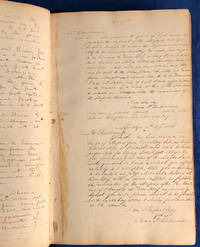
183524879<p>This volume is a fascinating primary source for the nation's oldest railroad still operating under its original name including correspondence setting the course for routes now traveled by millions of riders every month. Later use of this book by a New Jersey hatmaker and Civil War veteran gives insights into the daily life and expenses of a craftsman and farmer in the 1870s.</p> <b>LONG ISLAND RAILROAD.</b>Memorandum and Letter Book 1835-1872. 344 pp. of which 212 pp. have writing 8¼ x 13 x 1¼ in.<p><br /></p><p>This volume likely originally belonging to chief engineer James P. Kirkwood contains a wide variety of memoranda relating to the railroad. It begins with two pages of diary-like entries from February 8 to May 16 1836 including mention of Matthias W. Baldwin 1795-1866 the founder of Baldwin Locomotive Works February 8 and discussion of the route for the new Williamsburg Branch April 1 and reports on the contractors at Jamaica May 4 and 11.</p><p>It is followed by copies of two letters from the chief engineer regarding the delivery of railroad ties from Maine May 27 and August 4 1836 then six pages of estimates for grade work on new lines between Jericho and Ronkonkoma Pond between Jamaica and Jericho and between Flushing and Jericho.</p><p>Next are three draft letters totaling 40 pages to the president and directors of the railroad reporting engineering details on three different routes which had been surveyed from Jamaica to Greenport. The letters are dated November 4 1835 January 1836 and September 19 1836 and include tables estimating the costs for grading each route.</p><p>The following 37 pages include copies of letters to and from Long Island Rail Road engineer James P. Kirkwood between August 11 1835 and March 28 1837 mostly about surveying and construction issues. Among the interesting letters is one from Postmaster General Amos Kendall to the President of the Long Island Rail Road April 26 1836 asking for a map or plan of the route so the post office could update its maps. These pages also include an August 9 1836 letter from Lieutenant George Gordon Meade 1815-1872 acknowledging payment of $45.44 for "services rendered" to the railroad likely surveying shortly before he resigned from the army to pursue work as a civil engineer. Meade went on to lead the Army of the Potomac to victory at the Battle of Gettysburg in July 1863 and continued in command until the end of the Civil War.</p><p><b>James Pugh Kirkwood</b> 1807-1877 was born in Edinburgh Scotland. After his education and an apprenticeship to a land surveyor he began his own business in Glasgow in 1832. Later that same year he immigrated to the United States where he worked as an engineer on the Norwich & Worcester the Boston & Providence and the Stonington & Providence Railroads. In 1837 he became the resident engineer for the Long Island Rail Road. From 1840 to 1843 he was resident engineer for the Western Railroad of Massachusetts. Over the course of his career Kirkwood became one of the foremost civil engineers of the mid-nineteenth century. He was involved in many improvement projects to enhance the harbor of New York City. As general superintendent of the New York & Erie Railroad he pioneered the use of telegraph signals to manage trains. From 1850 to 1855 he was the chief engineer of the Missouri Pacific Railroad and managed its construction. He was a co-founder of the American Society of Civil Engineers in 1852 and served as its president from 1867 to 1868. He also became involved in a variety of water supply projects for various cities in the United States and Europe.</p><p><b>Long Island Rail Road</b> 1835-1928 1949-present is the oldest U.S. railroad still operating under its original name and charter. The New York General Assembly passed an act to incorporate the Brooklyn and Jamaica Railroad in 1831 which incorporated in 1832 to build a ten-mile line between those cities. Engineer Major D. B. Douglass planned for a continuation through the center of Long Island to near its eastern end to connect New York and Boston via rail and steamship. The legislature chartered the Long Island Rail Road Company in 1834. The railroad organized in June 1835 with Knowles Taylor as the first president and it soon acquired the Brooklyn and Jamaica line. The main line from Brooklyn to Greenport was completed in 1844 but rail and steamship service to Boston lasted only until 1847 when competing rail lines through southern Connecticut and steamships directly from New York took away business. The railroad then turned its attention to local service and added more branches to the northern and southern shores while small rival rail lines opened on the island. In 1875 New York rubber baron Conrad Poppenhusen acquired all of the railroads and consolidated them under the Long Island Railroad Company. By 1900 the Pennsylvania Railroad purchased a controlling interest in the Long Island Railroad and the railroad served more and more commuters into Manhattan. From 1928 to 1949 the railroad was largely owned by the Pennsylvania Railroad but it declared bankruptcy in 1949 and the Pennsylvania Railroad stopped supporting its debts. The Long Island Railroad came out of bankruptcy in 1954 and the State of New York purchased it in 1965. Today the railroad carries more than 300000 passengers each weekday over more than seven hundred miles of track.</p><p><b>Further items in the book:</b></p><p>Next comes eight pages of descriptions of land purchases dated between 1798 and 1842 which may be related to the Long Island Rail Road.</p><p>A three-page undated anti-Whig political letter regarding civic responsibility follows: "<i>There is no higher duty we owe to ourselves to each other and to our country in whatever situation we may be placed in whatever sphere of action we may fill than to understand the nature of our government and the civil institutions by which our rights are maintained as citizens and by which our civil duties & obligations towards each other are to be regulated</i>."</p><p>The latter half of the book was apparently used by at least two different owners who recorded property acquisitions reports on canals and railroads in different states and various memoranda.</p><p>Peter J. Butler used fifty-eight pages in the latter half of the volume for a diary with income and expenditures from January 1870 to March 1872. Later pages record Butler's individual accounts with John Allen Johnson Abner Reeves Charles Bessing the School District Nathan Squire and M. P. Hart. Four additional pages give school receipts and expenditures for school years ending August 31 1873 and July 31 1875; Butler served as clerk for the school. The diary provides an interesting view of the household finances of a craftsman and Civil War veteran in the years after the war.</p><p><b>Peter J. Butler</b> 1842-1889 was born in New Jersey as the son of Peter Butler 1806-1874 and Catherine Butler 1802-1893 both Irish immigrants. Peter J. Butler was a farmer and hatmaker in Livingston New Jersey twenty miles west of New York City. During the Civil War Butler served as a landsman for the navy steamers USS <i>North Carolina</i> and USS <i>Monticello</i> from August 1864 to June 1865. In February 1867 he married Hettie C. Denman with whom he had two children.</p><p>Among the interesting items is the following letter to a soldier perhaps Peter J. Butler from the Civil War:</p><p><i>Dear Friend</i></p><p> <i>I arrived at home on Saturday as I left on Thursday after a verry pleasant ride. I intended to write before but I have been on the go day and night since I have been home so that I have had no time yet I am anxious to hear from you as ever. The 4 of July was selebrated in great stile all over the country and all had a good time in general I am in hopes that you will not have to serve the whole of your time out in fact I think you ought to be entitled to your discharge oferd the verry reason that you have served in the army and navy ever since the commencement of the war and before and never had a bounty I think the Captain will interseed for you and he will if he has any manly principle in him whatever</i></p><p>Another owner of the book appears to have been John S. Cunningham who is likely responsible for the copy of the "<i>Speech of Adherbal to the Roman Senate imploring their Protection against Jugurtha</i>" in parallel Latin and English columns and a map of a battle from the Jugurthine War in 108 B.C. with Latin labels and narrative. Both have the initials "<i>J.S.C.</i>" at the bottom. Among other items in the book is a brief "List of John S. Cunningham's private library" including books on Greek Latin and French and an 1847 account of J. S. Cunningham with Andrew A. Smalley 1814-1893 covering two pages. Early in Butler's diary is an entry for January 9 1870: "<i>Wrote to John S Cunningham</i>" so perhaps Cunningham had given the ledger to Butler.</p><p><b>John S. Cunningham</b> 1827-1893 was born in New Jersey and educated at Orange Academy. He particularly studied surveying and civil engineering. He was involved in the manufacture of wrought bar iron for several years. In 1848 he became an assistant engineer with the Morris & Essex Railroad and then the Patterson & Ramapo Railroad. From 1849 to 1851 he worked as an engineer on the Chesapeake and Ohio Canal. He then returned to railroad work through the 1850s. He settled in Coalsmouth Virginia St. Albans West Virginia thirty-five miles east of Huntington. During the Civil War he served as an officer in a loyal Virginia regiment then returned to St. Albans where he held a variety of local offices including from 1889 judge of the Kanawha County Court.</p><p><b>Condition</b></p><p>Overall good. Cover wear and some missing spine cap; marbled endpapers; one torn page; interior clean.</p> hardcover books
1928TB30959Pennsylvania Station New York City: Long Island Railroad 1928. First Edition. Very good in printed multi-color wraps over a stapled binding. An octavo of 9 by 6 inches with light rubbing and wear around the perimeter of the covers and with modest soiling to the title page and verso of the front cover and to the recto of the rear cover. Without a dust jacket as issued. Issued by the General Passenger Department of the Long Island Railroad. 96 pages followed by a fold-out map five color map of Long Island which has a one inch closed tear in one fold and a two inch closed tear starting at the end of the above tear both of which have been repaired with archival tape. Illustrated throughout from black and white photographs and replete with ads for hotels resorts and inns. Long Island Railroad paperback books