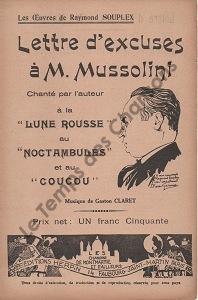
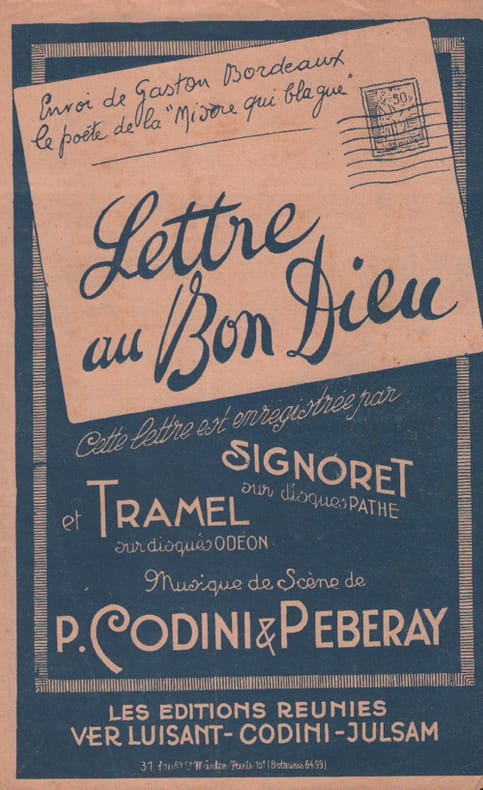
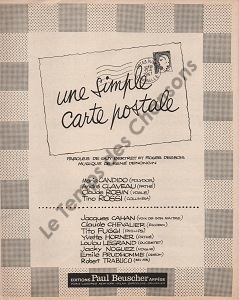
Robin Claude,Rossi Tino,Claveau André,Candido Maria - Denoncin René - Desbois Roger,Bertret GuyLivre Rare Book
380 résultats
196124444Partitions sur les Lettres et poste Beuscher Paul 1961
1986107200Marly-le-Roi, chez l'Auteur, 1986, in-8°, 187 pp, 29 illustrations et photos, broché, couv. illustrée, bon état
1987116673Marly-le-Roi, chez l'Auteur, 1987, in-8°, 174 pp, 41 illustrations et photos, broché, couv. illustrée, bon état
194870837Partitions sur le Métier,Partitions sur les Lettres et poste Breton Raoul 1948
19124574Belley, Imprimerie Louis Chaduc, 1912 ; in-8, broché ; (2) ff., 72 pp., 10 planches hors-texte de photographies et documents, couverture beige imprimée.
194741386Paris,Silombra 1947. In Paris,Silombra 1947. In-8 broché de 592 pages illustrées. Bon état
198471340Couverture souple. 12 revues brochées.
19091028571909 1909 - 25, Rue du Quatre Septembre, Paris - Société Industrielle de Téléphonie - In-4 broché - Catalogue illustré - 64 pages
19406249Partitions sur les Lettres et poste Breton Raoul 1940
193019388Partitions sur les Lettres et poste,Partitions sur la Politique et gouvernement Herpin 1930 approx.
192119391Partitions sur les Lettres et poste Herpin 1921 approx.
193520921935 br. in-8, fig. in-txt., qq. rouss., 212 p., 1935 courrier des examens,
193362788Cartonnage d'éditeur bleu-clair illustré. Dos toilé bleu. Dos et bords du cartonnage frottés. Bel état du contenu orné d'illustrations in-texte en noir et blanc réalisées par l'autrice. Ex-libris tamponné sur la page de garde.
196024314Partitions sur les Lettres et poste Universelles 1960
1931859ALBANS 1931 1 S.l., Albans, 1931, in-122, br, couverture illustrée en couleurs.
1980Q-0333309774Pan Macmillan 1980-11-13. Paperback. New. In shrink wrap. Looks like an interesting title! Pan Macmillan paperback
192816371928 Ed. du Messager Philatélique, Paris, 1928. In-8 broché. 106 pages, illustrations in-texte.
1946113787Partitions sur les Lettres et poste Ver Luisant 1946 approx.
19436507Partitions sur le Métier,Partitions sur les Lettres et poste Salabert 1943
198191175Washington DC: U.S. Government Printing Office 1981. Presumed First Edition First Printing. Wraps. Very good. iv 120 1 pages. Wraps. Tabular Data. The 1981 Senate hearings regarding the implementation of the nine-digit ZIP code ZIP4 were marked by intense debate over automation costs and mandatory versus voluntary usage. The hearings primarily held before the Subcommittee on Civil Service Post Office and General Services aimed to address public and Congressional concerns that the system was premature and overly burdensome. A major focus was ensuring the new longer code would be voluntary specifically for residential users to alleviate public fear of forced compliance. Postmaster General Bolger testified that he supported making it voluntary except for bulk mailers seeking discounts. Critics in the Senate such as Senator David Durenberger and Senator Roger Jepsen argued that the system was not fully tested might increase costs and that the public did not want it. The program was designed to cut costs through automated mail sorting using optical character readers OCRs. In April 1981 Congress considered legislation to block the June 1 1981 implementation date proposed by the Postal Service with leaders calling for a cost-benefit analysis. Despite the contention the Senate moved forward with the program with the legislative battle continuing through the end of the year eventually leading to the authorization of the program by late 1981 with full implementation planned for subsequent years. The hearings highlighted the transition from manual to automated mail processing and the friction caused by requiring the public to adopt a more detailed addressing system. The nine-digit zip code ZIP4 was introduced by the USPS in 1983 to improve mail sorting automation and speed up delivery. It adds a four-digit suffix to the original five-digit code identifying specific geographic segments—such as a city block apartment building or individual high-volume receiver. The first five digits define the region and local post office. The added 4 indicates a sector several blocks and a segment one side of a street. The system allows automated machinery to sort mail to smaller more precise delivery areas reducing manual handling. While proposed earlier the extended code was officially introduced in 1983. Initial uptake was slow due to a at the time small incentive for large-scale mailers. It provided increased accuracy faster delivery times sometimes up to two days faster and reduced costs for bulk mailers. While not mandatory for citizens it is heavily used by businesses for address verification mailing efficiency and better logistical analytics. The system evolved from the original 1963 five-digit Zone Improvement Plan ZIP to handle growing mail volumes. U.S. Government Printing Office paperback
191521992Partitions sur les Lettres et poste Ondet 1915
195738281957 cartonné in-octavo, dos rouge légèrement insolé - titre frappé or et liserets, illustrations : frontispice (fac-similé) planches (de timbres) hors-texte en couleurs + 1 fac-similé replié, 316 pages, 1957 Paris Presses de la Cité,
193916361939 Imp. Yvert, Amiens, 1939. 2 volumes brochés. 306, 72 pages. 2ème édition. Nombreuses illustrations in-texte
19128012Partitions sur les Lettres et poste Delormel 1912
191716132Partitions sur les Lettres et poste,Partitions sur la Première guerre Mondiale Willems 1917 approx.