Peru, Administracion General de CorreosBiblio.com
143 résultats
0282241663.Gpaperback. Good. Access codes and supplements are not guaranteed with used items. May be an ex-library book. paperback
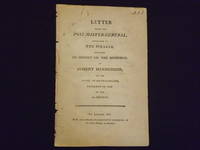
1805101503Pamphlet 8vo removed dbd 7 pp. Removed partially disbound ink numbers in upper right corners some wear or small chips at extremities moderate aging and browning; good or better. Gideon Granger 1767-1822 provides information on what would be involved in terms of costs for carrying mail between Fayetteville North Carolina to Charleston South Carolina. Granger born in Connecticut and a Yale graduate would become the Post-Master General under President Thomas Jefferson. While he would fail in a congressional bid in 1798 he would eventually serve in the New York Senate in 1820-1821. ANB.
0666096236.Ghardcover. Good. Access codes and supplements are not guaranteed with used items. May be an ex-library book. hardcover
1332043453.Gpaperback. Good. Access codes and supplements are not guaranteed with used items. May be an ex-library book. paperback
69-3644Paris France: La Poste ca 2000. 80 x 60 cm. Offset Color Lithograph. Good small tears on left and right edges Paris, France: La Poste, [ca 2000] unknown
042870980X.Ghardcover. Good. Access codes and supplements are not guaranteed with used items. May be an ex-library book. hardcover
54077Simon & Schuster Little Golden Book # 212-25 Very Good Condition. Illus. by Richard Scarry. Simon & Schuster Little Golden Book # 212-25 unknown
0483355550.Ghardcover. Good. Access codes and supplements are not guaranteed with used items. May be an ex-library book. hardcover
0666052719.Ghardcover. Good. Access codes and supplements are not guaranteed with used items. May be an ex-library book. hardcover
1333467206.Gpaperback. Good. Access codes and supplements are not guaranteed with used items. May be an ex-library book. paperback
198191175Washington DC: U.S. Government Printing Office 1981. Presumed First Edition First Printing. Wraps. Very good. iv 120 1 pages. Wraps. Tabular Data. The 1981 Senate hearings regarding the implementation of the nine-digit ZIP code ZIP4 were marked by intense debate over automation costs and mandatory versus voluntary usage. The hearings primarily held before the Subcommittee on Civil Service Post Office and General Services aimed to address public and Congressional concerns that the system was premature and overly burdensome. A major focus was ensuring the new longer code would be voluntary specifically for residential users to alleviate public fear of forced compliance. Postmaster General Bolger testified that he supported making it voluntary except for bulk mailers seeking discounts. Critics in the Senate such as Senator David Durenberger and Senator Roger Jepsen argued that the system was not fully tested might increase costs and that the public did not want it. The program was designed to cut costs through automated mail sorting using optical character readers OCRs. In April 1981 Congress considered legislation to block the June 1 1981 implementation date proposed by the Postal Service with leaders calling for a cost-benefit analysis. Despite the contention the Senate moved forward with the program with the legislative battle continuing through the end of the year eventually leading to the authorization of the program by late 1981 with full implementation planned for subsequent years. The hearings highlighted the transition from manual to automated mail processing and the friction caused by requiring the public to adopt a more detailed addressing system. The nine-digit zip code ZIP4 was introduced by the USPS in 1983 to improve mail sorting automation and speed up delivery. It adds a four-digit suffix to the original five-digit code identifying specific geographic segments—such as a city block apartment building or individual high-volume receiver. The first five digits define the region and local post office. The added 4 indicates a sector several blocks and a segment one side of a street. The system allows automated machinery to sort mail to smaller more precise delivery areas reducing manual handling. While proposed earlier the extended code was officially introduced in 1983. Initial uptake was slow due to a at the time small incentive for large-scale mailers. It provided increased accuracy faster delivery times sometimes up to two days faster and reduced costs for bulk mailers. While not mandatory for citizens it is heavily used by businesses for address verification mailing efficiency and better logistical analytics. The system evolved from the original 1963 five-digit Zone Improvement Plan ZIP to handle growing mail volumes. U.S. Government Printing Office paperback
18802111902160200356Not Available 1880. Soft Cover. Fine. Volume: 1 Not Available paperback
2012x-147570285XSpringer 2012. Paperback. New. reprint edition. 252 pages. 10.00x7.00x0.60 inches. Springer paperback
1937C209954London: Post Office 1937. Hardcover Hardcover. Very Good. Small quarto. Original printed ring binder with cloth spine. Contains R3 R4 R5. Some pages slightly worn creased and/or torn a few pages with ink updates and annotation otherwise a very good copy. 1937 1938 1959. Post Office, hardcover
0850121213New. hardcover. New. Satisfaction Guaranteed or your money back. hardcover
B9781019551295Hardback. New. hardcover
ria9783368124731_inpHardcover. New. New Book; Fast Shipping from UK; Not signed; Not First Edition; Reprint of the original first published in 1871. hardcover
ria9783368124724_inpPaperback. New. New Book; Fast Shipping from UK; Not signed; Not First Edition; Reprint of the original first published in 1871. paperback
B9783368124724Paperback / softback. New. paperback
B9783368124731Hardback. New. hardcover
3368124730.Ghardcover. Good. Access codes and supplements are not guaranteed with used items. May be an ex-library book. hardcover
1021307424.Gpaperback. Good. Access codes and supplements are not guaranteed with used items. May be an ex-library book. paperback
1019551291.Ghardcover. Good. Access codes and supplements are not guaranteed with used items. May be an ex-library book. hardcover
3368124722.Gpaperback. Good. Access codes and supplements are not guaranteed with used items. May be an ex-library book. paperback
1904004285Oxford Clarendon Press 1904. 4th Edition. Hardcover. Good. This copy belonged to Prof. Nic Wiehahn. Wiehahn was a South African labour expert and was best known for heading the Wiehahn Commission which proposed in 1979 that black trade unions be afforded legal recognition. Gilt titling to spine. The navy blue boards are shelf-rubbed and rubbed at all extremities. The spine ends are scuffed and the edges are fraying. The top edge of the spine is split for three quarters of its length from the top and the bottom edge is starting to split. The front joint is severely cracked. Wiehahn's rubber stamp appears five times in the prelims and there is also another prev owner's name dd 1925 to the ffep. The endpapers are browned. There is an inkstain to the bottom outer corner affecting the front pastedown and all the introductory pages. The pages are rough-cut and the bottom edge of the textblock has another two of Wiehahn's rubber stamps. The 668pp of well-thumbed text are very extensively underlined and annotated - largely in pencil. There are a couple of inkblots to the text but there is virtually no foxing. Some of the pages of the publisher's catalogue at the back are uncut and there are notes to the rear endpapers. This is a volume that has been worked through very thoroughly. Oxford Clarendon Press hardcover