Livre Rare Book
5 résultats
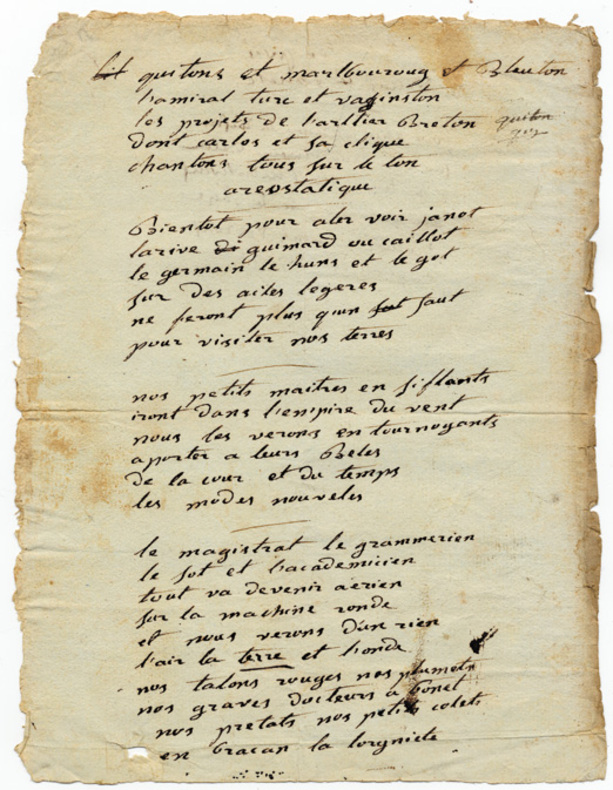
17501412Un feuillet, écrit recto-verso sur papier vert, écriture très lisible, ... ortographe très incertaine !
1785ST15350Paris: Cuchet 1783-1784; 1784; Amsterdam and Paris: Gueffier 1785. FIRST EDITIONS. Second Issue of the first work with the four-page "Supplément" at the end. 223 x 127 mm. 8 x 5". Three separately published works bound as a three-volume set the first work occupying the first two volumes. <br/> Uniform contemporary orange paste-paper boards backed with marbled sheepskin corners tipped with vellum raised bands flanked by decorative gilt rolls one red and one green morocco label. First work with a folding table and 14 ENGRAVED PLATES nine numbered plates in first volume five in second two of the latter folding; second with three engraved plates; third work with one folding plate. First work: Darmon 51; PMM 229; Norman I 769; Maggs Bros. "The History of Flight" 65. A hint of rubbing to extremities intermittent minor browning small rust spots or offsetting in the text bed largely due to inferior paper stock four leaves with one-inch brown stain to text nothing obscured a couple of short marginal tears from rough opening but QUITE A FINE SET--the text clean fresh and well-margined the plates with excellent impressions and the binding remarkably well preserved with few signs of wear.<br/> <br/> This is the second issue with the rare "Supplément" in the second volume of the earliest account of the first public experiments with hot air balloons and it is considered to be the first authoritative technical and historical work on aerostation as well as the first serious discussion of balloon travel as a practical possibility. The experiments were conducted by the Montgolfier brothers Joseph 1740-1810 and Etienne 1745-99 who had been intrigued by the experiments of Cavendish and Priestly with "inflammable air." The eminent scientist Faujas 1741-1823 who was the promoter financier and chronicler of the Montgolfiers quickly published this account after the brothers had launched a balloon at Annonay in June of 1783 then a balloon carrying some farm animals in September and finally a balloon carrying Pilatre de Rozier and the Marquis d'Arlandes in November. This last flight--the first manned aerial voyage in history--covered five-and-one-half miles across Paris and lasted 25 minutes. Plate 8 here shows the two original aeronauts viewed from the terrace of Franklin's home in Passy. <br /> <br /> The third volume begins with a discussion of the inflammable gas used to lift the balloons and gives a summary of Montgolfier's history of balloon flights. The final work sets forth another scientific innovation an electrostatic machine that employed sheets of taffeta to create friction that produced static electricity. The Royal Academy of Sciences tested the machine and found it a great improvement--less expensive and less liable to accidents--than earlier machines that had used plates of glass. The work seems to be very rare: we could find no copy sold at auction in either RBH or ABPC. This is a most appealing set its combination of works on inventions offering a glimpse of the popular fascination with emerging technologies especially those related to flight in the late 18th century. Cuchet, 1783-1784; 1784; Amsterdam and Paris: Gueffier unknown
171949895Kelly Field TX; Chanute Field IL; Scranton ND; Denver City TX: Almond Orwald Peterson 1917-1956. Two vols. Oblong folio. 1st. 13.25 x 10.25 in.; 12.25 x 10 in. 80; 80 pp unpaginated both with thick black paper stock with 359 tipped-in photos ranging in size from 1.75 x 2 in. up to 8 x 10 in many of them clearly marked in pencil and/or ink on versos some with signatures in lower white margin a images nearly all on glossy photo stock a couple hand-coloured many with minor creasing some damage to corners a couple with tears along the upper fore-edge still nearly all of the images are still quite clear and distinct; 4 leaf typescript on onion paper 24.5 x 36 in. blueprint folded for radio receiving station; 6 different course certifications for Peterson in handling oil field and natural gas pumping equipment. First album is contemporary ribbed cloth post-binder tied at gutter margin with black silk cord some bumping wear bumping to corners fraying; second padded leather album rounded corners gilt lettering front cover slots in leaves for postcards minor bumping head & foot of spine edgewear; still VG- set. These remarkable photo albums furnish an indispensable visual record of the history of American aviation just after World War I at Kelly Field TX and Chanute Field IL. Almond Orwald Peterson 1901-1977 son of Norwegian immigrants was born in Twin Valley MN moved with his family later to Billings and Scranton ND enlisted in the Army after High School trained as a radio operator and airplane mechanic worked as a mechanic after his service in North Dakota and then Texas and finally worked in the oil fields surrounding Denver City TX. Kelly Field in Texas was one of the Army Air Service’s primary fields for training and deploying pilots during World War I. After the massive demobilization at the end of the War the Kelly Field and Chanute Field in Illinois served as essential training grounds for Army pilots to exhibit their skills holding air races balloon races and training technicians. All technical schools were joined with the mechanics school at Chanute Field in 1922 and were re-designated the Air Corps Technical School by 1924. These excellent photographs not only include detailed shots of the barracks the radio towers the equipment rooms servicemen and more but also encompass a vast array of the aircraft which flew in and out of these fields along with many aerial shots. There are photos of German Fokker triplanes French Spads Curtiss DH-4s many of the Barling Bomber the Witteman-Lewis XNBL-1 an experimental long-range three-wing strategic bomber which proved massively unwieldy because it was too underpowered with its six engines a colour-tinted image of the USS Los Angeles Zeppelin and several other lighter-than-air balloons and airships as well. In addition there are many photographs of plane crashes showing the high attrition and danger of flying during the 1920s often in World War I surplus aircraft and even a few images of funerals and caskets for lost comrades. Almond Orwald Peterson, hardcover
171961835Akron OH: The Goodyear Tire & Rubber Co. 1917-1918. Three parts in one vol. 4to. 68 pp; 13 leaves typescript on onion-skin paper; 14 pp unpaginated. in ink manuscript on ruled paper. With 16 cyanotype blueprint leaves of hydrogen gas plants water bags equipment numerous tables diagrams 2 original linen-backed silver gelatin photo plates on linen hinges. Black-ribbed cloth split-pin post binder as issued gilt lettering & Goodyear winged logo on front cover marbled pastedowns minor soiling to edgewear fraying minor splitting to cloth at spine minor bumping to corners still a VG- exemplar with many annotations from the library of Arthur Sewell 1880-1973 longtime specialist with Goodyear Tire & Rubber instructor at the Airship Training School during World War I which also specialized in training U.S. Navy and U.S. Army ground crews for blimps balloons and dirigibles and Lt. Steven B.aker Hagadorn 1920-2007 who was serving during the Korean War at the U.S. Naval Air Station Ocean City New Jersey in 1950-1954. First edition of this exceedingly scarce manual written to train and educate Navy Balloonists before the U.S. entered World War I after the Goodyear Tire & Rubber Company secured a contract to train 20 men in free ballooning in May 1917. This work describes the free balloon how to construct and use various parts of the balloon details the physical properties of gases used for lift the physics behind the gases and atmosphere preparations for flight the proper methods of handling the balloon in the air as well as on the ground as well as advising the balloonist to exercise care in using gasoline to remove oil from balloon fabrics by avoiding the seams because it will cause the seam to deteriorate. The illustrations and photos at the end show a balloon being laid out for inflation inflated setting the sandbags rigging and ascension of the balloon. The Jan. 28 1918 typescript by Lieut. Comm. Teed specifically outlines the technical advantages and uses of employing hydrogen in the free balloons with specific equations and calculations for volume lift and more. Goodyear had established its Aeronautics Department in 1910 to market rubber impregnated fabrics and coatings for airplanes and lighter-than-air craft and began buildings its first balloons in 1912. In 1916 Goodyear bought 720 acres of land southeast of Akron to serve as their flying school and manufacturing site. Around the same time they began building their first airship in March 1917 they were also negotiating for a contract with the government to train balloonists for the Navy. Of particular interest in this work are the presence of the original manuscript “Free Balloon Log Sheets†documenting free flights starting in Winfoot Lake OH and landing in East Lewistown Homeworth Youngstown & Minerva OH; Sagerstown & Hallston PA Columbia Station. Several of the sheets note weather conditions flight altitudes how they landed and manuscript observations taken during the flights. Roth 1885-1950 was a noted sport balloonist before and after World War I up through the 1930s was a balloon instructor during World War I for Goodyear Tire & Rubber Co. and also was a pilot in the U.S. National Balloon race in 1930. Original editions of this early Goodyear aviation work are quite scarce. No copies in Worldcat for the First Edition several located for the 77 pp. 2nd edition varying number of blueprints plans; No copies located of Typescript MS by Teed or printed version of Lift of Hydrogen Technical Note No. 21; See Hamlen First Lighter-than-air Class at Akron; Goodyear Blimp History. The Goodyear Tire & Rubber Co., hardcover
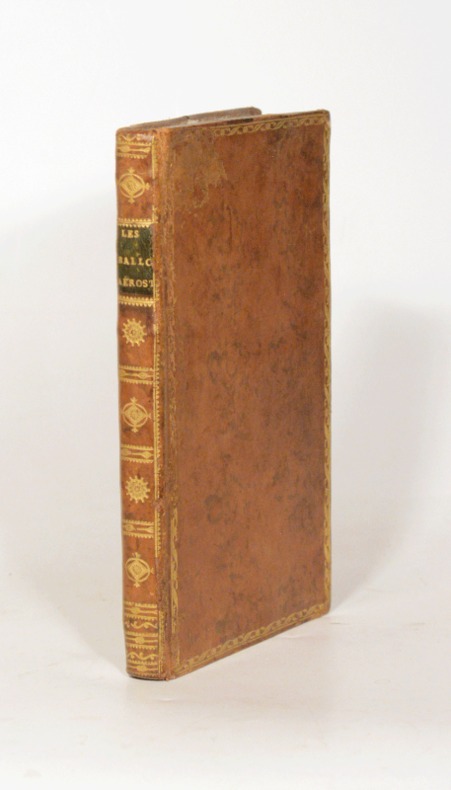
17840044271784 [Paris, Chez les Libraires, 1784]. In-8 (128 X 204) basane fauve marbrée, plats décorés d’un encadrement de roulette dorée, dos lisse orné de filets et fleurons dorés, pièce de titre cuir vert, coupes et coiffes ornées, tranches jaspées (reliure de l’époque); frontispice illustré, 156 pages, 2 planches hors-texte. Epidermures sur les plats avec encadrement doré en partie effacé sur les plats, coins émoussés.