8 026 résultats
19101450561910. AVIATION. Aeroplanes d'Artois. Monoplans Aero-Torpilles Aero-Marins. One large fold-out plate with 6 photographs of planes. Small 4to. 165 x 190 mm bound in publisher's gray printed wrappers with a tipped on photograph in a new blue cloth folding box. Paris: Emile Dubonnet 1910. $1250.00 A promotional brochure for the d'Artois aviation company one of the pioneer manufacturers of aeroplanes. The cover is a photograph of the aviator Emile Dubonnet above the Place de la Concorde in 1910. A rare survival from the dawn of modern aviation. In fine condition. hardcover books
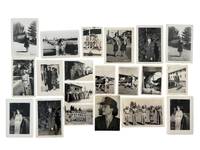
1943213501943. Women's Army Corps service and female aviation training during World War II documented in photographs dating from approximately 1943 to 1945. The images record the wartime expansion of women's participation in the United States military following the establishment of the Women's Army Corps in 1943 and the parallel development of programs that placed women in aviation related roles supporting the war effort. The photographs depict women in uniform participating in military drill training activities and aviation work around small aircraft illustrating the increasing presence of women in technical and logistical positions that supported military operations during the war. One image taken at Treasure Island in San Francisco situates part of the archive within one of the major naval training and transit centers used by the United States during the conflict.<br /> <br /> Archive of 20 original black and white silver gelatin photographs dating from the World War II years. Several images show members of the Women's Army Corps posing in formation saluting and participating in organized training exercises. Other photographs depict women standing beside small aircraft preparing for flight or seated in cockpits suggesting involvement in aviation training or aircraft support work connected to wartime flight programs. Informal photographs show servicewomen gathered outside wooden barracks relaxing in flight gear and posing beside aircraft. One photograph identifies the location as Treasure Island San Francisco. Several prints contain handwritten inscriptions on the reverse identifying individuals and dates including notes such as "Sincerely Leona" along with named individuals including Sensabough Bash Braughton Rogers Mazie Paula and June and Kay Gallagher with Bud Sterthors and Donley.<br /> <br /> During World War II the Women's Army Corps allowed women to serve in uniform in administrative mechanical and communications positions that had previously been reserved for men while aviation related programs trained women to ferry aircraft and assist in technical flight operations. These initiatives formed part of the broader mobilization of American women into wartime labor and military service during the 1940s. Photographic documentation of female service members provides important visual evidence of the changing roles of women within the armed forces during the war. Photographs measure approximately 3.5 x 5 inches and are preserved as loose prints. Minor edge wear and light creasing visible on several photographs; overall very good condition. The archive offers concise visual documentation of women's military and aviation participation during the Second World War. unknown
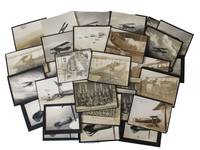
1918177171918. World War I military aviation. Primary-source photographs documenting early United States military aviation training at Henry Post Airfield Fort Sill Oklahoma during the formative period of the U.S. Army Air Service following its establishment in May 1918. The images record the first generation of American military pilots operating within a rapidly developing aviation program built in response to World War I supporting research into the expansion of U.S. airpower pilot training infrastructure and the integration of aircraft into military operations. The presence of DH-4 two-seat biplane bombers the principal American-built combat aircraft of the war situates the archive within the transition from experimental aviation units to operational military squadrons. A dated caption identifying "October 29 1918 Sergeant Schauble" flying at 3700 feet further anchors the material within the final phase of the war.<br /> <br /> Archive of 26 silver gelatin photographs Fort Sill Oklahoma circa 1917-1918 each measuring approximately 7.25 x 5.25 inches. The archive includes many photos of the biplanes in the air one photo shows several DH-4 bombers soaring in the clouds in a Flying-V formation. A handwritten caption on one image "October 29 1918 Sergeant Schauble " is depicted flying in a DH-4 at 3700 feet as well as going on a "parachute trip". One photo shows a serious plane crash with two DH-4s biplanes nose down in the ground. The pilots are also depicted in hot air balloons. Fort Sill was home to several US Army Balloon Companies during this period which were still primarily used for reconnaissance and directing aerial bombardment during World War I. The photo archive includes many shots of biplanes in the clouds or on runways with pilots in goggles including 4 images of pilots or troops in group shots. Most photos show the planes or balloons in mid air. . Army balloon companies stationed at Fort Sill for reconnaissance and artillery observation. Several images capture aircraft at altitude among cloud formations while others document runway activity and pre-flight staging. Versos of many prints retain remnants of black album paper indicating removal from a compiled photographic album.<br /> <br /> The archive documents the early operational environment of American military aviation at a moment when the United States was rapidly expanding its aerial capabilities following limited prewar development including the Army's first acquisition of aircraft from the Wright brothers in 1909. Henry Post Airfield functioned as a central training site for pilots entering service during World War I and the inclusion of both airplane and balloon units reflects the continued reliance on multiple aerial technologies for reconnaissance and combat support. The photographs provide visual evidence of training practices aircraft deployment and the material conditions of early air service operations during a period of institutional formation. Minor edge wear and surface wear are present with album residue on versos; overall very good condition. A cohesive photographic record of early U.S. military aviation training and aircraft use during World War I. unknown
192113582Dayton OH: The Otterbein Press. Fine. 1921. First Edition; First Printing. Hardcover. You would find less shelf wear on a new book at the corner bookshop. A beautiful copy of the very scarce first edition of this amazingly complete compendium of all the engines available in 1921. You will never see a better copy of this book. Although I will admit you may find a lesser one cheaper. I simply could not pass it up . ; 8vo 8" - 9" tall; 547 pages . The Otterbein Press hardcover
193015835Berlin: W. E. Harich. Good. 1930. First Edition. Hardcover. Text is in German. The covers are soiled and worn the spine is gone. The binding is still intact held by the sewing and endpapers. Drawings of aircraft. Includes a 6 language dictionary of aircraft technical terms. Includes drawing of seats various elevations of the aircraft landing gear etc. Pretty neat book. The contents are very good to fine. ; Oblong Small 4to 9" - 11" tall; 168 pages . W. E. Harich hardcover
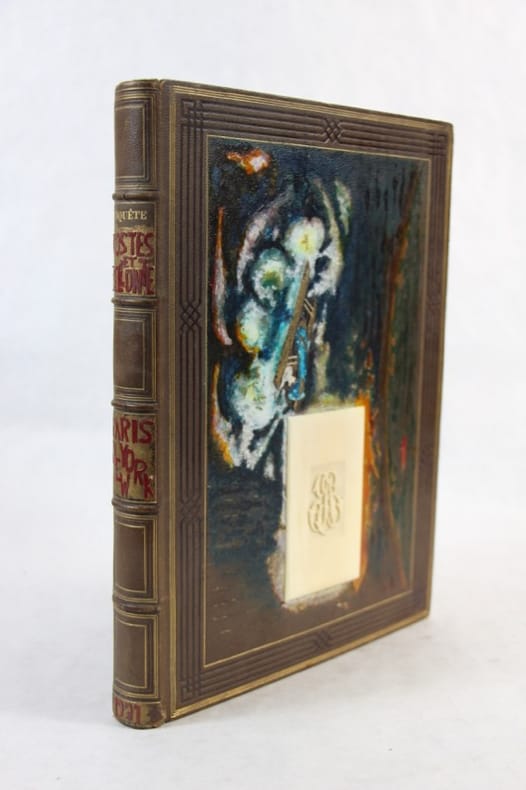
193123267Imprimerie nationale 1931 In-4 plein chagrin brun, dos à nerfs, caissons dorés et à froid, titre rapporté en lettres de maroquin rouge sur fond argenté au dos, premier plat orné d’une belle composition un breguet mosaïqué sur fond peint de nuit d’orage et d’Atlantique, une plaque ivoire de monogramme contrecollée, 252 pp. Plus de 100 reproductions en noir ou en couleurs, dont 6 planches dépliantes.
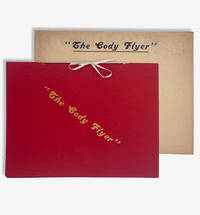
191221208461912. Aldershot: Gale and Polden. 1912. 4to. Original red card wrappers lettered in gilt original printed envelope preserved; pp. 11 1 highly illustrated after photographs and drawings printed on yellow blue and white coated paper; wire-stitching removed and replaced with new ties traces of oxidation along gutters final page with a little offsetting from red wrappers; a rare survival with the original printed envelope this a little spotted.Extremely rare trade catalogue for the Cody mono- and biplanes as well as a manned war kite. 'Samuel Franklin Cowdery was born in 1867 in Davenport Iowa was a Wild West showman and early pioneer of manned flight. He changed his name to Cody at age 21 when he was part of a touring Wild West show not to be confused with that of Buffalo Bill Cody. He is most famous for his work on the large kites known as Cody War-Kites that were used by the British in World War I as a smaller alternative to balloons for artillery spotting. Financed by his Wild West shows Cody's unusual interest in manned kites advanced significantly when he enlarged upon Lawrence Hargrave's double-cell box kite to increase its lifting power especially by adding wings on either side. He patented his design in 1901 and it became known as the Cody kite. Cody eventually managed to interest the British Army in his kites. In 1906 he was appointed Chief Instructor of Kiting for the Balloon School in Aldershot and soon after joined the new Army Balloon Factory down the road at Farnborough. The Factory would eventually become the Royal Aircraft Establishment. In 1908 the War Office officially adopted Cody's kites for the Balloon Companies he had been training. This group would in due course evolve into the Air Battalion of the Royal Engineers No. 1 Company of which later became No. 1 Squadron Royal Flying Corps and eventually No. 1 Squadron Royal Air Force. During 1907 he was given full authority as the designer of the the British governments dirigible understructure and propulsion system. On 5 October 1907 Britain's first powered airship British Army Dirigible No 1 and using Cody's engine the Nulli Secundus flew from Farnburough to London. In 1907 the British Army decided to back the development of Cody's powered aeroplane the British Army Aeroplane No 1. His flight of 16 October 1908 is recognized as the first official flight of a piloted heavier-than-air machine in Great Britain. He went on to win a number of aeronautical awards and started developing his own aircraft company. That company produced the Cody Flyer a monoplane for which this pamphlet was issued. On 7 August 1913 he was test flying his latest design the Cody Floatplane when it broke up at 200 feet and he and his passenger the cricketer William Evans were killed' Nat DesMarais Rare Books. The 1908 British Army Aeroplane No.1 was actually Cody's biplane sometimes called Cody 1 later officialy referred to as The Cody Flyer. 'On 16 October at Farnborough it made what is recognised officially as the first sustained powered flight in Great Britain by a heavier-than-air machine covering 423.7m before crash-landing' Virtual Aircraft Museum online.Library Hub locates a single copy in the National Aerospace Library. unknown
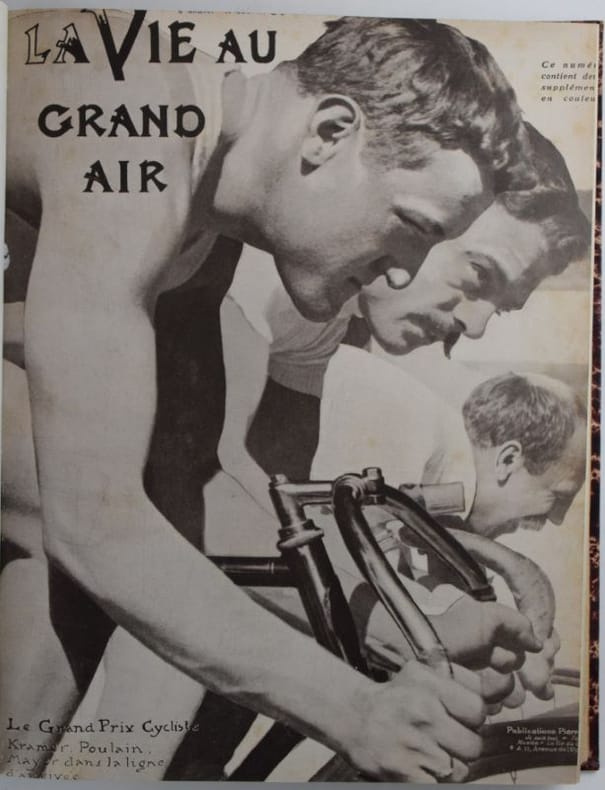
19028493Paris, 1902-1907. 6 années complètes reliées en 12 volumes in-folio, du numéro 173 du 5 janvier 1902 au n° 484 du 28 décembre 1907. Les numéros de 1902 comportent 8 ff. dont les couvertures comprises dans la pagination, ceux de 1907 de 9 à 30 ff., couvertures non comprises. Illustrées de très nombreuses photographies et dessins. Reliure d'époque demi-veau, titre et fleurons dorés au dos. Les couvertures, d'un format plus grand, sont parfois rognées très court avec perte de quelques lettres, dos éclaircis, il manque les suppléments hors-texte en couleurs. Très bel ensemble.
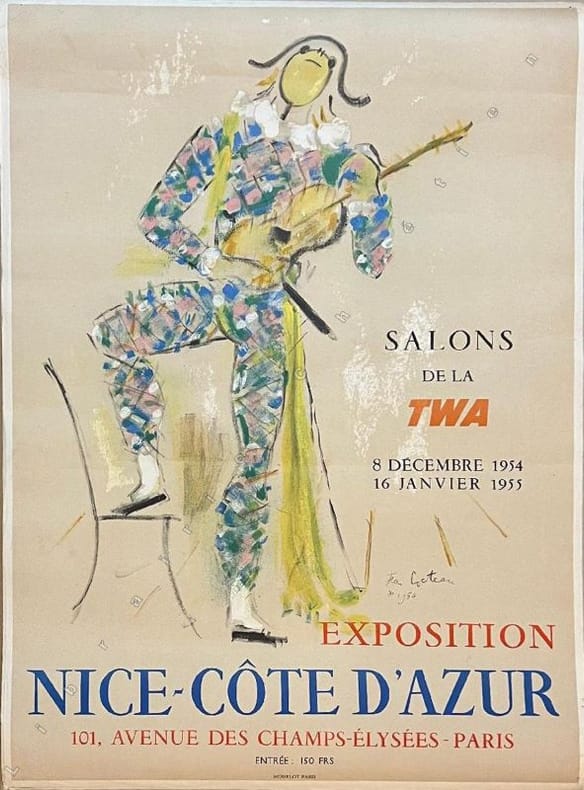
195425036Paris Mourlot 1954 Affiche lithographiée signée à droite dans la planche, Paris, Mourlot, 1954, 70 x 50 cm.
1920693DGBasel ca. 1920 - 1930. Glasnegative ca. 8,5 x 10 cms. gebraucht, einige mit Glassprung.
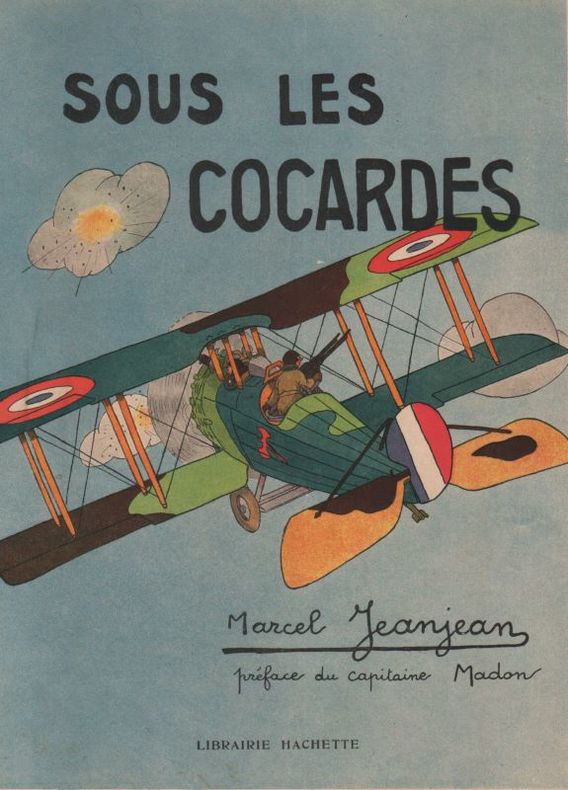
191922851Paris Hachette 1919 1 in-4 Texte et dessins de Marcel JEANJEAN. Préface du Capitaine Madon. Paris, Hachette, 1919, in-4, en feuilles couverture illustrée en couleurs, 39 pages sous chemise demi-percaline verte fermée de 4 cordons.
198256847Saudi Arabia: Ministry/Defense & Aviation 1982. good. Quarto approx. 150 3-ring plastic binder with customized front and spine text 3-hole punched color illus. color figures. Slight wear and soiling to binder. In early 1981 the Saudi government requested American assistance in providing meteorological support to the Kingdom's military forces. This request was accepted. This document constitutes a visionary organizational arrangement for the Kingdom. Weather morale and logistics are three imponderables of warfare with morale and logistics significantly affected by weather. This plan considers the unique position of the Kingdom the sophisticated armaments in the region command and control requirements economy of force and responsiveness to external contingencies among other factors. The plan represents the then state of the art technology and equipment and required a military-civil mix of personnel to execute and to understand and respond to military needs. This plan was prepared by a joint Saudi and U.S. team comprised of highly-skilled professionals including a number from the U.S. Department of Defense and the military services. This plan was deemed to meet military requirements standardize the service emphasize safety and operations response and to aid in decisions affecting the rules of engagement. Ministry/Defense & Aviation unknown
193185868Paris: Imprimerie Nationale 1931. First Edition. Small folio. 34cm. Later heavy grain oatmeal cloth with black leather title label to spine. 258pp.; 1. Clean and strong minor bumping to spine ends; internally clean and fresh illustrated throughout with photographs color images and charts all with captioned tissue guards. A near fine copy.<br /> <br /> <br /> From the library of Nathaniel Tarn noted poet translator and anthropologist bearing his bookplate to the front pastedown. A lavish and justifiably celebratory account of the first aerial crossing from Paris to New York performed in 1930 as the second traversal attempt by Costes and Bellonte with the first having to be abandoned in 1929 due to bad weather. The duo successfully made the crossing of 3850 miles in 37 hours and 18 minutes to international fanfare in their Breguet 19 Super Bidon named "Point D'Interrogation" or "Question Mark". Bellonte's rather lush and impressive account is quite scarce in trade and considering the importance of Costes and Bellonte's singular achievement seems sparse in institiutional holdings. Imprimerie Nationale unknown
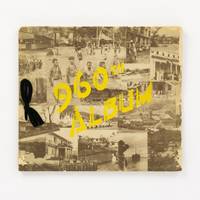
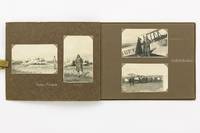
1945138169The Philippines: 960th Engineer Aviation Topographic Company 1945. First Edition. Paperback. Very Good. The Philippines 960th Engineer Aviation Topographic Company 1945. Oblong quarto 255 × 288 mm 45 leaves printed rectos only comprising the title-cover on a background of a collage of some two dozen illustrations and 44 leaves containing 133 illustrations with all illustrations reproduced from photographs. Shoelace-bound three-colour pictorial card cover a little worn at the extremities with trifling surface loss to silverfish; two leaves a little soiled; expert conservation to small chips and tears to the edges of four leaves; minor signs of age and use including some annotations - see below; overall a very good copy. The first leaf contains a large illustration of a Lockheed P-38 Lightning designed as a fighter but used in a variety of roles including aerial reconnaissance. An inscription in ink on the illustration identifies the pilot as '1st. Lt. Alexander Roberts Dec. 1943 New Guinea'. Written in the margin below the illustration is '960th Photo Recon. Dobodura New Guinea Non. sic 1943 - Feb. 1944 Ie Shima April 1945 P.I. Feb. 44 - Ap. 1945 Honolulu Sept 1945 deact.'. The servicemen in the four illustrations on the fourth leaf are identified: from left to right top to bottom they are 'MSgt. Burts' 'Ingelmann' 'Johnson' and '"Jesse" James and Samualson'. The dog on the next page is 'Killer'. At the rear Ernie Pyle's grave is identified. <p>'The second phase of the Okinawa Campaign consisted of the objectives of Ie Shima which housed the big airfield of the islands and Motobu Peninsula. With Rear Admiral Lawrence F. Reifsnider USN commanding the attack group the U.S. Army's 77th division landed on April 16 1945. The invading force thought that the Japanese had abandoned the airfield due to aerial photo reconnaissance but they met about 3000 men as they moved towards the center of the island. Not unlike the Battle for Iwo Jima the island had networks of underground tunnels enhanced by Mt. Gosuki but the island was secured on April 21. Famed War Correspondent Ernie Pyle was killed on Ie Shima while covering the occupation. To repair the destruction caused by prior bombing and naval gunfire support U.S. Navy Seabees repaired the airstrips. Of note the island was utilized by the Japanese Surrender delegation in mid-August 1945 as a stop point between Japan and Manila Bay Philippines for negotiations with General Douglas A. McArthur USA' National Museum of the United States Navy online. <p>The illustrations in this rare souvenir cover a wide range of the activities of the 960th in the Pacific theatre during the Second World War. 960th Engineer Aviation Topographic Company paperback
1929142560Adelaide: Harry Carew Nott 1929. Fine. Adelaide Harry Carew Nott 1929. A commercial photograph album oblong quarto 230 × 318 mm comprising 4 card leaves cord-bound in overlapping card covers with 21 gelatin silver photographs 84 × 136 mm or the reverse loosely attached with photocorners on both sides of the leaves and the inside surface of the covers; all photographs are captioned in white ink on the mount. Cord-bound commercial album stamped in blind 'Portraiture'; covers slightly marked and a little worn at the corners; the contents are in fine condition the last photograph is creased and cracked at one corner. A lengthy article related to this event appeared in 'The Advertiser' Thursday 23 May 1929: 'The Victorian section of the Australian Aero Club will conduct an aerial pageant at the Essendon Aerodrome near Melbourne on Saturday afternoon. The programme of events includes the Aerial Derby for which over 20 machines have been entered. Of these about eight will represent New South Wales and eight Victoria. South Australia will also have a strong representation. <p>Seven planes will leave the Parafield Aerodrome for Melbourne this morning at 9.30 if the weather permits. The following planes will comprise the formation: D.H. 60 Gipsy Moth G-AUIB D.H. Moth V-HUAM D.H. Moth V-EUAR D.H. Gipsy Moth G-AUIV D.H. Gipsy Moth G-AUKO Avro Avian G-AUSY and probably the De Havilland "Old Gold" passenger machine. The first three are Aero Club planes and the others are privately owned. <p>Flying-Officer J.A. Mollison Aero Club instructor will be leader of the formation and Mr. C.A. Hewitt will be deputy-leader. Others making the flight to Melbourne are Messrs. N. Birks J.A. Jukes A.H. Wilkins E.B. Lawson P. Knapman F. Wellington S. Hamilton L. Wood J. Churchill Smith secretary of Aero Club and Dr. H.C. Nott. The flight to Essendon will be made via Nhill Victoria. Friday will be spent by the airmen in tuning up engines for the races on the following day'. <p>The first eight photographs were taken at Parafield Aerodrome in outer-suburban Adelaide with portraits of Nott and Wood identified. These are followed by two at Nhill Aerodrome 'Mollison refuelling' and 'Lawson'; two at Ararat Aerodrome 'on Racecourse'; and eight taken at Rockbank 28 kms west of Melbourne. These are captioned 'Mollison taking off in "1B"'; 'Hewitt'; 'Nott in "A5"'; Lawson Mollison Hewitt & Wellington éxamining "A17"'; 'Hewitt Mollison Lawson & Wellington'; 'Nott Mollison Lawson & Wellington'; and 'Mollison Lawson & Hewitt'. <p>The last one taken from the air is captioned 'Crashed Aero at Nhill'. The Nhill Aviation Heritage Centre website records that on 23 May 1929 'J.A. Mollison arrived from Adelaide with 6 aircraft. One crash-landed at old Dimboola road aerodrome instead of landing at New site at Halpin Park'. The pilot was possibly Lin Wood. Harry Carew Nott unknown
1961265DGZürich, 1961. Poster - Offset printing. Illustration by Nikolaus Schwabe. 102 x 64 cm. + Wichtig: Für unsere Kunden in der EU erfolgt der Versand alle 14 Tage verzollt ab Deutschland / Postbank-Konto in Deutschland vorhanden +
1961265DGZürich, 1961. Poster - Offset printing. Illustration by Nikolaus Schwabe. 102 x 64 cm.
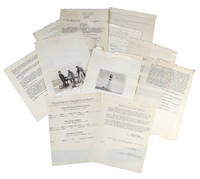
1923175141923. Wright Orville. Archive of aeronautical speed record trials 1923 a documentary record of early aviation competition and the formalization of international standards for measuring and certifying flight performance. Centered on trials conducted at McCook Field and Wilbur Wright Field in Dayton Ohio the material documents world record attempts over one kilometer 500 kilometers and 1000 kilometers under the supervision of Orville Wright who served as directing official. The archive captures a transitional moment in aviation history when experimental flight gave way to regulated competition with standardized timing calibrated instruments and formal reporting procedures required for international recognition by the Fédération Aéronautique Internationale.<br /> <br /> Archive comprising 14 manuscript and typed documents in English and French accompanied by two original black and white photographs. Materials include official reports submitted to the National Aeronautic Association and to the Fédération Aéronautique Internationale correspondence addressed to Secretary General Paul Tissandier technical certification documents from the Bureau of Standards and timing sheets recording individual pilot performance. A report dated March 29 1923 details speed trials conducted over 500 and 1000 kilometer courses while related documentation records the surveying and marking of one and three kilometer straightaway courses at Wilbur Wright Field. The bilingual nature of the archive reflects the FAI's use of French as its official language with parallel documentation measuring distinct record categories. Recorded achievements include Lt. R. L. Maughan's one kilometer speed of 380.751 kilometers per hour in a Curtiss R 6 Racer Lt. Alex Pearson's 500 kilometer record at 270.06 kilometers per hour and the 1000 kilometer endurance speed of 205 kilometers per hour achieved by Lts. H. R. Harris and R. Lockwood. Photographs depict course pylons at Wilbur Wright Field and official timer Odis A. Porter observing aircraft performance during timed runs.<br /> <br /> The archive documents the institutionalization of aviation record keeping in the early twentieth century when governing bodies such as the Fédération Aéronautique Internationale established uniform procedures for homologating records across national contexts. The involvement of Orville Wright alongside officials including Lorin Wright and Odis A. Porter situates the trials within the Dayton aviation community that had been central to powered flight since 1903. These materials illustrate the convergence of engineering innovation military aviation through the U.S. Army Air Service and international oversight demonstrating how record setting functioned both as technological advancement and as a structured competitive discipline. Minor handling wear to documents; photographs well preserved with strong contrast. Overall very good condition. unknown
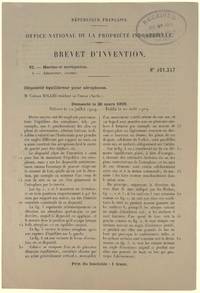
1909221611909. Bollée Camille. Dispositif équilibreur pour aéroplanes 1909 documents early efforts to solve the problem of aircraft stability in the immediate years following the Wright brothers first powered flight when engineers in Europe and the United States sought mechanical solutions to controlled flight. Issued by the French government this patent establishes a technical approach to maintaining equilibrium through adjustable aerodynamic surfaces mounted on a rotating vertical shaft shifting emphasis from pilot skill to engineered stabilization. The document supports research into early aviation engineering international patent exchange and the rapid development of aeronautical control systems in the pre-World War I period.<br /> <br /> Bollée Camille. Dispositif équilibreur pour aéroplanes. Paris: Office National de la Propriété Industrielle 1909. Three pages with one illustrated plate containing six technical diagrams; original printed paper wrapper measuring approximately 11 x 7.5 inches. Patent submitted March 26 1909 granted July 12 and published August 21. The text describes a stabilization system "composed of a generally vertical shaft. capable of a rotating motion around its axis upon which one or several surfaces are mounted" designed to counterbalance lateral instability through adjustable aerodynamic elements. Diagrams illustrate variable positioning of these surfaces to alter lift and drag with the stated objective "to maintain the balance of airplanes. for example during lateral gusts or slips." Front page bears a Chicago patent office stamp dated July 27 1910 indicating circulation and review within American patent or engineering contexts.<br /> <br /> This patent was produced during a period of intense international experimentation in powered flight when inventors across France Germany and the United States pursued competing methods to improve control safety and maneuverability. Bollée's design reflects early recognition of the need for mechanical stabilization systems that could respond dynamically to environmental forces anticipating later developments in controlled flight technologies. The presence of an American stamp demonstrates transatlantic interest in aeronautical innovation at a moment when aviation knowledge circulated rapidly through patent systems and technical publications. Light age toning with faint crease to upper corner; document remains clean and legible; overall near fine condition. This item provides direct evidence of early twentieth century engineering approaches to flight stability and the global exchange of aviation technology. unknown
19692110502150903106Jijitsushinsha 1969. Soft Cover. Fine. Number of books: 4 Jijitsushinsha paperback
192851438Paris S.E.C.M. 1928 In-8, broch, couverture imprime.Edition originale des impressions journalires notes par le capitaine Pelletier Doisy, le lieutenant Gonin et le mcanicien Vigroux, l'occasion du raid autour de la Mditerrane qui totalisa 10.850 kilomtres parcourus en 7 jours dont 67 heures de vol, effectus bord d'un Amiot 122 BP 3 de bombardement longue distance. Partis de Paris en septembre 1927, ils se posrent successivement Casablanca, Tunis, Benghazi, Le Caire, Rayak, Bucarest, Vienne, avant de revenir Paris. L'ouvrage comporte en frontispice la reproduction d'un texte manuscrit du ministre de l'Air Laurent Eynac, et a t magistralement illustr par Lon Raffin de 36 compositions reproduites en couleurs avec des aplats argents, dont une vignette de titre, 9 sur trois quarts de page et 26 bandeaux, culs-de-lampe et vignettes in texte, et de petits dessins reproduits en noir. Certaines vignettes sont rptes plusieurs fois. Exemplaire numrot sur vlin pur fil blanc Lafuma.
191940826Paris Hachette 1919 In-4, cartonnage illustr de l'diteur.Edition originale de cet album richement illustr par Marcel Jeanjean de planches et vignettes humoristiques en couleurs, reprsentant des scnes de l'aviation militaire durant la guerre de 14-18. Marcel Jeanjean (1893-1973) fut un illustrateur fcond dans le domaine de l'aviation. Pilote durant la premire guerre mondiale, et promu pilote de reconnaissance en 1917, il croqua la vie quotidienne de son escadrille sur des carnets dont il tirera plus tard cet album de croquis. Exemplaire en parfait tat.
1969115919Genève (CH), Interavia S.A. 1969 In-4 33 x 24,5 cm. Présentation composite. Brochés, couvertures illustrées, environ 90 pp. par numéro, abondamment illustré. Ensemble en bon état.
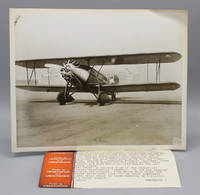
192917575<p>Underwood and Underwood n.d. 1929 On January 2 1929 Evelyn "Bobbi" Trout 1906 – 2003 set the women's endurance flight record with a time of twelve hours and eleven minutes. The record didn't last a month however before being beaten by Elinor Smith 1911 – 2010 by over an hour. The next month Trout reclaimed the record with a seventeen-hour flight; in April Smith smashed the record with a time of twenty-six hours. Trout and Smith's rivalry led them to collaboration: while participating in the Women's Transcontinental Air Derby in the summer of 1929 they agreed to attempt a month-long endurance flight. The present photo commemorates their first attempt which took place in November of 1929. Though Trout and Smith were able to successfully refuel the plane while in the air three times mechanical issues grounded them after forty-two hours. They set the women's endurance flight record with the time. The photograph shows aviator Bobbi Trout warming up the motor of a Commercial Aircraft Corporation "Sunbeam" plane at the Los Angeles Metropolitan Airport where Trout and Elinor Smith took off on their refueling endurance flight. The typewritten commentary suggests the headline "BOBBIE sic TROUT AND ELEANOR sic SMITH BURY THE HATCHET IN PREPARATION FOR REFUELING ENDURANCE FLIGHT. Photograph 10" x 8" with leaf of typewritten commentary by Underwood and Underwood adhered to verso at bottom edge. Some toning to edges and verso and some wear to the commentary leaf. Very good. Both Trout and Smith had illustrious aviation careers. Trout set an altitude record for light-class aircraft in June of 1929 and set another women's endurance flight record in 1931 by spending over 122 hours in the air with actress Edna Mae Cooper. Alongside Amelia Earhart Phoebe Omlie Louise Thaden and Blanche Noyes Trout co-founded the Ninety-Nines an organization for women pilots. Trout also co-founded founded the Women's Air Reserve with Pancho Barnes.</p> Underwood and Underwood,
191067316Various places:: Various publishers 1910-1945. publisher's original wrappers. Generally fine. Folio. Illustrated. Included are: L'Aerophile 4 issues 1911; Aero--America's Aviation Weekly 1 issue 1910; 15 issues 1911; 6 issues 1912; and 1 issue 1913; Fly: The National Aeronautic Monthly 3 issues 1912; Aerial Age Weekly 1 issue 1918; Vie au Grand Air 1 issue 1912; Flying Aces 9 isses 1941-1945; Flight: First Aero Weekly in the World 10 issues 1912-1914; and Aero and Hydro 8 issues 1911-1914. Various publishers, unknown